


Romans 15:25
- ΝυνὶNuniNowG3570ADVAdverb
- δὲdehoweverG1161CONJConjunction
- πορεύομαιporeuomaiI am goingG4198V-PNI-1SVerb Present Middle Or Passive Deponent Indicative 1st Singular
- εἰςeistoG1519PREPPreposition
- ἸερουσαλὴμIerousalēmJerusalemG2419N-ASF-LNoun Accusative Singular Feminine Location
- διακονῶνdiakonōnministeringG1247V-PAP-NSMVerb Present Active Participle Nominative Singular Masculine
- τοῖςtoisto theG3588T-DPMDefinite article Dative Plural Masculine
- ἁγίοιςhagioissaintsG40A-DPMAdjective Dative Plural Masculine
English is a literal word-by-word gloss of the Greek, not the KJV's wording. Why?
This is the original text the KJV's translators worked from — each Greek word with its own literal English meaning in this verse, prepared by scholars at Tyndale House, Cambridge. The KJV translates whole sentences, not word by word, so its wording differs: one Greek word can become several English words, and the KJV may choose “charity” where the gloss reads “love”. Both are faithful — they answer different questions. For the KJV's own rendering, switch to the KJV text.
Details
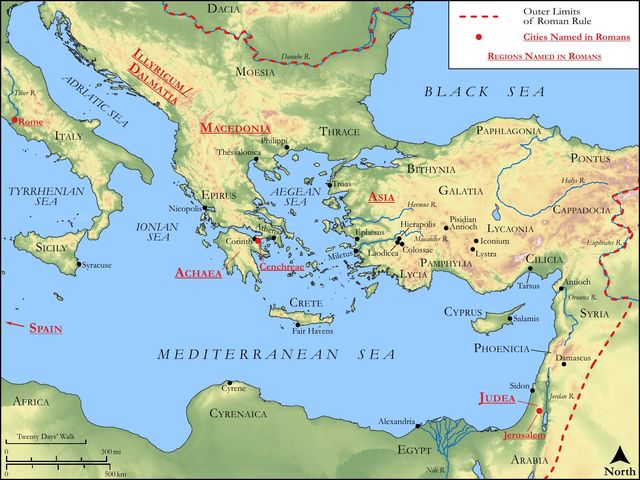
See on the biblical-era map

Study this verse
Public-domain commentary
Matthew Henry
From his Commentary on the Whole Bible. Henry comments on passages, not single verses — this entry covers Romans 15:22–29. His three-level outline is real structure in the source text, so it is rendered as structure.
St. Paul here declares his purpose to come and see the Christians at Rome. Upon this head his matter is but common and ordinary, appointing a visit to his friends; but the manner of his expression is gracious and savoury, very instructive, and for our imitation. We should learn by it to speak of our common affairs in the language of Canaan. Even our common discourse should have an air of grace; by this it will appear what country we belong to. it should seem that Paul's company was very much desired at Rome. He was a man that had as many friends and as many enemies as most men ever had: he passed through evil report and good report. No doubt they had heard much of him at Rome, and longed to see him. Should the apostle of the Gentiles be a stranger at Rome, the metropolis of the Gentile world? Why as to this he excuses it that he had not come yet, he promises to come shortly, and gives a good reason why he could not come now.
I.He excuses it that he never came yet.
Observe how careful Paul was to keep in with his friends, and to prevent or anticipate any exceptions against him; not as one that lorded it over God's heritage.
1.He assures them that he had a great desire to see them; not to see Rome, though it was now in its greatest pomp and splendour, nor to see the emperor's court, nor to converse with the philosophers and learned men that were then at Rome, though such conversation must needs be very desirable to so great a scholar as Paul was, but to come unto you (Rom 15:3), a company of poor despised saints in Rome, hated of the world, but loving God, and beloved of him. These were the men that Paul was ambitious of an acquaintance with at Rome; they were the excellent ones in whom he delighted, Psa 16:3. And he had a special desire to see them, because of the great character they had in all the churches for faith and holiness; they were men that excelled in virtue, and therefore Paul was so desirous to come to them. This desire Paul had had for many years, and yet could never compass it. The providence of God wisely overrules the purposes and desires of men. God's dearest servants are not always gratified in every thing that they have a mind to. Yet all that delight in God have the desire of their heart fulfilled (Psa 37:4), though all the desires in their heart be not humoured.
2.He tells them that the reason why he could not come to them was because he had so much work cut out for him elsewhere. For which cause, that is, because of his labours in other countries, he was so much hindered. God had opened a wide door for him in other places, and so turned him aside. Observe in this,
(1.)The gracious providence of God conversant in a special manner about his ministers, casting their lot, not according to their contrivance, but according to his own purpose. Paul was several times crossed in his intentions; sometimes hindered by Satan (as Th1 2:18), sometimes forbidden by the Spirit (Act 16:7), and here diverted by other work. Man purposes but God disposes, Pro 16:9; Pro 19:21; Jer 10:23. Ministers purpose, and their friends purpose concerning them, but God overrules both, and orders the journeys, removals, and settlements, of his faithful ministers as he pleases. The stars are in the right hand of Christ, to shine where he sets them. The gospel does not come by chance to any place, but by the will and counsel of God.
(2.)The gracious prudence of Paul, in bestowing his time and pains where there was most need. Had Paul consulted his own ease, wealth, and honour, the greatness of the word would never have hindered him from seeing Rome, but would rather have driven him thither, where he might have had more preferment and taken less pains. But Paul sought the things of Christ more than his own things, and therefore would not leave his work of planting churches, no, not for a time, to go and see Rome. The Romans were whole, and needed not the physician as other poor places that were sick and dying. While men and women were every day dropping into eternity, and their precious souls perishing for lack of vision, it was no time for Paul to trifle. There was now a gale of opportunity, the fields were white unto the harvest; such a season slipped might never be retrieved; the necessities of poor souls were pressing, and called aloud, and therefore Paul must be busy. It concerns us all to do that first which is most needful. True grace teaches us to prefer that which is necessary before that which is unnecessary, Luk 10:41, Luk 10:42. And Christian prudence teaches us to prefer that which is more necessary before that which is less so. This Paul mentions as a sufficient satisfying reason. We must not take it ill of our friends if they prefer necessary work, which is pleasing to God, before unnecessary visits and compliments, which may be pleasing to us. In this, as in other things, we must deny ourselves.
II.He promised to come and see them shortly, Rom 15:23, Rom 15:24, Rom 15:29.
Having no more place in these parts, namely, in Greece, where he then was. The whole of that country being more or less leavened with the savour of the gospel, churches being planted in the most considerable towns and pastors settled to carry on the work which Paul had begun, he had little more to do there. He had driven the chariot of the gospel to the sea-coast, and having thus conquered Greece he is ready to wish there were another Greece to conquer. Paul was one that went through with his work, and yet then did not think of taking his ease, but set himself to contrive more work, to devise liberal things. Here was a workman that needed not to be ashamed. Observe,
1.How he forecasted his intended visit. His project was to see them in his way to Spain. It appears by this that Paul intended a journey into Spain, to plant Christianity there. The difficulty and peril of the work, the distance of the place, the danger of the voyage, the other good works (though less needful, he thinks) which Paul might find to do in other places, did not quench the flame of his holy zeal for the propagating of the gospel, which did even eat him up, and make him forget himself. But it is not certain whether ever he fulfilled his purpose, and went to Spain. Many of the best expositors think he did not, but was hindered in this as he was in others of his purposes. He did indeed come to Rome, but he was brought thither a prisoner, and there was detained two years; and whither he went after is uncertain: but several of his epistles which he wrote in prison intimate his purpose to go eastward, and not towards Spain. However, Paul, forasmuch as it was in thine heart to bring the light of the gospel into Spain, thou didst well, in that it was in thine heart; as God said to David, Ch2 6:8. The grace of God often with favour accepts the sincere intention, when the providence of God in wisdom prohibits the execution. And do not we serve a good Master then? Co2 8:12. Now, in his way to Spain he proposed to come to them. Observe his prudence. It is wisdom for every one of us to order our affairs so that we may do the most work in the least time. Observe how doubtfully he speaks: I trust to see you: not, "I am resolved I will," but, "I hope I shall." We must purpose all our purposes and make all our promises in like manner with a submission to the divine providence; not boasting ourselves of tomorrow, because we know not what a day may bring forth, Pro 27:1; Jam 4:13-15.
2.What he expected in his intended visit.
(1.)What he expected from them. He expected they would bring him on his way towards Spain. It was not a stately attendance, such as princes have but a loving attendance, such as friends give, that Paul expected. Spain was then a province of the empire, well known to the Romans, who had a great correspondence with it, and therefore they might be helpful to Paul in his voyage thither; and it was not barely their accompanying him part of the way, but their furthering him in his expedition, that he counted upon: not only out of their respect to Paul, but out of respect to the souls of those poor Spaniards that Paul was going to preach to. It is justly expected from all Christians that they should lay out themselves for the promoting and furthering of every good work, especially that blessed work of the conversion of souls, which they should contrive to make as easy as may be to their ministers, and as successful as may be to poor souls.
(2.)What he expected in them: to be somewhat filled with their company. That which Paul desired was their company and conversation. The good company of the saints is very desirable and delightful. Paul was himself a man of great attainments in knowledge and grace, taller by head and shoulders than other Christians in these things, and yet see how he pleased himself with the thoughts of good company; for as iron sharpens iron so does a man the countenance of his friend. He intimates that he intended to make some stay with them, for he would be filled with their company; not just look at them, and away: and yet he thinks their converse so pleasant that he should never have enough of it; it is but somewhat filled, he thought he should leave them with a desire of more of their company. Christian society, rightly managed and improved, is a heaven upon earth, a comfortable earnest of our gathering together unto Christ at the great day. Yet observe, It is but somewhat filled, apo merous - in part. The satisfaction we have in communion with the saints in this world is but partial; we are but somewhat filled. It is partial compared with our communion with Christ; that, and that only, will completely satisfy, that will fill the soul. It is partial compared with the communion we hope to have with the saints in the other world. When we shall sit down with Abraham, and Isaac, and Jacob, with all the saints, and none but saints, and saints made perfect, we shall have enough of that society, and be quite filled with that company.
(3.)What he expected from God with them, Rom 15:29. He expected to come in the fulness of the blessing of the gospel of Christ. Observe, Concerning what he expected from them he speaks doubtfully: I trust to be brought on my way, and to be filled with your company. Paul had learnt not to be too confident of the best. These very men slipped from him afterwards, when he had occasion to use them (Ti2 4:16), At my first answer, no man stood by me; none of the Christians at Rome. The Lord teach us to cease from man. But concerning what he expected from God he speaks confidently. It was uncertain whether he should come or no, but I am sure when I do come I shall come in the fulness, etc. We cannot expect too little from man, nor too much from God. Now Paul expected that God would bring him to them, loaded with blessings, so that he should be an instrument of doing a great deal of good among them, and fill them with the blessings of the gospel. Compare Rom 1:11, That I may impart unto you some spiritual gift. The blessing of the gospel of Christ is the best and most desirable blessing. When Paul would raise their expectation of something great and good in his coming, he directs them to hope for the blessings of the gospel, spiritual blessings, knowledge, and grace, and comfort. There is then a happy meeting between people and ministers, when they are both under the fulness of the blessing. The blessing of the gospel is the treasure which we have in earthen vessels. When ministers are fully prepared to give out, and people fully prepared to receive, this blessing, both are happy. Many have the gospel who have not the blessing of the gospel, and so they have it in vain. The gospel will not profit, unless God bless it to us; and it is our duty to wait upon him for that blessing, and for the fulness of it.
III.He gives them a good reason why he could not come and see them now, because he had other business upon his hands, which required his attendance, upon which he must first make a journey to Jerusalem, Rom 15:25-28. He gives a particular account of it, to show that the excuse was real. He was going to Jerusalem, as the messenger of the church's charity to the poor saints there. Observe what he says,
1.Concerning this charity itself. And he speaks of that upon this occasion probably to excite the Roman Christians to do the like, according to their ability. Examples are moving, and Paul was very ingenious at begging, not for himself, but for others. Observe,
(1.)For whom it was intended: For the poor saints which are at Jerusalem, Rom 15:26. It is no strange thing for saints to be poor. Those whom God favours the world often frowns upon; therefore riches are not the best things, nor is poverty a curse. It seems, the saints at Jerusalem were poorer than other saints, either because the wealth of that people in general was now declining, as their utter ruin was hastening on (and, to be sure, if any must be kept poor, the saints must), or because the famine that was over all the world in the days of Claudius Caesar did in a special manner prevail in Judea, a dry country; and, God having called the poor of this world, the Christians smarted most by it. This was the occasion of that contribution mentioned Act 11:28-30. Or, because the saints at Jerusalem suffered most by persecution; for of all people the unbelieving Jews were most inveterate in their rage and malice against the Christians, wrath having come upon them to the uttermost, Th1 2:16. The Christian Hebrews are particularly noted too as having had their good spoiled (Heb 10:34), in consideration of which this contribution was made for them. Though the saints at Jerusalem were at a great distance form them, yet they thus extended their bounty and liberality to them, to teach us as we have ability, and as there is occasion, to stretch out the hand of our charity to all that are of the household of faith, though in places distant from us. Though in personal instances of poverty every church should take care to maintain their own poor (for such poor we have always with us), yet sometimes, when more public instances of poverty are presented as objects of our charity, though a great way off from us, we must extend our bounty, as the sun his beams; and, with the virtuous woman, stretch out our hands to the poor, and reach forth our hands to the needy, Pro 31:20.
(2.)By whom it was collected: By those of Macedonia (the chief of whom were the Philippians) and Achaia (the chief of whom were the Corinthians), two flourishing churches, though yet in their infancy, newly converted to Christianity. And I wish the observation did not hold that people are commonly more liberal at their first acquaintance with the gospel than they are afterwards, that, as well as other instances of the first love and the love of the espousals, being apt to cool and decay after a while. It seems those of Macedonia and Achaia were rich and wealthy, while those at Jerusalem were poor and needy, Infinite Wisdom ordering it so that some should have what others want, and so this mutual dependence of Christians one upon another might be maintained. - It pleased them. This intimates how ready they were to it - they were not pressed nor constrained to it, but they did it of their own accord; and how cheerful they were in it - they took a pleasure in doing good; and God loves a cheerful giver. - To make a certain contribution; koinōnian tina - a communication, in token of the communion of saints, and their fellow-membership, as in the natural body one member communicates to the relief, and succour, and preservation of another, as there is occasion. Every thing that passes between Christians should be a proof and instance of that common union which they have one with another in Jesus Christ. Time was when the saints at Jerusalem were on the giving hand, and very liberal they were, when they laid their estates at the apostles' feet for charitable uses, and took special care that the Grecian widows should not be neglected in the daily ministration, Act 6:1, etc. And now that the providence of God had turned the scale, and made them necessitous, they found the Grecians kind to them; for the merciful shall obtain mercy. We should give a portion to seven, and also to eight, because we know not what evil may be on the earth, which may make us glad to be beholden to others.
(3.)What reason there was for it (Rom 15:27): And their debtors they are. Alms are called righteousness, Psa 112:9. Being but stewards of what we have, we owe it where our great Master (by the calls of providence, concurring with the precepts of the word) orders us to dispose of it: but here there was a special debt owing; the Gentiles were greatly beholden to the Jews, and were bound in gratitude to be very kind to them. From the stock of Israel came Christ himself, according to the flesh, who is the light to enlighten the Gentiles; out of the same stock came the prophets, and apostles, and first preachers of the gospel. The Jews, having had the lively oracles committed to them, were the Christians' library-keepers - out of Zion went forth the law, and the word of the Lord from Jerusalem; their political church-state was dissolved, and they were cut off, that the Gentiles might be admitted in. Thus did the Gentiles partake of their spiritual things, and receive the gospel of salvation as it were at second-hand from the Jews; and therefore their duty is, they are bound in gratitude to minister unto them in carnal things: it is the least they can do: leitourgēsai - to minister as unto God in holy tings; so the word signifies. A conscientious regard to God in works of charity and almsgiving makes them an acceptable service and sacrifice to God, and fruit abounding to a good account. Paul mentions this, probably, as the argument he had used with them to persuade them to it, and it is an argument of equal cogency to other Gentile churches.
2.Concerning Paul's agency in this business. He could himself contribute nothing; silver and gold he had none, but lived upon the kindness of his friends; yet he ministered unto the saints (Rom 15:25) by stirring up others, receiving what was gathered, and transmitting it to Jerusalem. Many good works of that kind stand at a stay for want of some one active person to lead in them, and to set the wheels a going. Paul's labour in this work is not to be interpreted as any neglect of his preaching-work, nor did Paul leave the word of God, to serve tables; for, besides this, Paul had other business in this journey, to visit and confirm the churches, and took this by the bye; this was indeed a part of the trust committed to him, in which he was concerned to approve himself faithful (Gal 2:10): They would that we should remember the poor. Paul was one that laid out himself to do good every way, like his Master, to the bodies as well as to the souls of people. Ministering to the saints is good work, and is not below the greatest apostles. This Paul had undertaken, and therefore he resolves to go through with it, before he fell upon other work (Rom 15:28): When I have sealed to them this fruit. He calls the alms fruit, for it is one of the fruits of righteousness; it sprang from a root of grace in the givers, and redounded to the benefit and comfort of the receivers. And his sealing it intimates his great care about it, that what was given might be kept entire, and not embezzled, but disposed of according to the design of the givers. Paul was very solicitous to approve himself faithful in the management of this matter: an excellent pattern for ministers to write after, that the ministry may in nothing be blamed.
Historical interpretation
Historical reception
3 surviving comments on this verse. Each one is dated, so this reads as a timeline rather than a list.
Select a marker to jump to its quote. Markers stagger vertically where authors wrote within a few decades of each other.
Paul wants the Romans to understand that they ought to be concerned with this sort of thing, for those who live because of mercy and who are justified before God ought to show their devotion to their brothers.
Since he had said that I have no longer "more place in these parts," and, "I have a great desire, these many years, to come unto you," but he still intended to delay; lest it should be thought that he was making a jest of them, he mentions the cause also why he still puts it off, and he says, that "I am going unto Jerusalem," and is apparently giving the excuse for the delay. But by means of this he also makes good another object, which is the exhorting of them to alms, and making them more in earnest about it. Since if he had not been minded to effect this, it had sufficed to say, "I am going unto Jerusalem." But now he adds the reason of his journey. "For I go," says he, "to minister to the saints." And he dwells over the subject, and enters into reasonings, and says that they "are debtors," and that, "if the Gentiles have been made partakers of their spiritual things, their duty is also to minister unto them in carnal things," that they might learn to imitate these. Wherefore also there is much reason to admire his wisdom for devising this way of giving the advice. For they were more likely to bear it in this way than if he had said it in the form of exhortation; as then he would have seemed to be insulting them, if, with a view to incite them, he had brought before them Corinthians and Macedonians. Indeed, this is the ground on which he does incite the others as follows, saying, "Moreover, brethren, we do you to wit of the grace of God bestowed on the Churches in Macedonia." (2 Cor. viii. 1.) And again he incites the Macedonians by these. "For your zeal," he says, "hath provoked very many." (ib. ix. 2.) And by the Galatians in like manner he does this, as when he says, "As I have given order to the Churches of Galatia, even so do ye." (1 Cor. xvi. 1.) But in the case of the Romans he does not do so, but in a more covert way. And he does this also in regard to the preaching, as when he says, "What? came the word of God out from you? or came it unto you only?" (ib. xiv. 36.) For there is nothing so powerful as emulation. And so he often employs it. For elsewhere too he says," "And so ordain I in all the Churches;" (ib. vii. 17); and again, "As I teach everywhere in every Church." (ib. iv. 17.) And to the Colossians he says, "that the Gospel increaseth and bringeth forth fruit in all the world." (Col. i. 6.) This then he does here also in the case of alms. And consider what dignity there is in his expressions. For he does not say, I go to carry alms, but "to minister" (diakonwn). But if Paul ministers, just consider how great a thing is doing, when the Teacher of the world undertakes to be the bearer, and when on the point of travelling to Rome, and so greatly desiring them too, he yet prefers this to that. "For it hath pleased them of Macedonia and Achaia, that is, it meets their approbation, their desire. "A certain contribution," And, he does not say alms, but "contribution" (koinwnian). And the "certain" is not used without a meaning, but to prevent his seeming to reproach these. And he does not say the poor, merely, but the "poor saints," so making his recommendation twofold, both that from their virtue and that from their poverty. And even with this alone he was not satisfied, but he adds, "they are their debtors." Then he shows how they are debtors. For if, he says, "the Gentiles have been made partakers of their spiritual things, their debt (A. V. duty) is also to minister unto them in carnal things." But what he means is this. It was for their sakes that Christ came. To them it was that all the promises were made, to them of the Jews. Of them Christ came. (Wherefore also it said, "Salvation is of the Jews.") (John iv. 22.) From them were the Apostles, from them the Prophets, from them all good things. In all these things then the world was made a partaker. If then, he says, ye have been made partakers in that which is greater, and when it was for them that the banquet was prepared, ye have been brought in to enjoy the feast that was spread (Matt. xxii. 9), according to the Parable of the Gospel, ye are debtors also to share your carnal things with them, and to impart to them. But he does not say to share, but "to minister" (leitourghsai), so ranking them with ministers (diakonwn), and those that pay the tribute to kings. And he does not say in your carnal things, as he did in "their spiritual things." For the spiritual things were theirs. But the carnal belonged not to these alone, but were the common property of all. For he bade money to be held to belong to all, not to those who were its possessors only.
In Jerusalem there were saints who had sold all their possessions and laid them at the feet of the apostles, devoting themselves to prayer, reading and teaching. It is clear from this text that their character was such that Paul is traveling in order to attend them in person, and he hopes that his offering will be received by them … thereby showing that it is more blessed to give than to receive.
Continue studying Romans 15:25 across the web’s major study libraries — every link below opens this exact verse, chapter, or book on the destination site.
Read & Compare
 BibleGatewayThis verse in more than 200 translations and 70 languages.
 Bible.comThe YouVersion reader — hundreds of translations, reading plans, and highlights.
 ESV.orgCrossway's official English Standard Version reader.
 NET BibleThe NET translation with 60,000+ translators' notes on every rendering decision.
 STEP BibleTyndale House's free study tool — original text, vocabulary, and scholarly resources.
 BibliaLogos Bible Software's free web reader.
 USCCBThe New American Bible (Revised Edition) with the U.S. bishops' study notes.
Commentaries
 BibleHub CommentariesDozens of classic commentaries on this verse, gathered on one page.
 StudyLightMore than 100 commentary sets — the largest collection on the web.
 BibleRefPlain-English commentary on what this verse means, verse by verse.
 Enduring WordDavid Guzik's free commentary on this chapter, widely used by Bible teachers.
 Bible Study ToolsVerse commentary alongside Greek and Hebrew study aids.
Original Language & Research
- BibleHub InterlinearThe verse word by word — original language, transliteration, and English.
- BibleHub LexiconEvery word's original-language definition and Strong's entry.
 Blue Letter BibleDeep-study tools — Strong's numbers, concordance, and word studies.
 CNTR CollationThe earliest Greek manuscripts of this verse, collated letter by letter.
Sermons, Hymns & Audio


TrulyRandomVerse is not affiliated with these sites and doesn’t control their content. They’re linked because they’re genuinely useful.
Summary
In Romans 15:25, the Apostle Paul articulates his immediate and divinely directed travel plans, stating his intention to journey to Jerusalem. This journey is not for personal gain or exploration, but rather to perform a vital act of service and solidarity for the Christian community there. This verse serves as a crucial transition in his letter, outlining his present commitment before detailing his long-term missionary aspirations to visit Rome and eventually Spain.
Context
ShowHideLiterary Context
Romans 15:25 immediately follows Paul's detailed exposition of his missionary strategy and his deep desire to visit the Roman believers. In Romans 15:23-24, Paul expresses his eagerness to finally come to Rome after years of longing, intending to use it as a stepping stone for further missionary work in Spain. However, he introduces a critical detour to Jerusalem with the phrase "But now I go," indicating a necessary prior engagement. This statement clarifies that while his ultimate goal is Rome, his immediate divine mandate takes precedence. The subsequent verses in Romans 15:26-27 explicitly reveal the nature of this ministry: delivering a financial collection from the Gentile churches in Macedonia and Achaia to the impoverished saints in Jerusalem. This act underscores the practical outworking of Christian fellowship and the spiritual debt Gentile believers owed to their Jewish brethren, from whom the gospel originated.
Historical & Cultural Context
The collection for the Jerusalem saints was a significant undertaking for Paul, spanning several years and involving numerous churches (1 Corinthians 16:1-4 and 2 Corinthians 8-9). Jerusalem, as the birthplace of the church, faced severe economic hardship, compounded by famine and persecution. The Jewish Christians there were often ostracized by their Jewish communities and lacked the provisions for the needy available to others. Paul viewed this collection not merely as financial aid but as a tangible expression of unity between Jewish and Gentile believers, demonstrating that the gospel had indeed broken down the dividing wall (as described in Ephesians 2:14). Culturally, such an offering would have been understood as an act of profound solidarity and a recognition of the spiritual heritage shared by all believers. Paul's journey to Jerusalem was also fraught with danger, as he was aware of the hostility he faced from Jewish zealots who opposed his mission to the Gentiles (Acts 20:22-23).
Key Themes
ShowHideThis verse contributes significantly to several overarching themes in Romans and Paul's broader theology. Firstly, it highlights the theme of Christian Service and Ministry, emphasizing that true faith is expressed through practical acts of love and generosity towards fellow believers, particularly those in need. Paul's willingness to "minister" underscores the self-sacrificial nature of apostolic calling. Secondly, it reinforces the theme of Unity and Fellowship in the Body of Christ, showcasing how material support can bridge cultural and ethnic divides, fostering genuine communion between Jewish and Gentile believers—a central tenet of Paul's gospel. Thirdly, it exemplifies Apostolic Obedience and Divine Leading, as Paul prioritizes God's immediate call to Jerusalem, even though his personal desire was to proceed directly to Rome. This demonstrates his commitment to fulfilling his mission, regardless of personal convenience or potential peril, a resolve evident in passages like Acts 21.
Exposition and Analysis
ShowHideKey Word Analysis
ShowHideThis adverb emphasizes the immediate present, signaling a shift in Paul's itinerary from his long-desired trip to Rome to an urgent, current mission. It highlights the priority and immediacy of his journey to Jerusalem.
Derived from a word meaning "to traverse," this verb signifies purposeful movement or travel. It indicates Paul's deliberate and determined journey towards Jerusalem, implying a mission-oriented expedition rather than a casual visit.
This verb means "to be an attendant, to wait upon, or to serve." It emphasizes practical, often humble, service. In this context, it specifically refers to Paul's role in delivering the financial collection to the saints, underscoring that even a prominent apostle engages in tangible acts of care and support for the community.
Meaning "sacred, pure, or consecrated," this term refers to believers who are set apart by God. It is a common designation for Christians in the New Testament, emphasizing their unique status as God's chosen people, called to holiness and belonging to His divine family.
Verse Breakdown
ShowHide"But now I go"
This phrase marks a decisive pivot in Paul's plans. The conjunction "But" (G1161, dé) introduces a contrast or a new development. "Now" (G3570, nyní) emphasizes the immediacy of this action, indicating that despite his long-standing desire to visit Rome, an urgent and necessary task takes precedence. Paul's "going" (G4198, poreúomai) is not a casual trip but a purposeful journey, underscoring his commitment to his apostolic duties.
"unto Jerusalem"
This specifies the destination of Paul's immediate journey. Jerusalem holds immense significance as the spiritual capital of Judaism and the birthplace of the Christian church. It was also a place of considerable danger for Paul, given the intense opposition he faced from various Jewish factions. His willingness to go there demonstrates his courage and obedience to God's call, even into hostile territory.
"to minister unto the saints"
This clause clarifies the precise purpose of Paul's journey. The verb "to minister" (G1247, diakonéō) denotes practical service, specifically referring to the delivery of the financial collection gathered from the Gentile churches for the impoverished Jewish believers in Jerusalem. This act of service was a tangible expression of Christian love, solidarity, and the unity between Jewish and Gentile segments of the early church. The "saints" (G40, hágios) are the fellow believers, set apart by God, highlighting the communal and spiritual nature of this benevolent act.
Literary Devices
ShowHidePaul employs a Purpose Clause ("to minister unto the saints") which clearly articulates the specific reason for his journey, highlighting the practical and charitable nature of his immediate mission. The use of "But now" serves as a Transitional Marker, signaling a shift from his long-term desires (visiting Rome) to his immediate, divinely appointed task. This creates a sense of Anticipation for the Roman readers, as they learn of Paul's detour before his eventual arrival. Furthermore, given the historical context of Paul's eventual arrest and trials in Jerusalem, this verse can be seen as an instance of Foreshadowing, subtly hinting at the challenges and dangers that awaited him there, though Paul himself may not have fully grasped the extent of the peril at this precise moment of writing.
Theological and Thematic Connections
ShowHideRomans 15:25 powerfully illustrates the theological principle that Christian faith is not merely intellectual assent but is profoundly expressed through tangible acts of love and service. Paul's journey to Jerusalem to "minister unto the saints" embodies the deep interconnectedness of the global church, emphasizing that believers, regardless of their background, are one body in Christ and are called to bear one another's burdens. This act of generosity from Gentile churches to Jewish believers in Jerusalem served as a powerful testament to the unifying power of the gospel, breaking down ethnic and cultural barriers and demonstrating the practical outworking of reconciliation achieved through Christ. It underscores that true ministry extends beyond spiritual teaching to encompass compassionate action and fostering unity among all members of the body of Christ.
Reflection and Application
ShowHidePaul's immediate detour to Jerusalem, prioritizing the needs of the saints over his personal desire to visit Rome, offers profound lessons for contemporary believers. It challenges us to consider where our priorities lie and whether we are willing to set aside our own plans for the sake of serving others, especially those within the family of faith who are in need. This verse reminds us that "ministry" is not solely about preaching or teaching, but encompasses practical acts of generosity, compassion, and solidarity. It calls us to cultivate a heart that is sensitive to the physical and material needs of fellow believers, recognizing that our faith is made visible through our love for one another. Just as the Gentile churches expressed their gratitude and spiritual debt through a tangible offering, we too are called to participate in the mutual support and edification of the body of Christ, fostering genuine unity and alleviating suffering wherever we can.
Questions for Reflection
ShowHideFAQ
ShowHideWhat was the nature of the "ministry" Paul was going to perform in Jerusalem?
ShowHideThe "ministry" Paul was going to perform in Jerusalem was primarily the delivery of a significant financial collection. This offering had been gathered from the Gentile churches in Macedonia and Achaia (modern-day Greece) for the impoverished Jewish Christians in Jerusalem. Paul viewed this act as a sacred service, a tangible expression of the unity and fellowship between Jewish and Gentile believers, and a fulfillment of the spiritual debt Gentile believers owed to those from whom the gospel had originated. It was a practical demonstration of Christian love and solidarity, as detailed in 2 Corinthians 8-9.
Why was Jerusalem a significant and potentially dangerous destination for Paul?
ShowHideJerusalem was significant as the historical and spiritual center of Judaism and the birthplace of the early Christian church. However, it was also a city where Paul faced considerable opposition. As the "apostle to the Gentiles," his ministry was often viewed with suspicion and hostility by certain Jewish factions who believed he was undermining the Law and Jewish traditions. Paul himself was aware of the dangers, as indicated in Acts 20:22-23, where he speaks of being compelled by the Spirit to go to Jerusalem, "not knowing what will happen to me there, except that the Holy Spirit warns me in every city that imprisonment and hardships await me." His subsequent arrest and trials in Jerusalem, as recorded in Acts 21-26, confirmed these premonitions.
Christ-Centered Fulfillment
ShowHidePaul's journey to Jerusalem to "minister unto the saints" finds its ultimate and profound fulfillment in the person and work of Jesus Christ. Just as Paul willingly set aside his own desires and faced potential peril for the sake of serving the body of Christ, so too did Christ, the ultimate Servant, embark on His purposeful journey to Jerusalem. His "going" to Jerusalem was not merely a geographical movement but a determined progression towards the cross, where He would "minister" not just to the saints, but to all humanity, by offering Himself as the perfect sacrifice for sin. Philippians 2:5-8 beautifully articulates Christ's self-emptying service, taking "the form of a servant" and humbling Himself "even to the point of death on a cross." He came "not to be served but to serve, and to give his life as a ransom for many" (Mark 10:45). Furthermore, Christ's identification with the "saints" is absolute; He considers service rendered to His followers as service rendered to Himself (Matthew 25:40). Thus, Paul's act of ministering to the physical needs of the Jerusalem believers reflects the very heart of Christ, who perfectly exemplified sacrificial service and solidarity with His people, culminating in His ultimate act of love on Calvary.