


Romans 1:11
- ἐπιποθῶepipothōI longG1971V-PAI-1SVerb Present Active Indicative 1st Singular
- γὰρgarforG1063CONJConjunction
- ἰδεῖνideinto seeG1492V-2AANVerb 2nd Aorist Active Infinitive
- ὑμᾶςhumasyouG4771P-2APPersonal pronoun Accusative 2nd Plural
- ἵναinathatG2443CONJConjunction
- τιtisomeG5100X-ASNIndefinite pronoun Accusative Singular Neuter
- μεταδῶmetadōI may impartG3330V-2AAS-1SVerb 2nd Aorist Active Subjunctive 1st Singular
- χάρισμαcharismagiftG5486N-ASNNoun Accusative Singular Neuter
- ὑμῖνhuminto youG4771P-2DPPersonal pronoun Dative 2nd Plural
- πνευματικὸνpneumatikonspiritualG4152A-ASNAdjective Accusative Singular Neuter
- εἰςeistoG1519PREPPreposition
- τὸtotheG3588T-ASNDefinite article Accusative Singular Neuter
- στηριχθῆναιstērichthēnaistrengtheningG4741V-APNVerb Aorist Passive Infinitive
- ὑμᾶςhumasof youG4771P-2APPersonal pronoun Accusative 2nd Plural
English is a literal word-by-word gloss of the Greek, not the KJV's wording. Why?
This is the original text the KJV's translators worked from — each Greek word with its own literal English meaning in this verse, prepared by scholars at Tyndale House, Cambridge. The KJV translates whole sentences, not word by word, so its wording differs: one Greek word can become several English words, and the KJV may choose “charity” where the gloss reads “love”. Both are faithful — they answer different questions. For the KJV's own rendering, switch to the KJV text.
Details
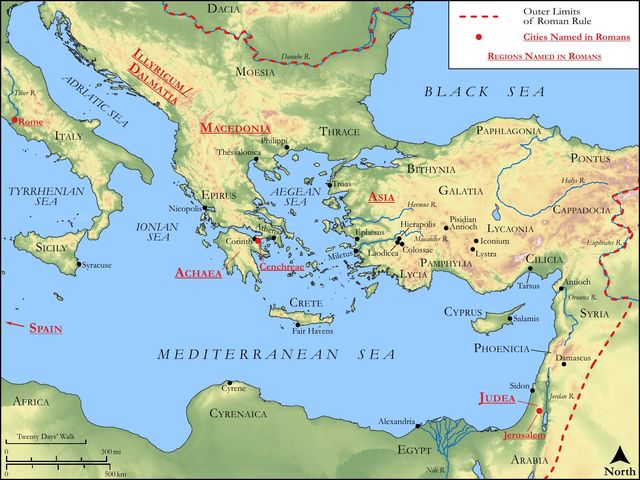
See on the biblical-era map

Study this verse
Public-domain commentary
Matthew Henry
From his Commentary on the Whole Bible. Henry comments on passages, not single verses — this entry covers Romans 1:8–15. His three-level outline is real structure in the source text, so it is rendered as structure.
We may here observe,
I.His thanksgivings for them (Rom 1:8):
First, I thank my God. It is good to begin every thing with blessing God, to make that the alpha and omega of every song, in every thing to give thanks. - My God. He speaks this with delight and triumph. In all our thanksgivings, it is good for us to eye God as our God; this makes every mercy sweet, when we can say of God, "He is mine in covenant." - Through Jesus Christ. All our duties and performances are pleasing to God only through Jesus Christ, praises as well as prayers. - For you all. We must express our love to our friends, not only by praying for them, but by praising God for them. God must have the glory of all the comfort we have in our friends; for every creature is that to us, and no more, which God makes it to be. Many of these Romans Paul had no personal acquaintance with, and yet he could heartily rejoice in their gifts and graces. When some of the Roman Christians met him (Act 28:15), he thanked God for them, and took courage; but here his true catholic love extends itself further, and he thanks God for them all; not only for those among them that were his helpers in Christ, and that bestowed much labour upon him (of whom he speaks Rom 16:3, Rom 16:6), but for them all. - That your faith is spoken of. Paul travelled up and down from place to place, and, wherever he came, he heard great commendations of the Christians at Rome, which he mentions, not to make them proud, but to quicken them to answer the general character people gave of them, and the general expectation people had from them. The greater reputation a man hath for religion, the more careful he should be to preserve it, because a little folly spoils him that is in reputation, Ecc 10:1. - Throughout the whole world, that is, the Roman empire, into which the Roman Christians, upon Claudius's edict to banish all the Jews from Rome, were scattered abroad, but had now returned, and, it seems, left a very good report behind them, wherever they had been, in all the churches. There was this good effect of their sufferings: if they had not been persecuted, they had not been famous. This was indeed a good name, a name for good things with God and good people. As the elders of old, so these Romans, obtained a good report through faith, Heb 11:2. It is a desirable thing to be famous for faith. The faith of the Roman Christians came to be thus talked of, not only because it was excelling in itself, but because it was eminent and observable in its circumstances. Rome was a city upon a hill, every one took notice of what was done there. Thus those who have many eyes upon them have need to walk circumspectly, for what they do, good or bad, will be spoken of. The church of Rome was then a flourishing church; but since that time how is the gold become dim! How is the most fine gold changed! Rome is not what it was. She was then espoused a chaste virgin to Christ, and excelled in beauty; but she has since degenerated, dealt treacherously, and embraced the bosom of a stranger; so that (as that good old book, the Practice of Piety, makes appear in no less than twenty-six instances) even the epistle to the Romans is now an epistle against the Romans; little reason has she therefore to boast of her former credit.
II.His prayer for them, Rom 1:9.
Though a famous flourishing church, yet they had need to be prayed for; they had not yet attained. Paul mentions this as an instance of his love to them. One of the greatest kindnesses we can do our friends, and sometimes the only kindness that is in the power of our hands, is, by prayer to recommend them to the loving-kindness of God. From Paul's example here we may learn,
1.Constancy in prayer: Always without ceasing. He did himself observe the same rules he gave to others, Eph 6:18; Th1 5:17. Not that Paul did nothing else but pray, but he kept up stated times for the solemn performance of that duty, and those very frequent, and observed without fail.
2.Charity in prayer: I make mention of you. Though he had not particular acquaintance with them, nor interest in them, yet he prayed for them; not only for all saints in general, but he made express mention of them. It is not unfit sometimes to be express in our prayers for particular churches and places; not to inform God, but to affect ourselves. We are likely to have the most comfort in those friends that we pray most for. Concerning this he makes a solemn appeal to the searcher of hearts: For God is my witness. It was in a weighty matter, and in a thing known only to God and his own heart, that he used this asseveration. It is very comfortable to be able to call God to witness to our sincerity and constancy in the discharge of a duty. God is particularly a witness to our secret prayers, the matter of them, the manner of the performance; then our Father sees in secret, Mat 6:6. God, whom I serve with my spirit. Those that serve God with their spirits may, with a humble confidence, appeal to him; hypocrites who rest in bodily exercise cannot. His particular prayer, among many other petitions he put up for them, was that he might have an opportunity of paying them a visit (Rom 1:10): Making request, if by any means, etc. Whatever comfort we desire to find in any creature, we must have recourse to God for it by prayer; for our times are in his hand, and all our ways at his disposal. The expressions here used intimate that he was very desirous of such an opportunity: if by any means; that he had long and often been disappointed: now at length; and yet that he submitted it to the divine Providence: a prosperous journey by the will of God. As in our purposes, so in our desires, we must still remember to insert this, if the Lord will, Jam 4:15. Our journeys are prosperous or otherwise according to the will of God, comfortable or not as he pleases.
III.His great desire to see them, with the reasons of it, Rom 1:11-15.
He had heard so much of them that he had a great desire to be better acquainted with them. Fruitful Christians are as much the joy as barren professors are the grief of faithful ministers. Accordingly, he often purposed to come, but was let hitherto (Rom 1:13), for man purposeth, but God disposeth. He was hindered by other business that took him off, by his care of other churches, whose affairs were pressing; and Paul was for doing that first, not which was most pleasant (then he would have gone to Rome), but which was most needful - a good example to ministers, who must not consult their own inclinations so much as the necessity of their people's souls. Paul desired to visit these Romans,
1.That they might be edified (Rom 1:11): That I may impart unto you. He received, that he might communicate. Never were full breasts so desirous to be drawn out to the sucking infant as Paul's head and heart were to be imparting spiritual gifts, that is, preaching to them. A good sermon is a good gift, so much the better for being a spiritual gift. - To the end you may be established. Having commended their flourishing he here expresses his desire of their establishment, that as they grew upward in the branches they might grow downward in the root. The best saints, while they are in such a shaking world as this, have need to be more and more established; and spiritual gifts are of special use for our establishment.
2.That he might be comforted, Rom 1:12. What he heard of their flourishing in grace was so much a joy to him that it must needs be much more so to behold it. Paul could take comfort in the fruit of the labours of other ministers. - By the mutual faith both of you and me, that is, our mutual faithfulness and fidelity. It is very comfortable when there is a mutual confidence between minister and people, they confiding in him as a faithful minister, and he in them as a faithful people. Or, the mutual work of faith, which is love; they rejoiced in the expressions of one another's love, or communicating their faith one to another. It is very refreshing to Christians to compare notes about their spiritual concerns; thus are they sharpened, as iron sharpens iron. - That I might have some fruit, Rom 1:13. Their edification would be his advantage, it would be fruit abounding to a good account. Paul minded his work, as one that believed the more good he did the greater would his reward be.
3.That he might discharge his trust as the apostle of the Gentiles (Rom 1:14): I am a debtor.
(1.)His receivings made him a debtor; for they were talents he was entrusted with to trade for his Master's honour. We should think of this when we covet great things, that all our receivings put us in debt; we are but stewards of our Lord's goods.
(2.)His office made him a debtor. He was a debtor as he was an apostle; he was called and sent to work, and had engaged to mind it. Paul had improved his talent, and laboured in his work, and done as much good as ever any man did, and yet, in reflection upon it, he still writes himself debtor; for, when we have done all, we are but unprofitable servants. - Debtor to the Greeks, and to the barbarians, that is, as the following words explain it, to the wise and to the unwise. The Greeks fancied themselves to have the monopoly of wisdom, and looked upon all the rest of the world as barbarians, comparatively so; not cultivated with learning and arts as they were. Now Paul was a debtor to both, looked upon himself as obliged to do all the good he could both to the one and to the other. Accordingly, we find him paying his debt, both in his preaching and in his writing, doing good both to Greeks and barbarians, and suiting his discourse to the capacity of each. You may observe a difference between his sermon at Lystra among the plain Lycaonians (Act 14:15, etc.) and his sermon at Athens among the polite philosophers, Act 17:22, etc. He delivered both as debtor to each, giving to each their portion. Though a plain preacher, yet, as debtor to the wise, he speaks wisdom among those that are perfect, Co1 2:6. For these reasons he was ready, if he had an opportunity, to preach the gospel at Rome, Rom 1:15. Though a public place, though a perilous place, where Christianity met with a great deal of opposition, yet Paul was ready to run the risk at Rome, if called to it: I am ready - prothumon. It denotes a great readiness of mind, and that he was very forward to it. What he did was not for filthy lucre, but of a ready mind. It is an excellent thing to be ready to meet every opportunity of doing or getting good.
Historical interpretation
Two Centuries of Reception
7 surviving comments on this verse. Each one is dated, so this reads as a timeline rather than a list.
Select a marker to jump to its quote. Markers stagger vertically where authors wrote within a few decades of each other.
We have in the apostle an unerring witness: "For I desire to see you, that I may impart unto you some spiritual gift, in order that ye may be strengthened; that is, that I may be comforted in you, by the mutual faith of you and me.".
"In allusion to the gnostic edifice also in the Epistle to the Romans, he says, "For I desire to see you, that I may impart unto you a spiritual gift, that ye may be established."
First of all we must learn that it is an apostolic duty to seek fellowship with our brothers for no reason other than to share some spiritual gift with them if we can, or if we cannot, to receive some spiritual gift from them. Otherwise a desire to visit the beloved is hardly commendable. When Paul says “that I might impart to you some spiritual gift” he seems to imply that there is something which may be called a gift but which is not spiritual. For the gift of faith is undoubtedly spiritual, as is the gift of wisdom, of knowledge, of virginity. But when he speaks of marriage and of virginity, saying: “But each one has his own gift from God, some this one, some that,” he says that marriage is a gift, since it is written: “The woman was given to the man by God,” but this gift is not, strictly speaking, a spiritual gift. Many other things may also be called gifts of God, e.g., riches and bodily strength, physical beauty and earthly power. These things are also given by God, as Daniel says: “He removes kings and sets up kings,” but they are not spiritual gifts.
This confirmation requires three persons: God, as helper; the apostle as minister and the people as receiver. Thus he now shows the will of his desire and what his wish for them is. For when he says: “that I might impart some spiritual gift to you,” he means that the Romans have followed carnal ideas, because in the name of Christ they have not followed what Christ taught but those things which had been handed down to them by the Jews. But he wants to come to them as quickly as possible in order to take them beyond that tradition and bestow on them a spiritual gift, that he might win them for God, making them partakers of spiritual grace, that they might be perfect in faith and behavior. From this we learn that he had not praised the content of their faith in the preceding verses but their readiness and devotion to Christ. For calling themselves Christians, they acted just as if they were under the law, as that had been handed down to them. For the mercy of God had been given for this reason, that they should cease from the works of the law, as I have often said, because God, taking pity on our weakness, decreed that the human race would be saved by faith alone, along with the natural law.When he admonishes them in writing and draws them away from carnal thoughts, when he says that his presence is necessary in order to impart a spiritual grace to them, what does this mean? Isn’t what he writes also spiritual? He does not want his teaching to be applied in a way he does not intend, for that is what happens with heretics. So he desires to be present with them and pass on to them the gospel teaching in the precise sense in which he writes it, lest by the authority of his letter their error should be confirmed and not removed. If he were with them he would be able to convince them by power, if words failed to persuade them.
For it was not merely as many now go travelling in a needless and profitless way that he also went, but for necessary and very urgent ends. And he does not tell them his meaning openly, but by way of hints, for he does not say that I may teach you, that I may instruct you, that I may fill up that which is wanting; but, "that I may impart;" showing, that it is not his own things which he is giving them, but that he was imparting to them what he had received. And here again he is unassuming, in saying "some," he means, a small one, and suited to my powers. And what may this small one be which thou art now going to impart? This it is, he says, "to the end that ye may be established." This then also cometh of grace, namely, the being unwavering and standing fast. But when you hear of grace, think not that the reward of resolve on our part is thereby cast aside; for he speaks of grace, not to disparage the labor of resolve on our part, but to undermine the haughtiness of an insolent spirit. Do not thou then, because that Paul hath called this a gift of grace, grow supine. For he knows how, in his great candor, to call even well doings, graces; because even in these we need much influence from above. But in saying, "to the end that ye may be established," he covertly shows that they needed much correction: for what he would say is this: Of a "long time I have both desired" and prayed to see you, for no other reason than that I may "stablish, strengthen, fix" you thoroughly in the word of God, so that ye be not continually wavering. But he does not express himself so (for he would have shocked them), but in another way he hints to them the same thing, though in a subdued tone. For when he says, "to the end that ye may be established," he makes this plain. Then since this also was very irksome, see how he softens it by the sequel. For that they may not say, are we wavering, and carried about? and need we speech of yours in order to stand fast? he anticipates and does away any gainsaying of the kind, by saying as follows.
You see him painfully desiring to see them, and yet not enduring to see them contrary to what seemed good unto God, but having his longing mingled with the fear of God. For he loved them, and was eager to come to them. Yet he did not, because he loved them, desire to see them, contrary to what seemed good unto God. This is true love not as we love who err on both sides from the laws of love: for either we love no one, or if we ever do love, we love contrary to what seemeth good unto God, acting in both against the Divine law. And if these things be grievous when spoken of, they are more grievous when done. And how do we love contrary to what seems good to God? (you will say.) When we neglect Christ pining with hunger, and provide our children and friends and relations above their needs. Or rather what need to carry the subject further. For if any one will examine his own conscience, he will find that this takes place in many things. But such was not that blessed person, but he knew both how to love and to love as he ought, and as was fitting, and though exceeding all men in loving, he transgressed not the measures of love. See then two things thrive extremely in him, fear of God, and also longing towards the Romans. For to be praying continually, and not to desist when he obtained not, shows exceeding love. But while loving, thus to continue yielding to the will of God, shows intense reverence. In another place, however, having "thrice besought the Lord" (2 Cor. xii. 8), he not only did not receive, but on the contrary, when he did not receive, he was very thankful for not having been heard. So, in all things did he look to God. But here he received, though not when he asked, but after delay, and neither hereat was he discontented. And these things I mention that we may not repine at not being heard, or at being heard slowly. For we are not better than Paul, who confesses his thankfulness for both, and with good ground. For when he had once given himself up to the all-governing Hand, and put himself with as much subjection under it, as clay under the potter, he followed wheresoever God led. Having then said that he desired to see them, he mentioned also the cause of his desire; and what is it?
Paul showed by his longing to see them that his desire was genuine, and by his eagerness to share, that the Romans’ spiritual gift was not something private but that he himself would be the one who would impart it.
These words are full of humility.… Paul only wants to share what he has himself received. And because the great Peter was the first to have taught them, Paul adds that he merely wants to confirm them in the teaching which has already been given to them and to water the trees which have already been planted. Once again, his speech is full of modesty.
Continue studying Romans 1:11 across the web’s major study libraries — every link below opens this exact verse, chapter, or book on the destination site.
Read & Compare
 BibleGatewayThis verse in more than 200 translations and 70 languages.
 Bible.comThe YouVersion reader — hundreds of translations, reading plans, and highlights.
 ESV.orgCrossway's official English Standard Version reader.
 NET BibleThe NET translation with 60,000+ translators' notes on every rendering decision.
 STEP BibleTyndale House's free study tool — original text, vocabulary, and scholarly resources.
 BibliaLogos Bible Software's free web reader.
 USCCBThe New American Bible (Revised Edition) with the U.S. bishops' study notes.
Commentaries
 BibleHub CommentariesDozens of classic commentaries on this verse, gathered on one page.
 StudyLightMore than 100 commentary sets — the largest collection on the web.
 BibleRefPlain-English commentary on what this verse means, verse by verse.
 Enduring WordDavid Guzik's free commentary on this chapter, widely used by Bible teachers.
 Bible Study ToolsVerse commentary alongside Greek and Hebrew study aids.
Original Language & Research
- BibleHub InterlinearThe verse word by word — original language, transliteration, and English.
- BibleHub LexiconEvery word's original-language definition and Strong's entry.
 Blue Letter BibleDeep-study tools — Strong's numbers, concordance, and word studies.
 CNTR CollationThe earliest Greek manuscripts of this verse, collated letter by letter.
Sermons, Hymns & Audio


TrulyRandomVerse is not affiliated with these sites and doesn’t control their content. They’re linked because they’re genuinely useful.
Summary
In Romans 1:11, the Apostle Paul articulates his profound desire to visit the believers in Rome, driven by a specific spiritual purpose. His longing is not merely for personal fellowship, but for the opportunity to share spiritual blessings and insights, thereby contributing to their growth and stability in faith. This verse encapsulates Paul's apostolic heart, revealing his commitment to nurturing and strengthening Christian communities through the impartation of God's grace and truth.
Context
ShowHideLiterary Context
Romans 1:11 is nestled within the opening salutation and introduction of Paul's magnum opus, the Epistle to the Romans (Romans 1:1-17). After establishing his apostolic credentials and expressing his indebtedness to preach the gospel to all (Romans 1:1-7), Paul declares his long-standing desire to visit Rome (Romans 1:8-10). Verse 11 then explicitly states the reason for this longing, clarifying that his motivation is deeply spiritual and pastoral. It directly precedes his declaration of readiness to preach the gospel in Rome (Romans 1:15) and the foundational statement of the gospel's power for salvation (Romans 1:16-17), positioning his personal desire within the broader framework of his divine commission.
Historical & Cultural Context
Rome, as the capital of the vast Roman Empire, was a strategic and influential city. Its Christian community, likely established by converts from Pentecost (Acts 2:10) or early missionaries, was diverse, comprising both Jewish and Gentile believers. This diversity often led to internal tensions and differing theological perspectives, which Paul addresses later in the letter (e.g., Romans 14-15). Furthermore, believers in Rome faced the pressures of a dominant pagan culture, imperial cult worship, and potential persecution. In such an environment, the church needed strong theological grounding and spiritual resilience to withstand external pressures and internal divisions, making Paul's desire to "establish" them particularly pertinent.
Key Themes
ShowHideRomans 1:11 contributes significantly to several overarching themes in the letter and Paul's theology. It highlights Apostolic Ministry and Pastoral Care, showcasing Paul's deep affection and commitment to the spiritual well-being of the churches, even those he had not personally founded. His intent to "impart some spiritual gift" underscores the theme of Spiritual Gifts and Edification, emphasizing that God bestows gifts not for individual prestige but for the mutual building up of the body of Christ, a concept further developed in Romans 12. The ultimate goal, "to the end ye may be established," speaks to the crucial theme of Christian Maturity and Steadfastness, indicating the necessity for believers to be firmly rooted in sound doctrine and unwavering faith, especially in challenging circumstances, a call echoed throughout the New Testament, such as in Colossians 2:6-7.
Exposition and Analysis
ShowHideKey Word Analysis
ShowHideThis verb signifies an intense craving, a strong and earnest desire, or even a yearning. It's more than a casual wish; it conveys a deep, passionate longing that reflects Paul's profound pastoral affection and his sense of apostolic duty towards the Roman believers.
Meaning "to give over" or "to share," this word implies a generous act of bestowing a portion of something one possesses. It suggests that Paul intends to share spiritual resources, insights, and blessings that God had entrusted to him, rather than merely visiting or receiving.
This term means "to set fast," "to strengthen," or "to confirm." It conveys the idea of making something firm, stable, or resolute. In a spiritual context, it refers to believers being made strong, grounded, and unwavering in their faith, doctrine, and conduct, providing stability against spiritual or doctrinal challenges.
Verse Breakdown
ShowHide"For I long to see you,"
Paul begins by reiterating his earnest desire to visit the Roman Christians, a longing he had already mentioned in the preceding verses. The "for" (G1063, gár) introduces the reason or explanation for this desire, emphasizing that his motivation is not superficial but deeply rooted in his apostolic calling and genuine affection. This is a personal expression of pastoral care, highlighting the importance of physical presence in ministry when possible.
"that I may impart unto you some spiritual gift,"
This clause reveals the primary purpose of Paul's longed-for visit. The phrase "spiritual gift" (G5486 chárisma and G4152 pneumatikós) here broadly refers to spiritual blessings, insights, or the exercise of his own God-given apostolic gifts (e.g., teaching, preaching, encouragement, prophetic insight) for their benefit. It is not necessarily about bestowing new charismatic gifts upon them, but rather sharing the spiritual wealth and grace that God had poured into his own ministry, for the edification of the church.
"to the end ye may be established;"
This final clause articulates the ultimate goal of Paul's impartation. The phrase "to the end" (G1519, eis with G2443, hína) indicates purpose or result. Paul's desire to share spiritual blessings is aimed at strengthening the Roman believers, making them firm and stable in their faith, doctrine, and Christian walk. This "establishment" would enable them to withstand the theological and cultural pressures prevalent in Rome, ensuring their steadfastness and maturity in Christ.
Literary Devices
ShowHideRomans 1:11 effectively employs several literary devices. The verse functions as a Purpose Clause, with Paul clearly stating his intention ("that I may impart...") and the desired outcome ("to the end ye may be established"). This structure provides clarity and emphasizes the teleological nature of his apostolic ministry. There is a strong Pastoral Tone evident in Paul's language, particularly in the use of "I long to see you," which conveys deep affection and a genuine concern for the spiritual welfare of the believers, characteristic of his letters to the churches. Furthermore, the concept of being "established" carries Metaphorical weight, evoking imagery of a building with a firm foundation or a tree with deep roots, suggesting stability, resilience, and growth in the face of adversity.
Theological and Thematic Connections
ShowHidePaul's desire to impart a spiritual gift for the establishment of the Roman believers underscores a fundamental theological principle: the communal nature of spiritual growth and the purpose of divine enablement. Spiritual gifts, whether charismatic manifestations or the grace to teach and encourage, are given by God not for individual glorification but for the mutual edification and strengthening of the entire body of Christ. This verse highlights the essential role of apostolic and pastoral ministry in nurturing the church towards maturity and stability, ensuring that believers are firmly rooted in the truth of the gospel. It speaks to the ongoing need for believers to be grounded in sound doctrine and to receive spiritual nourishment from one another, fostering resilience against error and promoting steadfastness in faith.
Reflection and Application
ShowHidePaul's earnest longing to see the Roman believers and his clear purpose in doing so offer a profound model for Christian fellowship and ministry today. This verse challenges us to consider our interactions within the body of Christ not merely as social engagements, but as opportunities for intentional spiritual impartation and mutual establishment. It calls us to move beyond superficial relationships and to actively seek ways to share the spiritual gifts, insights, and encouragement God has given us with others, for their strengthening in faith. Conversely, it also reminds us of our own need to be "established," to continually seek deeper grounding in God's truth and to be open to receiving spiritual nourishment from fellow believers. This mutual giving and receiving fosters a resilient and mature community, capable of standing firm in a world that often challenges Christian convictions.
Questions for Reflection
ShowHideFAQ
ShowHideWhat exactly does Paul mean by "spiritual gift" in this context?
ShowHideIn Romans 1:11, "spiritual gift" (Greek: charisma pneumatikon) is best understood broadly as the spiritual blessings, insights, and resources that Paul, as an apostle, possessed and desired to share. While Paul later discusses specific charismatic gifts in Romans 12 and 1 Corinthians 12, here in Romans 1, it likely refers to the full scope of spiritual benefits and truths he could minister to them, including deeper doctrinal understanding, encouragement, and the strengthening of their faith through his teaching and presence. It's about sharing the spiritual wealth God had given him for their edification, rather than necessarily bestowing new, individual charismatic gifts upon them.
Why was it so important for the Roman believers to be "established"?
ShowHideBeing "established" (Greek: sterizo) was crucial for the Roman believers due to the challenging environment they faced. Rome was a melting pot of diverse cultures and religions, and the early church there was composed of both Jewish and Gentile converts, leading to potential internal divisions and misunderstandings (as addressed in Romans 14-15). Externally, they faced the pressures of paganism, the imperial cult, and the ever-present threat of persecution. To navigate these complexities and remain faithful, believers needed to be firmly grounded in sound doctrine, steadfast in their faith, and resilient in their Christian walk. Paul's desire was to fortify their faith, ensuring they were stable and unwavering amidst these spiritual, cultural, and social challenges.
Christ-Centered Fulfillment
ShowHidePaul's earnest desire to impart spiritual gifts and establish the Roman believers finds its ultimate fulfillment and source in Jesus Christ. Christ Himself is the fount of all spiritual blessings and the one who builds and establishes His church. Paul's ministry, and indeed all true Christian ministry, is an extension of Christ's ongoing work through the Holy Spirit. It is Christ who, having ascended, "gave gifts to men" (Ephesians 4:8), empowering His followers with various spiritual endowments for the edification of the body. The "spiritual gift" Paul wished to impart ultimately flowed from Christ's abundant grace, and the "establishment" he sought for the believers was their being firmly rooted and built up "in Christ" (Colossians 2:7). Just as Christ is the "chief cornerstone" upon whom the entire spiritual house is built (Ephesians 2:20), so too is He the one who confirms and strengthens His people, enabling them to stand firm until the day of His return (1 Corinthians 1:8). Thus, Paul's longing reflects the very heart of Christ, who continually works through His Spirit and His servants to bring His people to maturity and steadfastness in Him.