


Philippians 4:22
- ἀσπάζονταιaspazontaiGreetG782V-PNI-3PVerb Present Middle Or Passive Deponent Indicative 3rd Plural
- ὑμᾶςhumasyouG4771P-2APPersonal pronoun Accusative 2nd Plural
- πάντεςpantesallG3956A-NPMAdjective Nominative Plural Masculine
- οἱhoitheG3588T-NPMDefinite article Nominative Plural Masculine
- ἅγιοιhagioisaintsG40A-NPMAdjective Nominative Plural Masculine
- μάλισταmalistaespeciallyG3122ADVAdverb
- δὲdenowG1161CONJConjunction
- οἱhoithoseG3588T-NPMDefinite article Nominative Plural Masculine
- ἐκekfromG1537PREPPreposition
- τῆςtēs<the>G3588T-GSFDefinite article Genitive Singular Feminine
- ΚαίσαροςKaisarosCaesar'sG2541N-GSM-TNoun Genitive Singular Masculine Title
- οἰκίαςoikiashouseholdG3614N-GSFNoun Genitive Singular Feminine
English is a literal word-by-word gloss of the Greek, not the KJV's wording. Why?
This is the original text the KJV's translators worked from — each Greek word with its own literal English meaning in this verse, prepared by scholars at Tyndale House, Cambridge. The KJV translates whole sentences, not word by word, so its wording differs: one Greek word can become several English words, and the KJV may choose “charity” where the gloss reads “love”. Both are faithful — they answer different questions. For the KJV's own rendering, switch to the KJV text.
Details
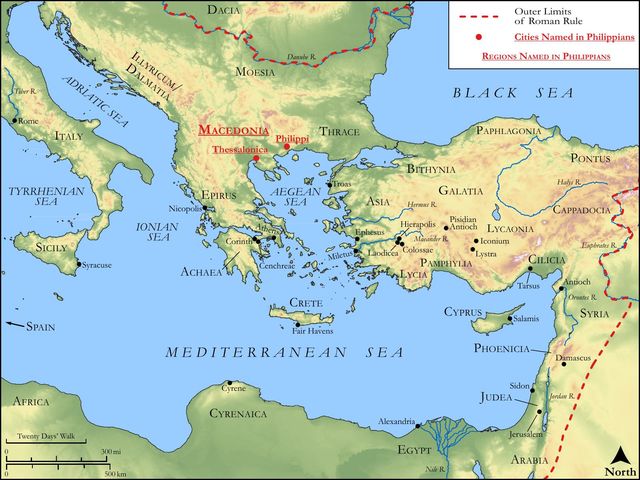
See on the biblical-era map

Study this verse
Public-domain commentary
Matthew Henry
From his Commentary on the Whole Bible. Henry comments on passages, not single verses — this entry covers Philippians 4:20–23. His three-level outline is real structure in the source text, so it is rendered as structure.
The apostle concludes the epistle in these verses,
1.With praises to God: Now unto God and our Father be glory for ever and ever, Amen, Phi 4:20. Observe,
(1.)God is to be considered by us as our Father: Now unto God and our Father. It is a great condescension and favour in God to own the relation of Father to sinners, and allow us to say to him, Our Father; and it is a title peculiar to the gospel dispensation. It is also a great privilege and encouragement to us to consider him as our Father, as one so nearly related and who bears so tender an affection towards us. We should look upon God, under all our weaknesses and fears, not as a tyrant or an enemy, but as a Father, who is disposed to pity us and help us.
(2.)We must ascribe glory to God as a Father, the glory of his own excellence and of all his mercy unto us. We must thankfully own the receipt of all from him, and give the praise of all to him. And our praise must be constant and perpetual; it must be glory for ever and ever.
2.With salutations to his friends at Philippi: "Salute every saint in Christ Jesus (Phi 4:21); give my hearty love to all the Christians in your parts." He desires remembrances not only to the bishops and deacons, and the church in general, but to every particular saint. Paul had a kind affection to all good Christians.
3.He sends salutations from those who were at Rome: "The brethren who are with me salute you; the ministers, and all the saints here, send their affectionate remembrances to you. Chiefly those who are of Caesar's household; the Christian converts who belonged to the emperor's court." Observe,
(1.)There were saints in Caesar's household. Though Paul was imprisoned at Rome, for preaching the gospel, by the emperor's command, yet there were some Christians in his own family. The gospel early obtained among some of the rich and great. Perhaps the apostle fared the better, and received some favour, by means of his friends at court.
(2.)Chiefly those, etc. Observe, They, being bred at court, were more complaisant than the rest. See what an ornament to religion sanctified civility is.
4.The apostolical benediction, as usual: "The grace of our Lord Jesus Christ be with you all, Amen. The free favour and good will of Christ be your portion and happiness."
Historical interpretation
Two Centuries of Reception
3 surviving comments on this verse. Each one is dated, so this reads as a timeline rather than a list.
Select a marker to jump to its quote. Markers stagger vertically where authors wrote within a few decades of each other.
For, while I was yet a boy, I saw thee in Lower Asia with Polycarp, distinguishing thyself in the royal court,
Many apparently have believed even from Caesar’s household. These are people who would otherwise have walked proudly and thought of nothing but Caesar. The power of the gospel has been revealed to these people. Many others who have believed are humble people. He equally greets them all, humbly and affably, wherever they are. The word “especially” in relation to “those of Caesar’s household” makes it apparent that they are taking pains to be pleasing in service.
"All the saints salute you, especially they that are of Caesar's household. The grace of the Lord Jesus Christ be with your spirit."
He elevated them and strengthened them, by showing that his preaching had reached even to the king's household. For if those who were in the king's palace despised all things for the sake of the King of Heaven, far more ought they to do this. And this too was a proof of the love of Paul, and that he had told many things of them, and said great things of them, whence he had even led those who were in the palace to a longing for them, so that those who had never seen them saluted them. Especially because the faithful were then in affliction, his love was great. And those who were absent from each other were closely conjoined together as if real limbs. And the poor man was similarly disposed toward the rich, and the rich toward the poor, and there was no preeminence, in that they were all equally hated and cast out, and that for the same cause. For as, if captives taken from divers cities should arise and come to the same towns, they eagerly embrace each other, their common calamity binding them together; thus too at that time they had great love one toward another, the communion of their afflictions and persecutions uniting them.
Continue studying Philippians 4:22 across the web’s major study libraries — every link below opens this exact verse, chapter, or book on the destination site.
Read & Compare
 BibleGatewayThis verse in more than 200 translations and 70 languages.
 Bible.comThe YouVersion reader — hundreds of translations, reading plans, and highlights.
 ESV.orgCrossway's official English Standard Version reader.
 NET BibleThe NET translation with 60,000+ translators' notes on every rendering decision.
 STEP BibleTyndale House's free study tool — original text, vocabulary, and scholarly resources.
 BibliaLogos Bible Software's free web reader.
 USCCBThe New American Bible (Revised Edition) with the U.S. bishops' study notes.
Commentaries
 BibleHub CommentariesDozens of classic commentaries on this verse, gathered on one page.
 StudyLightMore than 100 commentary sets — the largest collection on the web.
 BibleRefPlain-English commentary on what this verse means, verse by verse.
 Enduring WordDavid Guzik's free commentary on this chapter, widely used by Bible teachers.
 Bible Study ToolsVerse commentary alongside Greek and Hebrew study aids.
Original Language & Research
- BibleHub InterlinearThe verse word by word — original language, transliteration, and English.
- BibleHub LexiconEvery word's original-language definition and Strong's entry.
 Blue Letter BibleDeep-study tools — Strong's numbers, concordance, and word studies.
 CNTR CollationThe earliest Greek manuscripts of this verse, collated letter by letter.
Sermons, Hymns & Audio


TrulyRandomVerse is not affiliated with these sites and doesn’t control their content. They’re linked because they’re genuinely useful.
Summary
Philippians 4:22 concludes Paul's letter with a remarkable and encouraging greeting, extending the salutations of "all the saints" to the Philippian believers, with a special emphasis on those belonging to "Caesar's household." This final verse powerfully underscores the pervasive and transformative reach of the gospel, demonstrating that the message of Christ had penetrated even the highest echelons of Roman imperial power, uniting diverse individuals in a shared faith.
Context
ShowHideLiterary Context
This verse serves as the concluding salutation of Paul's deeply personal and joyful letter to the Philippians. Following a final exhortation to stand firm in the Lord, rejoice, and live in unity and peace (Philippians 4:1-9), and a heartfelt expression of gratitude for their financial support (Philippians 4:10-20), Paul delivers a series of greetings. First, he sends personal greetings from himself and his companions (Philippians 4:21). Then, in this verse, he broadens the scope to include "all the saints" in his vicinity, specifically highlighting the surprising presence of believers within the imperial administration, before offering a final benediction (Philippians 4:23). This progression from personal to universal greetings reinforces the themes of Christian fellowship and the expansive nature of God's kingdom.
Historical & Cultural Context
Paul wrote the Epistle to the Philippians while imprisoned, most likely in Rome, around A.D. 60-62. The phrase "Caesar's household" (Latin: familia Caesaris) refers not exclusively to the emperor's immediate family, but to the vast network of imperial servants, freedmen, and officials who managed the emperor's personal affairs, estates, and the broader imperial administration. This extensive group included a diverse range of individuals, from high-ranking administrators to household slaves, all directly connected to the imperial court. For believers in Philippi, a Roman colony with strong ties to Rome and a significant military presence, the news that the gospel had taken root within Caesar's own staff would have been profoundly significant. It offered tangible proof that Christianity was not merely a fringe movement but was impacting even the most powerful and seemingly impenetrable circles of the Roman Empire, a testament to the gospel's ability to transcend social and political barriers.
Key Themes
ShowHidePhilippians 4:22 contributes significantly to several overarching themes within the epistle and broader Pauline theology. Firstly, it powerfully illustrates the Pervasiveness of the Gospel, demonstrating that the message of Christ is not confined by social status, political power, or geographical location. The presence of believers in "Caesar's household" underscores the truth that the gospel can penetrate any barrier, fulfilling the commission to preach to "every creature" (Mark 16:15). Secondly, it highlights the theme of Christian Unity, showcasing how diverse individuals, from a prisoner-apostle to imperial servants, are brought together into one body by their shared faith in Christ, transcending societal distinctions often emphasized in the Roman world. This unity in Christ is a recurring emphasis in Paul's letters, as seen in his teaching on the body of Christ in 1 Corinthians 12. Finally, the verse offers profound Encouragement and Validation to the Philippian believers, assuring them that God is at work in powerful and unexpected ways, even within the very heart of the empire that might otherwise seem hostile to their faith. This aligns with Paul's broader message of joy and perseverance in the face of adversity, as expressed in Philippians 1:12-14).
Exposition and Analysis
ShowHideKey Word Analysis
ShowHideDerived from a root meaning "awful" or "sacred," this term denotes those who are "set apart" or "consecrated" to God. It implies both a positional holiness (being declared holy by God through Christ) and a practical holiness (living a life dedicated to God). In this context, "all the saints" refers to the entire community of believers in Rome who are united in Christ, emphasizing their shared identity and spiritual standing before God, regardless of their social status.
This adverb, meaning "most of all," "especially," or "particularly," serves to highlight and emphasize the subsequent phrase. Paul uses it to draw special attention to the group from "Caesar's household," indicating that their presence among the believers sending greetings is particularly noteworthy or surprising. It underscores the remarkable nature of the gospel's penetration into such an influential and unexpected sphere.
While literally meaning "residence" or "house," this term often extends to encompass the "family" or "domestics" associated with a particular dwelling or master. In the phrase "Caesar's household," it refers to the vast retinue of imperial servants, officials, freedmen, and slaves who served the emperor. Their inclusion signifies that the gospel had reached and transformed individuals across the entire spectrum of the imperial administration, from the lowest slave to potentially high-ranking officials.
Verse Breakdown
ShowHide"All the saints salute you,"
This initial clause conveys a general greeting from the entire Christian community in Rome (or wherever Paul was imprisoned, though Rome is most likely). It emphasizes the unity and fellowship among believers, demonstrating that the Philippians were remembered and cherished by their brothers and sisters in Christ, even those they had never met. The term "saints" (Greek: hagioi) highlights their shared identity as those set apart by God.
"chiefly they that are of Caesar's household."
This second, more specific clause provides a surprising and impactful detail. The Greek phrase hoi ek tēs Kaisaros oikias literally means "those out of Caesar's household." The adverb "chiefly" (Greek: málista) draws particular attention to this group, indicating their significant or unexpected presence among the believers. This detail would have been a profound encouragement to the Philippians, revealing that the gospel's influence extended even into the very heart of the Roman Empire, among those directly connected to the emperor's administration. It illustrates the gospel's power to transcend social barriers and political structures.
Literary Devices
ShowHideThe verse employs Emphasis through the use of the adverb "chiefly," drawing the reader's attention to the specific group of believers from "Caesar's household." This highlights the surprising and significant nature of their conversion and inclusion in the Christian community. There is also an element of Irony or Paradox at play: Paul, a prisoner of Caesar, is sending greetings from followers of Christ who are part of Caesar's own staff. This subtly underscores the ultimate sovereignty of Christ over earthly rulers and institutions. Furthermore, the phrase "Caesar's household" functions as a form of Metonymy, where the "household" stands in for the broader imperial administration and its reach, signifying the gospel's penetration into the very heart of the Roman power structure.
Theological and Thematic Connections
ShowHidePhilippians 4:22 serves as a powerful testament to the universal and unstoppable nature of the gospel. It reveals that God's redemptive work is not confined to specific social strata or geographical locations but actively penetrates all spheres of human society, including those considered most powerful or resistant. The presence of believers within Caesar's household demonstrates that no person or institution is beyond the reach of God's transforming grace, and that the kingdom of God is advancing even in unexpected and challenging environments. This truth would have been a profound source of encouragement for the Philippians, reminding them that their faith was part of a larger, divinely orchestrated movement that transcended local circumstances and imperial authority, binding together diverse individuals into one unified body in Christ.
Reflection and Application
ShowHideThe greeting from "Caesar's household" in Philippians 4:22 offers profound encouragement and challenges for believers today. It reminds us that the gospel is truly for "all people" and can take root in the most unexpected and seemingly impenetrable places. This should ignite a renewed sense of hope and purpose in our evangelistic efforts, urging us not to pre-judge who might be open to the message of Christ based on their social standing, profession, or background. We are called to be faithful witnesses, trusting that God's Spirit can work powerfully in any environment, transforming hearts and lives, even within structures that may seem hostile to faith. Moreover, this verse highlights the unifying power of Christ, demonstrating that in Him, all social, economic, and political divides are transcended, creating a single family of God. This calls us to embrace and celebrate the diversity within the global church, recognizing that our common identity in Christ far outweighs any earthly distinctions.
Questions for Reflection
ShowHideFAQ
ShowHideWho exactly were "Caesar's household" mentioned in Philippians 4:22?
ShowHideThe term "Caesar's household" (Greek: hoi ek tēs Kaisaros oikias, Latin: familia Caesaris) refers to the vast administrative staff and domestic servants connected to the Roman emperor. This was not limited to his immediate family but included a diverse array of individuals, such as imperial slaves, freedmen, administrative officials, secretaries, accountants, and even soldiers, who worked in various capacities within the imperial palace, estates, and broader government administration throughout the empire. Their conversion to Christianity demonstrates the widespread reach of the early church's evangelistic efforts and the transformative power of the gospel.
Why would Paul specifically mention "Caesar's household" in his greetings?
ShowHidePaul likely mentioned "Caesar's household" for several significant reasons. Firstly, it would have been a tremendous source of encouragement for the Philippian church. As a Roman colony, Philippi would have understood the immense power and influence of Caesar, and hearing that believers existed within his own staff would validate their faith and demonstrate God's active work even in the highest echelons of power. Secondly, it underscored the pervasive nature of the gospel, showing that the message of Christ was not confined to overlooked groups but was penetrating even the most influential and seemingly resistant circles of society. This served as powerful evidence of the gospel's unstoppable advance, even from Paul's imprisonment, which he himself noted was serving to advance the gospel (Philippians 1:12-14).
Christ-Centered Fulfillment
ShowHidePhilippians 4:22, with its surprising mention of believers from "Caesar's household," powerfully testifies to the cosmic and universal reign of Jesus Christ. While earthly empires rise and fall, and human rulers exercise temporary authority, this verse subtly proclaims that the true King, Jesus, is building a kingdom that transcends all earthly powers. The penetration of the gospel into Caesar's own administration signifies that Christ's authority extends over every domain, fulfilling the prophetic vision that "every knee should bow, of things in heaven, and things in earth, and things under the earth; and that every tongue should confess that Jesus Christ is Lord, to the glory of God the Father" (Philippians 2:10-11). The conversion of individuals within Caesar's household is a foretaste of the ultimate triumph of Christ, who disarmed principalities and powers, making a public spectacle of them, triumphing over them in the cross (Colossians 2:15). It demonstrates that the Lamb of God, who takes away the sin of the world (John 1:29), is also the Lion of Judah, whose kingdom will have no end (Luke 1:33). Thus, the "saints from Caesar's household" are not merely a historical footnote but a living testament to the expansive and irresistible power of Christ's redemptive work, bringing all peoples, from every walk of life, into His glorious and eternal household, the church (Ephesians 2:19-22).