


Philippians 4:23
- ἩHēTheG3588T-NSFDefinite article Nominative Singular Feminine
- χάριςcharisgraceG5485N-NSFNoun Nominative Singular Feminine
- τοῦtouof theG3588T-GSMDefinite article Genitive Singular Masculine
- κυρίουkuriouLordG2962N-GSM-TNoun Genitive Singular Masculine Title
- ἡμῶνhēmōnof usG3165P-1GPPersonal pronoun Genitive 1st Plural
- ἸησοῦIēsouJesusG2424N-GSM-PNoun Genitive Singular Masculine Individual
- ΧριστοῦChristouChristG5547N-GSM-TNoun Genitive Singular Masculine Title
- μετὰmeta[be] withG3326PREPPreposition
- πνεύματοςpneumatosspiritG4151N-GSNNoun Genitive Singular Neuter
- ὑμῶνhumōnof youG4771P-2GPPersonal pronoun Genitive 2nd Plural
- ἀμήνamēnAmenG281INJ-HEBInterjection
- πρόςprostoG4314PREPPreposition
- ΦιλιππησίουςPhilippēsiousPhilippiG5374N-APM-LGNoun Accusative Plural Masculine Location Gentilic
- ἐγράφηegraphēit was writtenG1125V-2API-3SVerb 2nd Aorist Passive Indicative 3rd Singular
- ἀπόapofromG575PREPPreposition
- ῬώμηςRhōmēsRomeG4516N-GSF-LNoun Genitive Singular Feminine Location
- δι᾽di᾽throughG1223PREPPreposition
- ἘπαφροδίτουEpaphroditouEpaphroditusG1891N-GSM-PNoun Genitive Singular Masculine Individual
English is a literal word-by-word gloss of the Greek, not the KJV's wording. Why?
This is the original text the KJV's translators worked from — each Greek word with its own literal English meaning in this verse, prepared by scholars at Tyndale House, Cambridge. The KJV translates whole sentences, not word by word, so its wording differs: one Greek word can become several English words, and the KJV may choose “charity” where the gloss reads “love”. Both are faithful — they answer different questions. For the KJV's own rendering, switch to the KJV text.
Details
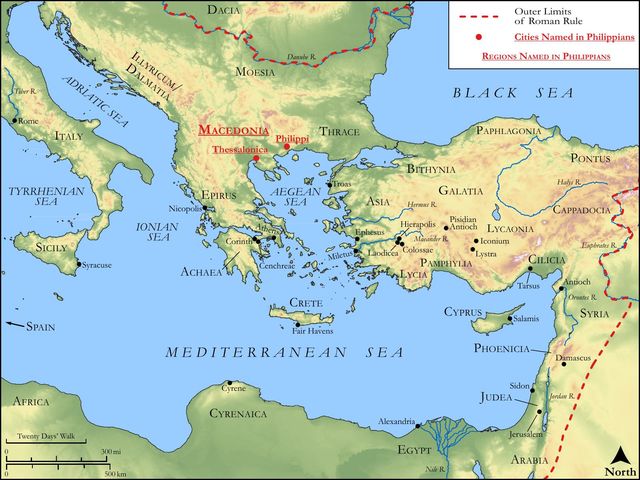
See on the biblical-era map

Study this verse
Public-domain commentary
Matthew Henry
From his Commentary on the Whole Bible. Henry comments on passages, not single verses — this entry covers Philippians 4:20–23. His three-level outline is real structure in the source text, so it is rendered as structure.
The apostle concludes the epistle in these verses,
1.With praises to God: Now unto God and our Father be glory for ever and ever, Amen, Phi 4:20. Observe,
(1.)God is to be considered by us as our Father: Now unto God and our Father. It is a great condescension and favour in God to own the relation of Father to sinners, and allow us to say to him, Our Father; and it is a title peculiar to the gospel dispensation. It is also a great privilege and encouragement to us to consider him as our Father, as one so nearly related and who bears so tender an affection towards us. We should look upon God, under all our weaknesses and fears, not as a tyrant or an enemy, but as a Father, who is disposed to pity us and help us.
(2.)We must ascribe glory to God as a Father, the glory of his own excellence and of all his mercy unto us. We must thankfully own the receipt of all from him, and give the praise of all to him. And our praise must be constant and perpetual; it must be glory for ever and ever.
2.With salutations to his friends at Philippi: "Salute every saint in Christ Jesus (Phi 4:21); give my hearty love to all the Christians in your parts." He desires remembrances not only to the bishops and deacons, and the church in general, but to every particular saint. Paul had a kind affection to all good Christians.
3.He sends salutations from those who were at Rome: "The brethren who are with me salute you; the ministers, and all the saints here, send their affectionate remembrances to you. Chiefly those who are of Caesar's household; the Christian converts who belonged to the emperor's court." Observe,
(1.)There were saints in Caesar's household. Though Paul was imprisoned at Rome, for preaching the gospel, by the emperor's command, yet there were some Christians in his own family. The gospel early obtained among some of the rich and great. Perhaps the apostle fared the better, and received some favour, by means of his friends at court.
(2.)Chiefly those, etc. Observe, They, being bred at court, were more complaisant than the rest. See what an ornament to religion sanctified civility is.
4.The apostolical benediction, as usual: "The grace of our Lord Jesus Christ be with you all, Amen. The free favour and good will of Christ be your portion and happiness."
Historical interpretation
Historical reception
3 surviving comments on this verse. Each one is dated, so this reads as a timeline rather than a list.
Select a marker to jump to its quote. Markers stagger vertically where authors wrote within a few decades of each other.
He knew that the Philippians, unlike those addressed in his other letters, held to correct teaching. They had not been seduced by false apostles. He is here writing only a short letter of exhortation. He prays that “the grace of our Lord Jesus Christ be with your spirit.” For if the Spirit dwells within them, they will respond rightly.
"All the saints salute you, especially they that are of Caesar's household. The grace of the Lord Jesus Christ be with your spirit."
He elevated them and strengthened them, by showing that his preaching had reached even to the king's household. For if those who were in the king's palace despised all things for the sake of the King of Heaven, far more ought they to do this. And this too was a proof of the love of Paul, and that he had told many things of them, and said great things of them, whence he had even led those who were in the palace to a longing for them, so that those who had never seen them saluted them. Especially because the faithful were then in affliction, his love was great. And those who were absent from each other were closely conjoined together as if real limbs. And the poor man was similarly disposed toward the rich, and the rich toward the poor, and there was no preeminence, in that they were all equally hated and cast out, and that for the same cause. For as, if captives taken from divers cities should arise and come to the same towns, they eagerly embrace each other, their common calamity binding them together; thus too at that time they had great love one toward another, the communion of their afflictions and persecutions uniting them.
The letter to the Philippians was sent from Rome by the hand of Epaphroditus.
Continue studying Philippians 4:23 across the web’s major study libraries — every link below opens this exact verse, chapter, or book on the destination site.
Read & Compare
 BibleGatewayThis verse in more than 200 translations and 70 languages.
 Bible.comThe YouVersion reader — hundreds of translations, reading plans, and highlights.
 ESV.orgCrossway's official English Standard Version reader.
 NET BibleThe NET translation with 60,000+ translators' notes on every rendering decision.
 STEP BibleTyndale House's free study tool — original text, vocabulary, and scholarly resources.
 BibliaLogos Bible Software's free web reader.
 USCCBThe New American Bible (Revised Edition) with the U.S. bishops' study notes.
Commentaries
 BibleHub CommentariesDozens of classic commentaries on this verse, gathered on one page.
 StudyLightMore than 100 commentary sets — the largest collection on the web.
 BibleRefPlain-English commentary on what this verse means, verse by verse.
 Enduring WordDavid Guzik's free commentary on this chapter, widely used by Bible teachers.
 Bible Study ToolsVerse commentary alongside Greek and Hebrew study aids.
Original Language & Research
- BibleHub InterlinearThe verse word by word — original language, transliteration, and English.
- BibleHub LexiconEvery word's original-language definition and Strong's entry.
 Blue Letter BibleDeep-study tools — Strong's numbers, concordance, and word studies.
 CNTR CollationThe earliest Greek manuscripts of this verse, collated letter by letter.
Sermons, Hymns & Audio


TrulyRandomVerse is not affiliated with these sites and doesn’t control their content. They’re linked because they’re genuinely useful.
Summary
Philippians 4:23 serves as Paul's final, heartfelt benediction to the church in Philippi, encapsulating the core of his theological message and pastoral affection. It is a concise yet profound prayer that the unmerited favor and divine enablement of God, channeled through the person and work of Jesus Christ, would remain with all the believers, affirming his earnest desire for their spiritual well-being and continued flourishing in the gospel. This closing emphasizes that grace, originating from Christ, is the essential foundation and sustaining power for their Christian walk.
Context
ShowHideLiterary Context
Philippians 4:23 concludes Paul's deeply personal and affectionate letter, often referred to as the "Epistle of Joy." It follows a series of practical exhortations that build upon the foundational themes of the letter. Immediately preceding this verse, Paul conveys greetings from the saints in Rome, particularly those of Caesar's household, highlighting the broad community of faith even amidst his imprisonment. The benediction itself is a common Pauline epistolary closing, but here it carries particular weight given the intimate relationship Paul shared with the Philippians, whom he considered his joy and crown. It solidifies the themes of partnership in the gospel, encouragement in suffering, and the peace of God that transcends understanding, bringing the letter to a spiritually rich and affirming close.
Historical & Cultural Context
The letter to the Philippians was written by Paul during his imprisonment in Rome, as indicated by the postscript (though not part of the inspired text, it reflects early tradition and is consistent with internal evidence). Philippi was a significant Roman colony in Macedonia, known for its strong Roman identity and military presence. It was the first place in Europe where Paul established a church, following Lydia's conversion and the jailer's baptism (as recounted in Acts 16). The Philippian church was unique in its consistent financial support for Paul's ministry, a partnership he deeply cherished. Culturally, the emphasis on "grace" would have contrasted sharply with the Roman and Greek societal norms that often valued merit, honor, and achievement. Paul's benediction, therefore, underscores a counter-cultural reality: divine favor is not earned but freely given through Christ, available to "all" believers, fostering unity in a diverse community.
Key Themes
ShowHideThis concluding verse powerfully reinforces several key themes woven throughout the letter. Firstly, it highlights the centrality of Christ, as all grace flows from "our Lord Jesus Christ," emphasizing His supremacy and sufficiency, a theme echoed in Paul's declaration that he can do all things through Christ who strengthens him. Secondly, the theme of divine grace is paramount, serving as the unmerited favor that underpins salvation and sustains Christian living, providing the peace that guards hearts and minds. Thirdly, the phrase "with you all" underscores unity and universal reach within the body of Christ, a vital message for a church that Paul had exhorted to be of the same mind and to stand firm together. Finally, the "Amen" signifies assurance and affirmation, reflecting Paul's confident prayer and the certainty of God's benevolent presence amidst their circumstances, whether in joy or in suffering, a constant call to rejoice in the Lord always.
Exposition and Analysis
ShowHideKey Word Analysis
ShowHideThis word, appearing over 100 times in Paul's letters, signifies God's unmerited favor, divine enablement, and benevolent disposition towards humanity. It is the active, transforming power of God, freely given, that undergirds salvation and empowers Christian living. In this context, it is not merely a wish for favor but a prayer for the active presence and influence of God's saving and sustaining power in their lives.
Derived from a root signifying supremacy, kýrios denotes supreme authority and control. When applied to Jesus, it declares His divine sovereignty, His position as Master, and His rightful claim over all creation and especially over believers. The grace is specifically "of our Lord Jesus Christ," emphasizing that this divine favor is intrinsically linked to His person and His absolute authority.
Transliterated directly from Hebrew, "Amen" functions as a strong affirmation, meaning "so be it," "truly," or "let it be true." It expresses Paul's fervent desire and confident expectation that the preceding benediction will indeed be realized in the lives of the Philippian believers. It is a powerful concluding statement that seals the prayer with conviction and faith.
Verse Breakdown
ShowHide"The grace of our Lord Jesus Christ"
This opening phrase identifies the source and nature of the blessing. "Grace" (cháris) is God's unmerited favor, His divine, benevolent influence. It is not a generic blessing but specifically flows "of our Lord Jesus Christ," emphasizing that all spiritual blessings and enablement are mediated through His person and His redemptive work. He is the ultimate wellspring of this divine favor.
"[be] with you all."
The verb "be" is implied in the Greek, making this a prayer or a declaration of desired reality. The phrase "with you all" highlights the communal and inclusive nature of this grace. It is not for a select few or for Paul alone, but for every member of the Philippian church, emphasizing unity, shared blessing, and the pervasive presence of Christ's grace among the entire community of believers.
"Amen."
This concluding word serves as a solemn and emphatic affirmation. It expresses Paul's fervent prayer and confident expectation that the grace of Christ will indeed be with them. It is a declaration of truth and a heartfelt "so be it," sealing the benediction with spiritual authority and deep conviction.
Literary Devices
ShowHidePhilippians 4:23 employs several potent literary devices. It functions primarily as a Benediction, a formal expression of divine blessing, common in Pauline epistles, which serves as a theological summary and a pastoral prayer. The phrase "The grace of our Lord Jesus Christ" is a form of Metonymy, where "grace" stands for the entire redemptive work and ongoing presence of Christ, from whom all blessings flow. The inclusion of "all" (G3956, pâs) provides Emphasis on the universal scope of the blessing, underscoring that this grace is for every believer without exception, fostering a sense of communal solidarity. Finally, the concluding "Amen" acts as a powerful Affirmation, lending solemnity and certainty to the benediction, transforming it from a mere wish into a confident declaration of faith and desire for its fulfillment.
Theological and Thematic Connections
ShowHideThis concluding benediction in Philippians 4:23 is far more than a mere formal closing; it is a profound theological statement that encapsulates the essence of the Christian faith. It asserts that divine grace is not an abstract concept but a dynamic, personal reality, originating from the very person of "our Lord Jesus Christ." This grace is the foundation of salvation, the power for sanctification, and the source of all spiritual blessings. It underscores God's initiative in redemption, His unmerited favor poured out through Christ, which sustains believers through every circumstance. The emphasis on "all" highlights the communal nature of this grace, binding believers together in a shared experience of Christ's presence and power, fostering unity and mutual encouragement within the body of Christ. This grace is sufficient for every need, empowering believers to live lives that honor God amidst trials and triumphs.
Reflection and Application
ShowHidePhilippians 4:23 offers a timeless and deeply comforting truth for every believer: the grace of our Lord Jesus Christ is continually with us. In a world that often demands performance and merit, this verse reminds us that our standing before God, our strength for daily living, and our hope for the future are not based on our own efforts but entirely on God's unmerited favor, freely given through Christ. This truth should cultivate a profound sense of humility, gratitude, and dependence. It assures us that no matter the challenges we face—whether internal struggles with anxiety or external pressures from the world—Christ's grace is sufficient to sustain, equip, and empower us. Living under this grace means embracing our identity in Christ, resting in His finished work, and allowing His presence to shape our attitudes and actions. It calls us to extend this same grace to others, fostering unity and love within the church, knowing that we all stand equally in need of and equally receive this divine blessing.
Questions for Reflection
ShowHideFAQ
ShowHideWhat is the significance of "grace" in this final benediction?
ShowHideThe term "grace" (Greek: cháris) is central to Paul's theology. In this benediction, it signifies God's unmerited favor, His benevolent disposition, and the divine enablement that He freely bestows upon believers through Jesus Christ. It's not just a polite closing but a profound theological statement affirming that everything in the Christian life—from salvation to sanctification and perseverance—is entirely dependent on God's undeserved kindness and power. It contrasts sharply with any notion of human merit, emphasizing that our relationship with God is a gift, as seen in Romans 3:24.
Why does Paul specifically say "of our Lord Jesus Christ"?
ShowHideBy attributing grace specifically to "our Lord Jesus Christ," Paul emphasizes that Jesus is the sole source and mediator of this divine favor. All of God's blessings, including His grace, flow to humanity through the person and redemptive work of Christ. It highlights the centrality of Jesus in Christian faith and experience, affirming His divine authority ("Lord") and His role as the Anointed One ("Christ") through whom God's favor is fully revealed and enacted.
What does the "Amen" signify at the end of the verse?
ShowHideThe "Amen" (from Hebrew, meaning "so be it" or "truly") serves as a strong affirmation and seal on the preceding benediction. It expresses Paul's fervent prayer and confident expectation that the grace of Christ will indeed be with the Philippian believers. It is a declaration of truth and a heartfelt "yes" to the truth and efficacy of the blessing, inviting the recipients to also affirm its reality. It's a common and powerful way to conclude prayers and declarations in the Bible, signifying certainty and agreement, as also seen in Revelation 22:20.
Christ-Centered Fulfillment
ShowHidePhilippians 4:23, though a closing benediction, profoundly points to Christ as the ultimate source and embodiment of all grace, fulfilling God's redemptive plan. The "grace of our Lord Jesus Christ" is not merely a concept but the active, saving, and sustaining presence of God made manifest in His Son. Christ Himself is the living embodiment of God's unmerited favor; in His incarnation, the Word became flesh and dwelt among us, full of grace and truth. His atoning death on the cross is the supreme demonstration of this grace, for while we were still sinners, Christ died for us. Through His resurrection, believers are granted newness of life by grace, and His ascension ensures His ongoing intercession for us as our great high priest. Thus, the grace Paul invokes is the very life and power of Christ, continually at work in believers, making His strength perfect in our weakness, as He declared, "My grace is sufficient for you". This benediction anticipates Christ's ultimate return, when the grace of God that brings salvation will be fully realized in His glorious appearing.