


2 Corinthians 13:14
Bible text: King James Version (1769 Blayney text) · Public domain
Bible text: King James Version with Strong's numbers · Public domain
Bible text: Berean Standard Bible · Public domain
Bible text: American Standard Version (1901) · Public domain
Bible text: World English Bible, Messianic edition · Public domain
Bible text: Geneva Bible (1599) · Public domain
Bible text: Young's Literal Translation · Public domain
- ἩHēTheG3588T-NSFDefinite article Nominative Singular Feminine
- χάριςcharisgraceG5485N-NSFNoun Nominative Singular Feminine
- τοῦtouof theG3588T-GSMDefinite article Genitive Singular Masculine
- κυρίουkuriouLordG2962N-GSM-TNoun Genitive Singular Masculine Title
- ἸησοῦIēsouJesusG2424N-GSM-PNoun Genitive Singular Masculine Individual
- ΧριστοῦChristouChristG5547N-GSM-TNoun Genitive Singular Masculine Title
- καὶkaiandG2532CONJConjunction
- ἡhētheG3588T-NSFDefinite article Nominative Singular Feminine
- ἀγάπηagapēloveG26N-NSFNoun Nominative Singular Feminine
- τοῦtou<the>G3588T-GSMDefinite article Genitive Singular Masculine
- θεοῦtheouof GodG2316N-GSM-TNoun Genitive Singular Masculine Title
- καὶkaiandG2532CONJConjunction
- ἡhētheG3588T-NSFDefinite article Nominative Singular Feminine
- κοινωνίαkoinōniafellowshipG2842N-NSFNoun Nominative Singular Feminine
- τοῦtouof theG3588T-GSNDefinite article Genitive Singular Neuter
- ἁγίουhagiouHolyG40A-GSNAdjective Genitive Singular Neuter
- πνεύματοςpneumatosSpiritG4151N-GSNNoun Genitive Singular Neuter
- μετὰmeta[be] withG3326PREPPreposition
- πάντωνpantōnallG3956A-GPMAdjective Genitive Plural Masculine
- ὑμῶνhumōnof youG4771P-2GPPersonal pronoun Genitive 2nd Plural
- ἀμήνamēnAmenG281INJ-HEBInterjection
- πρόςprostoG4314PREPPreposition
- ΚορινθίουςKorinthiousCorinthiansG2881N-APM-LGNoun Accusative Plural Masculine Location Gentilic
- δευτέρᾳdeuterasecondG1208A-NSFAdjective Nominative Singular Feminine
- ἐγράφηegraphēit was writtenG1125V-2API-3SVerb 2nd Aorist Passive Indicative 3rd Singular
- ἀπόapofromG575PREPPreposition
- ΦιλίππωνPhilippōnPhilippiG5375N-GSM-LNoun Genitive Singular Masculine Location
- τῆςtēs<the>G3588T-GSFDefinite article Genitive Singular Feminine
- ΜακεδονίαςMakedoniasof MacedoniaG3109N-GSF-LNoun Genitive Singular Feminine Location
- διάdiathroughG1223PREPPreposition
- ΤίτουTitouof TitusG5103N-GSM-PNoun Genitive Singular Masculine Individual
- καίkaiandG2532CONJConjunction
- ΛουκᾶLoukaLukeG3065N-GSM-PNoun Genitive Singular Masculine Individual
English is a literal word-by-word gloss of the Greek, not the KJV's wording. Why?
This is the original text the KJV's translators worked from — each Greek word with its own literal English meaning in this verse, prepared by scholars at Tyndale House, Cambridge. The KJV translates whole sentences, not word by word, so its wording differs: one Greek word can become several English words, and the KJV may choose “charity” where the gloss reads “love”. Both are faithful — they answer different questions. For the KJV's own rendering, switch to the KJV text.
Details
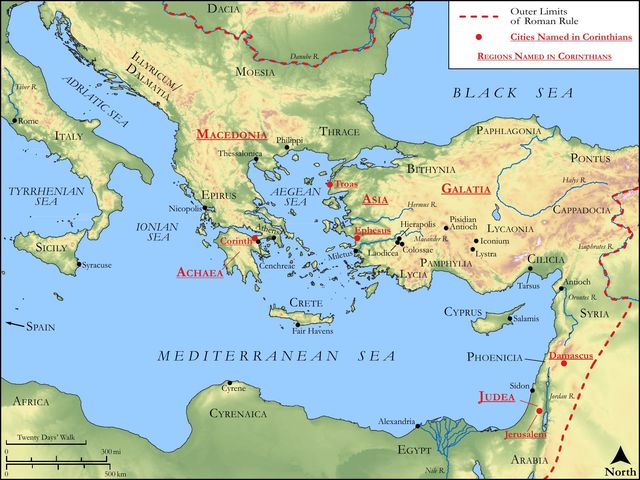
See on the biblical-era maps

Study this verse
Public-domain commentary
Matthew Henry
From his Commentary on the Whole Bible. Henry comments on passages, not single verses — this entry covers 2 Corinthians 13:11–14. His three-level outline is real structure in the source text, so it is rendered as structure.
Thus the apostle concludes this epistle with,
I.A valediction.
He gives them a parting farewell, and takes his leave of them for the present, with hearty good wishes for their spiritual welfare. In order to this,
1.He gives them several good exhortations.
(1.)To be perfect, or to be knit together in love, which would tend greatly to their advantage as a church, or Christian society.
(2.)To be of good comfort under all the sufferings and persecutions they might endure for the cause of Christ or any calamities and disappointments they might meet with in the world.
(3.)To be of one mind, which would greatly tend to their comfort; for the more easy we are with our brethren the more ease we shall have in our own souls. The apostle would have them, as far as was possible, to be of the same opinion and judgment; however, if this could not be attained, yet,
(4.)He exhorts them to live in peace, that difference in opinion should not cause an alienation of affections - that they should be at peace among themselves. He would have all the schisms that were among them healed, that there should be no more contention and wrath found among them, to prevent which they should avoid debates, envyings, backbitings, whisperings, and such like enemies to peace.
2.He encourages them with the promise of God's presence among them: The God of love and peace shall be with you, Co2 13:11. Note,
(1.)God is the God of love and peace. He is the author of peace, and lover of concord. He hath loved us, and is willing to be at peace with us; he commands us to love him, and to be reconciled to him, and also that we love one another, and be at peace among ourselves.
(2.)God will be with those who live in love and peace. He will love those who love peace; he will dwell with them here, and they shall dwell with him for ever. Such shall have God's gracious presence here, and be admitted to his glorious presence hereafter.
3.He gives directions to them to salute each other, and sends kind salutations to them from those who were with him, Co2 13:12, Co2 13:13. He would have them testify their affection to one another by the sacred rite of a kiss of charity, which was then used, but has long been disused, to prevent all occasions of wantonness and impurity, in the more declining and degenerate state of the church.
II.The apostolical benediction (Co2 13:14):
The grace of the Lord Jesus Christ, and the love of God, and the communion of the Holy Ghost, be with you all. Thus the apostle concludes his epistle, and thus it is usual and proper to dismiss worshipping assemblies. This plainly proves the doctrine of the gospel, and is an acknowledgment that Father, Son, and Spirit, are three distinct persons, yet but one God; and herein the same, that they are the fountain of all blessings to men. It likewise intimates our duty, which is to have an eye by faith to Father, Son, and Holy Ghost - to live in a continual regard to the three persons in the Trinity, into whose name we were baptized, and in whose name we are blessed. This is a very solemn benediction, and we should give all diligence to inherit this blessing. The grace of Christ, the love of God, and the communion (or communication) of the Holy Ghost: the grace of Christ as Redeemer, the love of God who sent the Redeemer, and all the communications of this grace and love, which come to us by the Holy Ghost; it is the communications of the Holy Ghost that qualify us for an interest in the grace of Christ, and the love of God: and we can desire no more to make us happy than the grace of Christ, the love of God, and the communion of the Holy Ghost. Amen.
Historical interpretation
Historical reception
9 surviving comments on this verse. Each one is dated, so this reads as a timeline rather than a list.
Select a marker to jump to its quote. Markers stagger vertically where authors wrote within a few decades of each other.
Here is the intertwining of the Trinity and the unity of power which brings all salvation to fulfillment. The love of God has sent us Jesus the Savior, by whose grace we have been saved. The fellowship of the Holy Spirit makes it possible for us to possess the grace of salvation, for he guards those who are loved by God and saved by the grace of Christ, so that the completeness of the Three may be the saving fulfillment of mankind.
If there is one grace, one peace, one love and one fellowship on the part of the Father and of the Son and of the Holy Spirit, surely there is one operation, and where there is one operation, certainly the power cannot be divided or the substance separated.
The grace of our Lord Jesus Christ saves us apart from works and fills us with grace.
Moreover, he will be found again, to put the gifts also themselves transposedly. For having said here, "The grace of Christ, and the love of God and the Father, and the communion of the Holy Ghost;" he in another place speaks of "the communion of the Son," and of "the love of the Spirit." For, "I beseech you," he says, "by the love of the Spirit." (Romans 15:30) And in his Epistle to the Corinthians, "God is faithful, by Whom ye were called into the communion of His Son." (1 Corinthians 1:9) Thus the things of the Trinity are undivided: and whereas the communion is of the Spirit, it hath been found of the Son; and whereas the grace is of the Son, it is also of the Father and of the Holy Spirit.
"The grace of our Lord Jesus Christ, and the love of God," and the Father, "and the communion of the Holy Ghost, be with you all." After having united them to one other by the salutations and the kisses, he again closes his speech with prayer, with much carefulness uniting them unto God also.
And I say these things, not confounding the Persons, (away with the thought!) but knowing both the individuality and distinctness of These, and the Unity of the Substance.
Where now are they who say that because the Holy Spirit is not inserted in the beginnings of the Epistles, He is not of the same substance? For, behold, he hath now enumerated Him with the Father and Son. And besides this, one may remark, that when writing to the Colossians and saying, "Grace to you, and peace from God our Father," he was silent of the Son, and added not, as in all his Epistles, and from the Lord Jesus Christ. Is then the Son not of the same substance either, because of this? Nay, these reasonings are of extreme folly. For this very thing especially shows Him to be of the same substance, that Paul useth the expression [or not] indifferently.
And that what is here said is no conjecture, hear how he mentions Son and Spirit, and is quite silent of the Father. For, writing to the Corinthians, he says, "But ye were washed, but ye were sanctified, but ye were justified in the name of the Lord Jesus Christ, and in the Spirit of our God." (1 Corinthians 6:11) What then, tell me? were these not baptized into the Father? Then assuredly they were neither washed nor sanctified. But did they baptize them? doubtless then just as also they did baptize. How then did he not say, 'Ye are washed in the name of the Father?' Because it was indifferent in his view, at one time to make mention of this, at another of that Person; and you may observe this custom in many places of the Epistles.
This is written against the Arians, who maintain that the Father is greater than the Son on the ground that he is usually mentioned first.
Continue studying 2 Corinthians 13:14 across the web’s major study libraries — every link below opens this exact verse, chapter, or book on the destination site.
Read & Compare
 BibleGatewayThis verse in more than 200 translations and 70 languages.
 Bible.comThe YouVersion reader — hundreds of translations, reading plans, and highlights.
 ESV.orgCrossway's official English Standard Version reader.
 NET BibleThe NET translation with 60,000+ translators' notes on every rendering decision.
 STEP BibleTyndale House's free study tool — original text, vocabulary, and scholarly resources.
 BibliaLogos Bible Software's free web reader.
 USCCBThe New American Bible (Revised Edition) with the U.S. bishops' study notes.
Commentaries
 BibleHub CommentariesDozens of classic commentaries on this verse, gathered on one page.
 StudyLightMore than 100 commentary sets — the largest collection on the web.
 BibleRefPlain-English commentary on what this verse means, verse by verse.
 Enduring WordDavid Guzik's free commentary on this chapter, widely used by Bible teachers.
 Bible Study ToolsVerse commentary alongside Greek and Hebrew study aids.
Original Language & Research
- BibleHub InterlinearThe verse word by word — original language, transliteration, and English.
- BibleHub LexiconEvery word's original-language definition and Strong's entry.
 Blue Letter BibleDeep-study tools — Strong's numbers, concordance, and word studies.
 CNTR CollationThe earliest Greek manuscripts of this verse, collated letter by letter.
Sermons, Hymns & Audio


TrulyRandomVerse is not affiliated with these sites and doesn’t control their content. They’re linked because they’re genuinely useful.
Summary
Paul's concluding benediction serves as a profound and comprehensive invocation of divine blessing upon the Corinthian church. It is a concise yet rich Trinitarian formula, invoking the grace of the Lord Jesus Christ, the love of God the Father, and the fellowship of the Holy Spirit, thereby encapsulating the unified work of the Godhead in sustaining and empowering believers. This final blessing underscores Paul's deep pastoral concern and his desire for the Corinthians to experience the full measure of God's presence amidst their challenges and internal divisions.
Context
ShowHideLiterary Context
This verse concludes Paul's Second Epistle to the Corinthians, a letter characterized by intense pastoral concern, apostolic defense, and calls for reconciliation. Immediately preceding this benediction, in 2 Corinthians 13:11-13, Paul offers final exhortations for the Corinthians to "be perfect, be of good comfort, be of one mind, live in peace," and assures them that "the God of love and peace shall be with you." The benediction, therefore, is not merely a polite farewell but a powerful, comprehensive blessing that encapsulates the very peace and unity Paul has been urging throughout the letter, serving as a divine seal on his apostolic instruction and pastoral heart. It transitions from direct commands to an invocation of God's enabling presence.
Historical & Cultural Context
The Corinthian church was plagued by numerous issues, including internal factions, challenges to Paul's apostolic authority by "super-apostles," moral laxity, and spiritual immaturity. Paul's second letter is a complex response to these problems, marked by both stern rebuke and tender affection. In the Greco-Roman world, letters often concluded with formal greetings and blessings, but Paul's benedictions frequently carried significant theological weight, serving as summaries of his teaching or prayers for the recipients. The explicit Trinitarian formulation here is particularly noteworthy, given the diverse spiritual and philosophical landscape of Corinth, where various deities and cults competed for allegiance. Paul's blessing firmly grounds the Corinthians' identity and well-being in the one true God, revealed as Father, Son, and Holy Spirit.
Key Themes
ShowHideThe primary theme is the Trinitarian nature of God and His unified work in the lives of believers. This verse is one of the clearest New Testament expressions of the distinct yet inseparable persons of the Godhead. It also highlights divine provision and enablement, emphasizing that the Christian life is sustained by God's unmerited favor (grace), His unconditional affection (love), and His intimate presence (communion) through the Holy Spirit. Furthermore, the benediction underscores unity and fellowship within the church, as the blessing is invoked upon "you all," echoing Paul's consistent appeals for the Corinthians to overcome their divisions and live in harmony, as seen in his earlier emphasis on the church as one body in Christ. This comprehensive blessing serves as a theological foundation for their reconciliation and spiritual growth, reminding them that their true source of peace and strength is found in the triune God, who is the ultimate source of all good, as echoed in James 1:17.
Exposition and Analysis
ShowHideKey Word Analysis
ShowHideThis term (G5485) denotes graciousness, favor, or divine influence upon the heart, and its reflection in the life. In the context of Jesus Christ, it signifies God's unmerited favor and divine enablement, which is the foundation of salvation and the power for Christian living, freely given despite human unworthiness.
This word (G26) describes affection or benevolence, specifically a selfless, sacrificial, and unconditional love. It is the characteristic love of God, demonstrated supremely in His sending of His Son, and it is the ultimate source of all divine blessings, flowing from God's very nature.
This rich term (G2842) signifies partnership, participation, social intercourse, or shared fellowship. In the context of the Holy Spirit, it implies an intimate, active relationship and shared life that believers have with the Spirit, and through Him, with one another, leading to unity and mutual participation in the divine life and mission.
Verse Breakdown
ShowHide"The grace of the Lord Jesus Christ"
This phrase points to Jesus Christ as the mediator and embodiment of God's unmerited favor. His life, death, and resurrection are the supreme demonstration of divine grace, providing salvation, forgiveness, and the power to live righteously. It is through Christ that believers receive spiritual strength and enablement for every aspect of their lives.
"and the love of God"
This refers to God the Father's unconditional, benevolent, and self-giving love. This agape love is the ultimate source and motivation behind all of God's redemptive work, including the sending of Jesus Christ and the gift of the Holy Spirit. It is the foundational truth that assures believers of God's enduring care and commitment.
"and the communion of the Holy Ghost"
This speaks to the active fellowship and intimate participation that believers have with the Holy Spirit. The Spirit indwells believers, empowering them, guiding them, and uniting them not only with God but also with one another in a shared spiritual life. This "communion" fosters unity, understanding, and shared purpose within the Christian community.
"be with you all. Amen."
This closing invocation expresses Paul's fervent desire and prayer that this comprehensive Trinitarian blessing would be present with all the Corinthians, emphasizing the corporate nature of the blessing. The "Amen" serves as a solemn affirmation, expressing certainty and agreement with the prayer, signifying "so be it" or "let it be true."
Literary Devices
ShowHideThe verse employs several significant literary devices. Foremost is the Trinitarian Formula, which explicitly names all three persons of the Godhead—Jesus Christ, God (the Father), and the Holy Spirit—in a single, concise blessing. This structure is rare and powerful, serving as one of the clearest New Testament statements of the Trinity. The verse also functions as a Benediction, a formal and solemn blessing pronounced at the conclusion of a letter or service. This benediction is not merely a polite farewell but an authoritative invocation of divine presence and power, reflecting Paul's apostolic authority and his deep pastoral care for the Corinthian church. Furthermore, the use of Parallelism is evident in the balanced phrasing "the grace of... and the love of... and the communion of...," which gives the blessing a rhythmic and memorable quality, emphasizing the distinct yet harmonious contributions of each person of the Trinity.
Theological and Thematic Connections
ShowHideThis profound benediction provides a concise yet comprehensive summary of Christian theology, encapsulating the triune nature of God and His unified work in salvation and sanctification. It affirms that the entire Godhead is actively involved in the life of the believer and the church, providing distinct yet interconnected blessings: grace from the Son for salvation and daily strength, love from the Father as the ultimate source and motivation, and communion from the Spirit for intimate fellowship and unity. This verse demonstrates that the Christian life is not lived in isolation but in constant, dynamic relationship with the Father, Son, and Holy Spirit, who work in perfect harmony to bring about God's purposes. It underscores that all spiritual blessings flow from this divine unity and are made available to believers, fostering both individual spiritual vitality and corporate church unity.
Reflection and Application
ShowHide2 Corinthians 13:14 serves as a powerful reminder of the comprehensive and holistic nature of God's provision for His people. For individual believers, it underscores that our spiritual life is sustained not by our own efforts but by the continuous outpouring of divine grace, love, and fellowship from the triune God. In moments of weakness, we draw upon the grace of Christ; in times of doubt, we are anchored by the unwavering love of God; and in our daily walk, we are guided and empowered by the communion of the Holy Spirit. For the church, this benediction is a profound call to unity, reminding us that just as the Father, Son, and Spirit are one, so too should believers strive for "one mind" and "peace" (as Paul exhorted in 2 Corinthians 13:11). This comprehensive blessing is the theological bedrock for overcoming division, fostering genuine fellowship, and living out our corporate identity as the body of Christ in a world desperately needing to see the unity and love of God.
Questions for Reflection
ShowHideFAQ
ShowHideWhy is this verse considered a Trinitarian blessing?
ShowHideThis verse is considered a Trinitarian blessing because it explicitly names all three persons of the Godhead: "the Lord Jesus Christ" (the Son), "God" (the Father), and "the Holy Ghost" (the Holy Spirit). This clear and concise enumeration of the divine persons, each with a distinct yet harmonious blessing, makes it one of the most direct Trinitarian formulations in the New Testament. It parallels other Trinitarian references, such as the baptismal formula in Matthew 28:19, which instructs disciples to baptize "in the name of the Father, and of the Son, and of the Holy Ghost."
What is the significance of "communion of the Holy Ghost"?
ShowHideThe "communion of the Holy Ghost" (Greek: koinōnía) signifies a profound and active fellowship, participation, and shared life with the Holy Spirit. It means that believers are not merely recipients of the Spirit's power but are invited into an intimate, personal relationship with Him. This koinōnía enables believers to experience God's presence, understanding, and unity. It is through the Spirit that believers are united with Christ and with one another, fostering genuine fellowship within the church and empowering them for service. This shared life in the Spirit is foundational to Christian unity, as emphasized in passages like Philippians 2:1, which speaks of "fellowship of the Spirit."
Christ-Centered Fulfillment
ShowHide2 Corinthians 13:14, while explicitly Trinitarian, finds its ultimate fulfillment and accessibility through the person and work of Jesus Christ. It is "the grace of the Lord Jesus Christ" that serves as the foundation for all divine blessings, for it is through His atoning sacrifice and resurrection that humanity gains access to God's unmerited favor and salvation (Romans 5:1-2). The "love of God" the Father is supremely demonstrated and made tangible in the sending of His Son, Jesus, into the world (John 3:16, Romans 5:8). Furthermore, the "communion of the Holy Ghost" is a direct result of Christ's finished work, as He promised to send the Helper, the Spirit of truth, to His disciples after His departure (John 14:16-17, John 16:7). Thus, Christ is not merely one part of the blessing but the central figure through whom the Father's love is poured out and the Spirit's fellowship is made possible, uniting believers into one body in Him (1 Corinthians 12:13). The entire Trinitarian blessing, therefore, flows from and points back to the redemptive work of Jesus Christ, making God's presence and provision accessible to all who believe.