


Romans 16:3
Bible text: King James Version (1769 Blayney text) · Public domain
Bible text: Berean Standard Bible · Public domain
Bible text: American Standard Version (1901) · Public domain
Bible text: World English Bible, Messianic edition · Public domain
Bible text: Geneva Bible (1599) · Public domain
Bible text: Young's Literal Translation · Public domain
- ἈσπάσασθεAspasasthedo greetG782V-ADM-2PVerb Aorist Middle Deponent Imperative 2nd Plural
- ΠρίσκανPriskanPriscaG4251N-ASF-PNoun Accusative Singular Feminine Individual
- καὶkaiandG2532CONJConjunction
- ἈκύλανAkulanAquilaG207N-ASM-PNoun Accusative Singular Masculine Individual
- τοὺςtoustheG3588T-APMDefinite article Accusative Plural Masculine
- συνεργούςsunergousfellow workersG4904A-APMAdjective Accusative Plural Masculine
- μουmouof mineG3165P-1GSPersonal pronoun Genitive 1st Singular
- ἐνeninG1722PREPPreposition
- ΧριστῷChristōChristG5547N-DSM-TNoun Dative Singular Masculine Title
- ἸησοῦIēsouJesus —G2424N-DSM-PNoun Dative Singular Masculine Individual
English is a literal word-by-word gloss of the Greek, not the KJV's wording. Why?
This is the original text the KJV's translators worked from — each Greek word with its own literal English meaning in this verse, prepared by scholars at Tyndale House, Cambridge. The KJV translates whole sentences, not word by word, so its wording differs: one Greek word can become several English words, and the KJV may choose “charity” where the gloss reads “love”. Both are faithful — they answer different questions. For the KJV's own rendering, switch to the KJV text.
Details
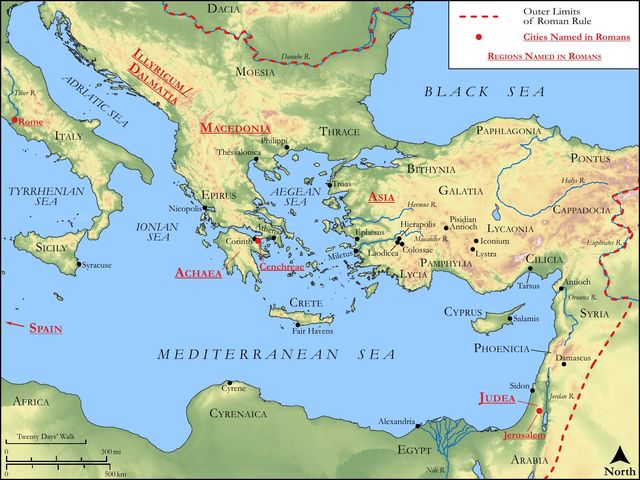
See on the biblical-era maps

Study this verse
Public-domain commentary
Matthew Henry
From his Commentary on the Whole Bible. Henry comments on passages, not single verses — this entry covers Romans 16:1–16. His three-level outline is real structure in the source text, so it is rendered as structure.
Such remembrances as these are usual in letters between friends; and yet Paul, by the savouriness of his expressions, sanctifies these common compliments.
I.Here is the recommendation of a friend, by whom (as some think) this epistle was sent - one Phebe, Rom 16:1, Rom 16:2.
It should seem that she was a person of quality and estate, who had business which called her to Rome, where she was a stranger; and therefore Paul recommends her to the acquaintance of the Christians there: an expression of his true friendship to her. Paul was as well skilled in the art of obliging as most men. True religion, rightly received, never made any man uncivil. Courtesy and Christianity agree well together. It is not in compliment to her, but in sincerity, that,
1.He gives a very good character of her.
(1.)As a sister to Paul: Phebe our sister; not in nature, but in grace; not in affinity or consanguinity, but in pure Christianity: his own sister in the faith of Christ, loving Paul, and beloved of him, with a pure and chaste and spiritual love, as a sister; for there is neither male nor female, but all are one in Christ Jesus, Gal 3:28. Both Christ and his apostles had some of their best friends among the devout (and upon that account honourable) women.
(2.)As a servant to the church at Cenchrea: diakonon, a servant by office, a stated servant, not to preach the word (that was forbidden to women), but in acts of charity and hospitality. Some think she was one of the widows that ministered to the sick and were taken into the church's number, Ti1 5:9. But those were old and poor, whereas Phebe seems to have been a person of some account; and yet it was no disparagement to her to be a servant to the church. Probably they used to meet at her house, and she undertook the care of entertaining the ministers, especially strangers. Every one in his place should strive to serve the church, for therein he serves Christ, and it will turn to a good account another day. Cenchrea was a small sea-port town adjoining to Corinth, about twelve furlongs distant. Some think there was a church there, distinct from that at Corinth, though, being so near, it is very probable that the church of Corinth is called the church of Cenchrea, because their place of meeting might be there, on account of the great opposition to them in the city (Act 18:12), as at Philippi they met out of the city by the water-side, Act 16:13. So the reformed church of Paris might be called the church at Charenton, where they formerly met, out of the city.
(3.)As a succourer of many, and particularly of Paul, Rom 16:2. She relieved many that were in want and distress - a good copy for women to write after that have ability. she was kind to those that needed kindness, intimated in her succouring them; and her bounty was extensive, she was a succourer of many. Observe the gratitude of Paul in mentioning her particular kindness to him: And to myself also. Acknowledgment of favours is the least return we can make. It was much to her honour that Paul left this upon record; for wherever this epistle is read her kindness to Paul is told for a memorial of her.
2.He recommends her to their care and kindness, as one worthy to be taken notice of with peculiar respect. (1.) "Receive her in the Lord. Entertain her; bid her welcome." This pass, under Paul's hand, could not but recommend her to any Christian church. "Receive her in the Lord," that is, "for the Lord's sake; receive her as a servant and friend of Christ." As it becometh saints to receive, who love Christ, and therefore love all that are his for his sake; or, as becometh saints to be received, with love and honour and the tenderest affection. There may be occasion sometimes to improve our interest in our friends, not only for ourselves, but for others also, interest being a price in the hand for doing good. (2.) Assist her in whatsoever business she has need of you. Whether she had business of trade, or law-business at the court, is not material; however being a woman, a stranger, a Christian, she had need of help: and Paul engaged them to be assistant to her. It becomes Christians to be helpful one to another in their affairs, especially to be helpful to strangers; for we are members one of another and we know not what need of help we may have ourselves. Observe, Paul bespeaks help for one that had been so helpful to many; he that watereth shall be watered also himself.
II.Here are commendations to some particular friends among those to whom he wrote, more than in any other of the epistles.
Though the care of all the churches came upon Paul daily, enough to distract an ordinary head, yet he could retain the remembrance of so many; and his heart was so full of love and affection as to send salutations to each of them with particular characters of them, and expressions of love to them and concern for them. Greet them, salute them; it is the same word, aspasasthe. "Let them know that I remember them, and love them, and wish them well." There is something observable in several of these salutations.
1.Concerning Aquila and Priscilla, a famous couple, that Paul had a special kindness for. They were originally of Rome, but were banished thence by the edict of Claudius, Act 18:2. At Corinth, Paul became acquainted with them, wrought with them at the trade of tent-making; after some time, when the edge of that edict was rebated, they returned to Rome, and thither he now sends commendations to them. He calls them his helpers in Christ Jesus, by private instructions and converse furthering the success of Paul's public preaching, one instance of which we have in their instructing Apollos, Act 18:26. Those are helpers to faithful ministers that lay out themselves in their families and among their neighbours to do good to souls. Nay, they did not only do much, but they ventured much, for Paul: They have for my life laid down their own necks. They exposed themselves to secure Paul, hazarded their own lives for the preservation of his, considering how much better they might be spared than he. Paul was in a great deal of danger at Corinth, while he sojourned with them; but they sheltered him, though they thereby made themselves obnoxious to the enraged multitudes, Act 18:12, Act 18:17. It was a good while ago that they had done Paul this kindness; and yet he speaks as feelingly of it as if it had been but yesterday. To whom (says he) not only I give thanks, but also all the churches of the Gentiles; who were all beholden to these good people for helping to save the life of him that was the apostle of the Gentiles. Paul mentions this, to engage the Christians at Rome to be the more kind to Aquila and Priscilla. He sends likewise greeting to the church in their house, Rom 16:5. It seems then, a church in a house is no such absurd thing as some make it to be. Perhaps there was a congregation of Christians that used to meet at their house at stated times; and then, no doubt, it was, like the house of Obed-Edom, blessed for the ark's sake. Others think that the church was no more than a religious, pious, well-governed family, that kept up the worship of God. Religion, in the power of it, reigning in a family, will turn a house into a church. And doubtless it had a good influence upon this that Priscilla the good wife of the family was so very eminent and forward in religion, so eminent that she is often named first. A virtuous woman, that looks well to the ways of her household, may do much towards the advancement of religion in a family. When Priscilla and Aquila were at Ephesus, though but sojourners there, yet there also they had a church in their house, Co1 16:19. A truly godly man will be careful to take religion along with him wherever he goes. When Abraham removed his tent, he renewed his altar, Gen 13:18.
2.Concerning Epenetus, Rom 16:5. He calls him his well-beloved. Where the law of love is in the heart the law of kindness will be in the tongue. Endearing language should pass among Christians to express love, and to engage love. So he calls Amplias, beloved in the Lord, with true Christian love for Christ's sake; and Stachys, his beloved: a sign that Paul had been in the third heaven, he was so much made up of love. Of Epenetus it is further said that he was the first-fruit of Achaia unto Christ; not only one of the most eminent believers in that country, but one of the first that was converted to the faith of Christ: one that was offered up to God by Paul, as the first-fruits of his ministry there; an earnest of a great harvest; for in Corinth, the chief city of Achaia, God had much people, Act 18:10. Special respect is to be paid to those that set out early, and come to work in the vineyard at the first hour, at the first call. The household of Stephanas is likewise said to be the first-fruits of Achaia, Co1 16:15. Perhaps Epenetus was one of that household; or, at least, he was one of the first three; not the first alone, but one of the first fleece of Christians, that the region of Achaia afforded.
3.Concerning Mary, and some others who were laborious in that which is good, industrious Christians: Mary, who bestowed much labour on us. True love never sticks at labour, but rather takes a pleasure in it; where there is much love there will be much labour. Some think this Mary had been at some of those places where Paul was, though now removed to Rome, and had personally ministered to him; others think Paul speaks of her labour as bestowed upon him because it was bestowed upon his friends and fellow-labourers, and he took what was done to them as done to himself. He says of Tryphena and Tryphosa, two useful women in their places, that they laboured in the Lord (Rom 16:12), and of the beloved Persis, another good woman, that she laboured much in the Lord, more than others, abounding more in the work of the Lord.
4.Concerning Andronicus and Junia, Rom 16:7. Some take them for a man and his wife, and the original will well enough bear it; and, considering the name of the latter, this is more probable than that they should be two men, as others think, and brethren. Observe,
(1.)They were Paul's cousins, akin to him; so was Herodion, Rom 16:11. Religion does not take away, but rectifies, sanctifies, and improves, our respect to our kindred, engaging us to lay out ourselves most for their good, and to rejoice in them the more, when we find them related to Christ by faith.
(2.)They were his fellow-prisoners. Partnership in suffering sometimes does much towards the union of souls and the knitting of affections. We do not find in the story of the Acts any imprisonment of Paul before the writing of this epistle, but that at Philippi, Act 16:23. But Paul was in prisons more frequent (Co2 11:23), in some of which, it seems, he met with his friends Andronicus and Junia, yoke-fellows, as in other things, so in suffering for Christ and bearing his yoke.
(3.)They were of note among the apostles, not so much perhaps because they were persons of estate and quality in the world as because they were eminent for knowledge, and gifts, and graces, which made them famous among the apostles, who were competent judges of those things, and were endued with a spirit of discerning not only the sincerity, but the eminency, of Christians.
(4.)Who also were in Christ before me, that is, were converted to the Christian faith. In time they had the start of Paul, though he was converted the next year after Christ's ascension. How ready was Paul to acknowledge in others any kind of precedency!
5.Concerning Apelles, who is here said to be approved in Christ (Rom 16:10), a high character! He was one of known integrity and sincerity in his religion, one that had been tried; his friends and enemies had tried him, and he was as gold. he was of approved knowledge and judgment, approved courage and constancy; a man that one might trust and repose a confidence in.
6.Concerning Aristobulus and Narcissus; notice is taken of their household, Rom 16:10, Rom 16:11. Those of their household who are in the Lord (as it is limited, Rom 16:11), that were Christians. How studious was Paul to leave none out of his salutations that he had any knowledge of or acquaintance with! Aristobulus and Narcissus themselves, some think, were absent, or lately dead; others think they were unbelievers, and such as did not themselves embrace Christianity; so Pareus: and some think this Narcissus was the same with one of that name who is frequently mentioned in the life of Claudius, as a very rich man that had a great family, but was very wicked and mischievous. It seems, then, there were some good servants, or other retainers, even in the family of a wicked man, a common case, Ti1 6:1. Compare Ti1 6:2. The poor servant is called, and chosen, and faithful, while the rich master is passed by, and left to perish in unbelief. Even so, Father, because it seemed good unto thee.
7.Concerning Rufus (Rom 16:13), chosen in the Lord. He was a choice Christian, whose gifts and graces evinced that he was eternally chosen in Christ Jesus. He was one of a thousand for integrity and holiness. - And his mother and mine, his mother by nature and mine by Christian love and spiritual affection; as he calls Phebe his sister, and teaches Timothy to treat the elder women as mothers, Ti1 5:2. This good woman, upon some occasion or other, had been as a mother to Paul, in caring for him, and comforting him; and Paul here gratefully owns it, and calls her mother.
8.Concerning the rest this is observable, that he salutes the brethren who are with them (Rom 16:14), and the saints who are with them (Rom 16:15), with them in family-relations, with them in the bond of Christian communion. It is the good property of saints to delight in being together; and Paul thus joins them together in his salutations to endear them one to another. Lest any should find themselves aggrieved, as if Paul had forgotten them, he concludes with the remembrance of the rest, as brethren and saints, though not named. In Christian congregations there should be smaller societies linked together in love and converse, and taking opportunities of being often together. Among all those to whom Paul sends greeting here is not a word of Peter, which gives occasion to suspect that he was not bishop of Rome, as the Papists say he was; for, if he was, we cannot but suppose him resident, or at least how could Paul write so long an epistle to the Christians there, and take no notice of him?
Lastly, He concludes with the recommendation of them to the love and embraces one of another: Salute one another with a holy kiss. Mutual salutations, as they express love, so they increase and strengthen love, and endear Christians one to another: therefore Paul here encourages the use of them, and only directs that they may be holy - a chaste kiss, in opposition to that which is wanton and lascivious; a sincere kiss, in opposition to that which is treacherous and dissembling, as Judas's, when he betrayed Christ with a kiss. He adds, in the close, a general salutation to them all, in the name of the churches of Christ (Rom 16:16): "The churches of Christ salute you; that is, the churches which I am with, and which I am accustomed to visit personally, as knit together in the bonds of the common Christianity, desire me to testify their affection to you and good wishes for you." This is one way of maintaining the communion of saints.
Historical interpretation
Historical reception
4 surviving comments on this verse. Each one is dated, so this reads as a timeline rather than a list.
Select a marker to jump to its quote. Markers stagger vertically where authors wrote within a few decades of each other.
These were Jews who, after they believed, became coworkers with the apostle because they had believed correctly and were thus able to persuade others to accept the right faith. Apollos, for example, although he was learned in the Scriptures, was nevertheless taught the way of the Lord more correctly by them. This is why Paul calls them his fellow workers “in Christ Jesus.”
"Greet Priscilla and Aquila, my helpers in Christ Jesus."
To the excellence of these St. Luke also bears witness. Partly when he says that Paul "abode with them, for by their occupation they were tent-makers"; and partly when he points out the woman as receiving Apollos, and instructing him in the way of the Lord. Now these are great things, but what Paul mentions are greater. And what does he mention? In the first place he calls them "helpers," to point out that they had been sharers of his very great labors and dangers. Then he says,
"Who for my life have laid down their own necks."
You see they are thoroughly furnished martyrs. For in Nero's time it is probable that there were thousands of dangers, at the time as he even commanded all Jews to be removed from Rome.
"Unto whom not only I give thanks, but also all the Churches of the Gentiles."
Here he hints at their hospitality, and pecuniary assistance, holding them in admiration because they had both poured forth their blood, and had made their whole property open to all. You see these were noble women, hindered no way by their sex in the course of virtue. And this is as might be expected. "For in Christ Jesus there is neither male nor female." And what he had said of the former, that he said also of this. For of her also he had said, "she hath been a succorer of many, and of myself also." So too of this woman "not only I give thanks, but also all the Churches of the Gentiles." Now that in this he might not seem to be a flatterer, he also adduces a good many more witnesses to these women.
They are said to have established Apollos in the faith. Paul calls them helpers because they helped him in his work of instruction.
Paul adds “in Christ Jesus” to show that Prisca (or Priscilla; both forms are found in the manuscripts) and Aquila were not merely Paul’s hosts but that they were fellow evangelists as well.
Continue studying Romans 16:3 across the web’s major study libraries — every link below opens this exact verse, chapter, or book on the destination site.
Read & Compare
 BibleGatewayThis verse in more than 200 translations and 70 languages.
 Bible.comThe YouVersion reader — hundreds of translations, reading plans, and highlights.
 ESV.orgCrossway's official English Standard Version reader.
 NET BibleThe NET translation with 60,000+ translators' notes on every rendering decision.
 STEP BibleTyndale House's free study tool — original text, vocabulary, and scholarly resources.
 BibliaLogos Bible Software's free web reader.
 USCCBThe New American Bible (Revised Edition) with the U.S. bishops' study notes.
Commentaries
 BibleHub CommentariesDozens of classic commentaries on this verse, gathered on one page.
 StudyLightMore than 100 commentary sets — the largest collection on the web.
 BibleRefPlain-English commentary on what this verse means, verse by verse.
 Enduring WordDavid Guzik's free commentary on this chapter, widely used by Bible teachers.
 Bible Study ToolsVerse commentary alongside Greek and Hebrew study aids.
Original Language & Research
- BibleHub InterlinearThe verse word by word — original language, transliteration, and English.
- BibleHub LexiconEvery word's original-language definition and Strong's entry.
 Blue Letter BibleDeep-study tools — Strong's numbers, concordance, and word studies.
 CNTR CollationThe earliest Greek manuscripts of this verse, collated letter by letter.
Sermons, Hymns & Audio


TrulyRandomVerse is not affiliated with these sites and doesn’t control their content. They’re linked because they’re genuinely useful.
Summary
In Romans 16:3, the Apostle Paul initiates his extensive list of personal greetings to the believers in Rome by specifically acknowledging Priscilla and Aquila, a prominent and highly esteemed couple. He identifies them as his "helpers in Christ Jesus," immediately underscoring their profound partnership in ministry and their indispensable role in the advancement of the Gospel, setting a tone of deep appreciation for co-laborers in the faith.
Context
ShowHideLiterary Context
Romans 16 serves as the concluding chapter of Paul's magnum opus, following a comprehensive theological treatise on justification by faith, the nature of Israel's salvation, and practical exhortations for Christian living. After establishing foundational doctrines and ethical principles in chapters 1-15, Paul transitions to a series of personal greetings and commendations. This shift from theological exposition to personal connection highlights the communal and relational nature of the early church. By naming specific individuals like Priscilla and Aquila at the very beginning of this list, Paul emphasizes the vital role of individual believers and their collaborative efforts in the church's mission, reinforcing that the grand theological truths he has expounded are lived out in the daily, sacrificial service of ordinary people.
Historical & Cultural Context
Priscilla and Aquila were a Jewish Christian couple, originally from Rome, who had been expelled along with other Jews by Emperor Claudius's edict around 49 AD (as referenced in Acts 18:2). They met Paul in Corinth, where they shared the same trade of tentmaking, forging a deep bond of fellowship and ministry. Their mobility (from Rome to Corinth, then to Ephesus with Paul, and eventually back to Rome) was characteristic of many early Christians, who often traveled for trade or due to persecution, spreading the Gospel as they went. The mention of a "church in their house" (implied by their prominent role and later explicit in 1 Corinthians 16:19 and Romans 16:5) reflects the common practice of early Christian communities gathering in private homes before dedicated church buildings existed, making hospitality a crucial aspect of ministry.
Key Themes
ShowHideThis verse, and indeed the entire chapter, contributes to several key themes within Romans and Paul's broader theology. Firstly, it highlights the importance of Christian community and partnership in ministry. Paul's extensive list of greetings underscores the interconnectedness of believers across geographical distances and the necessity of mutual support and co-laboring for the Gospel's advance. Secondly, it subtly emphasizes the role of women in early Christian leadership and ministry, as Priscilla is often mentioned before her husband, Aquila, indicating her significant standing and perhaps even her greater theological insight, as seen in their joint instruction of Apollos in Acts 18:26. Thirdly, the verse points to the theme of dedicated service and sacrifice, as the couple's willingness to travel, host churches, and even risk their lives (as explicitly stated in Romans 16:4) exemplifies the cost of discipleship and commitment to Christ.
Exposition and Analysis
ShowHideKey Word Analysis
ShowHideThis verb means "to enfold in the arms," and by implication, "to salute" or "to welcome." It conveys a sense of warm affection, respect, and personal connection. Paul's use of this word indicates a genuine, heartfelt desire for the Roman believers to extend a specific welcome and acknowledgment to Priscilla and Aquila, reflecting the deep bond of fellowship that characterized the early Christian community.
Derived from a compound meaning "with" (σύν) and "work" (ἔργον), this term literally means "co-laborer" or "fellow worker." It signifies active participation and partnership in a shared task. Paul's designation of Priscilla and Aquila as "helpers" is not merely a polite commendation but a theological statement about their indispensable role in his missionary endeavors. They were not passive supporters but active participants, working alongside him in spreading the Gospel and building up the church.
This primary preposition denotes "fixed position" (in place, time, or state) and "instrumentality." In the phrase "in Christ Jesus," it signifies the sphere or realm of their ministry and identity. Their work was not merely human effort but was rooted in, empowered by, and directed towards Christ Jesus. It speaks to the spiritual reality and divine enablement of their partnership, emphasizing that their effectiveness stemmed from their union with Christ.
Verse Breakdown
ShowHide"Greet Priscilla and Aquila"
Paul begins with a direct imperative, instructing the Roman church to extend a specific greeting to this couple. The fact that they are named first among a long list of individuals underscores their prominence and Paul's deep affection and respect for them. The order, with Priscilla often mentioned before Aquila, is notable in a patriarchal society and may suggest Priscilla's particular leadership or theological acumen within their shared ministry.
"my helpers"
This phrase reveals the nature of their relationship with Paul. They were not merely acquaintances but active partners in his missionary work. The term "helpers" (synergoi) implies a shared burden, a collaborative effort, and a mutual commitment to the same divine mission. It highlights the communal aspect of early Christian ministry, where individuals, regardless of formal titles, contributed significantly to the Gospel's advance.
"in Christ Jesus"
This crucial phrase defines the sphere and source of their partnership. Their collaboration was not simply a human alliance but was rooted in their shared identity and union with Christ. It signifies that their work was empowered by Christ, directed by Christ, and ultimately for the glory of Christ. Their effectiveness as "helpers" flowed from their spiritual position "in Christ," making their ministry fundamentally a spiritual endeavor.
Literary Devices
ShowHideThe verse employs several subtle but significant Literary Devices. The most prominent is Appellation, as Paul directly names and identifies Priscilla and Aquila, immediately establishing their importance and personal connection. The use of the term "helpers" functions as a form of Epithet, a descriptive phrase that characterizes the couple's essential role and relationship with Paul, immediately conveying their active participation in ministry. Furthermore, the phrase "in Christ Jesus" serves as a powerful Prepositional Phrase that defines the spiritual context and authority of their work, grounding their human efforts in a divine reality. This concise phrasing effectively communicates Paul's deep respect, the nature of their partnership, and the spiritual foundation of their shared mission.
Theological and Thematic Connections
ShowHideRomans 16:3 powerfully illustrates the New Testament emphasis on partnership in ministry, demonstrating that the advancement of God's kingdom is a collaborative effort, not solely dependent on a few prominent figures. Priscilla and Aquila embody the truth that all believers, regardless of their background or formal roles, are called to be active participants in the mission of Christ. Their example highlights the value of faithful, often behind-the-scenes, service and the crucial role of hospitality and community-building in the early church. Their partnership with Paul, and with each other, serves as a model for how believers are to co-labor, supporting and empowering one another for the sake of the Gospel.
Reflection and Application
ShowHidePaul's commendation of Priscilla and Aquila in Romans 16:3 serves as a profound reminder that Christian ministry is fundamentally a collaborative endeavor, thriving on the faithful contributions of every member of the body of Christ. It challenges us to look beyond hierarchical structures and recognize the invaluable work of those who serve diligently, often without public recognition, yet are indispensable "helpers in Christ Jesus." This verse encourages us to cultivate a spirit of appreciation and affirmation for our fellow believers, acknowledging their unique gifts and the ways they contribute to the Kingdom. It also prompts us to consider our own roles: Are we actively seeking to be "helpers" to others in ministry, using our homes, resources, and spiritual gifts to foster community and advance the Gospel? The example of Priscilla and Aquila calls us to a life of humble, dedicated, and sacrificial partnership, recognizing that our ultimate effectiveness flows from our shared identity and mission "in Christ Jesus."
Questions for Reflection
ShowHideFAQ
ShowHideWhy are Priscilla and Aquila mentioned first in Paul's greetings?
ShowHidePriscilla and Aquila are mentioned first due to their significant standing and close relationship with Paul, indicating their prominence and the high regard in which Paul held them. They were not only personal friends but also indispensable "helpers" or co-laborers in his missionary work. Their home often served as a meeting place for the church (as seen in Romans 16:5 and 1 Corinthians 16:19), and they had even risked their lives for Paul (as stated in Romans 16:4). Their consistent dedication and active partnership made them exemplary figures in the early Christian community, warranting Paul's immediate and heartfelt commendation.
Christ-Centered Fulfillment
ShowHideRomans 16:3, in its commendation of Priscilla and Aquila as "helpers in Christ Jesus," subtly points to the ultimate Helper and the very source of all Christian ministry: Jesus Christ Himself. Just as Priscilla and Aquila were co-laborers with Paul, believers are called to be co-laborers with Christ, participating in His ongoing redemptive work in the world. The phrase "in Christ Jesus" is profoundly significant, echoing the New Testament's consistent emphasis on the believer's union with Christ. Our ability to serve, to love, and to be "helpers" for the Gospel is not from our own strength but flows directly from our spiritual position "in Him," as Paul frequently articulates (e.g., Ephesians 2:10, Philippians 4:13). Christ is the Head of the Church, the one who builds His church (Matthew 16:18), and He empowers His followers through the Holy Spirit to be His witnesses and fellow workers (Acts 1:8). Thus, Priscilla and Aquila's faithful service is a beautiful illustration of lives yielded to and empowered by the Risen Christ, fulfilling His Great Commission and demonstrating the communal nature of His Kingdom.