


Genesis 13:18
- וַיֶּאֱהַלvai·ye·'e·Haland he moved tentH167Conj-w ¦ V-Qal-ConsecImperf-3msVerb Qal Consecutive Imperfect 3rd Singular Masculineוַandיֶּאֱהַלhe moved tent
- אַבְרָם'av·RamAbramH87N-proper-mNoun Proper Masculine
- וַיָּבֹאvai·ya·Vo'and he wentH935Conj-w ¦ V-Qal-ConsecImperf-3msVerb Qal Consecutive Imperfect 3rd Singular Masculineוַandיָּבֹאhe went
- וַיֵּשֶׁבvai·Ye·shevand he dweltH3427Conj-w ¦ V-Qal-ConsecImperf-3msVerb Qal Consecutive Imperfect 3rd Singular Masculineוַandיֵּשֶׁבhe dwelt
- בְּאֵלֹנֵיbe·'e·lo·Neiat [the] great trees ofH436Prep-b ¦ N-mpcNoun Plural Masculine Constructבְּatאֵלֹנֵי[the] great trees of
- מַמְרֵאmam·Re'MamreH4471N-proper-mNoun Proper Masculine
- אֲשֶׁר'a·SherwhichH834RelParticle Relative
- בְּחֶבְרוֹןbe·chev·Ron[are] at HebronH2275Prep-b ¦ N-properNoun Proper Locationבְּ[are] atחֶבְרוֹןHebron
- וַיִּבֶןvai·yi·venand he builtH1129Conj-w ¦ V-Qal-ConsecImperf-3msVerb Qal Consecutive Imperfect 3rd Singular Masculineוַandיִּבֶןhe built
- שָׁםshamthereH8033AdvAdverb
- מִזְבֵּחַmiz·Be·achan altarH4196N-msNoun Singular Masculine Absolute
- לַיהוָהla·Yah·wehto YahwehH3068Prep-l ¦ N-properNoun Proper TitleלַtoיהוָהYahweh
English is a literal word-by-word gloss of the Hebrew, not the KJV's wording. Why?
This is the original text the KJV's translators worked from — each Hebrew word with its own literal English meaning in this verse, prepared by scholars at Tyndale House, Cambridge. The KJV translates whole sentences, not word by word, so its wording differs: one Hebrew word can become several English words, and the KJV may choose “the LORD” where the gloss reads “Yahweh”. Both are faithful — they answer different questions. For the KJV's own rendering, switch to the KJV text.
Details
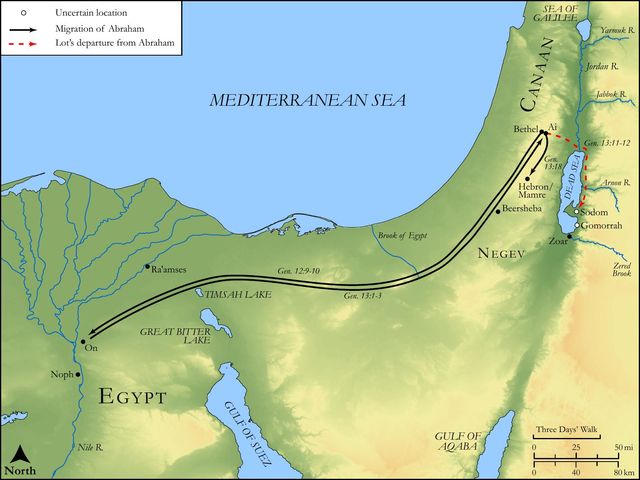
See on the biblical-era map


Study this verse
Public-domain commentary
Matthew Henry
From his Commentary on the Whole Bible. Henry comments on passages, not single verses — this entry covers Genesis 13:14–18. His three-level outline is real structure in the source text, so it is rendered as structure.
We have here an account of a gracious visit which God paid to Abram, to confirm the promise to him and his. Observe,
I.When it was that God renewed and ratified the promise: After that Lot was separated from him, that is,
1.After the quarrel was over; for those are best prepared for the visits of divine grace whose spirits are calm and sedate, and not ruffled with any passion.
2.After Abram's humble self-denying condescensions to Lot for the preserving of peace. It was then that God came to him with this token of his favour. Note, God will abundantly make up in spiritual peace what we lose for the preservation of neighbourly peace. When Abram had willingly offered Lot one-half of his right, God came, and confirmed the whole to him.
3.After he had lost the comfortable society of his kinsman, by whose departure his hands were weakened and his heart was saddened, then God came to him with these good words and comfortable words. Note, Communion with God may, at any time, serve to make up the want of conversation with our friends; when our relations are separated from us, yet God is not.
4.After Lot had chosen that pleasant fruitful vale, and had gone to take possession of it, lest Abram should be tempted to envy him and to repent that he had given him the choice, God comes to him, and assures him that what he had should remain to him and his heirs for ever; so that, though Lot perhaps had the better land, yet Abram had the better title. Lot had the paradise, such as it was, but Abram had the promise; and the event soon made it appear that, however it seemed now, Abram had really the better part. See Job 22:20. God owned Abram after his strife with Lot, as the churches owned Paul after his strife with Barnabas, Act 15:39, Act 15:40.
II.The promises themselves with which God now comforted and enriched Abram. Two things he assures him of - a good land, and a numerous issue to enjoy it.
1.Here is the grant of a good land, a land famous above all lands, for it was to be the holy land, and Immanuel's land; this is the land here spoken of.
(1.)God here shows Abram the land, as he had promised (Gen 12:1), and afterwards he showed it to Moses from the top of Pisgah. Lot had lifted up his eyes and beheld the plain of Jordan (Gen 13:10), and he had gone to enjoy what he saw: "Come," says God to Abram, "now lift thou up thy eyes, and look, and see thy own." Note, That which God has to show us is infinitely better and more desirable than any thing that the world has to offer our view. The prospects of an eye of faith are much more rich and beautiful than those of an eye of sense. Those for whom the heavenly Canaan is designed in the other world have sometimes, by faith, a comfortable prospect of it in their present state; for we look at the things that are not seen, as real, though distant.
(2.)He secures this land to him and his seed for ever (Gen 13:15): To thee will I give it; and again (Gen 13:17) I will give it unto thee; every repetition of the promise is a ratification of it. To thee and thy seed, not to Lot and his seed; they were not to have their inheritance in this land, and therefore Providence so ordered it that Lot should be separated from Abram first, and then the grant should be confirmed to him and his seed. Thus God often brings good out of evil, and makes men's sins and follies subservient to his own wise and holy counsels. To thee and thy seed - to thee to sojourn in as a stranger, to thy seed to dwell and rule in as proprietors. To thee, that is, to thy seed. The granting of it to him and his for ever intimates that it was typical of the heavenly Canaan, which is given to the spiritual seed of Abram for ever, Heb 11:14.
(3.)He gives him livery and seisin of it, though it was a reversion: "Arise, walk through the land, Gen 13:17. Enter, and take possession, survey the parcels, and it will appear better than upon a distant prospect." Note, God is willing more abundantly to show to the heirs of promise the immutability of his covenant, and the inestimable worth of covenant blessings. Go, walk about Sion, Psa 48:12.
2.Here is the promise of a numerous issue to replenish this good land, so that it should never be lost for want of heirs (Gen 13:16): I will make thy seed as the dust of the earth, that is, "They shall increase incredibly, and, take them altogether, they shall be such a great multitude as no man can number." They were so in Solomon's time, Kg1 4:20, Judah and Israel were many as the sand which is by the sea in multitude. This God here gives him the promise of. Note, The same God that provides the inheritance provides the heirs. He that has prepared the holy land prepares the holy seed; he that gives glory gives grace to make meet for glory.
Lastly, We are told what Abram did when God had thus confirmed the promise to him, Gen 13:18. 1. He removed his tent. God bade him walk through the land, that is, "Do not think of fixing in it, but expect to be always unsettled, and walking through it to a better Canaan:" in compliance with God's will herein, he removes his tent, confirming himself to the condition of a pilgrim. 2. He built there an altar, in token of his thankfulness to God for the kind visit he had paid him. Note, When God meets us with gracious promises, he expects that we should attend him with our humble praises.
Historical interpretation
Three Centuries of Reception
3 surviving comments on this verse. Each one is dated, so this reads as a timeline rather than a list.
Select a marker to jump to its quote. Markers stagger vertically where authors wrote within a few decades of each other.
Wonderful the extent of the promise; remarkable the depth of generosity of the Lord of us all; extraordinary the degree of the reward conferred by him in his mercy and love on this blessed man and on the descendants destined to be born to him! Hearing this, and amazed at God’s unspeakable goodness, the patriarch “struck camp and moved on until settling at the oak of Mamre, which is at Hebron.” After accepting the promise … and following Lot’s parting, he changed his campsite to the vicinity of the oak of Mamre. Notice his sensible attitude, his high sense of responsibility in effecting the transfer with ease and making no difficulty of changing from place to place. You will not find him shackled and hidebound by any custom, something that frequently affects a great number of people, even those considered wise and those generally free of concerns. If the occasion should require them to change and move in a different direction, even in many cases for a spiritual matter, you would find many of them troubled, beside themselves, regretting the change on account of their being prisoners of habit. The just man, on the other hand, wasn’t like that. He showed good sense from the very outset. Like a stranger or a pilgrim he moved from here to there and from there to the next place. And in all cases his concern was to give evidence of his God-fearing attitude in his actions.
Moving therefore Abram his tent, he came and dwelt by the valley of Mamre, which is in Hebron. Hebron is a city situated about twenty-two miles south of Jerusalem, which in the times of Moses was called Arbe or Kiriath-Arba, that is, the city of the Four, because there three patriarchs—Abraham, Isaac, and Jacob—are buried, and Adam the first man, as it is written in the book of Joshua. Later, Hebron received its name from one of the sons of Caleb, as the Words of the days recount. If anyone is moved by how it is now called by this name even before the times of the sons, let him understand that it could have been added in this place by Ezra the priest when he was renewing the sacred Scripture, which had been burned by the Chaldeans, as many such things added by him are found by those skilled in the sacred writings.
And he built an altar to the Lord. And this is the third altar that Abraham built: for the first he built near the place of Shechem, the second between Bethel and Ai. In all of these, it should be noted that nowhere is a sacrifice offered by him, but only the invocation of the name of the Lord is recorded in Scripture; nor in the following Scriptures is it found that he offered any victim or sacrifice to God, except for one ram, which he offered as a burnt offering to the Lord in place of his son, in which the passion of the Mediator between God and men is most clearly figured. Nor is it read that Isaac, his son, offered any victim to God, but only built an altar to the Lord. Similarly, Jacob, though he made an altar at the Lord's command, is not found to have slain any victims, except when, leaving the land of promise, he was about to enter Egypt because of Joseph. Then indeed, arriving in Beersheba, having slain victims there, he is reported to have received a divine oracle; but there both the species and the number of the victims are omitted: nor is any sacrifice offered to God by the fathers found from then until the time of the Passover which was sacrificed in Egypt with the blood of the lamb. Why is it, then, that from the time the promise was made to Abraham until the time the law was given, no victims were offered, except for only one, which the father sacrificed in place of his son in the figure of God the Father, who did not spare his own Son but delivered him up for us all, and that afterward, in the law, such an abundance of victims did not cease to be offered daily, except because it was clearly foreshadowed that the grace and truth promised to Abraham and his seed were to be given to the world not through the offerings of victims, but through the passion of Christ? By whose faith and sacraments of the passion not only we but also those righteous ones who preceded the times of his passion were saved. And this figure is supported by the fact that Melchizedek, the priest of God Most High, who was in the times of the patriarchs, is read to have offered not the blood of victims but bread and wine to the Lord, and to have presented not the form of the legal priesthood, but of the evangelical: who also blessed Abraham himself, to whom and in whom the blessing of all nations was promised, so that it was evident through all things that the promise given to the fathers was to be fulfilled not through the ceremonies of the Mosaic law, but through the grace of the Lord's passion.
Continue studying Genesis 13:18 across the web’s major study libraries — every link below opens this exact verse, chapter, or book on the destination site.
Read & Compare
 BibleGatewayThis verse in more than 200 translations and 70 languages.
 Bible.comThe YouVersion reader — hundreds of translations, reading plans, and highlights.
 ESV.orgCrossway's official English Standard Version reader.
 NET BibleThe NET translation with 60,000+ translators' notes on every rendering decision.
 STEP BibleTyndale House's free study tool — original text, vocabulary, and scholarly resources.
 BibliaLogos Bible Software's free web reader.
 USCCBThe New American Bible (Revised Edition) with the U.S. bishops' study notes.
Commentaries
 BibleHub CommentariesDozens of classic commentaries on this verse, gathered on one page.
 StudyLightMore than 100 commentary sets — the largest collection on the web.
 BibleRefPlain-English commentary on what this verse means, verse by verse.
 Enduring WordDavid Guzik's free commentary on this chapter, widely used by Bible teachers.
 Bible Study ToolsVerse commentary alongside Greek and Hebrew study aids.
Original Language & Research
- BibleHub InterlinearThe verse word by word — original language, transliteration, and English.
- BibleHub LexiconEvery word's original-language definition and Strong's entry.
 Blue Letter BibleDeep-study tools — Strong's numbers, concordance, and word studies.
 SefariaThe Hebrew text with Rashi and centuries of Jewish commentary.
Sermons, Hymns & Audio


TrulyRandomVerse is not affiliated with these sites and doesn’t control their content. They’re linked because they’re genuinely useful.
Summary
Genesis 13:18 meticulously details Abram's faithful relocation to the fertile region of Mamre near Hebron, a move directly following God's profound reaffirmation of His covenant promises regarding land and descendants. This verse culminates in Abram's construction of an altar to the LORD, an act that profoundly signifies his unwavering worship, deep dedication, and steadfast trust in divine provision and covenantal faithfulness amidst his nomadic journey through the promised land.
Context
ShowHideLiterary Context
This verse immediately follows the pivotal separation of Abram and Lot, a narrative that resolves the conflict arising from their burgeoning wealth and limited land resources. After Lot chose the well-watered Jordan Valley, seemingly the more prosperous option, God graciously intervened to reaffirm His covenant with Abram. Genesis 13:14-17 records God's expansive promise to Abram, showing him all the land from north to south, east to west, and guaranteeing innumerable descendants. Abram's response in Genesis 13:18 is therefore an act of immediate, faithful obedience and worship, establishing his presence in the very land God had just promised him, contrasting sharply with Lot's worldly choice.
Historical & Cultural Context
Abram's life was characterized by a nomadic existence, typical of patriarchs in the ancient Near East. Their "tents" were portable dwellings, signifying a transient lifestyle, yet their movements were often strategic, seeking pasturage for their flocks. The building of altars was a common practice, serving as physical markers of significant encounters with deity, places for sacrifice, and public declarations of worship and allegiance. Hebron, known as Kirjath-arba in older times, was an ancient city, strategically located in the Judean hills. Its association with Mamre, an Amorite chief and later an ally of Abram (Genesis 14:13), highlights the complex social and political landscape of the time, where alliances and local customs played a significant role in a patriarch's ability to settle and thrive.
Key Themes
ShowHideGenesis 13:18 powerfully reinforces several overarching themes within the book of Genesis and the broader Pentateuch. The theme of Divine Promise and Covenant is central, as Abram's move is a direct response to God's renewed oath of land and progeny, underscoring the unilateral nature of God's commitment. This verse also highlights Faithful Obedience, as Abram's immediate action of relocating and worshipping demonstrates his trust in God's word over perceived worldly advantages. The recurring theme of Worship and Altar Building establishes a pattern of spiritual devotion as the appropriate response to divine revelation, beginning with Abram's first altar in Shechem and continuing throughout his journey. Furthermore, the establishment of Abram's dwelling in Hebron foreshadows its future Covenantal Significance as a burial place for the patriarchs and a key location in Israel's history, as seen in Genesis 23.
Exposition and Analysis
ShowHideKey Word Analysis
ShowHideA denominative from ohel (tent), meaning "to tent" or "to pitch (remove) a tent." This word choice emphasizes Abram's nomadic lifestyle, indicating not merely a casual departure but a deliberate act of dismantling his dwelling to establish it elsewhere. It speaks to the transient nature of his existence, yet also his readiness to move at God's direction.
A primitive root meaning "to sit down," and by implication, "to dwell," "to remain," or "to settle." While Abram remained nomadic, this term suggests a more extended or purposeful stay than previous temporary encampments. It implies a sense of establishing a base, a place of residence, even if not a permanent fixed structure, signifying a period of stability in response to God's promise.
A primitive root meaning "to build" (literally and figuratively). This term denotes a deliberate, constructive act. In the context of an altar, it signifies the careful construction of a sacred space for worship and sacrifice. Abram's act of building an altar is a physical manifestation of his spiritual commitment and a public declaration of his allegiance to the LORD.
Verse Breakdown
ShowHide"Then Abram removed [his] tent"
This opening clause signifies a decisive action on Abram's part, reflecting his continued nomadic lifestyle. The act of "removing" his tent implies a deliberate breaking of camp and a readiness to journey, directly following God's renewed promises. It underscores his mobile existence, yet also his responsiveness to divine leading, contrasting with Lot's choice of a settled, fertile region.
"and came and dwelt in the plain of Mamre, which [is] in Hebron"
This phrase details Abram's new destination, indicating a more settled period after his separation from Lot. The "plain" (or oaks) of Mamre identifies a specific, well-known landmark, likely named after an Amorite ally. The mention of "Hebron" anchors the location to an ancient and historically significant city in the Judean hills. This move is not random but a purposeful settling in a region that would become deeply significant for Abram and his descendants, serving as a future burial place and a key site in the unfolding covenant history.
"and built there an altar unto the LORD"
This concluding action is the spiritual culmination of Abram's relocation. Building an altar (Hebrew: mizbêach, H4196) was a profound act of worship, thanksgiving, and dedication. It was a physical marker of God's presence and a place for communion and sacrifice. This is the third recorded altar Abram built, demonstrating a consistent pattern of prioritizing his relationship with God and publicly acknowledging God's sovereignty and faithfulness, especially after receiving significant divine revelation.
Literary Devices
ShowHideThe verse employs several significant literary devices. Repetition is evident in Abram's consistent act of altar-building, marking significant moments of divine encounter and covenant renewal (Genesis 12:7 and Genesis 12:8). This repeated action underscores the centrality of worship in Abram's life and his immediate, faithful response to God's promises. Symbolism is rich in the "altar," which serves as a tangible representation of Abram's devotion, a place of encounter between the human and the divine, and a public declaration of his allegiance to the LORD (H3068, Yᵉhôvâh). The act of "removing his tent" and "dwelling" implies a sense of pilgrimage and faith-journey, where physical movement is intertwined with spiritual progression. Furthermore, the specific mention of "Hebron" serves as foreshadowing, hinting at the future covenantal significance of this location as a burial place for the patriarchs and a key site in Israel's history, thereby connecting Abram's personal journey to the broader redemptive narrative.
Theological and Thematic Connections
ShowHideGenesis 13:18 beautifully illustrates that true faith responds to divine grace and promise not merely with intellectual assent, but with tangible acts of worship and dedication. Abram's immediate response to God's expansive covenant promises is to build an altar, signifying that the proper posture of a believer is one of devotion and gratitude, establishing a spiritual anchor in the midst of life's uncertainties. This act underscores the foundational principle that acknowledging God's sovereignty and faithfulness is paramount, even as one navigates the practicalities of life and land.
Reflection and Application
ShowHideAbram's actions in Genesis 13:18 offer a profound paradigm for contemporary believers. In an age often characterized by relentless pursuit of material gain or strategic advantage, Abram's immediate response to God's renewed promises is not to strategize for more wealth or security, but to build an altar. This teaches us that our primary response to God's grace, provision, and guidance should always be worship and dedication. Just as Abram established physical markers of his devotion, we are called to cultivate spiritual "altars" in our lives – disciplines, practices, and habits that consistently acknowledge God's presence, sovereignty, and faithfulness. This involves intentionally setting aside time for prayer, Bible study, communal worship, and acts of service, making God the undeniable center of our homes, decisions, and daily endeavors. It is a call to anchor our existence in a continuous posture of gratitude, trust, and devotion, recognizing that true security and fulfillment are found in our relationship with the Lord.
Questions for Reflection
ShowHideFAQ
ShowHideWhy did Abram consistently build altars?
ShowHideAbram built altars as a primary and recurring expression of worship, thanksgiving, and dedication to the LORD. Each altar marked a significant encounter with God, a response to His divine revelation, or a public declaration of his faith and obedience. These altars served as physical memorials of God's covenant presence and Abram's commitment. They were designated places for offering sacrifices, communing with God, and establishing a spiritual anchor in the land. This consistent practice highlights Abram's prioritization of spiritual devotion and his unwavering trust in God's guidance throughout his nomadic journey, as seen in Genesis 12:7-8 and here in Genesis 13:18.
Christ-Centered Fulfillment
ShowHideAbram's act of building an altar in the plain of Mamre, near Hebron, a place destined for profound covenantal significance, serves as a powerful foreshadowing of the ultimate worship and reconciliation accomplished through Jesus Christ. While Abram's altars were temporary structures where animal sacrifices offered a provisional means of communion with God, they pointed forward to the definitive and eternal sacrifice of the Lamb of God, who takes away the sin of the world. Christ Himself is the ultimate "altar" upon which the perfect sacrifice was offered, providing believers with direct and eternal access to God (Hebrews 13:10). Furthermore, Abram's dwelling in the promised land, even as a sojourner, prefigures the true spiritual rest and eternal inheritance that believers find in Christ, who fulfills all the promises made to Abram (Galatians 3:16). Through Christ, the true "Hebron" – a place of fellowship and covenant – is established, where worship is no longer confined to physical altars or specific locations, but is offered "in spirit and truth" by those who are truly united with Him (John 4:23-24). Thus, Abram's act of worship in Genesis 13:18 anticipates the new covenant worship made possible by the Lord Jesus Christ.