


Genesis 14:13
- וַיָּבֹאvai·ya·Vo'and he cameH935Conj-w ¦ V-Qal-ConsecImperf-3msVerb Qal Consecutive Imperfect 3rd Singular Masculineוַandיָּבֹאhe came
- הַפָּלִיטha·pa·Litthe fugitiveH6412Art ¦ N-msNoun Singular Masculine Absoluteהַtheפָּלִיטfugitive
- וַיַּגֵּדvai·ya·Gedand he toldH5046Conj-w ¦ V-Hiphil-ConsecImperf-3msVerb Hiphil Consecutive Imperfect 3rd Singular Masculineוַandיַּגֵּדhe told
- לְאַבְרָםle·'av·Ramto AbramH87Prep-l ¦ N-proper-mNoun Proper MasculineלְtoאַבְרָםAbram
- הָעִבְרִיha·'iv·Rithe HebrewH5680Art ¦ N-msNoun Gentilic Singular Masculine AbsoluteהָtheעִבְרִיHebrew
- וְהוּאve·Hu'and heH1931Conj-w ¦ Pro-3msPronoun Personal 3rd Singular Masculineוְandהוּאhe
- שֹׁכֵןsho·Khen[was] dwellingH7931V-Qal-Prtcpl-msVerb Qal Participle Singular Masculine Absolute
- בְּאֵלֹנֵיbe·'e·lo·Neiat [the] great trees ofH436Prep-b ¦ N-mpcNoun Plural Masculine Constructבְּatאֵלֹנֵי[the] great trees of
- מַמְרֵאmam·Re'MamreH4471N-proper-mNoun Proper Masculine
- הָאֱמֹרִיha·'e·mo·Rithe AmoriteH567Art ¦ N-msNoun Gentilic Singular Masculine AbsoluteהָtheאֱמֹרִיAmorite
- אֲחִי'a·Chi[the] brother ofH251N-mscNoun Singular Masculine Construct
- אֶשְׁכֹּל'esh·KolEshcolH812N-proper-mNoun Proper Masculine
- וַאֲחִיva·'a·Chiand [the] brother ofH251Conj-w ¦ N-mscNoun Singular Masculine Constructוַandאֲחִי[the] brother of
- עָנֵר'a·NerAnerH6063N-proper-mNoun Proper Masculine
- וְהֵםve·Hemand theyH1992Conj-w ¦ Pro-3mpPronoun Personal 3rd Plural Masculineוְandהֵםthey
- בַּעֲלֵיba·'a·Lei[were] [the] partners ofH1167N-mpcNoun Plural Masculine Construct
- בְרִיתve·rit[the] covenant ofH1285N-fscNoun Singular Feminine Construct
- אַבְרָם'av·RamAbramH87N-proper-mNoun Proper Masculine
English is a literal word-by-word gloss of the Hebrew, not the KJV's wording. Why?
This is the original text the KJV's translators worked from — each Hebrew word with its own literal English meaning in this verse, prepared by scholars at Tyndale House, Cambridge. The KJV translates whole sentences, not word by word, so its wording differs: one Hebrew word can become several English words, and the KJV may choose “the LORD” where the gloss reads “Yahweh”. Both are faithful — they answer different questions. For the KJV's own rendering, switch to the KJV text.
Details
See on the biblical-era maps


Study this verse
Public-domain commentary
Matthew Henry
From his Commentary on the Whole Bible. Henry comments on passages, not single verses — this entry covers Genesis 14:13–16. His three-level outline is real structure in the source text, so it is rendered as structure.
We have here an account of the only military action we ever find Abram engaged in, and this he was prompted to, not by his avarice or ambition, but purely by a principle of charity; it was not to enrich himself, but to help his friend. Never was any military expedition undertaken, prosecuted, and finished, more honourably than this of Abram's. Here we have,
I.The tidings brought him of his kinsman's distress.
Providence so ordered it that he now sojourned not far off, that he might be a very present help.
1.He is here called Abram the Hebrew, that is, the son and follower of Heber, in whose family the profession of the true religion was kept up in that degenerate age. Abram herein acted like a Hebrew - in a manner not unworthy of the name and character of a religious professor.
2.The tidings were brought by one that had escaped with his life for a prey. Probably he was a Sodomite, and as bad as the worst of them; yet knowing Abram's relation to Lot, and concern for him, he implores his help, and hopes to speed for Lot's sake. Note, The worst of men, in the day of their trouble, will be glad to claim acquaintance with those that are wise and good, and so get an interest in them. The rich man in hell called Abram Father; and the foolish virgins made court to the wise for a share of their oil.
II.The preparations he made for this expedition.
The cause was plainly good, his call to engage in it was clear, and therefore, with all speed, he armed his trained servants, born in his house, to the number of three hundred and eighteen - a great family, but a small army, about as many as Gideon's that routed the Midianites, Jdg 7:7. He drew out his trained servants, or his catechised servants, not only instructed in the art of war, which was then far short of the perfection which later and worse ages have improved it to, but instructed in the principles of religion; for Abram commanded his household to keep the way of the Lord. This shows that Abram was,
1.A great man, who had so many servants depending upon him, and employed by him, which was not only his strength and honour, but gave him a great opportunity of doing good, which is all that is truly valuable and desirable in great places and great estates.
2.A good man, who not only served God himself, but instructed all about him in the service of God. Note, Those that have great families have not only many bodies, but many souls besides their own, to take care of and provide for. Those that would be found the followers of Abram must see that their servants be catechised servants.
3.A wise man for, though he was a man of peace, yet he disciplined his servants for war, not knowing what occasion he might have, some time or other, so to employ them. Note, Though our holy religion teaches us to be for peace, yet it does not forbid us to provide for war.
III.His allies and confederates in this expedition.
He prevailed with his neighbours, Aner, Eshcol, and Mamre (with whom he kept up a fair correspondence) to go along with him. It was his prudence thus to strengthen his own troops with their auxiliary forces; and probably they saw themselves concerned, in interest, to act, as they could, against this formidable power, lest their own turn should be next. Note,
1.It is our wisdom and duty to behave ourselves so respectfully and obligingly towards all men as that, whenever there is occasion, they may be willing and ready to do us a kindness.
2.Those who depend on God's help, yet, in times of distress, ought to make use of men's help, as Providence offers it; else they tempt God.
IV.His courage and conduct were very remarkable.
1.There was a great deal of bravery in the enterprise itself, considering the disadvantages he lay under. What could one family of husbandmen and shepherds do against the armies of four princes, who now came fresh from blood and victory? It was not a vanquished, but a victorious army, that he was to pursue; nor was he constrained by necessity to this daring attempt, but moved to it by generosity; so that, all things considered, it was, for aught I know, as great an instance of true courage as ever Alexander or Caesar was celebrated for. Note, Religion tends to make men, not cowardly, but truly valiant. The righteous is bold as a lion. The true Christian is the true hero.
2.There was a great deal of policy in the management of it. Abram was no stranger to the stratagems of war: He divided himself, as Gideon did his little army (Jdg 7:16), that he might come upon the enemy from several quarters at once, and so make his few seem a great many; he made his attack by night, that he might surprise them. Note, Honest policy is a good friend both to our safety and to our usefulness. The serpent's head (provided it be nothing akin to the old serpent) may well become a good Christian's body, especially if it have a dove's eye in it, Mat 10:16.
V.His success was very considerable, Gen 14:15, Gen 14:16.
He defeated his enemies, and rescued his friends; and we do not find that he sustained any loss. Note, Those that venture in a good cause, with a good heart, are under the special protection of a good God, and have reason to hope for a good issue. Again, It is all one with the Lord to save by many or by few, Sa1 14:6. Observe,
1.He rescued his kinsman; twice here he is called his brother Lot. The remembrance of the relation that was between them, both by nature and grace, made him forget the little quarrel that had been between them, in which Lot had by no means acted well towards Abram. Justly might Abram have upbraided Lot with his folly in quarrelling with him and removing from him, and have told him that he was well enough served, he might have known when he was well off; but, in the charitable breast of pious Abram, it is all forgiven and forgotten, and he takes this opportunity to give a real proof of the sincerity of his reconciliation. Note,
(1.)We ought to be ready, whenever it is in the power of our hands, to succour and relieve those that are in distress, especially our relations and friends. A brother is born for adversity, Pro 17:17. A friend in need is a friend indeed.
(2.)Though others have been wanting in their duty to us, yet we must not therefore deny our duty to them. Some have said that they can more easily forgive their enemies than their friends; but we shall see ourselves obliged to forgive both if we consider, not only that our God, when we were enemies, reconciled us, but also that he passeth by the transgression of the remnant of his heritage, Mic 7:18.
2.He rescued the rest of the captives, for Lot's sake, though they were strangers to him and such as he was under no obligation to at all; nay, though they were Sodomites, sinners before the Lord exceedingly, and though, probably, he might have recovered Lot alone by ransom, yet he brought back all the women, and the people, and their goods, Gen 14:16. Note, As we have opportunity we must do good to all men. Our charity must be extensive, as opportunity offers itself. Wherever God gives life, we must not grudge the help we can give to support it. God does good to the just and unjust, and so must we, Mat 5:45. This victory which Abram obtained over the kings the prophet seems to refer to, Isa 41:2, Who raised up the righteous man from the east, and made him rule over kings? And some suggest that, as before he had a title to this land by grant, so now by conquest.
Historical interpretation
Three Centuries of Reception
3 surviving comments on this verse. Each one is dated, so this reads as a timeline rather than a list.
Select a marker to jump to its quote. Markers stagger vertically where authors wrote within a few decades of each other.
How was it that the patriarch had no knowledge that such forces of war were on the rampage? Perhaps he chanced to be at a great distance from the conflict and for that reason knew nothing of it. “Now, someone came and told Abraham the traveler,” the text says, to remind us that he got the news on his return from Chaldea. You see, because he had his camp across the Euphrates, consequently he was described also as traveler. Right from the outset his parents gave him this name, suggesting to him ahead of time his movement from there. In other words, he was also called Abram because he would one day cross the Euphrates and enter Palestine. Notice how his parents, all unaware, and unbelievers to boot, gave the child the name under the influence of God’s inventive wisdom, as was also the case when Lamech gave Noah his name. This, after all, is a characteristic of God’s loving kindness, oftentimes to foretell—even through unbelievers—of events due to happen a long time later. So, the text says, someone came and told the traveler what had happened, the capture of his nephew, the great power of those kings, the sack of Sodom and the shameful flight. “Now, he was camped near the oak of Mamre the Amorite, brother of Eschol and Aunan, who were confederates of Abram.” Perhaps at this point, however, someone might wonder, why was it that the just man Lot, alone of the fugitives from Sodom, was taken into captivity? Far from occurring idly or to no purpose, this was for Lot to learn through the events themselves the patriarch’s virtue, and that others might also be saved, and that he might learn not to hanker after pride of place but yield to his elders.
(Verse 13) And he who had fled, reported to Abram the passerby. And he himself was sitting by the oak of Mamre, the Amorite, the brother of Eschol, and the brother of Aner, who were allies of Abram. Concerning this, which we have set forth to the passerby, it is written in Hebrew as Ibri (), for this indeed signifies a passerby. But what he says: by the oak of Mamre, the Amorite, we read better in Hebrew as by the oak of Mamre, the Amorite, the brother of Eschol, and not the brother of Aner, as the Septuagint translated, but of Aner, so as to show that Mamre and Eschol, and Aner, were Amorites and brothers, allies of Abram.
And behold, one who had escaped came and reported to Abraham the Hebrew. It is evident from this passage that they err greatly who think that the people called Hebrews are named so from Abraham as if Ebrea, since Abraham himself is called a Hebrew; evidently from Heber, son of Joktan, in whose times the division of languages happened. However, "Hebrew" is interpreted as "passer" or "one who crosses over," which clearly matches the faith and merits of Abraham. For he indeed transcended temporal desires and hastened to pass from the present world to future joys. The holy man, after all, is not a resident of the earth, but a traveler and stranger, saying to his Creator, "for I am a sojourner with you, a stranger like all my ancestors." It is not in vain that, although both brothers, Abraham and Lot, descended from the line of Heber, not both are called Hebrews, but only Abraham; and he also left this name to the people of God born from him; but because he surpassed the world more perfectly, his crossing or passing was, as it were, an inheritable right that he passed on to his descendants, it is indicated by the surname what more he had received in grace than his brother. And aptly, Abraham is here first called a Hebrew, that is, a passer or crosser, as he was about to rescue his brother from the enemies, so that the Scripture might silently intimate that it is proper for those to save others from the perils of temptations by their teaching or intercession who themselves do not succumb weakly to the temptations of vices but know how to transcend them with a lively spirit. Moreover, Abraham freed his brother Lot, a man devoted to God, from the enemies, and also freed the Sodomites, people much odious to God, so that it might mystically prefigure that through his merits and intercessions often both the elect in the people of Israel and the reprobate are to be liberated from temporal evils: since only the elect can be saved from eternal destruction. It should also be noted that while the province of Sodom remained and was not yet punished, Lot the righteous was afflicted with temporal losses because of the reprobates, and the reprobates were delivered from temporal hardships by God’s mercy because of Lot the righteous. But when the judgment of ultimate strictness fell upon the reprobate citizens, then the just was in no way touched by the punishments of the wicked, nor could anyone of the wicked participate in his miraculous salvation, but then only the good were saved, only the wicked were lost: in which clearly the state and the end of the whole world is expressed, for doubtlessly in this life, sometimes the good are temporally afflicted because of the nearness of the wicked, and because of the nearness of the good the wicked are temporarily delivered from adversities. But at the moment of final judgment, only the wicked will be eternally lost, only the just will be eternally freed.
Continue studying Genesis 14:13 across the web’s major study libraries — every link below opens this exact verse, chapter, or book on the destination site.
Read & Compare
 BibleGatewayThis verse in more than 200 translations and 70 languages.
 Bible.comThe YouVersion reader — hundreds of translations, reading plans, and highlights.
 ESV.orgCrossway's official English Standard Version reader.
 NET BibleThe NET translation with 60,000+ translators' notes on every rendering decision.
 STEP BibleTyndale House's free study tool — original text, vocabulary, and scholarly resources.
 BibliaLogos Bible Software's free web reader.
 USCCBThe New American Bible (Revised Edition) with the U.S. bishops' study notes.
Commentaries
 BibleHub CommentariesDozens of classic commentaries on this verse, gathered on one page.
 StudyLightMore than 100 commentary sets — the largest collection on the web.
 BibleRefPlain-English commentary on what this verse means, verse by verse.
 Enduring WordDavid Guzik's free commentary on this chapter, widely used by Bible teachers.
 Bible Study ToolsVerse commentary alongside Greek and Hebrew study aids.
Original Language & Research
- BibleHub InterlinearThe verse word by word — original language, transliteration, and English.
- BibleHub LexiconEvery word's original-language definition and Strong's entry.
 Blue Letter BibleDeep-study tools — Strong's numbers, concordance, and word studies.
 SefariaThe Hebrew text with Rashi and centuries of Jewish commentary.
Sermons, Hymns & Audio


TrulyRandomVerse is not affiliated with these sites and doesn’t control their content. They’re linked because they’re genuinely useful.
Summary
A critical turning point in the narrative, serving as the catalyst for Abram's decisive military intervention to rescue his captured nephew, Lot. This verse not only delivers the urgent news of Lot's plight but also introduces Abram's distinctive identity as "the Hebrew" and highlights his significant, pre-existing alliances with powerful Amorite chieftains—Mamre, Eshcol, and Aner—establishing the immediate context for his strategic and successful counter-offensive and underscoring his leadership and network of support in a time of regional conflict.
Context
ShowHideLiterary Context
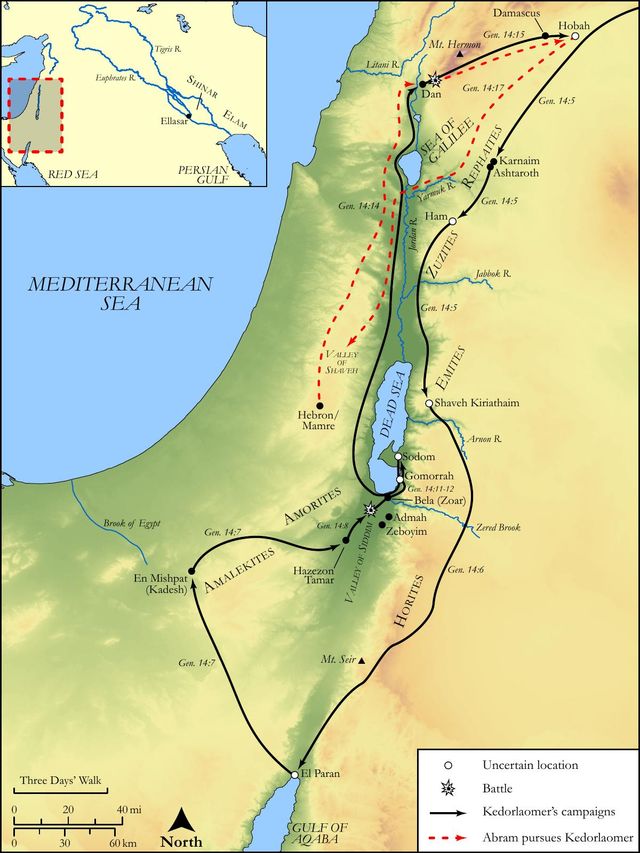
This verse immediately follows the dramatic "Battle of the Kings" described in Genesis 14:1-12, a conflict involving a coalition of eastern kings, led by Chedorlaomer, who decisively defeated the kings of the Jordan plain, including those of Sodom and Gomorrah. The preceding verses detail the capture of Lot, Abram's nephew, along with his possessions, as a direct consequence of Sodom's defeat. Genesis 14:13 acts as the narrative pivot, shifting the focus from the broader regional conflict to Abram's personal involvement. It provides the crucial intelligence that sets in motion Abram's response, transitioning the story from the general chaos of war to a specific act of familial loyalty and military prowess. The mention of Abram's dwelling place and his confederates also serves to establish his immediate sphere of influence and the resources available to him for the impending rescue mission.
Historical & Cultural Context
The ancient Near East, particularly during the Middle Bronze Age (roughly 2000-1550 BC), was characterized by a fragmented political landscape dominated by city-states and tribal confederations. Communication in such an environment was rudimentary, often relying on messengers or, as in this case, "escapees" or "fugitives" who could relay vital intelligence from battlefields or conquered territories. The concept of "confederacy" (Hebrew: bᵉrîyth / baʻal) was fundamental to survival, as formal alliances or treaties between chieftains and clans provided mutual protection, economic stability, and a means for collective military action against common threats. The "plain of Mamre" refers to a specific geographical location, likely an oak grove near Hebron, which was a significant gathering place and a strategic point, indicating Abram's established presence and integration, albeit as a distinct entity, within the local power dynamics of the Amorite tribes.
Key Themes
ShowHideGenesis 14:13 contributes to several overarching themes within the book of Genesis and the broader biblical narrative. Firstly, it underscores the theme of Divine Providence, as the seemingly random arrival of an escapee is the precise mechanism through which God ensures Abram receives the necessary information to act, aligning with His overarching plan for Abram's lineage and the fulfillment of the covenant promises. Secondly, it highlights the theme of Identity and Distinction, particularly through the designation "Abram the Hebrew." This term sets Abram apart from the surrounding Canaanite peoples, foreshadowing the unique identity of Israel as God's chosen people, distinct yet interacting with the nations. Finally, the verse introduces the theme of Abram's Active Faith and Leadership, demonstrating that God's promises do not negate human responsibility. Abram is not a passive recipient of blessings but a courageous leader who takes decisive action to protect his kin, even engaging in military conflict, thereby illustrating the practical outworking of his faith in a fallen world, as seen in his pursuit of the kings in Genesis 14:14-16.
Exposition and Analysis
ShowHideKey Word Analysis
ShowHideThis term refers to a "refugee" or "fugitive," one who has fled from danger or conflict. The use of this word emphasizes the urgency and dire nature of the situation, as the individual bringing the news has personally experienced the devastation of the battle and Lot's capture. It underscores the veracity and immediacy of the intelligence, crucial for Abram's rapid response.
This is a significant designation, marking the first time this term is applied to Abram in the biblical text. It is generally understood to mean "one who crossed over," either referring to Abram's geographical journey across the Euphrates River from Ur (as in Genesis 12:1) or his lineage as a descendant of Eber (as in Genesis 10:24). In either case, it identifies Abram as distinct, an outsider to the local Canaanite populations, possessing a unique origin and destiny that sets him apart.
The KJV translates the combination of H1167 (baʻal, meaning "master" or "owner," often used in phrases like "master of a covenant") and H1285 (bᵉrîyth, meaning "compact," "covenant," or "league") as "confederate." This signifies a formal, binding agreement or alliance. It indicates that Mamre, Eshcol, and Aner were not merely neighbors but had entered into a solemn pact with Abram, committing to mutual defense and support. This detail is crucial for understanding how Abram was able to quickly mobilize a significant force.
Verse Breakdown
ShowHide"And there came one that had escaped, and told Abram the Hebrew;"
This clause introduces the bearer of critical news. The "one that had escaped" is a survivor of the recent battle, highlighting the immediacy and reliability of the intelligence. The act of "telling" (Hebrew: nâgad, H5046) implies a full and detailed report. The designation "Abram the Hebrew" is a key identifier, distinguishing him from the surrounding peoples and hinting at his unique status and destiny as the patriarch of God's chosen nation.
"for he dwelt in the plain of Mamre the Amorite, brother of Eshcol, and brother of Aner:"
This segment provides essential geographical and relational context. It explains where Abram was residing—in the "plain" (Hebrew: ʼêlôwn, H436, often interpreted as an "oak grove") of Mamre. Mamre is identified as an Amorite chieftain, and his brothers, Eshcol, and Aner, are also named. This highlights Abram's established presence and his connections within the local power structure, emphasizing that he was not isolated but strategically located among influential regional leaders.
"and these [were] confederate with Abram."
This final clause clarifies the nature of Abram's relationship with Mamre, Eshcol, and Aner. The term "confederate" (Hebrew: baʻal bᵉrîyth) signifies a formal alliance or covenant between them. This mutual defense pact was vital in the ancient world for security and collective action. This detail is crucial for understanding Abram's ability to quickly gather a fighting force, as these alliances provided the necessary human and military resources for his subsequent rescue mission.
Literary Devices
ShowHideThe verse effectively employs Foreshadowing and Characterization. The designation of Abram as "the Hebrew" serves as a significant act of Characterization, immediately setting him apart and foreshadowing the distinct identity of the nation that will descend from him. This is the first time this ethnonym appears in the Bible, marking Abram as an individual "crossed over" or distinct from the local populace, implicitly carrying a unique divine purpose. Furthermore, the mention of Abram's "confederates" subtly Foreshadows his impending military action. It explains the practical means by which Abram will be able to pursue the victorious kings, hinting at the strength and support he commands, which will be crucial for his successful rescue of Lot in the verses that follow. The detailed naming of Mamre, Eshcol, and Aner also adds a layer of Realism and historical grounding to the narrative, portraying Abram as a figure deeply embedded in the political and social realities of his time.
Theological and Thematic Connections
ShowHideGenesis 14:13 is rich with theological implications, demonstrating God's providential care for His chosen servant and the unfolding of His redemptive plan. The arrival of the escapee, seemingly coincidental, can be understood as an act of divine orchestration, ensuring that Abram receives the vital information needed to intervene for Lot. This highlights God's active involvement in the details of human history, guiding events to accomplish His purposes. Abram's identity as "the Hebrew" signifies his unique calling and separation, not merely geographically but spiritually, foreshadowing the distinctiveness of Israel as God's covenant people. His willingness to act, even engaging in military conflict, underscores the theme of righteous action and responsibility, demonstrating that faith is not passive but active in addressing injustice and protecting the vulnerable. Furthermore, Abram's alliances with the Amorite chieftains illustrate that God can use unexpected means and relationships, even with those outside the covenant, to provide for His people's safety and success, provided these alliances do not compromise spiritual integrity.
Reflection and Application
ShowHideGenesis 14:13 offers profound lessons for believers today, emphasizing the interplay between divine providence and human responsibility. Just as Abram was strategically positioned and supported by his confederates, we are reminded of the invaluable role of community and trusted relationships in navigating life's challenges. In a world often characterized by isolation, this verse encourages us to cultivate genuine alliances, whether within our families, churches, or broader communities, recognizing that God often works through the network of relationships He provides. Abram's swift and decisive response to Lot's distress calls us to be attentive and proactive in addressing the needs of those around us, particularly our family and fellow believers, demonstrating a practical love that extends beyond mere sentiment. Moreover, understanding our identity in Christ—as those "called out" and "crossed over" from the world into His kingdom—should empower us to act with courage and conviction, demonstrating leadership and responsibility in our spheres of influence, even when navigating the complexities and dangers of a fallen world. Our distinct identity should not lead to isolation, but to a courageous engagement for justice and righteousness, leveraging the resources and relationships God has given us.
Questions for Reflection
ShowHideFAQ
ShowHideWhy is Abram called 'the Hebrew' here, and what is its significance?
ShowHideThe term "Hebrew" (עִבְרִי, ʻIbrîy) is used for the first time in the Bible in Genesis 14:13. Its precise etymology is debated, but it is most commonly linked to the verb עָבַר (avar), meaning "to pass over" or "to cross." This could refer to Abram having "crossed over" the Euphrates River from Ur of the Chaldees, as described in Genesis 12:1, signifying his foreign origin and migratory nature. Alternatively, it could designate him as a descendant of Eber, an ancestor mentioned in Genesis 10:24, marking a specific lineage. In either case, the designation "the Hebrew" serves to distinguish Abram from the local Canaanite populations, identifying him as an outsider with a unique heritage and, implicitly, a unique destiny foreshadowing the nation of Israel, God's chosen people.
Who were Mamre, Eshcol, and Aner, and what does it mean that they were "confederate" with Abram?
ShowHideMamre, Eshcol, and Aner were Amorite chieftains or leaders in the region where Abram resided, specifically near the "plain" or "oaks" of Mamre, which was a significant location near Hebron. They were powerful local figures who controlled their own territories and resources. Being "confederate" with Abram signifies that they had formed a formal alliance, pact, or treaty with him. In the ancient Near East, such alliances (Hebrew: bᵉrîyth) were crucial for mutual protection, defense, and collective action, providing a framework for security and stability in a time without strong central governments. Their confederation with Abram demonstrates his significant standing, influence, and diplomatic skill among the local inhabitants, and it explains how he was able to quickly muster a force to pursue the invading kings and rescue Lot, as detailed in Genesis 14:14-16.
Christ-Centered Fulfillment
ShowHideAbram's swift and courageous action to rescue Lot in Genesis 14:13 serves as a profound foreshadowing of Christ's ultimate redemptive work. Just as Abram, "the Hebrew"—an outsider yet divinely chosen—intervened to save his captive kin from powerful earthly enemies, so Christ, the ultimate "one who crossed over" from the glory of heaven to the humility of earth, came to deliver humanity from the far greater bondage of sin and death. Abram's leadership and the strength he drew from his alliances with Mamre, Eshcol, and Aner point to Christ as the true and perfect leader, who, through His ultimate sacrifice on the cross, established a new covenant with His people, forming a spiritual community—the Church—that transcends earthly alliances. This new covenant, sealed by His blood, empowers believers to live in freedom from spiritual adversaries and participate in His ongoing work of salvation and restoration, as promised in Hebrews 9:15. Like Abram, who acted decisively to rescue his own, Christ laid down His life for His sheep, as He declares in John 10:11, ultimately securing their eternal freedom and bringing them into His eternal kingdom, fulfilling the very essence of rescue and redemption.