


Genesis 14:12
Bible text: King James Version (1769 Blayney text) · Public domain
Bible text: Berean Standard Bible · Public domain
Bible text: American Standard Version (1901) · Public domain
Bible text: World English Bible, Messianic edition · Public domain
Bible text: Geneva Bible (1599) · Public domain
Bible text: Young's Literal Translation · Public domain
- וַיִּקְחוּvai·yik·Chuand they tookH3947Conj-w ¦ V-Qal-ConsecImperf-3mpVerb Qal Consecutive Imperfect 3rd Plural Masculineוַandיִּקְחוּthey took
- אֶת'et<obj.>H853DirObjMParticle Object Indicator
- לוֹטLotLotH3876N-proper-mNoun Proper Masculine
- וְאֶתve·'Etand <obj.>H853Conj-w ¦ DirObjMParticle Object Indicatorוְandאֶת<obj.>
- רְכֻשׁוֹre·khu·Shohis possession[s]H7399N-msc ¦ 3msNoun Singular Masculine Constructרְכֻשׁpossession[s]וֹhis
- בֶּןben[the] son ofH1121N-mscNoun Singular Masculine Construct
- אֲחִי'a·Chi[the] brother ofH251N-mscNoun Singular Masculine Construct
- אַבְרָם'av·RamAbramH87N-proper-mNoun Proper Masculine
- וַיֵּלֵכוּvai·ye·Le·khuand they wentH1980Conj-w ¦ V-Qal-ConsecImperf-3mpVerb Qal Consecutive Imperfect 3rd Plural Masculineוַandיֵּלֵכוּthey went
- וְהוּאve·Hu'and heH1931Conj-w ¦ Pro-3msPronoun Personal 3rd Singular Masculineוְandהוּאhe
- יֹשֵׁבyo·Shev[was] dwellingH3427V-Qal-Prtcpl-msVerb Qal Participle Singular Masculine Absolute
- בִּסְדֹםbis·Domin SodomH5467Prep-b ¦ N-properNoun Proper LocationבִּinסְדֹםSodom
English is a literal word-by-word gloss of the Hebrew, not the KJV's wording. Why?
This is the original text the KJV's translators worked from — each Hebrew word with its own literal English meaning in this verse, prepared by scholars at Tyndale House, Cambridge. The KJV translates whole sentences, not word by word, so its wording differs: one Hebrew word can become several English words, and the KJV may choose “the LORD” where the gloss reads “Yahweh”. Both are faithful — they answer different questions. For the KJV's own rendering, switch to the KJV text.
Details
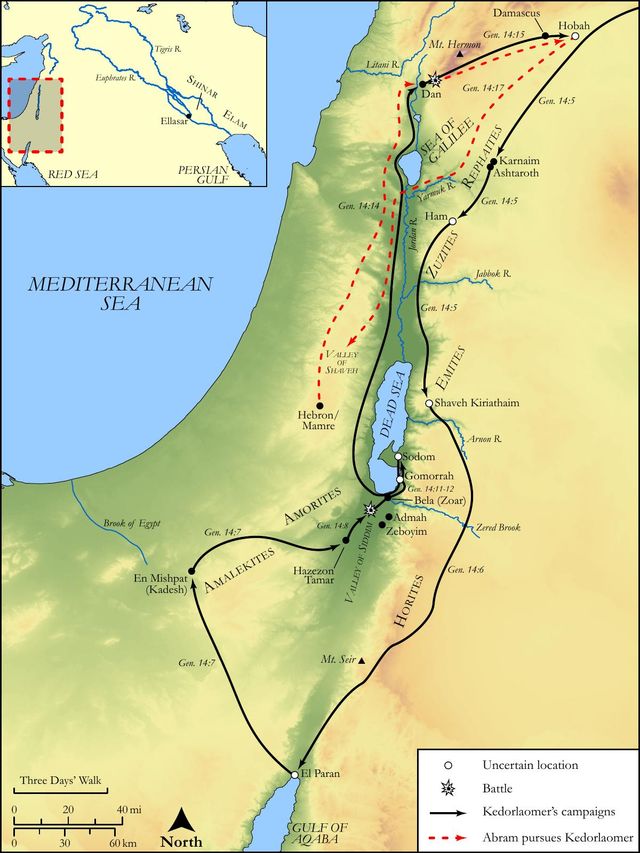
See on the biblical-era maps


Study this verse
Public-domain commentary
Matthew Henry
From his Commentary on the Whole Bible. Henry comments on passages, not single verses — this entry covers Genesis 14:1–12. His three-level outline is real structure in the source text, so it is rendered as structure.
We have here an account of the first war that ever we read of in scripture, which (though the wars of the nations make the greatest figure in history) we should not have had the history of if Abram and Lot had not been concerned in it. Now, concerning this war, we may observe,
I.The parties engaged in it.
The invaders were four kings, two of them no less than kings of Shinar and Elam (that is, Chaldea and Persia), yet probably not the sovereign princes of those great kingdoms in their own persons, but either officers under them, or rather the heads and leaders of some colonies which came out of those great nations, and settled themselves near Sodom, but retained the names of the countries from which they had their origin. The invaded were the kings of five cities that lay near together in the plain of Jordan, namely, Sodom, Gomorrah, Admah, Zeboiim, and Zoar. Four of them are named, but not the fifth, the king of Zoar or Bela, either because he was much more mean and inconsiderable or because he was much more wicked and inglorious than the rest, and worthy to be forgotten.
II.The occasion of this war was the revolt of the five kings from under the government of Chedorlaomer.
Twelve years they served him. Small joy they had of their fruitful land, while thus they were tributaries to a foreign power, and could not call what they had their own. Rich countries are a desirable prey, and idle luxurious countries are an easy prey, to growing greatness. The Sodomites were the posterity of Canaan whom Noah had pronounced a servant to Shem, from whom Elam descended; thus soon did that prophecy begin to e fulfilled. In the thirteenth year, beginning to be weary of their subjection, they rebelled, denied their tribute, and attempted to shake off the yoke and retrieve their ancient liberties. In the fourteenth year, after some pause and preparation, Chedorlaomer, in conjunction with his allies, set himself to chastise and reduce the rebels, and, since he could not have it otherwise, to fetch his tribute from them on the point of his sword. Note, Pride, covetousness, and ambition, are the lusts from which wars and fightings come. To these insatiable idols the blood of thousands has been sacrificed.
III.The progress and success of the war.
The four kings laid the neighbouring countries waste and enriched themselves with the spoil of them (Gen 14:5-7), upon the alarm of which it had been the wisdom of the king of Sodom to submit, and desire conditions of peace; for how could he grapple with an enemy thus flushed with victory? But he would rather venture the utmost extremity than yield, and it sped accordingly. Quos Deus destruet eos dementat - Those whom God means to destroy he delivers up to infatuation.
1.The forces of the king of Sodom and his allies were routed; and, it should seem, many of them perished in the slime-pits who had escaped the sword, Gen 14:10. In all places we are surrounded with deaths of various kinds, especially in the field of battle.
2.The cities were plundered, Gen 14:11. All the goods of Sodom, and particularly their stores and provisions of victuals, were carried off by the conquerors. Note, When men abuse the gifts of a bountiful providence to gluttony and excess, it is just with God, and his usual way, by some judgment or other to strip them of that which they have so abused, Hos 2:8, Hos 2:9.
3.Lot was carried captive, Gen 14:12. They took Lot among the rest, and his goods. Now Lot may here be considered,
(1.)As sharing with his neighbours in this common calamity. Though he was himself a righteous man, and (which is here expressly noticed) Abram's brother's son, yet he was involved with the rest in all this trouble. Note, All things come alike to all, Ecc 9:2. The best of men cannot promise themselves an exemption from the greatest troubles in this life; neither from our own piety nor our relation to those that are the favourites of heaven will be our security, when God's judgments are abroad. Note, further, Many an honest man fares the worse for his wicked neighbours. It is therefore our wisdom to separate ourselves, or at least to distinguish ourselves, from them (Co2 6:17), and so deliver ourselves, Rev 18:4.
(2.)As smarting for the foolish choice he made of a settlement here. This is plainly intimated when it is said, They took Abram's brother's son, who dwelt in Sodom. So near a relation of Abram should have been a companion and disciple of Abram, and should have abode by his tents; but, if he choose to dwell in Sodom, he must thank himself if he share in Sodom's calamities. Note, When we go out of the way of our duty we put ourselves from under God's protection, and cannot expect that the choices which are made by our lusts should issue to our comfort. Particular mention is made of their taking Lot's goods, those goods which had occasioned his contest with Abram and his separation from him. Note, It is just with God to deprive us of those enjoyments by which we have suffered ourselves to be deprived of our enjoyment of him.
Historical interpretation
Historical reception
1 surviving comment on this verse from the historical church.
Notice that what I said yesterday has come to be true, that Lot, far from being better off for his choice of the better parts, rather had learned from experience not to set his heart on the better parts. You see, not only did no benefit come to him from it, but indeed he was even led away into captivity. He learned the lesson through experience that it was much better for him to enjoy the just man’s company than to be parted from him and undergo these great trials even if living independently. I mean, he parted from the patriarch and thought he enjoyed greater independence, had the good fortune to enjoy the better parts and experience great prosperity—and all of a sudden he becomes a captive, dispossessed, without hearth or home. The purpose was for you to learn what a great evil division is and what a great good harmony is, and that we ought not hanker after pride of place but love to take second place instead. “Now, they seized Lot and his accoutrements,” the text says, remember. How much better was it to be in the company of the patriarch and accept everything for the sake of not sundering the mutual harmony than be separated and while choosing the better parts be immediately beset with such awful perils and fall into the clutches of barbarians?
Continue studying Genesis 14:12 across the web’s major study libraries — every link below opens this exact verse, chapter, or book on the destination site.
Read & Compare
 BibleGatewayThis verse in more than 200 translations and 70 languages.
 Bible.comThe YouVersion reader — hundreds of translations, reading plans, and highlights.
 ESV.orgCrossway's official English Standard Version reader.
 NET BibleThe NET translation with 60,000+ translators' notes on every rendering decision.
 STEP BibleTyndale House's free study tool — original text, vocabulary, and scholarly resources.
 BibliaLogos Bible Software's free web reader.
 USCCBThe New American Bible (Revised Edition) with the U.S. bishops' study notes.
Commentaries
 BibleHub CommentariesDozens of classic commentaries on this verse, gathered on one page.
 StudyLightMore than 100 commentary sets — the largest collection on the web.
 BibleRefPlain-English commentary on what this verse means, verse by verse.
 Enduring WordDavid Guzik's free commentary on this chapter, widely used by Bible teachers.
 Bible Study ToolsVerse commentary alongside Greek and Hebrew study aids.
Original Language & Research
- BibleHub InterlinearThe verse word by word — original language, transliteration, and English.
- BibleHub LexiconEvery word's original-language definition and Strong's entry.
 Blue Letter BibleDeep-study tools — Strong's numbers, concordance, and word studies.
 SefariaThe Hebrew text with Rashi and centuries of Jewish commentary.
Sermons, Hymns & Audio


TrulyRandomVerse is not affiliated with these sites and doesn’t control their content. They’re linked because they’re genuinely useful.
Summary
Genesis 14:12 vividly recounts the immediate and devastating outcome of the regional conflict between the eastern kings and the rebellious cities of the Jordan Valley. It specifically details the capture of Lot, Abram's nephew, who had chosen to reside in the morally compromised city of Sodom. Alongside Lot himself, all his accumulated possessions were seized by the victorious forces as spoils of war, a pivotal event that directly precipitates Abram's subsequent heroic intervention to rescue his kinsman.
Context
ShowHideLiterary Context
This verse is situated within the broader narrative of Genesis 14, which describes the first major war in biblical history. Preceding this verse, Genesis 14:1-11 details the confederation of four eastern kings, led by Chedorlaomer of Elam, who waged war against five city-states in the Jordan Valley, including Sodom and Gomorrah. These cities had rebelled after twelve years of subjugation, and the eastern kings decisively defeated them in the Valley of Siddim. Genesis 14:12 serves as the direct consequence of this victory, specifically highlighting the fate of Lot, whose prior choice to settle near and eventually within Sodom (Genesis 13:10-12) now directly impacts his well-being. This capture is the critical turning point that compels Abram, who had previously separated from Lot, to re-engage and act as a rescuer.
Historical & Cultural Context
The events of Genesis 14 reflect the geopolitical realities of the patriarchal period. Regional conflicts, often involving powerful kings from distant empires asserting dominance over smaller city-states, were common. Conquered peoples and their possessions were routinely taken as spoils of war, either to be enslaved, ransomed, or integrated into the victor's domain. The Jordan Valley, particularly the area around Sodom, was known for its fertility and strategic location, making it a desirable prize. The mention of "goods" (Hebrew: rᵉkûwsh) signifies all movable property, including livestock, servants, and accumulated wealth, which constituted a person's entire economic standing. The swift "departed" indicates the typical practice of raiders quickly withdrawing with their plunder before counterattacks could be organized.
Key Themes
ShowHideGenesis 14:12 contributes significantly to several overarching themes within the patriarchal narratives and the book of Genesis. It powerfully illustrates the consequences of choices, particularly Lot's decision to prioritize material prosperity by settling in Sodom, despite its moral depravity, as noted in Genesis 13:13. This verse also underscores the theme of divine providence and redemption, as Lot's capture sets the stage for Abram's faithful intervention, which, in turn, leads to the significant encounter with Melchizedek in Genesis 14:18-20. Furthermore, it highlights the enduring theme of family loyalty and intercession within the Abrahamic covenant, demonstrating Abram's commitment to his kin even after their separation.
Exposition and Analysis
ShowHideKey Word Analysis
ShowHideThis primitive root (H3947) means "to take" in the widest variety of applications, encompassing seizing, accepting, bringing, or carrying away. In this context, it denotes a forceful, decisive act of capture, indicating that Lot and his possessions were forcibly removed as plunder, not willingly surrendered.
This word (H1121) refers to a son in the widest sense, including literal and figurative relationships like grandson, subject, or even a builder of the family name. Here, it clarifies Lot's direct familial relationship to Abram, emphasizing the close kinship that would compel Abram's later actions.
This primitive root (H3427) primarily means "to sit down," but by implication, it extends to dwelling, remaining, or settling. Lot's "dwelling" in Sodom implies a settled residence, a deliberate choice to make that city his home, which directly exposed him to its fate during the war.
This primitive root (H3212) means "to walk" literally or figuratively, and causatively, "to carry" or "to go away." In this context, it signifies the swift and unhindered movement of the victorious kings and their forces as they left the conquered territory, taking their captives and spoils with them.
Verse Breakdown
ShowHide"And they took Lot,"
This opening clause immediately identifies the primary action and its victim. "They" refers to the victorious eastern kings and their armies, who, having conquered Sodom, are now gathering their spoils. Lot, Abram's nephew, is singled out as a significant captive, indicating his established presence and perhaps prominence within Sodom.
"Abram's brother's son,"
This parenthetical phrase is crucial. It clarifies Lot's exact relationship to Abram (son of Abram's brother Haran), establishing the familial bond that will serve as the primary motivation for Abram's subsequent intervention. This kinship underscores the cultural imperative of family loyalty and responsibility in the households of the patriarchs.
"who dwelt in Sodom,"
This clause reiterates Lot's residential choice, which was first detailed in Genesis 13:12. It serves as a stark reminder that Lot's chosen environment, despite its allure of prosperity, was inherently dangerous due to its wickedness and its vulnerability to conflict. His dwelling there directly led to his present predicament.
"and his goods,"
The Hebrew term rᵉkûwsh (H7399) refers to all of Lot's movable property, including his livestock, servants, and accumulated wealth. This signifies a complete material loss alongside his personal captivity, emphasizing the comprehensive nature of the plunder taken by the victorious armies.
"and departed."
This concise phrase describes the swift and decisive exit of the conquering forces. Having achieved their objective of pillaging the city and taking captives, they quickly withdrew, leaving behind a devastated landscape and setting the stage for Abram's pursuit.
Literary Devices
ShowHideThe verse employs several literary devices to convey its significant message. Foreshadowing is prominent, as Lot's capture directly foreshadows the later divine judgment on Sodom in Genesis 19, implying that those who align themselves with such wickedness will ultimately share in its fate. There is also a strong element of Irony in Lot's situation; he chose Sodom for its perceived prosperity and well-watered plains (Genesis 13:10), yet this very choice leads to his complete material loss and personal enslavement. The phrase "Abram's brother's son" acts as a Narrative Hook, immediately establishing the personal connection that will drive the subsequent plot, highlighting the theme of Kinship Obligation. The brevity and directness of the final phrase, "and departed," create a sense of Urgency and finality, emphasizing the swift, unyielding nature of the raiders' actions and the dire reality of Lot's new status as a captive.
Theological and Thematic Connections
ShowHideGenesis 14:12 serves as a powerful theological statement about the consequences of human choices and the pervasive nature of sin's influence. Lot's decision to settle in Sodom, driven by worldly considerations rather than spiritual discernment, directly leads to his entanglement in its fate. This narrative highlights that association with corrupt environments can bring personal peril and material loss, even for those who are not directly participating in the wickedness. However, it also subtly introduces the theme of divine providence and the need for a redeemer, as Lot's capture becomes the catalyst for Abram's faithful and courageous intervention, setting the stage for a demonstration of God's power and Abram's unique role in His plan.
Reflection and Application
ShowHideGenesis 14:12 offers a profound and enduring lesson for believers regarding the environments we choose and the company we keep. Lot's capture serves as a stark reminder that prioritizing worldly advantages—be it material prosperity, social status, or convenience—over spiritual discernment and moral integrity can lead to dire consequences. While we are called to engage with the world, we are simultaneously exhorted not to be conformed to its patterns or entangled by its corrupting influences, as cautioned in Romans 12:2. Lot's experience underscores that compromise with ungodly values often results in vulnerability, loss, and distress, making us susceptible to the world's dangers. It challenges us to critically evaluate our associations, our dwelling places, and our priorities, ensuring that our choices align with God's will and protect our spiritual well-being, rather than leaving us exposed to the inevitable consequences of a fallen world.
Questions for Reflection
ShowHideFAQ
ShowHideWhy is Lot identified as "Abram's brother's son" in this verse?
ShowHideThis specific identification emphasizes Lot's close familial relationship to Abram, highlighting the deep bond and responsibility Abram felt towards his nephew. It establishes the personal connection that motivates Abram's subsequent heroic actions to rescue him, underscoring the theme of loyalty and family obligation within the narrative. This kinship is crucial for understanding Abram's willingness to risk everything for Lot, as seen in Genesis 14:14.
What does the term "goods" encompass in this context?
ShowHideThe Hebrew word rᵉkûwsh (H7399), translated as "goods," is a comprehensive term referring to all movable property and wealth. In an ancient pastoral society like that of Lot and Abram, this would include a wide range of assets: livestock (sheep, goats, cattle), servants (often considered part of a household's wealth), household possessions, and any other accumulated material wealth. Its seizure signifies a complete material loss for Lot, leaving him utterly destitute.
What is the significance of Lot dwelling in Sodom for this narrative?
ShowHideLot's choice to dwell "in Sodom" is profoundly significant. It directly illustrates the consequences of prioritizing material prosperity and convenience over spiritual discernment and moral integrity. Despite the city's known wickedness (Genesis 13:13), Lot chose to settle there, making him vulnerable to its fate. His association with a city destined for divine judgment directly led to his capture and loss, serving as a powerful cautionary tale about the dangers of worldly entanglements and the vulnerability they create for believers.
Christ-Centered Fulfillment
ShowHideGenesis 14:12, with its account of Lot's capture by the victorious kings, powerfully foreshadows humanity's universal predicament of being enslaved by sin and death. Just as Lot was taken captive along with all his possessions, humanity, in its fallen state, is held captive by the spiritual forces of darkness and the dominion of sin, unable to free itself from this bondage (Romans 6:16). Abram's subsequent heroic rescue of Lot, undertaken at great personal risk and requiring him to engage in battle, serves as a compelling type of Christ, the ultimate Kinsman-Redeemer. Christ, who is "not ashamed to call them brothers" (Hebrews 2:11), entered into the spiritual conflict of this world not to take spoils, but to deliver those held captive by sin and the forces of evil. His victory on the cross over sin and death is the definitive rescue, where He "disarmed the powers and authorities, he made a public spectacle of them, triumphing over them by the cross" (Colossians 2:15). Through His sacrifice, believers are freed from the bondage of a corrupt world and restored to true liberty in Him (Galatians 5:1), fulfilling the shadow of Abram's intervention with divine perfection and eternal scope.