


Genesis 11:27
Bible text: King James Version (1769 Blayney text) · Public domain
Bible text: Berean Standard Bible · Public domain
Bible text: American Standard Version (1901) · Public domain
Bible text: World English Bible, Messianic edition · Public domain
Bible text: Geneva Bible (1599) · Public domain
Bible text: Young's Literal Translation · Public domain
- וְאֵלֶּהve·'E·lehand theseH428Conj-w ¦ PrtParticle Demonstrativeוְandאֵלֶּהthese
- תּוֹלְדֹתtol·Dot[are] [the] accounts ofH8435N-fpcNoun Plural Feminine Construct
- תֶּרַחTe·rachTerahH8646N-proper-mNoun Proper Masculine
- תֶּרַחTe·rachTerahH8646N-proper-mNoun Proper Masculine
- הוֹלִידho·Lidhe fatheredH3205V-Hiphil-Perf-3msVerb Hiphil Perfect 3rd Singular Masculine
- אֶת'et<obj.>H853DirObjMParticle Object Indicator
- אַבְרָם'av·RamAbramH87N-proper-mNoun Proper Masculine
- אֶת'et<obj.>H853DirObjMParticle Object Indicator
- נָחוֹרna·ChorNahorH5152N-proper-mNoun Proper Masculine
- וְאֶתve·'Etand <obj.>H853Conj-w ¦ DirObjMParticle Object Indicatorוְandאֶת<obj.>
- הָרָןha·RanHaranH2039N-proper-mNoun Proper Masculine
- וְהָרָןve·ha·Ranand HaranH2039Conj-w ¦ N-proper-mNoun Proper MasculineוְandהָרָןHaran
- הוֹלִידho·Lidhe fatheredH3205V-Hiphil-Perf-3msVerb Hiphil Perfect 3rd Singular Masculine
- אֶת'et<obj.>H853DirObjMParticle Object Indicator
- לוֹטLotLotH3876N-proper-mNoun Proper Masculine
English is a literal word-by-word gloss of the Hebrew, not the KJV's wording. Why?
This is the original text the KJV's translators worked from — each Hebrew word with its own literal English meaning in this verse, prepared by scholars at Tyndale House, Cambridge. The KJV translates whole sentences, not word by word, so its wording differs: one Hebrew word can become several English words, and the KJV may choose “the LORD” where the gloss reads “Yahweh”. Both are faithful — they answer different questions. For the KJV's own rendering, switch to the KJV text.
Details
See on the biblical-era maps


Study this verse
Public-domain commentary
Matthew Henry
From his Commentary on the Whole Bible. Henry comments on passages, not single verses — this entry covers Genesis 11:27–32. His three-level outline is real structure in the source text, so it is rendered as structure.
Here begins the story of Abram, whose name is famous, henceforward, in both Testaments. We have here,
I.His country:
Ur of the Chaldees. This was the land of his nativity, an idolatrous country, where even the children of Eber themselves had degenerated. Note, Those who are, through grace, heirs of the land of promise, ought to remember what was the land of their nativity, what was their corrupt and sinful state by nature, the rock out of which they were hewn.
II.His relations, mentioned for his sake, and because of their interest in the following story.
1.His father was Terah, of whom it is said (Jos 24:2) that he served other gods, on the other side of the flood, so early did idolatry gain footing in the world, and so hard is it even for those that have some good principles to swim against the stream. Though it is said (Gen 11:26) that when Terah was seventy years old he begat Abram, Nahor, and Haran (which seems to tell us that Abram was the eldest son of Terah, and was born in his seventieth year), yet, by comparing Gen 11:32, which makes Terah to die in his 205th year, with Act 7:4 (where it is said that he was but seventy-five years old when he removed from Haran), it appears that he was born in the 130th year of Terah, and probably was his youngest son; for, in God's choices, the last are often first and the first last. We have,
2.Some account of his brethren.
(1.)Nahor, out of whose family both Isaac and Jacob had their wives.
(2.)Haran, the father of Lot, of whom it is here said (Gen 11:28) that he died before his father Terah. Note, Children cannot be sure that they shall survive their parents; for death does not go by seniority, taking the eldest first. The shadow of death is without any order, Job 10:22. It is likewise said that he died in Ur of the Chaldees, before the happy removal of the family out of that idolatrous country. Note, It concerns us to hasten out of our natural state, lest death surprise us in it.
3.His wife was Sarai, who some think, was the same with Iscah, the daughter of Haran. Abram himself says of her that she was the daughter of his father, but not the daughter of his mother, Gen 20:12. She was ten years younger than Abram.
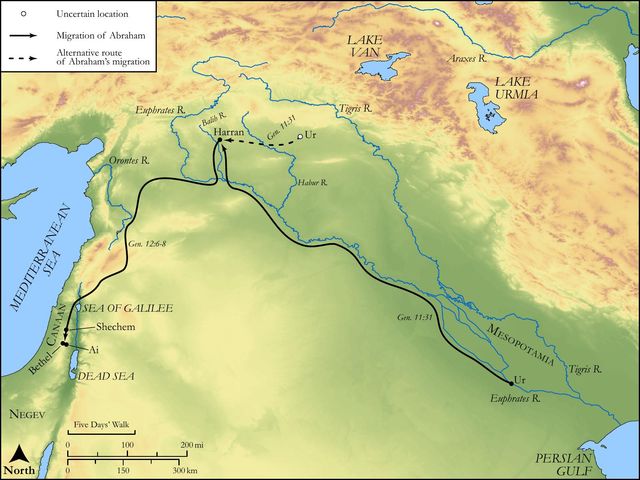
III.His departure out of Ur of the Chaldees, with his father Terah, his nephew Lot, and the rest of his family, in obedience to the call of God, of which we shall read more, Gen 12:1, etc. This chapter leaves them in Haran, or Charran, a place about mid-way between Ur and Canaan, where they dwelt till Terah's head was laid, probably because the old man was unable, through the infirmities of age, to proceed in his journey. Many reach to Charran, and yet fall short of Canaan; they are not far from the kingdom of God, and yet never come thither.
Historical interpretation
Three Centuries of Reception
2 surviving comments on this verse. Each one is dated, so this reads as a timeline rather than a list.
Select a marker to jump to its quote. Markers stagger vertically where authors wrote within a few decades of each other.
“And Aran [Haran] died before his father in the land in which he was born in the territory of the Chaldeans.” In place of what we read [in the LXX] as “in the territory of the Chaldeans,” in the Hebrew it has “in ur Chesdim,” that is, “in the fire of the Chaldeans.” Moreover the Hebrews, taking the opportunity afforded by this verse, hand on a story of this sort to the effect that Abraham was put into the fire because he refused to worship the fire, which the Chaldeans honor, and that he escaped through God’s help and fled from the fire of idolatry. What is written [in the LXX] in the following verses, that Thara [Terah] with his offspring “went out from the territory of the Chaldeans,” stands in place of what is contained in the Hebrew, “from the fire of the Chaldeans.” And they maintain that this refers to what is said in this verse: “Aran died before the face of Thara in the land of his birth in the fire of the Chaldeans”; that is, because he refused to worship fire, he was consumed by fire.
These are the generations of Terah. Terah became the father of Abram, Nahor, and Haran. The house of Terah was one, from which Abraham was born, in which the worship of the one true God was kept; and, as is credible, in which the Hebrew language alone also remained, when, as told by Joshua, he himself, like the manifest people of God in Egypt, served foreign gods in Mesopotamia. The others from the progeny of Heber gradually flowed into other languages and into other nations, in the same manner as after the flood of waters, one house of Noah remained to restore the human race. Thus, in the flood of many superstitions throughout the world, one house of Terah remained, in which the planting of the city of God was preserved. Finally, just as there, after enumerating the generations up to Noah along with the number of years, and after expounding the cause of the flood, before God began to speak to Noah about the construction of the ark, it is said "These are the generations of Noah"; so also here, after enumerating the generations from Shem, the son of Noah, up to Abraham, then a notable phrase is similarly put, so that it is said "These are the generations of Terah. Terah became the father of Abram, Nahor, and Haran." Indeed, there, the patriarch of the second age of the world was born, here, in the third age.
Continue studying Genesis 11:27 across the web’s major study libraries — every link below opens this exact verse, chapter, or book on the destination site.
Read & Compare
 BibleGatewayThis verse in more than 200 translations and 70 languages.
 Bible.comThe YouVersion reader — hundreds of translations, reading plans, and highlights.
 ESV.orgCrossway's official English Standard Version reader.
 NET BibleThe NET translation with 60,000+ translators' notes on every rendering decision.
 STEP BibleTyndale House's free study tool — original text, vocabulary, and scholarly resources.
 BibliaLogos Bible Software's free web reader.
 USCCBThe New American Bible (Revised Edition) with the U.S. bishops' study notes.
Commentaries
 BibleHub CommentariesDozens of classic commentaries on this verse, gathered on one page.
 StudyLightMore than 100 commentary sets — the largest collection on the web.
 BibleRefPlain-English commentary on what this verse means, verse by verse.
 Enduring WordDavid Guzik's free commentary on this chapter, widely used by Bible teachers.
 Bible Study ToolsVerse commentary alongside Greek and Hebrew study aids.
Original Language & Research
- BibleHub InterlinearThe verse word by word — original language, transliteration, and English.
- BibleHub LexiconEvery word's original-language definition and Strong's entry.
 Blue Letter BibleDeep-study tools — Strong's numbers, concordance, and word studies.
 SefariaThe Hebrew text with Rashi and centuries of Jewish commentary.
Sermons, Hymns & Audio


TrulyRandomVerse is not affiliated with these sites and doesn’t control their content. They’re linked because they’re genuinely useful.
Summary
Genesis 11:27 marks a pivotal moment in the biblical narrative, shifting from the broad history of humanity after the dispersion at Babel to the specific lineage that would lead to Abram. This verse introduces Terah and his three sons—Abram, Nahor, and Haran—and Haran's son, Lot, thereby establishing the immediate family context from which God would call the patriarch Abram to initiate His redemptive covenant.
Context
ShowHideLiterary Context
This verse serves as the structural marker known as a toledot (generations account), specifically "the generations of Terah." It follows the broader genealogies of Noah's descendants, particularly the line of Shem, which has been narrowing the focus from the universal (creation, flood, nations) to the particular. The preceding narrative culminates in the Tower of Babel incident, which explains the scattering of humanity and the confusion of languages. Genesis 11:27 then dramatically shifts the narrative's trajectory, setting the stage for the specific call of Abram in Genesis 12, thus narrowing the focus to the chosen family through whom God's redemptive plan would unfold.
Historical & Cultural Context
The family of Terah resided in "Ur of the Chaldees," a highly developed Chaldean city-state in ancient Sumeria. Ur was a significant cultural and religious center, known for its advanced urban planning and its polytheistic worship, in which, as Joshua recounts, Terah and his house "served other gods." This background highlights God's sovereign choice to call Abram out of a pagan environment, emphasizing that His covenant initiative was not based on human merit or existing religious purity but on divine election. The emphasis on lineage and "begetting" was also culturally vital, as genealogies established identity, inheritance, and social standing in the households of the patriarchs.
Key Themes
ShowHideGenesis 11:27 introduces several foundational themes. It underscores Divine Sovereignty and Election, as God's plan is seen moving toward a specific individual (Abram) and his family, chosen from an ordinary, pagan background. It highlights the Continuity of God's Redemptive Plan, demonstrating how God works through successive generations and specific family lines to achieve His purposes, building from the promises to Noah towards the Abrahamic covenant. The toledot structure itself emphasizes the Progression from Universal to Particular, as the narrative narrows its focus from all humanity to a single family, through whom God intends to bless all nations, a theme explicitly articulated in Genesis 12:3. This verse is thus the Foundation for the Abrahamic Covenant, providing the essential familial context for the pivotal events that follow.
Exposition and Analysis
ShowHideKey Word Analysis
ShowHideThis term (often plural) signifies "descent," "family," or "history." It is a crucial structural marker in Genesis, appearing eleven times (e.g., Genesis 2:4, Genesis 5:1). It denotes not merely a list of births but an account of the development, history, or lineage stemming from a particular individual or event. Here, "the generations of Terah" introduces the narrative segment focusing on Terah's descendants and the significant events that unfold through them, primarily the call of Abram.
A primitive root meaning "to bear young" or, causatively, "to beget." This verb is central to biblical genealogies, emphasizing the direct line of descent and the continuity of family. In this context, it highlights the biological and familial connection between Terah and his sons, and Haran and his son, Lot, establishing the specific lineage that will play a crucial role in the unfolding of God's covenant history.
Contracted from a phrase meaning "high father" or "exalted father." This is the original name of the patriarch who will later be renamed Abraham ("father of a multitude") by God in Genesis 17:5. His introduction here is highly significant, as he is the chosen vessel through whom God's covenant promises will be established, leading to the formation of Israel and, ultimately, the lineage of the Messiah.
Verse Breakdown
ShowHide"Now these are the generations of Terah:"
This opening clause employs the toledot formula, signaling a new section of the Genesis narrative. It shifts the focus to the family line of Terah, indicating that the subsequent narrative will detail the history and development of his descendants, particularly Abram, and their role in God's unfolding plan.
"Terah begat Abram, Nahor, and Haran;"
This clause identifies Terah as the patriarch and lists his three sons in order of their significance to the narrative: Abram, Nahor, and Haran. While Abram is the central figure, the inclusion of Nahor and Haran is vital, as their descendants (e.g., Rebekah through Nahor, Lot through Haran) will intersect with Abram's story and the broader history of Israel.
"and Haran begat Lot."
This final clause specifically highlights Lot, Haran's son. Haran's early death (mentioned in Genesis 11:28) makes Lot an orphan, leading to his close association with Abram and his eventual role in significant events, such as the separation from Abram and the destruction of Sodom.
Literary Devices
ShowHideGenesis 11:27 primarily employs Genealogy as a literary device. This is a common feature throughout the book of Genesis, serving not merely as a list of names but as a divinely guided record of lineage, establishing historical continuity and tracing the line of promise. The use of the toledot formula acts as a Structural Marker, signaling a transition in the narrative's focus from general human history to the specific, divinely chosen family of Terah. Furthermore, the mention of Abram, Nahor, Haran, and Lot, along with the subsequent narrative, functions as Foreshadowing, hinting at the future roles these individuals and their descendants will play in the unfolding drama of salvation history, particularly the pivotal role of Abram.
Theological and Thematic Connections
ShowHideGenesis 11:27, though a simple genealogical entry, is profoundly significant. It underscores God's meticulous preparation and sovereign plan, demonstrating that even the greatest figures in salvation history emerge from ordinary human families and specific, often unpromising, lineages. This seemingly mundane listing is the divine preface to the call of Abram, highlighting that God's redemptive purposes are not random but unfold through specific individuals chosen by His grace, even from a polytheistic background like Ur. It establishes the foundational family unit from which the covenant people would spring, emphasizing the continuity of God's work from creation through the patriarchs, leading ultimately to the nation of Israel and the coming of the Messiah.
Reflection and Application
ShowHideGenesis 11:27 reminds us that God's grand plan is often revealed incrementally, starting with seemingly small details and ordinary individuals that build into a magnificent narrative of faith and promise. It encourages us to recognize God's hand in the seemingly mundane aspects of life and history, understanding that He uses specific people and circumstances to achieve His overarching redemptive purposes. Our own lives, no matter how ordinary or seemingly insignificant in the grand scheme, are part of a larger divine tapestry. Just as God chose Terah's family, including Abram, from a pagan city to begin His covenant, He can use any of us, in our unique contexts, to further His kingdom. This verse invites us to trust in God's long-term vision and His capacity to work through humble beginnings to accomplish extraordinary ends.
Questions for Reflection
ShowHideFAQ
ShowHideWhat is the significance of the term "generations" (toledoth)?
ShowHideThe term toledoth (תּוֹלְדֹת) is a crucial structural marker in Genesis, appearing eleven times. It signifies more than just a list of births; it introduces a new section detailing the "account of," "descendants of," or "history stemming from" a particular individual or event. In Genesis 11:27, it signals a shift to the specific narrative of Terah's lineage, which directly leads to Abram and the Abrahamic covenant, setting the stage for the rest of salvation history. This literary device emphasizes continuity and the progressive unfolding of God's plan through specific family lines.
Why does Genesis 11:27 focus on Terah's family rather than directly on Abram?
ShowHideWhile Abram is indeed the central figure to come, focusing on Terah's family provides the essential background and context for Abram's call. It shows that Abram emerged from a specific, identifiable lineage, rooted in a particular cultural and religious environment (Ur of the Chaldees). This highlights God's sovereign choice to call Abram out of this background, emphasizing that God's plan unfolds through real families and historical circumstances, not in a vacuum. It also establishes the familial relationships (like Lot's) that are vital to subsequent narratives, demonstrating the interconnectedness of biblical history.
What is the importance of Haran and Lot in this genealogy?
ShowHideHaran's inclusion is significant because his early death in Ur, before the family's migration (Genesis 11:28), makes his son Lot an orphan. This circumstance directly leads to Lot accompanying Abram on his journey, creating a familial bond that plays a crucial role in later events, particularly the separation of Abram and Lot due to their growing possessions (Genesis 13:5-12) and Lot's involvement in the destruction of Sodom (Genesis 19:1-29). Thus, Haran and Lot's presence in this initial genealogy sets up key narrative developments and highlights the complexities of familial relationships within God's unfolding plan.
Christ-Centered Fulfillment
ShowHideGenesis 11:27 serves as a foundational verse in the unfolding of God's redemptive plan, ultimately culminating in Jesus Christ. By introducing the lineage of Terah, which directly leads to Abram, this verse initiates the specific genealogical line through which the promised Seed—the Messiah—would eventually come. God's call of Abram from this family (Genesis 12:1-3) establishes the covenant through which all nations would be blessed, a promise ultimately fulfilled in Christ, who is the true descendant of Abraham and the one through whom God's blessings extend to all humanity (Galatians 3:16). The meticulous record of this lineage, which continues through Isaac, Jacob, and Judah, finds its ultimate purpose in the birth of Jesus, "the son of David, the son of Abraham" (Matthew 1:1). Thus, this seemingly simple genealogical entry is a crucial step in tracing the divine preparation for the incarnation and redemptive work of Jesus, the Lamb of God who takes away the sin of the world.