


Genesis 19:1
- וַיָּבֹאוּVai·ya·vo·'uand they cameH935Conj-w ¦ V-Qal-ConsecImperf-3mpVerb Qal Consecutive Imperfect 3rd Plural Masculineוַandיָּבֹאוּthey came
- שְׁנֵיshe·Nei[the] twoH8147Adj-cdcAdjective Numerical Dual common gender Construct
- הַמַּלְאָכִיםha·mal·'a·Khimthe angelsH4397Art ¦ N-mpNoun Plural Masculine Absoluteהַtheמַּלְאָכִיםangels
- סְדֹמָהse·Do·mahSodom towardsH5467N-proper ¦ SfxNoun Proper LocationסְדֹמָSodomהtowards
- בָּעֶרֶבba·'E·revin the eveningH6153Prep-b ¦ N-msNoun Singular Masculine Absoluteבָּin theעֶרֶבevening
- וְלוֹטve·Lotand LotH3876Conj-w ¦ N-proper-mNoun Proper MasculineוְandלוֹטLot
- יֹשֵׁבyo·Shev[was] sittingH3427V-Qal-Prtcpl-msVerb Qal Participle Singular Masculine Absolute
- בְּשַׁעַרbe·sha·'arin [the] gate ofH8179Prep-b ¦ N-mscNoun Singular Masculine Constructבְּinשַׁעַר[the] gate of
- סְדֹםse·DomSodomH5467N-properNoun Proper Location
- וַיַּרְאvai·yar'and he saw [them]H7200Conj-w ¦ V-Qal-ConsecImperf-3msVerb Qal Consecutive Imperfect 3rd Singular Masculineוַandיַּרְאhe saw [them]
- לוֹטlOtLotH3876N-proper-mNoun Proper Masculine
- וַיָּקָםvai·Ya·komand he aroseH6965Conj-w ¦ V-Qal-ConsecImperf-3msVerb Qal Consecutive Imperfect 3rd Singular Masculineוַandיָּקָםhe arose
- לִקְרָאתָםlik·ra·Tamto meet themH7122Prep-l ¦ V-Qal-Inf ¦ 3mpVerb Qal Infinitive Constructלִtoקְרָאתָmeetםthem
- וַיִּשְׁתַּחוּvai·yish·Ta·chuand he bowed downH7812Conj-w ¦ V-Hishtaphel-ConsecImperf-3msVerb Hishtaphel Consecutive Imperfect 3rd Singular Masculineוַandיִּשְׁתַּחוּhe bowed down
- אַפַּיִם'a·Pa·yimfaceH639N-mdNoun Dual Masculine Absolute
- אָרְצָה'A·re·tzah[the] ground towardsH776N-fs ¦ SfxNoun Singular Feminine Absoluteאָרְצָ[the] groundהtowards
English is a literal word-by-word gloss of the Hebrew, not the KJV's wording. Why?
This is the original text the KJV's translators worked from — each Hebrew word with its own literal English meaning in this verse, prepared by scholars at Tyndale House, Cambridge. The KJV translates whole sentences, not word by word, so its wording differs: one Hebrew word can become several English words, and the KJV may choose “the LORD” where the gloss reads “Yahweh”. Both are faithful — they answer different questions. For the KJV's own rendering, switch to the KJV text.
Details
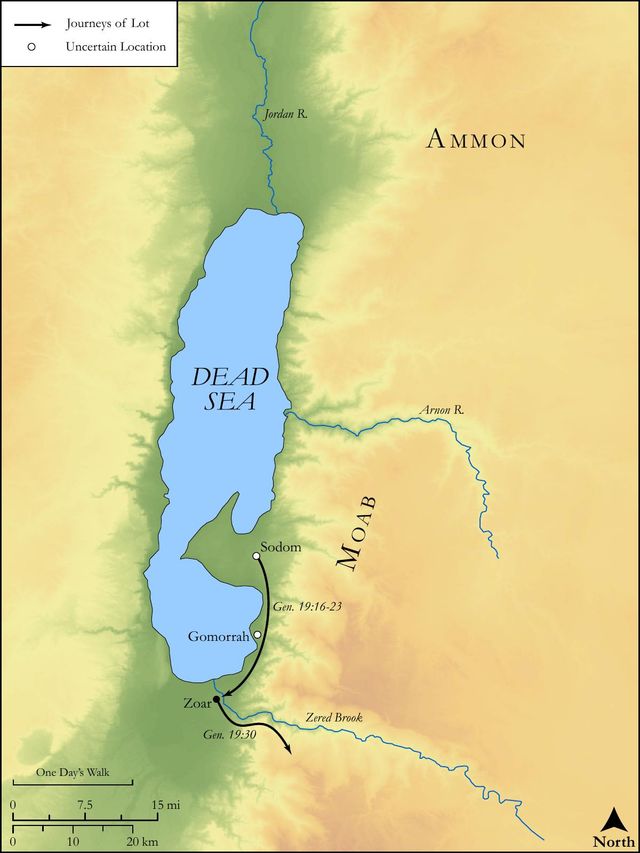
See on the biblical-era maps


Study this verse
Public-domain commentary
Matthew Henry
From his Commentary on the Whole Bible. Henry comments on passages, not single verses — this entry covers Genesis 19:1–3.
These angels, it is likely, were two of the three that had just before been with Abraham, the two created angels that were sent to execute God's purpose concerning Sodom. Observe here, 1. There was but one good man in Sodom, and these heavenly messengers soon found him out. Wherever we are, we should enquire out those of the place that live in the fear of God, and should choose to associate ourselves with them. Mat 10:11, Enquire who is worthy, and there abide. Those of the same country, when they are in a foreign country, love to be together. 2. Lot sufficiently distinguished himself from the rest of his neighbours, at this time, which plainly set a mark upon him. He that did not act like the rest must not fare like the rest. (1.) Lot sat in the gate of Sodom at even. When the rest, it is likely, were tippling and drinking, he sat alone, waiting for an opportunity to do good. (2.) He was extremely respectful to men whose mien and aspect were sober and serious, though they did not come in state. He bowed himself to the ground, when he met them, as if, upon the first view, he discerned something divine in them. (3.) He was hospitable, and very free and generous in his invitations and entertainments. He courted these strangers to his house, and to the best accommodations he had, and gave them all the evidences that he could of his sincerity; for, [1.] When the angels, to try whether he was hearty in the invitation, declined the acceptance of it, at first (which is the common usage of modesty, and no reproach at all to truth and honesty), their refusal did not make him more importunate; for he pressed upon them greatly (Gen 19:3), partly because he would be no means have them to expose themselves to the inconveniences and perils of lodging in the street of Sodom, and partly because he was desirous of their company and converse. He had not seen two such honest faces in Sodom this great while. Note, Those that live in bad places should know how to value the society of those that are wise and good, and earnestly desire it. [2.] When the angels accepted his invitation, he treated them nobly; he made a feast for them, and thought it well-bestowed on such guests. Note, Good people should be (with prudence) generous people.
Historical interpretation
Five Centuries of Reception
7 surviving comments on this verse. Each one is dated, so this reads as a timeline rather than a list.
Select a marker to jump to its quote. Markers stagger vertically where authors wrote within a few decades of each other.
Lot was not inside Sodom “but at the gate.” I might have said, just as Abraham was sitting outside his tent, out of hospitality, even at an inconvenient time (for it was the middle of the day) on the lookout for travelers, so his relative and the imitator of his morality “was sitting at the gate” ready to invite those passing through the land, even though evening had now come. For he surely knew the impiety of the Sodomites and that there was no rest for the stranger in that place.
“Now, the two angels,” the text says, “arrived at Sodom in the evening.” The time in particular shows us this good man’s extraordinary virtue in the fact that even despite the coming of evening he stayed at his post and did not leave it. That is to say, since he realized the advantage accruing to him from that, consequently he was anxious to attain the wealth and brought great vigilance to bear, not even desisting at the end of the day. This, you see, is what a fervent and vigilant soul is like. Far from being impeded by any obstacles from giving evidence of its virtue, it is spurred on to greater heights by the very impediments in particular and burns with a brighter flame of desire.
“Now, on seeing them,” the text goes on, “Lot rose to meet them.” Let this be heeded by those who are given to repulsing people who call on them with requests to make and causes to plead and who show them great inhumanity. I mean, see how this good man did not wait until the visitors reached him but like the patriarch, without knowing who the visitors were but presuming that they were travelers of some kind, well nigh jumped for joy on seeing them, as though falling upon his prey and not missing the object of his desire.
Scripture seems to have made no mention at all of angels before the flood. Only now [does it mention angels], as though seeing fit to have instructed people abundantly, by the length of the time past, to regard as God and Lord of the universe only that one Being who had made the created universe and supplied human beings, beginning with Adam, with the appropriate knowledge. [This knowledge was supplied] by his providence and through a variety of visions, guiding its transmission from the first people to those who followed in order.
It was “three men” who came to Abraham, and “in the heat of the day”; but in the case of Sodom, “two angels, and in the evening.” Good things are likened to light, bad things to evening, since the “sun of justice” has set on them. For the punishment of the wicked is night and darkness, but the righteous “will shine like light.” It is significant too that where there was an announcement of good things, the Lord was present. But when the subject is punishment, he does not appear in person, showing that when people have good experiences, it is his pleasure, so that he chooses, as it were, to act directly in such matters. Since he takes no pleasure in punishments but inflicts them only because of necessity, he makes use of underlings.
And the two angels came to Sodom in the evening, while Lot was sitting at the gates of the city. Not without cause, the angels who had come to Abraham at midday are reported to have come to Sodom in the evening, because they came to announce prosperity and joy to the former, but to bring adversity to the latter; he was burning with the fruit of light towards heavenly things, but this one, besieged by the darkness of vices, was approaching eternal perdition.
When he saw them, he rose, and went to meet them; he bowed down with his face to the ground and said: I beg you, my lords, turn aside to your servant's house and stay there, and so on. In blessed Lot a great and perfect example of godly hospitality is shown, who, seeing the guests entering the city, was not only prepared to meet and welcome them but also persistently asked them to turn aside to his house and rest with him. At first, they refused to enter his house, but eventually, at his urging, agreed to do so, so that they might more thoroughly test his hospitality's diligence and more worthily reward it, delivering him from the destruction of the sinners along with his house.
Continue studying Genesis 19:1 across the web’s major study libraries — every link below opens this exact verse, chapter, or book on the destination site.
Read & Compare
 BibleGatewayThis verse in more than 200 translations and 70 languages.
 Bible.comThe YouVersion reader — hundreds of translations, reading plans, and highlights.
 ESV.orgCrossway's official English Standard Version reader.
 NET BibleThe NET translation with 60,000+ translators' notes on every rendering decision.
 STEP BibleTyndale House's free study tool — original text, vocabulary, and scholarly resources.
 BibliaLogos Bible Software's free web reader.
 USCCBThe New American Bible (Revised Edition) with the U.S. bishops' study notes.
Commentaries
 BibleHub CommentariesDozens of classic commentaries on this verse, gathered on one page.
 StudyLightMore than 100 commentary sets — the largest collection on the web.
 BibleRefPlain-English commentary on what this verse means, verse by verse.
 Enduring WordDavid Guzik's free commentary on this chapter, widely used by Bible teachers.
 Bible Study ToolsVerse commentary alongside Greek and Hebrew study aids.
Original Language & Research
- BibleHub InterlinearThe verse word by word — original language, transliteration, and English.
- BibleHub LexiconEvery word's original-language definition and Strong's entry.
 Blue Letter BibleDeep-study tools — Strong's numbers, concordance, and word studies.
 SefariaThe Hebrew text with Rashi and centuries of Jewish commentary.
Sermons, Hymns & Audio


TrulyRandomVerse is not affiliated with these sites and doesn’t control their content. They’re linked because they’re genuinely useful.
Summary
Genesis 19:1 marks the pivotal arrival of two divine messengers in Sodom at dusk, initiating the climactic narrative of the city's impending judgment and Lot's miraculous deliverance. The verse immediately establishes Lot's presence at the city gate, a place of civic prominence, and highlights his immediate, profound act of hospitality and reverence toward the strangers, setting a stark moral contrast with the depraved society he inhabits and foreshadowing the divine intervention about to unfold.
Context
ShowHideLiterary Context
This verse immediately follows the profound theological exchange between Abraham and the Lord in Genesis 18, where Abraham intercedes passionately for the righteous within Sodom. The two angels arriving in Sodom are the same two who accompanied the Lord to Abraham's tent, confirming the promise of Isaac and revealing God's intent to investigate the "great outcry" against Sodom and Gomorrah (Genesis 18:20-21). Their arrival at the city gate, a public and legal hub, sets the stage for the dramatic events of the night, contrasting Lot's righteous hospitality with the city's inherent wickedness, which will be starkly revealed in the subsequent verses. This transition shifts the narrative focus from divine deliberation to active judgment and deliverance.
Historical & Cultural Context
In the ancient Near East, city gates were not merely points of entry but served as the central hub of urban life. They were places for commerce, legal proceedings, public assembly, and social interaction. Elders and judges would often sit at the gate to conduct official business and resolve disputes, as seen in Ruth 4:1-2. For Lot to be "sitting in the gate" suggests he held a position of some status or authority within Sodom, or at least was a regular, integrated participant in its public life. Hospitality was a paramount virtue in this culture, often considered a sacred duty, especially towards travelers. The act of bowing "with his face toward the ground" (prostration) was a common gesture of profound respect, deference, and submission, often shown to superiors, royalty, or divine beings, highlighting the significance of Lot's immediate response to the arriving strangers.
Key Themes
ShowHideGenesis 19:1 contributes significantly to several overarching themes within the book of Genesis and the broader biblical narrative. It underscores the theme of Divine Judgment as God's patience with human wickedness reaches its limit, fulfilling the Lord's stated intention to act upon the "great outcry" against Sodom (Genesis 18:20). Simultaneously, it introduces the theme of Divine Deliverance, as the angels' arrival is specifically for the purpose of rescuing Lot and his family, demonstrating God's faithfulness to His covenant and His commitment to preserving a righteous remnant, even amidst widespread corruption. The verse also highlights the crucial theme of Hospitality, contrasting Lot's virtuous welcome with the city's subsequent depravity, a virtue consistently upheld throughout Scripture, as seen later in Hebrews 13:2.
Exposition and Analysis
ShowHideGenesis 19:1 meticulously details the initial encounter that sets the stage for divine judgment and a narrow escape.
Key Word Analysis
ShowHideDerived from an unused root meaning "to dispatch as a deputy," this term specifically refers to a messenger, often of God. In this context, these are not mere human travelers but divine agents, dispatched by God to execute His will concerning Sodom. Their identity as "angels" (H4397) immediately signals the supernatural and authoritative nature of their mission, directly linking back to the Lord's declaration in Genesis 18.
This primitive root (H3427) means "to sit down," but can also imply "to dwell," "to remain," or "to settle." Lot's action of "sitting" in the gate suggests a settled presence, perhaps indicating a position of authority, a regular routine, or a deliberate waiting for travelers. It signifies his integration, albeit a precarious one, into the public life of Sodom.
This primitive root (H7812) means "to depress," specifically "to prostrate" oneself, often reflexively, in homage to royalty or God. Lot's act of bowing "with his face toward the ground" is a profound gesture of reverence, submission, and honor. It speaks volumes about his character, his adherence to deeply ingrained cultural norms of respect, and potentially his spiritual sensitivity to the extraordinary nature of his visitors.
Verse Breakdown
ShowHide"And there came two angels to Sodom at even"
This clause establishes the divine initiative and the specific timing of the events. The arrival of "two angels" (not just men) underscores the supernatural nature of the impending judgment and deliverance. "At even" (dusk) is a practical time for travelers to seek lodging, but also symbolically precedes the moral and literal darkness that will envelop Sodom.
"and Lot sat in the gate of Sodom"
This detail places Lot in a position of public visibility and potential influence. The "gate of Sodom" was the city's administrative and social center, suggesting Lot's integration into the city's life, perhaps as a respected figure or a regular participant in its public affairs, despite the city's deep-seated wickedness.
"and Lot seeing [them] rose up to meet them"
Lot's immediate "seeing" and "rising up" demonstrate his attentiveness and eagerness to extend hospitality. This active response contrasts sharply with the later actions of the city's inhabitants, highlighting Lot's distinct character and adherence to ancient customs of welcome.
"and he bowed himself with his face toward the ground"
This final action is a powerful gesture of profound respect, humility, and reverence. It is the highest form of ancient Near Eastern greeting, often reserved for superiors, royalty, or divine beings. Lot's immediate prostration indicates either his spiritual discernment of their extraordinary nature or his unwavering commitment to the highest standards of hospitality, even in a morally corrupt environment.
Literary Devices
ShowHideThe verse employs several significant literary devices. Foreshadowing is prominent, as the arrival of the angels at "even" hints at the impending darkness and judgment that will soon fall upon Sodom. The contrast between Lot's immediate, profound hospitality and the city's later violent rejection of the strangers creates powerful Irony, highlighting the moral bankruptcy of Sodom. The setting of the "gate of Sodom" functions as Symbolism, representing the public sphere, civic authority, and the moral pulse of the city, emphasizing Lot's precarious position within its corrupt system. Lot's act of bowing "with his face toward the ground" is a form of Hyperbole in its expression of extreme deference, underscoring the gravity of the encounter and Lot's character.
Theological and Thematic Connections
ShowHideThe arrival of the angels in Genesis 19:1 powerfully illustrates God's active involvement in human history, demonstrating His unwavering awareness of human sin and His readiness to execute both righteous judgment and merciful salvation. This divine intervention underscores that no wickedness goes unnoticed and that God's patience, though long-suffering, has a limit. Simultaneously, Lot's immediate and profound act of hospitality serves as a stark moral counterpoint to the impending depravity of Sodom, highlighting a virtue that is consistently valued in God's economy and is often a prerequisite for receiving divine favor or protection.
Reflection and Application
ShowHideGenesis 19:1 offers profound and enduring lessons for believers today, particularly regarding our posture in a fallen world and the enduring value of biblical virtues. Lot's immediate and humble offer of hospitality to strangers, even within a city steeped in profound corruption, serves as a timeless example of a virtue that God deeply values. This act reminds us of the New Testament exhortation to "be not forgetful to entertain strangers: for thereby some have entertained angels unawares" (Hebrews 13:2), challenging us to extend grace and welcome, even when it is inconvenient or seems undeserved. The arrival of these divine messengers also powerfully signifies God's active involvement in human affairs, demonstrating His unwavering awareness of sin and His readiness to execute both righteous judgment and merciful salvation. Furthermore, Lot, though living within the depraved environment of Sodom, maintained a degree of righteousness that distinguished him from its inhabitants, as noted in 2 Peter 2:7-8. This illustrates the ongoing tension and call for believers to stand apart from the world's corruption while living within it, maintaining our distinct identity and values, and being prepared to act righteously when God's timing for intervention arrives.
Questions for Reflection
ShowHideFAQ
ShowHideWho were these two angels, and why were they sent?
ShowHideThese two angels were part of the three divine visitors who had previously appeared to Abraham in Genesis 18. They were sent by God specifically to investigate the "great outcry" against Sodom and Gomorrah, to confirm the depth of the cities' wickedness, and to deliver Lot and his family before the impending divine judgment. Their divine nature underscores the seriousness of God's intent.
Why was Lot sitting in the city gate?
ShowHideIn ancient Near Eastern cities, the city gate was the primary public space where legal proceedings, commercial transactions, and community discussions took place. Lot's presence there suggests he held a position of some prominence or authority, perhaps as an elder or a judge, or simply that he was a regular participant in the city's public life. It indicates his integration into Sodom's society, despite his personal righteousness, which would soon be tested.
What is the significance of the angels arriving "at even"?
ShowHide"At even" (dusk or evening) was a common time for travelers to seek lodging and hospitality for the night, making Lot's offer of shelter culturally appropriate. It also carries symbolic weight, preceding the literal darkness that would soon cover Sodom, and metaphorically foreshadowing the moral darkness of the city's escalating wickedness and the subsequent divine judgment that would occur under the cover of night.
Why did Lot "bow himself with his face toward the ground"?
ShowHideThis gesture, known as prostration, was a profound act of respect, reverence, and submission in the ancient world. It was typically shown to superiors, royalty, or divine beings. Lot's immediate and humble response suggests he either recognized the extraordinary, perhaps divine, nature of his visitors, or was simply demonstrating the highest form of hospitality and deference to strangers, a virtue that would soon be starkly contrasted with the inhabitants of Sodom.
Christ-Centered Fulfillment
ShowHideGenesis 19:1, with the arrival of divine messengers to a city steeped in sin, profoundly foreshadows the ultimate advent of Christ. Just as two angels arrived to execute God's judgment and offer a narrow path of salvation, so too did Christ, the ultimate Divine Messenger and Son of God, come into a world condemned by sin, not primarily to condemn it, but to offer a comprehensive path of deliverance from eternal judgment (John 3:17). His first coming serves as the decisive moment for humanity, separating those who receive Him in faith from those who reject Him, much like Lot's family was separated from Sodom. Lot's immediate and profound hospitality to the strangers, who were angels, prefigures Christ's call to welcome the stranger and the "least of these" (Matthew 25:35-40), recognizing that in doing so, we serve Him. Ultimately, Christ is the One who delivers the righteous from the wrath to come, offering a salvation far greater than physical escape—eternal redemption from sin and death, and the promise of a new heaven and a new earth (Revelation 21:1-4). He is the true refuge and deliverer, fulfilling the partial rescue seen in Lot's story.