


Genesis 18:1
- וַיֵּרָאvai·ye·Ra'and he appearedH7200Conj-w ¦ V-Niphal-ConsecImperf-3msVerb Niphal Consecutive Imperfect 3rd Singular Masculineוַandיֵּרָאhe appeared
- אֵלָיו'e·Lavto himH413Prep ¦ 3msPreposition Definiteאֵלָיtoוhim
- יְהוָהYah·wehYahwehH3068N-properNoun Proper Title
- בְּאֵלֹנֵיbe·'e·lo·Neiat [the] great trees ofH436Prep-b ¦ N-mpcNoun Plural Masculine Constructבְּatאֵלֹנֵי[the] great trees of
- מַמְרֵאmam·Re'MamreH4471N-proper-mNoun Proper Masculine
- וְהוּאve·Hu'and heH1931Conj-w ¦ Pro-3msPronoun Personal 3rd Singular Masculineוְandהוּאhe
- יֹשֵׁבyo·Shev[was] sittingH3427V-Qal-Prtcpl-msVerb Qal Participle Singular Masculine Absolute
- פֶּתַחpe·tach[the] opening ofH6607N-mscNoun Singular Masculine Construct
- הָאֹהֶלha·'O·helthe tentH168Art ¦ N-msNoun Singular Masculine Absoluteהָtheאֹהֶלtent
- כְּחֹםke·Chomwhen [the] heat ofH2527Prep-k ¦ V-Qal-InfVerb Qal Infinitive Constructכְּwhenחֹם[the] heat of
- הַיּוֹםhai·Yomthe dayH3117Art ¦ N-msNoun Singular Masculine Absoluteהַtheיּוֹםday
English is a literal word-by-word gloss of the Hebrew, not the KJV's wording. Why?
This is the original text the KJV's translators worked from — each Hebrew word with its own literal English meaning in this verse, prepared by scholars at Tyndale House, Cambridge. The KJV translates whole sentences, not word by word, so its wording differs: one Hebrew word can become several English words, and the KJV may choose “the LORD” where the gloss reads “Yahweh”. Both are faithful — they answer different questions. For the KJV's own rendering, switch to the KJV text.
Details
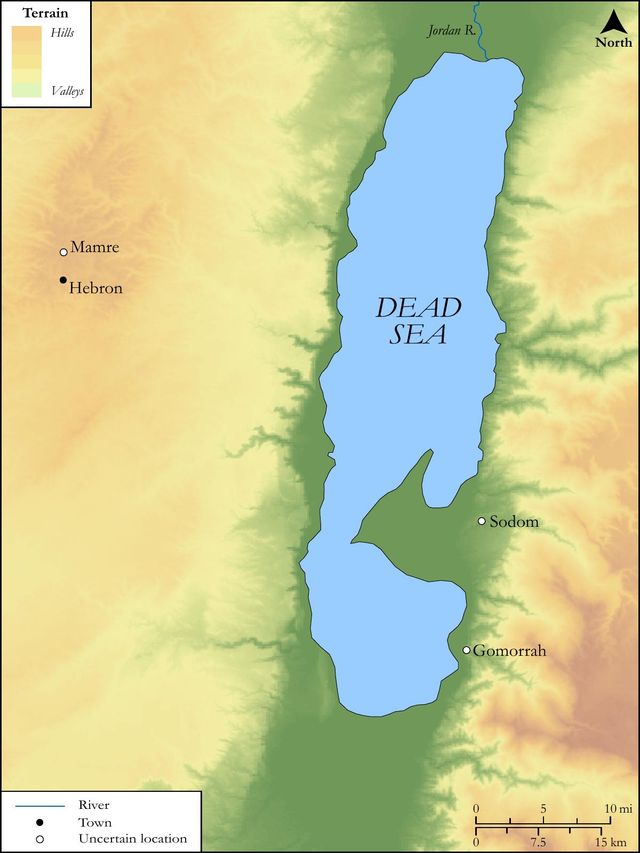
See on the biblical-era maps


Study this verse
Public-domain commentary
Matthew Henry
From his Commentary on the Whole Bible. Henry comments on passages, not single verses — this entry covers Genesis 18:1–8. His three-level outline is real structure in the source text, so it is rendered as structure.
The appearance of God to Abraham seems to have had in it more of freedom and familiarity, and less of grandeur and majesty, than those we have hitherto read of; and therefore more resembles that great visit which, in the fullness of time, the Son of God was to make to the world, when the Word would be flesh, and appear as one of us. Observe here,
I.How Abraham expected strangers, and how richly his expectations were answered (Gen 18:1):
He sat in the tent-door, in the heat of the day; not so much to repose or divert himself as to seek an opportunity of doing good, by giving entertainment to strangers and travellers, there being perhaps no inns to accommodate them. Note,
1.We are likely to have the most comfort of those good works to which we are most free and forward.
2.God graciously visits those in whom he has first raised the expectation of him, and manifests himself to those that wait for him. When Abraham was thus sitting, he saw three men coming towards him. These three men were three spiritual heavenly beings, now assuming human bodies, that they might be visible to Abraham, and conversable with him. Some think that they were all created angels, others that one of them was the Son of God, the angel of the covenant, whom Abraham distinguished from the rest (Gen 18:3), and who is called Jehovah, Gen 18:13. The apostle improves this for the encouragement of hospitality, Heb 13:2. Those that have been forward to entertain strangers have entertained angels, to their unspeakable honour and satisfaction. Where, upon a prudent and impartial judgment, we see no cause to suspect ill, charity teaches us to hope well and to show kindness accordingly. It is better to feed five drones, or wasps, than to starve one bee.
II.How Abraham entertained those strangers, and how kindly his entertainment was accepted.
The Holy Ghost takes particular notice of the very free and affectionate welcome Abraham gave to the strangers.
1.He was very complaisant and respectful to them. Forgetting his age and gravity, he ran to meet them in the most obliging manner, and with all due courtesy bowed himself towards the ground, though as yet he knew nothing of them but that they appeared graceful respectable men. Note, Religion does not destroy, but improve, good manners, and teaches us to honour all men. Decent civility is a great ornament to piety.
2.He was very earnest and importunate for their stay, and took it as a great favour, Gen 18:3, Gen 18:4. Note,
(1.)It becomes those whom God has blessed with plenty to be liberal and open-hearted in their entertainments, according to their ability, and (not in compliment, but cordially) to bid their friends welcome. We should take a pleasure in showing kindness to any; for both God and man love a cheerful giver. Who would eat the bread of him that has an evil eye? Pro 23:6, Pro 23:7.
(2.)Those that would have communion with God must earnestly desire it and pray for it. God is a guest worth entertaining.
3.His entertainment, though it was very free, was yet plain and homely, and there was nothing in it of the gaiety and niceness of our times. His dining-room was an arbour under a tree; no rich table-linen, no side-board set with plate. His feast was a joint or two of veal, and some cakes baked on the hearth, and both hastily dressed up. Here were no dainties, no varieties, no forced-meats, no sweet-meats, but good, plain, wholesome food, though Abraham was very rich and his guests were very honourable. Note, We ought not to be curious in our diet. Let us be thankful for food convenient, though it be homely and common; and not be desirous of dainties, for they are deceitful meat to those that love them and set their hearts upon them.
4.He and his wife were both of them very attentive and busy, in accommodating their guests with the best they had. Sarah herself is cook and baker; Abraham runs to fetch the calf, brings out the milk and butter, and thinks it not below him to wait at table, that he might show how heartily welcome his guests were. Note,
(1.)Those that have real merit need not take state upon them, nor are their prudent condescensions any disparagement to them.
(2.)Hearty friendship will stoop to any thing but sin. Christ himself has taught us to wash one another's feet, in humble love. Those that thus abase themselves shall be exalted. Here Abraham's faith showed itself in good works; and so must ours, else it is dead, Jam 2:21, Jam 2:26. The father of the faithful was famous for charity, and generosity, and good house-keeping; and we must learn of him to do good and to communicate. Job did not eat his morsel alone, Job 31:17.
Historical interpretation
Five Centuries of Reception
7 surviving comments on this verse. Each one is dated, so this reads as a timeline rather than a list.
Select a marker to jump to its quote. Markers stagger vertically where authors wrote within a few decades of each other.
But let us see what this tree represents, under which Abraham stood and provided a meal for the Lord and the angels. “Under the tree of Mamre” the text says. Mamre in our language is translated “vision” or “sharpness of sight.” Do you see what kind of place it is where the Lord can have a meal? Abraham’s vision and sharpness of sight pleased the Lord. For he was pure in heart so that he could see God. In such a place, therefore, and in such a heart the Lord can have a meal with his angels. In fact, earlier prophets were called seers.
Thus the Lord God is said to have appeared as a common man to Abraham while he was seated by the oak of Mamre. But [Abraham] immediately fell down, although he saw a man with his eyes, and worshiped him as God, besought him as Lord and confessed that he was not ignorant as to who he was, using these very words, “O Lord, judge of all the earth, will you not judge righteously?” For if it should be unreasonable to suppose that the unbegotten and immutable substance of God the Almighty was changed into the form of man and, in turn, that the eyes of the beholders were deceived by the phantasm of something created and that such things were falsely invented by Scripture, who else could be proclaimed God and the Lord who judges all the earth and judges righteously, appearing in the shape of a man—if it be not proper to call him the first cause of all things—than his preexistent Word alone?
Abraham, ready to receive strangers, faithful towards God, devoted in ministering, quick in his service, saw the Trinity in a type; he added religious duty to hospitality, when beholding Three he worshipped One, and preserving the distinction of the Persons, yet addressed one Lord, he offered to Three the honour of his gift, while acknowledging one Power. It was not learning but grace which spoke in him, and he believed better what he had not learnt than we who have learnt. No one had falsified the representation of the truth, and so he sees Three, but worships the Unity. He brings forth three measures of fine meal, and slays one victim, considering that one sacrifice is sufficient, but a triple gift; one victim, an offering of three.
[Daniel 8:15] "And it came to pass that when I, Daniel, had seen the vision, I sought to understand it." He beheld the vision by way of a picture or likeness, and he failed to understand it. Consequently, not everyone who sees comprehends what he has seen; it is just as if we read the Holy Scripture with our eyes and do not understand it with our heart,
"...And behold, one stood before me who resembled the appearance of a man." Angels, after all, are not actually men by nature, but they resemble men in appearance. For example, three persons appeared as men to Abraham at the oak of Mamre (Genesis 18:1-2), and yet they certainly were not men, for one of them was worshipped as the Lord. And so the Savior also stated in the Gospel: "Abraham beheld My day; he beheld it and rejoiced" (John 8:56).
God appeared again to Abraham at the oak of Mamre in three men, who it is not to be doubted were angels, although some think that one of them was Christ and assert that he was visible before he put on flesh. Now it belongs to the divine power and invisible, incorporeal and incommunicable nature, without changing itself at all, to appear even to mortals, not by what it is but by what is subject to it. And what is not subject to it? Yet if they try to establish that one of these three was Christ by the fact that although he saw three, he addressed the Lord in the singular, as it is written, “He lifted up his eyes and looked, and behold, three men stood in front of him. When he saw them, he ran from the tent door to meet them, and bowed himself to the earth and said, ‘My lord, if I have found favor in your sight.’ ” Why do they not refer also to this, that when two of them came to destroy the Sodomites, while Abraham still spoke to one, calling him Lord and interceding that he would not destroy the righteous along with the wicked in Sodom, Lot received these two in such a way that he too in his conversation with them addressed the Lord in the singular? For after saying to them in the plural, “My lords, turn aside, I pray you, to your servant’s house,” yet it is afterward said, “So [the angels] seized him and his hand, [because] the Lord [was] merciful to him, and they brought him forth and set him outside the city. And when they had brought them forth, they said, ‘Flee for your life; do not look back or stop anywhere in the valley; flee to the hills, lest you be consumed.’ And Lot said to them, ‘Oh, no, my lords; behold, your servant has found favor in your sight.…’ ” And then after these words the Lord also answered him in the singular, although he was in two angels, saying, “Behold, I grant you this favor.…” This makes it much more credible that Abraham in the three men and Lot in the two recognized the Lord, addressing him in the singular number, even when they were addressing men; for they received them as they did for no other reason than that they might minister human nourishment to them as men who needed it. Yet there was about them something so excellent that those who showed them hospitality as men could not doubt that God was in them as he was wont to be in the prophets and therefore sometimes addressed them in the plural, and sometimes God in them in the singular. But that they were angels the Scripture testifies, not only in this book of Genesis, in which these transactions are related, but also in the epistle to the Hebrews, where in praising hospitality it is said, “For thereby some have entertained angels unawares.”
Now where did this happen? “Near the holm-oak of Mamre,” which in Latin is interpreted as “vision” or “discernment.” Do you see what kind of a place it is in which the Lord can have a feast? The vision and discernment of Abraham delighted him; he was clean of heart, so that he could see God. Therefore in such a place and in such a heart the Lord can have his feast. Of this vision our Lord spoke to the Jews in the Gospel when he said, “Abraham rejoiced that he was to see my day. He saw it and was glad.” He saw my day, he says, because he recognized the mystery of the Trinity. He saw the Father as day, the Son as day, the Holy Spirit as day, and in these three one day. Thus the Father is God, the Son is God, the Holy Spirit is God, and these three are one God. For individually each person is complete God, and all three together are one God. Moreover, because of the unity of substance, in those three measures of flour the Father, Son and Holy Spirit are not unfittingly understood. However, this can also be taken in another way by understanding Sarah as the church; the three measures of flour then are faith, hope and charity. In these three virtues all the fruits of the church are contained, so that if one merits to possess the three within oneself, one can with security receive the entire Trinity at the banquet of one’s heart.
The Lord appeared to him in the valley of Mamre as he was sitting at the entrance of his tent in the heat of the day, etc. This appearance of the Lord is considered to be more sacred than all the previous ones, in which He was seen so many times by the blessed Abraham. And rightly so, after receiving the sacrament of circumcision, after the name was amplified by which he was to be marked as the father of all nations, he came to know the more secret mysteries of God, of which, notably, not only circumcision but also the uncircumcised were to be participants. Rightly, the appearance in the valley of Mamre is remembered as having taken place. For Mamre, as we read above, was indeed an Amorite by race, but together with his brothers, he was allied with Abraham; hence the valley of Mamre aptly represents our humility, who, having derived fleshly origin from the nations, have Abraham as our father in spirit and faith. To whom the Apostle, drawing from Abraham both the origin of flesh and virtue, says: We announce to you eternal life, which was with the Father and appeared to us; what we have seen and heard, we declare to you, so that you too may have fellowship with us (1 John 1:2). And indeed in this reading, apart from the spiritual understanding, it greatly edifies the readers that Abraham, seeing unknown men, immediately ran to meet them as if to offer the grace of hospitality to strangers; that he approached them humbly, worshipped on the ground, that he asked them to wait and accept his service, and hastily provided what they agreed to; and that he completed this not through servants and maidservants, but by himself and Sarah. It is indeed remarkable if, upon first seeing them, he did not believe they were men, why he would want to bring them water to wash their feet; how he would ask them to rest under a tree as if weary from walking; why he requested to strengthen their bodies with refreshment, as if they were laboring in fasting. If anyone seeks to investigate this reading more deeply, he will find it to be full of spiritual senses. For the fact that the Lord appeared to Abraham sitting at the entrance of his tent greatly suits both Abraham's devotion and that of all the heirs of the same promise, who testify that they are strangers and sojourners in this world but truly citizens of another life, that is, of the heavenly homeland. For we use tents in a journey or in war, but a house in our homeland, in which mystery, Isaac and Jacob are also read to have dwelled in tents. He who remains in the midst of his tent, knowing that he is a stranger and not destined to live forever in this world, and yet is not ashamed to engage himself as much as he can in the affairs and allurements of the world, remains. But Abraham and his followers, who conduct the things of the world out of necessity and not out of pleasure, sit as if at the entrance of their tent, because they are ready to leave the world at any moment, always with a joyful mind stretched towards the future rewards and waiting for the entrance into the following life. And it is well added, in the heat of the day; for the heat of the day, in which Abraham was sitting at the entrance of his tent, signifies the virtue of love with which he was burning in his mind with respect towards the Sun of righteousness. And such a state of place and time was fitting for him who was to see the Lord and enjoy His conversation, in which both the sojourner of this world would be figuratively represented, and irradiated by the light of true heavenly grace, and zealously enflamed with the love of divine contemplation.
Continue studying Genesis 18:1 across the web’s major study libraries — every link below opens this exact verse, chapter, or book on the destination site.
Read & Compare
 BibleGatewayThis verse in more than 200 translations and 70 languages.
 Bible.comThe YouVersion reader — hundreds of translations, reading plans, and highlights.
 ESV.orgCrossway's official English Standard Version reader.
 NET BibleThe NET translation with 60,000+ translators' notes on every rendering decision.
 STEP BibleTyndale House's free study tool — original text, vocabulary, and scholarly resources.
 BibliaLogos Bible Software's free web reader.
 USCCBThe New American Bible (Revised Edition) with the U.S. bishops' study notes.
Commentaries
 BibleHub CommentariesDozens of classic commentaries on this verse, gathered on one page.
 StudyLightMore than 100 commentary sets — the largest collection on the web.
 BibleRefPlain-English commentary on what this verse means, verse by verse.
 Enduring WordDavid Guzik's free commentary on this chapter, widely used by Bible teachers.
 Bible Study ToolsVerse commentary alongside Greek and Hebrew study aids.
Original Language & Research
- BibleHub InterlinearThe verse word by word — original language, transliteration, and English.
- BibleHub LexiconEvery word's original-language definition and Strong's entry.
 Blue Letter BibleDeep-study tools — Strong's numbers, concordance, and word studies.
 SefariaThe Hebrew text with Rashi and centuries of Jewish commentary.
Sermons, Hymns & Audio


TrulyRandomVerse is not affiliated with these sites and doesn’t control their content. They’re linked because they’re genuinely useful.
Summary
Genesis 18:1 introduces a pivotal divine encounter where the LORD reveals Himself to Abraham in the plains of Mamre. This seemingly ordinary moment, with Abraham resting in his tent door during the day's heat, becomes the setting for an extraordinary visitation that precedes the miraculous announcement of Isaac's birth and Abraham's subsequent intercession for the cities of Sodom and Gomorrah. The verse underscores God's sovereign initiative in drawing near to His chosen patriarch, initiating a profound dialogue that shapes the unfolding covenant narrative.
Context
ShowHideLiterary Context
This verse immediately follows the significant covenant renewal in Genesis 17, where God reconfirms His promises to Abraham, institutes circumcision as a sign, and changes Abram's name to Abraham, signifying his destiny as "father of a multitude." The promise of a son through Sarah, Isaac, is explicitly given, though Sarah's initial reaction is one of doubt. Genesis 18:1 thus opens a new chapter in the unfolding of this promise, moving from a verbal declaration to a direct, visible manifestation of the LORD. It sets the stage for the miraculous birth announcement in Genesis 18:9-15 and Abraham's intercessory prayer for Sodom, which begins in Genesis 18:23.
Historical & Cultural Context
Abraham's life was characterized by a nomadic existence, dwelling in tents and moving through the land of Canaan. Mamre, located near Hebron, was a significant place for Abraham, where he had previously built an altar to the LORD and settled for a period, as noted in Genesis 13:18. The description of Abraham "sitting in the tent door in the heat of the day" is rich with ancient Near Eastern cultural nuances. Midday was typically a time when activity ceased due to the intense heat, and people would rest in the shade. Sitting at the tent door was a common posture for a patriarch, a place of observation, welcome, and hospitality, signaling a readiness to receive guests. This detail highlights Abraham's availability and openness, even during a time of rest, making him receptive to the unexpected divine visitation.
Key Themes
ShowHideGenesis 18:1 introduces and reinforces several foundational themes woven throughout the book of Genesis and the broader biblical narrative. The most prominent is the divine initiative, where God consistently takes the first step to reveal Himself and engage with humanity, as seen in God's initial call to Abram in Genesis 12:1. This verse also powerfully illustrates God's immanence—His willingness to draw near and interact directly with His people in their physical space and daily lives. The setting also subtly introduces the theme of hospitality, which becomes central to the subsequent narrative as Abraham welcomes the three visitors. Furthermore, Abraham's posture and the unexpected nature of the encounter underscore the theme of receptivity and attentiveness to God's presence, even in the mundane. Ultimately, this encounter advances the overarching theme of covenant faithfulness, as God continues to work towards the fulfillment of His promises to Abraham.
Exposition and Analysis
ShowHideKey Word Analysis
ShowHideThis is the Tetragrammaton, YHWH, God's personal, covenant name, often translated as "Jehovah" or "Yahweh." It derives from the Hebrew verb "to be" (H1961, hâyâh'), signifying God's eternal, self-existent, and unchanging nature. Its use here emphasizes the intimate and faithful character of the God who is revealing Himself to Abraham, the same God who established the covenant with him.
The verb used here is in the Niphal stem (passive or reflexive), vayyera (וַיֵּרָא), meaning "He was seen" or "He caused Himself to be seen." This indicates a visible, direct, and often unexpected manifestation of God. It is not merely a vision or a dream, but a tangible, real encounter where God takes the initiative to make Himself known, underscoring the reality and immediacy of the divine presence.
This verb signifies "to sit down," but also "to dwell," "to remain," or "to settle." In this context, it describes Abraham's posture of rest and ease. However, sitting at the tent door also implies a state of readiness, observation, and availability, particularly for receiving guests. This seemingly mundane detail is crucial, as it portrays Abraham as being in a state of receptivity, open to whatever the day might bring, including a divine visitation.
Verse Breakdown
ShowHide"And the LORD appeared unto him"
This opening clause immediately establishes the divine initiative. God, identified by His personal covenant name, YHWH, actively and visibly manifests Himself to Abraham. The verb "appeared" (Niphal of râʼâh') denotes a real, tangible, and unprompted self-revelation, emphasizing God's sovereignty and His desire to engage directly with His chosen servant.
"in the plains of Mamre"
This provides the specific geographical setting for the encounter. Mamre was a familiar and significant location for Abraham, near Hebron, where he had previously settled and built an altar, signifying a place of established relationship and worship with God. The term "plains" (or "oaks" in some translations, from H436, ʼêlôwn') suggests an open, perhaps sacred, space, grounding the divine visitation in Abraham's everyday reality.
"and he sat in the tent door"
This detail describes Abraham's posture and location. Sitting at the entrance of his tent was characteristic of a nomadic patriarch, a place of rest, observation, and readiness to offer hospitality. The "tent door" (H168, ʼôhel' and H6607, pethach') serves as a threshold between the private and public, symbolizing an open disposition, not hidden away but accessible to visitors.
"in the heat of the day"
This specifies the time of the encounter—midday, when the sun's intensity in the ancient Near East typically led to a cessation of activity and a search for shade. This seemingly ordinary, even inconvenient, time for a divine encounter highlights that God can choose to reveal Himself in the most mundane and unexpected moments of human life, not just in times of explicit spiritual seeking. It also subtly sets the stage for Abraham's immediate act of hospitality to the three visitors who appear in the subsequent verses.
Literary Devices
ShowHideGenesis 18:1 masterfully employs several literary devices. The most prominent is Theophany, the visible manifestation of God to humanity, which establishes the supernatural nature of the event. The description of Abraham's mundane activities provides a stark Contrast between the ordinary human setting and the extraordinary divine visitation, emphasizing God's ability to break into everyday life. The precise details of the setting—"plains of Mamre," "tent door," "heat of the day"—serve as Setting as Character, grounding the narrative in a specific, relatable context while imbuing these elements with symbolic weight. Abraham's posture at the tent door also acts as Foreshadowing, subtly preparing the reader for the profound act of hospitality that immediately follows in the narrative, where Abraham welcomes the divine visitors. Finally, the use of Anthropomorphic Language in "the LORD appeared" suggests God's interaction in a humanly perceivable form, making the divine accessible to human understanding.
Theological and Thematic Connections
ShowHideGenesis 18:1 powerfully illustrates the active, personal nature of God in the lives of His people. It is God who takes the initiative to "appear," demonstrating His sovereign will and His commitment to His covenant promises. This divine self-revelation underscores the intimate relationship God desires with humanity, drawing near to Abraham not in a grand temple or a burning bush, but in the ordinary setting of his tent door during a mundane time of day. This encounter reaffirms God's faithfulness to His word, setting the stage for the miraculous fulfillment of the promise of Isaac's birth, despite the human impossibilities. It also subtly introduces the theme of hospitality, a virtue highly valued in the ancient world and spiritually significant, as welcoming strangers can mean welcoming divine messengers.
Reflection and Application
ShowHideGenesis 18:1 offers a profound invitation to recognize God's active presence in the seemingly ordinary moments of our lives. Abraham was not actively seeking a vision or engaged in a spiritual ritual; he was simply resting from the day's heat. Yet, it was precisely in this mundane setting that the LORD chose to reveal Himself. This encourages us to cultivate a spirit of attentiveness and availability, understanding that divine encounters are not confined to specific times or places of worship, but can break into our daily routines, our moments of rest, or even our times of quiet reflection. It challenges us to remain open to God's initiative, to be receptive to His voice and presence, and to recognize that His faithfulness to His promises extends even to the most unexpected circumstances. Like Abraham, we are called to be ready to receive God's revelation, whether it comes in a dramatic manifestation or a quiet whisper in the midst of our everyday lives, trusting in His unwavering commitment to His children.
Questions for Reflection
ShowHideFAQ
ShowHideWhat is the significance of "the LORD" appearing to Abraham?
ShowHideThe term "the LORD" translates the Hebrew YHWH (H3068, Yᵉhôvâh'), God's personal covenant name, signifying His eternal, self-existent nature and His unwavering faithfulness to His promises. His direct appearance (Hebrew: H7200, râʼâh', in the Niphal form, vayyera) signifies a real, visible, and tangible manifestation, not merely a dream or vision. This emphasizes God's sovereign initiative in drawing near to Abraham, reaffirming His covenant relationship and intentions, particularly regarding the promise of Isaac's birth, as detailed later in Genesis 18.
Why is Abraham described as "sitting in the tent door in the heat of the day"?
ShowHideThis detail is rich with cultural and spiritual significance. In the ancient Near East, midday heat (H2527, chôm') was a time for rest, and sitting at the "tent door" (H168, ʼôhel' and H6607, pethach') was a common posture for a patriarch. It suggests Abraham was available and open to visitors, embodying the virtue of hospitality. Spiritually, it highlights that God can meet us in our ordinary, even restful, moments, not just during specific times of spiritual seeking. It also subtly foreshadows Abraham's immediate and crucial act of hospitality to the three divine visitors in the verses that follow Genesis 18:2-8.
Christ-Centered Fulfillment
ShowHideThe appearance of "the LORD" to Abraham in Genesis 18:1 serves as a profound Old Testament foreshadowing of God's ultimate self-revelation in Jesus Christ. While the exact nature of this theophany—whether a pre-incarnate appearance of the Son, an angel representing God, or God Himself in a visible form—has been debated, it undeniably points to God's desire for direct communion with humanity. In the person of Jesus Christ, God did not merely "appear" in a transient form, but took on full humanity, dwelling among us as the Word made flesh (as beautifully articulated in John 1:14). Jesus is the perfect and final revelation of God, the one through whom we truly see the Father, as He Himself declared, "Whoever has seen me has seen the Father" (John 14:9). Thus, this ancient encounter in the plains of Mamre anticipates the greater, permanent, and saving presence of God in the person of Jesus Christ, who bridges the gap between the divine and the human, making intimate relationship with God eternally possible.