


Genesis 18:23
- וַיִּגַּשׁvai·yi·Gashand he drew nearH5066Conj-w ¦ V-Qal-ConsecImperf-3msVerb Qal Consecutive Imperfect 3rd Singular Masculineוַandיִּגַּשׁhe drew near
- אַבְרָהָם'av·ra·HamAbrahamH85N-proper-mNoun Proper Masculine
- וַיֹּאמַרvai·yo·Marand he saidH559Conj-w ¦ V-Qal-ConsecImperf-3msVerb Qal Consecutive Imperfect 3rd Singular Masculineוַandיֹּאמַרhe said
- הַאַףha·'Af¿ alsoH637Interrog ¦ PrtParticle Interjectionהַ¿אַףalso
- תִּסְפֶּהtis·Pehwill you sweep awayH5595V-Qal-Imperf-2msVerb Qal Imperfect 2nd Singular Masculine
- צַדִּיקtza·Dik[the] righteousH6662Adj-msAdjective Singular Masculine Absolute
- עִם'imwithH5973PrepPreposition
- רָשָׁעra·Sha'[the] wickedH7563N-msNoun Singular Masculine Absolute
English is a literal word-by-word gloss of the Hebrew, not the KJV's wording. Why?
This is the original text the KJV's translators worked from — each Hebrew word with its own literal English meaning in this verse, prepared by scholars at Tyndale House, Cambridge. The KJV translates whole sentences, not word by word, so its wording differs: one Hebrew word can become several English words, and the KJV may choose “the LORD” where the gloss reads “Yahweh”. Both are faithful — they answer different questions. For the KJV's own rendering, switch to the KJV text.
Details
See on the biblical-era maps


Study this verse
Public-domain commentary
Matthew Henry
From his Commentary on the Whole Bible. Henry comments on passages, not single verses — this entry covers Genesis 18:23–33. His four-level outline is real structure in the source text, so it is rendered as structure.
Communion with God is kept up by the word and by prayer. In the word God speaks to us; in prayer we speak to him. God had revealed to Abraham his purposes concerning Sodom; now from this Abraham takes occasion to speak to God on Sodom's behalf. Note, God's word then does us good when it furnishes us with matter for prayer and excites us to it. When God has spoken to us, we must consider what we have to say to him upon it. Observe,
I.The solemnity of Abraham's address to God on this occasion:
Abraham drew near, Gen 18:23. The expression intimates, 1. A holy concern: He engaged his heart to approach to God, Jer 30:21. "Shall Sodom be destroyed, and I not speak one good word for it?" 2. A holy confidence: He drew near with an assurance of faith, drew near as a prince, Job 31:37. Note, When we address ourselves to the duty of prayer, we ought to remember that we are drawing near to God, that we may be filled with a reverence of him, Lev 10:3.
II.The general scope of this prayer.
It is the first solemn prayer we have upon record in the Bible; and it is a prayer for the sparing of Sodom. Abraham, no doubt, greatly abhorred the wickedness of the Sodomites; he would not have lived among them, as Lot did, if they would have given him the best estate in their country; and yet he prayed earnestly for them. Note, Though sin is to be hated, sinners are to be pitied and prayed for. God delights not in their death, nor should we desire, but deprecate, the woeful day.
1.He begins with a prayer that the righteous among them might be spared, and not involved in the common calamity, having an eye particularly to just Lot, whose disingenuous carriage towards him he had long since forgiven and forgotten, witness his friendly zeal to rescue him before by his sword and now by his prayers.
2.He improves this into a petition that all might be spared for the sake of the righteous that were among them, God himself countenancing this request, and in effect putting him upon it by his answer to his first address, Gen 18:26. Note, We must pray, not only for ourselves, but for others also; for we are members of the same body, at least of the same body of mankind. All we are brethren.
III.The particular graces eminent in this prayer.
1.Here is great faith; and it is the prayer of faith that is the prevailing prayer. His faith pleads with God, orders the cause, and fills his mouth with arguments. He acts faith especially upon the righteousness of God, and is very confident.
(1.)That God will not destroy the righteous with the wicked, Gen 18:23. No, that be far from thee, Gen 18:25. We must never entertain any thought that derogates from the honour of God's righteousness. See Rom 3:5, Rom 3:6. Note,
[1.]The righteous are mingled with the wicked in this world. Among the best there are, commonly, some bad, and among the worst some good: even in Sodom, one Lot.
[2.]Though the righteous be among the wicked, yet the righteous God will not, certainly he will not, destroy the righteous with the wicked. Though in this world they may be involved in the same common calamities, yet in the great day a distinction with be made.
(2.)That the righteous shall not be as the wicked, Gen 18:25. Though they may suffer with them, yet they do not suffer like them. Common calamities are quite another thing to the righteous than what they are to the wicked, Isa 27:7.
(3.)That the Judge of all the earth will do right; undoubtedly he will, because he is the Judge of all the earth; it is the apostle's argument, Rom 3:5, Rom 3:6. Note,
[1.]God is the Judge of all the earth; he gives charge to all, takes cognizance of all, and will pass sentence upon all.
[2.]That God Almighty never did nor ever will do any wrong to any of the creatures, either by withholding that which is right or by exacting more than is right, Job 34:10, Job 34:11.
2.Here is great humility.
(1.)A deep sense of his own unworthiness (Gen 18:27): Behold now, I have taken upon me to speak unto the Lord, who am but dust and ashes; and again, Gen 18:31. He speaks as one amazed at his own boldness, and the liberty God graciously allowed him, considering God's greatness - he is the Lord; and his own meanness - but dust and ashes. Note,
[1.]The greatest of men, the most considerable and deserving, are but dust and ashes, mean and vile before God, despicable, frail, and dying.
[2.]Whenever we draw near to God, it becomes us reverently to acknowledge the vast distance that there is between us and God. He is the Lord of glory, we are worms of the earth.
[3.]The access we have to the throne of grace, and the freedom of speech allowed us, are just matter of humble wonder, Sa2 7:18.
(2.)An awful dread of God's displeasure: O let not the Lord be angry (Gen 18:30), and again, Gen 18:32. Note,
[1.]The importunity which believers use in their addresses to God is such that, if they were dealing with a man like themselves, they could not but fear that he would be angry with them. But he with whom we have to do is God and not man; and, whoever he may seem, is not really angry with the prayers of the upright (Psa 80:4), for they are his delight (Pro 15:8), and he is pleased when he is wrestled with.
[2.]That even when we receive special tokens of the divine favour we ought to be jealous over ourselves, lest we make ourselves obnoxious to the divine displeasure; and therefore we must bring the Mediator with us in the arms of our faith, to atone for the iniquity of our holy things.
3.Here is great charity.
(1.)A charitable opinion of Sodom's character: as bad as it was, he thought there were several good people in it. It becomes us to hope the best of the worst places. Of the two it is better to err in that extreme.
(2.)A charitable desire of Sodom's welfare: he used all his interest at the throne of grace for mercy for them. We never find him thus earnest in pleading with God for himself and his family, as here for Sodom.
4.Here are great boldness and believing confidence.
(1.)He took the liberty to pitch upon a certain number of righteous ones which he supposed might be in Sodom. Suppose there be fifty, Gen 18:24.
(2.)He advanced upon God's concessions, again and again. As God granted much, he still begged more, with the hope of gaining his point.
(3.)He brought the terms as low as he could for shame (having prevailed for mercy if there were but ten righteous ones in five cities), and perhaps so low that he concluded they would have been spared.
IV.The success of the prayer.
He that thus wrestled prevailed wonderfully; as a prince he had power with God: it was but ask and have.
1.God's general good-will appears in this, that he consented to spare the wicked for the sake of the righteous. See how swift God is to show mercy; he even seeks a reason for it. See what great blessings good people are to any place, and how little those befriend themselves that hate and persecute them.
2.His particular favour to Abraham appeared in this, that he did not leave off granting till Abraham left off asking. Such is the power of prayer. Why then did Abraham leave off asking, when he had prevailed so far as to get the place spared it there were but ten righteous in it? Either,
(1.)Because he owned that it deserved to be destroyed if there were not so many; as the dresser of the vineyard, who consented that the barren tree should be cut down if one year's trial more did not make it fruitful, Luk 13:9. Or,
(2.)Because God restrained his spirit from asking any further. When God has determined the ruin of a place, he forbids it to be prayed for, Jer 7:16; Jer 11:14; Jer 14:11.
V.Here is the breaking up of the conference, Gen 18:33.
1.The Lord went his way. The visions of God must not be constant in this world, where it is by faith only that we are to set God before us. God did not go away till Abraham had said all he had to say; for he is never weary of hearing prayer, Isa 59:1.
2.Abraham returned unto his place, not puffed up with the honour done him, nor by these extraordinary interviews taken off from the ordinary course of duty. He returned to his place to observe what that event would be; and it proved that his prayer was heard, and yet Sodom was not spared, because there were not ten righteous in it. We cannot expect too little from man nor too much from God.
Historical interpretation
Historical reception
1 surviving comment on this verse from the historical church.
And they turned themselves from there and went towards Sodom; but Abraham still stood before the Lord, and approaching he said: Will you indeed destroy the righteous with the wicked? If fifty righteous are in the city, will they perish along with the rest, until he said: If ten are found there; and the Lord said: I will not destroy it for the sake of the ten. It is read further that two angels came to Sodom and were received by Lot; hence it seems likely that at this place two angels departed from Abraham, and he spoke with the one who remained with him, interceding for the perishing city. In which intercession, the humility of the blessed Abraham is especially to be considered, who, although he was esteemed so highly by God that he received Him as a familiar guest and interceded with Him as if with a friend of one mind for others, nevertheless in his own estimation he remained vile and despicable; hence in his second prayer he says to Him:
Continue studying Genesis 18:23 across the web’s major study libraries — every link below opens this exact verse, chapter, or book on the destination site.
Read & Compare
 BibleGatewayThis verse in more than 200 translations and 70 languages.
 Bible.comThe YouVersion reader — hundreds of translations, reading plans, and highlights.
 ESV.orgCrossway's official English Standard Version reader.
 NET BibleThe NET translation with 60,000+ translators' notes on every rendering decision.
 STEP BibleTyndale House's free study tool — original text, vocabulary, and scholarly resources.
 BibliaLogos Bible Software's free web reader.
 USCCBThe New American Bible (Revised Edition) with the U.S. bishops' study notes.
Commentaries
 BibleHub CommentariesDozens of classic commentaries on this verse, gathered on one page.
 StudyLightMore than 100 commentary sets — the largest collection on the web.
 BibleRefPlain-English commentary on what this verse means, verse by verse.
 Enduring WordDavid Guzik's free commentary on this chapter, widely used by Bible teachers.
 Bible Study ToolsVerse commentary alongside Greek and Hebrew study aids.
Original Language & Research
- BibleHub InterlinearThe verse word by word — original language, transliteration, and English.
- BibleHub LexiconEvery word's original-language definition and Strong's entry.
 Blue Letter BibleDeep-study tools — Strong's numbers, concordance, and word studies.
 SefariaThe Hebrew text with Rashi and centuries of Jewish commentary.
Sermons, Hymns & Audio


TrulyRandomVerse is not affiliated with these sites and doesn’t control their content. They’re linked because they’re genuinely useful.
Summary
Genesis 18:23 marks the dramatic commencement of Abraham's bold intercession for the cities of Sodom and Gomorrah, as he courageously approaches the Lord with a direct and challenging question concerning the very nature of divine justice. His query, "Wilt thou also destroy the righteous with the wicked?", is not a challenge to God's authority but a profound appeal to His inherent righteousness and a testament to Abraham's deep concern for human life, setting the spiritual stage for his persistent and remarkable negotiation on behalf of the inhabitants of the condemned cities.
Context
ShowHideLiterary Context
This verse is situated within a highly significant narrative in Genesis 18, immediately following the Lord's revelation to Abraham regarding the impending judgment upon Sodom and Gomorrah. After the divine visitors reaffirm the promise of Isaac's birth in Genesis 18:10 and Sarah's subsequent laughter, the focus shifts dramatically. The Lord, recognizing Abraham's unique status as His friend and the progenitor of a great nation, chooses to confide in him His intentions concerning the cities whose sin had become "very grievous" (Genesis 18:20). As two of the visitors depart towards Sodom, Abraham "drew near" to the remaining divine figure, initiating this extraordinary dialogue of intercession. This moment highlights Abraham's intimate relationship with God and his emerging role as a spiritual advocate, bridging the gap between divine judgment and human plight.
Historical & Cultural Context
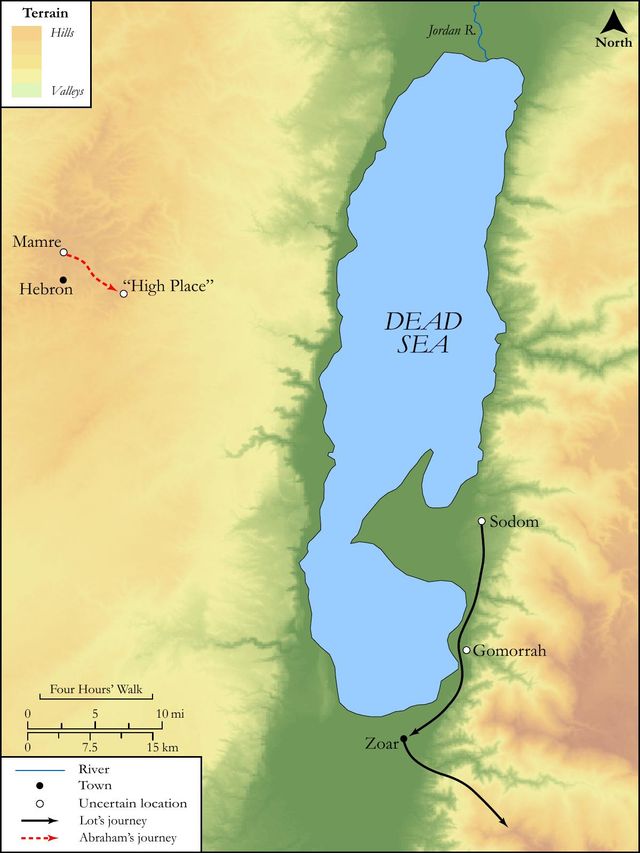
The setting is the patriarchal period, characterized by nomadic or semi-nomadic life, tribal structures, and a strong emphasis on hospitality, family lineage, and covenant relationships. Abraham is at the oaks of Mamre, a familiar encampment. The cities of Sodom and Gomorrah, located in the fertile plain of the Jordan (likely near the southern end of the Dead Sea), were renowned for their prosperity but also for their extreme moral depravity, as indicated by the "outcry" against them. In the ancient Near East, divine judgment on cities was not uncommon, often linked to severe moral corruption or defiance against a deity. Abraham's intercession, however, stands out as a unique act of bold negotiation with the divine, reflecting a deep-seated belief in a God who operates by principles of justice and righteousness, unlike the capricious deities of surrounding pagan cultures.
Key Themes
ShowHideGenesis 18:23 contributes significantly to several overarching themes in the book of Genesis and beyond. It powerfully illustrates God's justice and righteousness, demonstrating that His judgment is not arbitrary but based on moral accountability. Simultaneously, it reveals God's mercy and willingness to hear intercession, as He patiently engages with Abraham's plea. The passage also develops the theme of Abraham's unique relationship with God, solidifying his role as a "friend of God" (James 2:23) and a prototype of the intercessor. Furthermore, it implicitly introduces the concept of the righteous remnant, foreshadowing how the presence of even a few righteous individuals can influence divine action and potentially avert widespread destruction, a theme that resonates throughout biblical history (e.g., Isaiah 1:9).
Exposition and Analysis
ShowHideKey Word Analysis
ShowHideThis primitive root (H5066) signifies a purposeful and intentional approach, often implying a respectful yet determined posture before a superior for direct address or prayer. It conveys Abraham's courage and spiritual intimacy, enabling him to engage in such a direct and challenging dialogue with the Almighty. It can also imply an adversarial approach, but in this context, it is one of reverent petition.
This primitive root (H5595) primarily means to scrape together or away, leading to meanings like to accumulate, increase, scatter, remove, or ruin. In this context, it specifically means to "perish" or "consume," indicating a complete and utter annihilation. Abraham's question directly addresses the finality and scope of this destruction.
Derived from the root meaning "to be just," this term (H6662) denotes someone who is morally upright, just, and lawful, aligning with God's covenant and ethical standards. Abraham's appeal hinges on God's distinction between such individuals and the wicked.
This term (H7563) describes someone who is morally wrong, an actively bad person, often characterized by guilt and ungodliness. It stands in stark contrast to the "righteous" and represents those who defy God's law and will.
Verse Breakdown
ShowHide"And Abraham drew near, and said,"
This opening clause highlights Abraham's intentional and courageous action. The verb "drew near" (nâgash) suggests a deliberate, perhaps even bold, approach, signifying his unique relationship with God that allowed for such direct engagement. It sets the stage for a dialogue of profound spiritual intimacy and theological wrestling.
"Wilt thou also destroy the righteous with the wicked?"
This is the core of Abraham's intercession, framed as a rhetorical question that implicitly appeals to God's known character. It is not a challenge to God's authority but an appeal to His inherent justice and righteousness. Abraham trusts that God, who is perfectly just, would not indiscriminately punish the innocent alongside the guilty. This question lays the moral and theological foundation for his subsequent negotiation, demonstrating his profound understanding of God's nature and his role as an advocate.
Literary Devices
ShowHideThe verse employs several significant literary devices. Rhetorical Question is central, as Abraham's query is not seeking information but rather making a forceful appeal to a self-evident truth about God's character. He assumes God's justice and uses the question to affirm it, setting the premise for his intercession. Juxtaposition is evident in the stark contrast between "the righteous" and "the wicked," highlighting the moral categories that are fundamental to biblical ethics and divine judgment. This contrast underscores the perceived injustice of a blanket destruction. Furthermore, the scene is rich in Dramatic Irony and Foreshadowing, as the reader knows the ultimate fate of Sodom and Gomorrah, yet Abraham's plea, driven by faith, will reveal the extent of God's patience and the profound impact of even a few righteous individuals.
Theological and Thematic Connections
ShowHideThis passage profoundly illuminates the tension between God's perfect justice, which demands judgment for sin, and His profound mercy, which seeks to spare the innocent and even the guilty for the sake of the righteous. It underscores the biblical principle that God desires not the death of the wicked but that they turn from their way and live, revealing a God who is both holy and compassionate. Abraham's role as an intercessor becomes a model for believers, demonstrating the power and importance of prayer for others, even for those who seem beyond hope. This narrative also implicitly introduces the concept of a righteous remnant, suggesting that the presence of even a few faithful individuals can have a profound impact on the fate of a community or nation, potentially averting divine wrath.
Reflection and Application
ShowHideGenesis 18:23 offers timeless and profound lessons for believers today, primarily encouraging us to engage in bold, persistent, and faith-filled intercessory prayer for others. Abraham's example reassures us that we can approach God with our deepest concerns, even challenging Him (in a reverent sense) based on His revealed character. We are reminded that God is always just, seeing and knowing the difference between the righteous and the wicked, and His judgments are always perfect and fair; we can rest in His character, knowing that the "Judge of all the earth" will indeed "do right" (Genesis 18:25). Furthermore, this narrative highlights the profound impact that even a small number of righteous individuals can have on a community, underscoring the importance of living righteously. Our faithfulness and moral integrity can become a point of grace, preservation, and even salvation for those around us, calling us to be salt and light in a decaying world.
Questions for Reflection
ShowHideFAQ
ShowHideWhy does Abraham question God's justice?
ShowHideAbraham's question is not born of doubt in God's power or authority, but rather an earnest appeal to God's known and perfect character of justice and righteousness. He is seeking clarification and appealing to God's own standards, implicitly trusting that the Judge of all the earth would not act unjustly. It represents a bold prayer of faith and a deep understanding of God's moral nature, rather than a challenge of disbelief. This dialogue reveals the intimacy and trust in their relationship, where Abraham feels comfortable wrestling with divine decrees.
What is the significance of Abraham "drawing near" to the Lord?
ShowHideThe Hebrew phrase "drew near" (nâgash) implies an intentional, purposeful, and often reverent approach. In this context, it signifies Abraham's spiritual intimacy and boldness in approaching God directly for intercession. It highlights his unique relationship with God, enabling him to engage in such a profound and challenging dialogue. This act underscores Abraham's role as a mediator and friend of God, demonstrating a level of access and trust rarely seen.
Does God ever destroy the righteous with the wicked?
ShowHideThe biblical principle, as affirmed by Abraham's successful intercession and God's subsequent actions, is that God does not indiscriminately destroy the righteous with the wicked. God's justice always distinguishes between the two. While the righteous may suffer consequences due to the wicked's actions in a fallen world (e.g., in a natural disaster or war), God's ultimate judgment and salvation are always based on individual righteousness, often provided through His grace. The narrative of Sodom and Gomorrah explicitly shows God's willingness to spare the city if even ten righteous individuals were found, underscoring His commitment to justice and His desire to preserve the innocent.
Christ-Centered Fulfillment
ShowHideAbraham's intercession in Genesis 18:23, characterized by his bold appeal to divine justice and his plea for the righteous, finds its ultimate and perfect fulfillment in Jesus Christ. While Abraham stood as an advocate, Christ is the perfect and ultimate Intercessor, who not only pleads for humanity but also perfectly embodies the righteousness that Abraham sought to protect. Unlike Abraham, who could only appeal to God's justice, Christ, the Righteous One (1 Peter 3:18), bore the judgment due to the wicked on the cross (2 Corinthians 5:21). Through His atoning sacrifice, He ensures that those who believe in Him are declared righteous, not by their own merit, but by His imputed righteousness (Romans 3:21-26). He is the one through whom God's justice is fully satisfied and His mercy abundantly poured out, perfectly reconciling the divine attributes that Abraham wrestled with in his prayer, making a way for the wicked to become righteous through faith in Him.