


1 Peter 3:18
- ὅτιhotibecauseG3754CONJConjunction
- καὶkaialsoG2532CONJConjunction
- ΧριστὸςChristosChristG5547N-NSM-TNoun Nominative Singular Masculine Title
- ἅπαξhapaxonceG530ADVAdverb
- περὶperiforG4012PREPPreposition
- ἁμαρτιῶνhamartiōnsinsG266N-GPFNoun Genitive Plural Feminine
- ἔπαθενepathensufferedG3958V-2AAI-3SVerb 2nd Aorist Active Indicative 3rd Singular
- δίκαιοςdikaios[the] righteousG1342A-NSMAdjective Nominative Singular Masculine
- ὑπὲρhuperforG5228PREPPreposition
- ἀδίκωνadikōn[the] unrighteousG94A-GPMAdjective Genitive Plural Masculine
- ἵναinaso thatG2443CONJConjunction
- ὑμᾶςhumasyouG4771P-2APPersonal pronoun Accusative 2nd Plural
- προσαγάγῃprosagagēHe may bringG4317V-2AAS-3SVerb 2nd Aorist Active Subjunctive 3rd Singular
- τῷtō<the>G3588T-DSMDefinite article Dative Singular Masculine
- θεῷtheōto GodG2316N-DSM-TNoun Dative Singular Masculine Title
- θανατωθεὶςthanatōtheishaving been put to deathG2289V-APP-NSMVerb Aorist Passive Participle Nominative Singular Masculine
- μὲνmenindeedG3303PRTParticle or Disjunctive
- σαρκίsarkiin [the] fleshG4561N-DSFNoun Dative Singular Feminine
- ζῳοποιηθεὶςzōopoiētheishaving been made aliveG2227V-APP-NSMVerb Aorist Passive Participle Nominative Singular Masculine
- δὲdehoweverG1161CONJConjunction
- τῷtōin theG3588T-DSNDefinite article Dative Singular Neuter
- πνεύματιpneumatispiritG4151N-DSNNoun Dative Singular Neuter
English is a literal word-by-word gloss of the Greek, not the KJV's wording. Why?
This is the original text the KJV's translators worked from — each Greek word with its own literal English meaning in this verse, prepared by scholars at Tyndale House, Cambridge. The KJV translates whole sentences, not word by word, so its wording differs: one Greek word can become several English words, and the KJV may choose “charity” where the gloss reads “love”. Both are faithful — they answer different questions. For the KJV's own rendering, switch to the KJV text.
Details
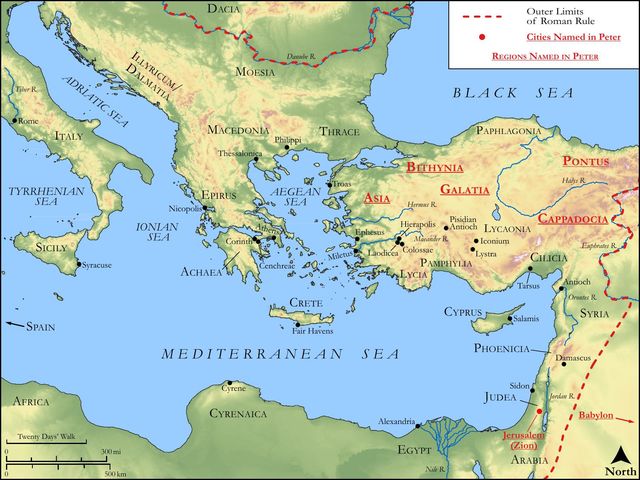
See on the biblical-era map

Study this verse
Public-domain commentary
Matthew Henry
From his Commentary on the Whole Bible. Henry comments on passages, not single verses — this entry covers 1 Peter 3:18–20. His three-level outline is real structure in the source text, so it is rendered as structure.
Here, I. The example of Christ is proposed as an argument for patience under sufferings, the strength of which will be discerned if we consider the several points contained in the words; observe therefore, 1. Jesus Christ himself was not exempted from sufferings in this life, though he had no guilt of his own and could have declined all suffering if he had pleased. 2. The reason or meritorious cause of Christ's suffering was the sins of men: Christ suffered for sins. The sufferings of Christ were a true and proper punishment; this punishment was suffered to expiate and to make an atonement for sin; and it extends to all sin. 3. In the case of our Lord's suffering, it was the just that suffered for the unjust; he substituted himself in our room and stead, and bore our iniquities. He that knew no sin suffered instead of those that knew no righteousness. 4. The merit and perfection of Christ's sacrifice were such that for him to suffer once was enough. The legal sacrifices were repeated from day to day, and from year to year; but the sacrifice of Christ, once offered, purgeth away sin, Heb 7:27; Heb 9:26, Heb 9:28; Heb 10:10, Heb 10:12, Heb 10:14. 5. The blessed end or design of our Lord's sufferings was to bring us to God, to reconcile us to God, to give us access to the Father, to render us and our services acceptable, and to bring us to eternal glory, Eph 2:13, Eph 2:18; Eph 3:12; Heb 10:21, Heb 10:22. 6. The issue and event of Christ's suffering, as to himself, were these, he was put to death in his human nature, but he was quickened and raised again by the Spirit. Now, if Christ was not exempted from sufferings, why should Christians expect it? If he suffered, to expiate sins, why should not we be content when our sufferings are only for trial and correction, but not for expiation? If he, though perfectly just, why should not we, who are all criminals? If he once suffered, and then entered into glory, shall not we be patient under trouble, since it will be but a little time and we shall follow him to glory? If he suffered, to bring us to God, shall not we submit to difficulties, since they are of so much use to quicken us in our return to God, and in the performance of our duty to him?
II.The apostle passes from the example of Christ to that of the old world, and sets before the Jews, to whom he wrote, the different event of those who believed and obeyed Christ preaching by Noah, from those that continued disobedient and unbelieving, intimating to the Jews that they were under a like sentence. God would not wait much longer upon them. They had now an offer of mercy; those that accepted of it should be saved, but those who rejected Christ and the gospel should be as certainly destroyed as ever the disobedient in the times of Noah were.
1.For the explication of this we may notice,
(1.)The preacher - Christ Jesus, who has interested himself in the affairs of the church and of the world ever since he was first promised to Adam, Gen 3:15. He went, not by a local motion, but by special operation, as God is frequently said to move, Gen 11:5; Hos 5:15; Mic 1:3. He went and preached, by his Spirit striving with them, and inspiring and enabling Enoch and Noah to plead with them, and preach righteousness to them, as Pe2 2:5.
(2.)The hearers. Because they were dead and disembodied when the apostle speaks of them, therefore he properly calls them spirits now in prison; not that they were in prison when Christ preached to them, as the vulgar Latin translation and the popish expositors pretend.
(3.)The sin of these people: They were disobedient, that is, rebellious, unpersuadable, and unbelieving, as the word signifies; this their sin is aggravated from the patience and long-suffering of God (which once waited upon them for 120 years together), while Noah was preparing the ark, and by that, as well as by his preaching, giving them fair warning of what was coming upon them.
(4.)The event of all: Their bodies were drowned, and their spirits cast into hell, which is called a prison (Mat 5:25; Pe2 2:4, Pe2 2:5); but Noah and his family, who believed and were obedient, were saved in the ark.
2.From the whole we learn that,
(1.)God takes exact notice of all the means and advantages that people in all ages have had for the salvation of their souls; it is put to the account of the old world that Christ offered them his help, sent his Spirit, gave them fair warning by Noah, and waited a long time for their amendment.
(2.)Though the patience of God wait long upon sinners, yet it will expire at last; it is beneath the majesty of the great God always to wait upon man in vain.
(3.)The spirits of disobedient sinners, as soon as they are out of their bodies, are committed to the prison of hell, whence there is no redemption.
(4.)The way of the most is neither the best, the wisest, nor the safest way to follow: better to follow the eight in the ark than the eight millions drowned by the flood and damned to hell.
Historical interpretation
Eleven Centuries of Reception
31 surviving comments on this verse. Each one is dated, so this reads as a timeline rather than a list.
Select a marker to jump to its quote. Markers stagger vertically where authors wrote within a few decades of each other.
Sheol saw me and was shattered, and Death ejected me and many with me.
I have been vinegar and bitterness to it, and I went down with it as far as its depth.
Then the feet and the head it released, because it was not able to endure my face.
And I made a congregation of living among his dead; and I spoke with them by living lips; in order that my word may not be unprofitable.
And those who had died ran towards me; and they cried out and said, Son of God, have pity on us.
And deal with us according to Your kindness, and bring us out from the bonds of darkness.
And open for us the door by which we may come out to You; for we perceive that our death does not touch You.
May we also be saved with You, because You are our Savior.
Then I heard their voice, and placed their faith in my heart.
And I placed my name upon their head, because they are free and they are mine.
Trypho: We ask you first of all to tell us some of the Scriptures which you allege have been completely cancelled.
Justin: I shall do as you please... And since this passage from the sayings of Jeremiah is still written in some copies [of the Scriptures] in the synagogues of the Jews (for it is only a short time since they were cut out)... And again, from the sayings of the same Jeremiah these have been cut out: 'The Lord God remembered His dead people of Israel who lay in the graves; and He descended to preach to them His own salvation.'
"This he said at the suggestion and urgent persuasion of the Jews, who also watched us, as we sought to take him out of the fire, being ignorant of this, that it is neither possible for us ever to forsake Christ, who suffered for the salvation of such as shall be saved throughout the whole world (the blameless one for sinners)
"For Christ," he says, "hath once suffered for our sins, the just for the unjust, that he might present us to God; being put to death in the flesh, but quickened in the spirit." He says these things, reducing them to their faith. That is, He became alive in our spirits.
"Coming," he says, "He preached to those who were once unbelieving." They saw not His form, but they heard His voice.
Wherefore the Lord preached the Gospel to those in Hades. Accordingly the Scripture says, "Hades says to Destruction, We have not seen His form, but we have heard His voice." It is not plainly the place, which, the words above say, heard the voice, but those who have been put in Hades, and have abandoned themselves to destruction, as persons who have thrown themselves voluntarily from a ship into the sea. They, then, are those that hear the divine power and voice. For who in his senses can suppose the souls of the righteous and those of sinners in the same condemnation, charging Providence with injustice?
But how? Do not [the Scriptures] show that the Lord preached the Gospel to those that perished in the flood, or rather had been chained, and to those kept "in ward and guard"? [1 Peter 3:19-20] And it has been shown also, in the second book of the Stromata, that the apostles, following the Lord, preached the Gospel to those in Hades. For it was requisite, in my opinion, that as here, so also there, the best of the disciples should be imitators of the Master; so that He should bring to repentance those belonging to the Hebrews, and they the Gentiles; that is, those who had lived in righteousness according to the Law and Philosophy, who had ended life not perfectly, but sinfully...
And, as I think, the Saviour also exerts His might because it is His work to save; which accordingly He also did by drawing to salvation those who became willing, by the preaching [of the Gospel], to believe in Him, wherever they were. If, then, the Lord descended to Hades for no other end but to preach the Gospel, as He did descend; it was either to preach the Gospel to all or to the Hebrews only...
If, then, He preached only to the Jews, who wanted the knowledge and faith of the Saviour, it is plain that, since God is no respecter of persons, the apostles also, as here, so there preached the Gospel to those of the heathen who were ready for conversion. And it is well said by the Shepherd, "They went down with them therefore into the water, and again ascended. But these descended alive, and again ascended alive. But those who had fallen asleep, descended dead, but ascended alive." Further the Gospel [Matthew 27:52] says, "that many bodies of those that slept arose,"— plainly as having been translated to a better state. There took place, then, a universal movement and translation through the economy of the Saviour...
It is evident that those, too, who were outside of the Law, having lived rightly, in consequence of the peculiar nature of the voice, though they are in Hades and in ward, [1 Peter 3:19] on hearing the voice of the Lord, whether that of His own person or that acting through His apostles, with all speed turned and believed...
So I think it is demonstrated that the God being good, and the Lord powerful, they save with a righteousness and equality which extend to all that turn to Him, whether here or elsewhere...
Did not the same dispensation obtain in Hades, so that even there, all the souls, on hearing the proclamation, might either exhibit repentance, or confess that their punishment was just, because they believed not? And it were the exercise of no ordinary arbitrariness, for those who had departed before the advent of the Lord (not having the Gospel preached to them, and having afforded no ground from themselves, in consequence of believing or not) to obtain either salvation or punishment. For it is not right that these should be condemned without trial, and that those alone who lived after the advent should have the advantage of the divine righteousness...
If, then, He preached the Gospel to those in the flesh that they might not be condemned unjustly, how is it conceivable that He did not for the same cause preach the Gospel to those who had departed this life before His advent?
"For Christ," he says, "has once suffered for our sins, the just for the unjust, that he might present us to God; being put to death in the flesh, but quickened in the spirit." He says these things, reducing them to their faith. That is, He became alive in our spirits.
"Coming," he says, "He preached to those who were once unbelieving." They saw not His form, but they heard His voice.
"When the long-suffering of God" holds out. God is so good, as to work the result by the teaching of salvation.
"By the resurrection," it is said, "of Jesus Christ:" that, namely, which is effected in us by faith.
"Angels being subjected to Him," which are the first order; and "principalities" being subject, who are of the second order; and "powers" being also subject, which are said to belong to the third order.
For to this end had He come, that, being Himself pure from sin, and in all respects holy, He might undergo death on behalf of sinners. Similarly, you who emulate Him in condoning sins, if you yourself have done no sin, plainly suffer in my stead.
Well, I on my side will first explain the reason of his offence, that I may the more easily explode the scandal of our heretic. Now, that the very Lord Himself of all might, the Word and Spirit of the Father, was operating and preaching on earth, it was necessary that the portion of the Holy Spirit which, in the form of the prophetic gift, had been through John preparing the ways of the Lord, should now depart from John, and return back again of course to the Lord, as to its all-embracing original.
If, on the other hand, as it reads in some manuscripts, "even in those who did not sin in the likeness of Adam's transgression," this death, namely that which was keeping souls bound in the underworld, is said to exercise dominion, then we shall understand it to mean that even the saints had fallen prey to that death certainly under the law of dying, even if not under the punishment of sin. But it was on this account that Christ descended into the underworld, not only because he would not be held by death [Acts 2:24], but also in order that he might release those who were held there, as we said, not so much through the crime of transgression as much as by the condition of dying. As it is written, "Many bodies of saints who were sleeping were resurrected with him and entered into the holy city." [Matthew 27:52-53] In this as well the prophet's sayings were fulfilled, in which he said of Christ, "In ascending on high he led captivity captive." [Ephesians 4:8-9] Thus by his own resurrection he has already destroyed the dominions of death, which is also why it is written that he set captivity free.
Also in the Epistle of Peter the apostle: "Christ hath died once for our sins, the just for the unjust, that He might present us to God."
But tomorrow assemble for me all your citizens, and I will preach in their presence and sow among them the word of God, concerning the coming of Jesus, how he was born; and concerning his mission, for what purpose he was sent by the Father; and concerning the power of his works, and the mysteries which he proclaimed in the world, and by what power he did these things; and concerning his new preaching, and his abasement and humiliation, and how he humbled himself, and died and debased his divinity and was crucified, and descended into Hades, and burst the bars which from eternity had not been broken, and raised the dead; for he descended alone, but rose with many, and thus ascended to his Father.
This Body it was that was laid in a grave, when the Word had left it, yet was not parted from it, to preach, as Peter says, also to the spirits in prison [1 Peter 3:19].
And this above all shows the foolishness of those who say that the Word was changed into bones and flesh. For if this had been so, there were no need of a tomb. For the Body would have gone by itself to preach to the spirits in Hades. But as it was, He Himself went to preach, while the Body Joseph wrapped in a linen cloth, and laid it away at Golgotha. [Mark 15:46]
He departed from Sheol and took up His abode in the Kingdom; that He might seek out a path from Sheol which oppresses all, to the Kingdom which requites all. For our Lord gave His resurrection as a pledge to mortals, that He would remove them from Sheol, which receives the departed without distinction, to the Kingdom which admits the invited with distinction; so that, from [the plan] which makes equal the bodies of all men within it, we may come to [the plan] which distinguishes the works of all men within it. This is He Who descended to Sheol and ascended, that from [the place] which corrupts its sojourners, He might bring us to the place which nourishes with its blessings its dwellers...
Sheol brought Him forth, that through Him its treasures might be emptied out...
For our Lord bare His cross and went forth according to the will of Death: but He cried upon the cross [Matthew 27:50-52] and brought forth the dead from within Sheol against the will of Death. For in that very thing by which Death had slain Him [i.e., the body], in that as armour He bore off the victory over Death. But the Godhead concealed itself in the manhood and fought against Death, Death slew and was slain. Death slew the natural life; and the supernatural life slew Him. And because Death was not able to devour Him without the body, nor Sheol to swallow Him up without the flesh, He came unto the Virgin, that from thence He might obtain that which should bear Him to Sheol; as from beside the ass they brought for Him the colt whereon He entered Jerusalem, and proclaimed concealing her overthrow and the destruction of her children. With the body then that [was] from the Virgin, He entered Sheol and plundered its storehouses and emptied its treasures. He came then to Eve the Mother of all living. This is the vine whose fence Death laid open by her own hands, and caused her to taste of his fruits. So Eve the Mother of all living became the well-spring of death to all living. But Mary budded forth, a new shoot from Eve the ancient vine; and new life dwelt in her, that when Death should come confidently after his custom to feed upon mortal fruits, the life that is slayer of death might be stored up [therein] against him; that when Death should have swallowed [the fruits] without fear, he might vomit them forth and with them many. For [He Who is] the Medicine of life flew down from heaven, and was mingled in the body, the mortal fruit. And when Death came to feed after his custom, the Life in His turn swallowed up Death. This is the food that hungered to eat its eater. So then, by one fruit which Death swallowed hungrily, he vomited up many lives which he had swallowed greedily. The hunger then which hurried him against one, emptied out his greed which had hurried him against many. Thus Death was diligent to swallow one, but was in haste to set many free. For while One was dying on the cross, many that were buried from within Sheol were coming forth at His cry. [Matthew 27:50-53] This is the fruit that cleft asunder Death who had swallowed it, and brought out from within it the Life in quest of which it was sent. For Sheol hid away all that she had devoured. But through One that was not devoured, all that she had devoured were restored from within her. He, whose stomach is disordered, vomits forth both that which is sweet to him and that which is not sweet. So the stomach of Death was disordered, and as he was vomiting forth the medicine of life which had sickened it, he vomited forth along with it also those lives that had been swallowed by him with pleasure.
This is the Son of the carpenter, Who skilfully made His cross a bridge over Sheol that swallows up all, and brought over mankind into the dwelling of life. And because it was through the tree that mankind had fallen into Sheol, so upon the tree they passed over into the dwelling of life. Through the tree then wherein bitterness was tasted, through it also sweetness was tasted; that we might learn of Him that among the creatures nothing resists Him. Glory be to You, Who laid Your cross as a bridge over death, that souls might pass over upon it from the dwelling of the dead to the dwelling of life!
He cried to the Father, saying, Father, into Your hands I commend My spirit [Luke 23:46]; I commend it, that I may take it again. And having said these things, He gave up the ghost [Matthew 27:50]; but not for any long time, for He quickly rose again from the dead.
The Sun was darkened, because of the Sun of Righteousness [Malachi 4:2]. Rocks were rent, because of the spiritual Rock. Tombs were opened, and the dead arose, because of Him who was free among the dead; He sent forth His prisoners out of the pit wherein is no water [Zechariah 9:11].
He was truly laid as Man in a tomb of rock; but rocks were rent asunder by terror because of Him. He went down into the regions beneath the earth, that thence also He might redeem the righteous. For, tell me, could thou wish the living only to enjoy His grace, and that, though most of them are unholy; and not wish those who from Adam had for a long while been imprisoned to have now gained their liberty? Esaias the Prophet proclaimed with loud voice so many things concerning Him; would you not wish that the King should go down and redeem His herald? David was there, and Samuel, and all the Prophets, John himself also, who by his messengers said, Are you He that should come, or look we for another [Matthew 11:3]? Would you not wish that He should descend and redeem such as these?
But He who descended into the regions beneath the earth came up again; and Jesus, who was buried, truly rose again the third day. And if the Jews ever worry you, meet them at once by asking thus: Did Jonah come forth from the whale on the third day, and has not Christ then risen from the earth on the third day?
Something strange is happening - there is a great silence on earth today, a great silence and stillness. The whole earth keeps silence because the King is asleep. The earth trembled and is still because God has fallen asleep in the flesh and he has raised up all who have slept ever since the world began. God has died in the flesh and hell trembles with fear.
He has gone to search for our first parent, as for a lost sheep. Greatly desiring to visit those who live in darkness and in the shadow of death, he has gone to free from sorrow the captives Adam and Eve, he who is both God and the son of Eve. The Lord approached them bearing the cross, the weapon that had won him the victory. At the sight of him Adam, the first man he had created, struck his breast in terror and cried out to everyone: “My Lord be with you all.” Christ answered him: “and with your spirit.” He took him by the hand and raised him up, saying : “Awake, O sleeper, and rise from the dead, and Christ will give you light.”
I am your God, who for your sake have become your son. Out of love for you and for your descendants I now by my own authority command all who are held in bondage to come forth , all who are in darkness to be enlightened, all who are sleeping to arise. I order you, O sleeper, to awake. I did not create you to be held a prisoner in hell. Rise from the dead, for I am the life of the dead. Rise up, work of my hands, you who were created in my image. Rise, let us leave this place, for you are in me and I am in you; together we form only one person and we cannot be separated.
For your sake I, your God, became your son; I, the Lord, took the form of a slave; I, whose home is above the heavens, descended to the earth and beneath the earth. For your sake, for the sake of man, I became like a man without help, free among the dead. For the sake of you, who left a garden, I was betrayed to the Jews in a garden, and I was crucified in a garden.
See on my face the spittle I received in order to restore to you the life I once breathed into you. See there the marks of the blows I received in order to refashion your warped nature in my image. On my back see the marks of scourging I endured to remove the burden of sin that weighs upon your back. See my hands, nailed firmly to a tree, for you who once wickedly stretched out your hand to a tree.
I slept on the cross and a sword pierced my side for you who slept in paradise and brought forth Eve from your side. My side has healed the pain in yours. My sleep will rouse you from your sleep in hell. The sword that pierced me has sheathed the sword that was turned against you.
Rise, let us leave this place. The enemy led you out of the earthly paradise. I will not restore you to that paradise, but I will enthrone you in heaven. I forbade you the tree that was only a symbol of life, but see, I who am life itself am now one with you. I appointed cherubim to guard you as slaves are guarded, but now I make them worship you as God. The throne formed by cherubim awaits you, its bearers swift and eager. The bridal chamber is adorned, the banquet is ready, the eternal dwelling places are prepared, the treasure houses of all good things lie open. The kingdom of heaven has been prepared for you from all eternity.
That He descended into hell is also evidently foretold in the Psalms, where it is said, "You have brought Me also into the dust of the death." And again, "What profit is there in my blood, when I shall have descended into corruption?" And again, "I descended into the deep mire, where there is no bottom." Moreover, John says, "Are You He that shall come (into hell, without doubt), or do we look for another?" Whence also Peter says that "Christ being put to death in the flesh, but quickened in the Spirit which dwells in Him, descended to the spirits who were shut up in prison, who in the days of Noah believed not, to preach unto them;" where also what He did in hell is declared. Moreover, the Lord says by the Prophet, as though speaking of the future, "You will not leave my soul in hell, neither will You suffer Your Holy One to see corruption." Which again, in prophetic language he speaks of as actually fulfilled, "O Lord, You have brought my soul out of hell: You have saved me from them that go down into the pit"... He returned, therefore, a victor from the dead, leading with Him the spoils of hell. For He led forth those who were held in captivity by death, as He Himself had foretold, when He said, "When I shall be lifted up from the earth I shall draw all unto Me." To this the Gospel bears witness, when it says, "The graves were opened, and many bodies of saints which slept arose, and appeared unto many, and entered into the holy City"...
But the lower parts of the earth, hell, are understood to be where our Lord and Savior descended, so that He might lead with Him to the heavens the souls of the saints who were being held captive there. Hence, after His resurrection, many bodies of the righteous were seen in the holy city (Matthew 27:52-53). And that hell is in the lower part of the earth is attested by the Psalmist who says: "The earth opened and swallowed up Dathan and covered the congregation of Abiron" (Psalm 106:17). This is also explained more fully in the Book of Numbers (chapter 16). In another place we read: "Let death come upon them and let them go down alive into hell" (Psalm 55:15).
After having said that "Christ was put to death in the flesh, and quickened in the spirit," the apostle immediately went on to say: "in which also He went and preached unto the spirits in prison; which sometime were unbelieving, when once the long-suffering of God waited in the days of Noah, while the ark was a preparing, wherein few, that is, eight souls were saved by water;" thereafter he added the words: "which baptism also now by a like figure has saved you." [1 Peter 3:18-21] This, therefore, is felt by me to be difficult. If the Lord when He died preached in hell to spirits in prison, why were those who continued unbelieving while the ark was a preparing the only ones counted worthy of this favour, namely, the Lord's descending into hell? For in the ages between the time of Noah and the passion of Christ, there died many thousands of so many nations whom He might have found in hell. I do not, of course, speak here of those who in that period of time had believed in God, as, e.g. the prophets and patriarchs of Abraham's line, or, going farther back, Noah himself and his house, who had been saved by water (excepting perhaps the one son, who afterwards was rejected), and, in addition to these, all others outside of the posterity of Jacob who were believers in God, such as Job, the citizens of Nineveh, and any others, whether mentioned in Scripture or existing unknown to us in the vast human family at any time. I speak only of those many thousands of men who, ignorant of God and devoted to the worship of devils or of idols, had passed out of this life from the time of Noah to the passion of Christ. How was it that Christ, finding these in hell, did not preach to them, but preached only to those who were unbelieving in the days of Noah when the ark was a preparing? Or if he preached to all, why has Peter mentioned only these, and passed over the innumerable multitude of others?
It is established beyond question that the Lord, after He had been put to death in the flesh, "descended into hell;" for it is impossible to gainsay either that utterance of prophecy, "You will not leave my soul in hell," — an utterance which Peter himself expounds in the Acts of the Apostles, lest any one should venture to put upon it another interpretation — or the words of the same apostle, in which he affirms that the Lord "loosed the pains of hell, in which it was not possible for Him to be holden." Who, therefore, except an infidel, will deny that Christ was in hell? As to the difficulty which is found in reconciling the statement that the pains of hell were loosed by Him, with the fact that He had never begun to be in these pains as in bonds, and did not so loose them as if He had broken off chains by which He had been bound, this is easily removed when we understand that they were loosed in the same way as the snares of huntsmen may be loosed to prevent their holding, not because they have taken hold. It may also be understood as teaching us to believe Him to have loosed those pains which could not possibly hold Him, but which were holding those to whom He had resolved to grant deliverance...
As to the first man, the father of mankind, it is agreed by almost the entire Church that the Lord loosed him from that prison; a tenet which must be believed to have been accepted not without reason, — from whatever source it was handed down to the Church — although the authority of the canonical Scriptures cannot be brought forward as speaking expressly in its support, though this seems to be the opinion which is more than any other borne out by these words in the book of Wisdom. [Wisdom 10:1-2] Some add to this [tradition] that the same favour was bestowed on the holy men of antiquity — on Abel, Seth, Noah and his house, Abraham, Isaac, Jacob, and the other patriarchs and prophets, they also being loosed from those pains at the time when the Lord descended into hell...
But seeing that plain scriptural testimonies make mention of hell and its pains, no reason can be alleged for believing that He who is the Saviour went there, except that He might save from its pains; but whether He did save all whom He found held in them, or some whom He judged worthy of that favour, I still ask: that He was, however, in hell, and that He conferred this benefit on persons subjected to these pains, I do not doubt...
You perceive, therefore, how intricate is the question why Peter chose to mention, as persons to whom, when shut up in prison, the gospel was preached, those only who were unbelieving in the days of Noah when the ark was a preparing — and also the difficulties which prevent me from pronouncing any definite opinion on the subject.
Moreover, after your departure I learned from information given me by my most beloved sons the deacons that your Love had said that our Almighty Lord and Saviour Jesus Christ, when He descended into hell, saved all who there acknowledged Him as God, and delivered them from the pains due to them. With regard to this subject I desire that your Charity should think very differently. For, when He descended into hell, He delivered through His grace those only who both believed that He should come and observed His precepts in their lives... Considering, therefore, all these things, hold nothing but what the true faith teaches through the Catholic Church: namely, that the Lord in descending into hell rescued from infernal durance those only whom while living in the flesh He preserved through His grace in faith and good conduct.
Again Peter expounds Christ’s death and resurrection. Notice how he proclaims the mystery to us. For by saying that he died in the flesh and that he was made alive again in the Spirit, what he is really saying is that he died for the sake of our flesh, which is under the power of corruption, but that he rose again as God, for the word spirit means “God” in this instance.
Because Christ also once died for our sins, etc. Therefore, the righteous one who suffers imitates Christ; the one corrected by scourging imitates the thief who recognized Christ on the cross and entered paradise with Christ from the cross; the one who does not desist from faults even amid scourging imitates the left-hand thief, who ascended the cross for his sins and after the cross fell into Tartarus. But he recalls that Christ died once, so that it might also remind us that an eternal reward is given for our temporary sufferings.
That He might present us to God, indeed mortified in the flesh, etc. Concerning this mortification of the flesh and vivification of the spirit, which those who labor for the Lord through patience possess, the apostle Paul also speaks: Though our outer self is wasting away, our inner self is being renewed day by day (II Cor. IV). Therefore Christ offers us to God the Father when we joyfully sacrifice ourselves for Him through the mortification of the flesh, that is, He presents our praiseworthy life in the sight of the Father. Or certainly, He offers us to God when He introduces us, freed from the flesh, into the eternal kingdom. Indeed, as it is said: Made alive by the Spirit: Saint Athanasius, bishop of Alexandria, does not refer this to the human spirit, which is better vivified when the flesh is mortified, as the prophet says about the Lord: To revive the spirit of the humble, and to revive the heart of the contrite (Isaiah LVII), but rather refers it to the grace of the Holy Spirit, who gives eternal life to those mortifying their flesh. For he also uses this testimony against the Arians, who contradict the equality of the Holy Trinity, affirming that by the indivisible unity of divine operation, the Father gives life, the Son gives life, and the Holy Spirit gives life. The Father and the Son, as it is written: For as the Father raises the dead and gives them life, so also the Son gives life to whom He will. The Holy Spirit, indeed, as it is declared by this testimony, which is said of the Son, that He might present us to God, indeed mortified in the flesh, but made alive by the Spirit; and therefore, where the operation is one, the substance or essence cannot be different.
The soul when it was deified descended into Hades, in order that, just as the Sun of Righteousness [Malachi 4:2] rose for those upon the earth, so likewise He might bring light to those who sit under the earth in darkness and shadow of death [Isaiah 9:2]: in order that just as He brought the message of peace to those upon the earth, and of release to the prisoners, and of sight to the blind , and became to those who believed the Author of everlasting salvation and to those who did not believe a reproach of their unbelief [1 Peter 3:19], so He might become the same to those in Hades: That every knee should bow to Him, of things in heaven, and things in earth and things under the earth. [Philippians 2:10] And thus after He had freed those who had been bound for ages, straightway He rose again from the dead, showing us the way of resurrection.
For it is better to suffer for doing good, if that should be God's will, than for doing evil: for Christ also died once for sins, the righteous for the unrighteous, that he might bring us to God, being put to death indeed in the flesh but made alive in the spirit.
This is the explanation of the cause not relating to what has been said immediately, but to what was mentioned a little earlier, for example: “if you should suffer for righteousness' sake, you are blessed” (1 Peter 3:14); [now Peter says] for it is better to suffer for doing good than for doing evil. Or if someone wants to refer to the immediately preceding explanation of the cause: what is said about doing good should not be understood as pertaining to someone else doing good, but absolutely, that is, as doing good works. Similarly, it applies to those doing evil.
Peter also adds: "if that should be God's will," indicating that nothing happens to us without God's will, but either for the easing of sins, or for our praise and glory, or even for the salvation of others. This happens in two ways. Either a righteous person is afflicted for the correction of others' sins, as it has been said: If the righteous is scarcely saved, where will the ungodly appear? (1 Peter 4:18; See Proverbs 11:31 LXX) And this also presents twofold usefulness: for the just one who is afflicted, an increase in righteousness due to patience; for the sinner who observes, conversion, as we have said.
Therefore, the just man suffers for these reasons: either for the salvation of others, as Christ did. And for this reason, Peter now adds the example of Christ: for Christ died not for His own sins, but for ours.
Therefore, Peter also adds: righteous for the unrighteous. For He, as previously shown through the prophet, had not committed sin. However, showing the effectiveness and power of Him who suffered, he adds: once. So great, he says, was the strength of Him who suffered for men, that although He offended many of their sins, the single passion of the Lord was sufficient to overcome all the power of our sins. Therefore, since Christ suffered to bring us to God and His Father, it is shown that not all who suffer do so because of sins. And because Christ is considered in a twofold manner, namely God and man, He also bestowed upon us a double grace. For He died as a man, freeing us from death and corruption, renewing for us the resurrection, and giving by His example, that those dying from this time should not face death without the hope of resurrection.
But made alive, that is, rising from the dead by the power of divinity (for He rose from the dead not as a man, but as God), He simultaneously restored to life all who were in Hades, raising them up together with Himself. Indeed, many bodies of the saints who had fallen asleep were raised, according to the holy evangelist, and were seen by many. (Matt. 27:52) But when Peter has proceeded thus far in his discourse and has shown these things, he then proposes how the dead benefited those who had previously slept. At the same time, with much questioning, if the incarnation of the Lord occurred for the salvation of all men, what kind of salvation did those who had died before receive? He resolves both in one way and says that the death of the Lord accomplished both, namely the hope of action through the fact that he himself has risen, and again the salvation of those who had previously slept. For those who had adorned their lives with good works during the time they lived, just as if Christ had come at that time they would not have been deprived of the preaching that gives life to them, so also at that time through the Lord's descent to Hades they obtained salvation, as it also seems to the divine Gregory4. For he himself says: “Does Christ who appeared, namely in Hades, save all simply? Or does he also save those who believed there? For by saying: Those who believed, he signifies that they had prepared themselves in such a way that if he had come even then, they would have believed.” Nor do I think this should be rejected. Salvation is not held by inheritance, since although it comes to all the living, it does not save all, but only those who believe. Indeed, it was also the work of the free will of individuals, that since they were rational, they would not behave insensibly towards the magnificence of him who had granted such a gift, but would present themselves as worthy of the goodness of the giver. However, he stated, They had been disobedient, thereby resolving a certain objection. For it was likely that someone would say: And what else before Christ was preached, afterwards were they judged or deemed worthy of condemnation who preceded Christ? And since he could demonstrate this, just as Paul did, from the rational powers dispersed among us, which, when given to them, allowed them to discern between good and evil, and yet they did not act according to good afterwards, such were worthy of death; this does not, however, make it so, for that is of a higher consideration and a deeper philosophy than the mind of the Jews could bear: but it confirms disobedience from Scripture; nor is this from the times of the prophets, but almost from the very beginning of the world: from which he demonstrates that salvation was preached to men from the beginning, but was despised due to their inclination towards vain and sensual pleasures.
For even in their time, although there were countless wicked men, only eight, who believed what was proclaimed through the preparation of the ark, were saved (1 Peter 3:20). And because salvation was through water, he immediately applies this to the sacred baptism, and says that that water prefigured our baptism, since it also drowns and submerges unbelieving demons and saves the faithful who come to the ark of the Church. At the same time, he says: Just as water washes away filth, so does baptism. But it does not effect the removal of bodily dirt, rather, through a symbol, it demonstrates the washing away of the stains of the soul. It is, moreover, as it were, a pledge and guarantee of a good conscience toward God. For those who are well aware of themselves, that is, who embrace a blameless life and earnestly seek and, as it were, inquire after it (for those who seek something are accustomed to inquire), these also hasten to the sacred baptism. And who, he says, provides that divine baptism should be sought and requested? The resurrection of Christ. For before His resurrection and passion it is shown: “Unless one is born of water and the Spirit;” (Jn. 3:5) but after the resurrection: “Baptizing all nations who come, in the name of the Father, and of the Son, and of the Holy Spirit.” (Matt. 28:19-20) After he concluded the discourse on the dispensation, I speak now of the descent of the Lord into Hades, and for what reason he also went there—namely, that it was for the salvation of those who were in Hades as well. He again takes another occasion from the death of the Lord to exhort to virtue, and says:
If Christ died in the flesh for us (for he could not die in his immortal and divine nature), then surely you also, repaying him in turn, by dying to sin for his sake, will no longer be captivated by human desires, but will live for the rest of your time in the flesh only for the will of God.
“put to death indeed in the flesh” —that is, by the nature of the flesh, that is, the human nature, but rising by the power of divinity. For God is spirit (Jn. 4:24), just as He Himself, the source and wisdom of theology, has taught us.
These words of Peter [1 Peter 3:19] are referred by some to Christ's descent into hell: and they explain it in this sense: "Christ preached to them who formerly were unbelievers, and who were shut up in prison"—that is, in hell—"in spirit"—that is, by His soul. Hence Damascene says (De Fide Orth. iii): "As He evangelized them who are upon the earth, so did He those who were in hell"; not in order to convert unbelievers unto belief, but to put them to shame for their unbelief, since preaching cannot be understood otherwise than as the open manifesting of His Godhead. which was laid bare before them in the lower regions by His descending in power into hell.
Augustine, however, furnishes a better exposition of the text in his Epistle to Evodius quoted above, namely, that the preaching is not to be referred to Christ's descent into hell, but to the operation of His Godhead, to which He gave effect from the beginning of the world. Consequently, the sense is, that "to those (spirits) that were in prison"—that is, living in the mortal body, which is, as it were, the soul's prison-house—"by the spirit" of His Godhead "He came and preached" by internal inspirations, and from without by the admonitions spoken by the righteous: to those, I say, He preached "which had been some time incredulous," i.e. not believing in the preaching of Noah, "when they waited for the patience of God," whereby the chastisement of the Deluge was put off: accordingly (Peter) adds: "In the days of Noah, when the Ark was being built."
When Christ descended into hell, all who were in any part of hell were visited in some respect: some to their consolation and deliverance, others, namely, the lost, to their shame and confusion.
I answer that, As Christ, in order to take our penalties upon Himself, willed His body to be laid in the tomb, so likewise He willed His soul to descend into hell. But the body lay in the tomb for a day and two nights, so as to demonstrate the truth of His death. Consequently, it is to be believed that His soul was in hell, in order that it might be brought back out of hell simultaneously with His body from the tomb.
Reply to Objection 1. When Christ descended into hell He delivered the saints who were there, not by leading them out at once from the confines of hell, but by enlightening them with the light of glory in hell itself. Nevertheless it was fitting that His soul should abide in hell as long as His body remained in the tomb.
Reply to Objection 2. By the expression "bars of hell" are understood the obstacles which kept the holy Fathers from quitting hell, through the guilt of our first parent's sin; and these bars Christ burst asunder by the power of His Passion on descending into hell: nevertheless He chose to remain in hell for some time, for the reason stated above.
Reply to Objection 3. Our Lord's expression is not to be understood of the earthly corporeal paradise, but of a spiritual one, in which all are said to be who enjoy the Divine glory. Accordingly, the thief descended locally into hell with Christ, because it was said to him: "This day thou shalt be with Me in paradise"; still as to reward he was in paradise, because he enjoyed Christ's Godhead just as the other saints did.
“Wilson blithely asserts that the "Jewish name for Elysium was Abraham's bosom, or Paradise". Where is the evidence for that?”
This is my “quacks like a duck” argument. Hades had two compartments, Tartarus and Elysium. The New Testament uses the names of two of these three, and I infer the third by good and imaginative consequence...
Jesus said He was going to the heart of the earth like Jonah did, and Jonah went down to Sheol, which was in the heart of the earth, and which the New Testament calls Hades, and Jesus told the thief on the cross that He was going to Paradise, and the only subterranean place that could remotely be thought of as a kind of Paradise would be Elysium.
The final place of torment is Gehenna, which I take as the lake of fire. There is an intermediate place of torment, which is located within Hades. We can tell they are distinct because at a certain point, death and Hades are thrown into the lake of fire (Rev. 20:14). And in the Apostles Creed, Jesus descends to Hades, not into Hell.
Aeneas descended into Hades, which was a place divided into two compartments. The bad side was called Tartarus and the good side was called Elysium. Aeneas went to commune with his father, who was a shade, but who was in Elysium, a place of peace. The Jewish name for Elysium was Abraham’s bosom, or Paradise. Lazarus was in Abraham’s bosom, within shouting distance of the rich man, who was in torment in Hades (presumably Tartarus). Jesus descended into Elysium because He told the thief on the cross that he would be with him that day in Paradise (Luke 23:43). That is where He preached (across the chasm) to the spirits who had been disobedient in the time of Noah, announcing to them their final defeat (1 Pet. 3:19-20). The apostle Peter even refers to Tartarus by name (2 Pet. 2:4), using a word in verb form that means to cast into Hell/Tartarus. When Jesus rises from the dead, He holds the keys of death and Hades (Rev. 1:18), and when He ascends He transfers Paradise to the third heaven (2 Cor. 12:2-4). When believers die now, that is where they go (2 Cor. 5:8)...
Jesus tells us where this Paradise was. He says that just as Jonah was three days and three nights in the belly of the fish, so He would be three days and three nights in the heart of the earth (Matt. 12:40). Jonah cried out to God from Sheol, the Hebrew word that is rendered in the New Testament (without redefinition) as Hades. Hades is not the grave — Plato thought he knew where the gates of Hades were. It was the kind of place you could get to if you got lost in Carlsbad Caverns, you and your flashlight.
In the time before the Messiah came, the expectation of the godly was to die and go to Sheol. Jonah (most likely) actually died and cried out to God from the depths of Sheol (Jon. 2:1). The psalmist expected that Sheol would swallow him up (Ps. 18:5; 86:13; 116:3).
In the parable of Lazarus and the rich man, they both died and went down to Hades. In that parable, Hades was divided in two by a vast chasm. The side where Lazarus was had the name of Abraham’s bosom (Luke 16:23), while the rich man was in torment in Hades. Nevertheless, it was possible for communication to occur across the chasm.
In our text [Matt. 12:40], Jesus said that He was going to be three days and nights in the heart of the earth. But He also told the thief on the cross that He would be with him in Paradise that same day (Luke 23:43). So then, Abraham’s bosom was also known as Paradise. To the Greeks, this went by the name of Elysium. This is where Jesus went, and preached across the chasm.
The Greek word for the lowest pit of Hades, the worst part, was Tartarus. This word is used once in the New Testament (without any redefinition, mind). Peter tells us this: “For if God spared not the angels that sinned, but cast them down to hell [Tartarus], and delivered them into chains of darkness, to be reserved unto judgment” (2 Peter 2:4).
While in Hades, the Lord preached. But the preaching was not “second chance” preaching. Rather the word used is one used for heralding or announcing, not the word for preaching the gospel. “By which also he went and preached unto the spirits in prison; Which sometime were disobedient, when once the longsuffering of God waited in the days of Noah, while the ark was a preparing, wherein few, that is, eight souls were saved by water” (1 Pet. 3:19–20). The Lord was announcing their final defeat to the “sons of God” and Nephilim both. And this, incidentally, tells us how momentous the rebellion at the time of the Flood actually was. Thousands of years after their definitive defeat, Jesus went to them to announce their final defeat.
The Bible teaches us that Jesus is the king of all things. The devil is not the ruler of Gehenna—Jesus is. The lake of fire was prepared for the devil and his angels (Matt. 25:41). It is a place of torment for the devil. Furthermore, Jesus holds the keys to Hades as well. “I am he that liveth, and was dead; and, behold, I am alive for evermore, Amen; and have the keys of hell [Hades] and of death.” (Rev. 1:18). Jesus, not the devil, is the King of Hell. Jesus, not the devil, is the Lord of Hades.
When the Lord rose from the dead, He led captivity captive (Eph. 4:8)—all the saints in the Old Testament who had died and gone to Abraham’s bosom were transferred when Paradise was moved (Matt. 27:52). And by the time of Paul, Paradise was up (2 Cor. 12:4). So if you had lived in the Old Testament, you would have died and gone down to Sheol/Hades. But the part of Hades that contained the saints of God has been emptied out, and now when God’s people die, what happens? To be absent from the body is to be present with the Lord (2 Cor. 5:6, 8). We still go to Paradise, but Paradise itself has been moved into the heavens.
Continue studying 1 Peter 3:18 across the web’s major study libraries — every link below opens this exact verse, chapter, or book on the destination site.
Read & Compare
 BibleGatewayThis verse in more than 200 translations and 70 languages.
 Bible.comThe YouVersion reader — hundreds of translations, reading plans, and highlights.
 ESV.orgCrossway's official English Standard Version reader.
 NET BibleThe NET translation with 60,000+ translators' notes on every rendering decision.
 STEP BibleTyndale House's free study tool — original text, vocabulary, and scholarly resources.
 BibliaLogos Bible Software's free web reader.
 USCCBThe New American Bible (Revised Edition) with the U.S. bishops' study notes.
Commentaries
 BibleHub CommentariesDozens of classic commentaries on this verse, gathered on one page.
 StudyLightMore than 100 commentary sets — the largest collection on the web.
 BibleRefPlain-English commentary on what this verse means, verse by verse.
 Enduring WordDavid Guzik's free commentary on this chapter, widely used by Bible teachers.
 Bible Study ToolsVerse commentary alongside Greek and Hebrew study aids.
Original Language & Research
- BibleHub InterlinearThe verse word by word — original language, transliteration, and English.
- BibleHub LexiconEvery word's original-language definition and Strong's entry.
 Blue Letter BibleDeep-study tools — Strong's numbers, concordance, and word studies.
 CNTR CollationThe earliest Greek manuscripts of this verse, collated letter by letter.
Sermons, Hymns & Audio


TrulyRandomVerse is not affiliated with these sites and doesn’t control their content. They’re linked because they’re genuinely useful.
Summary
First Peter 3:18 encapsulates the profound theological core of the Christian faith, articulating that Christ's singular, decisive suffering for sins—the righteous One dying on behalf of the unrighteous—was for the express purpose of reconciling humanity to God. This verse powerfully summarizes the substitutionary atonement, emphasizing that while His physical body endured death, His spirit was victoriously made alive, providing the foundation for believers' hope and perseverance amidst suffering.
Context
ShowHideLiterary Context
This verse serves as the theological bedrock for Peter's preceding exhortations regarding righteous living and patient endurance in suffering, particularly for believers facing persecution. In 1 Peter 3:13-17, Peter encourages his readers to not fear those who persecute them but to sanctify Christ as Lord and be ready to give a defense for their hope, doing so with gentleness and respect. Verse 18 then provides the ultimate example and motivation: Christ Himself suffered unjustly, not for His own sins, but for ours, to bring us to God. This suffering, leading to His death and subsequent quickening by the Spirit, is the pattern and power for believers' own trials. The subsequent verses, 1 Peter 3:19-22, further elaborate on Christ's post-resurrection activity and His exaltation, reinforcing the triumph that follows suffering.
Historical & Cultural Context
Peter is addressing Christians dispersed throughout Asia Minor (modern-day Turkey), a region under Roman rule. These early believers were experiencing various forms of social ostracization, verbal abuse, and even physical persecution simply for their adherence to Christ. They were often misunderstood, accused of disloyalty to the state (for not participating in emperor worship), and alienated from their pagan neighbors and even Jewish communities. In this context, Peter's letter provides pastoral encouragement, reminding them of their identity in Christ and the ultimate purpose of their suffering. The Roman legal system, while generally tolerant of diverse religions, viewed Christianity with suspicion due to its exclusive claims and refusal to conform to state-sanctioned religious practices. Thus, the concept of suffering "for righteousness' sake" was a lived reality, making the example of Christ's suffering, as the "just for the unjust," profoundly relevant and comforting.
Key Themes
ShowHideFirst Peter 3:18 is rich with central Christian themes. Foremost is Substitutionary Atonement, where Christ, the sinless one, takes the place of sinful humanity, bearing their penalty. This is inextricably linked to the theme of Reconciliation and Access to God, as Christ's sacrifice bridges the chasm created by sin, enabling believers to draw near to a holy God. The verse also highlights the Sufficiency and Finality of Christ's Sacrifice ("once suffered"), emphasizing that His work on the cross was a complete and unrepeatable act, unlike the repeated sacrifices under the Old Covenant (Hebrews 9:26-28). Furthermore, it underscores the Victory of Resurrection over Death, presenting Christ's death "in the flesh" as a necessary prelude to His being "quickened by the Spirit," a foundational truth that empowers believers to face death and suffering with hope (Romans 8:11). These themes collectively provide a robust theological framework for enduring suffering with a Christ-like perspective.
Exposition and Analysis
ShowHideKey Word Analysis
ShowHideThis verb denotes experiencing a sensation or impression, typically a painful one. In the context of Christ, it refers to His profound and agonizing experience of crucifixion, encompassing both physical torment and spiritual anguish as He bore the weight of humanity's sin. This is not merely passive endurance but active suffering with a redemptive purpose.
This adjective describes someone who is equitable in character or act, innocent, or holy. Applied to Christ, it affirms His absolute sinlessness and perfect righteousness, which stands in stark contrast to the "unjust" humanity He suffered for. His perfect righteousness is what qualified Him to be the spotless sacrifice.
This term signifies being unrighteous, wicked, or treacherous. It describes the state of humanity, characterized by sin and rebellion against God, for whom Christ suffered. The juxtaposition of "just" and "unjust" powerfully highlights the substitutionary nature of Christ's work.
Derived from the word for death (thanatos), this verb means "to kill" or "to cause to be put to death." It unequivocally refers to the physical demise of Jesus on the cross, emphasizing the reality and finality of His bodily death. This was a true death, not a mere swoon or appearance.
This verb means "to make alive" or "to give life to," implying a restoration or vivification. In this context, it refers to Christ being brought back to life from the dead, His resurrection. It is the divine act that reverses the death He experienced, demonstrating His victory over sin and death.
This word can refer to a current of air, breath, or figuratively, a spirit. In the context of Christ being "quickened by the Spirit," it refers to the Holy Spirit, the divine agent through whom Christ was raised from the dead. This highlights the Trinitarian nature of the resurrection, with the Father raising the Son through the power of the Spirit.
Verse Breakdown
ShowHide"For Christ also hath once suffered for sins,"
This opening clause establishes the reason for Peter's preceding exhortations. "For" (G3754, hóti) introduces the foundational truth: Christ's suffering is the ultimate example and motivation. The word "once" (G530, hápax) is crucial, emphasizing the singular, unrepeatable, and therefore completely sufficient nature of Christ's atoning sacrifice. It signifies a definitive act that does not need to be repeated, setting it apart from Old Testament sacrifices. His suffering was "for sins" (G4012 perí G266 hamartía), meaning concerning or on account of sins—the sins of humanity.
"the just for the unjust,"
This phrase articulates the core of substitutionary atonement. Christ, identified as "the just" (G1342, díkaios) because of His perfect righteousness and sinlessness, suffered "for" (G5228, hypér) "the unjust" (G94, ádikos), representing sinful humanity. The preposition hypér here carries the sense of "on behalf of," "instead of," or "in the place of," clearly indicating that Christ's suffering was a vicarious act, bearing the penalty that was due to others.
"that he might bring us to God,"
This is a purpose clause, introduced by "that" (G2443, hína), revealing the ultimate goal of Christ's suffering and death. The verb "bring" (G4317, proságō) means to lead towards or to conduct near. Christ's sacrifice was not an end in itself but the means by which sinful humanity could be reconciled and granted access to a holy God (G2316, theós). This speaks to the restoration of a broken relationship and the establishment of a new covenant of grace.
"being put to death in the flesh,"
This clause describes the manner of Christ's suffering and its immediate consequence. "Put to death" (G2289, thanatóō) unequivocally refers to His physical death on the cross. The phrase "in the flesh" (G4561, sárx) specifies that it was His human body, His physical existence, that truly died. This emphasizes the reality of His humanity and the tangible nature of His sacrifice.
"but quickened by the Spirit:"
This final clause introduces a powerful contrast ("but" G1161, dé) and reveals the triumph that followed death. While Christ's physical body was put to death, He was "quickened" (G2227, zōopoiéō), meaning "made alive" or "given life," by "the Spirit" (G4151, pneûma). This refers to His resurrection from the dead, accomplished by the power of the Holy Spirit. This vivification by the Spirit signifies Christ's victory over death and His divine nature, providing the ultimate assurance of salvation and new life for those He died for.
Literary Devices
ShowHideFirst Peter 3:18 employs several powerful literary devices to convey its profound message. Most prominent is Antithesis or Contrast, seen in the pairing of "the just for the unjust" and "put to death in the flesh, but quickened by the Spirit." These stark oppositions highlight the radical nature of Christ's substitutionary work and the miraculous reversal of death by divine power. The phrase "the just for the unjust" is a form of Chiasm (A-B-B'-A') in its conceptual structure, where Christ's righteousness (A) is contrasted with human unrighteousness (B), and His suffering (B') is for the benefit of those who are unrighteous (A'). This emphasizes the vicarious nature of the atonement. The verse also functions as a Purpose Statement, introduced by "that he might bring us to God," which clearly articulates the redemptive goal of Christ's suffering. This teleological framing provides meaning and direction to the otherwise grim reality of suffering. Finally, the entire verse serves as a powerful Exemplum or Example, presenting Christ's experience as the ultimate pattern for believers who are called to suffer righteously.
Theological and Thematic Connections
ShowHideThe theological depth of 1 Peter 3:18 resonates throughout the biblical narrative, particularly in its articulation of substitutionary atonement and the transformative power of Christ's death and resurrection. It underscores the profound truth that God, in His infinite love and justice, provided a perfect sacrifice in Christ to bridge the chasm of sin separating humanity from Himself. This divine initiative not only addresses the problem of human sin but also establishes a new, living way for believers to draw near to God. The "once for all" nature of Christ's suffering emphasizes the completeness and finality of His work, eliminating the need for any further sacrifice and establishing the New Covenant on an unshakeable foundation. This truth forms the bedrock of Christian assurance, reminding believers that their reconciliation with God is based entirely on Christ's finished work, not on their own merit or efforts.
Reflection and Application
ShowHideFirst Peter 3:18 offers profound comfort and a powerful call to live in light of Christ's finished work. Understanding that Christ, the perfectly just One, suffered "once for all" on behalf of us, the unjust, to bring us into relationship with God, fundamentally reshapes our perspective on sin, salvation, and suffering. It assures us that our access to God is not predicated on our performance but on His perfect sacrifice. This truth liberates us from the burden of earning God's favor and empowers us to live righteously, not out of obligation, but out of grateful response to His immense love. When we face suffering or injustice, we are reminded that Christ Himself endured the ultimate injustice, and His suffering led to glorious resurrection and reconciliation. Our trials, when endured for righteousness' sake, can deepen our fellowship with Him and serve His redemptive purposes, knowing that just as He was quickened by the Spirit, we too are destined for new life and glory.
Questions for Reflection
ShowHideFAQ
ShowHideWhat does it mean that Christ "once suffered for sins"?
ShowHideThe phrase "once suffered" (Greek: hapax) emphasizes the singular, definitive, and completely sufficient nature of Christ's sacrifice on the cross. Unlike the repeated animal sacrifices in the Old Testament, which could only temporarily cover sins, Christ's death was a perfect, one-time offering that permanently atoned for the sins of humanity. It means His work is complete and does not need to be repeated or supplemented by any human effort. This concept is powerfully articulated in Hebrews 10:10-14.
How did "the just" suffer "for the unjust"?
ShowHideThis refers to the doctrine of substitutionary atonement. Christ, being perfectly righteous and without sin ("the just"), voluntarily took upon Himself the penalty for the sins of humanity ("the unjust"). He bore the wrath of God that was due to sinful humanity, dying in their place. This exchange, where the innocent suffers for the guilty, is the core of the Gospel message and is central to God's plan of salvation, as seen in passages like Isaiah 53:5-6.
What is the significance of Christ being "put to death in the flesh, but quickened by the Spirit"?
ShowHideThis statement highlights both the reality of Christ's human death and the divine power of His resurrection. "Put to death in the flesh" confirms that Jesus truly died physically, experiencing the full extent of human mortality and suffering. "But quickened by the Spirit" means He was made alive again, resurrected from the dead, by the power of the Holy Spirit. This demonstrates His victory over sin and death, validating His divine claims and providing the foundation for the believer's hope of new life and resurrection. This resurrection by the Spirit is a key theme in the New Testament, for example, in Romans 1:4 and Romans 8:11.
Christ-Centered Fulfillment
ShowHideFirst Peter 3:18 stands as a profound Christ-centered declaration, revealing the very heart of God's redemptive plan. It portrays Jesus Christ as the ultimate fulfillment of all Old Testament prophecies and sacrificial systems. He is the spotless Lamb of God (John 1:29), the perfectly "just" sacrifice who, unlike the temporary offerings of the Law, suffered "once" for all time. His suffering "for sins" and "the just for the unjust" directly fulfills the prophetic vision of the Suffering Servant in Isaiah 53, who bore the iniquities of many. The ultimate purpose of His death, "that he might bring us to God," perfectly aligns with His role as the Great High Priest who, through His own blood, entered the holy places "once for all" to secure eternal redemption, thereby opening a new and living way for us to draw near to God (Hebrews 9:11-14 and Hebrews 10:19-22). Furthermore, the declaration that He was "put to death in the flesh, but quickened by the Spirit" points to Christ as the Victor over death and the Firstfruits of the resurrection (1 Corinthians 15:20-23). His resurrection by the Spirit's power is the divine validation of His atoning work and the guarantee of new life for all who believe, demonstrating that His earthly suffering was not defeat but the necessary path to glorious exaltation and the establishment of His eternal kingdom.