


Hosea 5:15
- אֵלֵךְ'e·LekhI will goH1980V-Qal-Imperf-1csVerb Qal Imperfect 1st Singular common gender
- אָשׁוּבָה'a·Shu·vahI will returnH7725V-Qal-Imperf-1csVerb Qal Imperfect 1st Singular common gender
- אֶל'eltoH413PrepPreposition
- מְקוֹמִיme·ko·Mimy placeH4725N-msc ¦ 1csNoun Singular Masculine Constructמְקוֹמִplaceיmy
- עַד'aduntilH5704PrepPreposition
- אֲשֶׁר'a·SherthatH834RelParticle Relative
- יֶאְשְׁמוּye'·she·Muthey will be held guiltyH816V-Qal-Imperf-3mpVerb Qal Imperfect 3rd Plural Masculine
- וּבִקְשׁוּu·vik·Shuand they will seekH1245Conj-w ¦ V-Piel-ConsecPerf-3cpVerb Piel Consecutive Perfect 3rd Plural common genderוּandבִקְשׁוּthey will seek
- פָנָיfa·Naimy faceH6440N-mpc ¦ 1csNoun Plural Masculine Constructפָנָfaceיmy
- בַּצַּרba·Tzarwhen <the> it is distressH6862Prep-b ¦ Adj-msAdjective Singular Masculine Absoluteבַּwhen <the>צַּרit is distress
- לָהֶםla·Hemto themPrep-l ¦ 3mpSuffix Personal 3rd Plural Masculineלָtoהֶםthem
- יְשַׁחֲרֻנְנִיye·sha·cha·Ru·nithey will seek earnestly meH7836V-Piel-Imperf-3mp ¦ 1csVerb Piel Imperfect 3rd Plural Masculineיְשַׁחֲרֻthey will seek earnestlyנְנִיme
English is a literal word-by-word gloss of the Hebrew, not the KJV's wording. Why?
This is the original text the KJV's translators worked from — each Hebrew word with its own literal English meaning in this verse, prepared by scholars at Tyndale House, Cambridge. The KJV translates whole sentences, not word by word, so its wording differs: one Hebrew word can become several English words, and the KJV may choose “the LORD” where the gloss reads “Yahweh”. Both are faithful — they answer different questions. For the KJV's own rendering, switch to the KJV text.
Details
See on the biblical-era map
Study this verse
Public-domain commentary
Matthew Henry
From his Commentary on the Whole Bible. Henry comments on passages, not single verses — this entry covers Hosea 5:8–15. His three-level outline is real structure in the source text, so it is rendered as structure.
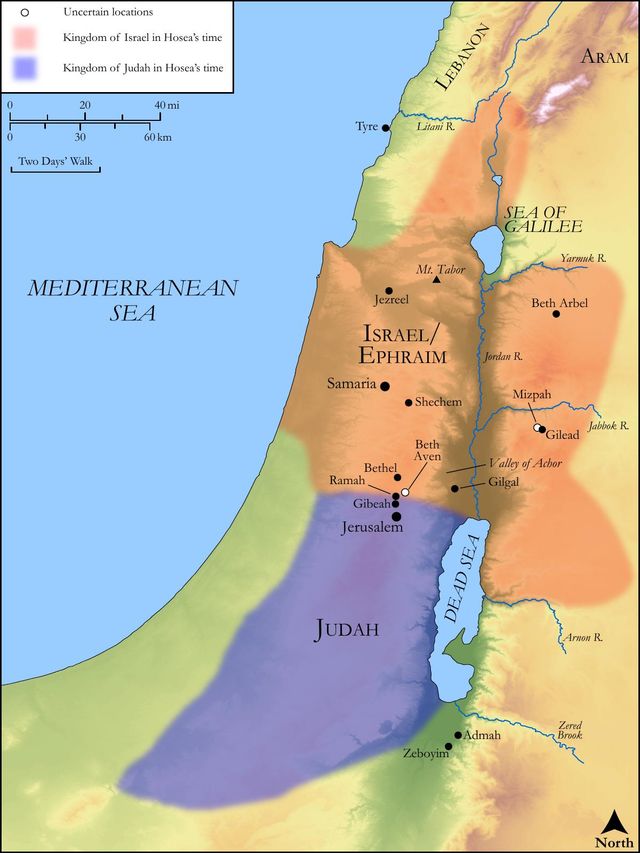
Here is, I. A loud alarm sounded, giving notice of judgments coming (Hos 5:8): Blow you the cornet in Gibeah and in Ramah, two cities near together in the confines of the two kingdoms of Judah and Israel, Gibeah a frontier-town of the kingdom of Judah, Ramah of Israel; so that the warning is hereby sent into both kingdoms. "Cry aloud at Beth-aven, or Bethel, which place seems to be already seized upon by the enemy, and therefore the trumpet is not sounded there, but you hear the outcries of those that shout for mastery, mixed with theirs that are overcome." Let them cry aloud, "After thee, O Benjamin! comes the enemy. The tribe of Ephraim is already vanquished, and the enemy will be upon thy back, O Benjamin! in a little time; thy turn comes next. The cup of trembling shall go round." The prophet had described God's controversy with them as a trial at law (Hos 4:1); here he describes it as a trial by battle; and here also when he judges he will overcome. Let all therefore prepare to meet their God. He had before spoken of the judgments as certain; here he speaks of them as near; and, when they are apprehended as just at the door, they are very startling and awakening. The blowing of this cornet is explained, Hos 5:9. Among the tribes of Israel have I made known that which shall surely be, that which is true or certain, so the word is. Note, The destruction of impenitent sinners is a thing which shall surely be; it is not mere talk, to frighten them, but it is an irrevocable sentence. And it is a mercy to us that it is made known to us, that we have timely warning given us of it, that we may flee from the wrath to come. It is the privilege of the tribes of Israel that, as they are told their duty, so they are told their danger, by the oracles of God committed to them.
II.The ground of God's controversy with them.
1.He has a quarrel with the princes of Judah, because they were daring leaders in sin, Hos 5:10. They are like those that remove the bound, or the ancient land-marks. God has given them his law, to be a fence about his own property; but they have sacrilegiously broken through it, and set it aside; they have encroached even upon God's rights, have trampled upon the distinctions between good and evil, and the most sacred obligations of reason and equity, thinking, because they were princes, that they might do any thing, Quicquid libet, licet - Their will was a law. Or it may be understood of their invading the liberty and property of the subject for the advancing of the prerogative, which was like removing the ancient land-marks. Some have observed that the princes of Judah were more absolute, and assumed a more arbitrary power, than the princes of Israel did; now, for this, God has a controversy with them: I will pour out my wrath upon them like water, in great abundance, like the waters of the flood, which were poured upon the giants of the old world, for the violence which the earth was filled with through them, Gen 6:13. Note, There are bounds which even princes themselves must not remove, bounds both of religion and justice, which they are limited by, and, if they break through them, they must know that there is a God above them that will call them to account for it.
2.He has a quarrel with the people of Ephraim, because they were sneaking followers in sin (Hos 5:11): He willingly walked after the commandment, that is, the commandment of Jeroboam and the succeeding kings of Israel, who obliged all their subjects by a law to worship the calves at Dan and Bethel, and never to go up to Jerusalem to worship. This was the commandment; it was the law of the land, and backed with reasons of state; and the people not only walked after it in a blind implicit obedience to authority, but they willingly walked after it, from a secret antipathy they had to the worship of idols. Note, An easy compliance with the commandments of men that thwart the commandments of God ripens a people for ruin as much as any thing. And the punishment of the sequacious disobedience (if I may so call it) answers to the sin; for it is for this that Ephraim is oppressed and broken in judgment, has all his civil rights and liberties broken in upon and trodden down; and,
(1.)It is just with God that it should be so, that those who betray God's property should lose their own, that those who subject their consciences to an infallible judge, and an arbitrary power, should have enough of both.
(2.)There is a natural tendency in the thing itself towards it. Those that willingly walk after the commandment, even when it walks contrary to the command of God, will find the commandment an encroaching thing, and that the more power is given it the more it will claim. Note, Nothing gives greater advantage to a mastiff-like tyranny, that is fierce and furious, than a spaniel-like submission, that is fawning and flattering. Thus is Ephraim oppressed and broken in judgment, that is, he is wronged under a face and colour of right. Note, It is a sad and sore judgment upon any people to be oppressed under pretence of having justice done them. This explains the threatening Hos 5:9, Ephraim shall be desolate in the day of rebuke. Note, Daring sinners must expect that a day of rebuke will come, and such a day of rebuke as will make them desolate, will deprive them of the comfort of all they have and all they hope for.
III.The different methods that God would take both with Judah and Ephraim, sometimes one method and sometimes the other, and sometimes both together, or rather by which, first the one and then the other, he would advance towards their complete ruin.
1.He would begin with less judgments, which should sometimes work silently and insensibly (Hos 5:12): I will be (that is, my providences shall be) unto Ephraim as a moth; nay (as it might better be supplied), they are unto Ephraim as a moth, for it is such a sickness as Ephraim now sees, Hos 5:13. Note, The judgments of God are sometimes to a sinful people as a moth, and as rottenness, or as a worm. The former signifies the little animals that breed in clothes, the latter those that breed in wood; as these consume the clothes and the wood, so shall the judgments of God consume them.
(1.)Silently, so as not to make any noise in the world, nay, so as they themselves shall not be sensible of it; they shall think themselves safe and thriving, but, when they come to look more narrowly into their state, shall find themselves wasting and decaying.
(2.)Slowly, and with long delays and intervals, that he may give them space to repent. Many a nation, as well as many a person, in the prime of its time, dies of a consumption.
(3.)Gradually. God comes upon sinners with less judgments, so to prevent greater, if they will be wise and take warning; he comes upon them step by step, to show he is not willing that they should perish.
(4.)The moth breeds in the clothes, and the worm or rottenness in the wood; thus sinners are consumed by a fire of their own kindling.
2.When it appeared that those had not done their work he would come upon them with greater (Hos 5:14): I will be unto Ephraim as a lion, and to the house of Judah as a young lion, though Judah is himself, in Jacob's blessing, a lion's whelp. Lest any should think his power weakened, because he was said to be as a moth to them, he says that he will now be as a lion to them, not only to frighten them with his roaring, but to pull them to pieces. Note, If less judgments prevail not to do their work, it may be expected that God will send greater. Christ is sometimes a lion of the tribe of Judah, here he is a lion against that tribe. See what God will do to a people that are secure in sin: Even I will tear. He seems to glory in it, as his prerogative, to be able to destroy, as the alone lawgiver, Jam 4:12. "I, even I, will take the work into my own hands; I say it that will do it." There is a more immediate work of God in some judgments than in others. I will tear, and go away. He will go away,
(1.)As not fearing them; he will go away in state, and with a majestic face, as the lion from his prey.
(2.)As not helping them. If God tear by afflicting providences, and yet by his graces and comforts stays with us, it is well enough; but our condition is sad indeed if he tear and go away, if, when he deprives us of our creature comforts, he does himself depart from us. When he goes away he will take away all that is valuable and dear, for, when God goes, all good goes along with him. He will take away, and none shall rescue him, as the prey cannot be rescued from the lion, Mic 5:8. Note, None can be delivered out of the hands of God's justice but those that are delivered into the hands of his grace. It is in vain for a man to strive with his Maker.
IV.The different effects of those different methods.
1.When God contended with them by less judgments they neglected him, and sought to creatures for relief, but sought in vain, Hos 5:13. When God was to them as a moth, and as rottenness, they perceived their sickness and their wound; after a while they found themselves going down the hill, and that they were behind - hand in their affairs, their estate was sensibly decaying, and then they sent to the Assyrian, to come in to their assistance, made their court to king Jareb, which some think, was one of the names of Pul, or Tiglathpileser, kings of Assyria, to whom both Israel and Judah applied for relief in their distress, hoping by an alliance with them to repair and re-establish their declining interests. Note, Carnal hearts, in time of trouble, see their sickness and see their wound, but do not see the sin that is the cause of it, nor will be brought to acknowledge that, no, nor to acknowledge the hand of God, his mighty hand, much less his righteous hand, in their trouble; and therefore, instead of going the next way to the Creator, who could relieve them, they take a great deal of pains to go about to creatures, who can do them no service. Those who repent not that they have offended God by their sins are loth to be beholden to him in their afflictions, but would rather seek relief any where than with him. And what is the consequence? Yet could he not heal you, nor cure you of your wound. Note, Those who neglect God, and seek to creatures for help, will certainly be disappointed; those who depend upon them for support will find them, not foundations, but broken reeds; those who depend upon them for supply will find them, not fountains, but broken cisterns; those who depend upon them for comfort and a cure will find them miserable comforters, and physicians of no value. The kings of Assyria, whom Judah and Israel sought unto, distressed them and helped them not, Ch2 28:16, Ch2 28:22. Some make king Jareb to signify the great, potent, or magnificent king, for they built much upon his power; others the king that will plead, or should plead, for they built much upon his wisdom and eloquence, and in his interesting himself in their affairs. They had sent him a present (Hos 10:6), a good fee, and, having so retained him of counsel for them, they doubted not of his fidelity to them; but he deceived them, as an arm of flesh does those that trust in it, Jer 17:5, Jer 17:6.
2.When, to convince them of their folly, God brought greater judgments upon them, then they would at length be forced to apply to him, Hos 5:15. When he has torn as a lion,
(1.)He will leave them: I will go and return to my place, to heaven, or to the mercy-seat, the throne of grace, which is his glory. When God punishes sinners he comes out of his place (Isa 26:21); but, when he designs them favour, he returns to his place, where he waits to be gracious, upon their submission. Or he will return to his place when he has corrected them, as not regarding them, hiding his face from them, and not taking notice of their troubles or prayers; and this for their further humiliation, till they are qualified in some measure for the returns of his favour.
(2.)He will at length work upon them, and bring them home to himself, by their afflictions, which is the thing he waits for; and then he will no longer withdraw from them. Two things are here mentioned as instances of their return: - [1.] Their penitent confession of sin: Till they acknowledge their offence; marg. Till they be guilty, that is, till they be sensible of their guilt, and be brought to own it, and humble themselves before God for it. Note, When men begin to complain more of their sins than of their afflictions then there begins to be some hope of them; and this is that which God requires of us, when we are under his correcting hand, that we own ourselves in a fault and justly corrected. [2.] Their humble petition for the favour of God: Till they seek my face, which, it may be expected, they will do when they are brought to the last extremity, and they have tried other helpers in vain. In their affliction they will seek me early, that is, diligently and earnestly, and with great importunity; and if they seek him thus, and be sincere in it, though it might be called seeking him late, because it was long ere they were brought to it, yet it is not too late, nay, he is pleased to call it seeking him early, so willing is he to make the best of true penitents in their return to him. Note, When we are under the convictions of sin, and the corrections of the rod, our business is to seek God's face; we must desire the knowledge of him, and an acquaintance with him, that he may manifest himself to us, and for us, in token of his being at peace with us. And it may reasonably be expected that affliction will bring those to God that had long gone astray from him, and kept at a distance. Therefore God for a time turns away from us, that he may turn us to himself, and then return to us. Is any among you afflicted? Let him pray.
Historical interpretation
Historical reception
4 surviving comments on this verse. Each one is dated, so this reads as a timeline rather than a list.
Select a marker to jump to its quote. Markers stagger vertically where authors wrote within a few decades of each other.
By “my place” we have to understand God’s place, his splendor and majesty, so that by no means according to the dispensation does he descend to men, become angry, merciful, forgetful, become as a panther, turn into a lion, change into beasts. On the contrary, he disdains human things and allows those whom he once protected to be cast to enemies so that they may languish, disappear and be destroyed, and seek eventually the face of the Lord.… Others consider God’s place the heaven where God returns after being offended by the inhabitants of the earth, and he allows to go to ruin those who, due to the multitude of their sins, turned the mercy of the Lord into the rage of beasts toward them.
"I will take and go, and I will take away and there is no one who can deliver: going I will return to my place until you fail and seek my face." LXX: "And I will snatch, and go and take away, and there will be no one who can deliver: I will go and return to my rightful place until they are destroyed and seek my face." It is asked, if God takes, and takes away, and holds, no one can take them from his hands, according to what is written: "No one can snatch them from the hand of my Father" (John X, 29) how was Judas snatched from the hand of God through betrayal? We will briefly answer this, that no one can snatch from the hand of God: however, he who is held, can by his own will fall away from the hand of God. And what follows: "Going, I shall return to my place," we ought to accept the place of God, his magnificence and majesty: so that he does not in any way descend to deal with men, become angry, show mercy, forget, become like a panther, turn into a lion, change into beasts: but may despise human things, and allow those whom he formerly protected to submit to their enemies, so that they may waste away, and fail, and die, and afterwards seek the face of the Lord and say: "Illuminate your face and we will be saved" (Ps. LXXIX, 4). "And: Show us, Lord, your mercy, and grant us your salvation" (Psalm 85:8). Even to heretics and the negligent Church, God turns into a panther and a lion; and He will reclaim the prey from those who had previously seized it from the Church, so that those who had been lost might be saved when they are captured. He will not dwell in the gathering of the wicked but will return to His place, as He said, "I am in the Father, and the Father is in me" (John 14:1). He will reject and despise them until they are consumed by their impiousness and seek Him through penance, abandoned as they once were. Some think heaven is God's dwelling place; thus God, offended by those who dwell on earth, will return and make perish those who, through the enormity of their sins, have converted the most merciful Lord into a wild beast for themselves.
“They seek early” seems to indicate here that they, as if awakened from the sleep of thoughtlessness which was in them, and further as if brought from night and darkness to light and day, will call out to one another that it is fitting to return to the Lord. This is a return to the senses of those fallen into deception and those taken up by the worship of idols. For the fruit of vigilance is at present seeking to get out of the gloom which is demonic.
It seems that the saying refers very suitably to the mystery of Christ and the redemption through him, pointing to the conversion to God. For the face of God we seek signifies most certainly the Son himself, “who is the image, and the radiance, and the very seal of the Father’s nature.” Thus the true face of God and Father is the Son, inasmuch as he is recognized in him: “And who saw him, saw the Father.” The psalmist thus calls him when he cries out to God of all, saying: “Cause your face to shine upon your servant.” Indeed, just as from the person of those who were already transformed according to the Son through the Spirit: “The light of your face, O Lord, has been marked upon us.” Or as the prophet says: “The light of our face, the anointed Lord.”
Continue studying Hosea 5:15 across the web’s major study libraries — every link below opens this exact verse, chapter, or book on the destination site.
Read & Compare
 BibleGatewayThis verse in more than 200 translations and 70 languages.
 Bible.comThe YouVersion reader — hundreds of translations, reading plans, and highlights.
 ESV.orgCrossway's official English Standard Version reader.
 NET BibleThe NET translation with 60,000+ translators' notes on every rendering decision.
 STEP BibleTyndale House's free study tool — original text, vocabulary, and scholarly resources.
 BibliaLogos Bible Software's free web reader.
 USCCBThe New American Bible (Revised Edition) with the U.S. bishops' study notes.
Commentaries
 BibleHub CommentariesDozens of classic commentaries on this verse, gathered on one page.
 StudyLightMore than 100 commentary sets — the largest collection on the web.
 BibleRefPlain-English commentary on what this verse means, verse by verse.
 Enduring WordDavid Guzik's free commentary on this chapter, widely used by Bible teachers.
 Bible Study ToolsVerse commentary alongside Greek and Hebrew study aids.
Original Language & Research
- BibleHub InterlinearThe verse word by word — original language, transliteration, and English.
- BibleHub LexiconEvery word's original-language definition and Strong's entry.
 Blue Letter BibleDeep-study tools — Strong's numbers, concordance, and word studies.
 SefariaThe Hebrew text with Rashi and centuries of Jewish commentary.
Sermons, Hymns & Audio


TrulyRandomVerse is not affiliated with these sites and doesn’t control their content. They’re linked because they’re genuinely useful.
Summary
Hosea 5:15 presents a profound divine declaration of withdrawal, where God states He will return to His "place" until the unfaithful Israelites genuinely acknowledge their guilt and earnestly seek His presence. This withdrawal is not abandonment but a disciplinary measure, designed to allow the natural consequences of their sin to unfold, thereby compelling them to seek Him diligently and urgently, particularly during their inevitable period of affliction. The verse underscores God's justice, His desire for true repentance, and His ultimate readiness to be found by those who seek Him wholeheartedly.
Context
ShowHideLiterary Context
Hosea 5:15 concludes a section (Hosea 5:1-15) filled with stern judgment against both Israel (Ephraim) and Judah for their spiritual adultery, idolatry, and reliance on foreign alliances rather than on the Lord. The preceding verses detail God's intention to bring severe punishment, described as a "lion" tearing them apart and leaving them (Hosea 5:14). This imagery sets the stage for the divine withdrawal in verse 15, which is presented as the culmination of God's judicial action. The verse then transitions to the hope of repentance, serving as a bridge to chapter 6, which begins with the people's response to this affliction and their desire to return to the Lord, albeit initially a superficial one.
Historical & Cultural Context
The prophecy of Hosea is set against the backdrop of the declining Northern Kingdom of Israel (Ephraim) in the 8th century BCE, leading up to its fall to Assyria in 722 BCE. Both Israel and Judah were characterized by political instability, oppression, and widespread syncretism, blending Yahweh worship with Canaanite Baal worship. They sought military alliances with Egypt and Assyria, rather than trusting in God's protection. God's declaration to "return to my place" reflects a common ancient Near Eastern concept of a deity withdrawing favor or presence, leaving the people vulnerable. The "affliction" mentioned is a direct consequence of their covenant breaking and disobedience, a divinely ordained discipline intended to bring them to their senses and back to their covenant Lord.
Key Themes
ShowHideThis verse powerfully encapsulates several overarching themes in Hosea and the prophetic literature. It highlights divine judgment as a necessary consequence of unfaithfulness, demonstrating that God's patience is not limitless. The concept of divine withdrawal emphasizes God's sovereignty and His willingness to allow His people to experience the bitter fruit of their choices, rather than perpetually intervening to prevent suffering. Crucially, the verse introduces the theme of repentance as a prerequisite for restoration, emphasizing the need for a genuine acknowledgment of sin and an earnest "seeking of God's face." Finally, it underscores the paradoxical truth that affliction can serve as a catalyst for spiritual awakening, driving a wayward people back to the very God they abandoned, as seen in the broader prophetic call for Israel to return to the Lord their God.
Exposition and Analysis
ShowHideKey Word Analysis
ShowHideThe verb yâlak means "to walk, go, carry," often implying movement or departure. Shûwb means "to turn back, return, restore." Together, "I will go and return" signifies a deliberate and decisive act of divine withdrawal. It is not an abandonment, but a strategic retreat by God from His active intervention and protective presence among His people. This withdrawal is intended to allow the full weight of their self-inflicted consequences to fall upon them, serving as a severe form of discipline designed to prompt repentance.
This word carries the meaning "to be guilty," and by implication, "to be punished or perish." It denotes not just a mistake or an act of sin, but a state of culpability and the inherent guilt that demands restitution or punishment. For Israel, acknowledging their ʼâsham means recognizing their profound guilt and culpability before God for their idolatry and covenant breaking, understanding that their suffering is a just consequence of their actions, rather than an arbitrary misfortune.
The phrase "seek my face" (from bâqash meaning "to search out, strive after, seek" and pânîym meaning "face, presence") is a powerful idiom for earnestly desiring and pursuing God's favor, presence, and intimate communion. It implies a longing for restored relationship and reconciliation. The addition "seek me early" (from shâchar meaning "to dawn, be up early at any task," implying earnestness and painstaking effort) intensifies this desire, suggesting an urgent, diligent, and wholehearted pursuit, often arising from a desperate situation. This combined emphasis highlights the depth and urgency of the repentance God desires.
Verse Breakdown
ShowHide"I will go [and] return to my place"
This clause declares God's deliberate act of withdrawing His active presence and protective hand from Israel. "My place" refers to His heavenly abode, signifying a cessation of direct intervention in their affairs and a removal of His immediate favor. This withdrawal is a judicial act, allowing the natural consequences of their sin to take their course.
"till they acknowledge their offence"
This sets the condition for God's return. The Hebrew word for "offence" (ʼâsham) implies not just a recognition of wrongdoing, but a deep confession of guilt and culpability for their covenant breaking and idolatry. It's a call for genuine repentance that stems from an internal conviction of sin against God, rather than merely regret over negative outcomes.
"and seek my face"
This clause further specifies the nature of the desired repentance. "Seeking God's face" is an idiomatic expression for earnestly pursuing His presence, favor, and reconciliation. It implies a longing for restored relationship, a turning away from idols, and a desire for intimate communion with the Lord. It signifies a shift from self-reliance or reliance on foreign powers to a humble dependence on God alone.
"in their affliction they will seek me early"
This prophetic statement reveals God's understanding of human nature. It predicts that Israel's suffering and distress ("affliction," tsar) will serve as a catalyst, compelling them to seek God with urgency and diligence ("seek me early," shâchar). This implies that while God's withdrawal is painful, it is ultimately redemptive, designed to bring His people to a point of desperation where they will earnestly turn back to Him.
Literary Devices
ShowHideHosea 5:15 employs several potent literary devices. Anthropomorphism is evident in God's declaration, "I will go and return to my place," attributing human actions of movement and spatial presence to God, making His withdrawal tangible and comprehensible. The phrase "seek my face" is a powerful metaphor or idiom, representing the earnest pursuit of God's presence, favor, and intimate relationship, rather than a literal search for His physical countenance. The entire verse functions as a conditional promise or prophetic statement, where God's future action (return) is contingent upon Israel's response (acknowledgment of offence, seeking His face). Finally, there is a subtle irony or paradox in the final clause: the very affliction that results from God's withdrawal becomes the means by which the people are driven to seek Him, highlighting God's redemptive purpose even in judgment.
Theological and Thematic Connections
ShowHideHosea 5:15 articulates a profound theological truth about God's disciplinary love and His unwavering desire for genuine relationship. God's withdrawal is not an act of abandonment but a calculated, painful strategy to bring His wayward people to a place of true repentance. It underscores that suffering can be a divinely ordained instrument to expose sin, humble the proud, and redirect hearts back to the only true source of life and blessing. This passage teaches that God values authentic acknowledgment of guilt and a fervent pursuit of His presence above superficial rituals or forced obedience. His ultimate goal is reconciliation, but it must be predicated on a sincere turning from sin and a heartfelt longing for Him.
Reflection and Application
ShowHideHosea 5:15 serves as a powerful mirror for individual believers and the church today. It challenges us to examine our own spiritual posture: are we truly acknowledging our "offence" (sin) before God, or merely regretting the consequences? Are we earnestly "seeking His face" in all circumstances, or only when affliction compels us? This verse reminds us that God's discipline, though painful, is always purposeful, aiming to draw us into deeper intimacy with Him. We are called not to wait for hardship to drive us to our knees, but to proactively and consistently seek God's presence, confess our sins, and live in humble dependence on Him. When we find ourselves in "affliction," this passage offers hope: it is precisely in such moments that God is most intent on being found by those who seek Him with all their heart. Our response to difficulty reveals the true depth of our faith and our desire for God Himself.
Questions for Reflection
ShowHideFAQ
ShowHideWhat does it mean for God to "return to my place"?
ShowHideWhen God says, "I will go and return to my place," it signifies a deliberate act of divine withdrawal. It means He is removing His active, protective, and intervening presence from His people. This is not abandonment, but a judicial and disciplinary measure. It allows the natural consequences of their sin and disobedience to unfold without His usual restraining or protecting hand. The "place" refers to His heavenly dwelling, implying that He is stepping back from direct engagement in their earthly affairs until they meet the conditions for His return. This withdrawal is intended to create a spiritual vacuum and a state of desperation that will ultimately compel them to seek Him.
Is God's withdrawal a sign of His anger or His love?
ShowHideWhile God's withdrawal is a manifestation of His righteous judgment against sin, it is ultimately rooted in His loving desire for His people's repentance and restoration. It is a form of divine discipline, akin to a loving parent allowing a child to experience the painful consequences of their choices to teach them a vital lesson. The purpose is not to destroy, but to correct and refine, leading to genuine acknowledgment of sin and a heartfelt return to Him. The verse explicitly states the purpose of this withdrawal: "till they acknowledge their offence, and seek my face: in their affliction they will seek me early." This demonstrates God's redemptive intent, even in His severity. This concept is echoed in Hebrews 12:6.
Christ-Centered Fulfillment
ShowHideHosea 5:15, with its depiction of divine withdrawal and the subsequent call for repentance through affliction, finds its ultimate fulfillment and transformation in Christ. While Israel's "offence" led to God's temporary departure, the ultimate "offence" of humanity's sin against a holy God was fully acknowledged and atoned for in the person of Jesus Christ. He is the ultimate "place" where God's presence dwells fully (Colossians 2:9), and through His atoning sacrifice, the barrier of sin that caused God's withdrawal was removed. We no longer need to wait for God to "return to His place" because in Christ, God has definitively come to us, reconciling the world to Himself (2 Corinthians 5:19). Our "affliction" now, rather than prompting a desperate search for a distant God, draws us into deeper reliance on the Christ who suffered for us and is our ever-present help. We are called to "seek His face" not through a painful, uncertain quest, but by drawing near to God confidently through the blood of Jesus (Hebrews 4:16). In Christ, the seeking is met with immediate finding, and the promise of His presence is eternal and unwavering (Matthew 28:20).