


Hosea 5:14
- כִּיkiforH3588PrtParticle Conditional
- אָנֹכִי'a·no·KhiIH595Pro-1csPronoun Personal 1st Singular common gender
- כַשַּׁחַלkha·Sha·chal[will be] like <the> lionH7826Prep-k ¦ N-msNoun Singular Masculine Absoluteכַ[will be] like <the>שַּׁחַלlion
- לְאֶפְרַיִםle·'ef·Ra·yimto EphraimH669Prep-l ¦ N-proper-mNoun Proper MasculineלְtoאֶפְרַיִםEphraim
- וְכַכְּפִירve·kha·ke·Firand like <the> young lionH3715Conj-w ¦ Prep-k ¦ N-msNoun Singular Masculine Absoluteוְandכַlike <the>כְּפִירyoung lion
- לְבֵיתle·Veitto [the] house ofH1004Prep-l ¦ N-mscNoun Singular Masculine Constructלְtoבֵית[the] house of
- יְהוּדָהye·hu·DahJudahH3063N-properNoun Proper Location
- אֲנִי'a·NiIH589Pro-1csPronoun Personal 1st Singular common gender
- אֲנִי'a·NiIH589Pro-1csPronoun Personal 1st Singular common gender
- אֶטְרֹף'et·RofI will tear to piecesH2963V-Qal-Imperf-1csVerb Qal Imperfect 1st Singular common gender
- וְאֵלֵךְve·'e·Lekhand I may goH1980Conj-w ¦ V-Qal-ConjImperf-1csVerb Qal Conjunction+Imperfect 1st Singular common genderוְandאֵלֵךְI may go
- אֶשָּׂא'e·Sa'I will carry offH5375V-Qal-Imperf-1csVerb Qal Imperfect 1st Singular common gender
- וְאֵיןve·'Einand there notH369Conj-w ¦ N-mscNoun Singular Masculine Constructוְandאֵיןthere not
- מַצִּילma·Tzil[will be] a delivererH5337V-Hiphil-Prtcpl-msVerb Hiphil Participle Singular Masculine Absolute
English is a literal word-by-word gloss of the Hebrew, not the KJV's wording. Why?
This is the original text the KJV's translators worked from — each Hebrew word with its own literal English meaning in this verse, prepared by scholars at Tyndale House, Cambridge. The KJV translates whole sentences, not word by word, so its wording differs: one Hebrew word can become several English words, and the KJV may choose “the LORD” where the gloss reads “Yahweh”. Both are faithful — they answer different questions. For the KJV's own rendering, switch to the KJV text.
Details
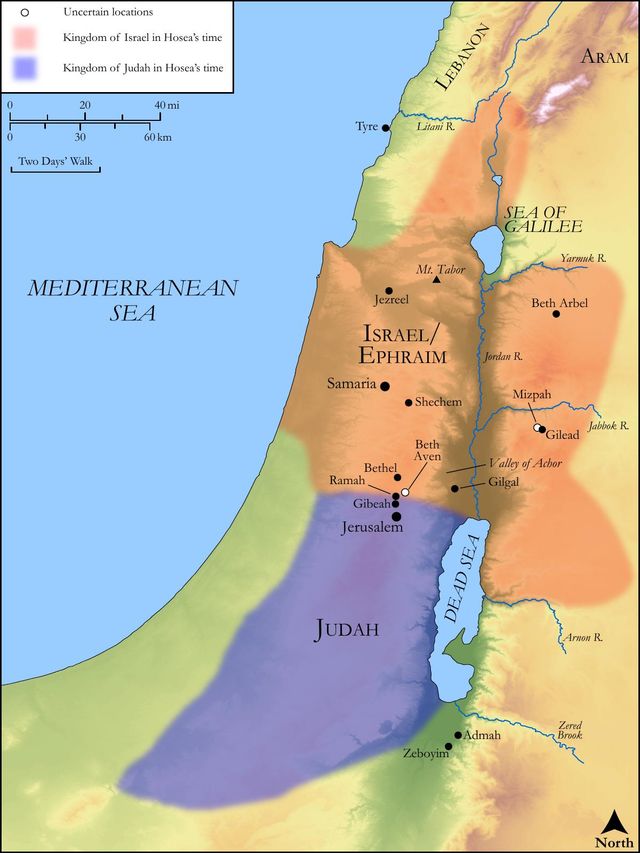
See on the biblical-era map
Study this verse
Public-domain commentary
Matthew Henry
From his Commentary on the Whole Bible. Henry comments on passages, not single verses — this entry covers Hosea 5:8–15. His three-level outline is real structure in the source text, so it is rendered as structure.
Here is, I. A loud alarm sounded, giving notice of judgments coming (Hos 5:8): Blow you the cornet in Gibeah and in Ramah, two cities near together in the confines of the two kingdoms of Judah and Israel, Gibeah a frontier-town of the kingdom of Judah, Ramah of Israel; so that the warning is hereby sent into both kingdoms. "Cry aloud at Beth-aven, or Bethel, which place seems to be already seized upon by the enemy, and therefore the trumpet is not sounded there, but you hear the outcries of those that shout for mastery, mixed with theirs that are overcome." Let them cry aloud, "After thee, O Benjamin! comes the enemy. The tribe of Ephraim is already vanquished, and the enemy will be upon thy back, O Benjamin! in a little time; thy turn comes next. The cup of trembling shall go round." The prophet had described God's controversy with them as a trial at law (Hos 4:1); here he describes it as a trial by battle; and here also when he judges he will overcome. Let all therefore prepare to meet their God. He had before spoken of the judgments as certain; here he speaks of them as near; and, when they are apprehended as just at the door, they are very startling and awakening. The blowing of this cornet is explained, Hos 5:9. Among the tribes of Israel have I made known that which shall surely be, that which is true or certain, so the word is. Note, The destruction of impenitent sinners is a thing which shall surely be; it is not mere talk, to frighten them, but it is an irrevocable sentence. And it is a mercy to us that it is made known to us, that we have timely warning given us of it, that we may flee from the wrath to come. It is the privilege of the tribes of Israel that, as they are told their duty, so they are told their danger, by the oracles of God committed to them.
II.The ground of God's controversy with them.
1.He has a quarrel with the princes of Judah, because they were daring leaders in sin, Hos 5:10. They are like those that remove the bound, or the ancient land-marks. God has given them his law, to be a fence about his own property; but they have sacrilegiously broken through it, and set it aside; they have encroached even upon God's rights, have trampled upon the distinctions between good and evil, and the most sacred obligations of reason and equity, thinking, because they were princes, that they might do any thing, Quicquid libet, licet - Their will was a law. Or it may be understood of their invading the liberty and property of the subject for the advancing of the prerogative, which was like removing the ancient land-marks. Some have observed that the princes of Judah were more absolute, and assumed a more arbitrary power, than the princes of Israel did; now, for this, God has a controversy with them: I will pour out my wrath upon them like water, in great abundance, like the waters of the flood, which were poured upon the giants of the old world, for the violence which the earth was filled with through them, Gen 6:13. Note, There are bounds which even princes themselves must not remove, bounds both of religion and justice, which they are limited by, and, if they break through them, they must know that there is a God above them that will call them to account for it.
2.He has a quarrel with the people of Ephraim, because they were sneaking followers in sin (Hos 5:11): He willingly walked after the commandment, that is, the commandment of Jeroboam and the succeeding kings of Israel, who obliged all their subjects by a law to worship the calves at Dan and Bethel, and never to go up to Jerusalem to worship. This was the commandment; it was the law of the land, and backed with reasons of state; and the people not only walked after it in a blind implicit obedience to authority, but they willingly walked after it, from a secret antipathy they had to the worship of idols. Note, An easy compliance with the commandments of men that thwart the commandments of God ripens a people for ruin as much as any thing. And the punishment of the sequacious disobedience (if I may so call it) answers to the sin; for it is for this that Ephraim is oppressed and broken in judgment, has all his civil rights and liberties broken in upon and trodden down; and,
(1.)It is just with God that it should be so, that those who betray God's property should lose their own, that those who subject their consciences to an infallible judge, and an arbitrary power, should have enough of both.
(2.)There is a natural tendency in the thing itself towards it. Those that willingly walk after the commandment, even when it walks contrary to the command of God, will find the commandment an encroaching thing, and that the more power is given it the more it will claim. Note, Nothing gives greater advantage to a mastiff-like tyranny, that is fierce and furious, than a spaniel-like submission, that is fawning and flattering. Thus is Ephraim oppressed and broken in judgment, that is, he is wronged under a face and colour of right. Note, It is a sad and sore judgment upon any people to be oppressed under pretence of having justice done them. This explains the threatening Hos 5:9, Ephraim shall be desolate in the day of rebuke. Note, Daring sinners must expect that a day of rebuke will come, and such a day of rebuke as will make them desolate, will deprive them of the comfort of all they have and all they hope for.
III.The different methods that God would take both with Judah and Ephraim, sometimes one method and sometimes the other, and sometimes both together, or rather by which, first the one and then the other, he would advance towards their complete ruin.
1.He would begin with less judgments, which should sometimes work silently and insensibly (Hos 5:12): I will be (that is, my providences shall be) unto Ephraim as a moth; nay (as it might better be supplied), they are unto Ephraim as a moth, for it is such a sickness as Ephraim now sees, Hos 5:13. Note, The judgments of God are sometimes to a sinful people as a moth, and as rottenness, or as a worm. The former signifies the little animals that breed in clothes, the latter those that breed in wood; as these consume the clothes and the wood, so shall the judgments of God consume them.
(1.)Silently, so as not to make any noise in the world, nay, so as they themselves shall not be sensible of it; they shall think themselves safe and thriving, but, when they come to look more narrowly into their state, shall find themselves wasting and decaying.
(2.)Slowly, and with long delays and intervals, that he may give them space to repent. Many a nation, as well as many a person, in the prime of its time, dies of a consumption.
(3.)Gradually. God comes upon sinners with less judgments, so to prevent greater, if they will be wise and take warning; he comes upon them step by step, to show he is not willing that they should perish.
(4.)The moth breeds in the clothes, and the worm or rottenness in the wood; thus sinners are consumed by a fire of their own kindling.
2.When it appeared that those had not done their work he would come upon them with greater (Hos 5:14): I will be unto Ephraim as a lion, and to the house of Judah as a young lion, though Judah is himself, in Jacob's blessing, a lion's whelp. Lest any should think his power weakened, because he was said to be as a moth to them, he says that he will now be as a lion to them, not only to frighten them with his roaring, but to pull them to pieces. Note, If less judgments prevail not to do their work, it may be expected that God will send greater. Christ is sometimes a lion of the tribe of Judah, here he is a lion against that tribe. See what God will do to a people that are secure in sin: Even I will tear. He seems to glory in it, as his prerogative, to be able to destroy, as the alone lawgiver, Jam 4:12. "I, even I, will take the work into my own hands; I say it that will do it." There is a more immediate work of God in some judgments than in others. I will tear, and go away. He will go away,
(1.)As not fearing them; he will go away in state, and with a majestic face, as the lion from his prey.
(2.)As not helping them. If God tear by afflicting providences, and yet by his graces and comforts stays with us, it is well enough; but our condition is sad indeed if he tear and go away, if, when he deprives us of our creature comforts, he does himself depart from us. When he goes away he will take away all that is valuable and dear, for, when God goes, all good goes along with him. He will take away, and none shall rescue him, as the prey cannot be rescued from the lion, Mic 5:8. Note, None can be delivered out of the hands of God's justice but those that are delivered into the hands of his grace. It is in vain for a man to strive with his Maker.
IV.The different effects of those different methods.
1.When God contended with them by less judgments they neglected him, and sought to creatures for relief, but sought in vain, Hos 5:13. When God was to them as a moth, and as rottenness, they perceived their sickness and their wound; after a while they found themselves going down the hill, and that they were behind - hand in their affairs, their estate was sensibly decaying, and then they sent to the Assyrian, to come in to their assistance, made their court to king Jareb, which some think, was one of the names of Pul, or Tiglathpileser, kings of Assyria, to whom both Israel and Judah applied for relief in their distress, hoping by an alliance with them to repair and re-establish their declining interests. Note, Carnal hearts, in time of trouble, see their sickness and see their wound, but do not see the sin that is the cause of it, nor will be brought to acknowledge that, no, nor to acknowledge the hand of God, his mighty hand, much less his righteous hand, in their trouble; and therefore, instead of going the next way to the Creator, who could relieve them, they take a great deal of pains to go about to creatures, who can do them no service. Those who repent not that they have offended God by their sins are loth to be beholden to him in their afflictions, but would rather seek relief any where than with him. And what is the consequence? Yet could he not heal you, nor cure you of your wound. Note, Those who neglect God, and seek to creatures for help, will certainly be disappointed; those who depend upon them for support will find them, not foundations, but broken reeds; those who depend upon them for supply will find them, not fountains, but broken cisterns; those who depend upon them for comfort and a cure will find them miserable comforters, and physicians of no value. The kings of Assyria, whom Judah and Israel sought unto, distressed them and helped them not, Ch2 28:16, Ch2 28:22. Some make king Jareb to signify the great, potent, or magnificent king, for they built much upon his power; others the king that will plead, or should plead, for they built much upon his wisdom and eloquence, and in his interesting himself in their affairs. They had sent him a present (Hos 10:6), a good fee, and, having so retained him of counsel for them, they doubted not of his fidelity to them; but he deceived them, as an arm of flesh does those that trust in it, Jer 17:5, Jer 17:6.
2.When, to convince them of their folly, God brought greater judgments upon them, then they would at length be forced to apply to him, Hos 5:15. When he has torn as a lion,
(1.)He will leave them: I will go and return to my place, to heaven, or to the mercy-seat, the throne of grace, which is his glory. When God punishes sinners he comes out of his place (Isa 26:21); but, when he designs them favour, he returns to his place, where he waits to be gracious, upon their submission. Or he will return to his place when he has corrected them, as not regarding them, hiding his face from them, and not taking notice of their troubles or prayers; and this for their further humiliation, till they are qualified in some measure for the returns of his favour.
(2.)He will at length work upon them, and bring them home to himself, by their afflictions, which is the thing he waits for; and then he will no longer withdraw from them. Two things are here mentioned as instances of their return: - [1.] Their penitent confession of sin: Till they acknowledge their offence; marg. Till they be guilty, that is, till they be sensible of their guilt, and be brought to own it, and humble themselves before God for it. Note, When men begin to complain more of their sins than of their afflictions then there begins to be some hope of them; and this is that which God requires of us, when we are under his correcting hand, that we own ourselves in a fault and justly corrected. [2.] Their humble petition for the favour of God: Till they seek my face, which, it may be expected, they will do when they are brought to the last extremity, and they have tried other helpers in vain. In their affliction they will seek me early, that is, diligently and earnestly, and with great importunity; and if they seek him thus, and be sincere in it, though it might be called seeking him late, because it was long ere they were brought to it, yet it is not too late, nay, he is pleased to call it seeking him early, so willing is he to make the best of true penitents in their return to him. Note, When we are under the convictions of sin, and the corrections of the rod, our business is to seek God's face; we must desire the knowledge of him, and an acquaintance with him, that he may manifest himself to us, and for us, in token of his being at peace with us. And it may reasonably be expected that affliction will bring those to God that had long gone astray from him, and kept at a distance. Therefore God for a time turns away from us, that he may turn us to himself, and then return to us. Is any among you afflicted? Let him pray.
Historical interpretation
Historical reception
1 surviving comment on this verse from the historical church.
"For I am like a lioness of Ephraim, and like a lion's cub to the house of Judah." LXX: "For I am like a panther to Ephraim, and like a lion in the house of Judah." When they go to Assyria and send to the avenging or the revenger king, who will not be able to heal them; nor to undo the bound chain, I will show that with me opposing, all human help is vain: for I will be like a lioness to Ephraim, and like a lion's whelp to the house of Judah. For the lioness, which in Hebrew is called Sohel, the Seventy [translators] interpreted it as 'panther,' which is similarly said in Greek and in Latin, and both the name of the beast and every beast can be taken [in this sense]: so that you may recognize whatever is savage in the beasts, as existing in God's indignation. There is nothing swifter than the panther, nothing stronger than the lion: in the panther the swiftness of the destruction of the kingdom of Samaria is significant among the Assyrians; and in the lion, the strongest [beast], is shown their kingdom against Jerusalem and Judah somewhat later in time of the Chaldeans. And because she had said that she was both a lioness or panther, she maintains the metaphor and says:
Continue studying Hosea 5:14 across the web’s major study libraries — every link below opens this exact verse, chapter, or book on the destination site.
Read & Compare
 BibleGatewayThis verse in more than 200 translations and 70 languages.
 Bible.comThe YouVersion reader — hundreds of translations, reading plans, and highlights.
 ESV.orgCrossway's official English Standard Version reader.
 NET BibleThe NET translation with 60,000+ translators' notes on every rendering decision.
 STEP BibleTyndale House's free study tool — original text, vocabulary, and scholarly resources.
 BibliaLogos Bible Software's free web reader.
 USCCBThe New American Bible (Revised Edition) with the U.S. bishops' study notes.
Commentaries
 BibleHub CommentariesDozens of classic commentaries on this verse, gathered on one page.
 StudyLightMore than 100 commentary sets — the largest collection on the web.
 BibleRefPlain-English commentary on what this verse means, verse by verse.
 Enduring WordDavid Guzik's free commentary on this chapter, widely used by Bible teachers.
 Bible Study ToolsVerse commentary alongside Greek and Hebrew study aids.
Original Language & Research
- BibleHub InterlinearThe verse word by word — original language, transliteration, and English.
- BibleHub LexiconEvery word's original-language definition and Strong's entry.
 Blue Letter BibleDeep-study tools — Strong's numbers, concordance, and word studies.
 SefariaThe Hebrew text with Rashi and centuries of Jewish commentary.
Sermons, Hymns & Audio


TrulyRandomVerse is not affiliated with these sites and doesn’t control their content. They’re linked because they’re genuinely useful.
Summary
Hosea 5:14 powerfully depicts the Lord's impending and irresistible judgment upon the Northern Kingdom of Israel (Ephraim) and, to a lesser extent, the Southern Kingdom of Judah. Through vivid predatory imagery, God declares that He Himself will act as a fierce lion, tearing His unfaithful people and carrying them away, leaving no possibility of rescue from any human hand. This verse underscores the severity of divine wrath against persistent idolatry and covenant unfaithfulness, emphasizing the certainty and finality of His righteous indignation.
Context
ShowHideLiterary Context
This verse is situated within a series of prophetic pronouncements in Hosea 4-6, where the prophet meticulously details Israel's spiritual harlotry, moral corruption, and political instability. Chapters 4 and 5 specifically enumerate God's charges against the priests, prophets, and people for their lack of knowledge of God, their idolatry, and their reliance on foreign alliances rather than the Lord. The preceding verses (Hosea 5:8-13) speak of military invasion and national distress as a consequence of their sin, culminating in God's declaration that He will be like a moth and rottenness to them, slowly consuming them. Verse 14 then shifts to a more immediate, violent, and direct form of judgment, portraying God not as a subtle decay, but as a swift and devastating predator, signifying a heightened intensity of divine wrath. This dramatic shift in imagery underscores the escalating nature of God's judgment as His people remain unrepentant.
Historical & Cultural Context
Hosea prophesied during a turbulent period in Israel's history, spanning the reigns of several kings in both Israel and Judah (Uzziah, Jotham, Ahaz, Hezekiah in Judah; Jeroboam II, Zechariah, Shallum, Menahem, Pekahiah, Pekah, Hoshea in Israel). The Northern Kingdom, Ephraim, was particularly unstable, marked by frequent regicides, political assassinations, and a desperate search for security through alliances with powerful nations like Assyria and Egypt, rather than trusting in the Lord. Culturally, the worship of Baal and Asherah was rampant, often intertwined with the worship of Yahweh, leading to syncretism and spiritual adultery. The lion, in the ancient Near East, was a potent symbol of power, royalty, and destructive force. Kings often used lion imagery to depict their strength and conquest. By portraying Himself as a lion, God was asserting His supreme sovereignty and irresistible power, far exceeding that of any earthly king or foreign army. The "house of Judah" is mentioned, indicating that while the primary focus is on Ephraim, Judah is not entirely exempt from the consequences of similar unfaithfulness, though their judgment might be less immediate or severe in this context.
Key Themes
ShowHideHosea 5:14 contributes significantly to several overarching themes in the book of Hosea and biblical theology. Firstly, it powerfully illustrates the theme of Divine Judgment, emphasizing that God's justice is not passive but active, decisive, and destructive against unrepentant sin. This judgment is a direct consequence of Israel's covenant unfaithfulness and spiritual harlotry, as detailed in passages like Hosea 4:1-2. Secondly, the imagery highlights the Irresistible Power and Sovereignty of God. Just as no one can withstand a lion's attack, no human or nation can thwart God's determined judgment. This reinforces the truth that God is ultimately in control of history and the destiny of nations, a theme echoed in Isaiah 43:13. Lastly, the verse underscores the Consequences of Sin and Covenant Breaking. It serves as a stark warning that persistent rebellion against God's commands and rejection of His covenant love will inevitably lead to severe, unavoidable divine retribution. This principle is foundational to the prophetic message, demonstrating that God's holiness demands a response to sin, as seen throughout the Old Testament, from the warnings in Deuteronomy 28 to the laments of Lamentations 3:10.
Exposition and Analysis
ShowHideKey Word Analysis
ShowHideThis term refers to a mature, fierce lion, specifically emphasizing its characteristic roar and predatory nature. In this context, it conveys the terrifying and absolute power of God's impending judgment, suggesting a fully developed and formidable threat. Unlike a "young lion," shachal often implies a more experienced and devastating predator.
This word denotes a young lion, perhaps one that is particularly strong and aggressive, or one that has recently left the pride to hunt independently. Its inclusion alongside "lion" (shachal) might indicate a comprehensive and widespread attack, or perhaps a slightly different nuance of ferocity—the raw, untamed power of a younger beast. The pairing emphasizes the multifaceted and overwhelming nature of God's destructive power.
This primitive root means "to pluck off or pull to pieces," often used in the context of a predator rending its prey. It conveys violent, destructive action, leaving no hope for the victim. When applied to God, it signifies a complete and devastating judgment that utterly dismantles and destroys the nation, leaving them helpless and beyond human intervention.
Verse Breakdown
ShowHide"For I [will be] unto Ephraim as a lion,"
God declares His active role in the impending judgment, identifying Himself with the most formidable and feared predator. Ephraim, representing the Northern Kingdom of Israel, is the primary target of this divine wrath due to its persistent idolatry and covenant unfaithfulness. The simile emphasizes the ferocity, power, and inevitability of God's actions against them.
"and as a young lion to the house of Judah:"
The judgment extends to the Southern Kingdom of Judah, though perhaps with a slightly different nuance or intensity (implied by "young lion" vs. "lion," though both denote immense power). This indicates that Judah, despite its relative stability compared to Israel, is not exempt from divine discipline for its own sins and deviations from the covenant. The parallel imagery reinforces the comprehensive nature of God's judgment across both kingdoms.
"I, [even] I, will tear and go away;"
This phrase underscores God's direct, personal involvement and the decisive nature of His judgment. The repetition of "I, even I" (an emphatic Hebrew construction) highlights His sovereign will and unchallengeable authority. "Tear" (ṭāraph) signifies a violent, destructive act, akin to a predator rending its prey. "And go away" implies that once God has executed His judgment, He will withdraw, leaving the devastation in His wake, with no further intervention or immediate comfort.
"I will take away, and none shall rescue [him]."
This final clause emphasizes the absolute finality and irreversibility of God's judgment. "Take away" (nâsâʼ) here implies removal, carrying off, or utterly destroying. The declaration that "none shall rescue him" highlights the utter helplessness of Israel and Judah in the face of divine wrath. No human power, foreign alliance, or false god will be able to deliver them from the consequences of their sin, reinforcing God's supreme power and the futility of resisting His will.
Literary Devices
ShowHideHosea 5:14 is rich in literary devices that amplify its powerful message. The most prominent is Simile, where God explicitly compares Himself to a "lion" and a "young lion." This comparison is not merely descriptive but Metaphorical, as it attributes the characteristic ferocity, power, and predatory nature of these animals to God's actions in judgment. The imagery evokes terror and highlights the irresistible force of divine wrath. This also involves Anthropomorphism, as God is described as performing actions typically associated with a physical predator ("tear," "go away," "take away"), making His abstract judgment tangible and terrifying. The cumulative effect of the predatory imagery, combined with the emphatic "I, even I," creates a sense of Hyperbole or intense, absolute declaration, stressing the utter devastation God will bring. The final phrase, "none shall rescue him," functions as a powerful Understatement of the dire situation, implying complete and utter helplessness, and serving as a stark Warning to a rebellious people.
Theological and Thematic Connections
ShowHideHosea 5:14 profoundly reveals aspects of God's character and the nature of His covenant relationship with Israel. It demonstrates God's absolute holiness and justice, which necessitate a response to sin and covenant unfaithfulness. While God is merciful and long-suffering, there comes a point where His patience gives way to righteous indignation, and He acts decisively to uphold His covenant and demonstrate His sovereignty. The imagery of the tearing lion underscores that divine judgment is not merely passive abandonment but an active, devastating intervention. This verse reminds us that God's love does not negate His justice; rather, His justice is an expression of His perfect character, ensuring that sin is not trivialized and that His covenant demands faithfulness.
Reflection and Application
ShowHideHosea 5:14 stands as a solemn reminder of the gravity of sin and the certainty of God's judgment against unrepentant rebellion. While the specific historical context is ancient Israel, the underlying principles are timeless: God is holy, and He will not tolerate persistent unfaithfulness. This passage challenges us to examine our own hearts for any areas of spiritual idolatry, compromise, or reliance on anything other than God. It calls us to genuine repentance and a renewed commitment to covenant faithfulness. For believers, it deepens our appreciation for the immense grace found in Christ, who bore the full force of God's righteous wrath on our behalf, saving us from the tearing judgment described here. It compels us to live lives that honor God, not out of fear of condemnation, but out of grateful love for the salvation we have received, and to warn others of the consequences of living apart from Him.
Questions for Reflection
ShowHideFAQ
ShowHideWhy does God use such violent imagery to describe His judgment?
ShowHideGod uses vivid and often violent imagery, like that of a tearing lion in Hosea 5:14, to convey the absolute seriousness and devastating nature of His judgment against sin. In the ancient Near East, the lion symbolized ultimate power, ferocity, and destructive capability. By comparing Himself to a lion, God emphasizes His supreme sovereignty, His irresistible power, and the terrifying reality that His wrath is not to be trifled with. This imagery is meant to shock His people into recognizing the gravity of their rebellion and the futility of resisting Him, hopefully leading them to repentance. It communicates that His judgment is not a passive withdrawal but an active, decisive, and complete dismantling of their unfaithful way of life, leaving no hope of human rescue.
Is this kind of judgment still relevant for believers today, given God's love and grace in the New Covenant?
ShowHideWhile believers in Christ are no longer under the condemnation of the law and are saved from God's wrath through faith in Him (Romans 5:9), the principles of God's holiness and justice remain eternally relevant. Hosea 5:14 reminds us that God takes sin seriously and that unrepentant rebellion has severe consequences. For believers, this passage deepens our appreciation for the immense grace we have received through Christ, who bore the "tearing" judgment of God on the cross for us. It motivates us to live in obedience and faithfulness, not out of fear of condemnation, but out of grateful love for our Deliverer. It also serves as a warning to the world that apart from Christ, humanity remains under the just wrath of God, highlighting the urgency of the Gospel message.
Christ-Centered Fulfillment
ShowHideHosea 5:14, with its terrifying imagery of God as a tearing lion, finds its ultimate and profound fulfillment in the person and work of Jesus Christ. While the verse speaks of God's judgment against unfaithful Israel and Judah, the New Testament reveals how God's righteous wrath against sin was fully satisfied not by destroying His people, but by pouring it out upon His own Son. Jesus, the Lamb of God who takes away the sin of the world, willingly became the object of divine judgment, enduring the "tearing" and "taking away" on the cross, so that those who believe in Him might be rescued. He was "torn" by the nails, the spear, and the spiritual agony of bearing the world's sin, so that we might not be. Paradoxically, the very Lion of Judah, the victorious Lion from the tribe of Judah, is the one who conquered sin and death, not by tearing His people, but by being torn for them. Through His sacrifice, He delivers us from the wrath described in Hosea, offering a refuge where "none shall rescue" takes on a new meaning: no one can snatch us from His hand (John 10:28). Thus, Hosea 5:14, in its stark portrayal of divine judgment, powerfully magnifies the glorious grace and substitutionary atonement found in our Lord and Savior, Jesus Christ.