


Jeremiah 25:30
Bible text: King James Version (1769 Blayney text) · Public domain
Bible text: King James Version with Strong's numbers · Public domain
Bible text: Berean Standard Bible · Public domain
Bible text: American Standard Version (1901) · Public domain
Bible text: World English Bible, Messianic edition · Public domain
Bible text: Geneva Bible (1599) · Public domain
Bible text: Young's Literal Translation · Public domain
- וְאַתָּהve·'a·Tahand youH859Conj-w ¦ Pro-2msPronoun Personal 2nd Singular Masculineוְandאַתָּהyou
- תִּנָּבֵאti·na·Ve'you will prophesyH5012V-Niphal-Imperf-2msVerb Niphal Imperfect 2nd Singular Masculine
- אֲלֵיהֶם'a·lei·Hemto themH413Prep ¦ 3mpPreposition Definiteאֲלֵיtoהֶםthem
- אֵת'et<obj.>H853DirObjMParticle Object Indicator
- כָּלkolallH3605N-mscNoun Singular Masculine Construct
- הַדְּבָרִיםha·de·va·Rimthe wordsH1697Art ¦ N-mpNoun Plural Masculine Absoluteהַtheדְּבָרִיםwords
- הָאֵלֶּהha·'E·leh<the> theseH428Art ¦ PrtParticle Demonstrativeהָ<the>אֵלֶּהthese
- וְאָמַרְתָּve·'a·mar·Taand you will sayH559Conj-w ¦ V-Qal-ConsecPerf-2msVerb Qal Consecutive Perfect 2nd Singular Masculineוְandאָמַרְתָּyou will say
- אֲלֵיהֶם'a·lei·Hemto themH413Prep ¦ 3mpPreposition Definiteאֲלֵיtoהֶםthem
- יְהוָהYah·wehYahwehH3068N-properNoun Proper Title
- מִמָּרוֹםmi·ma·Romfrom a high placeH4791Prep-m ¦ N-msNoun Singular Masculine Absoluteמִfromמָּרוֹםa high place
- יִשְׁאָגyish·'Aghe will roarH7580V-Qal-Imperf-3msVerb Qal Imperfect 3rd Singular Masculine
- וּמִמְּעוֹןu·mi·me·'onand from [the] dwelling ofH4583Conj-w ¦ Prep-m ¦ N-mscNoun Singular Masculine Constructוּandמִfromמְּעוֹן[the] dwelling of
- קָדְשׁוֹka·de·Shohis holinessH6944N-msc ¦ 3msNoun Singular Masculine Constructקָדְשׁholinessוֹhis
- יִתֵּןyi·Tenhe will give forthH5414V-Qal-Imperf-3msVerb Qal Imperfect 3rd Singular Masculine
- קוֹלוֹko·Lohis voiceH6963N-msc ¦ 3msNoun Singular Masculine Constructקוֹלvoiceוֹhis
- שָׁאֹגsha·'Ogcertainly <to roar>H7580V-Qal-InfAbsVerb Qal Infinitive Absolute
- יִשְׁאַגyish·'Aghe will roarH7580V-Qal-Imperf-3msVerb Qal Imperfect 3rd Singular Masculine
- עַל'alonH5921PrepPreposition
- נָוֵהוּna·Ve·huhis habitationH5116N-msc ¦ 3msNoun Singular Masculine Constructנָוֵhabitationהוּhis
- הֵידָדhei·Dada shoutH1959N-msNoun Singular Masculine Absolute
- כְּדֹרְכִיםke·do·re·Khimlike [those who] treadH1869Prep-k ¦ V-Qal-Prtcpl-mpVerb Qal Participle Plural Masculine Absoluteכְּlikeדֹרְכִים[those who] tread
- יַעֲנֶהya·'a·Nehhe will singH6030V-Qal-Imperf-3msVerb Qal Imperfect 3rd Singular Masculine
- אֶל'eltoH413PrepPreposition
- כָּלkolallH3605N-mscNoun Singular Masculine Construct
- יֹשְׁבֵיyo·she·Vei[the] inhabitants ofH3427V-Qal-Prtcpl-mpVerb Qal Participle Plural Masculine Construct
- הָאָרֶץha·'A·retzthe earthH776Art ¦ N-fsNoun Singular Feminine Absoluteהָtheאָרֶץearth
English is a literal word-by-word gloss of the Hebrew, not the KJV's wording. Why?
This is the original text the KJV's translators worked from — each Hebrew word with its own literal English meaning in this verse, prepared by scholars at Tyndale House, Cambridge. The KJV translates whole sentences, not word by word, so its wording differs: one Hebrew word can become several English words, and the KJV may choose “the LORD” where the gloss reads “Yahweh”. Both are faithful — they answer different questions. For the KJV's own rendering, switch to the KJV text.
Details
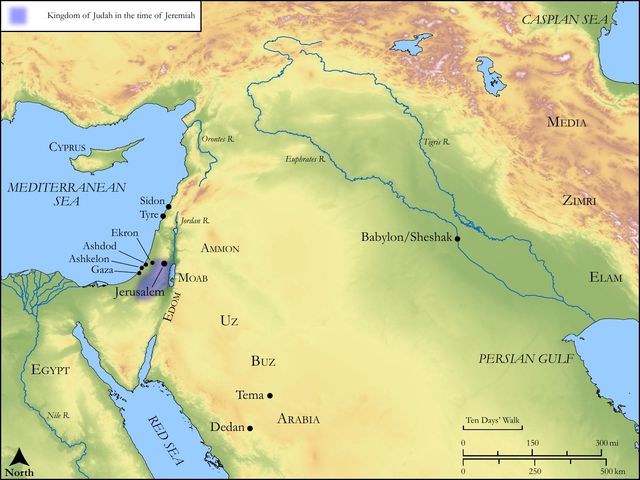
See on the biblical-era map
Study this verse
Public-domain commentary
Matthew Henry
From his Commentary on the Whole Bible. Henry comments on passages, not single verses — this entry covers Jeremiah 25:30–38.
We have, in these verses, a further description of those terrible desolations which the king of Babylon with his armies should make in all the countries and nations round about Jerusalem. In Jerusalem God had erected his temple; there were his oracles and ordinances, which the neighbouring nations should have attended to and might have received benefit by; thither they should have applied for the knowledge of God and their duty, and then they might have had reason to bless God for their neighbourhood to Jerusalem; but they, instead of that, taking all opportunities either to debauch or to disturb that holy city, when God came to reckon with Jerusalem because it learned so much of the way of the nations, he reckoned with the nations because they learned so little of the way of Jerusalem.
They will soon be aware of Nebuchadrezzar's making war upon them; but the prophet is here directed to tell them that it is God himself that makes war upon them, a God with whom there is no contending. 1. The war is here proclaimed (Jer 25:30): The Lord shall roar from on high; not from Mount Zion and Jerusalem (as Joe 3:16, Amo 1:2), but from heaven, from his holy habitation there; for now Jerusalem is one of the places against which he roars. He shall mightily roar upon his habitation on earth from that above. He has been long silent, and seemed not to take notice of the wickedness of the nations; the times of this ignorance God winked at; but now he shall give a shout, as the assailants in battle do, against all the inhabitants of the earth, to whom it shall be a shout of terror, and yet a shout of joy in heaven, as theirs that tread the grapes; for, when God is reckoning with the proud enemies of his kingdom among men, there is a great voice of much people heard in heaven, saying, Hallelujah, Rev 19:1. He roars as a lion (Amo 3:4, Amo 3:8), as a lion that has forsaken his covert (Jer 25:38), and is going abroad to seek his prey, upon which he roars, that he may the more easily seize it. 2. The manifesto is here published, showing the causes and reasons why God proclaims this war (Jer 25:31): The Lord has a controversy with the nations; he has just cause to contend with them, and he will take this way of pleading with them. His quarrel with them is, in one word, for their wickedness, their contempt of him, and his authority over them and kindness to them. He will give those that are wicked to the sword. They have provoked God to anger, and thence comes all this destruction; it is because of the fierce anger of the Lord (Jer 25:37 and again Jer 25:38), the fierceness of the oppressor, or (as it might better be read) the fierceness of the oppressing sword (for the word is feminine) is because of his fierce anger; and we are sure that he is never angry without cause; but who knows the power of his anger? 3. The alarm is here given and taken: A noise will come even to the ends of the earth, so loud shall it roar, so far shall it reach, Jer 25:31. The alarm is not given by sound of trumpet, or beat of drum, but by a whirlwind, a great whirlwind, storm, or tempest, which shall be raised up from the coasts, the remote coasts of the earth, Jer 25:32. The Chaldean army shall be like a hurricane raised in the north, but thence carried on with incredible fierceness and swiftness, bearing down all before it. It is like the whirlwind out of which God answered Job, which was exceedingly terrible, Job 37:1; Job 38:1. And, when the wrath of God thus roars like a lion from heaven, no marvel if it be echoed with shrieks from earth; for who can choose but tremble when God thus speaks in displeasure? See Hos 11:10. Now the shepherds shall howl and cry, the kings, and princes, and the great ones of the earth, the principal of the flock. They used to be the most courageous and secure, but now their hearts shall fail them; they shall wallow themselves in the ashes, Jer 25:34. Seeing themselves utterly unable to make head against the enemy, and seeing their country, which they have the charge of and a concern for, inevitably ruined, they shall abandon themselves to sorrow. There shall be a voice of the cry of the shepherds, and a howling of the principal of the flock shall be heard, Jer 25:36. Those are great calamities indeed that strike such a terror upon the great men, and put them into this consternation. The Lord hath spoiled their pasture, in which they fed their flock, and out of which they fed themselves; the spoiling of that makes them cry-out thus. Perhaps, carrying on the metaphor of a lion roaring, it alludes to the great fright that shepherds are in when they hear a roaring lion coming towards their flocks, and find they have no way to flee (Jer 25:35) for their own safety, neither can the principal of their flock escape. The enemy will be so numerous, so furious, so sedulous, and the extent of their armies so vast, that it will be impossible to avoid falling into their hands. Note, As we cannot out-face, so we cannot out-run, the judgments of God. This is that for which the shepherds howl and cry. 4. The progress of this war is here described (Jer 25:32): Behold, evil shall go forth from nation to nation; as the cup goes round, every nation shall have its share and take warning by the calamities of another to repent and reform. Nay, as if this ere to be a little representation of the last and general judgment, it shall reach from one end of the earth even unto the other end of the earth, Jer 25:33. The day of vengeance is in his heart, and now his hand shall find out all his enemies, wherever they are, Psa 21:8. Note, When our neighbour's house is on fire it is time to be concerned for our own. When one nation is a seat of war every neighbouring nation should hear, and fear, and make its peace with God. 5. The dismal consequences of this war are here foretold: The days of slaughter and dispersions are accomplished, that is, they are fully come (Jer 25:34), the time fixed in the divine counsel for the slaughter of some and the dispersion of the rest, which will make the nations completely desolate. Multitudes shall fall by the sword of the merciless Chaldeans, so that the slain of the Lord shall be every where found: they are slain by commission from him, and are sacrificed to his justice. The slain for sin are the slain of the Lord. To complete the misery of their slaughter, they shall not be lamented in particular, so general shall the matter of lamentation be. Nay, they shall not be gathered up, nor buried, for they shall have no friends left to bury them, and the enemies shall not have so much humanity in them as to do it; and then they shall be as dung upon the earth, so vile and noisome: and it is well if, as dung manures the earth and makes it fruitful, so these horrid spectacles, which lie as monuments of divine justice, might be a means to awaken the inhabitants of the earth to learn righteousness. The effect of this war will be the desolation of the whole land that is the seat of it (Jer 25:38), one land after another. But here are two expressions more that seem to make the case in a particular manner piteous. (1.) You shall fall like a pleasant vessel, Jer 25:34. The most desirable persons among them, who most valued themselves and were most valued, who were looked upon as vessels of honour, shall fall by the sword. You shall fall as a Venice glass or a China dish, which is soon broken all to pieces. Even the tender and delicate shall share in the common calamity; the sword devours one as well as another. (2.) Even the peaceable habitations are cut down. Those that used to be quiet, and not molested, the habitations in which you have long dwelt in peace, shall now be no longer such, but cut down by the war. Or, Those who used to be quiet, and not molesting any of their neighbours, those who lived in peace, easily, and gave no provocation to any, even those shall not escape. This is one of the direful effects of war, that even those who were most harmless and inoffensive suffer hard things. Blessed be God, there is a peaceable habitation above for all the sons of peace, which is out of the reach of fire and sword.
Historical interpretation
Historical reception
1 surviving comment on this verse from the historical church.
(Verse 30, 31.) And you shall prophesy to them all these words, and you shall say to them: The Lord will roar from on high (or give a response), and from His holy habitation He will utter His voice. He roars loudly over His glorious place (or responds to His place), His shout resounds like those who trample the earth. The sound (or destruction) reaches to the ends (or above) of the earth: for the Lord has a judgment with the nations: He shall judge all flesh: I have given the wicked (or I gave the wicked) to the sword, says the Lord. First, let us say that the truth of the interpretation is evident. You will prophesy to all nations, he says, and you will declare that the Lord roars from on high, that is, he gives a clear sign of his anger; according to what is written: The lion will roar, and who will not fear? The Lord has spoken, and who will not prophesy? And from his holy dwelling he will make his voice heard, to terrify all who hear it. He will roar over his sanctuary, that is, over the Temple. And when he roars like those treading the winepress, a loud noise will be sung, and during the pouring out of the mutual blood, a mournful song will be chanted: which Symmachus calls a conclusion; Aquila, a remedy. The sound of this singing and song will reach to the ends of the earth, because the judgment of the Lord is with the nations. But if the judgment of the Lord is with the nations, then the merits of the nations are different (Hosea 4). To explain that passage, as some want: Whoever does not believe is already judged (John 3:18). Indeed, he is judged because he did not believe; but those who do not believe among themselves will be subjected to different punishments. He himself is judged with all flesh, so that no one may leave uninjudged. But the ungodly, that is, those who do not believe in the Lord, are handed over to eternal sword. Allegorical interpreters according to the Septuagint explain this passage in such a way that they interpret the Lord's open threat in a positive manner. The Lord, they say, will give a response from on high to those whom he intends to save. And from His holy place He will give His voice, and He will answer with His word in His place. But they, like reapers full of fruit, will respond to His message: Destruction will come upon all the inhabitants of the earth, not upon the whole earth, but upon a part of the earth, namely those who do not believe. Judgment will be among the nations, and He will judge with all flesh. But the wicked will be delivered by the sword.
Continue studying Jeremiah 25:30 across the web’s major study libraries — every link below opens this exact verse, chapter, or book on the destination site.
Read & Compare
 BibleGatewayThis verse in more than 200 translations and 70 languages.
 Bible.comThe YouVersion reader — hundreds of translations, reading plans, and highlights.
 ESV.orgCrossway's official English Standard Version reader.
 NET BibleThe NET translation with 60,000+ translators' notes on every rendering decision.
 STEP BibleTyndale House's free study tool — original text, vocabulary, and scholarly resources.
 BibliaLogos Bible Software's free web reader.
 USCCBThe New American Bible (Revised Edition) with the U.S. bishops' study notes.
Commentaries
 BibleHub CommentariesDozens of classic commentaries on this verse, gathered on one page.
 StudyLightMore than 100 commentary sets — the largest collection on the web.
 BibleRefPlain-English commentary on what this verse means, verse by verse.
 Enduring WordDavid Guzik's free commentary on this chapter, widely used by Bible teachers.
 Bible Study ToolsVerse commentary alongside Greek and Hebrew study aids.
Original Language & Research
- BibleHub InterlinearThe verse word by word — original language, transliteration, and English.
- BibleHub LexiconEvery word's original-language definition and Strong's entry.
 Blue Letter BibleDeep-study tools — Strong's numbers, concordance, and word studies.
 SefariaThe Hebrew text with Rashi and centuries of Jewish commentary.
Sermons, Hymns & Audio


TrulyRandomVerse is not affiliated with these sites and doesn’t control their content. They’re linked because they’re genuinely useful.
Summary
Jeremiah 25:30 serves as a profound prophetic declaration, unveiling the LORD's imminent and comprehensive judgment upon all nations, including Judah. It vividly portrays God as a divine warrior, roaring from His transcendent, holy dwelling and unleashing a devastating shout likened to the violent trampling of grapes in a winepress. This verse powerfully underscores God's absolute sovereignty, His righteous indignation against widespread rebellion, and the terrifying certainty of His coming wrath, ensuring that no inhabitant of the earth will escape His ultimate decree.
Context
ShowHideLiterary Context
Jeremiah 25 is a pivotal chapter, delivered in the fourth year of King Jehoiakim's reign (605 BC), a critical juncture just prior to Nebuchadnezzar's first invasion of Judah. The chapter commences with a comprehensive indictment of Judah's persistent idolatry and disobedience over 23 years, culminating in the prophecy of the seventy-year Babylonian captivity for Judah and surrounding nations, as detailed in Jeremiah 25:1-14. Following this, the prophecy expands to a global scope, introducing the potent imagery of the "cup of God's wrath" which Jeremiah is commanded to make all nations drink, signifying a universal judgment (see Jeremiah 25:15-29). Verse 30 specifically describes the manner and intense nature of this divine judgment, transitioning from the symbolic cup to a direct, audible, and terrifying manifestation of God's wrath, thereby setting the stage for the subsequent lament and widespread destruction described in Jeremiah 25:31-38.
Historical & Cultural Context
The prophecy in Jeremiah 25 was delivered during a period of intense geopolitical upheaval among the nations. The Babylonian Empire was rapidly ascending, having decisively defeated Egypt at the Battle of Carchemish in 605 BC, which effectively ended Assyrian and Egyptian dominance in the region. Judah, caught between these rising and falling superpowers, had repeatedly vacillated in its alliances and remained unrepentant despite Jeremiah's persistent warnings. Culturally, the imagery of a roaring lion resonated deeply in Israel, where lions were revered symbols of power, royalty, and danger, often associated with divine judgment or kingly might. The "treading of grapes" was a common agricultural practice, and its association with judgment would have been immediately understood as a metaphor for crushing, violent destruction and the shedding of blood, akin to the juice flowing from grapes in a winepress. This imagery taps into a rich biblical tradition of God's wrath being poured out like wine, as seen in passages like Isaiah 63:3.
Key Themes
ShowHideJeremiah 25:30 powerfully contributes to several overarching themes within the book of Jeremiah and broader biblical theology. Firstly, it emphasizes Divine Judgment and Sovereignty, portraying Yahweh as the supreme and active judge over all the earth, not exclusively Israel. His "roaring" and "shouting" signify a deliberate, inescapable, and terrifying judgment against widespread sin and rebellion, underscoring His absolute authority over nations and their destinies. Secondly, the phrase "from on high, and utter his voice from his holy habitation" highlights God's Transcendent Holiness and Justice, indicating that this judgment originates from His heavenly throne, a place of purity and righteousness. This ensures that His decrees are not arbitrary but flow from His perfect character. Finally, the vivid metaphors convey Irresistible Power and Inevitable Destruction, reinforcing the theme that no one can escape the coming wrath of God. The imagery of a lion's roar and the treading of grapes paints a picture of overwhelming force and total devastation, serving as a stark warning to all who defy Him.
Exposition and Analysis
ShowHideKey Word Analysis
ShowHideThis word signifies "a word," but by implication, it can also mean "a matter" or "thing." In this context, it refers to the entirety of the prophetic message Jeremiah is commanded to deliver, emphasizing that every aspect of this divine declaration is a weighty and authoritative "word" from the LORD.
This primitive root means "to rumble or moan," specifically used for the roar of a lion. In this context, it signifies God's powerful and terrifying declaration of judgment, akin to a lion's roar signaling its presence and imminent attack. It evokes fear and the overwhelming power of divine wrath, indicating an active and forceful intervention.
This word denotes "acclamation" or "shouting." Here, it refers to a battle cry or a shout of triumph that accompanies the act of judgment, particularly in the context of treading grapes. It implies a loud, forceful utterance that precedes or accompanies a destructive act, emphasizing the decisive and public nature of God's intervention and the inevitability of His triumph in judgment.
A primitive root meaning "to tread" or "to walk." In the context of "tread [the grapes]," it refers to the physical act of crushing grapes in a winepress. This vivid agricultural metaphor is consistently used in prophetic literature to depict the violent, destructive, and bloody nature of divine judgment, where the wicked are "trampled" under God's wrath, their lives crushed and their blood spilled like grape juice.
This primitive root means "to sit down," and by implication, "to dwell" or "to remain." Here, it refers to those who reside or dwell within a place, emphasizing that the judgment is directed at all who have settled and made their home on the earth, indicating a comprehensive and inescapable reach.
Verse Breakdown
ShowHide"Therefore prophesy thou against them all these words, and say unto them"
This opening clause serves as a direct divine command to Jeremiah, emphasizing his indispensable role as God's authoritative messenger. It underscores that the ensuing prophecy is not Jeremiah's own sentiment but a direct, comprehensive revelation from the LORD, intended for "all these words" to be faithfully delivered to "them"—referring to the nations previously addressed in the chapter, including Judah.
"The LORD shall roar from on high, and utter his voice from his holy habitation"
This powerful declaration introduces God (YHVH, H3068), the covenant-keeping and supreme authority, as the active agent of judgment. His "roaring from on high" (H4791, altitude/height) and "uttering his voice from his holy habitation" (H4583, abode/dwelling place; H6944, sacred) vividly depict God's judgment originating from His transcendent, heavenly, and sacred dwelling place. This signifies that the judgment is righteous, authoritative, and flows from the ultimate source of power, purity, and holiness.
"he shall mightily roar upon his habitation; he shall give a shout, as they that tread [the grapes]"
The repetition of "roar" (H7580, intensified by H8800, "mightily") amplifies the imagery, suggesting an overwhelming, thunderous sound that is impossible to ignore. The phrase "upon his habitation" (H5116, home/dwelling place) can refer broadly to the earth, or more specifically to Jerusalem/Judah as His chosen dwelling, indicating that judgment often begins with His own people. The subsequent "shout" (H1959) is then explicitly compared to "they that tread the grapes" (H1869), a vivid and visceral metaphor for the crushing, violent, and bloody nature of God's wrath, where nations are trampled and destroyed like grapes in a winepress.
"against all the inhabitants of the earth"
This concluding phrase unequivocally broadens the scope of the judgment to be universal and all-encompassing. "Inhabitants" (H3427, those who dwell/sit) of "the earth" (H776, the land/world) signifies that no nation, people group, or individual will be exempt from this sweeping divine reckoning. It powerfully reinforces the theme of God's global sovereignty and the comprehensive, inescapable nature of His impending wrath.
Literary Devices
ShowHideJeremiah 25:30 is exceptionally rich in Imagery and Metaphor, creating a vivid and terrifying depiction of divine judgment. The central Metaphor of God as a roaring lion (Hebrew sha'ag) is potent, conveying His immense power, majesty, and the imminent, terrifying nature of His attack. This is further amplified by the strong Auditory Imagery of God "uttering His voice" and giving a "shout," suggesting a thunderous, inescapable declaration of wrath that resounds across the earth. The most striking Simile is "as they that tread [the grapes]," which employs a familiar agricultural process to represent the violent, crushing, and bloody destruction that awaits the wicked. This Metaphor of the divine winepress is a common and powerful biblical motif for judgment. The repetition of "roar" (a form of Anaphora or Repetition for Emphasis) intensifies the sense of overwhelming power and the certainty of God's action. The use of Spatial Language in phrases like "from on high, and... from his holy habitation" emphasizes God's transcendence and the divine origin of His judgment, while "upon his habitation" and "against all the inhabitants of the earth" highlight the universal and inescapable scope of this impending wrath.
Theological and Thematic Connections
ShowHideJeremiah 25:30 powerfully articulates the biblical truth of God's absolute sovereignty and His role as the righteous judge of all the earth. This verse underscores that God's patience is not infinite and that persistent rebellion against His holiness will inevitably lead to divine retribution. The imagery of His roaring from His holy habitation emphasizes that judgment flows from His very character—a God who is both holy and just, unable to tolerate unrighteousness indefinitely. This judgment is not arbitrary but a necessary consequence of humanity's sin, demonstrating that God holds all nations accountable for their actions and that His ultimate authority extends over every corner of creation. It serves as a stark reminder that while God is merciful and long-suffering, He is also a consuming fire, and His word of judgment, once uttered, is certain to be fulfilled.
Reflection and Application
ShowHideJeremiah 25:30 calls us to a profound reflection on the nature of God and our posture before Him. The terrifying imagery of God's roar and the treading of grapes serves as a sober reminder of the gravity of sin and the certainty of divine judgment. For those living in disobedience, it is a clarion call to urgent repentance, emphasizing that God's warnings are not empty threats but expressions of His righteous character and His desire for humanity to turn from destruction. For believers, this verse, while awe-inspiring, also offers a deep sense of security and comfort. Knowing that God is the supreme judge who will ultimately bring justice to all the earth assures us that evil will not prevail indefinitely and that His perfect plan will be fully realized. It compels us to live lives that honor His holiness, to take His word seriously, and to share the urgent message of repentance and reconciliation with a world that desperately needs to hear it before the roar of judgment becomes a terrifying reality.
Questions for Reflection
ShowHideFAQ
ShowHideDoes this verse imply that God is angry or vengeful?
ShowHideWhile the imagery of roaring and treading grapes certainly conveys God's intense displeasure and the destructive consequences of His judgment, it's crucial to understand this not as arbitrary vengeance but as righteous indignation against sin and rebellion. God's holiness and justice demand that He respond to persistent unrighteousness. His actions are always consistent with His perfect character. The "wrath of God" in Scripture is often understood as His settled, holy opposition to all that is evil, rather than an uncontrolled outburst of emotion. This judgment is a necessary outworking of His covenant faithfulness and His commitment to upholding moral order in His creation. As Romans 1:18 states, "For the wrath of God is revealed from heaven against all ungodliness and unrighteousness of men, who hold the truth in unrighteousness."
How can a loving God unleash such a terrifying judgment on "all the inhabitants of the earth"?
ShowHideThis question touches on the profound tension between God's boundless love and His perfect justice. The Bible consistently presents God as both infinitely loving and perfectly just. His love is profoundly demonstrated in His patience, His repeated warnings, and His ultimate provision of a way of salvation through Christ, as beautifully articulated in John 3:16. However, His justice requires that sin be punished. When humanity persistently rejects His warnings, spurns His grace, and continues in rebellion, God's justice must prevail. The judgment described here is a consequence of widespread, unrepentant sin, not an act of random cruelty. It underscores that God's love does not negate His holiness or His unwavering commitment to righteousness, and that ultimately, He will set all things right, ensuring that every wrong is addressed and every act of rebellion receives its just recompense.
Christ-Centered Fulfillment
ShowHideWhile Jeremiah 25:30 speaks of God's universal judgment, its ultimate Christ-centered fulfillment is found in how Jesus Christ both embodies and averts this divine wrath. The terrifying roar of God's judgment, meant for "all the inhabitants of the earth," was uniquely absorbed by Christ on the cross. He became the Lamb of God who takes away the sin of the world, stepping into the winepress of God's wrath so that all who believe in Him might be spared its crushing force. The "shout" of judgment that tramples the wicked is transformed, for believers, into the triumphant cry of "It is finished!" (John 19:30), signifying the completed work of redemption and the payment in full for sin. Furthermore, Christ Himself is depicted as the one who will execute final judgment, returning with a sharp sword to strike down the nations and "tread the winepress of the fierceness and wrath of Almighty God" (Revelation 19:15). Thus, Jeremiah's prophecy points to the righteous judgment of God, which is both satisfied in Christ's atoning sacrifice for believers and will be perfectly executed by Christ at His glorious second coming for those who reject Him, demonstrating His ultimate authority over all creation and His role as the just and final Judge.