


Jeremiah 25:29
- כִּיkiforH3588PrtParticle Conditional
- הִנֵּהhi·Nehhere!H2009PrtParticle Interjection
- בָעִירva·'Iron the cityH5892Prep-b ¦ N-fsNoun Singular Feminine Absoluteבָon theעִירcity
- אֲשֶׁר'a·SherwhichH834RelParticle Relative
- נִקְרָאnik·ra'it is calledH7121V-Niphal-Perf-3msVerb Niphal Perfect 3rd Singular Masculine
- שְׁמִיshe·Mimy nameH8034N-msc ¦ 1csNoun Singular Masculine Constructשְׁמִnameיmy
- עָלֶיהָ'a·Lei·haon itH5921Prep ¦ 3fsPreposition Definiteעָלֶיonהָit
- אָנֹכִי'a·no·KhiIH595Pro-1csPronoun Personal 1st Singular common gender
- מֵחֵלme·Chel[am] beginningH2490V-Hiphil-Prtcpl-msVerb Hiphil Participle Singular Masculine Absolute
- לְהָרַעle·ha·Ra'to do harmH7489Prep-l ¦ V-Hiphil-InfVerb Hiphil Infinitive Constructלְtoהָרַעdo harm
- וְאַתֶּםve·'a·Temand youH859Conj-w ¦ Pro-2mpPronoun Personal 2nd Plural Masculineוְandאַתֶּםyou
- הִנָּקֵהhi·na·Kehcertainly <to exempt from punishment>H5352V-Niphal-InfAbsVerb Niphal Infinitive Absolute
- תִנָּקוּti·na·Kuwill you be exempt from punishment?H5352V-Niphal-Imperf-2mpVerb Niphal Imperfect 2nd Plural Masculine
- לֹאlo'notH3808NegParticle Negative
- תִנָּקוּti·na·Kuyou will be exempt from punishmentH5352V-Niphal-Imperf-2mpVerb Niphal Imperfect 2nd Plural Masculine
- כִּיkiforH3588PrtParticle Conditional
- חֶרֶבChe·reva swordH2719N-fsNoun Singular Feminine Absolute
- אֲנִי'a·NiIH589Pro-1csPronoun Personal 1st Singular common gender
- קֹרֵאko·Re'[am] callingH7121V-Qal-Prtcpl-msVerb Qal Participle Singular Masculine Absolute
- עַל'alonH5921PrepPreposition
- כָּלkolallH3605N-mscNoun Singular Masculine Construct
- יֹשְׁבֵיyo·she·Vei[the] inhabitants ofH3427V-Qal-Prtcpl-mpVerb Qal Participle Plural Masculine Construct
- הָאָרֶץha·'A·retzthe earthH776Art ¦ N-fsNoun Singular Feminine Absoluteהָtheאָרֶץearth
- נְאֻםne·'Um[the] utterance ofH5002N-mscNoun Singular Masculine Construct
- יְהוָהYah·wehYahwehH3068N-properNoun Proper Title
- צְבָאוֹתtze·va·'otof hostsH6635N-fpNoun Plural Feminine Absolute
English is a literal word-by-word gloss of the Hebrew, not the KJV's wording. Why?
This is the original text the KJV's translators worked from — each Hebrew word with its own literal English meaning in this verse, prepared by scholars at Tyndale House, Cambridge. The KJV translates whole sentences, not word by word, so its wording differs: one Hebrew word can become several English words, and the KJV may choose “the LORD” where the gloss reads “Yahweh”. Both are faithful — they answer different questions. For the KJV's own rendering, switch to the KJV text.
Details
See on the biblical-era map
Study this verse
Public-domain commentary
Matthew Henry
From his Commentary on the Whole Bible. Henry comments on passages, not single verses — this entry covers Jeremiah 25:15–29. His three-level outline is real structure in the source text, so it is rendered as structure.
Under the similitude of a cup going round, which all the company must drink of, is here represented the universal desolation that was now coming upon that part of the world which Nebuchadrezzar, who just now began to reign and act, was to be the instrument of, and which should at length recoil upon his own country. The cup in the vision is to be a sword in the accomplishment of it: so it is explained, Jer 25:16. It is the sword that I will send among them, the sword of war, that should be irresistibly strong and implacably cruel.
I.As to the circumstances of this judgment, observe,
1.Whence this destroying sword should come - from the hand of God. It is the sword of the Lord (Jer 47:6), bathed in heaven, Isa 34:5. Wicked men are made use of as his sword, Psa 17:13. It is the wine-cup of his fury. It is the just anger of God that sends this judgment. The nations have provoked him by their sins, and they must fall under the tokens of his wrath. These are compared to some intoxicating liquor, which they shall be forced to drink of, as, formerly, condemned malefactors were sometimes executed by being compelled to drink poison. The wicked are said to drink the wrath of the Almighty, Job 21:20; Rev 14:10. Their share of troubles in his world is represented by the dregs of a cup of red wine full of mixture, Psa 75:8. See Psa 11:6. The wrath of God in this world is but as a cup, in comparison of the full streams of it in the other world.
2.By whose hand it should be sent to them - by the hand of Jeremiah as the judge set over the nations (Jer 1:10), to pass his sentence upon them, and by the hand of Nebuchadrezzar as the executioner. What a much greater figure then does the poor prophet make than what the potent prince makes, if we look upon their relation to God, though in the eye of the world it was the reverse of it! Jeremiah must take the cup at God's hand, and compel the nations to drink it. He foretells no hurt to them but what God appoints him to foretell; and what is foretold by a divine authority will certainly be fulfilled by a divine power.
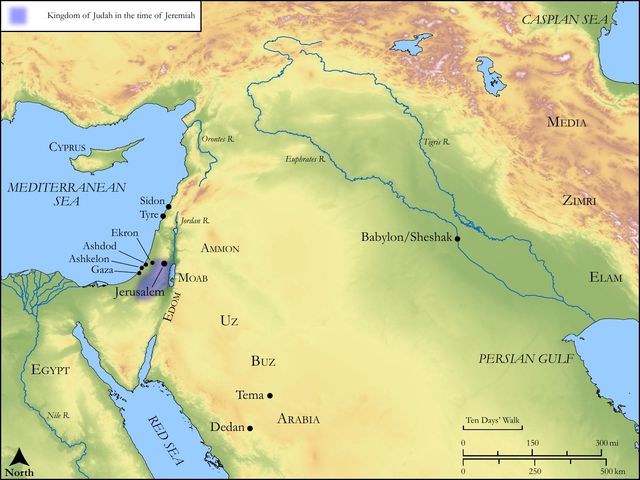
3.On whom it should be sent - on all the nations within the verge of Israel's acquaintance and the lines of their communication. Jeremiah took the cup, and made all the nations to drink of it, that is, he prophesied concerning each of the nations here mentioned that they should share in this great desolation that was coming. Jerusalem and the cities of Judah are put first (Jer 25:18); for judgment begins at the house of God (Pe1 4:17), at the sanctuary, Eze 9:6. Whether Nebuchadrezzar had his eye principally upon Jerusalem and Judah in this expedition or no does not appear; probably he had; for it was as considerable as any of the nations here mentioned. However God had his eye principally to them. And this part of the prophecy was already begun to be accomplished; this is denoted by that melancholy parenthesis (as it is this day), for in the fourth year of Jehoiakim things had come into a very bad posture, and all the foundations were out of course. Pharaoh king of Egypt comes next, because the Jews trusted to that broken reed (v. 19); the remains of them fled to Egypt, and there Jeremiah particularly foretold the destruction of that country, Jer 43:10, Jer 43:11. All the other nations that bordered upon Canaan must pledge Jerusalem in this bitter cup, this cup of trembling. The mingled people, the Arabians (so some), some rovers of divers nations that lived by rapine (so others); the kings of the land of Uz, joined to the country of the Edomites. The Philistines had been vexatious to Israel, but now their cities and their lords become a prey to this mighty conqueror. Edom, Moab, Ammon, Tyre, and Zidon, are places well known to border upon Israel; the Isles beyond, or beside, the sea, are supposed to be those parts of Phoenicia and Syria that lay upon the coast of the Mediterranean Sea. Dedan and the other countries mentioned (Jer 25:23, Jer 25:24) seem to have lain upon the confines of Idumea and Arabia the desert. Those of Elam are the Persians, with whom the Medes are joined, now looked upon as inconsiderable and yet afterwards able to make reprisals upon Babylon for themselves and all their neighbours. The kings of the north, that lay nearer to Babylon, and others that lay at some distance, will be sure to be seized on and made a prey of by the victorious sword of Nebuchadrezzar. Nay, he shall push on his victories with such incredible fury and success that all the kingdoms of the world that were then and there known should become sacrifices to his ambition. Thus Alexander is said to have conquered the world, and the Roman empire is called the world, Luk 2:1. Or it may be taken as reading the doom of all the kingdoms of the earth; one time or other, they shall feel the dreadful effects of war. The world has been, and will be, a great cockpit, while men's lusts war as they do in their members, Jam 4:1. But, that the conquerors may see their fate with the conquered, it concludes, The king of Sheshach shall drink after them, that is, the king of Babylon himself, who has given his neighbours all this trouble and vexation, shall at length have it return upon his own head. That by Sheshach is meant Babylon is plain from Jer 51:41; but whether it was another name of the same city or the name of another city of the same kingdom is uncertain. Babylon's ruin was foretold, Jer 25:12, Jer 25:13. Upon this prophecy of its being the author of the ruin of so many nations it is very fitly repeated here again.
4.What should be the effect of it. The desolations which the sword should make in all these kingdoms are represented by the consequences of excessive drinking (Jer 25:16): They shall drink, and be moved, and be mad. They shall be drunken, and spue, and fall and rise no more, Jer 25:27. Now this may serve,
(1.)To make us loathe the sin of drunkenness, that the consequences of it are made use of to set forth a most woeful and miserable condition. Drunkenness deprives men, for the present, of the use of their reason, makes them mad. It takes from them likewise that which, next to reason, is the most valuable blessing, and that is health; it makes them sick, and endangers the bones and the life. Men in drink often fall and rise no more; it is a sin that is its own punishment. How wretchedly are those intoxicated and besotted that suffer themselves at any time to be intoxicated, especially to be by the frequent commission of the sin besotted with wine or strong drink!
(2.)To make us dread the judgments of war. When God sends the sword upon a nation, with warrant to make it desolate, it soon becomes like a drunken man, filled with confusion at the alarms of war, put into a hurry; its counsellors mad, and at their wits' end, staggering in all the measures they take, all the motions they make, sick at heart with continual vexation, vomiting up the riches they have greedily swallowed down (Job 20:15), falling down before the enemy, and as unable to get up again, or do any thing to help themselves, as a man dead drunk is, Hab 2:16.
5.The undoubted certainty of it, with the reason given for it, Jer 25:28, Jer 25:29. They will refuse to take the cup at thy hand; not only they will be loth that the judgment should come, but they will be loth to believe that ever it will come; they will not give credit to the prediction of so despicable a man as Jeremiah. But he must tell them that it is the word of the Lord of hosts, he hath said it; and it is in vain for them to struggle with Omnipotence: You shall certainly drink. And he must give them this reason, It is a time of visitation, it is a reckoning day, and Jerusalem has been called to an account already: I begin to bring evil on the city that is called by my name; its relation to me will not exempt it from punishment, and should you be utterly unpunished? No; If this be done in the green tree, what shall be done in the dry? If those who have some good in them smart so severely for the evil that is found in them, can those expect to escape who have worse evils, and no good, found among them? If Jerusalem be punished for learning idolatry of the nations, shall not the nations be punished, of whom they learned it? No doubt they shall: I will call for a sword upon all the inhabitants of the earth, for they have helped to debauch the inhabitants of Jerusalem.
II.Upon this whole matter we may observe,
1.That there is a God that judges in the earth, to whom all the nations of the earth are accountable, and by whose judgment they must abide.
2.That God can easily bring to ruin the greatest nations, the most numerous and powerful, and such as have been most secure.
3.That those who have been vexatious and mischievous to the people of God will be reckoned with for it at last. Many of these nations had in their turns given disturbance to Israel, but now comes destruction on them. The year of the redeemer will come, even the year of recompenses for the controversy of Zion.
4.That the burden of the word of the Lord will at last become the burden of his judgments. Isaiah had prophesied long since against most of these nations (ch. 13, etc.) and now at length all his prophecies will have their complete fulfilling.
5.That those who are ambitious of power and dominion commonly become the troublers of the earth and the plagues of their generation. Nebuchadrezzar was so proud of his might that he had no sense of right. These are the men that turn the world upside down, and yet expect to be admired and adored. Alexander thought himself a great prince when others thought him no better than a great pirate.
6.That the greatest pomp and power in this world are of very uncertain continuance. Before Nebuchadrezzar's greater force kings themselves must yield and become captives.
Historical interpretation
Two Centuries of Reception
6 surviving comments on this verse. Each one is dated, so this reads as a timeline rather than a list.
Select a marker to jump to its quote. Markers stagger vertically where authors wrote within a few decades of each other.
Know that it was foretold that wars would continue frequently to prevail, death and famine accumulate anxiety, health would be shattered by raging diseases and the human race be wasted by the desolation of pestilence. It was predicted that evils should be multiplied in the last times and that misfortunes should be varied and that as the day of judgment is now drawing near, the censure of an indignant God should be more and more aroused for the scourging of the human race. For these things do not happen, as your false complaining and ignorant inexperience of the truth asserts and repeats, because your gods are not worshiped by us, but because God is not worshiped by you. For since he is Lord and Ruler of the world and all things are carried on by his will and direction, nor can anything be done save what he has done or allowed to be done, certainly when those things occur that show the anger of an offended God, they happen not on account of us by whom God is worshiped, but they are called down by your sins and by what you deserve, by whom God is neither in any way sought or feared, because your vain superstitions are not forsaken, nor is the true religion known in such a way that he who is the one God over all might alone be worshiped and petitioned. Finally, listen to himself speaking with a divine voice at once instructing and warning us: “You will worship the Lord your God, and him only shall you serve.” And again, “You will have no other gods but me.” And again, “Do not go after other gods to serve them, and do not worship them, and do not provoke me to anger with the works of your hands to destroy you.”
Consider and observe, my hearer, that if God had provided hope for Sodom and its companions, he would not have overthrown them with fire and brimstone, the sign of the last day of the world. Instead, he would have delivered them over to one of the kingdoms to be chastised. This is what was written, for instance, when Jeremiah caused the nations and kingdoms to drink the cup of wrath. Concerning each one of the cities, he said that after they shall “drink the cup, I will turn back the captivity of Elam, of Tyre, of Sidon, of the children of Ammon, and of Moab and of Edom.” Concerning each one of these kingdoms he said, “In the last days I will turn back its captivity.” Now we see that Tyre was inhabited and was opulent after it had wandered seventy years, and after it had received the reward of its harlotries and after it had committed fornication with all the kingdoms. And Tyre took the harp, and played it sweetly and multiplied its music. And also the region of Elam is inhabited and opulent. And with regard to Babylon Jeremiah said, “Babylon shall fall and shall not rise.” And look! Up to the present day it continues in desolation and will do so forever. And also about Jerusalem he said, “The virgin of Israel shall fall and shall not rise again. She is forsaken on the ground, and there is none to raise her up.” For if the prophecy is true that Jeremiah spoke about Babylon, also that about Jerusalem is true and worthy of faith. And Isaiah said to Jerusalem, “I will not again be angry with you, nor will I reprove you.” He truly will not be angry with Jerusalem ever again, nor will he reprove her forever; for that which is in desolation he will not reprove, nor will she provoke him to wrath.
The pouring out of the cup—and that a cup of pure or unmixed wine (which is called akratos in Greek)—is a sign of the Lord’s wrath so that all the nations who have waged war against the people of God will drink from the cup of the wrath of the Lord. Also, Isaiah writes concerning this cup against Jerusalem, “You have drunk and emptied the drinking cup of wrath, the cup of destruction; therefore, arise!” But that cup is being drunk by all nations so that they can vomit and be maddened. To be sure, an unsound interpretation understands this cup in a good sense, so that like a purgative it forces out whatever bile or phlegm or noxious humor is in the chest and restores pristine health. This interpretation understands the Savior instead of Jeremiah as the one who would make all the nations drink it, to whom also he was sent, so that when they had rejected idolatry they might dedicate themselves to the worship of God. But the words that follow will show that this is contrary to the Holy Scripture, for they are made to drink of the cup of pure wine not as a remedy (as this interpretation wants to understand it) but as a punishment.
(Verse 29.) For I will call the sword upon all the inhabitants of the earth, says the Lord of hosts. This is the most bitter potion, this cup of the Lord's fury, which is not only upon Jerusalem, but upon all the earth, and upon all the surrounding nations. As it was said before: And I will send to Nebuchadnezzar, the king of Babylon, my servant, and I will bring him over this land, and over its inhabitants, and over all the nations around it.
He gives the name drinking cup to punishment, as also in another psalm, “In the hand of the Lord there is a cup of wine, full of a strong mixture,” and a little later, “all the sinners of the earth will drink it.” This drinking cup blessed Jeremiah was ordered to offer to the nations.
And he calls God’s punishment the “cup of unmixed wine.” … By “drinking” and “vomiting” Jeremiah implies they have had enough, and in their “raving,” he alludes to the terrible nature of their punishment. Then the prophet further relates how Jerusalem and the cities that paid tribute to it, along with their kings and rulers, were made to drink this cup.
Continue studying Jeremiah 25:29 across the web’s major study libraries — every link below opens this exact verse, chapter, or book on the destination site.
Read & Compare
 BibleGatewayThis verse in more than 200 translations and 70 languages.
 Bible.comThe YouVersion reader — hundreds of translations, reading plans, and highlights.
 ESV.orgCrossway's official English Standard Version reader.
 NET BibleThe NET translation with 60,000+ translators' notes on every rendering decision.
 STEP BibleTyndale House's free study tool — original text, vocabulary, and scholarly resources.
 BibliaLogos Bible Software's free web reader.
 USCCBThe New American Bible (Revised Edition) with the U.S. bishops' study notes.
Commentaries
 BibleHub CommentariesDozens of classic commentaries on this verse, gathered on one page.
 StudyLightMore than 100 commentary sets — the largest collection on the web.
 BibleRefPlain-English commentary on what this verse means, verse by verse.
 Enduring WordDavid Guzik's free commentary on this chapter, widely used by Bible teachers.
 Bible Study ToolsVerse commentary alongside Greek and Hebrew study aids.
Original Language & Research
- BibleHub InterlinearThe verse word by word — original language, transliteration, and English.
- BibleHub LexiconEvery word's original-language definition and Strong's entry.
 Blue Letter BibleDeep-study tools — Strong's numbers, concordance, and word studies.
 SefariaThe Hebrew text with Rashi and centuries of Jewish commentary.
Sermons, Hymns & Audio


TrulyRandomVerse is not affiliated with these sites and doesn’t control their content. They’re linked because they’re genuinely useful.
Summary
Jeremiah 25:29 serves as a powerful divine declaration, asserting that the judgment God initiates upon Jerusalem, the city uniquely identified with His name, is but the precursor to a universal reckoning. This verse underscores God's unwavering commitment to justice and His absolute sovereignty, revealing that if His own covenant people are held accountable for their disobedience, then no nation on earth will escape the consequences of their rebellion, culminating in an inescapable global judgment orchestrated by the Lord of hosts.
Context
ShowHideLiterary Context
Jeremiah 25 marks a crucial turning point in the prophet's ministry, summarizing decades of warnings and prophecies concerning impending judgment. The chapter is strategically dated to the fourth year of King Jehoiakim of Judah, a period coinciding with the rise of Nebuchadnezzar's Babylonian Empire, which would soon become God's instrument of judgment. Jeremiah had faithfully delivered divine messages for 23 years, imploring Judah to repent and return to the Lord. The preceding verses detail the specific and severe judgment destined for Judah and Jerusalem, notably the seventy-year Babylonian captivity prophesied in Jeremiah 25:11. Jeremiah 25:29 acts as a pivotal transitional statement, broadening the scope of divine judgment from the immediate, localized context of Judah to a sweeping, global application, thereby setting the stage for the subsequent "cup of wrath" prophecy, where various nations are compelled to drink God's judgment.
Historical & Cultural Context
The late 7th and early 6th centuries BCE were characterized by immense geopolitical upheaval in the ancient Near East. The once-dominant Assyrian Empire was in decline, giving way to the rapidly ascending Babylonian Empire under Nebuchadnezzar. Judah, strategically positioned between these shifting powers, often pursued alliances with Egypt, directly defying God's command to trust solely in Him. Jerusalem, as the capital of Judah and the sacred site of the Temple, held profound religious and national significance. Its designation as "the city which is called by my name" emphasized its unique covenantal relationship with Yahweh and His dwelling presence there. The cultural understanding of divine judgment in this era frequently involved military conquest, famine, and exile—precisely the instruments God would employ through Babylon. The rhetorical question concerning punishment in the verse reflects a common ancient Near Eastern legal and moral principle: if even those closest to authority are punished for wrongdoing, how much more those who are distant or openly rebellious?
Key Themes
ShowHideJeremiah 25:29 powerfully contributes to several overarching themes prevalent in the book of Jeremiah and broader biblical theology. It unequivocally highlights the theme of Divine Justice and Impartiality, demonstrating that God's judgment commences with His own people before extending to the nations, a principle echoed in the New Testament in 1 Peter 4:17. This verse also emphatically underscores the Universal Scope of God's Sovereignty, asserting that His authority and judgment encompass "all the inhabitants of the earth," not merely the covenant nation of Israel. The solemn declaration, "saith the LORD of hosts," reinforces the theme of God's Absolute Power and Authority as the commander of heavenly armies and the supreme executor of His decrees. Furthermore, the rhetorical question regarding being "unpunished" powerfully emphasizes the Inevitable Consequences of Disobedience, affirming that persistent rebellion against God's commands will ultimately lead to divine reckoning, a truth consistently presented throughout the prophetic books, such as in Amos 3:2.
Exposition and Analysis
ShowHideKey Word Analysis
ShowHideThis primitive root primarily means "to bore" or "to wound," but figuratively, it can mean "to profane" or "to break." Crucially, it also carries the meaning "to begin," often implying an 'opening wedge' or initial action. In this context, it signifies God's decisive initiation of a process of judgment, indicating that the punishment upon Jerusalem is the foundational step in a broader, global judgment. It is not a tentative start, but a determined and authoritative opening act of divine reckoning.
This root means "to be (or make) clean," "to be blameless," or "to be guiltless." In an adverse sense, as used here, it signifies "to be bare" or "extirpated," implying that one will not escape the consequences of their actions. The powerful repetition and strong negation ("utterly unpunished? Ye shall not be unpunished") emphasize the absolute certainty that no one, especially not those who have sinned against God's covenant, will be acquitted or left free from the deserved judgment.
This term refers to a "cutting instrument," specifically a "sword," but more broadly, it represents a destructive force. Here, it is a potent metonymy for war, invasion, and divine judgment executed through military conflict. God "calling for a sword" indicates His active orchestration of these calamitous events, summoning them as instruments of His justice upon the nations.
Verse Breakdown
ShowHide"For, lo, I begin to bring evil on the city which is called by my name,"
This clause establishes the divine initiative and the primary target of judgment. "Lo" (or "behold") serves to draw immediate attention to the gravity and certainty of the declaration. God Himself is the one who "begins" to bring "evil"—not moral evil, but rather calamity, disaster, or affliction (H7489, râʻaʻ)—upon Jerusalem. Jerusalem is specifically identified as "the city which is called by my name," underscoring its unique covenant relationship with God and its status as the place where His presence dwelt. The judgment commencing here signifies a profound disappointment in His chosen people's unfaithfulness.
"and should ye be utterly unpunished?"
This is a powerful rhetorical question, designed not to elicit an answer but to provoke an emphatic "No!" from the audience. It challenges any lingering notion that Judah, despite its privileged status and covenant relationship, could possibly escape the severe consequences of its persistent rebellion and sin. The double emphasis of "utterly unpunished" (using the same Hebrew root H5352) underscores the absolute impossibility of their acquittal or exemption from divine retribution.
"Ye shall not be unpunished:"
This declarative statement directly and unequivocally answers the preceding rhetorical question, affirming the inevitability of judgment. It removes all doubt, reiterating with divine authority that Jerusalem's punishment is certain, unavoidable, and fully deserved. This serves as a direct, unyielding pronouncement of their predetermined fate.
"for I will call for a sword upon all the inhabitants of the earth, saith the LORD of hosts."
This final clause dramatically expands the scope of judgment from Jerusalem to a global scale and explicitly identifies the instrument and ultimate authority behind it. God declares His intention to "call for a sword," meaning He will summon war, destruction, and military conquest, to be executed upon "all the inhabitants of the earth." The concluding phrase, "saith the LORD of hosts" (H3068, Yᵉhôvâh H6635, tsâbâʼ), serves as a potent divine authentication, emphasizing God's supreme power, His command over all creation (including armies and nations), and His absolute authority to execute this universal judgment.
Literary Devices
ShowHideJeremiah 25:29 employs several potent literary devices to convey its message of inescapable and universal judgment. The most prominent is the Rhetorical Question, "and should ye be utterly unpunished?", which is not posed to elicit an answer but to underscore the self-evident truth that punishment for Judah's rebellion is inevitable. This is immediately followed by a direct, emphatic declaration, "Ye shall not be unpunished," creating a powerful sense of Repetition and Emphasis that hammers home the certainty of divine retribution. The use of "sword" is a clear example of Metonymy, where the instrument (sword) stands for the action or consequence (war, judgment, destruction). Finally, the recurring prophetic formula, "saith the LORD of hosts," serves as a Divine Formula or Attestation, lending ultimate authority and solemnity to the pronouncement, reminding the audience that these are not merely Jeremiah's words but the authoritative and unalterable decree of the Almighty God.
Theological and Thematic Connections
ShowHideJeremiah 25:29 is a cornerstone verse for understanding the universality of God's justice and the profound biblical principle that judgment begins with His own household. It decisively disabuses any notion of divine favoritism, demonstrating that a covenant relationship brings not immunity, but rather greater responsibility, and therefore, greater accountability. If God's chosen people, who bore His name and received His law, faced such severe consequences for their persistent disobedience, then the nations—who did not have such a direct covenant relationship but still rebelled against His inherent moral order—could certainly expect no less. This truth underscores God's absolute righteousness, His commitment to upholding justice across all humanity, and reveals that His sovereignty extends over all peoples and their actions, holding every individual and nation accountable to His standards.
Reflection and Application
ShowHideJeremiah 25:29 serves as a profoundly sobering reminder of God's unwavering holiness and unyielding justice, a truth that transcends all historical and cultural contexts. It compels us to recognize that our privileged positions—whether as individuals blessed with spiritual truth and the Gospel, or as nations enjoying freedom and prosperity—do not exempt us from divine scrutiny. Rather, such blessings increase our accountability before the Almighty. If God did not spare His own beloved city, Jerusalem, how can we, who have received even greater revelation in Christ, expect to escape if we neglect such a great salvation? This verse calls us to a deep and honest introspection, urging us to examine our own lives and the moral state of our communities and nations. It challenges any complacency regarding sin and fosters a healthy, reverential fear of the Lord, which is indeed the beginning of true wisdom. Ultimately, this passage should drive us to genuine repentance, a renewed commitment to living in accordance with God's righteous standards, and a profound understanding that His patience, while vast and merciful, is not infinite.
Questions for Reflection
ShowHideFAQ
ShowHideDoes "evil" in this verse mean God is morally evil?
ShowHideNo, the Hebrew word translated "evil" (H7489, râʻaʻ) in this context does not refer to moral evil on God's part. Instead, it signifies calamity, disaster, affliction, or misfortune that God brings about as a consequence of human sin and disobedience. It is God's righteous judgment, a just recompense for rebellion and unfaithfulness, not an act of malevolence. God is inherently good, righteous, and holy, and His judgments are always just and true, as affirmed in passages like Psalm 145:17.
Who are "all the inhabitants of the earth" that God will punish?
ShowHide"All the inhabitants of the earth" refers to all the nations and peoples beyond Judah. While the immediate context in Jeremiah 25 details the judgment on specific surrounding nations through the "cup of wrath" prophecy (e.g., Jeremiah 25:17-26), the phrase "all the inhabitants of the earth" signifies a universal scope of God's ultimate sovereignty and justice. It implies that no nation, no matter how powerful or remote, is beyond God's reach or accountability for their actions and rebellion against His moral order. This declaration foreshadows a final, global reckoning that encompasses all humanity.
Christ-Centered Fulfillment
ShowHideJeremiah 25:29, with its stark declaration of universal judgment beginning with God's own house, finds profound Christ-centered fulfillment in the New Testament. The ultimate "city called by my name" is not merely ancient Jerusalem, but the people of God across all ages, culminating in the Church, and indeed, all humanity for whom Christ came. The principle that judgment begins at the house of God (as seen in 1 Peter 4:17) culminates in Christ Himself bearing the full, terrifying weight of God's wrath against sin. He, the perfect Son, became the target of the divine "sword" (a metaphorical representation of God's judgment, as in Zechariah 13:7), so that those who believe in Him might be "unpunished." The judgment that began with God's own people in the Old Testament, and then extended to the nations, finds its ultimate and most terrifying expression in the cross, where Jesus, the Lamb of God, who takes away the sin of the world, bore the judgment we deserved. Furthermore, this verse powerfully foreshadows Christ's role as the final Judge of all the earth. The "sword" that God calls for upon all inhabitants of the earth will ultimately be wielded by the returning Christ, who comes with a sharp sword from His mouth to strike down the nations (Revelation 19:15), ensuring that no one remains unpunished for their rejection of God's grace and righteousness. Thus, the verse points both to the atoning work of Christ that delivers believers from judgment and to His future role as the righteous King who will execute final, universal justice.