


Ezekiel 38:21
Bible text: King James Version (1769 Blayney text) · Public domain
Bible text: Berean Standard Bible · Public domain
Bible text: American Standard Version (1901) · Public domain
Bible text: World English Bible, Messianic edition · Public domain
Bible text: Geneva Bible (1599) · Public domain
Bible text: Young's Literal Translation · Public domain
- וְקָרָאתִיve·ka·Ra·tiand I will summonH7121Conj-w ¦ V-Qal-ConsecPerf-1csVerb Qal Consecutive Perfect 1st Singular common genderוְandקָרָאתִיI will summon
- עָלָיו'a·Lavon himH5921Prep ¦ 3msPrepositionעָלָיonוhim
- לְכָלle·kholto allH3605Prep-l ¦ N-mscNoun Singular Masculine Constructלְtoכָלall
- הָרַיha·Raimy mountainsH2022N-mpc ¦ 1csNoun Plural Masculine Constructהָרַmountainsיmy
- חֶרֶבChe·reva swordH2719N-fsNoun Singular Feminine Absolute
- נְאֻםne·'Um[the] utterance ofH5002N-mscNoun Singular Masculine Construct
- אֲדֹנָי'a·do·Nai[the] LordH136N-properNoun Proper Title
- יְהוִהYah·wehYahwehH3069N-properNoun Proper Title
- חֶרֶבChe·rev[the] sword ofH2719N-fscNoun Singular Feminine Construct
- אִישׁ'isheachH376N-msNoun Singular Masculine Absolute
- בְּאָחִיוbe·'a·Chivon his brotherH251Prep-b ¦ N-msc ¦ 3msNoun Singular Masculine Constructבְּonאָחִיbrotherוhis
- תִּהְיֶהTih·Yehit will beH1961V-Qal-Imperf-3fsVerb Qal Imperfect 3rd Singular Feminine
English is a literal word-by-word gloss of the Hebrew, not the KJV's wording. Why?
This is the original text the KJV's translators worked from — each Hebrew word with its own literal English meaning in this verse, prepared by scholars at Tyndale House, Cambridge. The KJV translates whole sentences, not word by word, so its wording differs: one Hebrew word can become several English words, and the KJV may choose “the LORD” where the gloss reads “Yahweh”. Both are faithful — they answer different questions. For the KJV's own rendering, switch to the KJV text.
Details
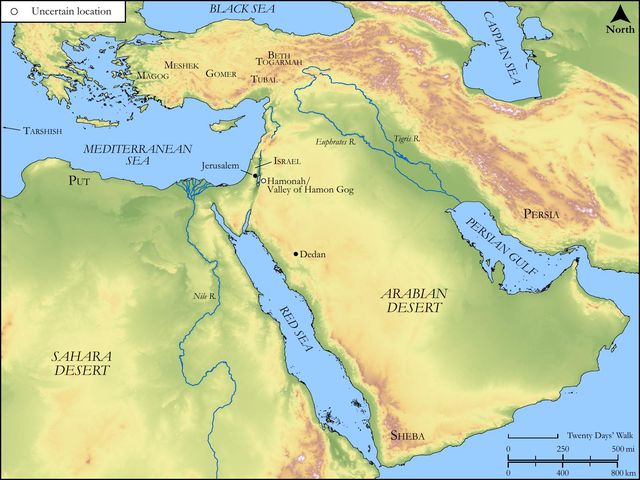
See on the biblical-era map
Study this verse
Public-domain commentary
Matthew Henry
From his Commentary on the Whole Bible. Henry comments on passages, not single verses — this entry covers Ezekiel 38:14–23. His two-level outline is real structure in the source text, so it is rendered as structure.
This latter part of the chapter is a repetition of the former; the dream is doubled, for the thing is certain and to be very carefully regarded.
I.It is here again foretold that this spiteful enemy should make a formidable descent upon the land of Israel (Eze 38:15):
"Thou shalt come out of the north parts (Syria lay on the north of Canaan) with a mighty army, shalt come like a cloud, and cover the land of my people Israel," Eze 38:16. These words (Eze 38:14), When my people Israel dwell safely, shalt thou not know it? may be taken two ways: - 1. As intimating his inducements to this attempt. "Thou shalt have intelligence brought thee how securely, and therefore how carelessly, the people of Israel dwell, which shall give rise to thy project against them; for when thou knowest not only what a rich, but what an easy prey they are likely to be, thou wilt soon determine to fall upon them" Note, God's providence is to be acknowledged in the occasion, the small occasion perhaps, that is given, and that not designedly neither, to those first thoughts from which great enterprises take their original. God, to bring about his own purposes, lets men know that which yet he knows they will make a bad use of, as here. Or, 2. As intimating his disappointment in this attempt, which here, as before, the prophecy begins with: "When my people Israel dwell safely, not in their own apprehension only, but in reality, forasmuch as they dwell safely under the divine protection, shalt not thou be made to know it by the fruitlessness of thy endeavours to destroy them?" Thou shalt soon find that there is no enchantment against Jacob, that no weapon formed against them shall prosper; thou shalt know to thy cost, shalt know to thy shame, that though they have no walls, nor bars, nor gates, they have God himself, a wall of fire, round about them, and that he who touches them touches the apple of his eye; whosoever meddles with them meddles to his own hurt. And it is for the demonstrating of this to all the world that God will bring this mighty enemy against his people. Those that gathered themselves against Israel said, Let us take the spoil and take they prey, but they knew not the thoughts of the Lord, Mic 4:11, Mic 4:12. I will bring thee against my land. This is strange news, that God will not only permit his enemies to come against his own children, but will himself bring them; but, if we understand what he aims at, we shall be well reconciled even to this: it is "that the heathen may know me to be the only living and true God when I shall be sanctified in thee, O Gog! that is, in thy defeat and destruction before their eyes, that all the nations may see, and say, There is none like unto the God of Jeshurun, that rides on the heavens for the help of his people." Note, God brings his people into danger and distress that he may have the honour of bringing about their deliverance, and suffers the enemies of his church to prevail awhile, though they profane his name by their sin, that he may have the honour of prevailing at last and sanctifying his own name in their ruin. Now it is said, This shall be in the latter days, namely, in the latter days of the Old Testament church; so the mischief that Antiochus did to Israel was; but in the latter days of the New Testament church another like enemy should arise, that should in like manner be defeated. Note, Effectual securities are treasured up in the word of God against the troubles and dangers the church may be brought into a great while hence, even in the latter days.
II.Reference is herein had to the predictions of the former prophets (Eze 38:17):
Art thou he of whom I have spoken in old time, of whom Moses spoke in his prophecy of the latter days (Deu 32:43, He will render vengeance to his adversaries), and David, Psa 9:15 (The heathen are sunk down into the pit that they made) and often elsewhere in the Psalms? This is the leviathan of whom Isaiah spoke (Isa 27:1), that congress of the nations of which Joel spoke, Joe 3:1. Many of the prophets had perhaps spoken particularly of this event, though it be not written, as they all had spoken and written too that which is applicable to it. Note, There is an amiable admirable harmony and agreement between the Lord's prophets, though they lived in several ages, for they were all guided by one and the same Spirit.
III.It is here foretold that this furious formidable enemy should be utterly cut off in this attempt upon Israel, and that it should issue in his own ruin. This is supposed by many to have its accomplishment in the many defeats given by the Maccabees to the forces of Antiochus and the remarkable judgments of God executed upon his own person, for he died of sore diseases. But these things are here foretold, as usual, in figurative expressions, which we are not to look for the literal accomplishment of, and yet they might be fulfilled nearer the letter than we know of.
1.God will be highly displeased with this bold invader: When he comes up in pride and anger against the land of Israel, and thinks to carry all before him with a high hand, then God's fury shall come up in his face, which is an allusion to the manner of men, whose colour rises in their faces when some high affront is offered them and they are resolved to show their resentment of it, Eze 38:18. God will speak against them in his jealousy for his people and in the fire of his wrath against his and their enemies, Eze 38:19. See how God's permitting sin, his laying occasions of sin before men, and his making use of it to serve his own purposes, consist with his hatred of sin and his displeasure against it. God brings this enemy against his land, letting him know what an easy prey it might be and determining thereby to glorify himself; and yet, when he comes against the land, God's fury comes up, and he speaks to him in the fire of his wrath. If any ask, Why does he thus find fault? for who has resisted his will? It is easy to answer, Nay, but, O man! who art thou that repliest against God?
2.His forces shall be put into the greatest confusion and consternation imaginable (Eze 38:19): There shall be a great shaking of them in the land of Israel, a universal concussion (Eze 38:20), such as shall affect the fishes and fowls, the beasts and creeping things, and much more the men that are upon the face of the earth, who sooner receive impressions of fear. There shall be such an earthquake as shall throw down the mountains, those natural heights, and the steep places, towers and walls, those artificial heights; they shall all fall to the ground. Some understand this of the fright which the land of Israel should be put into by the fury of the enemy. But it is rather to be understood of the fright which the enemy should be put into by the wrath of God; all those things which they both raise themselves and stay themselves upon shall be shaken down, and their hearts shall fail them.
3.He shall be routed and utterly ruined; both earth and heaven shall be armed against him (1.) The earth shall muster up its forces to destroy him. If the people of Israel have not strength and courage to resist him, God will call for a sword against him, Eze 38:21. And he has swords always at command, that are bathed in heaven, Isa 35:5. Throughout all the mountains of Israel, where he hoped to meet with spoil to enrich him, he shall meet with swords to destroy him, and, rather than fail, every man's sword shall be against his brother, as in the day of Midian, Psa 83:9. The great men of Syria shall undermine and overthrow one another, shall accuse one another, shall fight duels with one another. Note, God can, and often does, make the destroyers of his people to be their own destroyers and the destroyers of one another. However, he will himself be their destroyer, will take the work into his own hand, that it may be done thoroughly (Eze 38:22): I will plead against him with pestilence and blood. Note, Whom God acts against he pleads against; he shows them the ground of his controversy with them, that their mouths may be stopped, and he may be clear when he judges. (2.) The artillery of heaven shall also be drawn out against them: I will rain upon him an overflowing rain, Eze 38:22. He comes like a storm upon Israel, Eze 38:9. But God will come like a storm upon him, will rain upon him great hailstones as upon the Canaanites (Jos 10:11), fire and brimstone as upon Sodom, and a horrible tempest, Psa 11:6. Thus the Gog and Magog in the New Testament shall be devoured with fire from heaven, and cast into the lake of brimstone, Rev 20:9, Rev 20:10. That will be the everlasting portion of all the impenitent implacable enemies of God's church and people.
4.God, in all this, will be glorified. The end he aimed at (Eze 38:16) shall be accomplished (Eze 38:23): Thus will I magnify myself and sanctify myself. Note, In the destruction of sinners God makes it to appear that he is a great and holy God, and he will do so to eternity. And, if men do not magnify and sanctify him as they ought, he will magnify himself, and sanctify himself; and this we should desire and pray for daily, Father, glorify thy own name.
Historical interpretation
Historical reception
1 surviving comment on this verse from the historical church.
(Chapter XXXVIII.) "And the word of the Lord came to me, saying: Son of man, set your face against Gog, the land of Magog, the prince of the head (or head of) Meshech and Tubal, and prophesy against him. And you shall say to him: Thus says the Lord God: Behold, I am against you, O Gog, prince of the head (or head of) Meshech and Tubal. And I will turn you around, and put hooks into your jaws, and bring you out, and all your army, horses and horsemen, all clothed in armor, a great multitude, with bucklers and shields, wielding swords (or bucklers and helmets, and swords): Persians, Ethiopians, and Libyans, all with shields and helmets; Gomer and all his hordes; the house of Togarmah from the far north, and all his troops, and many peoples with you. Prepare and equip yourself, and your entire multitude which has gathered to you, and be a commandment to them (or you will be to me a custodian). After many days you will be visited: in the last years you will come to a land which has turned (or perverted) from the sword: and it has been gathered from many peoples to the mountain (or land) of Israel, who have been continuously deserted: this has been brought out from the peoples and they will confidently dwell (or have dwelt) in it. But when the storms come and the clouds cover the earth, you and all your armies, and many peoples (or nations) with you, will ascend. Thus says the Lord God: On that day, thoughts will arise in your heart, etc., and you will devise a wicked plan, and say: I will ascend to the land (or above the land) without a wall (or abject): I will go to those who dwell securely (or in peace): all ((Vulgate adds these)) dwell without a wall, bars and gates are not for them: to plunder spoils, and seize prey: to lay your hand upon those who were forsaken, and later restored, and upon the people who are gathered from the nations, who have begun to possess and inhabit the belly button of the earth. The people of Sheba and Dedan, and the merchants of Tarshish (or the Carthaginians and all the lion-like cities) will say to you: Have you come to gather spoils? Look, you have gathered your multitude to take silver and gold, and to take away possessions and spoil endless treasures. Therefore, prophesy, son of man, and say to Gog: Thus says the Lord God: Will you not know (or arise) on that day when my people Israel dwell confidently (or in peace)? And you will come from your place on the sides (or from the far north), you and many peoples with you, all mounted on horses, a great gathering and a mighty army. And you will come up over my people Israel like a cloud, to cover the land. In the latter days you will come (or he will come) and I will bring you against my land, so that all the nations may know me, when I shall be sanctified in you in their sight, O Gog. Thus says the Lord God: So you are the one of whom I spoke in the days of old by the hand of my servants, the prophets of Israel, who prophesied in those days and years (or times), that I would bring you against them? And it shall come to pass in that day, in the day of the coming of Gog against the land of Israel, says the Lord God, that my fury will arise in my anger. And in my zeal, in the fire of my wrath, I have spoken, because on that day there will be a great commotion over the land of Israel, and the fish of the sea, and the birds of the sky, and the beasts of the field (or the countryside), and every creeping creature that moves on the earth will be shaken. And all the men who are on the face of the earth will be overturned (or split) and the mountains will be overturned (or torn down), and the hedges (or valleys) will fall, and every wall on the land will collapse. And I will summon against him on all my mountains a sword (or every terror of the sword), says the Lord God. The sword of each (or every) man will be directed against his brother. And I will judge him with pestilence (or death), and blood, and severe rain and immense stones (or hailstones). I will rain fire and sulfur on him, and on his army (or on all those who are with him), and on many peoples who are with him. And I will be magnified, and sanctified, and I will be known in the sight (or eyes) of many nations, and they will know that I am the Lord." The foundations of the first history must be laid, and it must be known that this final discourse of the Lord is to the prophet Ezekiel. For after this we can find nothing similar, except that which is written in the twenty-fifth year of the transmigration of Jehoiachin: The hand of the Lord was upon me, and he brought me there, that is, to the land of Israel, when the building of the temple is described, and the order of its ceremonies is narrated. Then it is to be noted that the face of the prophet is set or hardened against the land of Gog, or the land of Magog. For it requires firmness and much consideration of countenance, so that we may understand the things that are spoken, according to the saying of the Apostle: But we all, with open face beholding as in a glass the glory of the Lord, are changed into the same image from glory to glory, even as by the Spirit of the Lord (1 Corinthians 3:18). Therefore, the Jews and those of us who follow Jewish customs believe that the Gentiles mentioned as Gog are the Scythians, who are savage and countless in number, stretching from beyond the Caucasus mountains and the Maeotis swamp to near the Caspian Sea and as far as India. And they believe that after a thousand years, these nations stirred up by the devil will come to the land of Israel to fight against the saints, gathering many other peoples with them. First, Mosoch, whom Josephus interprets as Cappadocians, then Tubal, whom the same interprets as Iberians, or Spaniards, Hebrews suspect to be Italians, having with them in their army Persians, Ethiopians, and Libyans: also Gomer and Thogorma, whom they interpret as Gauls and Phrygians: also the Sabaeans and Dedan, and the Carthaginians, or Tharsis, and this is what John also puts in his Apocalypse: 'And when the thousand years are finished, Satan will be released from his prison, and will come out to deceive the nations that are at the four corners of the earth, Gog and Magog, to gather them for battle; their number is like the sand of the sea. And they marched up over the broad plain of the earth and surrounded the camp of the saints and the beloved city.' And fire came down from God out of heaven, and devoured them: and the devil, that seduced them, was cast into the pool of fire and brimstone, where both the beast and the false prophet shall be tormented day and night for ever and ever (Rev. 20:9-10). They do not understand that the entire volume of John, which is titled Revelation, is mystical, and that we need revelation in order to be able to say with the prophet: Open my eyes, and I will behold wondrous things out of thy law (Ps. 119:18). But others, forsaking earthly sensibilities and harmful Judaic and elderly fables (I Tim. IV), and content with themselves, delve into the depths, ascend too high, and invent much worse things, in order to describe wars of the devil and all his host in the heavenly Jerusalem, and they interpret spiritual wickedness in celestial matters under the guise of the topologies of individual nations. We, conceding all these things to the judgment of the reader, will strive not so much to condemn foreign ideas as to affirm the ecclesiastical explanation. In the Greek language, a gift is called δόμα, and in Latin it is called tectum. Furthermore, Magog is interpreted as being uncovered. Therefore, all pride and false knowledge of name, which raises itself against the knowledge of truth, is demonstrated by these names. These are the roofs, about which Isaiah speaks in a vision against the Valley of Zion: What has happened to you now, since you have all gone up to empty roofs? (Isa. XXII, 1) And we will interpret the roofs as the leaders of heretics: and we will call those who have received their teachings from the roofs. And beautifully after many mystical prophecies in this volume, the final prophecy is against Gog and Magog. For if it is the time of judgment, according to Peter, that it begins with the house of God, and according to this same Ezekiel, who says: 'And begin with My holy ones' (above IX, 6), and the last enemy will be destroyed, death (1 Peter IV): in Isaiah also the first discourse is against Judah, in which the confession of the Lord is, and the last against the quadrupeds that are in the desert (Isaiah II): rightly here too the final discourse is against Gog and Magog, who attack the city of God, which the flow of the river delights (Psalm XLV). And what Isaiah says: 'I am the first city which is attacked' (Isaiah XXVII, 10). And concerning which it is written in the Gospel: A city that is set on a hill cannot be hid (Matthew 5:14). And more fully in the Psalm: Jerusalem is built as a city that is at unity in itself (Psalm 122:3). The mountains are round about it; and the LORD is round about his people (Psalm 125:2). Furthermore, in the army of Gog, or Magog, who according to the Septuagint, Symmachus, and Theodotion, is chief of Ros, Mosoch, and Thubal: the first nation is interpreted by Aquila as the head, which we also follow, so that the sense is: The prince of the head of Mosoch and Thubal. And indeed, neither in Genesis, nor in any other place in Scripture, nor even in Josephus, who in his first book of Antiquities explains the names of all the Hebrew nations, could we find this nation. From this it is clear that 'ros' does not mean nation, but head. It should also be briefly noted that in Ezekiel, Gog is said to be the prince of the land of Magog. And in the Apocalypse, it is mentioned that Gog and Magog are nations that come forth from the four corners of the earth. And just as Jacob, who was later called Israel, received the name of all the Hebrew people, and Aram received the name of Syria, and Mesraim received the name of Egypt, whose names are written in Genesis: so too, all those who are subject to the prince Gog are called Magog. However, Mosoch is interpreted as madness, and Thubal as everything or all. Therefore, the prince and the head of arrogant madness and of all evils are called Gog and Magog, according to what is written: The world is set in the evil one (1 John 5:19). These hostile and opposing nations of the saints come forth from the corners of the earth, deviating from the straight line and the arrangement of God's camp, as is recounted in Numbers, and not realizing this testimony: Many will come from the east and the west, from the north and the south, and will recline at the table with Abraham, Isaac, and Jacob in the kingdom of God (Matthew 8:11). And in another place: I will say to the North, give up; and to the South, do not withhold. Bring my sons from far away, and my daughters from the end of the earth, everyone who is called by my name (Isa. XLIII, 6). But not such the corners of the earth from which Gog and Magog come forth: next to these corners stands the harlot in Proverbs (Prov. XXIII), who, passing by, hastens to deceive foolish young men through the streets, that is, through the broad and spacious road that leads to death. The scribes and Pharisees also pray in the corners of the streets, so that they may be seen by men, who have received their reward (Matthew 6). So what is the curse against Gog? I will turn you around and put a bit in your jaws. First, I will make you waver from your opinion and be converted. And I will put a bit in your jaws, as it is written: 'With bit and bridle bind fast their jaws, who come not near Thee' (Psalm 32:9); so that the untamed and unruly horse, who falls down precipices, may be subject to the bridle of the Lord: to whom the prophet says: 'Ride upon thy horses, and thy riding shall be salvation' (Habakkuk 3:8). And it is said of Job, through a cloud and whirlwind: You have surrounded the horse with strength (Job. XXXIX, 19). Such were the horses and horsemen; whose multitude John saw in heaven (Apoc. VI). Therefore, he says to Gog: I will lead out, or gather you, and all the army, or your strength. He who is led out and gathered from dispersion is brought back to salvation, according to what is promised in the law: If your dispersion shall be from the top of the sky to its summit, from there I will gather you (Deut. XXX, 3). They also have horses and cavalry clad in armor, who imitate the apostle's equipment and boast of having the breastplate of righteousness (Ephesians 6): the multitude is excessive, and all seize the shield and sword against the Church, and they are the most savage and hostile nations, including the Persians, Ethiopians, and Libyans: their wars against the people of God are recounted in the Holy Scriptures. Also Gomer and the house of Thogorma, who come from the sides of the North, which is a very cold wind and is called the East wind, and the whole strength of Magog, and all the peoples who are subject to him, will come with him to battle. To whom it is said ironically: prepare yourself, make ready, and gather to yourself all your multitude that obeys your commands; and know that after many days you shall be visited, according to what is written: I will visit their iniquities with a rod and their sins with stripes (Psalm 88:33). In the last days, he says, you will come. Hence John also says: My little children, it is the last hour (1 John 2:18). And the people of the nations are hired at the eleventh hour to work in the vineyard (Matthew 20), to whose land, that is, the land of mildness, and the land of the saints, which brings forth one hundred, and sixty, and thirty fruits, Gog has come to conquer, which has turned away, or turned its back, from the sword. For it is written: Scatter, O Lord, the nations that desire war (Psalm 68:32). And it shall come to pass that, when the people and nations have been gathered together, and the error of the nations has been despised, it shall come to the mountains of Israel, namely the patriarchs and prophets, who once wandered in the desert without the law and commandments of God. To whom it is afterwards said: 'More are the children of the desolate, than of her that hath a husband.' (Isa. LIV, 1) These are the deserted and waterless places, in which the devil could not find a place, because they were called to salvation, and afterwards he, having taken seven other, more wicked spirits, returned to his house, namely to the people of Israel. (Matth. XI) These things, he says, are spoken of the people, understood as the earth; or, it is spoken of the nations, so that it may be understood as the people of believers who dwelt in peace and trusted in the Lord. But Gog, together with all his army, will come up like a storm and like a cloud, to cover the land of the believers. For what heretics, whose leader is the devil, do not come against the Church like a storm, and in a cloud of their words, they hasten to oppress and cover the simple believers? Therefore it is said to him: As much as it is within you, you will cover all things and all your armies, and many peoples with you. Gog, ascending proudly, does not have voluntary rain, nor temporary and late rain, which would rejoice the dry fields, but rather storm and darkness, so that it may confuse everything with darkness and error. Therefore, the Lord God speaks these words to him: At that time, that is, in the last days, evil thoughts will arise in your heart, and you will ponder a wicked plan, as the Scripture says: If the spirit of the one having power desires to rise against you, do not leave your place (Ecclesiastes 10:4). On the other hand, God ascends into the holy heart, about which it is written: He established his ascents in his heart (Ps. 83:6). And Gog says: I will ascend to the land without a wall, or a projecting one, that is, which is deprived of God's help, and not fortified by dialectical argumentation; I will come to those who are at rest and dwell securely, that is, in peace. For our King is peaceful, and his place is in peace (Psalm 75). All, he says, dwell without a wall, and there are no bars or gates for them. This prince of heretics speaks, having no defenses of the Church; nor secular wisdom, which is foolishness before God, in order to plunder the spoils and invade the prey of the Church, and lay his hand upon those who were deserted when they did not have knowledge of God; and then, restored through Christ, come to the Father, to whom he speaks in the Gospel: Father, I have revealed your name to men (John 17:6). And so that we may know that the people who were deserted and then restored signify the Christian people, it follows: And over the people who are gathered from the nations (Psalm 74:12). The people who began to possess the inheritance of Christ and to be inhabitants of the navel of the earth, of which it is written: He has worked salvation in the midst of the earth. For truth has risen from the earth (Ibid. LXXXIV, 1); who says in the Gospel: I am the way and the life, and the truth (John XIV, 6). While he was thinking and saying this, and eagerly trying to snatch the possession of the Church, the nations that had been converted from their ancient error to salvation, Sabah and Dedan, and the merchants of Tarshish, Carthage, or the sea, who seek merchandise in the waves of this world through good works, and all their cities, whether lions or lion cubs as it is contained in Hebrew, will speak to him what follows. But as for the cubs of lions, which are called Caphir in Hebrew (), both the Seventy and Theodotio translate as 'villas', it is a clear mistake. For if you write it with the letter chi, it is called a lion cub; but if you write it with ce, which is called Coph in Hebrew, it is called a field and a village. Hence, Capharnaum is said to be a beautiful field. Therefore, Saba and Dedan will say, and the merchants of Tharsis, and all the holy ones who are called lion cubs, or certainly the villages and dwellings of the believers: O Gog, do you come for this reason, to seize the spoils of the Church, and therefore have you gathered a multitude, so that the possession of Christ may become your inheritance? Or do you think that the silver and gold, which is understood in speech and meaning, will be possessed by the Church, so that you may take away all the furnishings and all the wealth, and plunder the countless spoils gathered by the victories of Christ? Therefore, O Prophet Ezekiel, who is called the son of man in the type of Christ, speak to Gog and say to him: Thus says the Lord God, when the error of the whole world is removed, my people Israel, who discern God with their minds, will dwell confidently in the Church, either in peace. Then you will know, whether you rise up or come from your place. However, the following discourse shows the place of heretical wickedness: From the sides of the North, which endeavors to cool down all the heat of believers. And many people will come with him, all riders on horses, of whom it is written: He threw horse and rider into the sea (Exodus 15:1): a great multitude and a powerful army, with whom he ascends, saying, 'Upon my people Israel, you shall come like a cloud and cover my land, as it is written: In the last days, you shall be, when the Gospel preaching: and I will bring you upon my land. For heresies must exist, so that those who are approved may be made manifest (1 Corinthians 11:19), and by God's will the devil, the fighter, and all perversions of doctrine have been abandoned: so that all nations may know and understand me, when I am sanctified in you in their eyes, o Gog, that is, when they understand me as their judge through your punishments. And he addresses Gog himself; Are you not the one of whom I spoke in ancient times, through the hands of my servants the prophets of Israel? Namely, Moses, who said in the book of Numbers, specifically in the Septuagint: A man will come forth from his seed, and he will rule over many nations, and his kingdom will be exalted, and his kingdom will grow (Num. 24:7). Moreover, according to the Hebrew text, I found it written as follows: Therefore, his king Agag (translated as Gog in the Latin Vulgate) will be removed, and his kingdom will be taken away, because the kingdom of Israel was destroyed by Agag, the king of Amalek, during the time of Saul. And in another place: He will cleanse the land of his people (Joel 3). Joel also describes the gathering of people in the valley of Josaphat, which is the judgement of God. And Isaiah and all the prophets, in whose hands the word of the Lord is made manifest through good works. So when my wrath and fury come upon the land of Israel, my indignation will rise against you, and my zeal for my people. In the fire of my anger, I have spoken, to consume all the wickedness of your actions. At that time, he says, there will be a great upheaval upon the land of Israel. For with the Devil unleashed, frequent persecution against the Church will occur: and when it has been suppressed and overcome by God's help, then the fish of the sea, the birds of the sky, the animals of the field, and all reptiles that move upon the land, and all the men who are upon the face of the earth will be shaken. This is clearly demonstrated concerning the inhabitants of the Church: some are like fish of the sea, others like birds of the sky, others like animals of the field and all creeping things that move on the earth, others like those who retain human dignity and dwell upon the face of the earth. And as for the diversity of character, which is designated by various names, the Apostle writes to the Corinthians that there are heavenly bodies and earthly bodies after the resurrection, and that one body is of a fish, another of a bird, another of animals, another of creeping things, and another of humans who have retained their original name. In the actions of the apostles, that linen cloth, which is shown to the third Apostle Peter with four principles (Acts X), also signifies the diversity of believers, which is also contained in the Ark of the flood. Then, indeed, the mountains will be overturned by the face of the Lord, and by the sight of His majesty, which were rising up against the knowledge of God; and the hedges or valleys, which were sunk to the lowest depths by the lowliness of their understanding, or certainly the fortifications, which promise something, in order to imitate the Church of God, of whose hedges it is said: 'He who breaks a hedge, a snake will bite him' (Sirach X, 8). And all the walls will fall to the ground. For when the strength of Ecclesiastical discourse appears, all the fortifications of the heretics will fall. And I will call, he says, him against them, that is, the leader of the heretics Gog, a sword in all his mountains, so that the leaders of his army may be defeated by the sword of the Lord. Then heresy will fight against heresy, their struggle is our victory. And I will judge him, saith the Lord, with death, or with plague, and blood, and severe rain, and immense stones, or hailstones. But Gog is judged with his own death, and with the blood which he shed, and with the severe rain, by the words of learned and perfect men, and with immense stones, which bury him with testimonies of the Scriptures, or with hailstones, which make his heat grow cold: For all who commit adultery, their hearts are like an oven. (Hosea 7:4). I will rain fire and sulfur upon him, whereby the punishment of eternal judgment is shown. And not only above him who was the author of wickedness, but even above his entire army and multitude, and above many nations who are with him. For heretics have many accomplices, indeed the devil himself, their prince, is surrounded by an infinite number. With every error removed, and with the leaders of the heretics punished and destroyed, the Lord is magnified and sanctified among the believers, and is known in the eyes of many nations who have believed in his faith; and both from the blessedness of his followers and from the punishment of his adversaries, it is understood and known that he is the Lord. We have interpreted these things as best as we could, obeying that precept: Neither shall you turn aside to the right hand, nor to the left, but shall walk in the royal way (Deut. XXVIII, 14). But if someone criticizes our work, let them either propose better things for us to follow, or if they have nothing to say, let them leave perfect knowledge of God behind; as long as they understand that we have no power, but the judgment of our mind.
Continue studying Ezekiel 38:21 across the web’s major study libraries — every link below opens this exact verse, chapter, or book on the destination site.
Read & Compare
 BibleGatewayThis verse in more than 200 translations and 70 languages.
 Bible.comThe YouVersion reader — hundreds of translations, reading plans, and highlights.
 ESV.orgCrossway's official English Standard Version reader.
 NET BibleThe NET translation with 60,000+ translators' notes on every rendering decision.
 STEP BibleTyndale House's free study tool — original text, vocabulary, and scholarly resources.
 BibliaLogos Bible Software's free web reader.
 USCCBThe New American Bible (Revised Edition) with the U.S. bishops' study notes.
Commentaries
 BibleHub CommentariesDozens of classic commentaries on this verse, gathered on one page.
 StudyLightMore than 100 commentary sets — the largest collection on the web.
 BibleRefPlain-English commentary on what this verse means, verse by verse.
 Enduring WordDavid Guzik's free commentary on this chapter, widely used by Bible teachers.
 Bible Study ToolsVerse commentary alongside Greek and Hebrew study aids.
Original Language & Research
- BibleHub InterlinearThe verse word by word — original language, transliteration, and English.
- BibleHub LexiconEvery word's original-language definition and Strong's entry.
 Blue Letter BibleDeep-study tools — Strong's numbers, concordance, and word studies.
 SefariaThe Hebrew text with Rashi and centuries of Jewish commentary.
Sermons, Hymns & Audio


TrulyRandomVerse is not affiliated with these sites and doesn’t control their content. They’re linked because they’re genuinely useful.
Summary
Ezekiel 38:21 powerfully declares the Lord GOD's absolute sovereignty and direct intervention against the formidable invading coalition led by Gog. This pivotal prophecy reveals God's strategic intent to orchestrate internal chaos within the enemy ranks on the mountains of Israel, causing them to turn their weapons against one another. This divinely initiated self-destruction serves not only to protect His covenant people but also to unequivocally demonstrate His holiness, power, and glory to all nations, fulfilling His ultimate redemptive purposes.
Context
ShowHideLiterary Context
This verse is a crucial component within the expansive prophetic vision of Ezekiel 38-39, which vividly describes a massive, multi-national invasion of the land of Israel in the "latter days." Prior to this declaration, God has already stated His intention to supernaturally bring Gog and his vast army against Israel, drawing them out for a specific purpose of divine judgment, as seen in Ezekiel 38:4. The immediate preceding verses, Ezekiel 38:19-20, describe a cataclysmic earthquake and other natural phenomena that will accompany God's wrath. Verse 21 then specifically details the internal strife that will further decimate the invading army, serving as a prelude to the broader description of God's comprehensive judgment through plague, bloodshed, torrential rain, hailstones, fire, and brimstone in Ezekiel 38:22. The subsequent chapter, Ezekiel 39, expands on the utter destruction of Gog's forces and the extensive clean-up required, underscoring the unprecedented scale of God's victory and the complete vindication of His name.
Historical & Cultural Context
The prophecy of Gog and Magog is distinctly set in the "latter days" (Ezekiel 38:8), signifying its eschatological nature and indicating that it transcends any specific historical event contemporary to Ezekiel's time. While Gog and Magog have been variously associated with northern peoples like the Scythians or Cimmerians, the prophecy's primary theological intent is not to identify precise historical nations but to illustrate God's ultimate and unchallengeable sovereignty over all earthly powers that oppose Him. In ancient warfare, internal dissension, panic, or confusion could indeed lead to devastating self-inflicted casualties, a phenomenon God has historically employed to defeat His enemies without direct human intervention from Israel, as exemplified in the victory over Midian in Judges 7:22 and the defeat of the Ammonites and Moabites in 2 Chronicles 20:23. The "mountains of Israel" serve as the designated stage for this climactic divine drama, profoundly symbolizing God's unwavering ownership and protective claim over His land and His covenant people.
Key Themes
ShowHideThe overarching theme illuminated by Ezekiel 38:21 is Divine Sovereignty and Judgment. God's explicit declaration, "I will call for a sword against him," emphatically underscores that this judgment is not an accidental occurrence or a mere consequence of human actions, but a direct, intentional, and divinely orchestrated act to fulfill His purposes. A second prominent theme is Internal Strife as a Divine Weapon, where God causes the vast enemy coalition to turn their weapons upon themselves. This unique method of warfare powerfully showcases God's supernatural power and His ability to defeat formidable adversaries without requiring Israel's military intervention, thereby highlighting His unique and unparalleled methods of warfare. Ultimately, the profound purpose of this judgment is the Protection and Vindication of Israel and the Revelation of God's Glory to all nations, as explicitly stated in Ezekiel 38:23. This climactic event serves as a powerful affirmation of God's unwavering faithfulness to His covenant promises, even in the face of seemingly overwhelming opposition.
Exposition and Analysis
ShowHideKey Word Analysis
ShowHideThis primitive root signifies the act of calling out to, addressing by name, or summoning. In the context of Ezekiel 38:21, God's declaration, "I will call for a sword," is far more than a mere prediction; it is an authoritative divine command and an active initiation of judgment. It emphasizes God's direct, personal, and sovereign role as the orchestrator of events, summoning the "sword" as His chosen instrument of divine wrath. This word underscores the intentionality and certainty of God's decree.
Derived from a root meaning "drought," this term refers to a cutting instrument, specifically a sword, knife, or other sharp implement, and is intrinsically linked to destructive effect and violence. Its potent repetition within the verse ("call for a sword," "every man's sword") intensifies the imagery of pervasive, lethal conflict and widespread decimation. Here, "sword" represents not only a physical weapon but also the tangible instrument of divine wrath, chaos, and the means by which God's judgment is executed.
This primitive word denotes a brother in its broadest sense, encompassing literal kinship, metaphorical affinity, or close association, such as allies or confederates. In the chilling phrase "every man's sword shall be against his brother," it highlights the complete and unnatural breakdown of unity, loyalty, and cohesion within the enemy ranks. This signifies a horrific and unprecedented turning of supposed allies against one another, leading to mutual destruction and emphasizing the chaotic and self-defeating nature of God's judgment.
Verse Breakdown
ShowHide"And I will call for a sword against him"
This declarative opening clause immediately establishes God's absolute sovereignty and divine initiative in the impending judgment. The phrase "I will call" (literally, "I will summon" or "I will proclaim") signifies an active, authoritative divine command, not a passive observation or a mere allowance of events. God is directly and intentionally initiating the judgment against Gog, using the "sword" as His chosen instrument for the destruction of the invading forces. This is a powerful declaration of God's deliberate intent and unchallengeable power.
"throughout all my mountains, saith the Lord GOD"
This segment precisely clarifies the geographical location where this climactic judgment will unfold – "my mountains," which unequivocally refers to the mountains of Israel. This possessive declaration profoundly emphasizes God's ownership and protective claim over the land where His covenant people reside. The authoritative concluding phrase, "saith the Lord GOD," employing the combined divine titles ʼĂdônây Yᵉhôvih (H136, H3069), underscores the absolute certainty, unchallengeable nature, and divine origin of this prophecy. It is an immutable decree from the sovereign ruler of the universe.
"every man's sword shall be against his brother."
This powerful and chilling concluding statement reveals the precise and devastating nature of the divine judgment: internal strife and catastrophic self-destruction. Instead of engaging in battle with Israel, the vast invading forces will be supernaturally compelled to turn their weapons upon themselves, leading to a chaotic, bloody, and devastating decimation from within their own ranks. This highlights the complete breakdown of cohesion and the terrifying effectiveness of God's judgment, where the enemies become their own destroyers, fulfilling God's purpose through their own internal collapse.
Literary Devices
ShowHideEzekiel 38:21 is profoundly enriched by several literary devices that amplify its prophetic impact and theological weight. The phrase "I will call for a sword" employs Personification, as God is depicted as actively summoning an inanimate object (a sword) as if it were a sentient agent, vividly highlighting His direct and active involvement in orchestrating the impending judgment. The deliberate Repetition of the word "sword" ("call for a sword," "every man's sword") creates a pervasive sense of inescapable violence and emphasizes the instrument of widespread destruction, intensifying the imagery of relentless internal conflict. There is profound Irony in the fact that the formidable enemies, who came with the intent to plunder and destroy Israel, are instead supernaturally caused to turn their weapons on each other. This unexpected and dramatic reversal powerfully underscores God's ability to confound and frustrate the plans of His adversaries. The phrase "every man's sword shall be against his brother" utilizes Hyperbole to convey the absolute, widespread, and total nature of the internal conflict, implying a complete and catastrophic breakdown of order and unity that leads to comprehensive self-destruction. Finally, the entire verse functions as a powerful Divine Fiat, an authoritative and irrevocable decree from God that declares His sovereign will and guarantees its certain fulfillment, leaving no doubt about the inevitable and devastating outcome for those who oppose Him.
Theological and Thematic Connections
ShowHideEzekiel 38:21 profoundly illustrates God's absolute and unchallengeable sovereignty over all nations, historical events, and even the internal dynamics of those who oppose Him. It reveals that God does not merely react to human aggression or geopolitical threats but actively orchestrates circumstances, even utilizing the internal divisions and self-destructive tendencies of His enemies, to achieve His righteous and redemptive purposes. This divine strategy ensures that His covenant people are protected, His promises are fulfilled, and His glory is unequivocally displayed to the entire world. The verse serves as a powerful and enduring reminder that ultimate victory belongs solely to the Lord, and no human, demonic, or combined force can thwart His eternal plans for His creation and His chosen people.
Reflection and Application
ShowHideEzekiel 38:21 offers profound reassurance and a compelling call to unwavering trust in God's ultimate and sovereign control over all things. In a world frequently characterized by geopolitical turmoil, escalating threats, and seemingly overwhelming forces of evil, this verse serves as a powerful reminder that God remains firmly on His throne, actively working to fulfill His divine purposes. We are called to trust that even when circumstances appear dire, and human solutions seem inadequate, God possesses countless and often unexpected ways to intervene, to protect His people, and to vindicate His holy name. This truth should inspire believers to live with profound confidence and peace, rather than fear, knowing that the Lord is the ultimate defender, judge, and orchestrator of history. It also challenges us to align our lives wholeheartedly with His righteous will, recognizing that any opposition to God's ultimate plans inevitably leads to futility and self-destruction.
Questions for Reflection
ShowHideFAQ
ShowHideWhat does "my mountains" refer to in this verse?
ShowHide"My mountains" refers specifically and unequivocally to the mountains of Israel, emphasizing that this decisive battle and the subsequent divine judgment will take place on the very land God has consecrated, claimed as His own, and given to His covenant people. This possessive phrase profoundly underscores God's ownership and protective claim over the territory of Israel, making it the central stage for the dramatic and public display of His power, holiness, and faithfulness. It signifies that God is actively defending His own possession and His chosen people against all invaders.
Has the prophecy of Gog and Magog, as described in Ezekiel 38-39, been fulfilled?
ShowHideThe prophecy of Gog and Magog in Ezekiel 38 and Ezekiel 39 is widely understood by the vast majority of biblical scholars to be an unfulfilled eschatological prophecy. This means it pertains to events in the "latter days" (Ezekiel 38:8, Ezekiel 38:16) that are yet to occur. While some interpretations have attempted to link it to various historical events or figures throughout history, the unprecedented scale, global scope, and numerous supernatural elements explicitly described (e.g., God's direct and cataclysmic intervention, the internal strife, the seven years of burning weapons, the seven months of burial, the universal revelation of God's glory) strongly suggest a future, climactic event that will unequivocally demonstrate God's sovereignty and holiness to all nations (Ezekiel 38:23).
Christ-Centered Fulfillment
ShowHideEzekiel 38:21, with its vivid portrayal of God's sovereign judgment and the divinely orchestrated self-destruction of His enemies, finds its ultimate and profound Christ-centered fulfillment in the person and redemptive work of Jesus Christ. The "sword" that God calls for, representing divine judgment, is ultimately wielded by Christ Himself, who is majestically depicted in Revelation as having a sharp, two-edged sword coming from His mouth, symbolizing His powerful, authoritative word of judgment and righteous decree (Revelation 1:16, Revelation 19:15). The divine principle of enemies turning on each other foreshadows the inherent internal division and ultimate defeat of the kingdom of darkness, as Jesus Himself profoundly taught that "every kingdom divided against itself will be ruined, and every city or household divided against itself will not stand" (Matthew 12:25). Christ's decisive victory on the cross disarmed and triumphed over the spiritual powers and authorities (Colossians 2:15), and His glorious second coming will culminate in the final and complete overthrow of all who oppose God, leading to their utter destruction, not by external human armies, but by the very breath of His mouth and the splendor of His coming (2 Thessalonians 1:7-9). Thus, Ezekiel's ancient prophecy points forward to Christ as the ultimate orchestrator of divine justice, ensuring the eternal protection of His redeemed people and the everlasting triumph of His glorious kingdom.