


Revelation 1:16
Bible text: King James Version (1769 Blayney text) · Public domain
Bible text: King James Version with Strong's numbers · Public domain
Bible text: Berean Standard Bible · Public domain
Bible text: American Standard Version (1901) · Public domain
Bible text: World English Bible, Messianic edition · Public domain
Bible text: Geneva Bible (1599) · Public domain
Bible text: Young's Literal Translation · Public domain
- καὶkaiandG2532CONJConjunction
- ἔχωνechōnHe is holdingG2192V-PAP-NSMVerb Present Active Participle Nominative Singular Masculine
- ἐνeninG1722PREPPreposition
- τῇtēatheG3588T-DSFDefinite article Dative Singular Feminine
- δεξιᾷdexiarightG1188A-DSFAdjective Dative Singular Feminine
- χειρὶcheirihandG5495N-DSFNoun Dative Singular Feminine
- αὐτοῦautouof HimG846P-GSMPersonal pronoun Genitive Singular Masculine
- ἀστέραςasterasstarsG792N-APMNoun Accusative Plural Masculine
- ἑπτὰheptasevenG2033A-NUIAdjective
- καὶkaiandG2532CONJConjunction
- ἐκekout ofG1537PREPPreposition
- τοῦtoutheG3588T-GSNDefinite article Genitive Singular Neuter
- στόματοςstomatosmouthG4750N-GSNNoun Genitive Singular Neuter
- αὐτοῦautouof HimG846P-GSMPersonal pronoun Genitive Singular Masculine
- ῥομφαίαrhomphaiaa swordG4501N-NSFNoun Nominative Singular Feminine
- δίστομοςdistomostwo-edgedG1366A-NSFAdjective Nominative Singular Feminine
- ὀξεῖαoxeiasharpG3691A-NSFAdjective Nominative Singular Feminine
- ἐκπορευομένηekporeuomenēis going forthG1607V-PNP-NSFVerb Present Middle Or Passive Deponent Participle Nominative Singular Feminine
- καὶkaiandG2532CONJConjunction
- ἡhētheG3588T-NSFDefinite article Nominative Singular Feminine
- ὄψιςopsisfaceG3799N-NSFNoun Nominative Singular Feminine
- αὐτοῦautouof HimG846P-GSMPersonal pronoun Genitive Singular Masculine
- ὡςhōs[is] likeG5613PRTParticle or Disjunctive
- ὁhotheG3588T-NSMDefinite article Nominative Singular Masculine
- ἥλιοςhēliossunG2246N-NSMNoun Nominative Singular Masculine
- φαίνειphaineishiningG5316V-PAI-3SVerb Present Active Indicative 3rd Singular
- ἐνeninG1722PREPPreposition
- τῇtēatheG3588T-DSFDefinite article Dative Singular Feminine
- δυνάμειdunameifull strengthG1411N-DSFNoun Dative Singular Feminine
- αὐτοῦautouof itG846P-GSMPersonal pronoun Genitive Singular Masculine
English is a literal word-by-word gloss of the Greek, not the KJV's wording. Why?
This is the original text the KJV's translators worked from — each Greek word with its own literal English meaning in this verse, prepared by scholars at Tyndale House, Cambridge. The KJV translates whole sentences, not word by word, so its wording differs: one Greek word can become several English words, and the KJV may choose “charity” where the gloss reads “love”. Both are faithful — they answer different questions. For the KJV's own rendering, switch to the KJV text.
Details
See on the biblical-era maps

Study this verse
Public-domain commentary
Matthew Henry
From his Commentary on the Whole Bible. Henry comments on passages, not single verses — this entry covers Revelation 1:9–20. His four-level outline is real structure in the source text, so it is rendered as structure.
We have now come to that glorious vision which the apostle had of the Lord Jesus Christ, when he came to deliver this revelation to him, where observe,
I.The account given of the person who was favoured with this vision. He describes himself,
1.By his present state and condition. He was the brother and companion of these churches in tribulation, and in the kingdom and patience of Christ. He was, at their time, as the rest of true Christians were, a persecuted man, banished, and perhaps imprisoned, for his adherence to Christ. He was their brother, though an apostle; he seems to value himself upon his relation to the church, rather than his authority in it: Judas Iscariot may be an apostle, but not a brother in the family of God. He was their companion: the children of God should choose communion and society with each other. He was their companion in tribulation: the persecuted servants of God did not suffer alone, the same trials are accomplished in others. He was their companion in patience, not only a sharer with them in suffering circumstances, but in suffering graces: if we have the patience of the saints, we should not grudge to meet with their trials. He was their brother and companion in the patience of the kingdom of Christ, a sufferer for Christ's cause, for asserting his kingly power over the church and the world, and for adhering to it against all who would usurp upon it. By this account he gives of his present state, he acknowledges his engagements to sympathize with them, and to endeavour to give them counsel and comfort, and bespeaks their more careful attention to what he had to say to them from Christ their common Lord.
2.By the place where he was when he was favoured with this vision: he was in the isle Patmos. He does not say who banished him thither. It becomes Christians to speak sparingly and modestly of their own sufferings. Patmos is said to be an island in the Aegean Sea, One of those called Cyclades, and was about thirty-five miles in compass; but under this confinement it was the apostle's comfort that he did not suffer as an evil-doer, but that it was for the testimony of Jesus, for bearing witness to Christ as the Immanuel, the Saviour. This was a cause worth suffering for; and the Spirit of glory and of God rested upon this persecuted apostle.
3.The day and time in which he had this vision: it was the Lord's day, the day which Christ had separated and set apart for himself, as the eucharist is called the Lord's supper. Surely this can be no other than the Christian sabbath, the first day of the week, to be observed in remembrance of the resurrection of Christ. Let us who call him our Lord honour him on his own day, the day which the Lord hath made and in which we ought to rejoice.
4.The frame that his soul was in at this time: He was in the Spirit. He was not only in a rapture when he received the vision, but before he received it; he was in a serious, heavenly, spiritual frame, under the blessed gracious influences of the Spirit of God. God usually prepares the souls of his people for uncommon manifestations of himself, by the quickening sanctifying influences of his good Spirit. Those who would enjoy communion with God on the Lord's day must endeavour to abstract their thoughts and affections from flesh and fleshly things, and be wholly taken up with things of a spiritual nature.
II.The apostle gives an account of what he heard when thus in the Spirit.
An alarm was given as with the sound of a trumpet, and then he heard a voice, the voice of Christ applying to himself the character before given, the first and the last, and commanding the apostle to commit to writing the things that were now to be revealed to him, and to send it immediately to the seven Asian churches, whose names are mentioned. Thus our Lord Jesus, the captain of our salvation, gave the apostle notice of his glorious appearance, as with the sound of a trumpet.
III.We have also an account of what he saw.
He turned to see the voice, whose it was and whence it came; and then a wonderful scene of vision opened itself to him.
1.He saw a representation of the church under the emblem of seven golden candlesticks, as it is explained in the last verse of the chapter. The churches are compared to candlesticks, because they hold forth the light of the gospel to advantage. The churches are not candles: Christ only is our light, and his gospel our lamp; but they receive their light from Christ and the gospel, and hold it forth to others. They are golden candlesticks, for they should be precious and pure, comparable to fine gold; not only the ministers, but the members of the churches ought to be such; their light should so shine before men as to engage others to give glory to God.
2.He saw a representation of the Lord Jesus Christ in the midst of the golden candlesticks; for he has promised to be with his churches always to the end of the world, filling them with light, and life, and love, for he is the very animating informing soul of the church. And here we observe,
(1.)The glorious form in which Christ appeared in several particulars.
[1.]He was clothed with a garment down to the foot, a princely and priestly robe, denoting righteousness and honour.
[2.]He was girt about with a golden girdle, the breast-plate of the high priest, on which the names of his people are engraven; he was ready girt to do all the work of a Redeemer.
[3.]His head and hairs were white like wool or snow. He was the Ancient of days; his hoary head was no sign of decay, but was indeed a crown of glory.
[4.]His eyes were as a flame of fire, piercing and penetrating into the very hearts and reins of men, scattering terrors among his adversaries.
[5.]His feet were like unto fine burning brass, strong and stedfast, supporting his own interest, subduing his enemies, treading them to powder.
[6.]His voice was as the sound of many waters, of many rivers falling in together. He can and will make himself heard to those who are afar off as well as to those who are near. His gospel is a profluent and mighty stream, fed by the upper springs of infinite wisdom and knowledge.
[7.]He had in his right hand seven stars, that is, the ministers of the seven churches, who are under his direction, have all their light and influence from him, and are secured and preserved by him.
[8.]Out of his mouth went a two-edged sword, his word, which both wounds and heals, strikes at sin on the right hand and on the left,
[9.]His countenance was as the sun shining, its strength too bright and dazzling for mortal eyes to behold.
(2.)The impression this appearance of Christ made upon the apostle John (Rev 1:17): He fell at the feet of Christ as dead; he was overpowered with the greatness of the lustre and glory in which Christ appeared, though he had been so familiar with him before. How well is it for us that God speaks to us by men like ourselves, whose terrors shall not make us afraid, for none can see the face of God and live!
(3.)The condescending goodness of the Lord Jesus to his disciple: He laid his hand upon him, Rev 1:17. He raised him up; he did not plead against him with his great power, but he put strength into him, he spoke kind words to him.
[1.]Words of comfort and encouragement: Fear not. He commanded away the slavish fears of his disciple.
[2.]Words of instruction, telling him particularly who he was that thus appeared to him. And here he acquaints him, First, with his divine nature: The first and the last. Secondly, With his former sufferings: I was dead; the very same that his disciples saw upon the cross dying for the sins of men. Thirdly, With his resurrection and life: "I live, and am alive for evermore, have conquered death and opened the grave, and am partaker of an endless life." Fourthly, With his office and authority: I have the keys of hell and of death, a sovereign dominion in and over the invisible world, opening and none can shut, shutting so that none can open, opening the gates of death when he pleases and the gates of the eternal world, of happiness or misery, as the Judge of all, from whose sentence there lies no appeal. Fifthly, With his will and pleasure: Write the things which thou hast seen, and the things which are, and which shall be hereafter. Sixthly, With the meaning of the seven stars, that they are the ministers of the churches; and of the seven candlesticks, that they are the seven churches, to whom Christ would now send by him particular and proper messages.
Historical interpretation
Eight Centuries of Reception
10 surviving comments on this verse. Each one is dated, so this reads as a timeline rather than a list.
Select a marker to jump to its quote. Markers stagger vertically where authors wrote within a few decades of each other.
Now the Apostle John, in the Apocalypse, describes a sword which proceeded from the mouth of God as "a doubly sharp, two-edged one." This may be understood to be the Divine Word, who is doubly edged with the two testaments of the law and the gospel-sharpened with wisdom, hostile to the devil, arming us against the spiritual enemies of all wickedness and concupiscence, and cutting us off from the dearest objects for the sake of God's holy name.
Who will ply the sword without practising the contraries to lenity and justice; that is, guile, and asperity, and injustice, proper (of course) to the business of battles? See we, then, whether that which has another action be not another sword,-that is, the Divine word of God, doubly sharpened with the two Testaments of the ancient law and the new law; sharpened by the equity of its own wisdom; rendering to each one according to his own action.
"And in His face was brightness as the sun." That which He called brightness was the appearance of that in which He spoke to men face to face. But the glory of the sun is less than the glory of the Lord. Doubtless on account of its rising and setting, and rising again, that He was born and suffered and rose again, therefore the Scripture gave this similitude, likening His face to the glory of the sun...
"And out of His mouth was issuing a sharp two-edged sword." By the twice-sharpened sword going forth out of His mouth is shown, that it is He Himself who has both now declared the word of the Gospel, and previously by Moses declared the knowledge of the law to the whole world. But because from the same word, as well of the New as of the Old Testament, He will assert Himself upon the whole human race, therefore He is spoken of as two-edged. For the sword arms the soldier, the sword slays the enemy, the sword punishes the deserter. And that He might show to the apostles that He was announcing judgment, He says: "I came not to send peace, but a sword." And after He had completed His parables, He says to them: "Have ye understood all these things? And they said, We have. And He added, Therefore is every scribe instructed in the kingdom of God like unto a man that is a father of a family, bringing forth from his treasure things new and old," -the new, the evangelical words of the apostles; the old, the precepts of the law and the prophets: and He testified that these proceeded out of His mouth. Moreover, He also says to Peter: "Go thou to the sea, and cast a hook, and take up the fish that shall first come up; and having opened its mouth, thou shalt find a stater (that is, two denarii), and thou shalt give it for me and for thee." And similarly David says by the Spirit: "God spake once, twice I have heard the same." Because God once decreed from the beginning what shall be even to the end. Finally, as He Himself is the Judge appointed by the Father. on account of His assumption of humanity, wishing to show that men shall be judged by the word that He had declared, He says: "Think ye that I will judge you at the last day? Nay, but the word," says He, "which I have spoken unto you, that shall judge you in the last day." And Paul, speaking of Antichrist to the Thessalonians, says: "Whom the Lord Jesus will slay by the breath of His mouth." And Isaiah says: "By the breath of His lips He shall slay the wicked." This, therefore, is the two-edged sword issuing out of His mouth...
"And He had in His right hand seven stars." He said that in His right hand He had seven stars, because the Holy Spirit of sevenfold agency was given into His power by the Father. As Peter exclaimed to the Jews: "Being at the right hand of God exalted, He hath shed forth this Spirit received from the Father, which ye both see and hear." Moreover, John the Baptist had also anticipated this, by saying to his disciples: "For God giveth not the Spirit by measure unto Him. The Father," says he, "loveth the Son, and hath given all things into His hands." Those seven stars are the seven churches, which he names in his addresses by name, old calls them to whom he wrote epistles. Not that they are themselves the only, or even the principal churches; but what he says to one, he says to all. For they are in no respect different, that on that ground any one should prefer them to the larger number of similar small ones. In the whole world Paul taught that all the churches are arranged by sevens, that they are called seven, and that the Catholic Church is one. And first of all, indeed, that he himself also might maintain the type of seven churches, he did not exceed that number. But he wrote to the Romans, to the Corinthians, to the Galatians, to the Ephesians, to the Thessalonians, to the Philippians, to the Colossians; afterwards he wrote to individual persons, so as not to exceed the number of seven churches. And abridging in a short space his announcement, he thus says to Timothy: "That thou mayest know how thou oughtest to behave thyself in the Church of the living God." We read also that this typical number is announced by the Holy Spirit by the month of Isaiah: "Of seven women which took hold of one man." The one man is Christ, not born of seed; but the seven women are seven churches, receiving His bread, and clothed with his apparel, who ask that their reproach should be taken away, only that His name should be called upon them. The bread is the Holy Spirit, which nourishes to eternal life, promised to them, that is, by faith. And His garments wherewith they desire to be clothed are the glory of immortality, of which Paul the apostle says: "For this corruptible must put on incorruption, and this mortal must put on mortality." Moreover, they ask that their reproach may be taken away-that is, that they may be cleansed from their sins: for the reproach is the original sin which is taken away in baptism, and they begin to be called Christian men, which is, "Let thy name be called upon us." Therefore in these seven churches, of one Catholic Church are believers, because it is one in seven by the quality of faith and election. Whether writing to them who labour in the world, and live of the frugality of their labours, and are patient, and when they see certain men in the Church wasters, and pernicious, they hear them, lest there should become dissension, he yet admonishes them by love, that in what respects their faith is deficient they should repent; or to those who dwell in cruel places among persecutors, that they should continue faithful; or to those who, under the pretext of mercy, do unlawful sins in the Church, and make them manifest to be done by others; or to those that are at ease in the Church; or to those who are negligent, and Christians only in name; or to those who are meekly instructed, that they may bravely persevere in faith; or to those who study the Scriptures, and labour to know the mysteries of their announcement, and are unwilling to do God's work that is mercy and love: to all he urges penitence, to all he declares judgment.
“Let two-edged swords be in their hands.” They who sing for joy upon their couches—this means the saints surely, perfect men—what else do they have? “Let two-edged swords be in their hands.” “Two-edged swords”—the swords of the saints are two-edged. We read in the Apocalypse of John—which, by the way, is read in the churches and is accepted, for it is not held among the Apocrypha but is included in the canonical writings—as I was saying, it is written there of the Lord Savior: “Out of his mouth came forth a sharp two-edged sword.” Mark well that these saints receive from the mouth of God the two-edged swords that they hold in their hands. The Lord, therefore, gives the sword from his mouth to his disciples. It is a two-edged sword, namely, the word of his teachings. It is a two-edged sword, historically and allegorically, the letter and the spirit. It is a two-edged sword that slays adversaries and at the same time defends his faithful. “A two-edged sword”—the sword has two heads. It speaks of the present and future world. Here below, it strikes down adversaries; above, it opens the kingdom of heaven.
Hold most firmly and never doubt that the same Holy Spirit, who is the one Spirit of the Father and the Son, proceeds from the Father and the Son. For the Son says, “When the Spirit of Truth comes, who has proceeded from the Father,” where he taught that the Spirit is his, because he is the Truth. That the Holy Spirit proceeds from the Son, the prophetic and apostolic teaching shows us. So Isaiah says concerning the Son: “He shall strike the earth with the rod of his mouth, and with the breath of his lips he shall kill the wicked.” Concerning him the apostle also says, “Whom the Lord Jesus will kill with the breath of his mouth.” The one Son of God himself, showing who the Spirit of his mouth is, after his resurrection, breathing on his disciples, says, “receive the Holy Spirit.” “From the mouth,” indeed, of the Lord Jesus himself, says John in the Apocalypse, “a sharp two-edged word came forth.” The very Spirit of his mouth is the sword itself which comes forth from his mouth.
And his face was as the sun shining in its strength. As he appeared to the disciples on the mountain, so will the Lord appear to all the saints after the judgment. For the impious will see in the judgment him whom they pierced (John XIX). However, this entire appearance of the Son of Man also applies to the Church, with whom Christ has become one in nature, granting it the honor of priestly and judicial power, and that it may shine like the sun in the kingdom of his Father (Matt. XIII).
And he had in his right hand seven stars. In the right hand of Christ is the spiritual Church. "The queen stood at your right hand in gilded clothing" (Psalm XLIV). To whom standing on His right, He says: "Come, blessed of my Father, inherit the kingdom" (Matt. XXV).
And out of his mouth went a sharp two-edged sword. Who judging visible and invisible things, after He has slain, has the power to cast into the hell of fire.
And he had in his right hand seven stars. By the seven stars, as the same angel explains below, angels are meant; not however those spirits of the heavenly fatherland, in whom nothing reprehensible can be found, but preachers of the Church, about whom it is said, The angels of peace shall weep bitterly. [Is. 33:7] It is right for these to be represented by stars and angels, because they both shine in the night of this world by the cleanness of their lives, and prove to be angels of truth by announcing heavenly things to their listeners. Because they are seven not truly in number, but in the signification of totality, this species includes all the preachers of the Church. Whence in signification there are no longer seven angels, but one, that is the perfected order of preachers, just as the seven candlesticks represent not only the churches of Asia, but the universal Church; and if we pay subtle attention, we also find the candlesticks in these seven stars, that is, the universal Church in the holy preachers. Whence, when the Lord speaks to one angel, he says in the end: Let him hear what the Spirit saith to the churches. [Rev. 2:7, 11, 17, 29; 3:6, 13, 22] The right hand in this passage should be understood to mean the utmost blessedness, which now is there in hope, and will then be there in fact; whence this saying of Isaiah: The right hand of my just one will uphold thee. [Variant of Is. 41:10] Then, when we hear that the Church is held in the right hand, from the whole we must understand a part, which must be placed on the right hand in the future. And from his mouth came out a sharp two-edged sword. What is symbolized by the sword but the preaching of the Old and of the New Testament? As in this saying of Paul's: and the sword of the Spirit, which is the word of God. [Eph. 6:17] It is right for it to be called two-edged, because it cuts off faults committed in deed on one side, and forbidden thoughts on the other; or because it informs imperfect people on the outside according to the literal meaning, and instructs perfect people on the inside according to the mystical meaning. And his face was as the sun shineth in his power. By the face shining as the sun, we may understand the elect, as in The just shall shine as the sun. [Matt. 13:43] If we wish to understand the sun mentioned in this sentence to mean the visible sun, we should know that it will then be of a greater brightness than it now is, and the glory of the saints will then be greater, as Isaiah attests, who says, The light of the moon shall be as the light of the sun, and the light of the sun shall be sevenfold, as the light of seven days: in the day when the Lord shall bind up the wound of his people; [Is. 30:26] whence in this passage it is added in his power. Alternatively: what is symbolized by the face of the angel but the Redeemer's manifest incarnation, which had, as it were, a rising in being born, a setting in dying, and again a rising in being resurrected? And since his resurrection had already become well-known throughout the world, it is as if the sun had gone up to the hours around midday when John was seeing these things, and this is why he said, with those words added, as the sun shineth in his power.
"The seven lampstands," as John himself goes on to explain, are the seven churches to which he has been commanded to write; he calls them "lampstands" because they bear the light of the glory of Christ. For he does not call them lamps, but "lampstands." This lamp itself does not emit light; rather, it contains within itself the power to illuminate. Christ illuminates His churches spiritually. For just as the holy apostle encourages those who have received the faith: "Become like stars in the world, holding forth the word of life," (Philip. 2:15-16) so too, the star itself does not possess light by itself but is receptive to an external light. In the same way, here the evangelist saw the churches not as lamps themselves but as "lampstands." For it has been said concerning Christ, "you wonderfully illuminate from eternal mountains," (Ps. 75:3) perhaps that means angelic powers; and again, towards the Father; "send forth your light and your truth" (Ps. 43:3); and again, the illumination of your face, O Lord. (Ps. 44:3) The participants in the divine light were recorded, some as stars, others as lamps.
John says that the "lampstands" are "golden" because it is honorable and surpassing to receive the divine radiance.
And he says that "in the midst of the seven lampstands, one like a son of man"; for if the Lord Himself promises to dwell and walk among the souls that received Him, how would He not be "seen in the midst of the lampstands"?
He says that the "Son of Man," Christ, who humbled himself for us "taking the form of a servant," (Philip. 2:7) became the fruit of the womb according to the divine melody (Ps. 126:3); the womb of the undefiled and ever-virgin Mary; for since Mary is a human and our sister, it is fitting that the one born from her without seed, according to the flesh the Word of God, is called the "Son of Man."
And he has spoken carefully without saying "the son of man", but "like a son of man," and also God and Lord of all, Emmanuel; and the vision shows his varied form, outlining the shape from his works and powers.
And first, he puts on a priestly garment; for the long "robe" and the "belt" are priestly garments; for it is said to him from God and the Father: "You are a priest forever according to the order of Melchizedek." (Heb. 5:6; Ps. 109:4) But the apostle also calls Christ "a high priest and apostle of our confession," (Heb. 3:1) as one who performs priestly service and brings to himself and to the Father and the Spirit our confession of faith.
And he puts on "a golden belt," having a belt with decorated attire [φάρους], as prescribed by the law for priests. For it was necessary for the difference between slaves and master to be shown, between the shadowy law and the truth in the New Covenant.
"His head and his hair were white like wool, as white as snow." For the mystery according to Christ is new in its appearance, but indeed eternal in its good pleasure. For the divine apostle wrote concerning him the mystery hidden from the ages and from the generations, which now has been revealed to his saints, to whom he willed. Therefore, the ancient aspect of the mystery, as far as it reached into divine favor, reveals the gray of the head intermingled with "wool" and "snow."
"and his eyes were like a flame." It is shown since Christ is also light, and He calls Himself this, saying "I am the light and the truth," (Jn. 8:12; 14:6) or He reveals the fearful things and the threat against the seven churches to which the things of the Revelation are sent, as those who are not following His laws perfectly. And He says,
"his feet were like gleaming bronze." They say that the copper mined in Mount Lebanon is both pure and self-originating, becoming purer after being purified in a furnace from the moderate impurity within it; through this, the firm and unshakable faith in Christ, bright and visible, is shown to have been firmly established in safekeeping. For Christ has been called the rock [πέτρα] by the apostle (1 Cor. 10:4), and a precious stone [λίθος] in the foundations of Zion by Isaiah (Isa. 28:16). Or he means that the "gleaming bronze" is incense that is bronze-like, which the physicians [ἰατρῶν παῖδες] have been accustomed to call male [ἄρρενα].
But this one is fragrant when it is burning; for the burning "furnace" is a sign that it is being burned. It shows that the foundation of the evangelical proclamation; for the foundation of the rest of the body are the "feet," which is Christ; for He is fragrant and, by fixing the spiritual fragrance, both the things in heaven and those on earth. The foundation is Christ, and Paul refers to this in a certain letter he wrote to the Corinthians, wisely saying, "I have laid the foundation as an expert builder; another is building upon it. Each person must consider how they build upon it, for no one can lay any foundation other than the one already laid, which is Jesus Christ." (1 Cor. 3:10-11) That Christ is fragrant in a spiritual sense is attested by the bride in the Song of Songs, who, having received a share of His fragrance, declares both that "the scent of your perfumes is more delightful than all spices" and that "your name is like a poured-out perfume." (Song 1:3) Moreover, the Lord Himself presents Himself as fragrant in His words to the bride, saying, "I am the flower of the field, the lily of the valleys." (Song 2:1) What then? Did not Paul also, having become fragrant from the participation [μετουσίας] in Christ, say: "that we are the fragrance of Christ?" (2 Cor. 2:15) And again: "and the aroma of the knowledge of Him is revealed to us." (2 Cor. 2:14)
"and his voice was like the sound of many waters," John said; and rightly so. For how else could his utterance have reached every part of the earth, and the proclamation about him to the ends of the inhabited world, if it were not unheard of? Not by audible loudness, but by the power of the proclamation.
"and he had seven stars in his right hand," he said. He himself interprets these stars as the angels of the seven churches, as the divine Gregory said in the presence of the bishops, addressing the ruling angels; "for I believe that each church is guarded by a different angel, as John teaches in the Revelation." I believe that the "stars" are called the holy angels because of the abundant illumination of Christ within them; and they "are in His right hand." For they are deemed worthy of the most honorable position before God, and as if they rest in the hand of God.
"and out of his mouth went a sharp two-edged sword." Therefore, the divine David says to the Lord, "Fix your sword upon your thigh, O mighty one." (Ps. 44:4) For at that time, the evangelical laws commanded us to observe them strictly, for violating them was deadly; therefore, the place of the thigh where the sword was placed indicated a delay in punishment, for it was not yet fully prepared for slaughter. Now from "his mouth" comes forth the "sword," signifying the riddle [αἰνίγματος] that those who are disobedient to the evangelical commandments face the danger of being cut in two by the sword of the soul. This is what the Lord declares in the Gospels, making this clear; and the apostle said: "for the word of God is living and active, and sharper than any two-edged sword" (Heb.4:12) against those who disobey, clearly indicating the threat it raises. Therefore, this sharpness is also attributed to John; it is the same as the sharp style found in the writings of Paul.
"and his face was like the sun shining in its power," John said. Well said, "like the sun"; for the Lord is "the sun of righteousness," according to the prophet Malachi. (Mal. 4:2) But so that you do not think the illumination of Christ's "face," which enlightens every person coming into the world (Jn. 1:9), is a physical body that is transparent and visibly shining, he attributed it to his power, as if to say: the light of Christ is intelligible, operating by power (Col. 1:29), not a bodily appearance, but one that enlightens the eyes of the soul.
Continue studying Revelation 1:16 across the web’s major study libraries — every link below opens this exact verse, chapter, or book on the destination site.
Read & Compare
 BibleGatewayThis verse in more than 200 translations and 70 languages.
 Bible.comThe YouVersion reader — hundreds of translations, reading plans, and highlights.
 ESV.orgCrossway's official English Standard Version reader.
 NET BibleThe NET translation with 60,000+ translators' notes on every rendering decision.
 STEP BibleTyndale House's free study tool — original text, vocabulary, and scholarly resources.
 BibliaLogos Bible Software's free web reader.
 USCCBThe New American Bible (Revised Edition) with the U.S. bishops' study notes.
Commentaries
 BibleHub CommentariesDozens of classic commentaries on this verse, gathered on one page.
 StudyLightMore than 100 commentary sets — the largest collection on the web.
 BibleRefPlain-English commentary on what this verse means, verse by verse.
 Enduring WordDavid Guzik's free commentary on this chapter, widely used by Bible teachers.
 Bible Study ToolsVerse commentary alongside Greek and Hebrew study aids.
Original Language & Research
- BibleHub InterlinearThe verse word by word — original language, transliteration, and English.
- BibleHub LexiconEvery word's original-language definition and Strong's entry.
 Blue Letter BibleDeep-study tools — Strong's numbers, concordance, and word studies.
 CNTR CollationThe earliest Greek manuscripts of this verse, collated letter by letter.
Sermons, Hymns & Audio


TrulyRandomVerse is not affiliated with these sites and doesn’t control their content. They’re linked because they’re genuinely useful.
Summary
Revelation 1:16 offers a profound continuation of the vision of the glorified Christ, depicting Him with seven stars in His right hand, a sharp two-edged sword proceeding from His mouth, and a countenance shining with the brilliance of the sun in its full strength. This powerful imagery underscores His absolute authority over His Church, the penetrating power of His divine Word as an instrument of judgment and truth, and His unapproachable, majestic glory, setting the stage for the messages He delivers to the seven churches.
Context
ShowHideLiterary Context
This verse is an integral part of John's inaugural vision of the resurrected and glorified Christ, which begins in Revelation 1:9. Following the initial description of Christ's appearance as "one like the Son of man" in Revelation 1:13-15, which details His robe, golden sash, white hair, fiery eyes, and bronze feet, Revelation 1:16 adds three more symbolic elements that further define His divine attributes and role. These specific details—the stars, the sword, and the radiant face—are not merely descriptive but are loaded with theological significance, directly preceding and providing the authoritative basis for the messages to the seven churches in Revelation 2-3. The vision establishes Christ's supreme authority and intimate knowledge of His churches, preparing the reader for the commendations, rebukes, and promises that follow.
Historical & Cultural Context
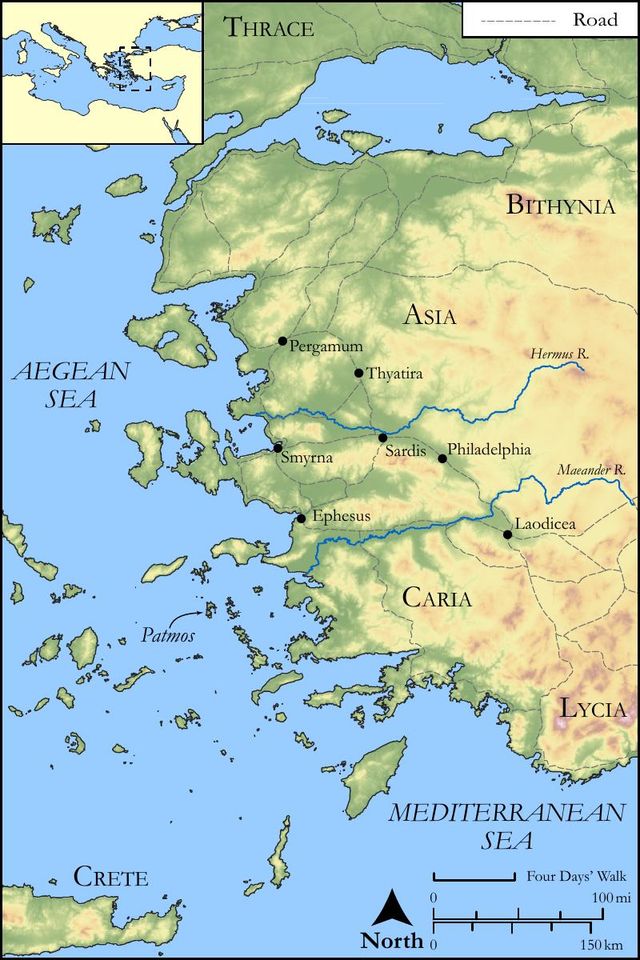
John received this vision while exiled on the island of Patmos, likely during the reign of Emperor Domitian, a period marked by escalating persecution of Christians for their refusal to participate in emperor worship. The seven churches addressed (Ephesus, Smyrna, Pergamum, Thyatira, Sardis, Philadelphia, and Laodicea) were real congregations in the Roman province of Asia Minor, facing various external pressures and internal spiritual challenges. The imagery used in Revelation 1:16 would have resonated deeply with its original audience. The "right hand" (G1188, dexiós) symbolized power, authority, and protection, as when Moses sang, "Thy right hand, O LORD, is become glorious in power." Swords were common instruments of war and judgment, but a sword from the mouth would immediately signify the power of speech or divine decree. The sun's brilliance (G2246, hḗlios) was often associated with divine majesty and unapproachable glory, a concept present in both Old Testament descriptions of God (e.g., Psalm 84:11) and pagan sun deities, here powerfully reappropriated to describe the true divine Son.
Key Themes
ShowHideRevelation 1:16 contributes significantly to several overarching themes in the book of Revelation. Firstly, it emphasizes Christ's sovereign authority and control over His Church. The "seven stars" in His "right hand" are explicitly identified in Revelation 1:20 as the "angels of the seven churches," signifying Christ's protective oversight and active involvement in the affairs of His congregations. Secondly, the "sharp twoedged sword" highlights the theme of divine judgment and the power of God's Word. This imagery portrays Christ as the ultimate judge, whose words are living, active, and capable of discerning and executing divine will, a theme echoed in Hebrews 4:12. Lastly, Christ's radiant "countenance [was] as the sun shineth in his strength" powerfully conveys His unapproachable glory, majesty, and holiness. This depiction reinforces His divine nature and supreme worthiness of worship, a central theme throughout Revelation.
Exposition and Analysis
ShowHideKey Word Analysis
ShowHideFrom δέχομαι, referring to the right side or hand, which is typically associated with strength, authority, and favor. In Scripture, the right hand is the hand of power, blessing, and endorsement. Christ holding the stars (representing the churches or their messengers) in His right hand signifies His absolute control, protection, and sovereign authority over them.
Probably of foreign origin, this term denotes a large, broad, and often heavy sabre or cutlass. Unlike a smaller, personal dagger (machaira), the rhomphaía was a weapon of significant destructive power, often associated with judgment or execution. Its use here, emanating from Christ's mouth, uniquely links it not to physical warfare but to the decisive, penetrating power of His spoken word.
From δύναμαι, meaning force, power, or ability, often implying miraculous power or a mighty deed. When applied to the sun's shining, it conveys the sun at its zenith, in its fullest, most intense, and unmitigated power and brilliance. This emphasizes the overwhelming, uncontainable, and majestic glory of Christ's countenance, far beyond human comprehension or endurance.
Verse Breakdown
ShowHide"And he had in his right hand seven stars"
This clause immediately establishes Christ's intimate connection and sovereign authority over the churches. The "right hand" (G1188, dexiós) is the place of power, protection, and possession. The "seven stars" (G2033, heptá G792, astḗr) are later explicitly identified in Revelation 1:20 as the "angels of the seven churches," understood by many as either the spiritual guardians or the human leaders/messengers of those congregations. Thus, Christ holds His church securely and powerfully, exercising direct oversight and care.
"and out of his mouth went a sharp twoedged sword"
This vivid image portrays Christ as the ultimate judge and the source of divine truth. The "sharp" (G3691, oxýs) and "twoedged" (G1366, dístomos) "sword" (G4501, rhomphaía) signifies its penetrating, discerning, and decisive power. Crucially, its emanation "out of his mouth" (G1537, ek G4750, stóma) indicates that this is not a literal weapon but the potent, living Word of God itself. It represents the power of Christ's spoken judgment, His authoritative declaration of truth, and His ability to expose and separate, to condemn and to save.
"and his countenance [was] as the sun shineth in his strength"
This final clause describes Christ's overwhelming divine glory and majesty. His "countenance" (G3799, ópsis) or face, shining "as the sun" (G5613, hōs G2246, hḗlios) in its full "strength" (G1411, dýnamis), evokes an unapproachable and blinding brilliance. This imagery speaks to His absolute purity, holiness, and inherent divinity, reminiscent of the Transfiguration and other biblical depictions of divine glory. It conveys a sense of awe, reverence, and the sheer power of His presence, which is both glorious and potentially terrifying to those who stand against Him.
Literary Devices
ShowHideRevelation 1:16 is rich in Symbolism, where each element carries profound theological meaning beyond its literal representation. The "seven stars" symbolize the churches or their spiritual leaders, representing Christ's direct oversight and care. The "sharp twoedged sword" is symbolic of the powerful, discerning, and authoritative Word of God, which judges and executes divine will. The "sun shining in its strength" symbolizes Christ's inherent divine glory, majesty, and unapproachable holiness. The verse also employs Metaphor, particularly in comparing Christ's countenance to the sun, directly equating His radiant glory with the most powerful source of light and energy known. Furthermore, there is an element of Anthropomorphism in depicting Christ with a "right hand" and a "mouth" from which a sword proceeds, attributing human-like physical characteristics to the divine, though these are clearly symbolic of divine attributes like power, authority, and communication. The description also borders on Hyperbole, as the sun shining "in its strength" suggests an intensity of light and power that is beyond normal human experience, emphasizing the extraordinary and overwhelming nature of Christ's divine presence.
Theological and Thematic Connections
ShowHideThis verse profoundly reveals the multifaceted nature of the glorified Christ, presenting Him as both the protective Shepherd and the righteous Judge. The imagery of the stars in His right hand assures believers of His constant care and sovereign control over His Church, implying that nothing can snatch them from His grasp, while also serving as a warning to the churches that He is intimately aware of their spiritual condition. The sword from His mouth underscores the living, active, and discerning power of His Word, which is not merely informative but transformative and judgmental, capable of exposing the deepest intentions of the heart. His radiant countenance, shining with the sun's full strength, speaks to His inherent divinity, unapproachable holiness, and ultimate authority, demanding reverence and worship from all creation. Together, these images paint a picture of a Christ who is utterly supreme, intimately involved, and eternally glorious.
Reflection and Application
ShowHideThe awe-inspiring vision of Christ in Revelation 1:16 offers both immense comfort and a sobering challenge to believers today. The assurance that the "seven stars" (representing the churches or their leaders) are held securely in His "right hand" should fill us with peace, knowing that our Lord is intimately involved in and sovereign over His Church, protecting and guiding it through all trials. This imagery encourages us to trust in His unfailing power and care, even amidst persecution or spiritual struggles. Simultaneously, the "sharp twoedged sword" proceeding from His mouth serves as a powerful reminder of the absolute authority, truth, and discerning power of His Word. It calls us to take His commands seriously, to allow His truth to penetrate our hearts, expose our motives, and guide our lives, knowing that His Word judges both outward actions and inner thoughts. Finally, His countenance, shining "as the sun shineth in his strength," compels us to worship Him with profound reverence and awe, recognizing His supreme majesty, holiness, and unapproachable glory. This vision encourages us to live lives worthy of such a glorious and powerful Lord, submitting to His authority and seeking to reflect His light in a dark world.
Questions for Reflection
ShowHideFAQ
ShowHideWhat do the "seven stars" in Christ's right hand represent?
ShowHideAs explicitly stated in Revelation 1:20, the "seven stars" are the "angels of the seven churches." While "angels" (Greek: angeloi) can refer to celestial beings, in this context, many scholars interpret them as the human messengers, leaders, or spiritual representatives of each of the seven churches in Asia Minor. This signifies Christ's direct and sovereign control, protection, and intimate knowledge of His churches, holding them securely in His position of ultimate authority.
What is the significance of the "sharp twoedged sword" coming out of Christ's mouth?
ShowHideThis powerful imagery signifies the authoritative, discerning, and judgmental power of Christ's Word. It is not a literal sword for physical combat but represents the divine truth and judgment that proceeds from His spoken commands and decrees. Just as a sword can cut and divide, Christ's Word has the power to expose sin, discern the thoughts and intentions of the heart, execute divine judgment, and distinguish truth from falsehood. This aligns with the description of God's Word in Hebrews 4:12 as "sharper than any twoedged sword, piercing even to the division of soul and spirit, of joints and marrow, and discerning the thoughts and intentions of the heart."
Why is Christ's "countenance... as the sun shineth in his strength"?
ShowHideThis description emphasizes Christ's overwhelming divine glory, majesty, and unapproachable holiness. The sun, especially shining "in its strength" (at its brightest and most powerful), is an ancient symbol of ultimate power, purity, and divine presence. This imagery is reminiscent of other biblical accounts of divine glory, such as the Transfiguration of Jesus in Matthew 17:2, where His face "did shine as the sun." It conveys the idea that Christ's inherent being is pure light and glory, too brilliant for human eyes to fully behold without being overwhelmed, underscoring His absolute deity and supreme authority.
Christ-Centered Fulfillment
ShowHideThe vivid imagery of Revelation 1:16 finds its profound Christ-centered fulfillment in the person and work of Jesus, who is the ultimate embodiment of these divine attributes. The "seven stars" in His "right hand" are fulfilled in Christ as the Head of the Church, the Good Shepherd who lays down His life for His sheep (John 10:11) and promises to build His church against which the gates of hell will not prevail (Matthew 16:18). His holding them signifies His protective, sovereign, and intimate care for His redeemed people, a fulfillment of the Father's promise that none can snatch them out of His hand (John 10:28). The "sharp twoedged sword" proceeding from His mouth is the ultimate fulfillment of God's powerful Word, for Christ Himself is the living Word of God made flesh (John 1:1, John 1:14). He is the one who speaks with absolute authority, whose words bring life (John 6:63) and also judge the living and the dead (John 5:22). Finally, His countenance shining "as the sun shineth in his strength" is the glorious manifestation of the Son who is the "radiance of God's glory and the exact representation of his being" (Hebrews 1:3), the light of the world who illuminates all darkness (John 8:12). This vision of Christ in His full glory anticipates His return when "every eye will see him" (Revelation 1:7), confirming that all Old Testament prophecies and divine attributes find their ultimate and perfect realization in the person of Jesus Christ, our reigning Lord and Judge.