


Revelation 1:15
- καὶkaiandG2532CONJConjunction
- οἱhoitheG3588T-NPMDefinite article Nominative Plural Masculine
- πόδεςpodesfeetG4228N-NPMNoun Nominative Plural Masculine
- αὐτοῦautouof HimG846P-GSMPersonal pronoun Genitive Singular Masculine
- ὅμοιοιhomoioi[are] likeG3664A-NPMAdjective Nominative Plural Masculine
- χαλκολιβάνῳchalkolibanōas fine bronzeG5474N-DSNNoun Dative Singular Neuter
- ὡςhōsasG5613PRTParticle or Disjunctive
- ἐνeninG1722PREPPreposition
- καμίνῳkaminōa furnaceG2575N-DSFNoun Dative Singular Feminine
- πεπυρωμένηςpepurōmenēsrefinedG4448V-RPP-GSFVerb Perfect Passive Participle Genitive Singular Feminine
- καὶkaiandG2532CONJConjunction
- ἡhētheG3588T-NSFDefinite article Nominative Singular Feminine
- φωνὴphōnēvoiceG5456N-NSFNoun Nominative Singular Feminine
- αὐτοῦautouof HimG846P-GSMPersonal pronoun Genitive Singular Masculine
- ὡςhōs[is] likeG5613PRTParticle or Disjunctive
- φωνὴphōnē[the] voiceG5456N-NSFNoun Nominative Singular Feminine
- ὑδάτωνhudatōnof watersG5204N-GPNNoun Genitive Plural Neuter
- πολλῶνpollōnmanyG4183A-GPNAdjective Genitive Plural Neuter
English is a literal word-by-word gloss of the Greek, not the KJV's wording. Why?
This is the original text the KJV's translators worked from — each Greek word with its own literal English meaning in this verse, prepared by scholars at Tyndale House, Cambridge. The KJV translates whole sentences, not word by word, so its wording differs: one Greek word can become several English words, and the KJV may choose “charity” where the gloss reads “love”. Both are faithful — they answer different questions. For the KJV's own rendering, switch to the KJV text.
Details
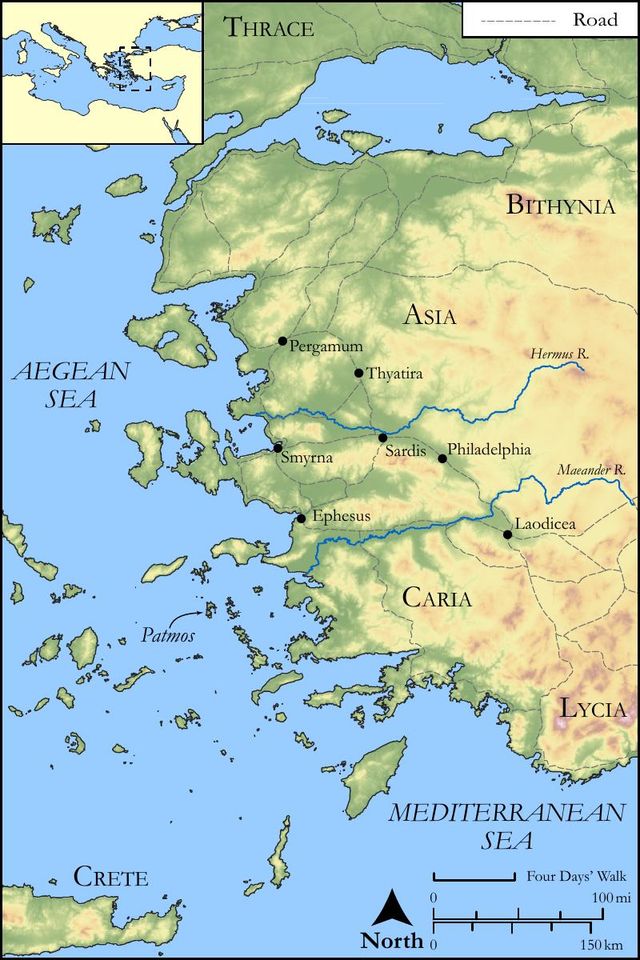
See on the biblical-era map

Study this verse
Public-domain commentary
Matthew Henry
From his Commentary on the Whole Bible. Henry comments on passages, not single verses — this entry covers Revelation 1:9–20. His four-level outline is real structure in the source text, so it is rendered as structure.
We have now come to that glorious vision which the apostle had of the Lord Jesus Christ, when he came to deliver this revelation to him, where observe,
I.The account given of the person who was favoured with this vision. He describes himself,
1.By his present state and condition. He was the brother and companion of these churches in tribulation, and in the kingdom and patience of Christ. He was, at their time, as the rest of true Christians were, a persecuted man, banished, and perhaps imprisoned, for his adherence to Christ. He was their brother, though an apostle; he seems to value himself upon his relation to the church, rather than his authority in it: Judas Iscariot may be an apostle, but not a brother in the family of God. He was their companion: the children of God should choose communion and society with each other. He was their companion in tribulation: the persecuted servants of God did not suffer alone, the same trials are accomplished in others. He was their companion in patience, not only a sharer with them in suffering circumstances, but in suffering graces: if we have the patience of the saints, we should not grudge to meet with their trials. He was their brother and companion in the patience of the kingdom of Christ, a sufferer for Christ's cause, for asserting his kingly power over the church and the world, and for adhering to it against all who would usurp upon it. By this account he gives of his present state, he acknowledges his engagements to sympathize with them, and to endeavour to give them counsel and comfort, and bespeaks their more careful attention to what he had to say to them from Christ their common Lord.
2.By the place where he was when he was favoured with this vision: he was in the isle Patmos. He does not say who banished him thither. It becomes Christians to speak sparingly and modestly of their own sufferings. Patmos is said to be an island in the Aegean Sea, One of those called Cyclades, and was about thirty-five miles in compass; but under this confinement it was the apostle's comfort that he did not suffer as an evil-doer, but that it was for the testimony of Jesus, for bearing witness to Christ as the Immanuel, the Saviour. This was a cause worth suffering for; and the Spirit of glory and of God rested upon this persecuted apostle.
3.The day and time in which he had this vision: it was the Lord's day, the day which Christ had separated and set apart for himself, as the eucharist is called the Lord's supper. Surely this can be no other than the Christian sabbath, the first day of the week, to be observed in remembrance of the resurrection of Christ. Let us who call him our Lord honour him on his own day, the day which the Lord hath made and in which we ought to rejoice.
4.The frame that his soul was in at this time: He was in the Spirit. He was not only in a rapture when he received the vision, but before he received it; he was in a serious, heavenly, spiritual frame, under the blessed gracious influences of the Spirit of God. God usually prepares the souls of his people for uncommon manifestations of himself, by the quickening sanctifying influences of his good Spirit. Those who would enjoy communion with God on the Lord's day must endeavour to abstract their thoughts and affections from flesh and fleshly things, and be wholly taken up with things of a spiritual nature.
II.The apostle gives an account of what he heard when thus in the Spirit.
An alarm was given as with the sound of a trumpet, and then he heard a voice, the voice of Christ applying to himself the character before given, the first and the last, and commanding the apostle to commit to writing the things that were now to be revealed to him, and to send it immediately to the seven Asian churches, whose names are mentioned. Thus our Lord Jesus, the captain of our salvation, gave the apostle notice of his glorious appearance, as with the sound of a trumpet.
III.We have also an account of what he saw.
He turned to see the voice, whose it was and whence it came; and then a wonderful scene of vision opened itself to him.
1.He saw a representation of the church under the emblem of seven golden candlesticks, as it is explained in the last verse of the chapter. The churches are compared to candlesticks, because they hold forth the light of the gospel to advantage. The churches are not candles: Christ only is our light, and his gospel our lamp; but they receive their light from Christ and the gospel, and hold it forth to others. They are golden candlesticks, for they should be precious and pure, comparable to fine gold; not only the ministers, but the members of the churches ought to be such; their light should so shine before men as to engage others to give glory to God.
2.He saw a representation of the Lord Jesus Christ in the midst of the golden candlesticks; for he has promised to be with his churches always to the end of the world, filling them with light, and life, and love, for he is the very animating informing soul of the church. And here we observe,
(1.)The glorious form in which Christ appeared in several particulars.
[1.]He was clothed with a garment down to the foot, a princely and priestly robe, denoting righteousness and honour.
[2.]He was girt about with a golden girdle, the breast-plate of the high priest, on which the names of his people are engraven; he was ready girt to do all the work of a Redeemer.
[3.]His head and hairs were white like wool or snow. He was the Ancient of days; his hoary head was no sign of decay, but was indeed a crown of glory.
[4.]His eyes were as a flame of fire, piercing and penetrating into the very hearts and reins of men, scattering terrors among his adversaries.
[5.]His feet were like unto fine burning brass, strong and stedfast, supporting his own interest, subduing his enemies, treading them to powder.
[6.]His voice was as the sound of many waters, of many rivers falling in together. He can and will make himself heard to those who are afar off as well as to those who are near. His gospel is a profluent and mighty stream, fed by the upper springs of infinite wisdom and knowledge.
[7.]He had in his right hand seven stars, that is, the ministers of the seven churches, who are under his direction, have all their light and influence from him, and are secured and preserved by him.
[8.]Out of his mouth went a two-edged sword, his word, which both wounds and heals, strikes at sin on the right hand and on the left,
[9.]His countenance was as the sun shining, its strength too bright and dazzling for mortal eyes to behold.
(2.)The impression this appearance of Christ made upon the apostle John (Rev 1:17): He fell at the feet of Christ as dead; he was overpowered with the greatness of the lustre and glory in which Christ appeared, though he had been so familiar with him before. How well is it for us that God speaks to us by men like ourselves, whose terrors shall not make us afraid, for none can see the face of God and live!
(3.)The condescending goodness of the Lord Jesus to his disciple: He laid his hand upon him, Rev 1:17. He raised him up; he did not plead against him with his great power, but he put strength into him, he spoke kind words to him.
[1.]Words of comfort and encouragement: Fear not. He commanded away the slavish fears of his disciple.
[2.]Words of instruction, telling him particularly who he was that thus appeared to him. And here he acquaints him, First, with his divine nature: The first and the last. Secondly, With his former sufferings: I was dead; the very same that his disciples saw upon the cross dying for the sins of men. Thirdly, With his resurrection and life: "I live, and am alive for evermore, have conquered death and opened the grave, and am partaker of an endless life." Fourthly, With his office and authority: I have the keys of hell and of death, a sovereign dominion in and over the invisible world, opening and none can shut, shutting so that none can open, opening the gates of death when he pleases and the gates of the eternal world, of happiness or misery, as the Judge of all, from whose sentence there lies no appeal. Fifthly, With his will and pleasure: Write the things which thou hast seen, and the things which are, and which shall be hereafter. Sixthly, With the meaning of the seven stars, that they are the ministers of the churches; and of the seven candlesticks, that they are the seven churches, to whom Christ would now send by him particular and proper messages.
Historical interpretation
Eight Centuries of Reception
9 surviving comments on this verse. Each one is dated, so this reads as a timeline rather than a list.
Select a marker to jump to its quote. Markers stagger vertically where authors wrote within a few decades of each other.
Thus, in a variety of ways, he adjusted the human race to an agreement with salvation. On this account also does John declare in the Apocalypse that his voice is “as the sound of many waters.” For the Spirit [of God] is truly [like] many waters, since the Father is both rich and great. And the Word, passing through all those [men], did liberally confer benefits upon his subjects, by drawing up in writing a law adapted and applicable to every class [among them].
"His feet were like unto yellow brass, as if burned in a furnace." He calls the apostles His feet, who, being wrought by suffering, preached His word in the whole world; for He rightly named those by whose means the preaching went forth, feet. Whence also the prophet anticipated this, and said: "We will worship in the place where His feet have stood." Because where they first of all stood and confirmed the Church, that is, in Judea, all the saints shall assemble together, and will worship their Lord...
"And His voice as it were the voice of many waters." The many waters are understood to be many peoples, or the gift of baptism that He sent forth by the apostles, saying: "Go ye, teach all nations, baptizing them in the name of the Father, and of the Son, and of the Holy Ghost."
The feet are the human nature which he possessed in himself which he assumed out of mercy for our salvation. For just as when copper ore is refined in a furnace there is no accretion or rusty buildup on the outside, so the most pure and perfect flesh of the assumed man, taken up by deity and remaining in deity, continues without any defect of human nature, without any guilt of the parent.
And the feet are also the foundations of the church. And they are “like bronze incense,” which, the medical people say, possesses a good smell when burned, and which is called by them masculine incense. There is another interpretation: since the bronze refers to the human nature and the incense refers to the divine nature, through these is indicated the sweet odor of the faith and the unconfusedness of the unity. Or another interpretation: the bronze shows the euphony of the proclamation, while the incense shows the conversion of the nations, from which the Bride is commanded to come.
And his feet are like fine brass. And he explains that the latter works of this church are more numerous than the former.
And his feet like unto fine brass, as if they burned in a furnace. The fiery feet represent the Church of the last time, which is to be examined and tested by severe tribulations. Fine brass is brass brought to a golden color by much fire and medicine. Another translation, which says like the brass of Lebanon, signifies the Church in Judea, whose mountain is Lebanon, to be persecuted especially at the end. For the temple often received the name of Lebanon, to which it is said: "Open, O Lebanon, your gates, and let fire devour your cedars" (Zach. XI).
And his voice as the sound of many waters. The voice of confession and preaching and praise resounds not only in Judea but among many peoples.
And his feet like unto fine brass, as in a burning furnace. The fabrication of fine brass is said to be as follows: copper is thrown into a furnace, a violent fire is applied to it, a certain medicine is also thrown into it all, and the copper as a result both gains a greater solidity and turns into the brightness of gold: whence it is appropriate for the feet like unto fine brass to refer to those last members of the Church that are to be melted by an intense fire of tribulation under the Antichrist, but will be found to be stronger and brighter after using the medicine of endurance. Because the trouble will be even more severe in Judea, where the Lord was crucified by the wicked Jews, another translation has “fine brass of Lebanon,” which is said to be a mountain in Judea. And his voice as the voice of many waters. Above, he compared the voice of the one who appeared to a trumpet, and now he compares it to the voice of many waters, because what was first proclaimed by a few preachers, was afterwards proclaimed by the whole world. Alternatively, we could understand, by the voice of the trumpet, the voice of the Old and of the New Testament, and by the voice of many waters, love, whose law is manifold, as it is said in and thou shalt know that his law is manifold. [Cf. Job 11:6]
"The seven lampstands," as John himself goes on to explain, are the seven churches to which he has been commanded to write; he calls them "lampstands" because they bear the light of the glory of Christ. For he does not call them lamps, but "lampstands." This lamp itself does not emit light; rather, it contains within itself the power to illuminate. Christ illuminates His churches spiritually. For just as the holy apostle encourages those who have received the faith: "Become like stars in the world, holding forth the word of life," (Philip. 2:15-16) so too, the star itself does not possess light by itself but is receptive to an external light. In the same way, here the evangelist saw the churches not as lamps themselves but as "lampstands." For it has been said concerning Christ, "you wonderfully illuminate from eternal mountains," (Ps. 75:3) perhaps that means angelic powers; and again, towards the Father; "send forth your light and your truth" (Ps. 43:3); and again, the illumination of your face, O Lord. (Ps. 44:3) The participants in the divine light were recorded, some as stars, others as lamps.
John says that the "lampstands" are "golden" because it is honorable and surpassing to receive the divine radiance.
And he says that "in the midst of the seven lampstands, one like a son of man"; for if the Lord Himself promises to dwell and walk among the souls that received Him, how would He not be "seen in the midst of the lampstands"?
He says that the "Son of Man," Christ, who humbled himself for us "taking the form of a servant," (Philip. 2:7) became the fruit of the womb according to the divine melody (Ps. 126:3); the womb of the undefiled and ever-virgin Mary; for since Mary is a human and our sister, it is fitting that the one born from her without seed, according to the flesh the Word of God, is called the "Son of Man."
And he has spoken carefully without saying "the son of man", but "like a son of man," and also God and Lord of all, Emmanuel; and the vision shows his varied form, outlining the shape from his works and powers.
And first, he puts on a priestly garment; for the long "robe" and the "belt" are priestly garments; for it is said to him from God and the Father: "You are a priest forever according to the order of Melchizedek." (Heb. 5:6; Ps. 109:4) But the apostle also calls Christ "a high priest and apostle of our confession," (Heb. 3:1) as one who performs priestly service and brings to himself and to the Father and the Spirit our confession of faith.
And he puts on "a golden belt," having a belt with decorated attire [φάρους], as prescribed by the law for priests. For it was necessary for the difference between slaves and master to be shown, between the shadowy law and the truth in the New Covenant.
"His head and his hair were white like wool, as white as snow." For the mystery according to Christ is new in its appearance, but indeed eternal in its good pleasure. For the divine apostle wrote concerning him the mystery hidden from the ages and from the generations, which now has been revealed to his saints, to whom he willed. Therefore, the ancient aspect of the mystery, as far as it reached into divine favor, reveals the gray of the head intermingled with "wool" and "snow."
"and his eyes were like a flame." It is shown since Christ is also light, and He calls Himself this, saying "I am the light and the truth," (Jn. 8:12; 14:6) or He reveals the fearful things and the threat against the seven churches to which the things of the Revelation are sent, as those who are not following His laws perfectly. And He says,
"his feet were like gleaming bronze." They say that the copper mined in Mount Lebanon is both pure and self-originating, becoming purer after being purified in a furnace from the moderate impurity within it; through this, the firm and unshakable faith in Christ, bright and visible, is shown to have been firmly established in safekeeping. For Christ has been called the rock [πέτρα] by the apostle (1 Cor. 10:4), and a precious stone [λίθος] in the foundations of Zion by Isaiah (Isa. 28:16). Or he means that the "gleaming bronze" is incense that is bronze-like, which the physicians [ἰατρῶν παῖδες] have been accustomed to call male [ἄρρενα].
But this one is fragrant when it is burning; for the burning "furnace" is a sign that it is being burned. It shows that the foundation of the evangelical proclamation; for the foundation of the rest of the body are the "feet," which is Christ; for He is fragrant and, by fixing the spiritual fragrance, both the things in heaven and those on earth. The foundation is Christ, and Paul refers to this in a certain letter he wrote to the Corinthians, wisely saying, "I have laid the foundation as an expert builder; another is building upon it. Each person must consider how they build upon it, for no one can lay any foundation other than the one already laid, which is Jesus Christ." (1 Cor. 3:10-11) That Christ is fragrant in a spiritual sense is attested by the bride in the Song of Songs, who, having received a share of His fragrance, declares both that "the scent of your perfumes is more delightful than all spices" and that "your name is like a poured-out perfume." (Song 1:3) Moreover, the Lord Himself presents Himself as fragrant in His words to the bride, saying, "I am the flower of the field, the lily of the valleys." (Song 2:1) What then? Did not Paul also, having become fragrant from the participation [μετουσίας] in Christ, say: "that we are the fragrance of Christ?" (2 Cor. 2:15) And again: "and the aroma of the knowledge of Him is revealed to us." (2 Cor. 2:14)
"and his voice was like the sound of many waters," John said; and rightly so. For how else could his utterance have reached every part of the earth, and the proclamation about him to the ends of the inhabited world, if it were not unheard of? Not by audible loudness, but by the power of the proclamation.
"and he had seven stars in his right hand," he said. He himself interprets these stars as the angels of the seven churches, as the divine Gregory said in the presence of the bishops, addressing the ruling angels; "for I believe that each church is guarded by a different angel, as John teaches in the Revelation." I believe that the "stars" are called the holy angels because of the abundant illumination of Christ within them; and they "are in His right hand." For they are deemed worthy of the most honorable position before God, and as if they rest in the hand of God.
"and out of his mouth went a sharp two-edged sword." Therefore, the divine David says to the Lord, "Fix your sword upon your thigh, O mighty one." (Ps. 44:4) For at that time, the evangelical laws commanded us to observe them strictly, for violating them was deadly; therefore, the place of the thigh where the sword was placed indicated a delay in punishment, for it was not yet fully prepared for slaughter. Now from "his mouth" comes forth the "sword," signifying the riddle [αἰνίγματος] that those who are disobedient to the evangelical commandments face the danger of being cut in two by the sword of the soul. This is what the Lord declares in the Gospels, making this clear; and the apostle said: "for the word of God is living and active, and sharper than any two-edged sword" (Heb.4:12) against those who disobey, clearly indicating the threat it raises. Therefore, this sharpness is also attributed to John; it is the same as the sharp style found in the writings of Paul.
"and his face was like the sun shining in its power," John said. Well said, "like the sun"; for the Lord is "the sun of righteousness," according to the prophet Malachi. (Mal. 4:2) But so that you do not think the illumination of Christ's "face," which enlightens every person coming into the world (Jn. 1:9), is a physical body that is transparent and visibly shining, he attributed it to his power, as if to say: the light of Christ is intelligible, operating by power (Col. 1:29), not a bodily appearance, but one that enlightens the eyes of the soul.
Continue studying Revelation 1:15 across the web’s major study libraries — every link below opens this exact verse, chapter, or book on the destination site.
Read & Compare
 BibleGatewayThis verse in more than 200 translations and 70 languages.
 Bible.comThe YouVersion reader — hundreds of translations, reading plans, and highlights.
 ESV.orgCrossway's official English Standard Version reader.
 NET BibleThe NET translation with 60,000+ translators' notes on every rendering decision.
 STEP BibleTyndale House's free study tool — original text, vocabulary, and scholarly resources.
 BibliaLogos Bible Software's free web reader.
 USCCBThe New American Bible (Revised Edition) with the U.S. bishops' study notes.
Commentaries
 BibleHub CommentariesDozens of classic commentaries on this verse, gathered on one page.
 StudyLightMore than 100 commentary sets — the largest collection on the web.
 BibleRefPlain-English commentary on what this verse means, verse by verse.
 Enduring WordDavid Guzik's free commentary on this chapter, widely used by Bible teachers.
 Bible Study ToolsVerse commentary alongside Greek and Hebrew study aids.
Original Language & Research
- BibleHub InterlinearThe verse word by word — original language, transliteration, and English.
- BibleHub LexiconEvery word's original-language definition and Strong's entry.
 Blue Letter BibleDeep-study tools — Strong's numbers, concordance, and word studies.
 CNTR CollationThe earliest Greek manuscripts of this verse, collated letter by letter.
Sermons, Hymns & Audio


TrulyRandomVerse is not affiliated with these sites and doesn’t control their content. They’re linked because they’re genuinely useful.
Summary
Revelation 1:15 presents a powerful and awe-inspiring description of the glorified Christ, focusing on two key aspects of His divine appearance: His feet and His voice. The imagery of feet "like unto fine brass, as if they burned in a furnace" conveys His unyielding authority, purity, and the formidable nature of His impending judgment against sin. Complementing this, His voice, described "as the sound of many waters," emphasizes His overwhelming majesty, irresistible power, and the profound, all-encompassing nature of His divine pronouncements. Together, these vivid metaphors establish the absolute sovereignty and majestic presence of the resurrected Lord, preparing John and the reader for the weighty revelations to follow.
Context
ShowHideLiterary Context
This verse is an integral part of John's initial vision of the exalted Christ, which begins in Revelation 1:12 and extends through Revelation 1:16. Following the introductory verses that establish the book's prophetic nature and the identity of the revealing Christ, John turns to see "one like unto the Son of man" (Revelation 1:13). The preceding verses (Revelation 1:13-14) describe His long robe, golden sash, white hair, and fiery eyes, progressively building a picture of divine majesty and purity. Verse 15 continues this detailed portrayal, focusing on His lower body and voice, further emphasizing His authority and power before He speaks directly to John in Revelation 1:17.
Historical & Cultural Context
John received this vision while exiled on the island of Patmos (Revelation 1:9) during a period of intense persecution of Christians, likely under the Roman Emperor Domitian. The imagery employed by John draws heavily from Old Testament prophetic traditions, particularly the visions of heavenly beings in Daniel 10:6 and Ezekiel 43:2. The use of "brass" (bronze) would have resonated with ancient audiences familiar with its use in weaponry, armor, and as a symbol of strength and durability, often associated with judgment, as seen in the brazen altar in the Tabernacle. The "furnace" would evoke images of refining precious metals or intense destructive heat. The "sound of many waters" was a common idiom for overwhelming power and majesty, reflecting the awe-inspiring force of the Mediterranean Sea or great rivers.
Key Themes
ShowHideThis verse contributes significantly to several overarching themes within Revelation. Firstly, it underscores the Divine Authority and Sovereignty of Christ, presenting Him as the all-powerful judge and ruler who is fully capable of executing God's will and overcoming all opposition. The imagery of the feet speaks to His ability to tread down enemies and administer justice, a theme prominent in the book's depiction of final judgment. Secondly, it highlights the Majesty and Transcendence of Christ, portraying Him in a way that evokes awe and reverence, emphasizing His divine nature beyond human comprehension. This ties into the theme of Worship and Adoration, as the vision compels John and the churches to worship this glorious Lord. Lastly, the powerful imagery foreshadows the Imminent Judgment and Victory that are central to Revelation's narrative, assuring believers of ultimate triumph over evil and warning the unrighteous of their impending doom, a message crucial for the persecuted churches of Asia Minor as they faced the trials described in Revelation 2-3.
Exposition and Analysis
ShowHideKey Word Analysis
ShowHideThis term, unique to Revelation in the New Testament, refers to a highly refined, perhaps glowing or incandescent, alloy of copper, possibly mixed with gold or silver. Its appearance "as if they burned in a furnace" intensifies the imagery of purity, strength, and the intense, refining heat of divine judgment. It signifies an unyielding, formidable, and radiant presence.
Derived from the word for fire (pyr), this verb means "to kindle," "to be ignited," "to glow," or "to be refined." In this context, it vividly describes the intense, fiery glow of Christ's feet, suggesting a state of extreme heat and purity, indicative of divine holiness and the consuming nature of His judgment.
This word denotes a tone, an articulate sound, or a language. Here, it describes Christ's vocal utterance. When coupled with "the sound of many waters," it conveys a sense of overwhelming volume, depth, and majesty, signifying a divine pronouncement that is authoritative, irresistible, and all-encompassing, demanding attention and obedience.
Verse Breakdown
ShowHide"And his feet like unto fine brass"
This clause introduces the first striking visual of Christ's lower body. The comparison of His feet to "fine brass" (or burnished bronze) immediately evokes a sense of strength, durability, and a radiant, perhaps glowing, appearance. In biblical symbolism, brass often relates to judgment and endurance, suggesting that Christ's very foundation and movements are characterized by divine justice and unwavering power.
"as if they burned in a furnace"
This intensifying simile amplifies the imagery of the "fine brass." The "furnace" implies intense heat, purification, and the refining process. This suggests that Christ's presence is one of consuming holiness, capable of purifying what is good and utterly destroying what is evil. It speaks to the fierceness and inevitability of His judgment, where nothing impure can stand before Him.
"and his voice as the sound of many waters"
This clause shifts focus to Christ's auditory presence. The comparison of His voice to "the sound of many waters" (like a mighty waterfall or the crashing ocean) conveys immense power, majesty, and an overwhelming, resonant quality. It is a voice that cannot be ignored, signifying absolute authority, the irresistible force of His divine word, and the vastness of His dominion.
Literary Devices
ShowHideRevelation 1:15 is rich in Imagery, painting a vivid picture of the glorified Christ through sensory details that evoke awe and power. The verse employs Simile extensively, using "like unto" and "as if" to compare Christ's feet to "fine brass, as if they burned in a furnace" and His voice to "the sound of many waters." These comparisons are not merely descriptive but are deeply symbolic. The Symbolism of "fine brass" and "furnace" conveys purity, strength, and the consuming nature of divine judgment, while the "sound of many waters" symbolizes overwhelming authority, majesty, and the irresistible force of God's pronouncements. This masterful use of literary devices creates a profound sense of the divine, emphasizing Christ's terrifying holiness and His absolute sovereignty.
Theological and Thematic Connections
ShowHideThe imagery in Revelation 1:15 profoundly impacts our understanding of Christ's nature and role. His feet, glowing with the intensity of a furnace, signify His unwavering resolve and power to execute divine judgment and to tread down all opposition. This speaks to His holiness, which purifies and consumes, ensuring that no unrighteousness can stand in His presence. Concurrently, His voice, resonating like many waters, underscores His supreme authority and the irresistible power of His word. This is the voice that spoke creation into existence, the voice that calms storms, and the voice that will ultimately summon the dead. The combination of these two images presents Christ as the sovereign Lord, whose very being embodies both the purity of divine justice and the overwhelming force of His will, assuring believers of His ultimate victory and warning unbelievers of His inescapable judgment.
Reflection and Application
ShowHideThe vivid portrayal of Christ in Revelation 1:15 calls us to a deeper reverence and understanding of His multifaceted nature. For those who belong to Him, the imagery of His feet like burning brass offers profound comfort and assurance. It reminds us that our Savior is not weak or passive; He is the mighty, holy, and just One who will ultimately conquer all evil, purify His church, and establish perfect righteousness. This should inspire confidence in His ultimate triumph over sin, death, and all opposing forces, encouraging us to stand firm in faith amidst trials. His voice, like the sound of many waters, signifies His absolute authority and the irresistible power of His word. This calls us to listen intently to His commands, to trust in His pronouncements, and to find security in His sovereign control over all things. For those who have not yet submitted to Him, this vision serves as a solemn warning of His inescapable judgment, urging repentance and faith before the day of His wrath. Ultimately, this verse compels us to worship the glorious, reigning Christ, whose power and holiness are beyond measure, and to live in light of His coming kingdom.
Questions for Reflection
ShowHideFAQ
ShowHideWhat is the significance of Christ's feet being like "fine brass" and "burned in a furnace"?
ShowHideThe imagery of Christ's feet being "like unto fine brass, as if they burned in a furnace" carries significant symbolic weight. "Fine brass" (or burnished bronze) often symbolizes strength, durability, and judgment in biblical contexts, as seen with the brazen altar in the Tabernacle, where sacrifices for sin were made. The addition of "as if they burned in a furnace" intensifies this, suggesting a state of extreme heat, purity, and refining. This signifies Christ's unyielding resolve, His capacity for righteous judgment, and His consuming holiness. It implies that His very presence and actions (symbolized by His feet) are characterized by a divine purity that purges evil and establishes justice, leaving no room for impurity or opposition. It speaks to the formidable nature of His authority to tread down His enemies and execute God's wrath.
Why is Christ's voice described as "the sound of many waters"?
ShowHideThe description of Christ's voice as "the sound of many waters" is a powerful Old Testament idiom used to convey overwhelming majesty, power, and authority. It evokes the roar of a mighty waterfall, the crashing waves of the ocean, or the thunderous sound of a great flood. This imagery is found elsewhere describing the voice of God, such as in Ezekiel 43:2 and Psalm 29:3-4. It signifies a voice that is not merely loud, but vast, deep, resonant, and impossible to ignore. When Christ speaks, His word carries absolute authority, irresistible force, and universal reach. It is the voice that commands attention, brings about divine will, and will ultimately judge the living and the dead.
Christ-Centered Fulfillment
ShowHideRevelation 1:15 powerfully portrays the glorified Christ, whose attributes find their ultimate fulfillment in His person and work. The imagery of His feet "like unto fine brass, as if they burned in a furnace" foreshadows His role as the righteous Judge, whose purity and power will ultimately consume all evil. This is the One who, having endured the fiery wrath of God on the cross for our sins, now possesses the authority to execute perfect justice, a truth echoed in John 5:22. His feet, once pierced for our transgressions (John 20:25), are now ablaze with divine holiness, signifying His triumph over sin and death and His readiness to tread down every enemy, as prophesied in Romans 16:20. Similarly, His voice "as the sound of many waters" reveals Him as the authoritative Word of God incarnate (John 1:1), whose pronouncements carry irresistible power. This is the voice that called Lazarus from the tomb (John 11:43), the voice that will one day summon all the dead to resurrection (John 5:28-29), and the voice that will usher in the new heavens and new earth (Revelation 21:5). Thus, the vision in Revelation 1:15 is not merely a description but a profound revelation of Christ as the sovereign, holy, and all-powerful King, whose past sacrifice, present reign, and future judgment are all perfectly aligned with God's redemptive plan.