


Daniel 10:6
- וּגְוִיָּתוֹu·ge·vi·ya·Toand his bodyH1472Conj-w ¦ N-fsc ¦ 3msNoun Singular Feminine Constructוּandגְוִיָּתbodyוֹhis
- כְתַרְשִׁישׁkhe·tar·Shish[was] like topazH8658Prep-k ¦ N-msNoun Singular Masculine Absoluteכְ[was] likeתַרְשִׁישׁtopaz
- וּפָנָיוu·fa·Navand his faceH6440Conj-w ¦ N-mpc ¦ 3msNoun Plural Masculine Constructוּandפָנָיfaceוhis
- כְּמַרְאֵהke·mar·'Eh[was] like [the] appearance ofH4758Prep-k ¦ N-mscNoun Singular Masculine Constructכְּ[was] likeמַרְאֵה[the] appearance of
- בָרָקva·RaklightningH1300N-msNoun Singular Masculine Absolute
- וְעֵינָיוve·'ei·Navand his eyesH5869Conj-w ¦ N-fdc ¦ 3msNoun Dual Feminine Constructוְandעֵינָיeyesוhis
- כְּלַפִּידֵיke·la·Pi·dei[were] like torches ofH3940Prep-k ¦ N-mpcNoun Plural Masculine Constructכְּ[were] likeלַפִּידֵיtorches of
- אֵשׁ'EshfireH784N-csNoun Singular common gender Absolute
- וּזְרֹעֹתָיוu·ze·ro·'o·Tavand his armsH2220Conj-w ¦ N-fpc ¦ 3msNoun Plural Feminine Constructוּandזְרֹעֹתָיarmsוhis
- וּמַרְגְּלֹתָיוu·mar·ge·lo·Tavand his feetH4772Conj-w ¦ N-fpc ¦ 3msNoun Plural Feminine Constructוּandמַרְגְּלֹתָיfeetוhis
- כְּעֵיןke·'Ein[were] like [the] appearance ofH5869Prep-k ¦ N-fscNoun Singular Feminine Constructכְּ[were] likeעֵין[the] appearance of
- נְחֹשֶׁתne·Cho·shetbronzeH5178N-fsNoun Singular Feminine Absolute
- קָלָלka·LalburnishedH7044Adj-msAdjective Singular Masculine Absolute
- וְקוֹלve·Koland [the] sound ofH6963Conj-w ¦ N-mscNoun Singular Masculine Constructוְandקוֹל[the] sound of
- דְּבָרָיוde·va·Ravhis wordsH1697N-mpc ¦ 3msNoun Plural Masculine Constructדְּבָרָיwordsוhis
- כְּקוֹלke·Kol[was] like [the] sound ofH6963Prep-k ¦ N-mscNoun Singular Masculine Constructכְּ[was] likeקוֹל[the] sound of
- הָמוֹןha·Mona multitudeH1995N-msNoun Singular Masculine Absolute
English is a literal word-by-word gloss of the Hebrew, not the KJV's wording. Why?
This is the original text the KJV's translators worked from — each Hebrew word with its own literal English meaning in this verse, prepared by scholars at Tyndale House, Cambridge. The KJV translates whole sentences, not word by word, so its wording differs: one Hebrew word can become several English words, and the KJV may choose “the LORD” where the gloss reads “Yahweh”. Both are faithful — they answer different questions. For the KJV's own rendering, switch to the KJV text.
Details
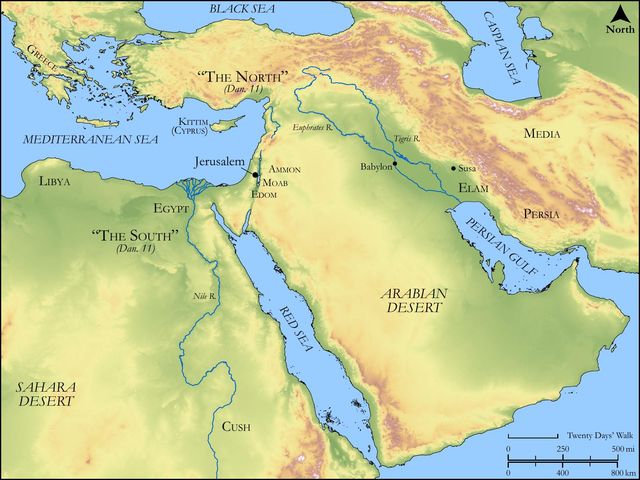
See on the biblical-era map
Study this verse
Public-domain commentary
Matthew Henry
From his Commentary on the Whole Bible. Henry comments on passages, not single verses — this entry covers Daniel 10:1–9. His two-level outline is real structure in the source text, so it is rendered as structure.
This vision is dated in the third year of Cyrus, that is, of his reign after the conquest of Babylon, his third year since Daniel became acquainted with him and a subject to him. Here is,
I.A general idea of this prophecy (Dan 10:1):
The thing was true; every word of God is so; it was true that Daniel had such a vision, and that such and such things were said. This he solemnly attests upon the word of a prophet. Et hoc paratus est verificare - He was prepared to verify it; and, if it was a word spoken from heaven, no doubt it is stedfast and may be depended upon. But the time appointed was long, as long as to the end of the reign of Antiochus, which was 300 years, a long time indeed when it is looked upon as to come. Nay, and because it is usual with the prophets to glance at things spiritual and eternal, there is that in this prophecy which looks in type as far forward as to the end of the world and the resurrection of the dead; and then he might well say, The time appointed was long. It was, however, made as plain to him as if it had been a history rather than a prophecy; he understood the thing; so distinctly was it delivered to him, and received by him, that he could say he had understanding of the vision. It did not so much operate upon his fancy as upon his understanding.
II.An account of Daniel's mortification of himself before he had this vision, not in expectation of it, nor, when he prayed that solemn prayer ch. 9, does it appear that he had any expectation of the vision in answer to it, but purely from a principle of devotion and pious sympathy with the afflicted people of God. He was mourning full three weeks (Dan 10:2), for his own sins and the sins of his people, and their sorrows. Some think that the particular occasion of his mourning was slothfulness and indifference of many of the Jews, who, though they had liberty to return to their own land, continued still in the land of their captivity, not knowing how to value the privileges offered them; and perhaps it troubled him the more because those that did so justified themselves by the example of Daniel, though they had not that reason to stay behind which he had. Others think that it was because he heard of the obstruction given to the building of the temple by the enemies of the Jews, who hired counsellors against them, to frustrate their purpose (Ezr 4:4, Ezr 4:5), all the days of Cyrus, and gained their point from his son Cambyses, or Artaxerxes, who governed while Cyrus was absent in the Scythian war. Note, Good men cannot but mourn to see how slowly the work of God goes on in the world and what opposition it meets with, how weak its friends are and how active its enemies. During the days of Daniel's mourning he ate no pleasant bread; he could not live without meat, but he ate little, and very sparingly, and mortified himself in the quality as well as the quantity of what he ate, which may truly be reckoned fasting, and a token of humiliation and sorrow. He did not eat the pleasant bread he used to eat, but that which was course and unpalatable, which he would not be tempted to eat any more of than was just necessary to support nature. As ornaments, so delicacies, are very disagreeable to a day of humiliation. Daniel ate no flesh, drank no wine, nor anointed himself, for those three week's time, Dan 10:3. Though he was now a very old man, and might plead that the decay of his nature required what was nourishing, though he was a very great man, and might plead that, being used to dainty meats, he could not do without them, it would prejudice his health if he were, yet, when it was both to testify and to assist his devotion, he could thus deny himself; let this be noted to the shame of many young people in the common ranks of life who cannot persuade themselves thus to deny themselves.
III.A description of that glorious person whom Daniel saw in vision, which, it is generally agreed, could be no other that Christ himself, the eternal Word. He was by the side of the river Hiddekel (Dan 10:4), probably walking there, not for diversion, but devotion and contemplation, as Isaac walked in the field, to meditate; and, being a person of distinction, he had his servants attending him at some distance. There he looked up, and saw one man Christ Jesus. It must be he, for he appears in the same resemblance wherein he appeared to St. John in the isle of Patmos, Rev 1:13-15. His dress was priestly, for he is the high priest of our profession, clothed in linen, as the high priest himself was on the day of atonement, that great day; his loins were girded (in St. John's vision his paps were girded) with a golden girdle of the finest gold, that of Uphaz, for every thing about Christ is the best in its kind. The girding of the loins denotes his ready and diligent application to his work, as his Father's servant, in the business of our redemption. His shape was amiable, his body like the beryl, a precious stone of a sky-colour. His countenance was awful, and enough to strike a terror on the beholders, for his face was as the appearance of lightning, which dazzles the eyes, both brightens and threatens. His eyes were bright and sparkling, as lamps of fire. His arms and feet shone like polished brass, Dan 10:6. His voice was loud, and strong, and very piercing, like the voice of a multitude. The vox Dei - voice of God can overpower the vox populi - voice of the people. Thus glorious did Christ appear, and it should engage us,
1.To think highly and honourably of him. Now consider how great this man is, and in all things let him have the pre-eminence.
2.To admire his condescension for us and our salvation. Over all this splendour he drew a veil when he took upon him the form of a servant, and emptied himself.
IV.The wonderful influence that this appearance had upon Daniel and his attendants, and the terror that it struck upon him and them.
1.His attendants saw not the vision; it was not fit that they should be honoured with the sight of it. There is a divine revelation vouchsafed to all, from converse with which none are excluded who do not exclude themselves; but such a vision must be peculiar to Daniel, who was a favourite. Paul's companions were aware of the light, but saw no man, Act 9:7; Act 22:9. Note, It is the honour of those who are beloved of God that, what is hidden from others, is known to them. Christ manifests himself to them, but not to the world, Joh 14:22. But, though they saw not the vision, they were seized with an unaccountable trembling; either from the voice they heard, or from some strange concussion or vibration of the air they felt, so it was that a great quaking fell upon them, so that they fled to hide themselves, probably among the willows that grew by the river's side. Note, Many have a spirit of bondage to fear who never receive a spirit of adoption, to whom Christ has been, and will be, never otherwise than a terror. Now the fright that Daniel's attendants were in is a confirmation of the truth of the vision; it could not be Daniel's fancy, or the product of a heated imagination of his own, or it had a real, powerful, and strange effect upon those about him.
2.He himself saw it, and saw it alone, but he was not able to bear the sight of it. It not only dazzled his eyes, but overwhelmed his spirit, so that there remained no strength in him, Dan 10:8. He said, as Moses himself, I exceedingly fear and quake. His spirits were all so employed, either in an intense speculation of the glory of this vision or in the fortifying of his heart against the terror of it, that his body was left in a manner lifeless and spiritless. He had no vigour in him, and was but one remove from a dead carcase; he looked as pale as death, his colour was gone, his comeliness in him was turned into corruption, and he retained no strength. Note, the greatest and best of men cannot bear the immediate discoveries of the divine glory; no man can see it and live; it is next to death to see a glimpse of it, as Daniel here; but glorified saints see Christ as he is and can bear the sight. But, though Daniel was thus dispirited with the vision of Christ, yet he heard the voice of his words and knew what he said. Note, We must take heed lest our reverence of God's glory, by which we should be awakened to hear his voice both in his word and in his providence, should degenerate into such a dread of him as will disable or indispose us to hear it. It should seem that when the vision of Christ terrified Daniel the voice of his words soon pacified and composed him, silenced his fear, and laid him to sleep in a holy security and serenity of mind: When I heard the voice of his words I fell into a slumber, a sweet slumber, on my face, and my face towards the ground. When he saw the vision he threw himself prostrate, into a posture of the most humble adoration, and dropped asleep, not as careless of what he heard and saw, but charmed with it. Note, How dreadful soever Christ may appear to those who are under convictions of sin, and in terror by reason of it, there is enough in his word to quiet their spirits and make them easy, if they will but attend to it and apply it.
Historical interpretation
Two Centuries of Reception
3 surviving comments on this verse. Each one is dated, so this reads as a timeline rather than a list.
Select a marker to jump to its quote. Markers stagger vertically where authors wrote within a few decades of each other.
"And the voice of His words." For all we who now believe on Him declare the words of Christ, as if we spake by His mouth the things enjoined by Him.
Verse 6. "And his body was like chrysolite." For "chrysolite," one of the twelve gems inserted in the oracular breastplate of the high priest, the Hebrew has trs'ys (tharsis) , a word which Theodotion and Symmachus simply left unchanged in transcription; but the Septuagint called it "the sea," according to the usage in the Psalms: "With a violent gale Thou dashest the ships of Tharsis in pieces," i.e., "the ships of the sea" (Psalm 48:7). Jonah, also, was desirous of fleeing, not to Tarsus, the Cilician city (as most people suppose, substituting one letter for another), nor to some region in India (as Josephus imagines), but simply out to the high seas in general (Jonah 1:3).
He says, “And his body was like Tharseis” instead of “it resembled purified gold brought from Tharseis,” for refined gold was brought to Solomon from there. “And his face was like the appearance of lightning.” He says that a radiance resembling light shone from his face. “And his eyes were like lamps of fire and his arms and legs like the sight of burnished bronze and the sound of his words like the sound of a crowd.” He says that he has eyes emitting fire and arms resembling the finest bronze. You would think that he had heard a multitude speaking.
Continue studying Daniel 10:6 across the web’s major study libraries — every link below opens this exact verse, chapter, or book on the destination site.
Read & Compare
 BibleGatewayThis verse in more than 200 translations and 70 languages.
 Bible.comThe YouVersion reader — hundreds of translations, reading plans, and highlights.
 ESV.orgCrossway's official English Standard Version reader.
 NET BibleThe NET translation with 60,000+ translators' notes on every rendering decision.
 STEP BibleTyndale House's free study tool — original text, vocabulary, and scholarly resources.
 BibliaLogos Bible Software's free web reader.
 USCCBThe New American Bible (Revised Edition) with the U.S. bishops' study notes.
Commentaries
 BibleHub CommentariesDozens of classic commentaries on this verse, gathered on one page.
 StudyLightMore than 100 commentary sets — the largest collection on the web.
 BibleRefPlain-English commentary on what this verse means, verse by verse.
 Enduring WordDavid Guzik's free commentary on this chapter, widely used by Bible teachers.
 Bible Study ToolsVerse commentary alongside Greek and Hebrew study aids.
Original Language & Research
- BibleHub InterlinearThe verse word by word — original language, transliteration, and English.
- BibleHub LexiconEvery word's original-language definition and Strong's entry.
 Blue Letter BibleDeep-study tools — Strong's numbers, concordance, and word studies.
 SefariaThe Hebrew text with Rashi and centuries of Jewish commentary.
Sermons, Hymns & Audio


TrulyRandomVerse is not affiliated with these sites and doesn’t control their content. They’re linked because they’re genuinely useful.
Summary
Daniel 10:6 provides a breathtaking description of a celestial being, likely a pre-incarnate appearance of the Son of God, encountered by the prophet Daniel. This verse vividly details the figure's radiant body, luminous face, fiery eyes, gleaming limbs, and powerful voice, all combining to convey an overwhelming sense of divine majesty, purity, and authority, setting the stage for the profound prophetic revelation that follows.
Context
ShowHideLiterary Context
This awe-inspiring vision occurs in Daniel's third year of King Cyrus's reign, following a period of intense mourning and fasting by Daniel for three weeks, during which he sought understanding regarding a great conflict (Daniel 10:1-3). Daniel is situated by the great river Hiddekel (Tigris) when he suddenly perceives this glorious figure. The detailed physical description in verse 6 serves to establish the immense power, holiness, and transcendent nature of the being, which is so overwhelming that it causes Daniel's companions to flee and leaves Daniel himself utterly prostrate and without strength (Daniel 10:7-9). This dramatic encounter underscores the divine origin and immense importance of the subsequent prophetic message concerning the future of Israel and the nations, which unfolds throughout the remainder of Daniel 10 through Daniel 12.
Historical & Cultural Context
Daniel's vision takes place during the Persian period, specifically in the third year of Cyrus the Great (c. 536 BC), a time when the Jewish exiles had received permission to return to Jerusalem but faced significant opposition in rebuilding the temple and city. The imagery used in the description of the celestial being draws upon ancient Near Eastern concepts of divine or highly exalted beings, often depicted with radiant appearances, precious stones, and overwhelming power, signifying their connection to the heavenly realm and their authority. The use of elements like "beryl," "lightning," "lamps of fire," and "polished brass" would have resonated with the cultural understanding of majesty and purity, often associated with divine presence or royal power. The "voice of a multitude" also evokes the sound of a powerful army or a roaring natural phenomenon, conveying irresistible force and authority, a common motif in ancient descriptions of divine manifestations.
Key Themes
ShowHideThe description in Daniel 10:6 contributes significantly to several overarching themes within the book of Daniel. Firstly, it powerfully conveys Divine Majesty and Glory, emphasizing the transcendent nature of God and His heavenly messengers. The elaborate, almost overwhelming imagery, from the beryl-like body to the voice of a multitude, underscores a being far superior to any human, evoking a sense of overwhelming grandeur and holiness. Secondly, it highlights Awe and Reverence, as Daniel's profound physical and emotional reaction to this vision (Daniel 10:8-9) demonstrates the human inability to withstand the unadulterated presence of divine light and power. This theme reinforces the need for humility in the presence of God. Lastly, the majestic appearance serves as a prelude to Revelation and Authority, signaling that the figure carries a message of immense importance and divine authority. This sets the stage for the profound prophetic revelation that follows, asserting God's sovereign control over history and His ultimate plan for His people, a message delivered through a being whose very appearance commands attention and belief, as seen in the subsequent unfolding of the prophecy in Daniel 11.
Exposition and Analysis
ShowHideKey Word Analysis
ShowHideThis word refers to a body, whether alive or dead. In this context, it describes the physical form of the celestial being, emphasizing its tangible, though ethereal, presence. The comparison to "beryl" (H8658, tarshîysh') suggests a radiant, almost translucent quality, indicative of purity, brilliance, and perhaps a divine, unearthly composition.
This term denotes lightning, by analogy a gleam, or concretely, a flashing sword. Applied to the figure's face, it conveys extreme brightness, instantaneous illumination, and a blinding intensity. This imagery symbolizes immense power, an unapproachable glory, and a swift, piercing quality, often associated with divine presence and judgment throughout scripture.
This word signifies a noise, tumult, crowd, or abundance. When describing the voice of the celestial being, it indicates a sound of overwhelming power, authority, and resonance, not merely loud but possessing the combined force and depth of many voices, akin to the sound of mighty waters or a great army. This suggests an irresistible and commanding presence, a voice that cannot be ignored.
Verse Breakdown
ShowHide"His body also [was] like the beryl"
This initial description establishes the radiant and precious nature of the being's form. The beryl, a gemstone known for its clarity and often greenish-blue or yellowish-green hue, implies a luminous, pure, and perhaps even translucent quality to the figure's body, setting it apart from ordinary human appearance and suggesting a divine or heavenly essence.
"and his face as the appearance of lightning"
The comparison of the face to lightning conveys extreme brilliance and instantaneous, blinding light. This imagery speaks to the being's overwhelming glory and power, suggesting an intensity that is difficult, if not impossible, for a human to gaze upon directly, symbolizing divine purity and an unapproachable majesty.
"and his eyes as lamps of fire"
This vivid metaphor indicates intense, penetrating vision. "Lamps of fire" suggest an all-seeing, all-knowing gaze, often associated with divine knowledge, judgment, and purification. It implies an ability to discern all things, piercing through darkness and revealing truth, a characteristic frequently attributed to God's eyes in biblical literature.
"and his arms and his feet like in colour to polished brass"
The imagery of "polished brass" (or bronze) signifies strength, endurance, and purity. Brass, a durable metal, often symbolizes judgment or firmness in biblical contexts. When polished, it gleams with a fiery luster, indicating both immense power and a refined, pure quality, suggesting that the being's actions and movements are executed with unwavering strength and divine purpose.
"and the voice of his words like the voice of a multitude"
This final descriptor emphasizes the overwhelming authority and resonance of the being's voice. It is not merely loud but possesses the combined force and depth of many voices, akin to the sound of rushing waters or a vast assembly. This conveys an irresistible and commanding presence, a voice that carries immense weight and signifies ultimate authority, ensuring that the message delivered is heard with profound impact.
Literary Devices
ShowHideDaniel 10:6 is rich in Simile, using "like" and "as" to compare the celestial being's attributes to earthly phenomena, thereby attempting to describe the indescribable. Examples include "body... like the beryl," "face as the appearance of lightning," "eyes as lamps of fire," "arms and his feet like... polished brass," and "voice... like the voice of a multitude." These similes create vivid Imagery, painting a powerful mental picture of the being's transcendent glory, purity, and power. The cumulative effect of these intense sensory details (sight, sound) is a profound sense of Hyperbole, emphasizing the overwhelming and superhuman nature of the figure, leading to Daniel's subsequent collapse. The consistent use of radiant and fiery elements (beryl, lightning, fire, polished brass) creates a strong motif of Luminosity and Purity, underscoring the divine holiness of the being.
Theological and Thematic Connections
ShowHideThe profound description of the celestial being in Daniel 10:6 resonates deeply with broader biblical theology, particularly concerning divine manifestations and the nature of God's presence. The overwhelming glory, fiery eyes, and powerful voice are consistent attributes of God or His highest angelic messengers throughout scripture, emphasizing His unapproachable holiness and immense power. This vision serves to prepare Daniel for a message of immense prophetic significance, demonstrating that the source of the revelation is none other than the sovereign Lord of history. The awe-inspiring nature of the encounter underscores the weight and truthfulness of the divine words that follow, reminding us that God's truth is delivered with authority and majesty, often beyond human comprehension or endurance.
Reflection and Application
ShowHideDaniel 10:6 invites us into a profound encounter with the transcendent majesty of the divine. The overwhelming beauty, power, and purity described should cultivate in us a deep sense of awe and reverence for God. In a world that often seeks to diminish or rationalize the divine, this verse reminds us that God is utterly beyond our full comprehension, glorious in holiness, and fearful in praises. It challenges us to reconsider the casualness with which we might approach spiritual matters, encouraging a posture of humility and wonder. For Daniel, this vision was a prelude to receiving vital prophetic truth; for us, it underscores that God communicates His will with authority and that His word is weighty and true. As we meditate on such descriptions, we are called to a greater appreciation for the spiritual realities that govern our world, recognizing that the unseen realm is infinitely more glorious and powerful than the visible, and that the God who speaks is worthy of all our attention and adoration.
Questions for Reflection
ShowHideFAQ
ShowHideWas the being Daniel saw in Daniel 10:6 an angel or a pre-incarnate appearance of Jesus Christ?
ShowHideWhile the text does not explicitly name the being, the description in Daniel 10:6 is so profoundly majestic and divine that many biblical scholars, both historically and contemporarily, interpret it as a pre-incarnate appearance of Jesus Christ, often referred to as a Christophany. The primary reason for this interpretation is the striking parallels between this description and the vision of the glorified Christ that the Apostle John records in Revelation 1:13-16. Both passages describe a figure with a radiant body, eyes like fire, and feet like polished bronze, and a voice like many waters. While high-ranking angels like Gabriel or Michael also appear in Daniel, their descriptions, though glorious, typically do not reach this level of divine attributes. The overwhelming effect on Daniel, similar to others who encountered the divine presence, further supports the idea that this was more than just an angel, but God Himself in a visible form.
Christ-Centered Fulfillment
ShowHideThe breathtaking vision of the celestial being in Daniel 10:6 finds its most profound Christ-centered fulfillment in the person and work of Jesus Christ, particularly in His glorified state. The radiant body, face like lightning, eyes like lamps of fire, and limbs of polished brass are not merely angelic splendor but foreshadow the very essence of the Son of God, who is the "radiance of God's glory and the exact representation of his being" (Hebrews 1:3). The voice "like the voice of a multitude" echoes the authority and power of the one through whom "all things were created, in heaven and on earth, visible and invisible" (Colossians 1:16). The imagery of fiery eyes, often associated with judgment and discernment, points to Christ as the one who will "judge the living and the dead" (2 Timothy 4:1) and whose "eyes are like blazing fire" (Revelation 1:14). Ultimately, this pre-incarnate manifestation serves as a powerful testament to the eternal glory and divine nature of Jesus, who, though he "made himself nothing by taking the very nature of a servant" (Philippians 2:7), will one day return in the full splendor and power foreshadowed in Daniel's vision, when "every eye will see him" (Revelation 1:7).