


Revelation 19:12
- οἱhoi<the>G3588T-NPMDefinite article Nominative Plural Masculine
- δὲdeAndG1161CONJConjunction
- ὀφθαλμοὶophthalmoithe eyesG3788N-NPMNoun Nominative Plural Masculine
- αὐτοῦautouof HimG846P-GSMPersonal pronoun Genitive Singular Masculine
- ὡςhōs[are] likeG5613PRTParticle or Disjunctive
- φλὸξphloxa flameG5395N-NSFNoun Nominative Singular Feminine
- πυρὸςpurosof fireG4442N-GSNNoun Genitive Singular Neuter
- καὶkaiandG2532CONJConjunction
- ἐπὶepiuponG1909PREPPreposition
- τὴνtēntheG3588T-ASFDefinite article Accusative Singular Feminine
- κεφαλὴνkephalēnheadG2776N-ASFNoun Accusative Singular Feminine
- αὐτοῦautouof HimG846P-GSMPersonal pronoun Genitive Singular Masculine
- διαδήματαdiadēmataroyal crownsG1238N-NPNNoun Nominative Plural Neuter
- πολλὰpollamanyG4183A-NPNAdjective Nominative Plural Neuter
- ἔχωνechōnhavingG2192V-PAP-NSMVerb Present Active Participle Nominative Singular Masculine
- ὄνομαonomaa nameG3686N-ASNNoun Accusative Singular Neuter
- γεγραμμένονgegrammenonwrittenG1125V-RPP-ASNVerb Perfect Passive Participle Accusative Singular Neuter
- ὃhowhichG3739R-ASNRelative pronoun Accusative Singular Neuter
- οὐδεὶςoudeisno [one]G3762A-NSMAdjective Nominative Singular Masculine
- οἶδενoidenknowsG1492V-RAI-3SVerb Perfect Active Indicative 3rd Singular
- εἰeionlyG1487CONDConjunction
- μὴmēexceptG3361PRT-NNegative Particle Negative
- αὐτὸςautosHe HimselfG846P-NSMPersonal pronoun Nominative Singular Masculine
English is a literal word-by-word gloss of the Greek, not the KJV's wording. Why?
This is the original text the KJV's translators worked from — each Greek word with its own literal English meaning in this verse, prepared by scholars at Tyndale House, Cambridge. The KJV translates whole sentences, not word by word, so its wording differs: one Greek word can become several English words, and the KJV may choose “charity” where the gloss reads “love”. Both are faithful — they answer different questions. For the KJV's own rendering, switch to the KJV text.
Details
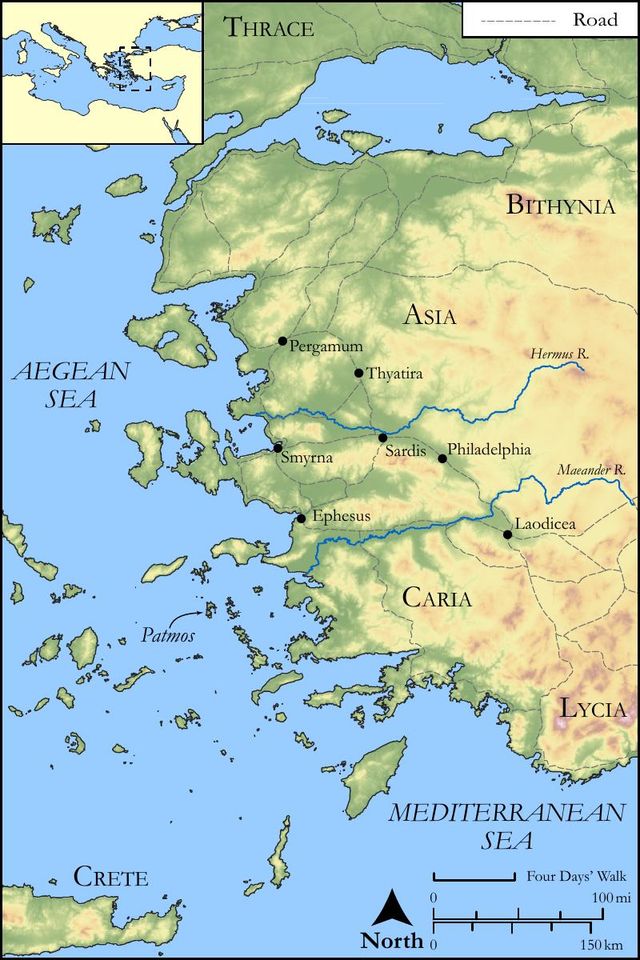
See on the biblical-era map

Study this verse
Public-domain commentary
Matthew Henry
From his Commentary on the Whole Bible. Henry comments on passages, not single verses — this entry covers Revelation 19:11–21. His two-level outline is real structure in the source text, so it is rendered as structure.
No sooner was the marriage solemnized between Christ and his church by the conversion of the Jews than the glorious head and husband of the church is called out to a new expedition, which seems to be the great battle that was to be fought at Armageddon, foretold Rev 16:16. And here observe,
I.The description of the great Commander,
1.By the seat of his empire; and that is heaven; his throne is there, and his power and authority are heavenly and divine.
2.His equipage: he is again described as sitting on a white horse, to show the equity of the cause, and certainty of success.
3.His attributes: he is faithful and true to his covenant and promise, he is righteous in all his judicial and military proceedings, he has a penetrating insight into all the strength and stratagems of his enemies, he has a large and extensive dominion, many crowns, for he is King of kings, and Lord of lords.
4.His armour; and that is a vesture dipped in blood, either his own blood, by which he purchased this mediatorial power, or the blood of his enemies, over whom he has always prevailed.
5.His name: The Word of God, a name that none fully knows but himself, only this we know, that this Word was God manifest in the flesh; but his perfections are incomprehensible by any creature.
II.The army which he commands (Rev 19:14), a very large one, made up of many armies; angels and saints followed his conduct, and resembled him in their equipage, and in their armour of purity and righteousness - chosen, and called, and faithful.
III.The weapons of his warfare - A sharp sword proceeding from his mouth (Rev 19:15), with which he smites the nations, either the threatenings of the written word, which now he is going to execute, or rather his word of command calling on his followers to take a just revenge on his and their enemies, who are now put into the wine-press of the wrath of God, to be trodden under foot by him.
IV.The ensigns of his authority, his coat of arms - a name written on his vesture and thigh, King of kings, and Lord of lords, asserting his authority and power, and the cause of the quarrel, Rev 19:16.
V.An invitation given to the fowls of heaven, that they should come and see the battle, and share in the spoil and pillage of the field (Rev 19:17, Rev 19:18), intimating that this great decisive engagement should leave the enemies of the church a feast for the birds of prey, and that all the world should have cause to rejoice in the issue of it.
VI.The battle joined.
The enemy falls on with great fury, headed by the beast, and the kings of the earth; the powers of earth and hell gathered, to make their utmost effort, Rev 19:19.
VII.The victory gained by the great and glorious head of the church:
The beast and the false prophet, the leaders of the army, are taken prisoners, both he who led them by power and he who led them by policy and falsehood; these are taken and cast into the burning lake, made incapable of molesting the church of God any more; and their followers, whether officers or common soldiers, are given up to military execution, and made a feast for the fowls of heaven. Though the divine vengeance will chiefly fall upon the beast, and the false prophet, yet it will be no excuse to those who fight under their banner that they only followed their leaders and obeyed their command; since they would fight for them, they must fall and perish with them. Be wise now therefore, O you kings, be instructed, you rulers of the earth; kiss the Son, lest he be angry, and you perish from the way, Psa 2:10, Psa 2:12.
Historical interpretation
Seven Centuries of Reception
12 surviving comments on this verse. Each one is dated, so this reads as a timeline rather than a list.
Select a marker to jump to its quote. Markers stagger vertically where authors wrote within a few decades of each other.
As the flame is bright and at the same time illuminating, and further also has a nature that is fiery and consumes the more material elements, so the eyes of the Word, if I may speak in this way, with which he sees, and everyone who participates in him, destroy and obliterate the more material and gross elements of thoughts by grasping them by means of the spiritual powers inherent in him. Everything false, in any way whatsoever, has fled the subtlety and precision of the truth.… If the lie were one and simple against which the Word who is “faithful and true” prevailed, who received the crown when the lie was overcome, the Word who became master of God’s opponents would also reasonably have been recorded to wear one diadem. But now, since the lies that profess the truth are many against which the Word has fought and is crowned, there are many diadems surrounding the head of him who has conquered them all.
The living Word alone understands some things because of the natural inferiority in those who came into existence after him. None of them can contemplate all the things that he grasps. And perhaps also only those who share in the Word, in contradistinction to those who do not, know what the others are missing.
-testify that He was born of God. His name is known to none, except to Himself and the Father, as John teaches in the Revelation.
In him “in whom we shall perform great deeds,” in him the multitude of the saints are said to have the beauty of crowns.
Perfect knowledge of the Word of God is revealed to those who are worthy to be the body of Christ and members [of him], since the Head especially gives knowledge of himself to the body, and he knows what the church is worthy to know in him. The apostle says, “He who is united to the Lord is one spirit, for the two shall be one flesh.” Neither the Jews nor the foreigners nor the heretics will ever know this name, for “if they had [known], they would not have crucified the Lord of glory,” and again, “The world has not known you.” And the Lord said again to his disciples, “You will see me; because I live, you will live also. In that day you will know that I am in my Father, and you in me, and I in you.” And the disciples answered, “Lord, how is it that you will manifest yourself to us and not to the world?” Concerning the heretics, the Lord said, “To you it has been given to know the secret of the kingdom of God, but for those outside everything is in parables, so that they may indeed see but not perceive.” He has a great name inscribed that no one knows except himself. However, we must beware lest by a purely carnal wisdom we think that the name of the Son is unknown to the Father or to the Holy Spirit.… If the Son alone is said to know something, the whole Trinity is also regarded as knowing it. Similarly, if the Father alone is said to know something, he is without doubt thought to know it together with his Wisdom, who is Christ, and with his Spirit, who is believed to be the Spirit of the Father and of the Son. For when the Father alone was said to know the day of judgment, certainly it was not denied that the Son and the Spirit also knew it. So also, when the Holy Spirit alone is said to know something, and the names of the Father and of the Son are unspoken, nevertheless it is declared that they know in the same manner. When the apostle says, “What person knows the thoughts of a man except the spirit of the man that is in him? So also no one comprehends the thoughts of God except the Spirit of God,” it would be foolish to separate the Father and the Son from such knowledge. When he says elsewhere, “Do not grieve the Holy Spirit of God, in whom you were sealed for the day of redemption,” she is not excluding the persons of the Father and of the Son from the work of our redemption, even though he does not mention their names. For through the undivided power of the one nature, we teach that the works of the Trinity are inseparable.
As fire penetrates everything which contains it and leaves no portion untouched by the force of its burning heat, so the eyes of the Lord cannot be avoided, for they are everywhere and pervade all things, and seeing all things which people do, they investigate them with a holy scrutiny.… There are many [diadems] because he brings to God, who gathers all, all the glory of the saints and all the honor of the blessed. And these do not remain quiet, but bring forth praise and thanksgiving.
That his name is unknown signifies the incomprehensibility of his essence. By virtue of his works he is known by many names, such as Good, Shepherd, Sun, Light, Life, Righteousness, Holiness, Redemption. Similarly, he is called by terms of negation, such as Incorruptible, Invisible, Immortal, Unchangeable. However, according to his essence he is without name and is unapproachable, being known by himself alone with the Father and the Spirit.
The flames of fire come forth from his eyes, that is, from his all-seeing power. For those who are righteous, this fire does no harm but illumines and makes bright. However, for the sinners this fire burns but does not make bright. The multiple diadems symbolize either his kingdom, which is over all things in heaven and on earth—as many as there are ranks of angels and kingdoms upon the earth and assemblies among holy people—or they signify the victory against the sinners that was won for us by all of his acts of mercy, as a certain holy person said, “And you will gain victory when you are judged.”
He has a name written that no one knows but himself. He says, no one knows but himself, because all the Church is in him. The perfect knowledge of the Word of God is revealed to those who have deserved to be the body and members of Christ. In the same way, the Lord says: No one has ascended into heaven except he who descended from heaven, the Son of Man (John 3).
His eyes are like a flame of fire. Sometimes the eyes of God are called his commandments, sometimes the spirit. Your word is a lamp to my feet, O Lord (Psalm 119). And of the Spirit: I came to cast fire on the earth (Luke 12).
And on his head are many diadems. In him we find our strength; in him, the multitude of saints is said to be adorned with a crown.
And his eyes, he says, are a flame of fire. The wrath against the enemies, he shows by the burning of the eyes.
And on his head he says many crowns, as many certainly as there are orders reigning in heaven and on earth.
He says he had a name written, that no man knew but himself. God says in the Exodus of the seventh day to the prophetic Moses: "I am the Lord who appeared to Abraham and Isaac and Jacob being their God; and I did not declare to them my name, the Lord," (Ex. 6:2-3) as clearer than or capable of being conveyed by human hearing. Therefore, and as the Lord instructed the apostles to baptize those returning to the knowledge of God, he said, "baptizing them into the name," and by saying "name" he did not hand over the proper names; for he did not have the strength to sustain their proclamation, but instead he delivered it in relational and nominative terms in place of the proper names, relational when saying "into the name of the Father and of the Son," and nominative when also invoking "and of the Holy Spirit." (Matt. 28:19) Therefore, very securely and in the Revelation the divine name of the Only-Begotten is allowed to be unknown to all.
Continue studying Revelation 19:12 across the web’s major study libraries — every link below opens this exact verse, chapter, or book on the destination site.
Read & Compare
 BibleGatewayThis verse in more than 200 translations and 70 languages.
 Bible.comThe YouVersion reader — hundreds of translations, reading plans, and highlights.
 ESV.orgCrossway's official English Standard Version reader.
 NET BibleThe NET translation with 60,000+ translators' notes on every rendering decision.
 STEP BibleTyndale House's free study tool — original text, vocabulary, and scholarly resources.
 BibliaLogos Bible Software's free web reader.
 USCCBThe New American Bible (Revised Edition) with the U.S. bishops' study notes.
Commentaries
 BibleHub CommentariesDozens of classic commentaries on this verse, gathered on one page.
 StudyLightMore than 100 commentary sets — the largest collection on the web.
 BibleRefPlain-English commentary on what this verse means, verse by verse.
 Enduring WordDavid Guzik's free commentary on this chapter, widely used by Bible teachers.
 Bible Study ToolsVerse commentary alongside Greek and Hebrew study aids.
Original Language & Research
- BibleHub InterlinearThe verse word by word — original language, transliteration, and English.
- BibleHub LexiconEvery word's original-language definition and Strong's entry.
 Blue Letter BibleDeep-study tools — Strong's numbers, concordance, and word studies.
 CNTR CollationThe earliest Greek manuscripts of this verse, collated letter by letter.
Sermons, Hymns & Audio


TrulyRandomVerse is not affiliated with these sites and doesn’t control their content. They’re linked because they’re genuinely useful.
Summary
Revelation 19:12 offers a profound and awe-inspiring description of Jesus Christ as He appears at His glorious second coming, emphasizing His divine authority, penetrating judgment, and unique, incomprehensible nature. This verse is part of a larger vision detailing the triumphant return of the 'Word of God' to conquer His enemies and establish His righteous reign, portraying Him not as a humble servant but as the sovereign King and Judge.
Context
ShowHideLiterary Context
This verse is deeply embedded within the climactic vision of Christ's return in Revelation 19. Following the celebratory "Marriage Supper of the Lamb" and the fall of Babylon (symbolizing the world system opposing God), John sees heaven opened and a majestic figure, identified as "Faithful and True" and "the Word of God," riding a white horse. Revelation 19:11 introduces this Rider, and verse 12 immediately launches into a detailed description of His appearance, setting the stage for the decisive battle against the beast and false prophet and the subsequent establishment of Christ's millennial reign. This passage marks a dramatic shift from earlier visions of tribulation and judgment to the direct intervention of Christ to establish His kingdom.
Historical & Cultural Context
The imagery in Revelation 19:12 draws heavily on Old Testament prophetic traditions concerning the Day of the Lord and the coming of a divine warrior-king. For John's original audience, likely facing persecution under the Roman Empire, the concept of a conquering king was familiar, yet Christ's portrayal transcends earthly rulers. "Many crowns" (diadems) would evoke the imperial authority of emperors, but here applied to Christ, it signifies His supreme, universal dominion over all earthly powers. The "flame of fire" for eyes is a common biblical metaphor for divine purity, judgment, and omniscience, found in visions of God's glory (e.g., Daniel 10:6) and applied to Christ in Revelation 1:14. The idea of an unknown name could resonate with ancient practices where a secret name conveyed ultimate power or an ineffable nature, emphasizing Christ's unique divine identity that transcends human comprehension.
Key Themes
ShowHideRevelation 19:12 contributes significantly to several overarching themes in the book of Revelation and biblical theology. Firstly, it powerfully underscores the theme of Divine Authority and Kingship, presenting Christ not merely as a victor but as the absolute sovereign, the "King of kings and Lord of lords" (Revelation 19:16). Secondly, the description of His eyes as a "flame of fire" emphasizes the theme of Righteous Judgment and Omniscience, indicating His perfect discernment and consuming power to execute justice. This ties into the broader theme of God's ultimate justice against evil, which culminates in this chapter. Thirdly, the "name written, that no man knew, but he himself" highlights the theme of the Incomprehensible Mystery of Christ's Divine Nature. It suggests that the fullness of His being, His deepest identity, remains beyond human or even angelic comprehension, known only to Himself and the Father, reinforcing His unique deity.
Exposition and Analysis
ShowHideKey Word Analysis
ShowHideFrom optánomai, referring to the eye literally or figuratively; here, it signifies Christ's penetrating vision, perfect discernment, and the intensity of His righteous judgment. His gaze is all-seeing, revealing truth and exposing all hidden things.
From a compound of diá and déō, meaning a "diadem" bound about the head. This term specifically denotes royal crowns or imperial regalia, signifying absolute sovereignty and rightful dominion. Its plural form, "many crowns," emphasizes the totality and supremacy of Christ's authority over all earthly and heavenly realms, distinct from a victor's wreath (stéphanos).
A primary verb, properly to see (literally or figuratively); by implication, in the perfect tense, to know. In this context, it emphasizes the exclusive, perfect knowledge Christ has of His own unique, ineffable identity and divine essence, which remains inscrutable to all others.
Verse Breakdown
ShowHide"His eyes [were] as a flame of fire"
This vivid imagery portrays Christ's penetrating and all-consuming gaze. The "flame of fire" symbolizes not only His perfect purity and holiness but also His absolute omniscience, seeing into the deepest recesses of hearts and discerning all truth. It also speaks to His righteous judgment, which will consume all unrighteousness, similar to how fire purifies or destroys.
"and on his head [were] many crowns"
This phrase powerfully communicates Christ's supreme and undisputed authority. The "crowns" are diadēmata, royal crowns, not merely victor's wreaths. The plurality, "many crowns," indicates His universal dominion, His rightful claim to sovereignty over all nations, kingdoms, and powers, signifying His absolute triumph and the breadth of His reign.
"and he had a name written, that no man knew, but he himself"
This mysterious statement points to the ineffable and unique nature of Christ's divine being. While He has many revealed names (e.g., "Word of God," "King of kings"), this unknown name suggests an aspect of His identity that transcends human comprehension and revelation, known only to the Godhead. It emphasizes His utter uniqueness, His divine mystery, and His being distinct from all created beings.
Literary Devices
ShowHideRevelation 19:12 is rich with Symbolism and vivid Imagery. The "flame of fire" for eyes is a powerful symbol of divine judgment, purity, and omniscience, recalling Old Testament theophanies and earlier descriptions of Christ in Revelation. The "many crowns" (diadems) symbolize Christ's absolute and universal sovereignty, contrasting with the limited power of earthly rulers. The "name written, that no man knew" symbolizes the profound, ineffable mystery of Christ's divine essence, an identity known only to Himself, emphasizing His transcendent nature. The cumulative effect of this imagery is to evoke Awe and Reverence, presenting Christ as an overwhelmingly powerful and majestic figure, far beyond human understanding or control. The verse also employs Hyperbole in the "many crowns" to emphasize the totality of His dominion.
Theological and Thematic Connections
ShowHideRevelation 19:12 presents a profound theological statement about the person and work of Jesus Christ, particularly His divine nature, supreme authority, and role as ultimate Judge. It underscores the biblical truth that Christ is not merely a human figure but the incarnate God, possessing attributes of omniscience and absolute sovereignty. The imagery of fiery eyes and many crowns connects Him directly to the divine majesty described in the Old Testament, fulfilling prophecies of a coming Messiah who would reign with justice and power. The unknown name highlights the inexhaustible depths of His being, reminding us that even in revelation, God retains an element of divine mystery beyond full human comprehension. This verse serves as a powerful reminder of Christ's ultimate victory over all opposing forces and His rightful place as the sovereign ruler of the universe.
Reflection and Application
ShowHideRevelation 19:12 calls believers to a profound sense of awe and worship for Jesus Christ. His return as depicted here is not merely a historical event to anticipate, but a theological truth that shapes our present reality. Knowing that our Savior possesses eyes like a flame of fire should instill both comfort and conviction: comfort that He sees all injustice and suffering and will bring perfect justice, and conviction that our lives are lived before His all-discerning gaze. The "many crowns" remind us that His authority is absolute and unchallenged, prompting us to submit every area of our lives to His Lordship. The mysterious, unknown name invites us to humble ourselves before the incomprehensible greatness of God, recognizing that there will always be depths of His being that transcend our understanding, fostering a lifelong journey of seeking and knowing Him more. This vision should inspire us to live with purposeful anticipation, eagerly awaiting His glorious return and striving to live in a manner worthy of His supreme reign.
Questions for Reflection
ShowHideFAQ
ShowHideWhat is the significance of "His eyes [were] as a flame of fire"?
ShowHideThis imagery signifies Christ's perfect purity, holiness, and His absolute omniscience. Like fire, His gaze penetrates all things, discerning truth from falsehood, exposing sin, and purifying. It also symbolizes His righteous judgment, indicating that He will consume all unrighteousness and execute justice with consuming power. This description is consistent with other biblical portrayals of divine judgment and discernment, such as in Revelation 1:14 and Daniel 10:6.
Why does Jesus have "many crowns" instead of just one?
ShowHideThe Greek word used here is diádēma (royal crown), not stéphanos (victor's wreath). The "many crowns" signify the totality and supremacy of Christ's universal authority and dominion. It emphasizes that He is the rightful ruler over all nations, kingdoms, and powers, having conquered every opposing force. This imagery reinforces His title as the "King of kings and Lord of lords" (Revelation 19:16), indicating His absolute and unchallenged sovereignty over all creation.
What is the meaning of "he had a name written, that no man knew, but he himself"?
ShowHideThis mysterious statement points to the ineffable and unique nature of Christ's divine being. While He is known by many names that reveal aspects of His character and mission (e.g., "Word of God" in Revelation 19:13), this unknown name suggests an aspect of His identity that transcends human or even angelic comprehension. It emphasizes His utter uniqueness, His divine mystery, and His being distinct from all created beings. It speaks to the infinite depth of His divine essence, known fully only to Himself and the Father (Matthew 11:27).
Christ-Centered Fulfillment
ShowHideRevelation 19:12 offers a climactic Christ-centered fulfillment of Old Testament prophecies concerning the coming Messiah and the Day of the Lord. The figure described, with eyes like a flame of fire and many crowns, is none other than Jesus Christ, the one who first came as a humble servant (Philippians 2:7-8). His appearance here as the conquering King, adorned with royal diadems, fulfills the promise of a sovereign ruler from the line of David who would establish an eternal kingdom (Isaiah 9:6-7). His fiery eyes speak to His divine omniscience and righteous judgment, echoing the prophetic warnings of a coming judgment that would purify the earth (Malachi 3:2-3). Furthermore, the mysterious, unknown name points to the ultimate revelation of God in Christ, yet maintaining an element of divine incomprehensibility, ensuring that even in His full manifestation, He remains infinitely glorious and beyond the exhaustive grasp of creation. This verse, therefore, powerfully declares that the Lamb who was slain (Revelation 5:6) is indeed the Lion of Judah (Revelation 5:5), the sovereign Lord who will return to perfectly execute justice and reign eternally, fulfilling all of God's redemptive purposes in Himself.