


Luke 10:22
- καὶkaiandG2532CONJConjunction
- στραφείςstrapheishaving turnedG4762V-2APP-NSMVerb 2nd Aorist Passive Participle Nominative Singular Masculine
- πρόςprostoG4314PREPPreposition
- τούςtous<the>G3588T-APMDefinite article Accusative Plural Masculine
- μαθητάςmathētasdisciplesG3101N-APMNoun Accusative Plural Masculine
- εἶπενeipensaidG2036V-2AAI-3SVerb 2nd Aorist Active Indicative 3rd Singular
- πάνταpantaAll thingsG3956A-NPNAdjective Nominative Plural Neuter
- μοιmoito MeG3165P-1DSPersonal pronoun Dative 1st Singular
- παρεδόθηparedothēwas deliveredG3860V-API-3SVerb Aorist Passive Indicative 3rd Singular
- ὑπὸhupobyG5259PREPPreposition
- τοῦtoutheG3588T-GSMDefinite article Genitive Singular Masculine
- πατρόςpatrosFatherG3962N-GSM-TNoun Genitive Singular Masculine Title
- μουmouof MineG3165P-1GSPersonal pronoun Genitive 1st Singular
- καὶkaiAndG2532CONJConjunction
- οὐδεὶςoudeisno [one]G3762A-NSMAdjective Nominative Singular Masculine
- γινώσκειginōskeiknowsG1097V-PAI-3SVerb Present Active Indicative 3rd Singular
- τίςtiswhoG5101I-NSMInterrogative pronoun Nominative Singular Masculine
- ἐστινestinisG1510V-PAI-3SVerb Present Active Indicative 3rd Singular
- ὁhotheG3588T-NSMDefinite article Nominative Singular Masculine
- υἱὸςhuiosSonG5207N-NSMNoun Nominative Singular Masculine
- εἰeionlyG1487CONDConjunction
- μὴmēexceptG3361PRT-NNegative Particle Negative
- ὁhotheG3588T-NSMDefinite article Nominative Singular Masculine
- πατήρpatērFatherG3962N-NSM-TNoun Nominative Singular Masculine Title
- καὶkaiandG2532CONJConjunction
- τίςtiswhoG5101I-NSMInterrogative pronoun Nominative Singular Masculine
- ἐστινestinisG1510V-PAI-3SVerb Present Active Indicative 3rd Singular
- ὁhotheG3588T-NSMDefinite article Nominative Singular Masculine
- πατὴρpatērFatherG3962N-NSM-TNoun Nominative Singular Masculine Title
- εἰeionlyG1487CONDConjunction
- μὴmēexceptG3361PRT-NNegative Particle Negative
- ὁhotheG3588T-NSMDefinite article Nominative Singular Masculine
- υἱὸςhuiosSonG5207N-NSMNoun Nominative Singular Masculine
- καὶkaiandG2532CONJConjunction
- ᾧhōto whomG3739R-DSMRelative pronoun Dative Singular Masculine
- ἐὰνeanmaybeG1437CONDConjunction
- βούληταιboulētaishall resolveG1014V-PNS-3SVerb Present Middle Or Passive Deponent Subjunctive 3rd Singular
- ὁhotheG3588T-NSMDefinite article Nominative Singular Masculine
- υἱὸςhuiosSonG5207N-NSMNoun Nominative Singular Masculine
- ἀποκαλύψαιapokalupsaito reveal [Him]G601V-AANVerb Aorist Active Infinitive
English is a literal word-by-word gloss of the Greek, not the KJV's wording. Why?
This is the original text the KJV's translators worked from — each Greek word with its own literal English meaning in this verse, prepared by scholars at Tyndale House, Cambridge. The KJV translates whole sentences, not word by word, so its wording differs: one Greek word can become several English words, and the KJV may choose “charity” where the gloss reads “love”. Both are faithful — they answer different questions. For the KJV's own rendering, switch to the KJV text.
Details
See on the biblical-era map

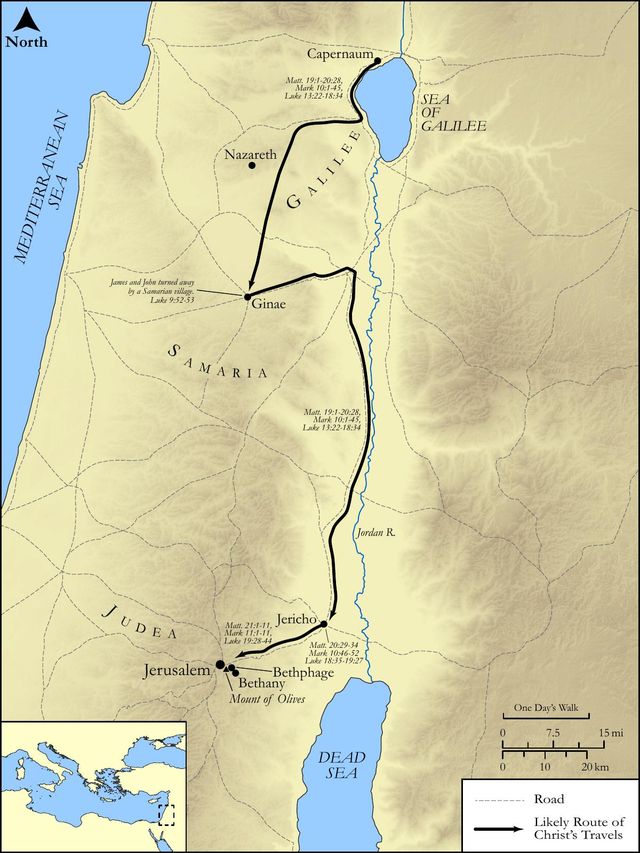
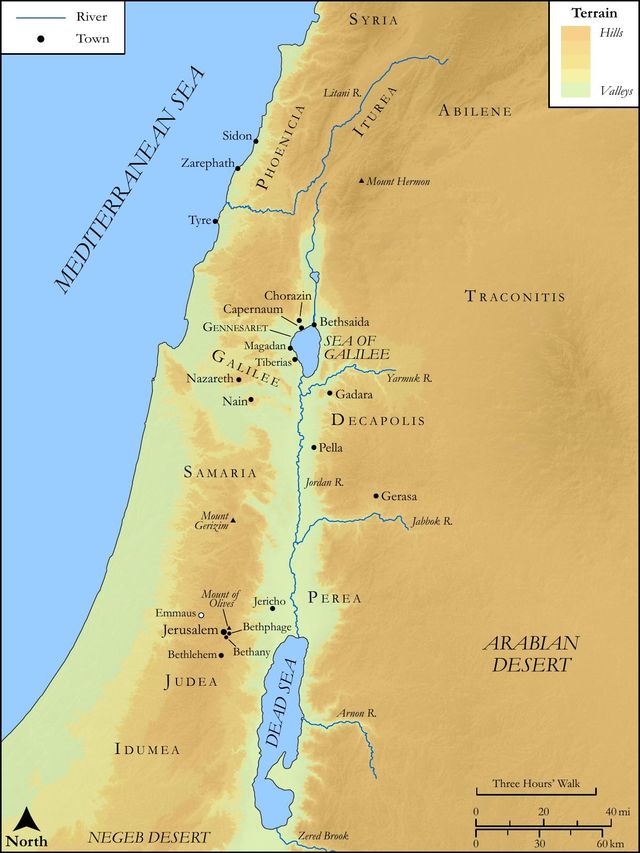
Study this verse
Public-domain commentary
Matthew Henry
From his Commentary on the Whole Bible. Henry comments on passages, not single verses — this entry covers Luke 10:17–24. His four-level outline is real structure in the source text, so it is rendered as structure.
Christ sent forth the seventy disciples as he was going up to Jerusalem to the feast of tabernacles, when he went up, not openly, but as it were in secret (Joh 7:10), having sent abroad so great a part of his ordinary retinue; and Dr. Lightfoot thinks it was before his return from that feast, and while he was yet at Jerusalem, or Bethany, which was hard by (for there he was, Luk 10:38), that they, or at least some of them, returned to him. Now here we are told,
1.What account they gave him of the success of their expedition: They returned again with joy (Luk 10:17); not complaining of the fatigue of their journeys, nor of the opposition and discouragement they met with, but rejoicing in their success, especially in casting out unclean spirits: Lord, even the devils are subject unto us through thy name. Though only the healing of the sick was mentioned in their commission (Luk 10:19), yet no doubt the casting out of devils was included, and in this they had wonderful success. 1. They give Christ the glory of this: It is through thy name. Note, all our victories over Satan are obtained by power derived from Jesus Christ. We must in his name enter the lists with our spiritual enemies, and, whatever advantages we gain, he must have all the praise; if the work be done in his name, the honour is due to his name. 2. They entertain themselves with the comfort of it; they speak of it with an air of exultation: Even the devils, those potent enemies, are subject to us. Note, the saints have no greater joy or satisfaction in any of their triumphs than in those over Satan. If devils are subject to us, what can stand before us?
II.What acceptance they found with him, and how he received this account.
1.He confirmed what they said, as agreeing with his own observation (Luk 10:18): "My heart and eye went along with you; I took notice of the success you had, and I saw Satan fall as lightning from heaven." Note, Satan and his kingdom fell before the preaching of the gospel. "I see how it is," saith Christ, "as you get ground the devil loseth ground." He falls as lightning falls from heaven, so suddenly, so irrecoverably, so visibly, that all may perceive it, and say, "See how Satan's kingdom totters, see how it tumbles." They triumphed in casting devils out of the bodies of people; but Christ sees and rejoices in the fall of the devil from the interest he has in the souls of men, which is called his power in high places, Eph 6:12. He foresees this to be but an earnest of what should now be shortly done and was already begun - the destroying of Satan's kingdom in the world by the extirpating of idolatry and the turning of the nations to the faith of Christ. Satan falls from heaven when he falls from the throne in men's hearts, Act 26:18. And Christ foresaw that the preaching of the gospel, which would fly like lightning through the world, would wherever it went pull down Satan's kingdom. Now is the prince of this world cast out. Some have given another sense of this, as looking back to the fall of the angels, and designed for a caution to these disciples, lest their success should puff them up with pride: "I saw angels turned into devils by pride: that was the sin for which Satan was cast down from heaven, where he had been an angel of light I saw it, and give you an intimation of it lest you, being lifted up with pride should fall into that condemnation of the devil, who fell by pride," Ti1 3:6.
2.He repeated, ratified, and enlarged their commission: Behold I give you power to tread on serpents, Luk 10:19. Note, To him that hath, and useth well what he hath, more shall be given. They had employed their power vigorously against Satan, and now Christ entrusts them with greater power.
(1.)An offensive power, power to tread on serpents and scorpions, devils and malignant spirits, the old serpent: "You shall bruise their heads in my name," according to the first promise, Gen 3:15. Come, set your feet on the necks of these enemies; you shall tread upon these lions and adders wherever you meet with them; you shall trample them under foot, Psa 91:13. You shall tread upon all the power of the enemy, and the kingdom of the Messiah shall be every where set up upon the ruins of the devil's kingdom. As the devils have now been subject to you, so they shall still be.
(2.)A defensive power: "Nothing shall by any means hurt you; not serpents nor scorpions, if you should be chastised with them or thrown into prisons and dungeons among them; you shall be unhurt by the most venomous creatures," as St. Paul was (Act 28:5), and as is promised in Mar 16:18. "If wicked men be as serpents to you, and you dwell among those scorpions (as Eze 2:6), you may despise their rage, and tread upon it; it need not disturb you, for they have no power against you but what is given them from above; they may hiss, but they cannot hurt." You may play upon the hole of the asp, for death itself shall not hurt nor destroy, Isa 11:8, Isa 11:9; Isa 25:8.
3.He directed them to turn their joy into the right channel (Luk 10:20): "Notwithstanding in this rejoice not, that the spirits are subject unto you, that they have been so, and shall be still so. Do not rejoice in this merely as it is your honour, and a confirmation of your mission, and as it sets you a degree above other good people; do not rejoice in this only, or in this chiefly, but rather rejoice because your names are written in heaven, because you are chosen of God to eternal life, and are the children of God through faith." Christ, who knew the counsels of God, could tell them that their names were written in heaven, for it is the Lamb's book of life that they are written in. All believers are through grace, entitled to the inheritance of sons, and have received the adoption of sons, and the Spirit of adoption, which is the earnest of that inheritance and so are enrolled among his family; now this is matter of joy, greater joy than casting out devils. Note, Power to become the children of God is to be valued more than a power to work miracles; for we read of those who did in Christ's name cast out devils, as Judas did, and yet will be disowned by Christ in the great day. But they whose names are written in heaven shall never perish; they are Christ's sheep, to whom he will give eternal life. Saving graces are more to be rejoiced in than spiritual gifts; holy love is a more excellent way than speaking with tongues.
4.He offered up a solemn thanksgiving to his Father, for employing such mean people as his disciples were in such high and honourable service, Luk 10:21, Luk 10:22. This we had before (Mat 11:25-27), only here it is prefixed that in that hour Jesus rejoiced. It was fit that particular notice should be taken of that hour, because there were so few such, for he was a man of sorrows. In that hour in which he saw Satan fall, and heard of the good success of his ministers, in that hour he rejoiced. Note, Nothing rejoices the heart of the Lord Jesus so much as the progress of the gospel, and its getting ground of Satan, by the conversion of souls to Christ. Christ's joy was a solid substantial joy, an inward joy: he rejoiced in spirit; but his joy, like deep waters, made no noise; it was a joy that a stranger did not intermeddle with. Before he applied himself to thank his Father, he stirred up himself to rejoice; for, as thankful praise is the genuine language of holy joy, so holy joy is the root and spring of thankful praise. Two things he gives thanks for: -
(1.)For what was revealed by the Father through the Son: I thank thee, O Father, Lord of heaven and earth, Luk 10:21. In all our adorations of God, we must have an eye to him, both as the Maker of heaven and earth and as the Father of our Lord Jesus Christ, and in him our Father. Now that which he gives thanks for is,
[1.]That the counsels of God concerning man's reconciliation to himself were revealed to some of the children of men, who might be fit also to teach others, and it is God that by his Son has spoken these things to us and by his Spirit has revealed them in us; he has revealed that which had been kept secret from the beginning of the world.
[2.]That they were revealed to babes, to those who were of mean parts and capacities, whose extraction and education had nothing in them promising, who were but children in understanding, till God by his Spirit elevated their faculties, and furnished them with this knowledge, and an ability to communicate it. We have reason to thank God, not so much for the honour he has hereby put upon babes, as for the honour he has hereby done himself in perfecting strength out of weakness.
[3.]That, at the same time when he revealed them unto babes, he hid them from the wise and prudent, the Gentile philosophers, the Jewish rabbin. He did not reveal the things of the gospel to them, nor employ them in preaching up his kingdom. Thanks be to God that the apostles were not fetched from their schools; for, First, they would have been apt to mingle their notions with the doctrine of Christ, which would have corrupted it, as afterwards it proved. For Christianity was much corrupted by the Platonic philosophy in the first ages of it, by the Peripatetic in its latter ages, and by the Judaizing teachers at the first planting of it. Secondly, If rabbin and philosophers had been made apostles, the success of the gospel would have been ascribed to their learning and wit and the force of their reasonings and eloquence; and therefore they must not be employed, lest they should have taken too much to themselves, and others should have attributed too much to them. They were passed by for the same reason that Gideon's army was reduced: The people are yet too many, Jdg 7:4. Paul indeed was bred a scholar among the wise and prudent; but he became a babe when he became an apostle, and laid aside the enticing words of man's wisdom, forgot them all, and made neither show nor use of any other knowledge than that of Christ and him crucified, Co1 2:2, Co1 2:4.
[4.]That God herein acted by way of sovereignty: Even so, Father, for so it seemed good in thy sight. If God gives his grace and the knowledge of his son to some that are less likely, and does not give it to others whom we should think better able to deliver it with advantage, this must satisfy: so it pleases God, whose thoughts are infinitely above ours. He chooses to entrust the dispensing of his gospel in the hands of those who with a divine energy will give it the setting on, rather than in theirs who with human art will give it the setting off.
(2.)For what was secret between the Father and the Son, Luk 10:22.
[1.]The vast confidence that the Father puts in the Son: All things are delivered to me of my Father, all wisdom and knowledge, all power and authority, all the grace and comfort which are intended for the chosen remnant; it is all delivered into the hands of the Lord Jesus; in him all fulness must dwell, and from him it must be derived: he is the great trustee that manages all the concerns of God's kingdom.
[2.]The good understanding that there is between the Father and the Son, and their mutual consciousness, such as no creature can be admitted to: No man knows who the Son is, nor what his mind is, but the Father, who possessed him in the beginning of his ways, before his works of old (Pro 8:22), nor who the Father is, and what his counsels are, but the Son, who lay in his bosom from eternity, was by him as one brought up with him, and was daily his delight (Pro 8:30), and he to whom the Son by the Spirit will reveal him. The gospel is the revelation of Jesus Christ, to him we owe all the discoveries made to us of the will of God for our salvation; and here he speaks of being entrusted with it as that which was a great pleasure to himself and for which he was very thankful to his Father.
5.He told his disciples how well it was for them that they had these things revealed to them, Luk 10:23, Luk 10:24. Having addressed himself to his Father, he turned to his disciples, designing to make them sensible how much it was for their happiness, as well as for the glory and honour of God, that they knew the mysteries of the kingdom and were employed to lead others into the knowledge of them, considering,
(1.)What a step it is towards something better. Though the bare knowledge of these things is not saving, yet it puts us in the way of salvation: Blessed are the eyes which see the things which we see. God therein blesseth them, and, if it be not their own fault it will be an eternal blessedness to them.
(2.)What a step it is above those that went before them, even the greatest saints, and those that were most the favourites of Heaven: "Many prophets and righteous men" (so it is in Mat 13:17), many prophets and kings (so it is here), "have desired to see and hear those things which you are daily and intimately conversant with, and have not seen and heard them." The honour and happiness of the New Testament saints far exceed those even of the prophets and kings of the Old Testament, though they also were highly favoured. The general ideas which the Old Testament saints had, according to the intimations given them, of the graces and glories of the Messiah's kingdom, made them wish a thousand times that their lot had been reserved for those blessed days, and that they might see the substance of those things of which they had faint shadows. Note, The consideration of the great advantages which we have in the New Testament light, above what they had who lived in Old Testament times, should awaken our diligence in the improvement of it; for, if it do not, it will aggravate our condemnation for the non-improvement of it.
Historical interpretation
Nine Centuries of Reception
22 surviving comments on this verse. Each one is dated, so this reads as a timeline rather than a list.
Select a marker to jump to its quote. Markers stagger vertically where authors wrote within a few decades of each other.
For the Lord, revealing Himself to His disciples, that He Himself is the Word, who imparts knowledge of the Father, and reproving the Jews, who imagined that they, had .
For the Son is the knowledge of the Father; but the knowledge of the Son is in the Father, and has been revealed through the Son; and this was the reason why the Lord declared: "No man knoweth the Son, but the Father; nor the Father, save the Son, and those to whomsoever the Son shall reveal .
Vain, therefore, ark those who, because of that declaration, "No man knoweth the Father, but the Son"
After we have repented of our sins, renounced our wickedness, and have been purified by baptism, we turn back to the eternal light, as children to their Father. “Rejoicing in the spirit, Jesus said, ‘I praise you, Father, God of heaven and earth, that you have hidden these things from the wise and prudent, and revealed them to little ones.’ ” The Educator and Teacher is naming us “little ones,” meaning that we are more ready for salvation than the worldly wise who, believing themselves wise, have blinded their own eyes. He cries out in joy and in great delight, as if attuning himself to the spirit of the little ones, “Yes, Father, for such was your good pleasure.” That is why he has revealed to little ones what has been hid from the wise and prudent of this world.
Of late, then, God was known by the coming of Christ: "For no man knoweth God but the Son, and he to whom the Son shall reveal Him.".
It is this same Father of His, then who being one is manifested by many powers And this was the import of the utterance, "No man knew the Father".
And He first announced the good righteousness that is from heaven, when He said, "No man knoweth the Son, but the Father; nor the Father, but the Son.".
"No one "says the Lord, "hath known the Father but the Son, and he to whom the Son shall reveal Him.".
Whence also this kind of cattle are apt to slip, not having a division in the foot, and not resting on the twofold support of faith. For "no man "it is said, "knoweth the Father, but he to whom the Son shall reveal Him."
But "no man knoweth who the Father is, but the Son; and who the Son is, but the Father, and he to whom the Son will reveal Him." And so it was an unknown god that Christ preached! And other heretics, too, prop themselves up by this passage; alleging in opposition to it that the Creator was known to all, both to lsrµl by familiar intercourse, and to the Gentiles by nature.
He exults in spirit when He says to the Father, "I thank Thee, O Father, because Thou hast hid these things from the wise and prudent." He, moreover, affirms also that to no man is the Father known, but to His Son; and promises that, as the Son of the Father, He will confess those who confess Him, and deny those who deny Him, before His Father.
But after all, it is, I presume, the edification rather than the demolition of the law and the prophets which we have thus far found effected in Christ. "All things," He says, "are delivered unto me of my Father." You may believe Him, if He is the Christ of the Creator to whom all things belong; because the Creator has not delivered to a Son who is less than Himself all things, which He created by Him, that is to say, by His Word.
(non occ.) He wishes to reveal as the Word, not without the exercise of reason; and as Justice, who knoweth rightly both the times for revealing, and the measures of revelation; but He reveals by removing the opposing veil from the heart, (2 Cor. 3:15) and the darkness which He has made His secret place. (Ps. 18:11.) But since upon this men who are of another opinion think to build up their impious doctrine, that in truth the Father of Jesus was sent down to the ancient saints, we must tell them that the words, To whomsoever the Son will reveal him, not only refer to the future time, after our Saviour uttered this, but also to the past time. But if they will not take this word reveal for what is past, they must be told, that it is not the same thing to know and to believe. To one is given by the Spirit the word of knowledge; to another faith by the same Spirit. (1 Cor. 12:8, 9.) There were then those who believed, but did not know.
1. This text refers not to the eternal Word but to the Incarnate.
And from not perceiving this they of the sect of Arius, Eusebius and his fellows, indulge impiety against the Lord. For they say, if all things were delivered (meaning by 'all' the Lordship of Creation), there was once a time when He had them not. But if He had them not, He is not of the Father, for if He were, He would on that account have had them always, and would not have required to receive them. But this point will furnish all the clearer an exposure of their folly. For the expression in question does not refer to the Lordship over Creation, nor to presiding over the works of God, but is meant to reveal in part the intention of the Incarnation (τῆς οἰκονομίας). For if when He was speaking they 'were delivered' to Him, clearly before He received them, creation was void of the Word. What then becomes of the text in Him all things consist Colossians 1:17? But if simultaneously with the origin of the Creation it was all 'delivered' to Him, such delivery were superfluous, for 'all things were made by Him' John 1:3, and it would be unnecessary for those things of which the Lord Himself was the artificer to be delivered over to Him. For in making them He was Lord of the things which were being originated. But even supposing they were 'delivered' to Him after they were originated, see the monstrosity. For if they 'were delivered,' and upon His receiving them the Father retired, then we are in peril of falling into the fabulous tales which some tell, that He gave over [His works] to the Son, and Himself departed. Or if, while the Son has them, the Father has them also, we ought to say, not 'were delivered,' but that He took Him as partner, as Paul did Silvanus. But this is even more monstrous; for God is not imperfect , nor did He summon the Son to help Him in His need; but, being Father of the Word, He makes all things by His means, and without delivering creation over to Him, by His means and in Him exercises Providence over it, so that not even a sparrow falls to the ground without the Father Matthew 10:29, nor is the grass clothed without God Matthew 6:30, but at once the Father works, and the Son works hitherto cf.John 5:17. Vain, therefore, is the opinion of the impious. For the expression is not what they think, but designates the Incarnation.
2. Sense in which, and end for which all things were delivered to the Incarnate Son.
For whereas man sinned, and is fallen, and by his fall all things are in confusion: death prevailed from Adam to Moses cf.Romans 5:14, the earth was cursed, Hades was opened, Paradise shut, Heaven offended, man, lastly, corrupted and brutalised cf.Psalm 49:12, while the devil was exulting against us—then God, in His loving-kindness, not willing man made in His own image to perish, said, 'Whom shall I send, and who will go?' Isaiah 6:8. But while all held their peace, the Son said, 'Here am I, send Me.' And then it was that, saying 'Go,' He 'delivered' to Him man, that the Word Himself might be made Flesh, and by taking the Flesh, restore it wholly. For to Him, as to a physician, man 'was delivered' to heal the bite of the serpent; as to life, to raise what was dead; as to light, to illumine the darkness; and, because He was Word, to renew the rational nature (τὸ λογικόν). Since then all things 'were delivered' to Him, and He is made Man, straightway all things were set right and perfected. Earth receives blessing instead of a curse, Paradise was opened to the robber, Hades cowered, the tombs were opened and the dead raised, the gates of Heaven were lifted up to await Him that 'comes from Edom?' Psalm 24:7, Isaiah 63:1. Why, the Saviour Himself expressly signifies in what sense 'all things were delivered' to Him, when He continues, as Matthew tells us: 'Come unto Me all you that labour and are heavy laden, and I will give you rest' Matthew 11:28. Yes, you 'were delivered' to Me to give rest to those who had laboured, and life to the dead. And what is written in John's Gospel harmonises with this: 'The Father loves the Son, and has given all things into His hand' John 3:35. Given, in order that, just as all things were made by Him, so in Him all things might be renewed. For they were not 'delivered' unto Him, that being poor, He might be made rich, nor did He receive all things that He might receive power which before He lacked: far be the thought: but in order that as Saviour He might rather set all things right. For it was fitting that while 'through Him' all things came into being at the beginning, 'in Him' (note the change of phrase) all things should be set right cf. John 1:3, Ephesians 1:10. For at the beginning they came into being 'through' Him; but afterwards, all having fallen, the Word has been made Flesh, and put it on, in order that 'in Him' all should be set right. Suffering Himself, He gave us rest, hungering Himself, He nourished us, and going down into Hades He brought us back thence. For example, at the time of the creation of all things, their creation consisted in a fiat, such as 'let [the earth] bring forth,' 'let there be' Genesis 1:3, 11, but at the restoration it was fitting that all things should be 'delivered' to Him, in order that He might be made man, and all things be renewed in Him. For man, being in Him, was quickened: for this was why the Word was united to man, namely, that against man the curse might no longer prevail. This is the reason why they record the request made on behalf of mankind in the seventy-first Psalm: 'Give the King Your judgment, O God?' Psalm 72:1: asking that both the judgment of death which hung over us may be delivered to the Son, and that He may then, by dying for us, abolish it for us in Himself. This was what He signified, saying Himself, in the eighty-seventh Psalm: 'Your indignation lies hard upon me' Psalm 88:7. For He bore the indignation which lay upon us, as also He says in the hundred and thirty-seventh: 'Lord, You shall do vengeance for me' Psalm 137:8.
3. By 'all things' is meant the redemptive attributes and power of Christ.
Thus, then, we may understand all things to have been delivered to the Saviour, and, if it be necessary to follow up understanding by explanation, that has been delivered unto Him which He did not previously possess. For He was not man previously, but became man for the sake of saving man. And the Word was not in the beginning flesh, but has been made flesh subsequently cf.John 1:1 sqq, in which Flesh, as the Apostle says, He reconciled the enmity which was against us Colossians 1:20, 2:14, Ephesians 2:15-16 and destroyed the law of the commandments in ordinances, that He might make the two into one new man, making peace, and reconcile both in one body to the Father. That, however, which the Father has, belongs also to the Son, as also He says in John, 'All things whatsoever the Father has are Mine' John 16:15, expressions which could not be improved. For when He became that which He was not, 'all things were delivered' to Him. But when He desires to declare His unity with the Father, He teaches it without any reserve, saying: 'All things whatsoever the Father has are Mine.' And one cannot but admire the exactness of the language. For He has not said 'all things whatsoever the Father has, He has given to Me,' lest He should appear at one time not to have possessed these things; but 'are Mine.' For these things, being in the Father's power, are equally in that of the Son. But we must in turn examine what things 'the Father has.' For if Creation is meant, the Father had nothing before creation, and proves to have received something additional from Creation; but far be it to think this. For just as He exists before creation, so before creation also He has what He has, which we also believe to belong to the Son John 16:15. For if the Son is in the Father, then all things that the Father has belong to the Son. So this expression is subversive of the perversity of the heterodox in saying that 'if all things have been delivered to the Son, then the Father has ceased to have power over what is delivered, having appointed the Son in His place. For, in fact, the Father judges none, but has given all judgment to the Son?' John 5:22. But 'let the mouth of them that speak wickedness be stopped' Psalm 63:11, (for although He has given all judgment to the Son, He is not, therefore, stripped of lordship: nor, because it is said that all things are delivered by the Father to the Son, is He any the less over all), separating as they clearly do the Only-begotten from God, Who is by nature inseparable from Him, even though in their madness they separate Him by their words, not perceiving, the impious men, that the Light can never be separated from the sun, in which it resides by nature. For one must use a poor simile drawn from tangible and familiar objects to put our idea into words, since it is over bold to intrude upon the incomprehensible nature [of God].
4. The text John 16:15 , shows clearly the essential relation of the Son to the Father.
As then the light from the Sun which illumines the world could never be supposed, by men of sound mind, to do so without the Sun, since the Sun's light is united to the Sun by nature; and as, if the Light were to say: I have received from the Sun the power of illumining all things, and of giving growth and strength to them by the heat that is in me, no one will be mad enough to think that the mention of the Sun is meant to separate him from what is his nature, namely the light; so piety would have us perceive that the Divine Essence of the Word is united by nature to His own Father. For the text before us will put our problem in the clearest possible light, seeing that the Saviour said, 'All things whatsoever the Father has are Mine;' which shows that He is ever with the Father. For 'whatsoever He has' shows that the Father wields the Lordship, while 'are Mine' shows the inseparable union. It is necessary, then, that we should perceive that in the Father reside Everlastingness, Eternity, Immortality. Now these reside in Him not as adventitious attributes, but, as it were, in a well-spring they reside in Him, and in the Son. When then you wish to perceive what relates to the Son, learn what is in the Father, for this is what you must believe to be in the Son. If then the Father is a thing created or made, these qualities belong also to the Son. And if it is permissible to say of the Father 'there was once a time when He was not,' or 'made of nothing,' let these words be applied also to the Son. But if it is impious to ascribe these attributes to the Father, grant that it is impious also to ascribe them to the Son. For what belongs to the Father, belongs to the Son. For he that honours the Son, honours the Father that sent Him, and he that receives the Son, receives the Father with Him, because he that has seen the Son has seen the Father Matthew 10:40; John 14:9. As then the Father is not a creature, so neither is the Son; and as it is not possible to say of Him 'there was a time when He was not,' nor 'made of nothing,' so it is not proper to say the like of the Son either. But rather, as the Father's attributes are Everlastingness, Immortality, Eternity, and the being no creature, it follows that thus also we must think of the Son. For as it is written John 5:26, 'As the Father has life in Himself, so gave He to the Son also to have life in Himself.' But He uses the word 'gave' in order to point to the Father who gives. As, again, life is in the Father, so also is it in the Son, so as to show Him to be inseparable and everlasting. For this is why He speaks with exactness, 'whatsoever the Father has,' in order namely that by thus mentioning the Father He may avoid being thought to be the Father Himself. For He does not say 'I am the Father,' but 'whatsoever the Father has.'
5. The same text further explained.
For His Only-begotten Son might, you Arians, be called 'Father' by His Father, yet not in the sense in which you in your error might perhaps understand it, but (while Son of the Father that begot Him) 'Father of the coming age' Isaiah 9:6, Septuagint. For it is necessary not to leave any of your surmises open to you. Well then, He says by the prophet, 'A Son is born and given to us, whose government is upon his shoulder, and his name shall be called Angel of Great Counsel, mighty God, Ruler, Father of the coming age' Isaiah 9:6. The Only-begotten Son of God, then, is at once Father of the coming age, and mighty God, and Ruler. And it is shown clearly that all things whatsoever the Father has are His, and that as the Father gives life, the Son likewise is able to quicken whom He will. For 'the dead,' He says, 'shall hear the voice of the Son, and shall live' cf.John 5:25, and the will and desire of Father and Son is one, since their nature also is one and indivisible. And the Arians torture themselves to no purpose, from not understanding the saying of our Saviour, 'All things whatsoever the Father has are Mine.' For from this passage at once the delusion of Sabellius can be upset, and it will expose the folly of our modern Jews. For this is why the Only begotten, having life in Himself as the Father has, also knows alone Who the Father is, namely, because He is in the Father and the Father in Him. For He is His Image, and consequently, because He is His Image, all that belongs to the Father is in Him. He is an exact seal, showing in Himself the Father; living Word and true, Power, Wisdom, our Sanctification and Redemption 1 Corinthians 1:30. For 'in Him we both live and move and have our being' Acts 17:28, and 'no man knows Who is the Father, save the Son, and Who is the Son, save the Father?' Luke 10:22.
6. The Trisagion wrongly explained by Arians. Its true significance.
And how do the impious men venture to speak folly, as they ought not, being men and unable to find out how to describe even what is on the earth? But why do I say 'what is on the earth?' Let them tell us their own nature, if they can discover how to investigate their own nature? Rash they are indeed, and self-willed, not trembling to form opinions of things which angels desire to look into 1 Peter 1:12, who are so far above them, both in nature and in rank. For what is nearer [God] than the Cherubim or the Seraphim? And yet they, not even seeing Him, nor standing on their feet, nor even with bare, but as it were with veiled faces, offer their praises, with untiring lips doing nought else but glorify the divine and ineffable nature with the Trisagion. And nowhere has any one of the divinely speaking prophets, men specially selected for such vision, reported to us that in the first utterance of the word Holy the voice is raised aloud, while in the second it is lower, but in the third, quite low—and that consequently the first utterance denotes lordship, the second subordination, and the third marks a yet lower degree. But away with the folly of these haters of God and senseless men. For the Triad, praised, reverenced, and adored, is one and indivisible and without degrees (ἀ σχηματιστός). It is united without confusion, just as the Monad also is distinguished without separation. For the fact of those venerable living creatures Isaiah 6; Revelation 4:8 offering their praises three times, saying 'Holy, Holy, Holy,' proves that the Three Subsistences are perfect, just as in saying 'Lord,' they declare the One Essence. They then that depreciate the Only-begotten Son of God blaspheme God, defaming His perfection and accusing Him of imperfection, and render themselves liable to the severest chastisement. For he that blasphemes any one of the Subsistences shall have remission neither in this world nor in that which is to come. But God is able to open the eyes of their heart to contemplate the Sun of Righteousness, in order that coming to know Him whom they formerly set at nought, they may with unswerving piety of mind together with us glorify Him, because to Him belongs the kingdom, even to the Father Son and Holy Spirit, now and for ever. Amen.
(con. Greg. Sabell. 3. con. gentes 6.) We know also that the Saviour often speaks as man. For His divine nature has human nature joined to it, yet you would not, because of His clothing Himself with a body, be ignorant that He was God. But what do they answer to this, who wish to make out a substance of evil, but form to themselves another God, other than the true Father of Christ? And they say that he is unbegotten, the creator of evil and prince of iniquity, as well as the maker of the world's fabric. (Gen. 1:1.) Now our Lord, affirming the word of Moses, says, I give thanks unto thee, Father, Lord of heaven and earth.
(Tract. in Matt. 11:22.) The followers of Arius, not rightly understanding this, rave against our Lord, saying, If all things were given to him, that is, the dominion of the creatures, there was a time when He had them not, and so was not of the substance of the Father. For if He had been, there would be no need for Him to receive. But hereby is their madness the rather detected. For if before He had received them, the creature was independent of the Word, how will that verse stand, In him all things consist? (Col. 4:17.) But if as soon as the creatures were made, they were all given to Him, where was the need to give, for by him were all things made? (John 13.) The dominion of the creation is not then, as they think, here meant, but the words signify the dispensation made in the flesh. For after that man sinned, all things were confounded; the Word then was made flesh, that He might restore all things. All things therefore were given Him, not because He was wanting in power, but that as Saviour He should repair all things; that as by the Word all things at the beginning were brought into being, so when the Word was made flesh, He should restore all things in Himself.
(Orat. 1. cont. Arian.) But though our Lord says this, it is plain that the Arians object to Him, saying, that the Father is not seen by the Son. But their folly is manifest, as if the Word did not know Itself which reveals to all men the knowledge of the Father and Itself; for it follows, And to whomsoever the Son will reveal him.
(non occ.) For all other things have been produced by Christ from nothing, but He alone was incomprehensibly begotten of His Father; Who therefore of the Only-begotten alone, as a true Son, is by nature the Father. Hence He alone says to His Father, I give thanks to thee, O Father, Lord, &c. that is, I glorify thee. Marvel not that the Son glorifies the Father. For the whole substance of the Only-begotten is the glory of the Father. For both those things which were created, and the Angels, are the glory of the Creator. But since these are placed too low in respect of His dignity, the Son alone, since He is perfect God like His Father, perfectly glorifies His Father.
Now a revelation is the communication of knowledge in proportion to each man's nature and capacity; and when indeed the nature is congenial, there is knowledge without teaching; but here the instruction is by revelation.
Lastly, he unveils the heavenly mystery by which it pleased God to reveal His grace, rather to the little ones than the wise of the world. Hence it follows, That thou hast hid these things from the wise and prudent.
Or by a babe we should here understand one who knew nothing of exalting himself, and of boasting in proud words of the excellence of his wisdom, as the Pharisees often do.
Or, when you read all things, you acknowledge the Almighty, not the Son lower than the Father; when you read delivered, you confess the Son, to whom by the nature of one substance all things rightly belong, not conferred as a gift by grace.
But that you may know that as the Son revealed the Father to whom He will, the Father also reveals the Son to whom He will, hear our Lord's words, Blessed art thou, Simon Barjona, for flesh and blood have not revealed it to thee, but my Father which is in heaven.
To this Simon replied: "From the words of your master I shall refute you, because even he introduces to all men a certain God who was known. For although both Adam knew the God who was his creator, and the maker of the world; and Enoch knew him, inasmuch as he was translated by him; and Noah, since he was ordered by him to construct the ark; and although Abraham, and Isaac, and Jacob, and Moses, and all, even every people and all nations, know the maker of the world, and confess him to be a God, yet your Jesus, who appeared long after the patriarchs, says: 'No one knows the Son, but the Father; neither knows any one the Father, but the Son, and he to whom the Son has been pleased to reveal Him.' Thus, therefore, even your Jesus confesses that there is another God, incomprehensible and unknown to all."
"'And that he does not really believe even the doctrines proclaimed by his teacher is evident, for he proclaims doctrines opposite to his. For he said to some one, as I learn, Call me not good, for the good is one. Now in speaking of the good one, he no longer speaks of that just one, whom the Scriptures proclaim, who kills and makes alive,—kills those who sin, and makes alive those who live according to His will. But that he did not really call Him who is the framer of the world good, is plain to any one who can reflect. For the framer of the world was known to Adam whom He had made, and to Enoch who pleased Him, and to Noah who was seen to be just by Him; likewise to Abraham, and Isaac, and Jacob; also to Moses, and the people, and the whole world. But Jesus, the teacher of Peter himself, came and said, No one knew the Father except the Son, as no one knows even the Son except the Father, and those to whom the Son may wish to reveal Him. If, then, it was the Son himself who was present, it was from the time of his appearance that he began to reveal to those to whom he wished, Him who was unknown to all. And thus the Father was unknown to all who lived before him, and could not thus be He who was known to all."
(adv. Hær. 42.) But a Gospel composed by Marcion has, "I give thanks to Thee, O Lord," being silent as to the words of heaven and earth, and the word Father, lest it should be supposed that He calls the Father the Creator of the heaven and the earth.
The proof that the Son knows the Father perfectly rests on the fact that he is “the one who is from God.” The Son has clear knowledge of the Father, because he is from God. The fact that he is from God is a sign and indication that he knows him clearly. An inferior essence would not be able to have clear knowledge of a superior essence, even if the difference between them were slight.
(Hom. 38. in Matt.) Now He does not rejoice and give thanks because the mysteries of God were hid from the Scribes and Pharisees, (for this were not a subject of rejoicing, but of lament,) but for this cause gives He thanks, that what the wise knew not, babes knew. But moreover He gives thanks to the Father, together with whom He Himself does this, to show the great love wherewith He loves us. He explains in the next place, that the cause of this thing was first His own will and the Father's, who of His own will did this. As it follows, Even so, Father; for so it seemed good in thy sight.
(Hom. 38. in Matt.) But after He had said, I thank thee that thou hast revealed them to babes, lest you should suppose that Christ was destitute of the power to do this, He adds, All things are delivered to me of my Father.
Now having said that all things were given Him by His Father, He rises to His own glory and excellence, showing that in nothing He is surpassed by His Father. Hence He adds, And no one knoweth who the Son is but the Father, &c. For the mind of the creatures is not able to comprehend the manner of the Divine substance, which passes all understanding, and His glory transcends our highest contemplations. By Itself only is known what the Divine nature is. Therefore the Father, by that which He is, knoweth the Son; the Son, by that which He is, knoweth the Father, no difference intervening as regards the Divine nature. And in another place. For that God is, we believe, but what He is by nature, is incomprehensible. But if the Son was created, how could He alone know the Father, or how could He be known only by the Father. For to know the Divine nature is impossible to any creature, but to know each created thing what it is, does not surpass every understanding, though it is far beyond our senses.
(25. Moral. c. 14.) We receive these words as an example of humility, that we should not rashly presume to scan the heavenly counsel, concerning the calling of some, and the rejection of others; for that cannot be unjust which seemed good to the Just One. In all things therefore, externally disposed, the cause of the visible system is the justice of the hidden will.
Confessing (confiteor) does not always signify penitence, but also thanksgiving, as is frequently found in the Psalms. (Ps. 18:49; 30:12; 52:9.)
He therefore gives thanks that He had revealed to the Apostles as unto babes the sacraments of His coming, of which the Scribes and Pharisees were ignorant, who think themselves wise, and are prudent in their own sight.
To the wise and prudent then He opposed not the dull and foolish, but babes; that is, the humble, to show that He condemned pride, not quickness of mind.
Or by the words, All things are delivered to me, He means not the elements of the world, but those babes to whom by the Spirit the Father made known the Sacraments of His Son; and in whose salvation when He here spoke He was rejoicing.
And no one knows who the Son is except the Father, and who the Father is except the Son, and anyone to whom the Son chooses to reveal him. This is not to be understood as though the Son could be known by no one except the Father alone, and the Father not only by the Son but also by those to whom the Son reveals him, but it refers to both when he says: And anyone to whom the Son chooses to reveal him, so that we may understand both the Father and the Son being revealed by the Son.
All things have been handed over to me by my Father. When you read all things, you recognize the almighty, not discolored, not degenerate from the Father. When you read handed over, you confess the Son, to whom by nature all things of one substance are rightfully proper, not granted as a gift by grace. However, all things which he says were handed over to him are not to be understood as the elements of the world, which he himself created, but as those to whom the Father revealed the sacraments of the Son, being humble in spirit, and concerning whose salvation the same Son, when he spoke these things, rejoiced in the Holy Spirit. Of all these, he says elsewhere: All that the Father gives me will come to me (John VI).
As a loving father rejoices to see his sons do right, so Christ also rejoices that His Apostles were made worthy of such good things. Hence it follows, In that hour, &c.
The distinction may be, that it is said, the wise, meaning, the Pharisees and Scribes who interpret the law, and the prudent, meaning those who were taught by the Scribes, for the wise man is he who teaches, but the prudent man he who is taught; but the Lord calls His disciples babes, whom He chose not from the teachers of the law, but out of the multitude, and by calling, fishermen; babes, that is, as devoid of malice.
The mysteries then were hid from those who think themselves wise, and are not; for if they had been, these would have been revealed to them.
Continue studying Luke 10:22 across the web’s major study libraries — every link below opens this exact verse, chapter, or book on the destination site.
Read & Compare
 BibleGatewayThis verse in more than 200 translations and 70 languages.
 Bible.comThe YouVersion reader — hundreds of translations, reading plans, and highlights.
 ESV.orgCrossway's official English Standard Version reader.
 NET BibleThe NET translation with 60,000+ translators' notes on every rendering decision.
 STEP BibleTyndale House's free study tool — original text, vocabulary, and scholarly resources.
 BibliaLogos Bible Software's free web reader.
 USCCBThe New American Bible (Revised Edition) with the U.S. bishops' study notes.
Commentaries
 BibleHub CommentariesDozens of classic commentaries on this verse, gathered on one page.
 StudyLightMore than 100 commentary sets — the largest collection on the web.
 BibleRefPlain-English commentary on what this verse means, verse by verse.
 Enduring WordDavid Guzik's free commentary on this chapter, widely used by Bible teachers.
 Bible Study ToolsVerse commentary alongside Greek and Hebrew study aids.
Original Language & Research
- BibleHub InterlinearThe verse word by word — original language, transliteration, and English.
- BibleHub LexiconEvery word's original-language definition and Strong's entry.
 Blue Letter BibleDeep-study tools — Strong's numbers, concordance, and word studies.
 CNTR CollationThe earliest Greek manuscripts of this verse, collated letter by letter.
Sermons, Hymns & Audio


TrulyRandomVerse is not affiliated with these sites and doesn’t control their content. They’re linked because they’re genuinely useful.
Summary
Luke 10:22 is a profound declaration by Jesus, asserting His unique and exclusive relationship with God the Father and His unparalleled authority as the sole revealer of divine truth. This verse highlights the intimate, reciprocal knowledge shared between the Father and the Son, emphasizing that genuine understanding of God is not attainable through human effort or wisdom but is graciously disclosed only by the Son to those He chooses. It underscores Jesus' divine commission and His indispensable role in humanity's access to the Father.
Context
ShowHideLiterary Context
This powerful statement from Jesus immediately follows the joyous return of the seventy-two disciples, whom He had sent out on a mission. They reported success, including the submission of demons, which prompted Jesus' profound spiritual rejoicing. In this moment of exultation, Jesus offers a prayer of thanksgiving to the Father for revealing these truths to the humble rather than the wise, culminating in the declaration of His unique relationship with the Father in Luke 10:21-22. This declaration serves as a theological anchor for the disciples' successful ministry, grounding their authority in Jesus' own divine authority and exclusive knowledge. The passage is also paralleled in Matthew 11:27, indicating its significance in the Synoptic tradition as a key Christological statement.
Historical & Cultural Context
In the ancient world, especially within Jewish thought, knowledge of God was highly prized and often associated with divine revelation to prophets or through the Law. However, this knowledge was often mediated and partial. Jesus' declaration of an exclusive, reciprocal knowledge with the Father would have been revolutionary and audacious, placing Him in a unique, divine category. The concept of a "father" entrusting "all things" to his "son" resonated with cultural norms of inheritance and authority, where a son was the natural heir and representative of his father's estate and will. Yet, Jesus' claim transcends mere human analogy, speaking to a divine reality where the Father has fully delivered all authority and knowledge to the Son. This statement also implicitly challenges the prevailing Rabbinic understanding that access to God was primarily through strict adherence to the Law or through the wisdom of human teachers, asserting instead a direct and personal revelation through the Son.
Key Themes
ShowHideLuke 10:22 contributes significantly to several major themes found throughout Luke's Gospel and the broader New Testament. It powerfully establishes Jesus' Divine Authority and Sovereignty, asserting that "All things are delivered to me of my Father." This theme is foundational to understanding Jesus' ministry, miracles, and teachings, as seen in His authority over sickness, demons, and even the Sabbath, culminating in His post-resurrection declaration of "all authority" in Matthew 28:18. The verse also highlights the Exclusive and Intimate Relationship between the Father and the Son, a core Trinitarian truth, emphasizing a mutual knowledge that no other being possesses. This deep, personal communion is the basis for the Son's unique role as The Revealer of God. The final clause, "and [he] to whom the Son will reveal [him]," underscores the critical New Testament theme that saving knowledge of God is not achieved by human striving but is a gracious act of divine disclosure through Jesus, as articulated in John 1:18. This theme of revelation also connects to the broader Lukan emphasis on the accessibility of the Gospel to the humble and overlooked, contrasting with the self-proclaimed wise.
Exposition and Analysis
ShowHideKey Word Analysis
ShowHideThis word signifies a handing over, entrustment, or surrender. In this context, it emphasizes the Father's active and intentional act of conferring authority, power, and perhaps even the entirety of His redemptive plan and divine administration upon the Son. It implies a complete transfer of responsibility and dominion, not a mere delegation, underscoring the Son's comprehensive divine commission.
This term denotes a deep, personal, experiential knowledge, far beyond mere intellectual acquaintance or factual information. When applied to the Father and the Son, it describes an intimate, reciprocal, and essential understanding of each other's divine nature, will, and being. For humanity, this "knowing" of God through the Son implies a transformative, saving relationship, not just theological data.
Meaning "to take off the cover" or "to disclose," this verb highlights the act of making known what was previously hidden or obscured. In the context of Luke 10:22, it signifies Jesus' exclusive prerogative and power to unveil the true nature of God the Father to humanity. This revelation is not automatic but is a sovereign act of the Son's will, emphasizing that access to the Father is entirely dependent on His gracious disclosure.
Verse Breakdown
ShowHide"All things are delivered to me of my Father"
This clause asserts Jesus' universal authority and comprehensive commission. "All things" (Greek: pâs) signifies an absolute and complete entrustment, encompassing all power, judgment, and the entire redemptive plan. This authority is not self-assumed but divinely conferred by the Father, establishing Jesus' divine legitimacy and ultimate sovereignty over creation and salvation.
"and no man knoweth who the Son is, but the Father"
This declaration underscores the unique and exclusive identity of Jesus as the Son of God. His divine nature and essence are beyond human comprehension or discovery, known only by the Father. This highlights the mystery of the Son's person and His co-equality with the Father within the Godhead.
"and who the Father is, but the Son"
This parallel clause emphasizes the reciprocal and equally exclusive knowledge of the Son concerning the Father. Just as the Father perfectly knows the Son, so the Son perfectly knows the Father. This mutual, intimate knowledge is intrinsic to their divine relationship, establishing the Son's unique position as the perfect image and revealer of the invisible God.
"and [he] to whom the Son will reveal [him]"
This final, crucial clause reveals the sole means by which humanity can come to know the Father. Knowledge of the Father is not universally accessible through human reason or effort but is contingent upon the Son's sovereign will to disclose Him. This highlights Jesus' role as the exclusive mediator of revelation, emphasizing that salvation and true understanding of God are gifts bestowed by the Son, not achievements of human wisdom.
Literary Devices
ShowHideLuke 10:22 masterfully employs Parallelism to underscore the reciprocal and exclusive knowledge shared between the Father and the Son. The structure "no man knoweth who the Son is, but the Father; and who the Father is, but the Son" creates a balanced, emphatic statement that highlights the unique intimacy within the Godhead. This parallelism not only reinforces the co-equality and mutual understanding of the divine persons but also sets the stage for the crucial final clause. The verse also utilizes Exclusivity through the repeated use of "no man... but," emphasizing that access to and knowledge of God are not open to all by default but are strictly mediated through the Son's sovereign revelation. This linguistic choice elevates Jesus' position to one of unparalleled importance, making Him the sole conduit for divine truth.
Theological and Thematic Connections
ShowHideLuke 10:22 is a cornerstone passage for understanding the nature of God, the person of Christ, and the means of salvation. It provides a profound insight into the Trinitarian relationship, affirming the co-equality and distinct roles of the Father and the Son, bound by an eternal, intimate knowledge. Theologically, it asserts Jesus' absolute authority (divine commission) and His unique role as the quintessential revealer of God to humanity. This means that any true, saving knowledge of the Father is not achieved through human wisdom, philosophical speculation, or religious rituals, but is a gracious gift of revelation bestowed by the Son. It underscores the necessity of Christ as the mediator between God and humanity, without whom the Father remains unknown in a saving way.
Reflection and Application
ShowHideLuke 10:22 calls us to a profound humility and a radical reliance on Jesus for all spiritual understanding. In a world that often champions self-discovery, human reason, and diverse paths to truth, this verse stands as a powerful counter-cultural declaration: true knowledge of God the Father is exclusively and graciously revealed by His Son. This truth should lead us to abandon any attempts to approach God through our own merits, intellect, or preferred spiritual practices, and instead, to humbly receive the revelation that Jesus offers. For believers, it deepens our appreciation for Jesus' unique person and work, reminding us that He is not merely a prophet or a teacher, but the very embodiment of divine revelation. For those seeking God, it points directly to Jesus as the sole gateway to a saving relationship with the Father, inviting us to trust in His gracious willingness to unveil divine truth. Our spiritual journey, therefore, is not about finding God through our own efforts, but about being found by God through the Son's gracious revelation.
Questions for Reflection
ShowHideFAQ
ShowHideDoes Luke 10:22 imply that only Christians can know God?
ShowHideYes, in a saving and intimate sense, Luke 10:22 strongly suggests that a true, saving knowledge of God the Father is mediated exclusively through Jesus the Son. The verse states, "no man knoweth who the Son is, but the Father; and who the Father is, but the Son, and [he] to whom the Son will reveal [him]." This implies that human beings, by their own efforts or innate wisdom, cannot fully grasp or enter into a right relationship with God. It is only through the Son's gracious and sovereign act of revelation that such knowledge becomes possible. This aligns with other New Testament passages, such as John 14:6, where Jesus declares, "I am the way, the truth, and the life: no man cometh unto the Father, but by me." Therefore, while people may have a general awareness of a divine being, the deep, personal, and redemptive knowledge of God as Father is uniquely revealed through faith in Jesus Christ.
What does "All things are delivered to me of my Father" signify about Jesus' authority?
ShowHideThis phrase signifies Jesus' absolute, comprehensive, and divinely conferred authority over all creation and all aspects of God's redemptive plan. The Greek word for "delivered" (paradídōmi) implies a complete entrustment or handing over. It means that the Father has given the Son full dominion, power, and responsibility. This includes authority over salvation, judgment, the revelation of truth, and the establishment of God's kingdom. It's not merely a delegation of tasks but a sharing of divine prerogatives. This concept is foundational to understanding Jesus' claims throughout the Gospels, such as His authority to forgive sins (Mark 2:10) and His ultimate declaration of "all power... in heaven and in earth" after His resurrection (Matthew 28:18). It establishes Jesus as the sovereign Lord, acting with the full backing and will of the Father.
Christ-Centered Fulfillment
ShowHideLuke 10:22 finds its ultimate Christ-centered fulfillment in Jesus' very person and redemptive work as the incarnate Son of God. He is not merely a messenger or a prophet, but the message itself, the living embodiment of God's revelation. This verse powerfully anticipates the full scope of Jesus' mission: to make the invisible God known. As the unique Son, Jesus perfectly knows the Father, and it is this intimate, eternal communion that qualifies Him, and Him alone, to disclose the Father to humanity. The "all things delivered" to Him by the Father culminate in His atoning sacrifice and resurrection, through which He accomplishes the Father's will and opens the way for humanity to truly know God. The promise that the Son "will reveal" the Father is fulfilled in His teaching, miracles, death, and resurrection, but supremely in the sending of the Holy Spirit, who continues to illuminate hearts to the truth of Christ (John 16:13-15). Thus, Jesus is not just the path to God; He is the very revelation of God, the one through whom we see the Father's glory, grace, and truth (John 1:14). To know Jesus is to know the Father (John 14:7), making Him the indispensable center of all saving knowledge and access to God.