


John 6:46
- οὐχouchNotG3756PRT-NNegative Particle Negative
- ὅτιhotiforG3754CONJConjunction
- τὸνtontheG3588T-ASMDefinite article Accusative Singular Masculine
- πατέραpateraFatherG3962N-ASM-TNoun Accusative Singular Masculine Title
- ἑώρακένhe'ōrakenhas seenG3708V-RAI-3SVerb Perfect Active Indicative 3rd Singular
- τιςtisanyoneG5100X-NSMIndefinite pronoun Nominative Singular Masculine
- εἰeionlyG1487CONDConjunction
- μὴmēexceptG3361PRT-NNegative Particle Negative
- ὁhothe [One]G3588T-NSMDefinite article Nominative Singular Masculine
- ὢνōnbeingG1510V-PAP-NSMVerb Present Active Participle Nominative Singular Masculine
- παρὰparafromG3844PREPPreposition
- τοῦtou<the>G3588T-GSMDefinite article Genitive Singular Masculine
- θεοῦtheouGodG2316N-GSM-TNoun Genitive Singular Masculine Title
- οὗτοςhoutosHeG3778D-NSMDemonstrative pronoun Nominative Singular Masculine
- ἑώρακενhe'ōrakenhas seenG3708V-RAI-3SVerb Perfect Active Indicative 3rd Singular
- τὸνtontheG3588T-ASMDefinite article Accusative Singular Masculine
- πατέραpateraFatherG3962N-ASM-TNoun Accusative Singular Masculine Title
English is a literal word-by-word gloss of the Greek, not the KJV's wording. Why?
This is the original text the KJV's translators worked from — each Greek word with its own literal English meaning in this verse, prepared by scholars at Tyndale House, Cambridge. The KJV translates whole sentences, not word by word, so its wording differs: one Greek word can become several English words, and the KJV may choose “charity” where the gloss reads “love”. Both are faithful — they answer different questions. For the KJV's own rendering, switch to the KJV text.
Details
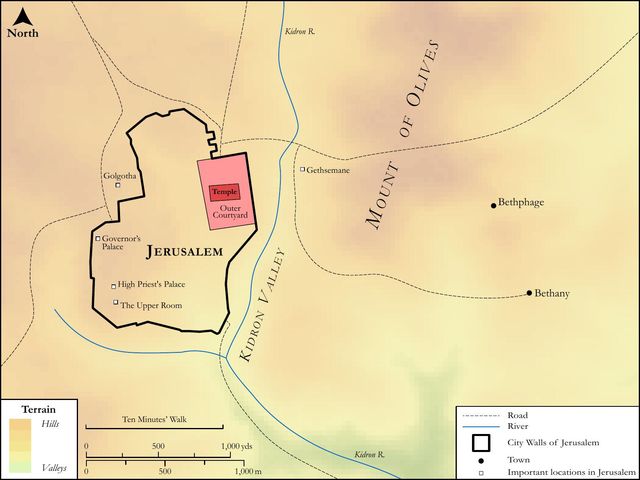
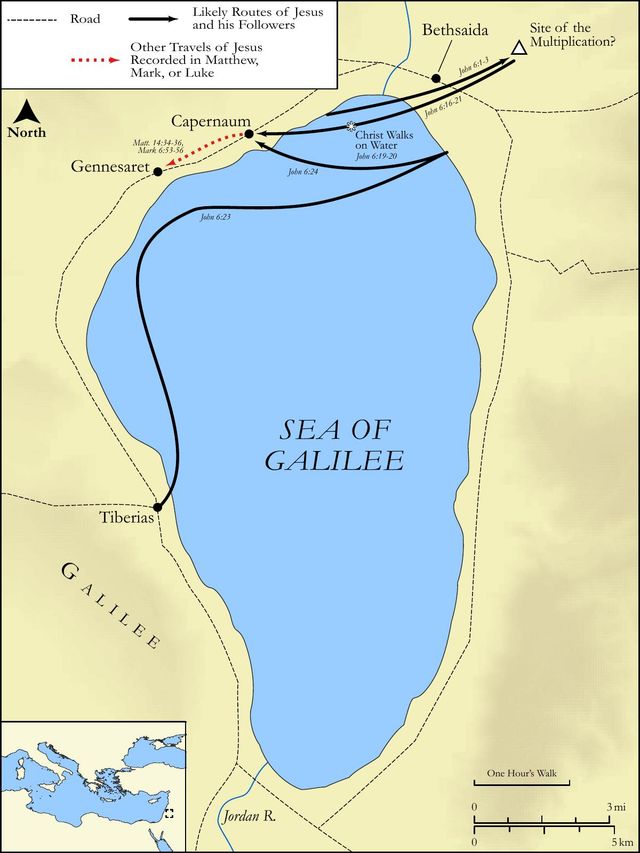
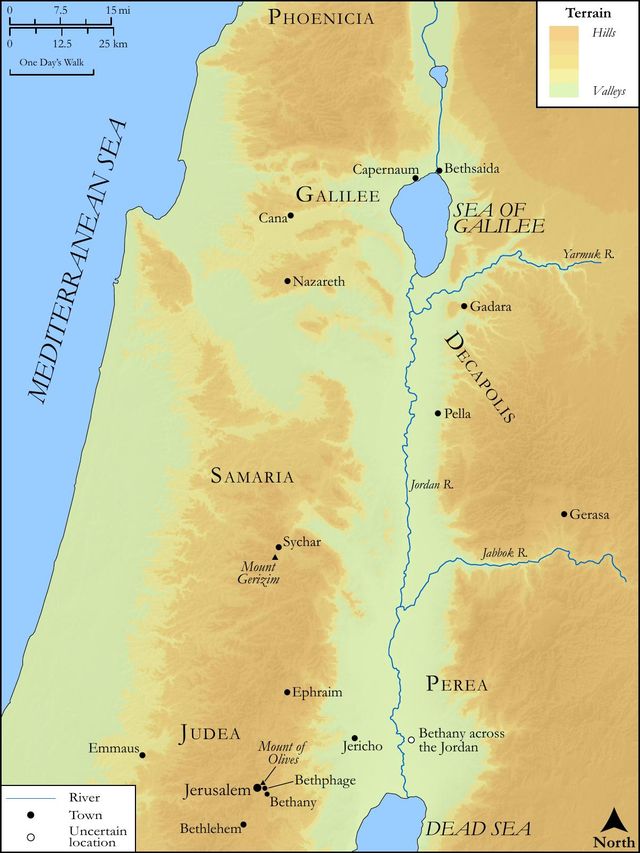
See on the biblical-era map
Study this verse
Public-domain commentary
Matthew Henry
From his Commentary on the Whole Bible. Henry comments on passages, not single verses — this entry covers John 6:28–59. His four-level outline is real structure in the source text, so it is rendered as structure.
Whether this conference was with the Capernaites, in whose synagogue Christ now was, or with those who came from the other side of the sea, is not certain nor material; however, it is an instance of Christ's condescension that he gave them leave to ask him questions, and did not resent the interruption as an affront, no, not from his common hearers, though not his immediate followers. Those that would be apt to teach must be swift to hear, and study to answer. It is the wisdom of teachers, when they are asked even impertinent unprofitable questions, thence to take occasion to answer in that which is profitable, that the question may be rejected, but not the request. Now,
I.Christ having told them that they must work for the meat he spoke of, must labour for it, they enquire what work they must do, and he answers them, v. 28, 29.
1.Their enquiry was pertinent enough (v. 28): What shall we do, that we may work the works of God? Some understand it as a pert question: "What works of God can we do more and better than those we do in obedience to the law of Moses?" But I rather take it as a humble serious question, showing them to be, at least for the present, in a good mind, and willing to know and do their duty; and I imagine that those who asked this question, How and What (v. 30), and made the request (v. 34), were not the same persons with those that murmured (v. 41, 42), and strove (v. 52), for those are expressly called the Jews, who came out of Judea (for those were strictly called Jews) to cavil, whereas these were of Galilee, and came to be taught. This question here intimates that they were convinced that those who would obtain this everlasting meat,
(1.)Must aim to do something great. Those who look high in their expectations, and hope to enjoy the glory of God, must aim high in those endeavours, and study to do the works of God, works which he requires and will accept, works of God, distinguished from the works of worldly men in their worldly pursuits. It is not enough to speak the words of God, but we must do the works of God.
(2.)Must be willing to do any thing: What shall we do? Lord, I am ready to do whatever thou shalt appoint, though ever so displeasing to flesh and blood, Acts ix. 6.
2.Christ's answer was plain enough (v. 29): This is the work of God that ye believe. Note,
(1.)The work of faith is the work of God. They enquire after the works of God (in the plural number), being careful about many things; but Christ directs them to one work, which includes all, the one thing needful: that you believe, which supersedes all the works of the ceremonial law; the work which is necessary to the acceptance of all the other works, and which produces them, for without faith you cannot please God. It is God's work, for it is of his working in us, it subjects the soul to his working on us, and quickens the soul in working for him,
(2.)That faith is the work of God which closes with Christ, and relies upon him. It is to believe on him as one whom God hath sent, as God's commissioner in the great affair of peace between God and man, and as such to rest upon him, and resign ourselves to him. See ch. xiv. 1.
II.Christ having told them that the Son of man would give them this meat, they enquire concerning him, and he answers their enquiry.
1.Their enquiry is after a sign (v. 30): What sign showest thou? Thus far they were right, that, since he required them to give him credit, he should produce his credentials, and make it out by miracle that he was sent of God. Moses having confirmed his mission by signs, it was requisite that Christ, who came to set aside the ceremonial law, should in like manner confirm his: "What dost thou work? What doest thou drive at? What lasting characters of a divine power does thou design to leave upon thy doctrine?" But herein they missed it,
(1.)That they overlooked the many miracles which they had seen wrought by him, and which amounted to an abundant proof of his divine mission. Is this a time of day to ask, "What sign showest thou?" especially at Capernaum, the staple of miracles, where he had done so many mighty works, signs so significant of his office and undertaking? Were not these very persons but the other day miraculously fed by him? None so blind as they that will not see; for they may be so blind as to question whether it be day or no, when the sun shines in their faces.
(2.)That they preferred the miraculous feeding of Israel in the wilderness before all the miracles Christ wrought (v. 31): Our fathers did eat manna in the desert; and, to strengthen the objection, they quote a scripture for it: He gave them bread from heaven (taken from Ps. lxxviii. 24), he gave them of the corn of heaven. What a good use might be made of this story to which they here refer! It was a memorable instance of God's power and goodness, often mentioned to the glory of God (Neh. xix. 20, 21), yet see how these people perverted it, and made an ill use of it. [1.] Christ reproved them for their fondness of the miraculous bread, and bade them not set their hearts upon meat which perisheth; "Why," say they, "meat for the belly was the great good thing that God gave to our fathers in the desert; and why should not we then labour for that meat? If God made much of them, why should not we be for those that will make much of us?" [2.] Christ had fed five thousand men with five loaves, and had given them that as one sign to prove him sent of God; but, under colour of magnifying the miracles of Moses, they tacitly undervalue this miracle of Christ, and evade the evidence of it. "Christ fed his thousands; but Moses his hundreds of thousands; Christ fed them but once, and then reproved those who followed him in hope to be still fed, and put them off with a discourse of spiritual food; but Moses fed his followers forty years, and miracles were not their rarities, but their daily bread: Christ fed them with bread out of the earth, barley-bread, and fishes out of the sea; but Moses fed Israel with bread from heaven, angel's food." Thus big did these Jews talk of the manna which their fathers did eat; but their fathers had slighted it as much as they did now the barley-loaves, and called light bread, Num. xxi. 5. Thus apt are we to slight and overlook the appearances of God's power and grace in our own times, while we pretend to admire the wonders of which our fathers told us. Suppose this miracle of Christ was outdone by that of Moses, yet there were other instances in which Christ's miracles outshone his; and, besides, all true miracles prove a divine doctrine, though not equally illustrious in the circumstances, which were ever diversified according as the occasion did require. As much as the manna excelled the barley-loaves, so much, and much more, did the doctrine of Christ excel the law of Moses, and his heavenly institutions the carnal ordinances of that dispensation.
2.Here is Christ's reply to this enquiry, wherein,
(1.)He rectifies their mistake concerning the typical manna. It was true that their fathers did eat manna in the desert. But,
[1.]It was not Moses that gave it to them, nor were they obliged to him for it; he was but the instrument, and therefore they must look beyond him to God. We do not find that Moses did so much as pray to God for the manna; and he spoke unadvisedly when he said, Must we fetch water out of the rock? Moses gave them not either that bread or that water.
[2.]It was not given them, as they imagined, from heaven, from the highest heavens, but only from the clouds, and therefore not so much superior to that which had its rise from the earth as they thought. Because the scripture saith, He gave them bread from heaven, it does not follow that it was heavenly bread, or was intended to be the nourishment of souls. Misunderstanding scripture language occasions many mistakes in the things of God.
(2.)He informs them concerning the true manna, of which that was a type: But my Father giveth you the true bread from heaven; that which is truly and properly the bread from heaven, of which the manna was but a shadow and figure, is now given, not to your fathers, who are dead and gone, but to you of this present age, for whom the better things were reserved: he is now giving you that bread from heaven, which is truly so called. As much as the throne of God's glory is above the clouds of the air, so much does the spiritual bread of the everlasting gospel excel the manna. In calling God his Father, he proclaims himself greater than Moses; for Moses was faithful but as a servant, Christ as a Son, Heb. iii. 5, 6.
III.Christ, having replied to their enquiries, takes further occasion from their objection concerning the manna to discourse of himself under the similitude of bread, and of believing under the similitude of eating and drinking; to which, together with his putting both together in the eating of his flesh and drinking of his blood, and with the remarks made upon it by the hearers, the rest of this conference may be reduced.
1.Christ having spoken of himself as the great gift of God, and the true bread (v. 32), largely explains and confirms this, that we may rightly know him.
(1.)He here shows that he is the true bread; this he repeats again and again, v. 33, 35, 48-51. Observe,
[1.]That Christ is bread is that to the soul which bread is to the body, nourishes and supports the spiritual life (is the staff of it) as bread does the bodily life; it is the staff of life. The doctrines of the gospel concerning Christ—that he is the mediator between God and man, that he is our peace, our righteousness, our Redeemer; by these things do men live. Our bodies could better live without food than our souls without Christ. Bread-corn is bruised (Isa. xxviii. 28), so was Christ; he was born at Bethlehem, the house of bread, and typified by the show-bread.
[2.]That he is the bread of God (v. 33), divine bread; it is he that is of God (v. 46), bread which my Father gives (v. 32), which he has made to be the food of our souls; the bread of God's family, his children's bread. The Levitical sacrifices are called the bread of God (Lev. xxi. 21, 22), and Christ is the great sacrifice; Christ, in his word and ordinances, the feast upon the sacrifice.
[3.]That he is the bread of life (v. 35, and again, v. 48), that bread of life, alluding to the tree of life in the midst of the garden of Eden, which was to Adam the seal of that part of the covenant, Do this and live, of which he might eat and live. Christ is the bread of life, for he is the fruit of the tree of life. First, He is the living bread (so he explains himself, v. 51): I am the living bread. Bread is itself a dead thing, and nourishes not but by the help of the faculties of a living body; but Christ is himself living bread, and nourishes by his own power. Manna was a dead thing; if kept but one night, it putrefied and bred worms; but Christ is ever living, everlasting bread, that never moulds, nor waxes old. The doctrine of Christ crucified is now as strengthening and comforting to a believer as ever it was, and his mediation still of as much value and efficacy as ever. Secondly, He gives life unto the world (v. 33), spiritual and eternal life; the life of the soul in union and communion with God here, and in the vision and fruition of him hereafter; a life that includes in it all happiness. The manna did only reserve and support life, did not preserve and perpetuate life, much less restore it; but Christ gives life to those that were dead in sin. The manna was ordained only for the life of the Israelites, but Christ is given for the life of the world; none are excluded from the benefit of this bread, but such as exclude themselves. Christ came to put life into the minds of men, principles productive of acceptable performances.
[4.]That he is the bread which came down from heaven; this is often repeated here, v. 33, 50, 51, 58. This denotes, First, The divinity of Christ's person. As God, he had a being in heaven, whence he came to take our nature upon him: I came down from heaven, whence we may infer his antiquity, he was in the beginning with God; his ability, for heaven is the firmament of power; and his authority, he came with a divine commission. Secondly, The divine original of all that good which flows to us through him. He comes, not only katabas—that came down (v. 51), but katabainoi—that comes down; he is descending, denoting a constant communication of light, life, and love, from God to believers through Christ, as the manna descended daily; see Eph. i. 3. Omnia desuper—All things from above.
[5.]That he is that bread of which the manna was a type and figure (v. 58), that bread, the true bread, v. 32. As the rock that they drank of was Christ, so was the manna they ate of spiritual bread, 1 Cor. x. 3, 4. Manna was given to Israel; so Christ to the spiritual Israel. There was manna enough for them all; so in Christ a fulness of grace for all believers; he that gathers much of this manna will have none to spare when he comes to use it; and he that gathers little, when his grace comes to be perfected in glory, shall find that he has no lack. Manna was to be gathered in the morning; and those that would find Christ must seek him early. Manna was sweet, and, as the author of the Wisdom of Solomon tells us (Wisd. xvi. 20), was agreeable to every palate; and to those that believe Christ is precious. Israel lived upon manna till they came to Canaan; and Christ is our life. There was a memorial of the manna preserved in the ark; so of Christ in the Lord's supper, as the food of souls.
(2.)He here shows what his undertaking was, and what his errand into the world. Laying aside the metaphor, he speaks plainly, and speaks no proverb, giving us an account of his business among men, v. 38-40.
[1.]He assures us, in general, that he came from heaven upon his Father's business (v. 38), not do his own will, but the will of him that sent him. He came from heaven, which bespeaks him an intelligent active being, who voluntarily descended to this lower world, a long journey, and a great step downward, considering the glories of the world he came from and the calamities of the world he came to; we may well ask with wonder, "What moved him to such an expedition?" Here he tells that he came to do, not his own will, but the will of his Father; not that he had any will that stood in competition with the will of his Father, but those to whom he spoke suspected he might. "No," saith he, "my own will is not the spring I act from, nor the rule I go by, but I am come to do the will of him that sent me." That is, First, Christ did not come into the world as a private person, that acts for himself only, but under a public character, to act for others as an ambassador, or plenipotentiary, authorized by a public commission; he came into the world as God's great agent and the world's great physician. It was not any private business that brought him hither, but he came to settle affairs between parties no less considerable than the great Creator and the whole creation. Secondly, Christ, when he was in the world, did not carry on any private design, nor had any separate interest at all, distinct from theirs for whom he acted. The scope of his whole life was to glorify God and do good to men. He therefore never consulted his own ease, safety, or quiet; but, when he was to lay down his life, though he had a human nature which startled at it, he set aside the consideration of that, and resolved his will as man into the will of God: Not as I will, but as thou wilt.
[2.]He acquaints us, in particular, with that will of the Father which he came to do; he here declares the decree, the instructions he was to pursue.
First, The private instructions given to Christ, that he should be sure to save all the chosen remnant; and this is the covenant of redemption between the Father and the Son (v. 38): "This is the Father's will, who hath sent me; this is the charge I am entrusted with, that of all whom he hath given me I should lose none." Note, 1. There is a certain number of the children of men given by the Father to Jesus Christ, to be his care, and so to be to him for a name and a praise; given him for an inheritance, for a possession. Let him do all that for them which their case requires; teach them, and heal them, pay their debt, and plead their cause, prepare them for, and preserve them to, eternal life, and then let him make his best of them. The Father might dispose of them as he pleased: as creatures, their lives and beings were derived from him; as sinners, their lives and beings were forfeited to him. He might have sold them for the satisfaction of his justice, and delivered them to the tormentors; but he pitched upon them to be the monuments of his mercy, and delivered them to the Saviour. Those whom God chose to be the objects of his special love he lodged as a trust in the hands of Christ. 2. Jesus Christ has undertaken that he will lose none of those that were thus given him of the Father. The many sons whom he was to bring to glory shall all be forth-coming, and none of them missing, Matt. xviii. 14. None of them shall be lost, for want of a sufficient grace to sanctify them. If I bring him not unto thee, and set him before thee, then let me bear the blame for ever, Gen. xliii. 9. 3. Christ's undertaking for those that are given him extends to the resurrection of their bodies. I will raise it up again at the last day, which supposes all that goes before, but this is to crown and complete the undertaking. The body is a part of the man, and therefore a part of Christ's purchase and charge; it pertains to the promises, and therefore it shall not be lost. The undertaking is not only that he shall lose none, no person, but that he shall lose nothing, no part of the person, and therefore not the body. Christ's undertaking will never be accomplished till the resurrection, when the souls and bodies of the saints shall be re-united and gathered to Christ, that he may present them to the Father: Behold I, and the children that thou has given me, Heb. ii. 13; 2 Tim. i. 12. 4. The spring and original of all this is the sovereign will of God, the counsels of his will, according to which he works all this. This was the commandment he gave to his Son, when he sent him into the world, and to which the Son always had an eye.
Secondly, The public instructions which were to be given to the children of men, in what way, and upon what terms, they might obtain salvation by Christ; and this is the covenant of grace between God and man. Who the particular persons were that were given to Christ is a secret: The Lord knows them that are his, we do not, nor is it fit we should; but, though their names are concealed, their characters are published. An offer is made of life and happiness upon gospel terms, that by it those that were given to Christ might be brought to him, and others left inexcusable (v. 40): "This is the will, the revealed will, of him that sent me, the method agreed upon, upon which to proceed with the children of men, that every one, Jew or Gentile, that sees the Son, and believes on him, may have everlasting life, and I will raise him up." This is gospel indeed, good news. Is it now reviving to hear this? 1. That eternal life may be had, if it be not our own fault; that whereas, upon the sin of the first Adam, the way of the tree of life was blocked up, by the grace of the second Adam it is laid upon again. The crown of glory is set before us as the prize of our high calling, which we may run for and obtain. 2. Every one may have it. This gospel is to be preached, this offer made, to all, and none can say, "It belongs not to me," Rev. xxii. 17. 3. This everlasting life is sure to all those who believe in Christ, and to them only. He that sees the Son, and believes on him, shall be saved. Some understand this seeing as a limitation of this condition of salvation to those only that have the revelation of Christ and his grace made to them. Every one that has the opportunity of being acquainted with Christ, and improves this so well as to believe in him, shall have everlasting life, so that none shall be condemned for unbelief (however they maybe for other sins) but those who have had the gospel preached to them, who, like these Jews here (v. 36), have seen, and yet have not believed; have known Christ, and yet not trusted in him. But I rather understand seeing here to mean the same thing with believing, for it is theoron, which signifies not so much the sight of the eye (as v. 36, heorakate me—ye have seen me) as the contemplation of the mind. Every one that sees the Son, that is, believes on him, sees him with an eye of faith, by which we come to be duly acquainted and affected with the doctrine of the gospel concerning him. It is to look upon him, as the stung Israelites upon the brazen serpent. It is not a blind faith that Christ requires, that we should be willing to have our eyes put out, and then follow him, but that we should see him, and see what ground we go upon in our faith. It is then right when it is not taken up upon hearsay (believing as the church believes), but is the result of a due consideration of, and insight into, the motives of credibility: Now mine eye sees thee. We have heard him ourselves. 4. Those who believe in Jesus Christ, in order to their having everlasting life, shall be raised up by his power at the last day. He had it in charge as his Father's will (v. 39), and here he solemnly makes it his own undertaking: I will raise him up, which signifies not only the return of the body to life, but the putting of the whole man into a full possession of the eternal life promised.
2.Now Christ discoursing thus concerning himself, as the bread of life that came down from heaven, let us see what remarks his hearers made upon it.
(1.)When they heard of such a thing as the bread of God, which gives life, they heartily prayed for it (v. 34): Lord, evermore give us this bread. I cannot think that this is spoken scoffingly, and in a way of derision, as most interpreters understand it: "Give us such bread as this, if thou canst; let us be fed with it, not for one meal, as with the five loaves, but evermore;" as if this were no better a prayer than that of the impenitent thief: If thou be the Christ, save thyself and us. But I take this request to be made, though ignorantly, yet honestly, and to be well meant; for they call him Lord, and desire a share in what he gives, whatever he means by it. General and confused notions of divine things produce in carnal hearts some kind of desires towards them, and wishes of them; like Balaam's wish, to die the death of the righteous. Those who have an indistinct knowledge of the things of God, who see men as trees walking, make, as I may call them, inarticulate prayers for spiritual blessings. They think the favour of God a good thing, and heaven a fine place, and cannot but wish them their own, while they have no value nor desire at all for that holiness which is necessary both to the one and to the other. Let this be the desire of our souls; have we tasted that the Lord is gracious, been feasted with the word of God, and Christ in the word? Let us say, "Lord, evermore give us this bread; let the bread of life be our daily bread, the heavenly manna our continual feast, and let us never know the want of it."
(2.)But, when they understood that by this bread of life Jesus meant himself, then they despised it. Whether they were the same persons that had prayed for it (v. 34), or some others of the company, does not appear; it seems to be some others, for they are called Jews. Now it is said (v. 41), They murmured at him. This comes in immediately after that solemn declaration which Christ had made of God's will and his own undertaking concerning man's salvation (v. 39, 40), which certainly were some of the most weighty and gracious words that ever proceeded out of the mouth of our Lord Jesus, the most faithful, and best worthy of all acceptation. One would think that, like Israel in Egypt, when they heard that God had thus visited them, they should have bowed their heads and worshipped; but on the contrary, instead of closing with the offer made them, they murmured, quarrelled with what Christ said, and, though they did not openly oppose and contradict it, yet they privately whispered among themselves in contempt of it, and instilled into one another's minds prejudices against it. Many that will not professedly contradict the doctrine of Christ (their cavils are so weak and groundless that they are either ashamed to own them or afraid to have them silenced), yet say in their hearts that they do not like it. Now,
[1.]That which offended them was Christ's asserting his origin to be from heaven, v. 41, 42. How is it that he saith, I came down from heaven? They had heard of angels coming down from heaven, but never of a man, overlooking the proofs he had given them of his being more than a man.
[2.]That which they thought justified them herein was that they knew his extraction on earth: Is not this Jesus the son of Joseph, whose father and mother we know? They took it amiss that he should say that he came down from heaven, when he was one of them. They speak slightly of his blessed name, Jesus: Is not this Jesus. They take it for granted that Joseph was really his father, though he was only reputed to be so. Note, Mistakes concerning the person of Christ, as if he were a mere man, conceived and born by ordinary generation, occasion the offence that is taken at his doctrine and offices. Those who set him on a level with the other sons of men, whose father and mother we know, no wonder if they derogate from the honour of his satisfaction and the mysteries of his undertaking, and, like the Jews here, murmur at his promise to raise us up at the last day.
3.Christ, having spoken of faith as the great work of God (v. 29), discourses largely concerning this work, instructing and encouraging us in it.
(1.)He shows what it is to believe in Christ.
[1.]To believe in Christ is to come to Christ. He that comes to me is the same with him that believes in me (v. 35), and again (v. 37): He that comes unto me; so v. 44, 45. Repentance towards God is coming to him (Jer. iii. 22) as our chief good and highest end; and so faith towards our Lord Jesus Christ is coming to him as our prince and Saviour, and our way to the Father. It denotes the out-goings of our affection towards him, for these are the motions of the soul, and actions agreeable; it is to come off from all those things that stand in opposition to him or competition with him, and to come up to those terms upon which life and salvation are offered to us through him. When he was here on earth it was more that barely coming where he was; so it is now more than coming to his word and ordinances.
[2.]It is to feed upon Christ (v. 51): If any man eat of this bread. The former denotes applying ourselves to Christ; this denotes applying Christ to ourselves, with appetite and delight, that we may receive life, and strength, and comfort from him. To feed on him as the Israelites on the manna, having quitted the fleshpots of Egypt, and not depending on the labour of their hands (to eat of that), but living purely on the bread given them from heaven.
(2.)He shows what is to be got by believing in Christ. What will he give us if we come to him? What shall we be the better of we feed upon him? Want and death are the chief things we dread; may we but be assured of the comforts of our being, and the continuance of it in the midst of these comforts, we have enough; now these two are here secured to true believers.
[1.]They shall never want, never hunger, never thirst, v. 35. Desires they have, earnest desires, but these so suitably, so seasonably, so abundantly satisfied, that they cannot be called hunger and thirst, which are uneasy and painful. Those that did eat manna, and drink of the rock, hungered and thirsted afterwards. Manna surfeited them; water out of the rock failed them. But there is such an over-flowing fulness in Christ as can never be exhausted, and there are such ever-flowing communications from him as can never be interrupted.
[2.]They shall never die, not die eternally; for, First, He that believes on Christ has everlasting life (v. 47); he has the assurance of it, the grant of it, the earnest of it; he has it in the promise and first-fruits. Union with Christ and communion with God in Christ are everlasting life begun. Secondly, Whereas they that did eat manna died, Christ is such bread as a man may eat of and never die, v. 49, 50. Observe here, 1. The insufficiency of the typical manna: Your fathers did eat manna in the wilderness, and are dead. There may be much good use made of the death of our fathers; their graves speak to us, and their monuments are our memorials, particularly of this, that the greatest plenty of the most dainty food will neither prolong the thread of life nor avert the stroke of death. Those that did eat manna, angel's food, died like other men. There could be nothing amiss in their diet, to shorten their days, nor could their deaths be hastened by the toils and fatigues of life (for they neither sowed nor reaped), and yet they died. (1.) Many of them died by the immediate strokes of God's vengeance for their unbelief and murmurings; for, though they did eat that spiritual meat, yet with many of them God was not well-pleased, but they were overthrown in the wilderness, 1 Cor. x. 3-5. Their eating manna was no security to them from the wrath of God, as believing in Christ is to us. (2.) The rest of them died in a course of nature, and their carcases fell, under a divine sentence, in that wilderness where they did eat manna. In that very age when miracles were daily bread was the life of man reduced to the stint it now stands at, as appears, Ps. xc. 10. Let them not then boast so much of manna. 2. The all-sufficiency of the true manna, of which the other was a type: This is the bread that cometh down from heaven, that truly divine and heavenly food, that a man may eat thereof and not die; that is, not fall under the wrath of God, which is killing to the soul; not die the second death; no, nor the first death finally and irrecoverably. Not die, that is, not perish, not come short of the heavenly Canaan, as the Israelites did of the earthly, for want of faith, though they had manna. This is further explained by that promise in the next words: If any man eat of this bread, he shall live for ever, v. 51. This is the meaning of this never dying: though he go down to death, he shall pass through it to that world where there shall be no more death. To live for ever is not to be for ever (the damned in hell shall be for ever, the soul of man was made for an endless state), but to be happy for ever. And because the body must needs die, and be as water spilt upon the ground, Christ here undertakes for the gathering of that up too (as before, v. 44, I will raise him up at the last day); and even that shall live for ever.
(3.)He shows what encouragements we have to believe in Christ. Christ here speaks of some who had seen him and yet believed not, v. 36. They saw his person and miracles, and heard him preach, and yet were not wrought upon to believe in him. Faith is not always the effect of sight; the soldiers were eye-witnesses of his resurrection, and yet, instead of believing in him, they belied him; so that it is a difficult thing to bring people to believe in Christ: and, by the operation of the Spirit of grace, those that have not seen have yet believed. Two things we are here assured of, to encourage our faith:—
[1.]That the Son will bid all those welcome that come to him (v. 37): Him that cometh to me I will in no wise cast out. How welcome should this word be to our souls which bids us welcome to Christ! Him that cometh; it is in the singular number, denoting favour, not only to the body of believers in general, but to every particular soul that applies itself to Christ. Here, First, The duty required is a pure gospel duty: to come to Christ, that we may come to God by him. His beauty and love, those great attractives, must draw us to him; sense of need and fear of danger must drive us to him; any thing to bring us to Christ. Secondly, The promise is a pure gospel promise: I will in no wise cast out—ou me ekbago exo. There are two negatives: I will not, no, I will not. 1. Much favour is expressed here. We have reason to fear that he should cast us out. Considering our meanness, our vileness, our unworthiness to come, our weakness in coming, we may justly expect that he should frown upon us, and shut his doors against us; but he obviates these fears with this assurance, he will not do it; will not disdain us though we are mean, will not reject us though we are sinful. Do poor scholars come to him to be taught? Though they be dull and slow, he will not cast them out. Do poor patients come to him to be cured, poor clients come to him to be advised? Though their case be bad, and though they come empty-handed, he will in no wise cast them out. But, 2. More favour is implied than is expressed; when it is said that he will no cast them out the meaning is, He will receive them, and entertain them, and give them all that which they come to him for. As he will not refuse them at their first coming, so he will not afterwards, upon every displeasure, cast them out. His gifts and callings are without repentance.
[2.]That the Father will, without fail, bring all those to him in due time that were given him. In the federal transactions between the Father and the Son, relating to man's redemption, as the Son undertook for the justification, sanctification, and salvation, of all that should come to him ("Let me have them put into my hands, and then leave the management of them to me"), so the Father, the fountain and original of being, life, and grace, undertook to put into his hand all that were given him, and bring them to him. Now,
First, He here assures us that this shall be done: All that the Father giveth me shall come to me, v. 37. Christ had complained (v. 36) of those who, though they had seen him, yet would not believe on him; and then he adds this,
a.For their conviction and awakening, plainly intimating that their not coming to him, and believing on him, if they persisted in it, would be a certain sign that they did not belong to the election of grace; for how can we think that God gave us to Christ if we give ourselves to the world and the flesh? 2 Pet. i. 10.
b.For his own comfort and encouragement: Though Israel be not gathered, yet shall I be glorious. The election has obtained, and shall though multitudes be blinded, Rom. xi. 7. Though he lose many of his creatures, yet none of his charge: All that the Father gives him shall come to him notwithstanding. Here we have, (a.) The election described: All that the father giveth me, pan ho didosi—every thing which the Father giveth to me; the persons of the elect, and all that belongs to them; all their services, all their interests. As all that he has is theirs, so all that they have is his, and he speaks of them as his all: they were given him in full recompense of his undertaking. Not only all persons, but all things, are gathered together in Christ (Eph. i. 10) and reconciled, Col. i. 20. The giving of the chosen remnant to Christ is spoken of (v. 39) as a thing done; he hath given them. Here it is spoken of as a thing in the doing; he giveth them; because, when the first begotten was brought into the world, it should seem, there was a renewal of the grant; see Heb. x. 5, &c. God was now about to give him the heathen for his inheritance (Ps. ii. 8), to put him in possession of the desolate heritages (Isa. xlix. 8), to divide him a portion with the great, Isa. liii. 12. And though the Jews, who saw him, believed not on him, yet these (saith he) shall come to me; the other sheep, which are not of this fold, shall be brought, ch. x. 15, 16. See Acts xiii. 45-48. (b.) The effect of it secured: They shall come to me. This is not in the nature of a promise, but a prediction, that as many as were in the counsel of God ordained to life shall be brought to life by being brought to Christ. They are scattered, are mingled among the nations, yet none of them shall be forgotten; not a grain of God's corn shall be lost, as is promised, Amos ix. 9. They are by nature alienated from Christ, and averse to him, and yet they shall come. As God's omniscience is engaged for the finding of them all out, so is his omnipotence for the bringing of them all in. Not, They shall be driven, to me, but, They shall come freely, shall be made willing.
Secondly, He here acquaints us how it shall be done. How shall those who are given to Christ be brought to him? Two things are to be done in order to it:—
a.Their understandings shall be enlightened; this is promised, v. 45, 46. It is written in the prophets, who spoke of these things before, And they shall be all taught of God; this we find, Isa. liv. 13, and Jer. xxxi. 34. They shall all know me. Note,
(a.)In order to our believing in Jesus Christ, it is necessary that we be taught of God; that is, [a.] That there be a divine revelation made to us, discovering to us both what we are to believe concerning Christ and why we are to believe it. There are some things which even nature teaches, but to bring us to Christ there is need of a higher light. [b.] That there be a divine work wrought in us, enabling us to understand and receive these revealed truths and the evidence of them. God, in giving us reason, teaches us more than the beasts of the earth; but in giving us faith he teaches more than the natural man. Thus all the church's children, all that are genuine, are taught of God; he hath undertaken their education.
(b.)It follows then, by way of inference from this, that every man that has heard and learned of the Father comes to Christ, v. 45. [a.] It is here implied that none will come to Christ but those that have heard and learned of the Father. We shall never be brought to Christ but under a divine conduct; except God by his grace enlighten our minds, inform our judgments, and rectify our mistakes, and not only tell us that we may hear, but teach us, that we may learn the truth as it is in Jesus, we shall never be brought to believe in Christ. [b.] That this divine teaching does so necessarily produce the faith of God's elect that we may conclude that those who do not come to Christ have never heard nor learned of the Father; for, if they had, doubtless they would have come to Christ. In vain do men pretend to be taught of God if they believe not in Christ, for he teaches no other lesson, Gal. i. 8, 9. See how God deals with men as reasonable creatures, draws them with the cords of a man, opens the understanding first, and then by that, in a regular way, influences the inferior faculties; thus he comes in by the door, but Satan, as a robber, climbs up another way. But lest any should dream of a visible appearance of God the Father to the children of men (to teach them these things), and entertain any gross conceptions about hearing and learning of the Father, he adds (v. 46): Not that any man hath seen the Father; it is implied, nor can see him, with bodily eyes, or may expect to learn of him as Moses did, to whom he spoke face to face; but God, in enlightening men's eyes and teaching them, works in a spiritual way. The Father of spirits hath access to, and influence upon, men's spirits, undiscerned. The Father of spirits hath access to, and influence upon, men's spirits, undiscerned. Those that have not seen his face have felt his power. And yet there is one intimately acquainted with the Father, he who is of God, Christ himself, he hath seen the Father, ch. i. 18. Note, First, Jesus Christ is of God in a peculiar manner, God of God, light of light; not only sent of God, but begotten of God before all worlds. Secondly, It is the prerogative of Christ to have seen the Father, perfectly to know him and his counsels. Thirdly, Even that illumination which is preparative to faith is conveyed to us through Christ. Those that learn of the Father, forasmuch as they cannot see him themselves, must learn of Christ, who alone hath seen him. As all divine discoveries are made through Christ, so through him all divine powers are exerted.
b.Their wills shall be bowed. If the soul of man had now its original rectitude there needed no more to influence the will than the illumination of the understanding; but in the depraved soul of fallen man there is a rebellion of the will against the right dictates of the understanding; a carnal mind, which is enmity itself to the divine light and law. It is therefore requisite that there be a work of grace wrought upon the will, which is here called drawing, (v. 44): No man can come to me except the Father, who hath sent me, draw him. The Jews murmured at the doctrine of Christ; not only would not receive it themselves, but were angry that others did. Christ overheard their secret whisperings, and said (v. 43), "Murmur not among yourselves; lay not the fault of your dislike of my doctrine one upon another, as if it were because you find it generally distasted; no, it is owing to yourselves, and your own corrupt dispositions, which are such as amount to a moral impotency; your antipathies to the truths of God, and prejudices against them, are so strong that nothing less than a divine power can conquer them." And this is the case of all mankind: "No man can come to me, can persuade himself to come up to the terms of the gospel, except the Father, who hath sent me, draw him," v. 44. Observe, (a.) The nature of the work: It is drawing, which denotes not a force put upon the will, whereby of unwilling we are made willing, and a new bias is given to the soul, by which it inclines to God. This seems to be more than a moral suasion, for by that it is in the power to draw; yet it is not to be called a physical impulse, for it lies out of the road of nature; but he that formed the spirit of man within him by his creating power, and fashions the hearts of men by his providential influence, knows how to new-mould the soul, and to alter its bent and temper, and make it conformable to himself and his own will, without doing any wrong to its natural liberty. It is such a drawing as works not only a compliance, but a cheerful compliance, a complacency: Draw us, and we will run after thee. (b.) The necessity of it: No man, in this weak and helpless state, can come to Christ without it. As we cannot do any natural action without the concurrence of common providence, so we cannot do any action morally good without the influence of special grace, in which the new man lives, and moves, and has its being, as much as the mere man has in the divine providence. (c.) The author of it: The Father who hath sent me. The Father, having sent Christ, will succeed him, for he would not send him on a fruitless errand. Christ having undertaken to bring souls to glory, God promised him, in order thereunto, to bring them to him, and so to give him possession of those to whom he had given him a right. God, having by promise given the kingdom of Israel to David, did at length draw the hearts of the people to him; so, having sent Christ to save souls, he sends souls to him to be saved by him. (d.) The crown and perfection of this work: And I will raise him up at the last day. This is four times mentioned in this discourse, and doubtless it includes all the intermediate and preparatory workings of divine grace. When he raises them up at the last day, he will put the last hand to his undertaking, will bring forth the topstone. If he undertakes this, surely he can do any thing, and will do every thing that is necessary in order to do it. Let our expectations be carried out towards a happiness reserved for the last day, when all the years of time shall be fully complete and ended.
4.Christ, having thus spoken of himself as the bread of life, and of faith as the work of God, comes more particularly to show what of himself is this bread, namely, his flesh, and that to believe is to eat of that, v. 51-58, where he still prosecutes the metaphor of food. Observe, here, the preparation of this food: The bread that I will give is my flesh (v. 51), the flesh of the Son of man and his blood, v. 53. His flesh is meat indeed, and his blood is drink indeed, v. 55. Observe, also, the participation of this food: We must eat the flesh of the Son of man and drink his blood (v. 53); and again (v. 54), Whoso eateth my flesh and drinketh my blood; and the same words (v. 56, 57), he that eateth me. This is certainly a parable or figurative discourse, wherein the actings of the soul upon things spiritual and divine are represented by bodily actions about things sensible, which made the truths of Christ more intelligible to some, and less so to others, Mark iv. 11-12. Now,
(1.)Let us see how this discourse of Christ was liable to mistake and misconstruction, that men might see, and not perceive.
[1.]It was misconstrued by the carnal Jews, to whom it was first delivered (v. 52): They strove among themselves; they whispered in each other's ears their dissatisfaction: How can this man give us his flesh to eat? Christ spoke (v. 51) of giving his flesh for us, to suffer and die; but they, without due consideration, understood it of his giving it to us, to be eaten, which gave occasion to Christ to tell them that, however what he said was otherwise intended, yet even that also of eating of his flesh was no such absurd thing (if rightly understood) as prima facie—in the first instance, they took it to be.
[2.]It has been wretchedly misconstrued by the church of Rome for the support of their monstrous doctrine of transubstantiation, which gives the lie to our senses, contradicts the nature of a sacrament, and overthrows all convincing evidence. They, like these Jews here, understand it of a corporal and carnal eating of Christ's body, like Nicodemus, ch. iii. 4. The Lord's supper was not yet instituted, and therefore it could have no reference to that; it is a spiritual eating and drinking that is here spoken of, not a sacramental.
[3.]It is misunderstood by many ignorant carnal people, who hence infer that, if they take the sacrament when they die, they shall certainly go to heaven, which, as it makes many that are weak causelessly uneasy if they want it, so it makes many that are wicked causelessly easy if they have it. Therefore,
(2.)Let us see how this discourse of Christ is to be understood.
[1.]What is meant by the flesh and blood of Christ. It is called (v. 53), The flesh of the Son of man, and his blood, his as Messiah and Mediator: the flesh and blood which he assumed in his incarnation (Heb. ii. 14), and which he gave up in his death and suffering: my flesh which I will give to be crucified and slain. It is said to be given for the life of the world, that is, First, Instead of the life of the world, which was forfeited by sin, Christ gives his own flesh as a ransom or counterprice. Christ was our bail, bound body for body (as we say), and therefore his life must go for ours, that ours may be spared. Here am I, let these go their way. Secondly, In order to the life of the world, to purchase a general offer of eternal life to all the world, and the special assurances of it to all believers. So that the flesh and blood of the Son of man denote the Redeemer incarnate and dying; Christ and him crucified, and the redemption wrought out by him, with all the precious benefits of redemption: pardon of sin, acceptance with God, the adoption of sons, access to the throne of grace, the promises of the covenant, and eternal life; these are called the flesh and blood of Christ, 1. Because they are purchased by his flesh and blood, by the breaking of his body, and shedding of his blood. Well may the purchased privileges be denominated from the price that was paid for them, for it puts a value upon them; write upon them pretium sanguinis—the price of blood. 2. Because they are meat and drink to our souls. Flesh with the blood was prohibited (Gen. ix. 4), but the privileges of the gospel are as flesh and blood to us, prepared for the nourishment of our souls. He had before compared himself to bread, which is necessary food; here to flesh, which is delicious. It is a feast of fat things, Isa. xxv. 6. The soul is satisfied with Christ as with marrow and fatness, Ps. lxiii. 5. It is meat indeed, and drink indeed; truly so, that is spiritually; so Dr. Whitby; as Christ is called the true vine; or truly meat, in opposition to the shows and shadows with which the world shams off those that feed upon it. In Christ and his gospel there is real supply, solid satisfaction; that is meat indeed, and drink indeed, which satiates and replenishes, Jer. xxxi. 25, 26.
[2.]What is meant by eating this flesh and drinking this blood, which is so necessary and beneficial; it is certain that is means neither more nor less than believing in Christ. As we partake of meat and drink by eating and drinking, so we partake of Christ and his benefits by faith: and believing in Christ includes these four things, which eating and drinking do:—First, It implies an appetite to Christ. This spiritual eating and drinking begins with hungering and thirsting (Matt. v. 6), earnest and importunate desires after Christ, not willing to take up with any thing short of an interest in him: "Give me Christ or else I die." Secondly, An application of Christ to ourselves. Meat looked upon will not nourish us, but meat fed upon, and so made our own, and as it were one with us. We must so accept of Christ as to appropriate him to ourselves: my Lord, and my God, ch. xx. 28. Thirdly, A delight in Christ and his salvation. The doctrine of Christ crucified must be meat and drink to us, most pleasant and delightful. We must feast upon the dainties of the New Testament in the blood of Christ, taking as great a complacency in the methods which Infinite Wisdom has taken to redeem and save us as ever we did in the most needful supplies or grateful delights of nature. Fourthly, A derivation of nourishment from him and a dependence upon him for the support and comfort of our spiritual life, and the strength, growth, and vigour of the new man. To feed upon Christ is to do all in his name, in union with him, and by virtue drawn from him; it is to live upon him as we do upon our meat. How our bodies are nourished by our food we cannot describe, but that they are so we know and find; so it is with this spiritual nourishment. Our Saviour was so well pleased with this metaphor (as very significant and expressive) that, when afterwards he would institute some outward sensible signs, by which to represent our communicating of the benefits of his death, he chose those of eating and drinking, and made them sacramental actions.
(3.)Having thus explained the general meaning of this part of Christ's discourse, the particulars are reducible to two heads:—
[1.]The necessity of our feeding upon Christ (v. 53): Except you eat the flesh of the Son of man, and drink his blood, you have no life in you. That is, First, "It is a certain sign that you have no spiritual life in you if you have no desire towards Christ, nor delight in him." If the soul does not hunger and thirst, certainly it does not live: it is a sign that we are dead indeed if we are dead to such meat and drink as this. When artificial bees, that by curious springs were made to move to and fro, were to be distinguished from natural ones (they say), it was done by putting honey among them, which the natural bees only flocked to, but the artificial ones minded not, for they had no life in them. Secondly, "It is certain that you can have no spiritual life, unless you derive it from Christ by faith; separated from him you can do nothing." Faith in Christ is the primum vivens—the first living principle of grace; without it we have not the truth of spiritual life, nor any title to eternal life: our bodies may as well live without meat as our souls without Christ.
[2.]The benefit and advantage of it, in two things:—
First, We shall be one with Christ, as our bodies are with our food when it is digested (v. 56): He that eats my flesh, and drinks my blood, that lives by faith in Christ crucified (it is spoken of as a continued act), he dwelleth in me, and I in him. By faith we have a close and intimate union with Christ; he is in us, and we in him, ch. xvii. 21-23; 1 John iii. 24. Believers dwell in Christ as their stronghold or city of refuge; Christ dwells in them as the master of the house, to rule it and provide for it. Such is the union between Christ and believers that he shares in their griefs, and they share in his graces and joys; he sups with them upon their bitter herbs, and they with him upon his rich dainties. It is an inseparable union, like that between the body and digested food, Rom. viii. 35; 1 John iv. 13.
Secondly, We shall live, shall live eternally, by him, as our bodies live by our food.
a.We shall live by him (v. 57): As the living Father hath sent me, and I live by the Father, so he that eateth me, even he shall live by me. We have here the series and order of the divine life. (a.) God is the living Father, hath life in and of himself. I am that I am is his name for ever. (b.) Jesus Christ, as Mediator, lives by the Father; he has life in himself (ch. v. 26), but he has it of the Father. He that sent him, not only qualified him with that life which was necessary to so great an undertaking, but constituted him the treasury of divine life to us; he breathed into the second Adam the breath of spiritual lives, as into the first Adam the breath of natural lives. (c.) True believers receive this divine life by virtue of their union with Christ, which is inferred from the union between the Father and the Son, as it is compared to it, ch. xvii. 21. For therefore he that eateth me, or feeds on me, even he shall live by me: those that live upon Christ shall live by him. The life of believers is had from Christ (ch. i. 16); it is hid with Christ (Col. iii. 4), we live by him as the members by the head, the branches by the root; because he lives, we shall live also.
b.We shall live eternally by him (v. 54): Whoso eateth my flesh, and drinketh my blood, as prepared in the gospel to be the food of souls, he hath eternal life, he hath it now, as v. 40. He has that in him which is eternal life begun; he has the earnest and foretaste of it, and the hope of it; he shall live for ever, v. 58. His happiness shall run parallel with the longest line of eternity itself.
Historical interpretation
Historical reception
7 surviving comments on this verse. Each one is dated, so this reads as a timeline rather than a list.
Select a marker to jump to its quote. Markers stagger vertically where authors wrote within a few decades of each other.
The angels behold as much as they can bear, and archangels as much as they are able; and thrones and dominions more than the former, but still less than his worthiness. For with the Son, the Holy Spirit alone can rightly behold him. For “he searches all things and knows even the deep things of God,” as indeed the only begotten Son also with the Holy Spirit knows the Father fully. “For neither,” he says, “does anyone know the Father, except the Son and he to whom the Son will reveal him.” For he [the Son] fully beholds and reveals God through the Spirit to each person as he is able to receive, since the only begotten Son together with the Holy Spirit is a partaker of the Father’s Godhead. He who was begotten knows him who begat. And he who begat knows him who is begotten. Since angels then are ignorant (for the Only Begotten reveals him through the Holy Spirit to each according to his own capacity, as we have said), let no one be ashamed to confess his ignorance.
(Hom. xlvi. 1) He then shows the way in which the Father draws. It is written in the Prophets, And they shall all be taught of God. You see the excellence of faith; that it cannot be learnt from men, or by the teaching of man, but only from God Himself. The Master sits, dispensing His truth to all, pouring out His doctrine to all. But if all are to be taught of God, how is it that some believe not? Because all here only means the generality, or, all that have the will.
(Hom. xlvi. 1) An important distinction. All men before learnt the things of God through men; now they learn them through the Only Son of God, and the Holy Spirit.
(Hom. xlvi. s. 1) We are all from God. That which belongs peculiarly and principally to the Son, He omits the mention of, as being unsuitable to the weakness of His hearers.
"But what of those," saith some one, "who were before His time? Were not they taught of God? why then the special application of the words here?" Because of old they learned the things of God by the hands of men, but now by the Only-begotten Son of God, and by the Holy Ghost. Then He addeth, "Not that any man hath seen the Father, save He which is of God," using this expression here not with reference to the cause, but to the manner of being. Since had He spoken in the former sense, we are all "of God." And where then would be the special and distinct nature of the Son? "But wherefore," saith some one, "did He not put this more clearly?" Because of their weakness. For if when He said, "I am come down from heaven," they were so offended, what would they have felt had He added this?
"How then," saith some one, "doth the Father draw?" This the Prophet explained of old, when he proclaimed beforehand, and said, "They shall all be taught of God." Seest thou the dignity of faith, and that not of men nor by man, but by God Himself they shall learn this? And to make this assertion credible, He referred them to their prophets. "If then 'all shall be taught of God,' how is it that some shall not believe?" Because the words are spoken of the greater number. Besides, the prophecy meaneth not absolutely all, but all that have the will. For the teacher sitteth ready to impart what he hath to all, and pouring forth his instruction unto all.
When our Lord Jesus Christ, as we have heard in the Gospel when it was read, had said that He was Himself the bread which came down from heaven, the Jews murmured and said, "Is not Jesus the son of Joseph, whose father and mother we know? how is it then that he saith, I came down from heaven?" These Jews were far off from the bread of heaven, and knew not how to hunger after it. They had the jaws of their heart languid; with open ears they were deaf, they saw and stood blind. This bread, indeed, requires the hunger of the inner man: and hence He saith in another place, "Blessed are they that hunger and thirst after righteousness, for they shall be satisfied." But the Apostle Paul says that Christ is for us righteousness. And, consequently, he that hungers after this bread, hungers after righteousness,-that righteousness however which cometh down from heaven, the righteousness that God gives, not that which man works for himself. For if man were not making a righteousness for himself, the same apostle would not have said of the Jews: "For, being ignorant of the righteousness of God, and wishing to establish their own righteousness, they are not subject to the righteousness of God." Of such were these who understood not the bread that cometh down from heaven; because being satisfied with their own righteousness, they hungered not after the righteousness of God. What is this, God's righteousness and man's righteousness? God's righteousness here means, not that wherein God is righteous, but that which God bestows on man, that man may be righteous through God. But again, what was the righteousness of those Jews? A righteousness wrought of their own strength on which they presumed, and so declared themselves as if they were fulfillers of the law by their own virtue. But no man fulfills the law but he whom grace assists, that is, whom the bread that cometh down from heaven assists. "For the fulfilling of the law," as the apostle says in brief, "is charity." Charity, that is, love, not of money, but of God; love, not of earth nor of heaven, but of Him who made Heaven and earth. Whence can man have that love? Let us hear the same: "The love of God," saith he, "is shed abroad in our hearts by the Holy Spirit which is given unto us." Wherefore, the Lord, about to give the Holy Spirit, said that Himself was the bread that came down from heaven, exhorting us to believe on Him. For to believe on Him is to eat the living bread. He that believes eats; he is sated invisibly, because invisibly is he born again. A babe within, a new man within. Where he is made new, there he is satisfied with food.
What then did the Lord answer to such murmurers? "Murmur not among yourselves." As if He said, I know why ye are not hungry, and do not understand nor seek after this bread. "Murmur not among yourselves: no man can come unto me, except the Father that sent me draw him." Noble excellence of grace! No man comes unless drawn. There is whom He draws, and there is whom He draws not; why He draws one and draws not another, do not desire to judge, if thou desirest not to err. Accept it at once and then understand; thou art not yet drawn? Pray that thou mayest be drawn. What do we say here, brethren? If we are "drawn" to Christ, it follows that we believe against our will; so then is force applied, not the will moved. A man can come to Church unwillingly, can approach the altar unwillingly, partake of the sacrament unwillingly: but he cannot believe unless he is willing. If we believed with the body, men might be made to believe against their will. But believing is not a thing done with the body. Hear the apostle: "With the heart man believeth unto righteousness." And what follows? "And with the mouth confession is made unto salvation." That confession springs from the root of the heart. Sometimes thou hearest a man confessing, and knowest not whether he believes. But thou oughtest not to call him one confessing, if thou shouldest judge him to be one not believing. For to confess is this, to utter the thing that thou hast in thy heart: if thou hast one thing in thy heart, and another thing on thy tongue, thou art speaking, not confessing. Since, then, with the heart man believeth on Christ, which no man assuredly does against his will, and since he that is drawn seems to be as if forced against his will, how are we to solve this question, "No man cometh unto me, except the Father that sent me draw him"?
If he is drawn, saith some one, he comes unwillingly. If he comes unwillingly, then he believes not; but if he believes not, neither does he come. For we do not run to Christ on foot, but by believing; nor is it by a motion of the body, but by the inclination of the heart that we draw nigh to Him. This is why that woman who touched the hem of His garment touched Him more than did the crowd that pressed Him. Therefore the Lord said, "Who touched me?" And the disciples wondering said, "The multitude throng Thee, and press Thee, and sayest Thou, Who touched me?" And He repeated it, "Somebody hath touched me." That woman touched, the multitude pressed. What is "touched," except "believed"?
Thence also He says here, if thou turn thy attention to it, "No man cometh to me except he whom the Father shall draw." Do not think that thou art drawn against thy will. The mind is drawn also by love. Nor ought we to be afraid, lest perchance we be censured in regard to this evangelic word of the Holy Scriptures by men who weigh words, but are far removed from things, most of all from divine things; and lest it be said to us, "How can I believe with the will if I am drawn?" I say it is not enough to be drawn by the will; thou art drawn even by delight. What is it to be drawn by delight? "Delight thyself in the Lord, and He shall give thee the desires of thy heart." There is a pleasure of the heart to which that bread of heaven is sweet. Moreover, if it was right in the poet to say, "Every man is drawn by his own pleasure,"-not necessity, but pleasure; not obligation, but delight,-how much more boldly ought we to say that a man is drawn to Christ when he delights in the truth, when he delights in blessedness, delights in righteousness, delights in everlasting life, all which Christ is? Or is it the case that, while the senses of the body have their pleasures, the mind is left without pleasures of its own? If the mind has no pleasures of its own, how is it said, "The sons of men shall trust under the cover of Thy wings: they shall be well satisfied with the fullness of Thy house; and Thou shalt give them drink from the river of Thy pleasure. For with Thee is the fountain of life; and in Thy light shall we see light"? Give me a man that loves, and he feels what I say. Give me one that longs, one that hungers, one that is travelling in this wilderness, and thirsting and panting after the fountain of his eternal home; give such, and he knows what I say. But if I speak to the cold and indifferent, he knows not what I say. Such were those who murmured among themselves. "He whom the Father shall draw," saith He, "cometh unto me."
But what is this, "Whom the Father shall draw," when Christ Himself draws? Why did He say, "Whom the Father shall draw"? If we must be drawn, let us be drawn by Him to whom one who loves says, "We will run after the odor of Thine ointment." But let us, brethren, turn our minds to, and, as far as we can, apprehend how He would have us understand it. The Father draws to the Son those who believe on the Son, because they consider that God is His Father. For God begat the Son equal to Himself, so that he who ponders, and in his faith feels and muses that He on whom he has believed is equal to the Father, this same is drawn of the Father to the Son. Arius believed the Son to be creature: the Father drew not him; for he that believes not the Son to be equal to the Father, considers not the Father. What sayest thou, Arius? What, O heretic, dost thou speak? What is Christ? Not very God, saith he, but one whom very God has made. The Father has not drawn thee, for thou hast not understood the Father, whose Son thou deniest: it is not the Son Himself but something else that thou art thinking of. Thou art neither drawn by the Father nor drawn to the Son; for the Son is very different from what thou sayest. Photius said, "Christ is only a man, he is not also God." The Father hath not drawn him who thus believes. One whom the Father has drawn says: "Thou art Christ, Son of the living God." Not as a prophet, not as John, not as some great and just man, but as the only, the equal, "Thou art Christ, Son of the living God." See that he was drawn, and drawn by the Father. "Blessed art thou, Simon Barjonas: for flesh and blood hath not revealed it to thee, but my Father who is in heaven." This revealing is itself the drawing. Thou holdest out a green twig to a sheep, and thou drawest it. Nuts are shown to a child, and he is attracted; he is drawn by what he runs to, drawn by loving it, drawn without hurt to the body, drawn by a cord of the heart. If, then, these things, which among earthly delights and pleasures are shown to them that love them, draw them, since it is true that "every man is drawn by his own pleasure," does not Christ, revealed by the Father, draw? For what does the soul more strongly desire than the truth? For what ought it to have a greedy appetite, with which to wish that there may be within a healthy palate for judging the things that are true, unless it be to eat and drink wisdom, righteousness, truth, eternity?
But where will this be? There better, there more truly, there more fully. For here we can more easily hunger than be satisfied, especially if we have good hope: for "Blessed," saith He, "are they that hunger and thirst after righteousness," that is here; "for they shall be filled," that is there. Therefore when He had said," No man cometh unto me except the Father that sent me draw him," what did He subjoin? "And I will raise him up in the last day." I render unto him what he loves, what he hopes for: he will see what, not as yet by seeing, he has believed; he shall eat that which he hungers after; he shall be filled with that which he thirsts after. Where? In the resurrection of the dead; for "I will raise him up on the last day."
For it is written in the prophets, "And they shall all be taught of God." Why have I said this, O Jews? The Father has not taught you; how can ye know me? For all the men of that kingdom shall be taught of God, not learn from men. And though they do learn from men, yet what they understand is given them within, flashes within, is revealed within. What do men that proclaim tidings from without? What am I doing even now while I speak? I am pouring a clatter of words into your ears. What is that that I say or that I speak, unless He that is within reveal it? Without is the planter of the tree, within is the tree's Creator. He that planteth and He that watereth work from without: this is what we do. But "neither he that planteth is anything, nor he that watereth; but God that giveth the increase." That is, "they shall be all taught of God." All who? "Every one who has heard and learned of the Father cometh unto me." See how the Father draws: He delights by teaching, not by imposing a necessity. Behold how He draws: "They shall be all taught of God." This is God's drawing. "Every man that hath heard, and hath learned of the Father, cometh unto me." This is God's drawing.
What then, brethren? If every man who has heard and learned of the Father, the same cometh unto Christ, has Christ taught nothing here? What shall we say to this, that men who have not seen the Father as their teacher have seen the Son? The Son spake, but the Father taught. I, being a man, whom do I teach? Whom, brethren, but him who has heard my word? If I, being a man, do teach him who hears my word, the Father also teacheth him who hears His word. And if the Father teacheth him that hears His word, ask what Christ is, and thou wilt find the word of the Father. "In the beginning was the Word." Not in the beginning God made the Word, just as "in the beginning God made the heaven and the earth." Behold how that He is not a creature. Learn to be drawn to the Son by the Father: that the Father may teach thee, hear His Word. What Word of Him, sayest thou, do I hear? "In the beginning was the Word" (it is not "was made," but "was"), "and the Word was with God, and the Word was God." How can men abiding in the flesh hear such a Word? "The Word was made flesh, and dwelt among us."
He Himself explains this also, and shows us His meaning when He said, "He that hath heard and learned of the Father cometh unto me." He forthwith subjoined what we were able to conceive: "Not that any man hath seen the Father, save he who is of God, he hath seen the Father." What is that which He saith? I have seen the Father, you have not seen the Father; and yet ye come not unto me unless ye are drawn by the Father. And what is it for you to be drawn by the Father but to learn of the Father? What is to learn of the Father but to hear of the Father? What is to hear of the Father but to hear the Word of the Father-that is, to hear me? In case, therefore, when I say to you, "Every man that hath heard and learned of the Father," you should say within yourselves, But we have never seen the Father, how could we learn of the Father hear from myself: "Not that any man hath seen the Father, save He who is of God, He hath seen the Father." I know the Father, I am from Him; but in that manner in which the Word is from Him where the Word is, not that which sounds and passes away, but that which remains with the speaker and attracts the hearer.
(Tr. xxv. 19) See how the twofold resurrection is expressed here. He who cometh to Me, shall forthwith rise again; by becoming humble, and a member of Me. But then He proceeds; But I will raise him up at the last day. To explain the words, All that the Father hath given Me, and, I should lose nothing, He adds; And this is the will of Him that hath sent Me, that every one which seeth the Son, and believeth on Him, may have everlasting life: and I will raise him up at the last day. Above He said, Whoso heareth My word, and believeth on Him that sent Me: (c. 5:24) now it is, Every one which seeth the Son, and believeth on Him. He does not say, believe on the Father, because it is the same thing to believe on the Father, and on the Son; for as the Father hath life in Himself, even so hath He given to the Son to have life in Himself; and again, That whoso seeth the Son and believeth on Him, should have everlasting life: i. e. by believing, by passing over to life, as at the first resurrection. But this is only the first resurrection, He alludes to the second when He says, And I will raise him up at the last day.
(Tr. xxvi. 1) But they were far from being fit for that heavenly bread, and did not hunger for it. For they had not that hunger of the inner man.
(Tr. xxvi) He took man's flesh upon Him, but not after the manner of men; for, His Father being in heaven, He chose a mother upon earth, and was born of her without a father. The answer to the murmurers next follows: Jesus therefore answered and said unto them, Murmur not among yourselves; as if to say, I know why ye hunger not after this bread, and so cannot understand it, and do not seek it: No man can come to Me except the Father who hath sent Me draw him. This is the doctrine of grace: none cometh, except he be drawn. But whom the Father draws, and whom not, and why He draws one, and not another, presume not to decide, if thou wouldest avoid falling into error. Take the doctrine as it is given thee: and, if thou art not drawn, pray that thou mayest be.
(Tr. xxvi. 2. et sq.) Now if we are drawn to Christ without our own will, we believe without our own will; the will is not exercised, but compulsion is applied. But, though a man can enter the Church involuntarily, he cannot believe other than voluntarily; for with the heart man believeth unto righteousness. Therefore if he who is drawn, comes without his will, he does not believe; if he does not believe, he does not come. For we do not come to Christ, by running, or walking, but by believing, not by the motion of the body, but the will of the mind. Thou art drawn by thy will. But what is it to be drawn by the will? Delight thou in the Lord, and He will give thee thy heart's desire. (Ps. 36) There is a certain craving of the heart, to which that heavenly bread is pleasant. If the Poet could say, "Trahit sua quemque voluptas," how much more strongly may we speak of a man being drawn to Christ, i. e. being delighted with truth, happiness, justice, eternal life, all which is Christ? Have the bodily senses their pleasures, and has not the soul hers? Give me one who loves, who longs, who burns, who sighs for the source of his being and his eternal home; and he will know what I mean. But why did He say, Except my Father draw him? If we are to be drawn, let us be drawn by Him to whom His love saith, Draw me, we will run after Thee. (Cant. 1:4) But let us see what is meant by it. The Father draws to the Son those who believe on the Son, as thinking that He has God for His Father. For the Father begat the Son equal to Himself; and whoso thinks and believes really and seriously that He on Whom He believes is equal to the Father, him the Father draws to the Son. Arius believed Him to be a creature; the Father drew not him. Thomas says, Christ is only a man. Because he so believes, the Father draws him not. He drew Peter who said, Thou art the Christ, the Son of the living God (Mat. 16); to whom accordingly it was told, For flesh and blood hath not revealed it unto thee, but My Father which is in heaven. That revelation is the drawing. For if earthly objects, when put before us, draw us; how much more shall Christ, when revealed by the Father? For what doth the soul more long after than truth? But here men hunger, there they will be filled. Wherefore He adds, And I will raise him up at the last day: as if He said, He shall be filled with that, for which he now thirsts, at the resurrection of the dead; for I will raise him up.
(de Qu. Nov. et Vet.) Or the Father draws to the Son, by the works which He did by Him.
(de Prædest. Sanctorum, c. viii) Or thus; When a schoolmaster is the only one in a town, we say loosely, This man teaches all here to read; not that all learn of him, but that he teaches all who do learn. And in the same way we say that God teaches all men to come to Christ: not that all do come, but that no one comes in any other way.
(super Joan. Tr. xxv. 7) All the men of that kingdom shall be taught of God; they shall hear nothing from men: for, though in this world what they hear with the outward ear is from men, yet what they understand is given them from within; from within is light and revelation. I force certain sounds into your ears, but unless He is within to reveal their meaning, how, O ye Jews, can ye acknowledge Me, ye whom the Father hath not taught?
(de Prædest. Sanctorum, c. viii. et seq.) All that are taught of God come to the Son, because they have heard and learnt from the Father of the Son: wherefore He proceeds, Every man that hath heard, and hath learned of the Father, cometh to Me. But if every one that hath heard and learnt of the Father cometh, every one that hath not heard of the Father hath not learnt. For beyond the reach of the bodily senses is this school, in which the Father is heard, and men taught to come to the Son. Here we have not to do with the carnal ear, but the ear of the heart; for here is the Son Himself, the Word by which the Father teacheth, and together with Him the Holy Spirit: the operations of the three Persons being inseparable from each other. This is attributed however principally to the Father, because from Him proceeds the Son, and the Holy Spirit. Therefore the grace which the Divine bounty imparts in secret to men's hearts, is rejected by none from hardness of heart: seeing it is given in the first instance, in order to take away hard-heartedness. Why then does He not teach all to come to Christ? Because those whom He teaches, He teaches in mercy; and those whom He teaches not, He teaches not in judgment. But if we say, that those, whom He teaches not, wish to learn, we shall be answered, Why then is it said, Wilt thou not turn again, and quicken us? (Ps. 84:6) If God does not make willing minds out of unwilling, why prayeth the Church, according to our Lord's command, for her persecutors? For no one can say, I believed, and therefore He called me: rather the preventing mercy of God called him, that he might believe.
(Tr. xxvi. 7. et seq.) Behold then how the Father draweth; not by laying a necessity on man, but by teaching the truth. To draw, belongeth to God: Every one that hath heard, and hath learned of the Father, cometh to Me. What then? Hath Christ taught nothing? Not so. What if men saw not the Father teaching, but saw the Son. So then the Father taught, the Son spoke. As I teach you by My word, so the Father teaches by His Word. But He Himself explains the matter, if we read on: Not that any man hath seen the Father, save He which is of God, He hath seen the Father; as if He said, Do not when I tell you, Every man that hath heard and learnt of the Father, say to yourselves, We have never seen the Father, and how then can we have learnt from Him? Hear Him then in Me. I know the Father, and am from Him, just as a word is from him who speaks it; i. e. not the mere passing sound, but that which remaineth with the speaker, and draweth the hearer.
Having foreseen as God, that they would no wise receive the revelation through the Spirit, nor would take in the Wisdom from above in its illuminations, but would reject out of much ill-advisedness the very duty of seeing the Father and (so to say) of being instructed by very Vision of God, which as they supposed was once the case with their fathers, when the glory of God came down upon the mount Sinai: He first draws them back, and turns them as with a bridle to the duty of not having a gross conception of God, and of not supposing that the Invisible Nature will ever be visible: for no one (saith He) hath seen the Father at any time. But probably He was hinting at the hierophant Moses: for the Jews, in this also thinking very foolishly, supposed on account of his entering the thick darkness, that he saw the Ineffable Nature of God, and beheld with the bodily eyes, that which is by Nature the Untaint Beauty. But lest by saying anything more openly respecting the all-wise Moses, He should seem to be urging them to their wonted state of mind, He says indefinitely of all alike, and as of him, Not that any man hath seen the Father. Do not (says He) demand what is above nature, nor be ye borne in senseless course to that which is unattainable by all things that are made. For the Divine and Incomprehensible Nature hath retired and is withdrawn not from our eyes only, but also from those of the whole creation: for in the word No one, He comprehendeth all things, and in declaring that He Alone is of God, and hath seen the Father, He putteth Himself outside of all, whereof the 'no one' may be understood declarative. But since He is apart from all, and while none hath seen the Father, He Alone misseth not the seeing Him, how shall He not henceforth be conceived of, not among all, as one of them, but external to all, as above all? And if, whereas all things are said to be of God, and none seeth the Father (for all things are of God, as Paul saith), He Alone seeth the Father because He is of God: deeming aright we shall understand the words Of God, to be of the Essence of the Father, in respect of Him Alone. For if it be not so, why, as we said before, since all things are said to be of God, doth He Alone attain unto the Sight of Him That begat Him because He is of God? Wherefore it will be less accurately said of created things (for all things are of God by creation in that they are brought into being by Him): but of the Son, in another and truer sense will His being of God, be demonstrated, as being of Him by Nature. Wherefore He, not numbered among the all, but being external to all, and above all with the Father, will not share the infirmity of all, in that He is excepted from affinity with them, but mounting up unto the Nature of Him that begat Him, will surely see Him from Whom He is.
But how or in what manner, either He beholds the Father, or is seen of the Father, it pertains not to our tongue to say: we must nevertheless conceive of it in a God-befitting manner,
Continue studying John 6:46 across the web’s major study libraries — every link below opens this exact verse, chapter, or book on the destination site.
Read & Compare
 BibleGatewayThis verse in more than 200 translations and 70 languages.
 Bible.comThe YouVersion reader — hundreds of translations, reading plans, and highlights.
 ESV.orgCrossway's official English Standard Version reader.
 NET BibleThe NET translation with 60,000+ translators' notes on every rendering decision.
 STEP BibleTyndale House's free study tool — original text, vocabulary, and scholarly resources.
 BibliaLogos Bible Software's free web reader.
 USCCBThe New American Bible (Revised Edition) with the U.S. bishops' study notes.
Commentaries
 BibleHub CommentariesDozens of classic commentaries on this verse, gathered on one page.
 StudyLightMore than 100 commentary sets — the largest collection on the web.
 BibleRefPlain-English commentary on what this verse means, verse by verse.
 Enduring WordDavid Guzik's free commentary on this chapter, widely used by Bible teachers.
 Bible Study ToolsVerse commentary alongside Greek and Hebrew study aids.
Original Language & Research
- BibleHub InterlinearThe verse word by word — original language, transliteration, and English.
- BibleHub LexiconEvery word's original-language definition and Strong's entry.
 Blue Letter BibleDeep-study tools — Strong's numbers, concordance, and word studies.
 CNTR CollationThe earliest Greek manuscripts of this verse, collated letter by letter.
Sermons, Hymns & Audio


TrulyRandomVerse is not affiliated with these sites and doesn’t control their content. They’re linked because they’re genuinely useful.
Summary
John 6:46 serves as a pivotal declaration within Jesus' "Bread of Life" discourse, asserting His unique and exclusive authority to reveal the Father. Amidst the crowd's murmuring and questioning of His divine claims, Jesus clarifies that no human being has possessed direct, intimate knowledge of God the Father, except for the one who originates from God—namely, Himself. This verse underscores Jesus' unparalleled divine origin and His singular role as the only true mediator and revealer of God's nature and will to humanity, emphasizing that genuine understanding of the Father is solely accessible through the Son.
Context
ShowHideLiterary Context
This verse is deeply embedded within Jesus' profound "Bread of Life" discourse, delivered in the synagogue at Capernaum (John 6). Following the miraculous feeding of the five thousand (John 6:1-15) and His walking on water (John 6:16-21), Jesus transitions from providing physical sustenance to presenting Himself as the spiritual sustenance for eternal life. The immediate preceding verses, particularly John 6:44-45, explain that coming to Jesus is a divinely initiated act, where those who are "drawn" by the Father and "hear, and have learned of the Father" will come to Him. John 6:46 then clarifies how this learning and drawing occur, by emphasizing Jesus' exclusive access to the Father, thereby establishing His unique authority as the revealer of God. It sets the stage for the challenging teachings on eating His flesh and drinking His blood.
Historical & Cultural Context
The setting is Capernaum, a significant Jewish town on the Sea of Galilee, where Jesus had a base for much of His Galilean ministry. The audience consisted primarily of Jews, many of whom were steeped in Old Testament traditions and expectations of a Messiah. Their understanding of God was shaped by the Mosaic Law and prophetic writings, which often depicted God as unapproachable and unseen by mortals (e.g., Exodus 33:20). The concept of a divine messenger or prophet was familiar, but the claim of intimate, direct knowledge of God, let alone being "of God" in a unique sense, would have been highly controversial and potentially blasphemous to many, especially given the Jewish emphasis on monotheism and the transcendence of God. This cultural backdrop highlights the radical nature of Jesus' claim.
Key Themes
ShowHideJohn 6:46 contributes significantly to several major themes in the Gospel of John and the broader "Bread of Life" discourse. Foremost is the theme of Jesus' Divine Identity and Origin. His claim to be "of God" and to have "seen the Father" underscores His pre-existence and unique relationship with God, distinguishing Him from all other prophets or human figures. This ties into the theme of Exclusive Revelation, where Jesus is presented as the sole means by which humanity can truly know God. As seen in John 1:18, no one has seen God, but the Son has made Him known. This exclusivity further reinforces Jesus' role as the Sole Mediator between God and humanity, a concept echoed throughout John's Gospel, particularly in His declaration, "No one comes to the Father except through me." The verse also subtly touches upon the Nature of Spiritual Knowledge, implying that true understanding of God is not a matter of human intellect or effort alone, but a divine impartation through the Son.
Exposition and Analysis
ShowHideKey Word Analysis
ShowHideProperly meaning "to stare at," but implying "to discern clearly (physically or mentally)," "to attend to," or "to experience." In this context, especially when referring to God the Father, horáō transcends mere physical sight, which is impossible for mortals (as affirmed in Exodus 33:20). Instead, it denotes a profound, intimate, and experiential knowledge, a direct and comprehensive understanding of the Father's essence, character, and will. Only one with divine access could possess such "seeing."
A primary word meaning "a father" literally or figuratively, near or more remote. In the Gospel of John, "the Father" consistently refers to God, emphasizing His paternal relationship with Jesus and, through Jesus, with believers. The repeated mention of "the Father" in this verse highlights the central object of this unique "seeing" and knowledge, underscoring the intimate, familial bond between Jesus and God.
Composed of G3844 (pará, "from beside," "at the vicinity of," "to the proximity with") and G2316 (theós, "God," "the supreme Divinity"). This phrase, "he which is of God," is crucial. Pará here signifies origin or source, indicating that Jesus comes directly from God, implying a unique, pre-existent relationship and divine sending. It's not merely being "from God" in the sense of being a prophet or a creation, but being "from beside God" or "in God's immediate presence," denoting a shared nature and intimate communion that no other human being possesses.
Verse Breakdown
ShowHide"Not that any man hath seen the Father,"
This initial clause sets a universal negative, asserting that no human being, regardless of their piety, wisdom, or spiritual aspirations, has ever achieved a direct, comprehensive, and intimate knowledge or "seeing" of God the Father. This is not about physical sight, which is impossible, but about a profound, experiential understanding of God's essence and being. It refutes any human claim to independent access or knowledge of God apart from divine revelation.
"save he which is of God,"
This is the crucial exception clause, introducing the unique individual who possesses this unparalleled access. The phrase "he which is of God" points exclusively to Jesus Christ. It signifies His divine origin, His pre-existence, and His intimate, unique relationship with the Father. He is not merely a prophet or a man inspired by God, but one who comes directly from God's presence, implying a shared nature and an unparalleled commission.
"he hath seen the Father."
This final emphatic declaration reiterates and confirms the unique status of the one "of God" (Jesus). Because He originates from God and is in intimate communion with Him, He alone possesses the true, direct, and complete "seeing" (knowledge and understanding) of the Father. This statement solidifies Jesus' claim as the exclusive revealer of God, making Him the indispensable conduit for humanity to truly know the Father.
Literary Devices
ShowHideThe verse employs several powerful Literary Devices. The primary one is Exclusivity, highlighted by the strong contrast between "Not that any man" and "save he which is of God." This stark juxtaposition emphasizes Jesus' singular status and unique relationship with the Father, setting Him apart from all humanity. There is also an element of Paradox or Mystery presented; while God is inherently unseen and unknowable to humanity, Jesus' claim to have "seen" Him reveals a divine reality that transcends human limitations. The repetition of "hath seen the Father" at the beginning and end of the exception clause creates a Chiasm (A-B-A' structure: "seen the Father" - "he which is of God" - "seen the Father"), which serves to underscore and reinforce the central truth of Jesus' unique access and revelation. Furthermore, the phrase "he which is of God" acts as a Metonymy for Jesus' divine origin and nature, where a characteristic (being "of God") stands for the person Himself.
Theological and Thematic Connections
ShowHideJohn 6:46 is a cornerstone for understanding the Christian doctrine of revelation. It unequivocally establishes Jesus Christ as the sole, authoritative revealer of God the Father. This is not merely a statement about Jesus' superior spiritual insight, but about His essential nature as the Son who shares the very being of the Father and has always existed in intimate communion with Him. Therefore, any true knowledge of God, His character, His will, and His plan for salvation, must come through Jesus. This verse refutes any notion of alternative paths to God or independent human discovery of divine truth, emphasizing the necessity of Christ for genuine spiritual understanding and relationship with the Creator.
Reflection and Application
ShowHideJohn 6:46 profoundly shapes our approach to knowing God. It calls us away from speculative theology, human-centered spirituality, or attempts to define God based on our own reasoning or desires. Instead, it directs us solely and entirely to Jesus Christ. If we desire to truly know God the Father—His love, His justice, His mercy, His purposes—we must fix our gaze upon the Son. This means engaging deeply with the Gospels, listening to Jesus' words, observing His life, and understanding His sacrifice. Our spiritual formation, our worship, and our evangelism must be Christ-centered, recognizing that He is the only window into the divine heart. This verse offers immense comfort and assurance, for in Jesus, we have a clear, perfect, and accessible revelation of the otherwise unapproachable God. It eliminates ambiguity about how to find God, pointing us directly to the living Word.
Questions for Reflection
ShowHideFAQ
ShowHideDoes "seen the Father" mean physical sight?
ShowHideNo, in this context, "seen the Father" (Greek: horáō) does not refer to physical sight. The Bible consistently teaches that God is spirit and cannot be physically seen by human eyes in His full glory (e.g., Exodus 33:20 and 1 Timothy 6:16). Instead, it signifies a profound, intimate, and experiential knowledge of God's essence, character, and will. Jesus' unique relationship with the Father grants Him this unparalleled spiritual comprehension and direct communion, enabling Him to perfectly reveal God to humanity.
How does John 6:46 relate to other passages where people "saw" God?
ShowHidePassages in the Old Testament where individuals like Moses (Exodus 33:11) or Isaiah (Isaiah 6:1) are described as "seeing" God are typically understood as seeing a manifestation or a partial revelation of God, often in a theophany or Christophany (a pre-incarnate appearance of Christ), rather than seeing God's full, unveiled essence. John 6:46, along with John 1:18, clarifies that no human being has ever had the direct, comprehensive, and intimate knowledge of the Father that Jesus possesses. Jesus' "seeing" is of a different, divine order, stemming from His unique origin and eternal communion with the Father. He is the ultimate and perfect revelation.
Christ-Centered Fulfillment
ShowHideJohn 6:46 finds its profound Christ-centered fulfillment in Jesus' unique role as the Incarnate Son, the perfect image and revelation of the invisible God. This verse, with its emphatic declaration that only "he which is of God" has "seen the Father," points directly to Jesus as the singular mediator through whom humanity can truly know God. The Old Testament longed for a fuller revelation of God, often experiencing Him through shadows, types, and partial encounters. However, in Christ, the very essence of God is made manifest. As the author of Hebrews declares, "God, who at sundry times and in divers manners spake in time past unto the fathers by the prophets, hath in these last days spoken unto us by his Son," who is "the brightness of his glory, and the express image of his person" (Hebrews 1:3). Jesus is not merely a messenger from God, but God Himself, "God with us" (Matthew 1:23), who perfectly embodies and reveals the Father's character, love, and truth. His entire life, teachings, miracles, death, and resurrection are the Father's self-disclosure, culminating in the ultimate truth that "he that hath seen me hath seen the Father" (John 14:9). Thus, John 6:46 is a powerful testament to the necessity and sufficiency of Christ for all true knowledge of God.