


John 3:13
- καὶkaiAndG2532CONJConjunction
- οὐδεὶςoudeisno [one]G3762A-NSMAdjective Nominative Singular Masculine
- ἀναβέβηκενanabebēkenhas gone upG305V-RAI-3SVerb Perfect Active Indicative 3rd Singular
- εἰςeisintoG1519PREPPreposition
- τὸνton<the>G3588T-ASMDefinite article Accusative Singular Masculine
- οὐρανὸνouranonheavenG3772N-ASMNoun Accusative Singular Masculine
- εἰeionlyG1487CONDConjunction
- μὴmēexceptG3361PRT-NNegative Particle Negative
- ὁhothe [One]G3588T-NSMDefinite article Nominative Singular Masculine
- ἐκekout ofG1537PREPPreposition
- τοῦtou<the>G3588T-GSMDefinite article Genitive Singular Masculine
- οὐρανοῦouranouheavenG3772N-GSMNoun Genitive Singular Masculine
- καταβάςkatabashaving come downG2597V-2AAP-NSMVerb 2nd Aorist Active Participle Nominative Singular Masculine
- ὁhotheG3588T-NSMDefinite article Nominative Singular Masculine
- υἱὸςhuiosSonG5207N-NSM-TNoun Nominative Singular Masculine Title
- τοῦtou<the>G3588T-GSMDefinite article Genitive Singular Masculine
- ἀνθρώπουanthrōpouof ManG444N-GSM-TNoun Genitive Singular Masculine Title
- ὁhowhoG3588T-NSMDefinite article Nominative Singular Masculine
- ὢνōnis beingG1510V-PAP-NSMVerb Present Active Participle Nominative Singular Masculine
- ἐνeninG1722PREPPreposition
- τῷtō<the>G3588T-DSMDefinite article Dative Singular Masculine
- οὐρανῷouranōheavenG3772N-DSMNoun Dative Singular Masculine
English is a literal word-by-word gloss of the Greek, not the KJV's wording. Why?
This is the original text the KJV's translators worked from — each Greek word with its own literal English meaning in this verse, prepared by scholars at Tyndale House, Cambridge. The KJV translates whole sentences, not word by word, so its wording differs: one Greek word can become several English words, and the KJV may choose “charity” where the gloss reads “love”. Both are faithful — they answer different questions. For the KJV's own rendering, switch to the KJV text.
Details
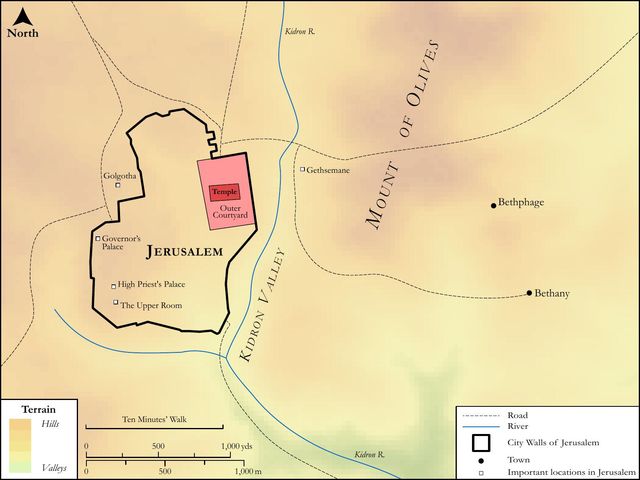
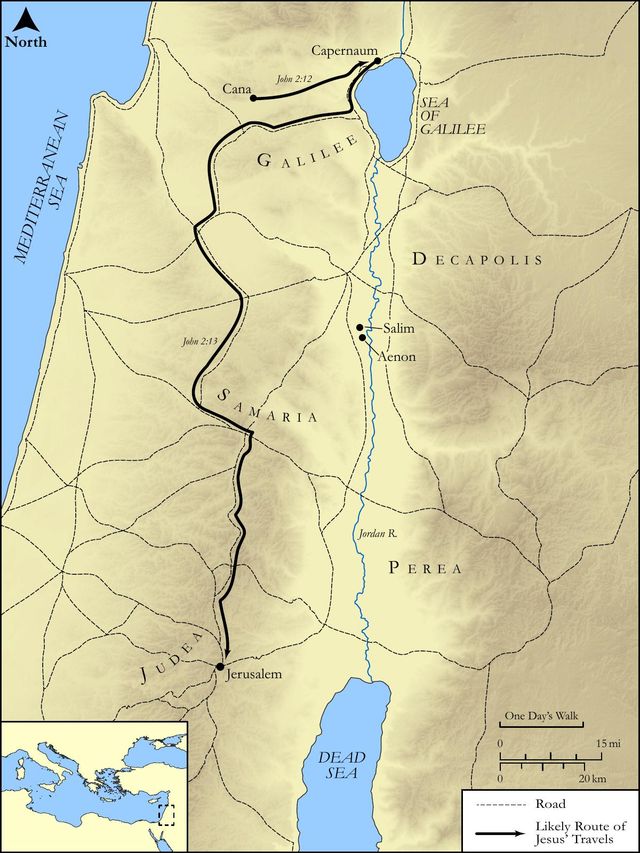
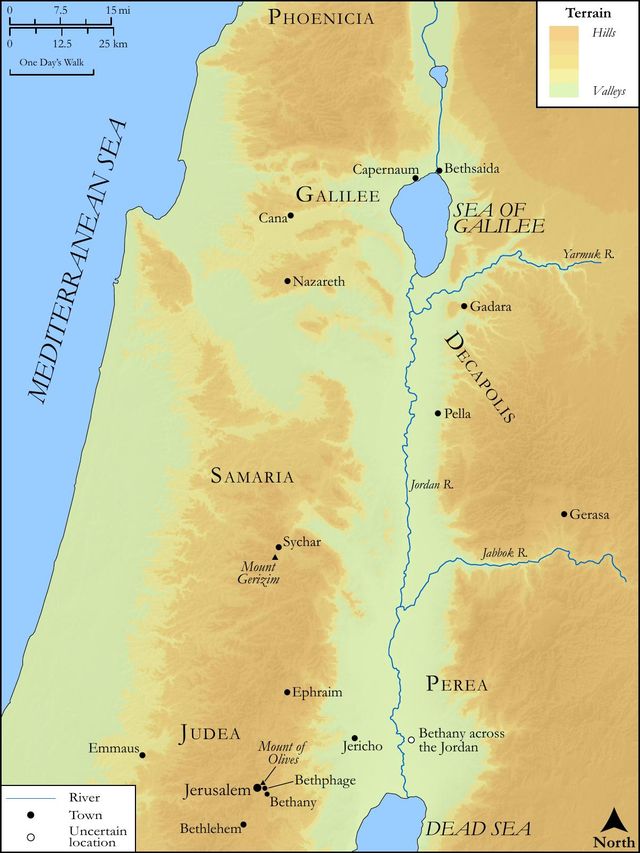
See on the biblical-era map
Study this verse
Public-domain commentary
Matthew Henry
From his Commentary on the Whole Bible. Henry comments on passages, not single verses — this entry covers John 3:1–21. His four-level outline is real structure in the source text, so it is rendered as structure.
We found, in the close of the foregoing chapter, that few were brought to Christ at Jerusalem; yet here was one, a considerable one. It is worth while to go a great way for the salvation though but of one soul. Observe,
I.Who this Nicodemus was.
Not many mighty and noble are called; yet some are, and here was one. Not many of the rulers, or of the Pharisees; yet.
1.This was a man of the Pharisees, bred to learning, a scholar. Let it not be said that all Christ's followers are unlearned and ignorant men. The principles of the Pharisees, and the peculiarities of their sect, were directly contrary to the spirit of Christianity; yet there were some in whom even those high thoughts were cast down and brought into obedience to Christ. The grace of Christ is able to subdue the greatest opposition.
2.He was a ruler of the Jews, a member of the great sanhedrim, a senator, a privy-counsellor, a man of authority in Jerusalem. Bad as things were, there were some rulers well inclined, who yet could do little good because the stream was so strong against them; they were over-ruled by the majority, and yoked with those that were corrupt, so that the good which they wished to do they could not do; yet Nicodemus continued in his place, and did what he could, when he could not do what he would.
II.His solemn address to our Lord Jesus Christ, v. 2. See here,
1.When he came: He came to Jesus by night. Observe,
(1.)He made a private and particular address to Christ, and did not think it enough to hear his public discourses. He resolved to talk with him by himself, where he might be free with him. Personal converse with skilful faithful ministers about the affairs of our souls would be of great use to us, Mal. ii. 7.
(2.)He made this address by night, which may be considered,
[1.]As an act of prudence and discretion. Christ was engaged all day in public work, and he would not interrupt him then, nor expect his attendance then, but observed Christ's hour, and waited on him when he was at leisure. Note, Private advantages to ourselves and our own families must give way to those that are public. The greater good must be preferred before the less. Christ had many enemies, and therefore Nicodemus came to him incognito, lest being known to the chief priests they should be the more enraged against Christ.
[2.]As an act of zeal and forwardness. Nicodemus was a man of business, and could not spare time all day to make Christ a visit, and therefore he would rather take time from the diversions of the evening, or the rest of the night, than not converse with Christ. When others were sleeping, he was getting knowledge, as David by meditation, Ps. lxiii. 6, and cxix. 148. Probably it was the very next night after he saw Christ's miracles, and he would not neglect the first opportunity of pursuing his convictions. He knew not how soon Christ might leave the town, nor what might happen betwixt that and another feast, and therefore would lose no time. In the night his converse with Christ would be more free, and less liable to disturbance. These were Noctes Christianæ—Christian nights, much more instructive than the Noctes Atticæ—Attic nights. Or,
[3.]As an act of fear and cowardice. He was afraid, or ashamed, to be seen with Christ, and therefore came in the night. When religion is out of fashion, there are many Nicodemites, especially among the rulers, who have a better affection to Christ and his religion than they would be known to have. But observe, First, Though he came by night, Christ bade him welcome, accepted his integrity, and pardoned his infirmity; he considered his temper, which perhaps was timorous, and the temptation he was in from his place and office; and hereby taught his ministers to become all things to all men, and to encourage good beginnings, though weak. Paul preached privately to those of reputation, Gal. ii.
2.Secondly, Though now he came by night, yet afterwards, when there was occasion, he owned Christ publicly, ch. vii. 50; xix. 39. The grace which is at first but a grain of mustard-seed may grow to be a great tree.
2.What he said. He did not come to talk with Christ about politics and state-affairs (though he was a ruler), but about the concerns of his own soul and its salvation, and, without circumlocution, comes immediately to the business; he calls Christ Rabbi, which signifies a great man; see Isa. xix. 20. He shall send them a Saviour, and a great one; a Saviour and a rabbi, so the word is. There are hopes of those who have a respect for Christ, and think and speak honourably of him. He tells Christ how far he had attained: We know that thou art a teacher. Observe,
(1.)His assertion concerning Christ: Thou art a teacher come from God; not educated nor ordained by men, as other teachers, but supported with divine inspiration and divine authority. He that was to be the sovereign Ruler came first to be a teacher; for he would rule with reason, not with rigour, by the power of truth, not of the sword. The world lay in ignorance and mistake; the Jewish teachers were corrupt, and caused them to err: It is time for the Lord to work. He came a teacher from God, from God as the Father of mercies, in pity to a dark deceived world; from God as the Father of lights and fountain of truth, all the light and truth upon which we may venture our souls.
(2.)His assurance of it: We know, not only I, but others; so he took it for granted, the thing being so plain and self-evident. Perhaps he knew that there were divers of the Pharisees and rulers with whom he conversed that were under the same convictions, but had not the grace to own it. Or, we may suppose that he speaks in the plural number (We know) because he brought with him one or more of his friends and pupils, to receive instructions from Christ, knowing them to be of common concern. "Master," saith he, "we come with a desire to be taught, to be thy scholars, for we are fully satisfied thou art a divine teacher." (3.) The ground of this assurance: No man can do those miracles that thou doest, except God be with him. Here,
[1.]We are assured of the truth of Christ's miracles, and that they were not counterfeit. Here was Nicodemus, a judicious, sensible, inquisitive man, one that had all the reason and opportunity imaginable to examine them, so fully satisfied that they were real miracles that he was wrought upon by them to go contrary to his interest, and to the stream of those of his own rank, who were prejudiced against Christ.
[2.]We are directed what inference to draw from Christ's miracles: Therefore we are to receive him as a teacher come from God. His miracles were his credentials. The course of nature could not be altered but by the power of the God of nature, who, we are sure, is the God of truth and goodness, and would never set his seal to a lie or a cheat.
III.The discourse between Christ and Nicodemus hereupon, or, rather, the sermon Christ preached to him; the contents of it, and that perhaps an abstract of Christ's public preaching; see v. 11, 12. Four things our Saviour here discourses of:—
1.Concerning the necessity and nature of regeneration or the new birth, v. 3-8. Now we must consider this,
(1.)As pertinently answered to Nicodemus's address. Jesus answered, v. 3. This answer was wither,
[1.]A rebuke of what he saw defective in the address of Nicodemus. It was not enough for him to admire Christ's miracles, and acknowledge his mission, but he must be born again. It is plain that he expected the kingdom of heaven, the kingdom of the Messiah now shortly to appear. He is betimes aware of the dawning of that day; and, according to the common notion of the Jews, he expects it to appear in external pomp and power. He doubts not but this Jesus, who works these miracles, is either the Messiah or his prophet, and therefore makes his court to him, compliments him, and so hopes to secure a share to himself of the advantages of that kingdom. But Christ tells him that he can have no benefit by that change of the state, unless there be a change of the spirit, of the principles and dispositions, equivalent to a new birth. Nicodemus came by night: "But this will not do," saith Christ. His religion must be owned before men; so Dr. Hammond. Or,
[2.]A reply to what he saw designed in his address. When Nicodemus owned Christ a teacher come from God, one entrusted with an extraordinary revelation from heaven, he plainly intimated a desire to know what this revelation was and a readiness to receive it; and Christ declares it.
(2.)As positively and vehemently asserted by our Lord Jesus: Verily, verily, I say unto thee. I the Amen, the Amen, say it; so it may be read: "I the faithful and true witness." The matter is settled irreversibly that except a man be born again he cannot see the kingdom of God. "I say it to thee, though a Pharisee, though a master in Israel." Observe,
[1.]What it is that is required: to be born again; that is, First, We must live a new life. Birth is the beginning of life; to be born again is to begin anew, as those that have hitherto lived either much amiss or to little purpose. We must not think to patch up the old building, but begin from the foundation. Secondly, We must have a new nature, new principles, new affections, new aims. We must be born anothen, which signifies both denuo—again, and desuper—from above. 1. We must be born anew; so the word is taken, Gal. iv. 9, and ab initio—from the beginning, Luke i. 3. By our first birth we are corrupt, shapen in sin and iniquity; we must therefore undergo a second birth; our souls must be fashioned and enlivened anew. 2. We must be born from above, so the word is used by the evangelist, ch. iii. 31; xix. 11, and I take this to be especially intended here, not excluding the other; for to be born from above supposes being born again. But this new birth has its rise from heaven (ch. i. 13) and its tendency to heaven: it is to be born to a divine and heavenly life, a life of communion with God and the upper world, and, in order to this, it is to partake of a divine nature and bear the image of the heavenly.
[2.]The indispensable necessity of this: "Except a man (Any one that partakes of the human nature, and consequently of its corruptions) be born again, he cannot see the kingdom of God, the kingdom of the Messiah begun in grace and perfected in glory." Except we be born from above, we cannot see this. That is, First, We cannot understand the nature of it. Such is the nature of things pertaining to the kingdom of God (in which Nicodemus desired to be instructed) that the soul must be re-modelled and moulded, the natural man must become a spiritual man, before he is capable of receiving and understanding them, 1 Cor. ii. 14. Secondly, We cannot receive the comfort of it, cannot expect any benefit by Christ and his gospel, nor have any part or lot in the matter. Note, Regeneration is absolutely necessary to our happiness here and hereafter. Considering what we are by nature, how corrupt and sinful,—what God is, in whom alone we can be happy,—and what heaven is, to which the perfection of our happiness is reserved,—it will appear, in the nature of the thing, that we must be born again, because it is impossible that we should be happy if we be not holy; see 1 Cor. vi. 11, 12.
This great truth of the necessity of regeneration being thus solemnly laid down,
a.It is objected against by Nicodemus (v. 4): How can a man be born when he is old, old as I am: geron on—being an old man? Can he enter the second time into his mother's womb, and be born? Herein appears, (a.) His weakness in knowledge; what Christ spoke spiritually he seems to have understood after a corporal and carnal manner, as if there were no other way of regenerating and new-moulding an immortal soul than by new-framing the body, and bringing that back to the rock out of which it was hewn, as if there was such a connection between the soul and the body that there could be no fashioning the heart anew but by forming the bones anew. Nicodemus, as others of the Jews, valued himself, no doubt, very much on his first birth and its dignities and privileges,—the place of it, the Holy Land, perhaps the holy city,—his parentage, such as that which Paul could have gloried in, Phil. iii. 5. And therefore it is a great surprise to him to hear of being born again. Could he be better bred and born than bred and born an Israelite, or by any other birth stand fairer for a place in the kingdom of the Messiah? Indeed they looked upon a proselyted Gentile to be as one born again or born anew, but could not imagine how a Jew, a Pharisee, could ever better himself by being born again; he therefore thinks, if he must be born again, it must be of her that bore him first. They that are proud of their first birth are hardly brought to a new birth. (b.) His willingness to be taught. He does not turn his back upon Christ because of his hard saying, but ingenuously acknowledges his ignorance, which implies a desire to be better informed; and so I take this, rather than that he had such gross notions of the new birth Christ spoke of: "Lord, make me to understand this, for it is a riddle to me; I am such a fool as to know no other way for a man to be born than of his mother." When we meet with that in the things of God which is dark, and hard to be understood, we must with humility and industry continue our attendance upon the means of knowledge, till God shall reveal even that unto us.
b.It is opened and further explained by our Lord Jesus, v. 5-8. From the objection he takes occasion,
(a.)To repeat and confirm what he had said (v. 5): "Verily, verily, I say unto thee, the very same that I said before." Note, The word of God is not yea and nay, but yea and amen; what he hath said he will abide by, whoever saith against it; nor will he retract any of his sayings for the ignorance and mistakes of men. Though Nicodemus understood not the mystery of regeneration, yet Christ asserts the necessity of it as positively as before. Note, It is folly to think of evading the obligation of evangelical precepts, by pleading that they are unintelligible, Rom. iii. 3, 4.
(b.)To expound and clear what he had said concerning regeneration; for the explication of which he further shows,
[a.]The author of this blessed change, and who it is that works it. To be born again is to be born of the Spirit, v. 5-8. The change is not wrought by any wisdom or power of our own, but by the power and influence of the blessed Spirit of grace. It is the sanctification of the Spirit (1 Pet. i. 2) and renewing of the Holy Ghost, Tit. iii. 5. The word he works by is his inspiration, and the heart to be wrought on he has access to.
[b.]The nature of this change, and what that is which is wrought; it is spirit, v. 6. Those that are regenerated are made spiritual, and refined from the dross and dregs of sensuality. The dictates and interests of the rational and immortal soul have retrieved the dominion they ought to have over the flesh. The Pharisees placed their religion in external purity and external performances; and it would be a mighty change indeed with them, no less than a new birth, to become spiritual.
[c.]The necessity of this change. First, Christ here shows that it is necessary in the nature of the thing, for we are not fit to enter into the kingdom of God till we are born again: That which is born of the flesh if flesh, v. 6. Here is our malady, with the causes of it, which are such that it is plain there is no remedy but we must be born again. 1. We are here told what we are: We are flesh, not only corporeal but corrupt, Gen. vi. 3. The soul is still a spiritual substance, but so wedded to the flesh, so captivated by the will of the flesh, so in love with the delights of the flesh, so employed in making provision for the flesh, that it is mostly called flesh; it is carnal. And what communion can there be between God, who is a spirit, and a soul in this condition? 2. How we came to be so; by being born of the flesh. It is a corruption that is bred in the bone with us, and therefore we cannot have a new nature, but we must be born again. The corrupt nature, which is flesh, takes rise from our first birth; and therefore the new nature, which is spirit, must take rise from a second birth. Nicodemus spoke of entering again into his mother's womb, and being born; but, if he could do so, to what purpose? If he were born of his mother a hundred times, that would not mend the matter, for still that which is born of the flesh if flesh; a clean thing cannot be brought out of an unclean. He must seek for another original, must be born of the Spirit, or he cannot become spiritual. The case is, in short, this: though man is made to consist of body and soul, yet his spiritual part had then so much the dominion over his corporeal part that he was denominated a living soul (Gen. ii. 7), but by indulging the appetite of the flesh, in eating forbidden fruit, he prostituted the just dominion of the soul to the tyranny of sensual lust, and became no longer a living soul, but flesh: Dust thou art. The living soul became dead and inactive; thus in the day he sinned he surely died, and so he became earthly. In this degenerate state, he begat a son in his own likeness; he transmitted the human nature, which had been entirely deposited in his hands, thus corrupted and depraved; and in the same plight it is still propagated. Corruption and sin are woven into our nature; we are shapen in iniquity, which makes it necessary that the nature be changed. It is not enough to put on a new coat or a new face, but we must put on the new man, we must be new creatures. Secondly, Christ makes it further necessary, by his own word: Marvel not that I said unto thee, You must be born again, v. 7. 1. Christ hath said it, and as he himself never did, nor ever will, unsay it, so all the world cannot gainsay it, that we must be born again. He who is the great Lawgiver, whose will is a law,—he who is the great Mediator of the new covenant, and has full power to settle the terms of our reconciliation to God and happiness in him,—he who is the great Physician of souls, knows their case, and what is necessary to their cure,—he hath said, You must be born again. "I said unto thee that which all are concerned in, You must, you all, one as well as another, you must be born again: not only the common people, but the rulers, the masters in Israel." 2. We are not to marvel at it; for when we consider the holiness of the God with whom we have to do, the great design of our redemption, the depravity of our nature, and the constitution of the happiness set before us, we shall not think it strange that so much stress is laid upon this as the one thing needful, that we must be born again.
[d.]This change is illustrated by two comparisons. First, The regenerating work of the Spirit is compared to water, v. 5. To be born again is to be born of water and of the Spirit, that is, of the Spirit working like water, as (Matt. iii. 11) with the Holy Ghost and with fire means with the Holy Ghost as with fire. 1. That which is primarily intended here is to show that the Spirit, in sanctifying a soul, (1.) Cleanses and purifies it as water, takes away its filth, by which it was unfit for the kingdom of God. It is the washing of regeneration, Tit. iii. 5. You are washed, 1 Cor. vi. 11. See Ezek. xxxvi. 25. (2.) Cools and refreshes it, as water does the hunted hart and the weary traveller. The Spirit is compared to water, ch. vii. 38, 39; Isa. xliv. 3. In the first creation, the fruits of heaven were born of water (Gen. i. 20), in allusion to which, perhaps, they that are born from above are said to be born of water. 2. It is probable that Christ had an eye to the ordinance of baptism, which John had used and he himself had begun to use, "You must be born again of the Spirit," which regeneration by the Spirit should be signified by washing with water, as the visible sign of that spiritual grace: not that all they, and they only, that are baptized, are saved; but without that new birth which is wrought by the Spirit, and signified by baptism, none shall be looked upon as the protected privileged subjects of the kingdom of heaven. The Jews cannot partake of the benefits of the Messiah's kingdom, they have so long looked for, unless they quit all expectations of being justified by the works of the law, and submit to the baptism of repentance, the great gospel duty, for the remission of sins, the great gospel privilege. Secondly, It is compared to wind: The wind bloweth where it listeth, so is every one that is born of the Spirit, v. 8. The same word (pneuma) signifies both the wind and the Spirit. The Spirit came upon the apostles in a rushing mighty wind (Acts ii. 2), his strong influences on the hearts of sinners are compared to the breathing of the wind (Ezek. xxxvii. 9), and his sweet influences on the souls of saints to the north and south wind, Cant. iv. 16. This comparison is here used to show, 1. That the Spirit, in regeneration, works arbitrarily, and as a free agent. The wind bloweth where it listeth for us, and does not attend our order, nor is subject to our command. God directs it; it fulfils his word, Ps. cxlviii. 8. The Spirit dispenses his influences where, and when, on whom, and in what measure and degree, he pleases, dividing to every man severally as he will, 1 Cor. xii. 11. 2. That he works powerfully, and with evident effects: Thou hearest the sound thereof; though its causes are hidden, its effects are manifest. When the soul is brought to mourn for sin, to groan under the burden of corruption, to breathe after Christ, to cry Abba—Father, then we hear the sound of the Spirit, we find he is at work, as Acts ix. 11, Behold he prayeth. 3. That he works mysteriously, and in secret hidden ways: Thou canst not tell whence it comes, nor whither it goes. How it gathers and how it spends its strength is a riddle to us; so the manner and methods of the Spirit's working are a mystery. Which way went the Spirit? 1 Kings xxii. 24. See Eccl. xi. 5, and compare it with Ps. cxxxix. 14.
2.Here is a discourse concerning the certainty and sublimity of gospel truths, which Christ takes occasion for from the weakness of Nicodemus. Here is,
(1.)The objection which Nicodemus still made (v. 9): How can these things be? Christ's explication of the doctrine of the necessity of regeneration, it should seem, made it never the clearer to him. The corruption of nature which makes it necessary, and the way of the Spirit which makes it practicable, are as much mysteries to him as the thing itself; though he had in general owned Christ a divine teacher, yet he was unwilling to receive his teachings when they did not agree with the notions he had imbibed. Thus many profess to admit the doctrine of Christ in general, and yet will neither believe the truths of Christianity nor submit to the laws of it further than they please. Christ shall be their teacher, provided they may choose their lesson. Now here,
[1.]Nicodemus owns himself ignorant of Christ's meaning, after all: "How can these things be? They are things I do not understand, my capacity will not reach them." Thus the things of the Spirit of God are foolishness to the natural man. He is not only estranged from them, and therefore they are dark to him, but prejudiced against them, and therefore they are foolishness to him.
[2.]Because this doctrine was unintelligible to him (so he was pleased to make it), he questions the truth of it; as if, because it was a paradox to him, it was a chimera in itself. Many have such an opinion of their own capacity as to think that that cannot be proved which they cannot believe; by wisdom they knew not Christ.
(2.)The reproof which Christ gave him for his dulness and ignorance: "Art thou a master in Israel, Didaskalos—a teacher, a tutor, one who sits in Moses's chair, and yet not only unacquainted with the doctrine of regeneration, but incapable of understanding it?" This word is a reproof,
[1.]To those who undertake to teach others and yet are ignorant and unskilful in the word of righteousness themselves.
[2.]To those that spend their time in learning and teaching notions and ceremonies in religion, niceties and criticisms in the scripture, and neglect that which is practical and tends to reform the heart and life. Two words in the reproof are very emphatic:—First, The place where his lot was cast: in Israel, where there was such great plenty of the means of knowledge, where divine revelation was. He might have learned this out of the Old Testament. Secondly, The things he was thus ignorant in: these things, these necessary things, there great things, these divine things; had he never read Ps. l. 5, 10; Ezek. xviii. 31; xxxvi. 25, 26?
(3.)Christ's discourse, hereupon, of the certainty and sublimity of gospel truths (v. 11-13), to show the folly of those who make strange of these things, and to recommend them to our search. Observe here,
[1.]That the truths Christ taught were very certain and what we may venture upon (v. 11): We speak that we do know. We; whom does he mean besides himself? Some understand it of those that bore witness to him and with him on earth, the prophets and John Baptist; they spoke what they knew, and had seen, and were themselves abundantly satisfied in: divine revelation carries its own proof along with it. Others of those that bore witness from heaven, the Father and the Holy Ghost; the Father was with him, the Spirit of the Lord was upon him; therefore he speaks in the plural number, as ch. xiv. 23: We will come unto him. Observe, First, That the truths of Christ are of undoubted certainty. We have all the reason in the world to be assured that the sayings of Christ are faithful sayings, and such as we may venture our souls upon; for he is not only a credible witness, who would not go about to deceive us, but a competent witness, who could not himself be deceived: We testify that we have seen. He spoke not upon hear-say, but upon the clearest evidence, and therefore with the greatest assurance. What he spoke of God, of the invisible world, of heaven and hell, of the divine will concerning us, and the counsels of peace, was what he knew, and had seen, for he was by him as one brought up with him, Prov. viii. 30. Whatever Christ spoke, he spoke of his own knowledge. Secondly, That the unbelief of sinners is greatly aggravated by the infallible certainty of the truths of Christ. The things are thus sure, thus clear; and yet you receive not our witness. Multitudes to be unbelievers of that which yet (so cogent are the motives of credibility) they cannot disbelieve!
[2.]The truths Christ taught, though communicated in language and expressions borrowed from common and earthly things, yet in their own nature were most sublime and heavenly; this is intimated, v. 12: "If I have told them earthly things, that is, have told them the great things of God in similitudes taken from earthly things, to make them the more easy and intelligible, as that of the new birth and the wind,— if I have thus accommodated myself to your capacities, and lisped to you in your own language, and cannot make you to understand my doctrine,—what would you do if I should accommodate myself to the nature of the things, and speak with the tongue of angels, that language which mortals cannot utter? If such familiar expressions be stumbling-blocks, what would abstract ideas be, and spiritual things painted proper?" Now we may learn hence, First, To admire the height and depth of the doctrine of Christ; it is a great mystery of godliness. The things of the gospel are heavenly things, out of the road of the enquiries of human reason, and much more out of the reach of its discoveries. Secondly, To acknowledge with thankfulness the condescension of Christ, that he is pleased to suit the manner of the gospel revelation to our capacities, to speak to us as to children. He considers our frame, that we are of the earth, and our place, that we are on the earth, and therefore speaks to us earthly things, and makes things sensible the vehicle of things spiritual, to make them the more easy and familiar to us. Thus he has done both in parables and in sacraments. Thirdly, To lament the corruption of our nature, and our great unaptness to receive and entertain the truths of Christ. Earthly things are despised because they are vulgar, and heavenly things because they are abstruse; and so, whatever method is taken, still some fault or other is found with it (Matt. xi. 17), but Wisdom is, and will be, justified of her children, notwithstanding.
[3.]Our Lord Jesus, and he alone, was fit to reveal to us a doctrine thus certain, thus sublime: No man hath ascended up into heaven but he, v. 13.
First, None but Christ was able to reveal to us the will of God for our salvation. Nicodemus addressed Christ as a prophet; but he must know that he is greater than all the Old-Testament prophets, for none of them had ascended into heaven. They wrote by divine inspiration, and not of their own knowledge; see ch. i. 18. Moses ascended into the mount, but not into heaven. No man hath attained to the certain knowledge of God and heavenly things as Christ has; see Matt. xi. 27. It is not for us to send to heaven for instructions; we must wait to receive what instructions Heaven will send to us; see Prov. xxx. 4; Deut. xxx. 12.
Secondly, Jesus Christ is able, and fit, and every way qualified, to reveal the will of God to us; for it is he that came down from heaven and is in heaven. He had said (v. 12), How shall ye believe, if I tell you of heavenly things? Now here, 1. He gives them an instance of those heavenly things which he could tell them of, when he tells them of one that came down from heaven, and yet is the Son of man; is the Son of man, and yet is in heaven. If the regeneration of the soul of man is such a mystery, what then is the incarnation of the Son of God? These are divine and heavenly things indeed. We have here an intimation of Christ's two distinct natures in one person: his divine nature, in which he came down from heaven; his human nature, in which he is the Son of man; and that union of those two, in that while he is the Son of man yet he is in heaven. 2. He gives them a proof of his ability to speak to them heavenly things, and to lead them into the arcana of the kingdom of heaven, by telling them, (1.) That he came down from heaven. The intercourse settled between God and man began above; the first motion towards it did not arise from this earth, but came down from heaven. We love him, and send to him, because he first loved us, and sent to us. Now this intimates, [1.] Christ's divine nature. He that came down from heaven is certainly more than a mere man; he is the Lord from heaven, 1 Cor. xv. 47. [2.] His intimate acquaintance with the divine counsels; for, coming from the court of heaven, he had been from eternity conversant with them. [3.] The manifestation of God. Under the Old Testament God's favours to his people are expressed by his hearing from heaven (2 Chron. vii. 14), looking from heaven (Ps. lxxx. 14), speaking from heaven (Neh. ix. 13), sending from heaven, Ps. lvii. 3. But the New Testament shows us God coming down from heaven, to teach and save us. That he thus descended is an admirable mystery, for the Godhead cannot change places, nor did he bring his body from heaven; but that he thus condescended for our redemption is a more admirable mercy; herein he commended his love. (2.) That he is the Son of man, that Son of man spoken of by Daniel (vii. 13), by which the Jews always understand to be meant the Messiah. Christ, in calling himself the Son of man, shows that he is the second Adam, for the first Adam was the father of man. And of all the Old-Testament titles of the Messiah he chose to make use of this, because it was most expressive of his humility, and most agreeable to his present state of humiliation. (3.) That he is in heaven. Now at this time, when he is talking with Nicodemus on earth, yet, as God, he is in heaven. The Son of man, as such, was not in heaven till his ascension; but he that was the Son of man was now, by his divine nature, every where present, and particularly in heaven. Thus the Lord of glory, as such, could not be crucified, nor could God, as such, shed his blood; yet that person who was the Lord of glory was crucified (1 Cor. ii. 8), and God purchased the church with his own blood, Acts xx. 28. So close is the union of the two natures in one person that there is a communication of properties. He doth not say hos esti. God is the ho on to ourano—he that is, and heaven is the habitation of his holiness.
3.Christ here discourses of the great design of his own coming into the world, and the happiness of those that believe in him, v. 14-18. Here we have the very marrow and quintessence of the whole gospel, that faithful saying (1 Tim. i. 15), that Jesus Christ came to seek and to save the children of men from death, and recover them to life. Now sinners are dead men upon a twofold account:— (1.) As one that is mortally wounded, or sick of an incurable disease, is said to be a dead man, for he is dying; and so Christ came to save us, by healing us, as the brazen serpent healed the Israelites, v. 14, 15. (2.) As one that is justly condemned to die for an unpardonable crime is a dead man, he is dead in law; and, in reference to this part of our danger, Christ came to save as a prince or judge, publishing an act of indemnity, or general pardon, under certain provisos; this saving here is opposed to condemning, v. 16-18.
[1.]Jesus Christ came to save us by healing us, as the children of Israel that were stung with fiery serpents were cured and lived by looking up to the brazen serpent; we have the story of it, Num. xxi. 6-9. It was the last miracle that passed through the hand of Moses before his death. Now in this type of Christ we may observe,
First, The deadly and destructive nature of sin, which is implied here. The guilt of sin is like the pain of the biting of a fiery serpent; the power of corruption is like the venom diffused thereby. The devil is the old serpent, subtle at first (Gen. iii. 1), but ever since fiery, and his temptations fiery darts, his assaults terrifying, his victories destroying. Ask awakened consciences, ask damned sinners, and they will tell you, how charming soever the allurements of sin are, at the last it bites like a serpent, Prov. xxiii. 30-32. God's wrath against us for sin is as those fiery serpents which God sent among the people, to punish them for their murmurings. The curses of the law are as fiery serpents, so are all the tokens of divine wrath.
Secondly, The powerful remedy provided against this fatal malady. The case of poor sinners is deplorable; but is it desperate? Thanks be to God, it is not; there is balm in Gilead. The Son of man is lifted up, as the serpent of brass was by Moses, which cured the stung Israelites. 1. It was a serpent of brass that cured them. Brass is bright; we read of Christ's feet shining like brass, Rev. i. 15. It is durable; Christ is the same. It was made in the shape of a fiery serpent, and yet had no poison, no sting, fitly representing Christ, who was made sin for us and yet knew no sin; was made in the likeness of sinful flesh and yet not sinful; as harmless as a serpent of brass. The serpent was a cursed creature; Christ was made a curse. That which cured them reminded them of their plague; so in Christ sin is set before us most fiery and formidable. 2. It was lifted up upon a pole, and so must the Son of man be lifted up; thus it behoved him, Luke xxiv. 26, 46. No remedy now. Christ is lifted up, (1.) In his crucifixion. He was lifted up upon the cross. His death is called his being lifted up, ch. xii. 32, 33. He was lifted up as a spectacle, as a mark, lifted up between heaven and earth, as if he had been unworthy of either and abandoned by both. (2.) In his exaltation. He was lifted up to the Father's right hand, to give repentance and remission; he was lifted up to the cross, to be further lifted up to the crown. (3.) In the publishing and preaching of his everlasting gospel, Rev. xiv. 6. The serpent was lifted up that all the thousands of Israel might see it. Christ in the gospel is exhibited to us, evidently set forth; Christ is lifted up as an ensign, Isa. xi. 10. 3. It was lifted up by Moses. Christ was made under the law of Moses, and Moses testified of him. 4. Being thus lifted up, it was appointed for the cure of those that were bitten by fiery serpents. He that sent the plague provided the remedy. None could redeem and save us but he whose justice had condemned us. It was God himself that found the ransom, and the efficacy of it depends upon his appointment. The fiery serpents were sent to punish them for their tempting Christ (so the apostle saith, 1 Cor. x. 9), and yet they were healed by virtue derived from him. He whom we have offended is our peace.
Thirdly, The way of applying this remedy, and that is by believing, which plainly alludes to the Israelites' looking up to the brazen serpent, in order to their being healed by it. If any stung Israelite was either so little sensible of his pain and peril, or had so little confidence in the word of Moses as not to look up to the brazen serpent, justly did he die of his wound; but every one that looked up to it did well, Num. xxi. 9. If any so far slight either their disease by sin or the method of cure by Christ as not to embrace Christ upon his own terms, their blood is upon their own head. He hath said, Look, and be saved (Isa. xlv. 22), look and live. We must take a complacency in and give consent to the methods which Infinite Wisdom has taken is saving a guilty world, by the mediation of Jesus Christ, as the great sacrifice and intercessor.
Fourthly, The great encouragements given us by faith to look up to him. 1. It was for this end that he was lifted up, that his followers might be saved; and he will pursue his end. 2. The offer that is made of salvation by him is general, that whosoever believes in him, without exception, might have benefit by him. 3. The salvation offered is complete. (1.) They shall not perish, shall not die of their wounds; though they may be pained and ill frightened, iniquity shall not be their ruin. But that is not all. (2.) They shall have eternal life. They shall not only not die of their wounds in the wilderness, but they shall reach Canaan (which they were then just ready to enter into); they shall enjoy the promised rest.
[2.]Jesus Christ came to save us by pardoning us, that we might not die by the sentence of the law, v. 16, 17. Here is gospel indeed, good news, the best that ever came from heaven to earth. Here is much, here is all in a little, the word of reconciliation in miniature.
First, Here is God's love in giving his Son for the world (v. 16), where we have three things:— 1. The great gospel mystery revealed: God so loved the world that he gave his only-begotten Son. The love of God the Father is the original of our regeneration by the Spirit and our reconciliation by the lifting up of the Son. Note, (1.) Jesus Christ is the only-begotten Son of God. This magnifies his love in giving him for us, in giving him to us; now know we that he loves us, when he has given his only-begotten Son for us, which expresses not only his dignity in himself, but his dearness to his Father; he was always his delight. (2.) In order to the redemption and salvation of man, it pleased God to give his only-begotten Son. He not only sent him into the world with full and ample power to negotiate a peace between heaven and earth, but he gave him, that is, he gave him up to suffer and die for us, as the great propitiation or expiatory sacrifice. It comes in here as a reason why he must be lifted up; for so it was determined and designed by the Father, who gave him for this purpose, and prepared him a body in order to it. His enemies could not have taken him if his Father had not given him. Though he was not yet crucified, yet in the determinate counsel of God he was given up, Acts ii. 23. Nay, further, God has given him, that is, he has made an offer of him, to all, and given him to all true believers, to all the intents and purposes of the new covenant. He has given him to be our prophet, a witness to the people, the high priest of our profession, to be our peace, to be head of the church and head over all things to the church, to be to us all we need. (3.) Herein God has commended his love to the world: God so loved the world, so really, so richly. Now his creatures shall see that he loves them, and wishes them well. He so loved the world of fallen man as he did not love that of fallen angels; see Rom. v. 8; 1 John iv. 10. Behold, and wonder, that the great God should love such a worthless world! That the holy God should love such a wicked world with a love of good will, when he could not look upon it with any complacency. This was a time of love indeed, Ezek. xvi. 6, 8. The Jews vainly conceited that the Messiah should be sent only in love to their nation, and to advance them upon the ruins of their neighbours; but Christ tells them that he came in love to the whole world, Gentiles as well as Jews, 1 John ii. 2. Though many of the world of mankind perish, yet God's giving his only-begotten Son was an instance of his love to the whole world, because through him there is a general offer of life and salvation made to all. It is love to the revolted rebellious province to issue out a proclamation of pardon and indemnity to all that will come in, plead it upon their knees, and return to their allegiance. So far God loved the apostate lapsed world that he sent his Son with this fair proposal, that whosoever believes in him, one or other, shall not perish. Salvation has been of the Jews, but now Christ is known as salvation to the ends of the earth, a common salvation. 2. Here is the great gospel duty, and that is to believe in Jesus Christ (Whom God has thus given, given for us, given to us), to accept the gift, and answer the intention of the giver. We must yield an unfeigned assent and consent to the record God hath given in his word concerning his Son. God having given him to us to be our prophet, priest, and king, we must give up ourselves to be ruled, and taught, and saved by him. 3. Here is the great gospel benefit: That whosoever believes in Christ shall not perish. This he had said before, and here repeats it. It is the unspeakable happiness of all true believers, for which they are eternally indebted to Christ, (1.) That they are saved from the miseries of hell, delivered from going down to the pit; they shall not perish. God has taken away their sin, they shall not die; a pardon is purchased, and so the attainder is reversed. (2.) They are entitled to the joys of heaven: they shall have everlasting life. The convicted traitor is not only pardoned, but preferred, and made a favourite, and treated as one whom the King of kings delights to honour. Out of prison he comes to reign, Eccl. iv. 14. If believers, then children; and, if children, then heirs.
Secondly, Here is God's design in sending hi Son into the world: it was that the world through him might be saved. He came into the world with salvation in his eye, with salvation in his hand. Therefore the aforementioned offer of live and salvation is sincere, and shall be made good to all that by faith accept it (v. 17): God sent his Son into the world, this guilty, rebellious, apostate world; sent him as his agent or ambassador, not as sometimes he had sent angels into the world as visitants, but as resident. Ever since man sinned, he has dreaded the approach and appearance of any special messenger from heaven, as being conscious of guilt and looking for judgment: We shall surely die, for we have seen God. If therefore the Son of God himself come, we are concerned to enquire on what errand he comes: Is it peace? Or, as they asked Samuel trembling, Comest thou peaceably? And this scripture returns the answer, Peaceably. 1. He did not come to condemn the world. We had reason enough to expect that he should, for it is a guilty world; it is convicted, and what cause can be shown why judgment should not be given, and execution awarded, according to law? That one blood of which all nations of men are made (Acts xvii. 26) is not only tainted with an hereditary disease, like Gehazi's leprosy, but it is tainted with an hereditary guilt, like that of the Amalekites, with whom God had war from generation to generation; and justly may such a world as this be condemned; and if God would have sent to condemn it he had angels at command, to pour out the vials of his wrath, a cherub with a flaming sword ready to do execution. If the Lord had been pleased to kill us, he would not have sent his Son amongst us. He came with full powers indeed to execute judgment (ch. v. 22, 27), but did not begin with a judgment of condemnation, did not proceed upon the outlawry, nor take advantage against us for the breach of the covenant of innocency, but put us upon a new trial before a throne of grace. 2. He came that the world through him might be saved, that a door of salvation might be opened to the world, and whoever would might enter in by it. God was in Christ reconciling the world to himself, and so saving it. An act of indemnity is passed and published, through Christ a remedial law made, and the world of mankind dealt with, not according to the rigours of the first covenant, but according to the riches of the second; that the world through him might be saved, for it could never be saved but through him; there is not salvation in any other. This is good news to a convinced conscience, healing to broken bones and bleeding wounds, that Christ, our judge, came not to condemn, but to save.
[3.]From all this is inferred the happiness of true believers: He that believeth on him is not condemned, v. 18. Though he has been a sinner, a great sinner, and stands convicted (habes confilentem reum—by his own confession), yet, upon his believing, process is stayed, judgment is arrested, and he is not condemned. This denotes more than a reprieve; he is not condemned, that is, he is acquitted; he stand upon his deliverance (as we say), and if he be not condemned he is discharged; ou krinetai—he is not judged, not dealt with in strict justice, according to the desert of his sins. He is accused, and he cannot plead not guilty to the indictment, but he can plead in bar, can plead a noli prosequi upon the indictment, as blessed Paul does, Who is he that condemns? It is Christ that died. He is afflicted, chastened of God, persecuted by the world; but he is not condemned. The cross perhaps lies heavy upon him, but he is saved from the curse: condemned by the world, it may be, but not condemned with the world, Rom. viii. 1; 1 Cor. xi. 32.
4.Christ, in the close, discourses concerning the deplorable condition of those that persist in unbelief and wilful ignorance, v. 18-21.
(1.)Read here the doom of those that will not believe in Christ: they are condemned already. Observe,
[1.]How great the sin of unbelievers is; it is aggravated from the dignity of the person they slight; they believe not in the name of the only-begotten Son of God, who is infinitely true, and deserves to be believed, infinitely good, and deserves to be embraced. God sent one to save us that was dearest to himself; and shall not he be dearest to us? Shall we not believe on his name who has a name above every name?
[2.]How great the misery of unbelievers is: they are condemned already; which bespeaks, First, A certain condemnation. They are as sure to be condemned in the judgment of the great day as if they were condemned already. Secondly, A present condemnation. The curse has already taken hold of them; the wrath of God now fastens upon them. They are condemned already, for their own hearts condemn them. Thirdly, A condemnation grounded upon their former guilt: He is condemned already, for he lies open to the law for all his sins; the obligation of the law is in full force, power, and virtue, against him, because he is not by faith interested in the gospel defeasance; he is condemned already, because he has not believed. Unbelief may truly be called the great damning sin, because it leaves us under the guilt of all our other sins; it is a sin against the remedy, against our appeal.
(2.)Read also the doom of those that would not so much as know him, v. 19. Many inquisitive people had knowledge of Christ and his doctrine and miracles, but they were prejudiced against him, and would not believe in him, while the generality were sottishly careless and stupid, and would not know him. And this is the condemnation, the sin that ruined them, that light is come into the world, and they loved darkness rather. Now here observe,
[1.]That the gospel is light, and, when the gospel came, light came into the world, Light is self-evidencing, so is the gospel; it proves its own divine origin. Light is discovering, and truly the light is sweet, and rejoices the heart. It is a light shining in a dark place, and a dark place indeed the world would be without it. It is come into all the world (Col. i. 6), and not confined to one corner of it, as the Old-Testament light was.
[2.]It is the unspeakable folly of the most of men that they loved darkness rather than light, rather than this light. The Jews loved the dark shadows of their law, and the instructions of their blind guides, rather than the doctrine of Christ. The Gentiles loved their superstitious services of an unknown God, whom they ignorantly worshipped, rather than the reasonable service which the gospel enjoins. Sinners that were wedded to their lusts loved their ignorance and mistakes, which supported them in their sins, rather than the truths of Christ, which would have parted them from their sins. Man's apostasy began in an affectation of forbidden knowledge, but is kept up by an affectation of forbidden ignorance. Wretched man is in love with his sickness, in love with his slavery, and will not be made free, will not be made whole.
[3.]The true reason why men love darkness rather than light is because their deeds are evil. They love darkness because they think it is an excuse for their evil deeds, and they hate the light because it robs them of the good opinion they had of themselves, by showing them their sinfulness and misery. Their case is sad, and, because they are resolved that they will not mend it, they are resolved that they will not see it.
[4.]Wilful ignorance is so far from excusing sin that it will be found, at the great day, to aggravate the condemnation: This is the condemnation, this is what ruins souls, that they shut their eyes against the light, and will not so much as admit a parley with Christ and his gospel; they set God so much at defiance that they desire not the knowledge of his ways, Job xxi. 14. We must account in the judgment, not only for the knowledge we had, and used not, but for the knowledge we might have had, and would not; not only for the knowledge we sinned against, but for the knowledge we sinned away. For the further illustration of this he shows (v. 20, 21) that according as men's hearts and lives are good or bad, so they stand affected to the light Christ has brought into the world.
First, It is not strange if those that do evil, and resolve to persist in it, hate the light of Christ's gospel; for it is a common observation that every one that doeth evil hateth the light, v. 20. Evil-doers seek concealment, out of a sense of shame and fear of punishment; see Job xxiv. 13, &c. Sinful works are works of darkness; sin from the first affected concealment, Job xxxi. 33. The light shakes the wicked, Job xxxviii. 12, 13. Thus the gospel is a terror to the wicked world: They come not to this light, but keep as far off it as they can, lest their deeds should be reproved. Note, 1. The light of the gospel is sent into the world to reprove the evil deeds of sinners; to make them manifest (Eph. v. 13), to show people their transgressions, to show that to be sin which was not thought to be so, and to show them the evil of their transgressions, that sin by the new commandment might appear exceeding sinful. The gospel has its convictions, to make way for its consolations. 2. It is for this reason that evil-doers hate the light of the gospel. There were those who had done evil and were sorry for it, who bade this light welcome, as the publicans and harlots. But he that does evil, that does it and resolves to go on in it, hateth the light, cannot bear to be told of his faults. All that opposition which the gospel of Christ has met with in the world comes from the wicked heart, influenced by the wicked one. Christ is hated because sin is loved. 3. They who do not come to the light thereby evidence a secret hatred of the light. If they had not an antipathy to saving knowledge, they would not sit down so contentedly in damning ignorance.
Secondly, On the other hand, upright hearts, that approve themselves to God in their integrity, bid this light welcome (v. 21): He that doeth truth cometh to the light. It seems, then, that though the gospel had many enemies it had some friends. It is a common observation that truth seeks no corners. Those who mean and act honestly dread not a scrutiny, but desire it rather. Now this is applicable to the gospel light; as it convinces and terrifies evil-doers, so it confirms and comforts those that walk in their integrity. Observe here, 1. The character of a good man. (1.) He is one that doeth truth; that is, he acts truly and sincerely in all he does. Though sometimes he comes short of doing good, the good he would do, yet he doeth truth, he aims honestly; he has his infirmities, but holds fast his integrity; as Gaius, that did faithfully (3 John 5), as Paul (2 Cor. i. 12), as Nathanael (ch. i. 47), as Asa, 1 Kings xv. 14. (2.) He is one that cometh to the light. He is ready to receive and entertain divine revelation as far as it appears to him to be so, what uneasiness soever it may create him. He that doeth truth is willing to know the truth by himself, and to have his deeds made manifest. A good man is much employed in trying himself, and is desirous that God would try him, Ps. xxvi. 2. He is solicitous to know what the will of God is, and resolves to do it, though ever so contrary to his own will and interest. 2. Here is the character of a good work: it is wrought in God, in union with him by a covenanting faith, and in communion with him by devout affections. Our works are then good, and will bear the test, when the will of God is the rule of them and the glory of God the end of them; when they are done in his strength, and for his sake, to him, and not to men; and if, by the light of the gospel, it be manifest to us that our works are thus wrought, then shall we have rejoicing, Gal. vi. 4; 2 Cor. i. 12.
Historical interpretation
Nine Centuries of Reception
20 surviving comments on this verse. Each one is dated, so this reads as a timeline rather than a list.
Select a marker to jump to its quote. Markers stagger vertically where authors wrote within a few decades of each other.
It is the Son, too, who ascends to the heights of heaven, [John 3:13] and also descends to the inner parts of the earth. [Ephesians 4:9]
It is the Son, too, who ascends to the heights of heaven, and also descends to the inner parts of the earth.
And for this reason three seasons of the year prefigured the Saviour Himself, so that He should fulfil the mysteries prophesied of Him. In the Passover season, so as to exhibit Himself as one destined to be sacrificed like a sheep, and to prove Himself the true Paschal-lamb, even as the apostle says, "Even Christ," who is God, "our passover was sacrificed for us." And at Pentecost so as to presignify the kingdom of heaven as He Himself first ascended to heaven and brought man as a gift to God.
If, again, he allege His own word when He said, "I and the Father are one," let him attend to the fact, and understand that He did not say, "I and the Father am one, but are one." For the word are is not said of one person, but it refers to two persons, and one power. He has Himself made this clear, when He spake to His Father concerning the disciples, "The glory which Thou gavest me I have given them; that they may be one, even as we are one: I in them, and Thou in me, that they may be made perfect in one; that the world may know that Thou hast sent me." What have the Noetians to say to these things? Are alI one body in respect of substance, or is it that we become one in the power and disposition of unity of mind? In the same manner the Son, who was sent and was not known of those who are in the world, confessed that He was in the Father in power and disposition. For the Son is the one mind of the Father. We who have the Father's mind believe so (in Him); but they who have it not have denied the Son. And if, again, they choose to allege the fact that Philip inquired about the Father, saying, "Show us the Father, and it sufficeth us," to whom the Lord made answer in these terms: "Have I been so long time with you, and yet hast thou not known me, Philip? He that hath seen me hath seen the Father. Believest thou not that I am in the Father, and the Father in me? " and if they choose to maintain that their dogma is ratified by this passage, as if He owned Himself to be the Father, let them know that it is decidedly against them, and that they are confuted by this very word. For though Christ had spoken of Himself, and showed Himself among all as the Son, they had not yet recognised Him to be such, neither had they been able to apprehend or contemplate His real power. And Philip, not having been able to receive this, as far as it was possible to see it, requested to behold the Father. To whom then the Lord said, "Philip, have I been so long time with you, and yet hast thou not known me? He that hath seen me hath seen the Father." By which He means, If thou hast seen me, thou mayest know the Father through me. For through the image, which is like (the original), the Father is made readily known. But if thou hast not known the image, which is the Son, how dost thou seek to see the Father? And that this is the case is made clear by the rest of the chapter, which signifies that the Son who "has been set forth was sent from the Father, and goeth to the Father."
It is not possible by the laws of bodies for the same object to remain and to descend. The one is the change of downward motion, the other the stillness of being at rest. The infant wails but is in heaven: the boy grows but remains ever the immeasurable God. By what perception of human understanding can we comprehend that he ascended where he was before, and he descended who remained in heaven? The Lord says, “What if you should behold the Son of man ascending to where he was before?” The Son of man ascends where he was before. Can sense apprehend this? The Son of man—who is in heaven—descends from heaven. Can reason cope with this? The Word was made flesh—can words express this? The Word becomes flesh, that is, God becomes man. The man is in heaven: the God is from heaven. He ascends who descended, but he descends and yet does not descend. He is as he ever was, yet he was not ever what he is. We pass in review of the causes, but we cannot explain the manner. We perceive the manner but cannot understand the causes. Yet, if we understand Christ Jesus even in this way, we shall know him. If we seek to understand him further, we shall not know him at all.
(de Trin. c. 16.) Or, His descending from heaven is the source of His origin as conceived by the Spirit: Mary gave not His body its origin, though the natural qualities of her sex contributed its birth and increase. That He is the Son of man is from the birth of the flesh which was conceived in the Virgin. That He is in heaven is from the power of His everlasting nature, which did not contract the power of the Word of God, which is infinite, within the sphere of a finite body. Our Lord remaining in the form of a servant, far from the whole circle, inner and outer, of heaven and the world, yet as Lord of heaven and the world, was not absent therefrom. So then He came down from heaven because He was the Son of man; and He was in heaven, because the Word, which was made flesh, had not ceased to be the Word.
"Descended from heaven" refers to his origin from the Spirit. For though Mary contributed to his growth in the womb and birth all that is natural to her sex, his body did not owe to her its origin. The “Son of man” refers to the birth of the flesh conceived in the Virgin; “who is in heaven” implies the power of his eternal nature—an infinite nature, which could not restrict itself to the limits of the body—of which it was itself the source and base. By the virtue of the Spirit and the power of God the Word, though he sojourned in the form of a servant, he was ever present as Lord of all within and beyond the circle of heaven and earth. So he descended from heaven and is the Son of man, yet is in heaven. For the Word made flesh did not cease to be the Word. As the Word, he is in heaven, as flesh he is the Son of man. As Word made flesh, he is at once from heaven, and Son of man and in heaven. For the power of the Word, abiding eternally without body, was present still in the heaven he had left. The flesh owed its origin to him and to no one else. So the Word made flesh, though he was flesh, nonetheless never ceased to be the Word.
Possessing both natures, that is, the human and the divine, [Christ] endured the passion in his humanity, in order that without distinction he who suffered should be called both Lord of glory and Son of man, even as it is written: “Who descended from heaven.”
(Hom. xxvii. 1) Or thus: Be not surprised at His calling Baptism earthly. It is performed upon earth, and is compared with that stupendous birth, which is of the substance of the Father, an earthly birth being one of mere grace. And well hath He said, not, Ye understand not, but, Ye believe not: for when the understanding cannot take in certain truths, we attribute it to natural deficiency or ignorance: but where that is not received which it belongs to faith only to receive, the fault is not deficiency, but unbelief. These truths, however, were revealed that posterity might believe and benefit by them, though the people of that age did not.
(Hom. xxvii. 1) Or thus: Nicodemus having said, We know that Thou art a teacher sent from God; our Lord says, And no man hath ascended, &c. in that He might not appear to be a teacher only like one of the Prophets.
(Hom. xxvii. 1) By the title Son of man here, He does not mean His flesh, but Himself altogether; the lesser part of His nature being put to express the whole. It is not uncommon with Him to name Himself wholly from His humanity, or wholly from His divinity.
(Hom xxvii. 1) That too which seemeth very lofty is still unworthy of His vastness. For He is not in heaven only, but every where, and filleth all things. But for the present He accommodates Himself to the weakness of His hearer, that by degrees He may convert him.
Since Nicodemus had said, "We know that Thou art a teacher come from God," on this very point He sets him right, all but saying, "Think Me not a teacher in such manner as were the many of the prophets who were of earth, for I have come from heaven (but) now. None of the prophets hath ascended up thither, but I dwell there." Seest thou how even that which appears very exalted is utterly unworthy of his greatness? For not in heaven only is He, but everywhere, and He fills all things; but yet He speaks according to the infirmity of His hearer, desiring to lead him up little by little. And in this place He called not the flesh "Son of Man," but He now named, so to speak, His entire Self from the inferior substance; indeed this is His wont, to call His whole Person often from His Divinity, and often from His humanity.
Spiritual birth happens when human beings, being earthly, become heavenly. And this can only happen when they are made members of me. So that he may ascend who descended, since no one ascends who did not descend. Therefore everyone who needs to be changed and raised must meet together in a union with Christ so that the Christ who descended may ascend, considering his body (that is to say, his church) as nothing other than himself.
"And no man hath ascended into heaven, but He that came down from heaven, the Son of man who is in heaven." Behold, He was here, and was also in heaven; was here in His flesh, in heaven by His divinity; yea, everywhere by His divinity. Born of a mother, not quitting the Father. Two nativities of Christ are understood: one divine, the other human: one, that by which we were to be made; the other, that by which we were to be made anew: both marvellous; that without mother, this without father. But because He had taken a body of Adam, for Mary was of Adam, and was about to raise that same body again, it was an earthly thing He had said in saying, "Destroy this temple, and in three days I will raise it up." But this was a heavenly thing, when He said, "Except a man be born again of water and of the Spirit, he shall not see the kingdom of God." Come then, brethren! God has willed to be the Son of man; and willed men to be sons of God. He came down for our sakes; let us ascend for His sake. For He alone descended and ascended, He who saith, "No man hath ascended into heaven, but He who came down from heaven." Are they not therefore to ascend into heaven whom He makes sons of God? Certainly they are: this is the promise to us, "They shall be equal to the angels of God." Then how is it that no man ascends, but He that descended? Because one only descended, only one ascends. What of the rest? What are we to understand, but that they shall be His members, that one may ascend? Therefore it follows that "no man hath ascended into heaven, but He who came down from heaven, the Son of man who is in heaven." Dost thou marvel that He was both here and in heaven? Such He made His disciples. Hear the Apostle Paul saying, "But our conversation is in heaven." If the Apostle Paul, a man, walked in the flesh on earth, and yet had his conversation in heaven, was the God of heaven and earth not able to be both in heaven and on earth?
Some people, certainly, find very surprising what the Lord said in the Gospel, “Nobody has ascended into heaven, except the one who came down from heaven, the Son of man who is in heaven.” How, they ask, can the Son of man be said to have come down from heaven, when it was here that he was taken on in the Virgin’s womb? People who say this are not to be rejected but instructed. I think, you see, that they are raising this question out of piety but are not yet able to understand what they are inquiring about. They do not realize, I mean, that the divinity took on the humanity in such a way as to become one person, God and man; and that the humanity was attached to the divinity in such a way that Word, soul and flesh were the one Christ. And that is why it could be said, “No one has ascended into heaven, except the one who came down from heaven, the Son of man who is in heaven.”
(De Pecc. mer. et remiss. c. xxxi) After taking notice of this lack of knowledge in a person, who, on the strength of his magisterial station, set himself above others, and blaming the unbelief of such men, our Lord says, that if such as these do not believe, others will: No one hath ascended into heaven, but He that came down from heaven, even the Son of man who is in heaven. This may be rendered: The spiritual birth shall be of such sort, as that men from being earthly shall become heavenly: which will not be possible, except they are made members of Me; so that he who ascends, becomes one with Him who descended. Our Lord accounts His body, i. e. His Church, as Himself.
(ut sup.) Although He was made the Son of man upon earth, yet His Divinity with which, remaining in heaven, He descended to earth, He hath declared not to disagree with the title of Son of man, as He hath thought His flesh worthy the name of Son of God. For through the Unity of person, by which both substances are one Christ, He walked upon earth, being Son of God; and remained in heaven, being Son of man. And the belief of the greater, involves belief in the less. If then the Divine substance, which is so far more removed from us, and could for our sake take up the substance of man so as to unite them in one person; how much more easily may we believe, that the Saints united with the man Christ, become with Him one Christ; so that while it is true of all, that they ascend by grace, it is at the same time true, that He alone ascends to heaven, Who came down from heaven.
(Tr. xii. c. 8) But thou wonderest that He was at once here, and in heaven. Yet such power hath He given to His disciples. Hear Paul, Our conversation is in heaven. (Phil. 3:20) If the man Paul walked upon earth, and had his conversation in heaven; shall not the God of heaven and earth be able to be in heaven and earth?
Therefore, if none but He descended and ascended, what hope is there for the rest? The hope for the rest is this, that He came down in order that in Him and with Him they might be one, who should ascend through Him. "He saith not, And to seeds," saith the apostle, "as in many; but as in one, And to thy seed, which is Christ." And to believers he saith, "And ye are Christ's; and if Christ's, then are Abraham's seed." What he said to be one, that he said that we all are. Hence, in the Psalms, many sometimes sing, to show that one is made of many; sometimes one sings, to show what is made of many. Therefore was it only one that was healed in the pool; and whoever else went down into it was not healed. Now this one shows forth the oneness of the Church. Woe to them who hate unity, and make to themselves parties among men! Let them hear him who wished to make them one, in one, for one: let them hear him who says, Be not ye making many: "I have planted, Apollos watered; but God gave the increase. But neither he that planteth is anything, neither he that watereth; but God that giveth the increase." They were saying, "I am of Paul, I of Apollos, I of Cephas." And he says, "Is Christ divided?" Be ye in one, be one thing, be one person: "No man hath ascended into heaven, but He who came down from heaven." Lo! we wish to be thine, they said to Paul. And he said to them, I will not that ye be Paul's, but be ye His whose is Paul together with you.
As a human being he was on earth, not in heaven where he now is … although in his nature as Son of God he was in heaven, but as Son of man he was still on earth and had not yet ascended into heaven. In a similar way, although in his nature as Son of God he is the Lord of glory, in his nature as Son of man he was crucified.
For no man hath ascended up to heaven but He That came down from heaven the Son of man. For since the Word of God came down from heaven, He says that the son of man came down, refusing after the Incarnation to be divided into two persons, and not suffering certain to say that the Temple taken by reason of need of the Virgin is one Son, the Word again which appeared from God the Father another: save only as regards the distinction which belongs to each by nature. For as He is the Word of God, so Man too of a woman, but One Christ of both, Undivided in regard of Sonship and God-befitting Glory. For how does He clothe as its own the Temple of the Virgin, with what befitteth the bare Word Alone: and again appropriateth to Himself what befitteth the Flesh only? For now He saith that the Son of man hath come down from heaven: but at the time of His Passion, He feareth, and is sore afraid, and very heavy, and is recorded as Himself suffering the Sufferings which befitted His Human Nature only.
(xxvii. Mor. c. 8. al. 11.) For as much as we are made one with Him, to the place from which He came alone in Himself, thither He returns alone in us; and He who is ever in heaven, daily ascendeth to heaven.
If a man of set purpose descend naked to the valley, and there providing himself with clothes and armour, ascend the mountain again, he who ascended may be said to be the same with him who descended.
But when thou hearest that the Son of man came down from heaven, think not that His flesh came down from heaven; for this is the doctrine of those heretics, who held that Christ took His Body from heaven, and only passed through the Virgin.
Continue studying John 3:13 across the web’s major study libraries — every link below opens this exact verse, chapter, or book on the destination site.
Read & Compare
 BibleGatewayThis verse in more than 200 translations and 70 languages.
 Bible.comThe YouVersion reader — hundreds of translations, reading plans, and highlights.
 ESV.orgCrossway's official English Standard Version reader.
 NET BibleThe NET translation with 60,000+ translators' notes on every rendering decision.
 STEP BibleTyndale House's free study tool — original text, vocabulary, and scholarly resources.
 BibliaLogos Bible Software's free web reader.
 USCCBThe New American Bible (Revised Edition) with the U.S. bishops' study notes.
Commentaries
 BibleHub CommentariesDozens of classic commentaries on this verse, gathered on one page.
 StudyLightMore than 100 commentary sets — the largest collection on the web.
 BibleRefPlain-English commentary on what this verse means, verse by verse.
 Enduring WordDavid Guzik's free commentary on this chapter, widely used by Bible teachers.
 Bible Study ToolsVerse commentary alongside Greek and Hebrew study aids.
Original Language & Research
- BibleHub InterlinearThe verse word by word — original language, transliteration, and English.
- BibleHub LexiconEvery word's original-language definition and Strong's entry.
 Blue Letter BibleDeep-study tools — Strong's numbers, concordance, and word studies.
 CNTR CollationThe earliest Greek manuscripts of this verse, collated letter by letter.
Sermons, Hymns & Audio


TrulyRandomVerse is not affiliated with these sites and doesn’t control their content. They’re linked because they’re genuinely useful.
Summary
John 3:13 profoundly asserts Jesus' unique divine origin and unparalleled authority to reveal heavenly truths. In conversation with Nicodemus, Jesus declares that no human has ascended to heaven to gain divine knowledge; rather, He alone has "come down from heaven." This statement establishes His pre-existence and His singular position as the Son of Man who simultaneously remains in unbroken communion with God in heaven, thereby validating His capacity to speak definitively on spiritual realities.
Context
ShowHideLiterary Context
John 3:13 is a pivotal statement within Jesus' nocturnal dialogue with Nicodemus, a prominent Pharisee and Jewish leader. The conversation begins with Nicodemus's acknowledgment of Jesus as a teacher from God, prompted by His miraculous signs. Jesus immediately introduces the concept of being born again to see and enter the kingdom of God. Nicodemus, struggling with this spiritual truth, asks "How can these things be?" (John 3:9). Jesus gently rebukes Nicodemus's lack of understanding of "earthly things" and then transitions to the even more profound "heavenly things." Verse 13 serves as the foundational claim for Jesus' authority to speak on these divine matters, asserting that His knowledge comes not from human ascent or study, but from His unique descent from heaven. This sets the stage for the Gospel's central message of salvation through belief in the Son of God, culminating in the well-known John 3:16.
Historical & Cultural Context
In first-century Judaism, particularly among the Pharisees, spiritual knowledge was often associated with rigorous study of the Torah, prophetic writings, and oral traditions. While prophets and righteous individuals might receive divine revelations, the idea of a human "ascending to heaven" to acquire ultimate truth was not a common concept, nor was it seen as a path to authoritative revelation. Instead, revelation was understood as God's initiative, descending to humanity. Jesus' claim in John 3:13 directly challenges any notion that human effort or religious piety could grant access to the deepest divine mysteries. His statement positions Him as fundamentally different from all other teachers or prophets, asserting a unique, pre-existent relationship with the divine realm that transcends all human experience and understanding. The title "Son of Man" also carried significant weight, drawing on prophetic imagery from Daniel 7:13-14 which depicted a heavenly, authoritative figure.
Key Themes
ShowHideThis verse powerfully contributes to several key themes in John's Gospel. Firstly, it underscores Jesus' Divine Origin and Pre-existence. The declaration that He "came down from heaven" unequivocally asserts His unique, non-earthly beginning, distinguishing Him from all other humans and implying His existence with God before His incarnation. This theme is echoed throughout John, such as when Jesus states, "I came down from heaven, not to do mine own will, but the will of him that sent me". Secondly, it establishes Exclusive Revelation, emphasizing that only Jesus, by virtue of His divine origin and continuous heavenly communion, possesses the authority and capacity to reveal truths about God and eternal life. Human wisdom or spiritual striving cannot attain this ultimate understanding; Jesus is the sole mediator and revealer of divine mysteries, a truth highlighted in John 1:18. Thirdly, the verse presents the Dual Nature of Christ, a profound theological paradox. While physically present on Earth speaking to Nicodemus, Jesus declares Himself simultaneously "in heaven." This affirms His full humanity ("Son of Man") and His full divinity ("which is in heaven"), speaking to His omnipresence and His continuous, unbroken communion with the Father even in His incarnate state.
Exposition and Analysis
ShowHideKey Word Analysis
ShowHideFrom ἀνά (ana, "up") and the base of βάσις (basis, "a stepping"). It means "to go up, arise, ascend." In this context, it refers to a human gaining knowledge or access to heaven through their own effort or experience. Jesus' statement denies that any human has achieved this, setting up a stark contrast with His own origin.
From εἰ (ei, "if") and μή (mē, "not"). This particle functions as an exclusive conjunction, meaning "except," "unless," or "but only." It strongly emphasizes the singularity of the one exception to the preceding negative statement, highlighting Jesus' unique status as the only one who has descended from heaven.
From κατά (kata, "down") and the base of βάσις (basis, "a stepping"). It means "to descend, come down, fall down." This word directly contrasts with "ascended up," signifying Jesus' pre-existent state and His deliberate, divine act of entering the earthly realm from heaven. It implies both His divine origin and His mission.
Verse Breakdown
ShowHide"And no man hath ascended up to heaven,"
This initial clause sets a universal negative. It declares that no human being, through their own efforts, wisdom, or spiritual journey, has ever gained access to the full knowledge of heavenly realities by "ascending" to God's dwelling place. This refutes any human claim to ultimate divine insight independent of God's revelation.
"but he that came down from heaven,"
This clause introduces the singular exception to the universal negative. The Greek "ei mē" ("but he") emphasizes the unique identity of this individual. This person did not ascend, but rather "came down," signifying a pre-existent state in heaven and a deliberate descent to Earth. This highlights Jesus' divine origin and His unique authority as the one sent from God.
"[even] the Son of man which is in heaven."
This final phrase identifies the one who descended: "the Son of Man." This title, frequently used by Jesus, connects Him to both His humanity and the messianic, authoritative figure prophesied in the Old Testament (e.g., Daniel 7). The seemingly paradoxical addition "which is in heaven" (literally, "the one being in heaven") while Jesus is physically on Earth, underscores His omnipresence and His continuous, unbroken communion with the Father. It affirms His full divinity alongside His humanity, indicating that even in His incarnate state, He retains His divine nature and heavenly connection.
Literary Devices
ShowHideThe verse employs several significant literary devices. Contrast is central, highlighted by the opposition between "ascended up" and "came down," emphasizing Jesus' unique origin versus all humanity. This contrast underscores His unparalleled authority. Paradox is strikingly present in the phrase "the Son of man which is in heaven." Jesus is physically on Earth, yet He claims to be simultaneously "in heaven," pointing to His dual nature as fully human and fully divine, and His omnipresence. This creates a profound theological statement that challenges conventional understanding. Furthermore, there is an element of Exclusivity through the use of "no man... but he," which firmly establishes Jesus as the sole source of ultimate divine revelation, setting Him apart from all others.
Theological and Thematic Connections
ShowHideJohn 3:13 serves as a foundational Christological statement, asserting Jesus' unique identity as the pre-existent Son of God who alone possesses the authority to reveal divine truth. It establishes that true knowledge of God and heavenly realities does not come from human striving or intellectual ascent, but solely from the one who has descended from the divine realm. This underscores Jesus' role as the ultimate and exclusive mediator between God and humanity. He is not merely a prophet or a teacher, but the very embodiment of divine revelation, bringing heaven's truth to Earth. This verse is crucial for understanding the nature of salvation as a gift from above, rather than an achievement from below, setting the stage for the Gospel's emphasis on faith in Christ as the means to eternal life.
Reflection and Application
ShowHideJohn 3:13 offers profound reassurance and a clear directive for our spiritual lives. It teaches us that the deepest truths about God, eternal life, and the kingdom of heaven are not hidden from us or beyond our intellectual grasp, but have been fully and perfectly revealed in the person of Jesus Christ. We are not called to strive to "ascend" to heaven through our own efforts, rituals, or philosophies to find spiritual understanding; rather, the ultimate truth has graciously "descended" to us in the person of Jesus. This calls us to humble ourselves and place our trust not in human wisdom, but in Him as the ultimate source of all spiritual knowledge and salvation. It reminds us that His unique divine perspective makes Him the only one capable of truly guiding us into heavenly realities and that His words carry the weight of divine authority, worthy of our complete faith and obedience.
Questions for Reflection
ShowHideFAQ
ShowHideWhat does the title "Son of Man" signify in this verse?
ShowHideThe title "Son of Man" (Greek: ho huios tou anthrōpou) is Jesus' most frequent self-designation in the Gospels. While it emphasizes His full humanity and identification with humankind, it also carries profound theological weight, especially in John's Gospel. It directly links Jesus to the divine, messianic figure prophesied in Daniel 7:13-14, who is given everlasting dominion and glory. In John 3:13, by combining "Son of Man" with the declaration that He "came down from heaven" and "is in heaven," Jesus asserts both His true humanity and His unique, divine, pre-existent, and authoritative nature as the one appointed by God to reveal ultimate truth and execute judgment.
How can Jesus be "in heaven" while He is physically on Earth speaking to Nicodemus?
ShowHideThis statement highlights the profound mystery of Jesus' dual nature—fully God and fully man. While His human body was physically present on Earth, His divine nature, as the eternal Son of God, was not limited by space or time. The phrase "which is in heaven" (Greek: ho ōn en tō ouranō, "the one being in heaven") speaks to His omnipresence and His continuous, unbroken communion and co-existence with the Father. It signifies that even in His incarnate state, Jesus retained His divine attributes and His intrinsic connection to the heavenly realm. This paradox underscores His unique identity as the God-man, the one who bridges the gap between heaven and Earth.
Why is Jesus' statement about His origin important for understanding His teaching?
ShowHideJesus' statement about His origin is crucial because it establishes the ultimate source and authority of His teachings. Unlike other teachers or prophets who received revelation, Jesus is the revelation. His knowledge of heavenly things is not acquired but inherent, stemming from His pre-existent state and continuous communion with God. Therefore, His words are not mere human insights or interpretations, but divine truth. This unique authority means that His teachings on salvation, eternal life, and the nature of God are definitive and trustworthy, providing the only reliable path to understanding and entering the kingdom of God.
Christ-Centered Fulfillment
ShowHideJohn 3:13 finds its profound Christ-centered fulfillment in Jesus as the ultimate revelation of God and the sole means of access to the Father. He is the one who, by His divine nature, truly "came down from heaven," embodying God's love and truth in human form. This descent culminates in His atoning work on the cross, making a way for humanity to be reconciled to God. Unlike any human who might strive to ascend to God, Jesus, the Son of Man, not only descended but, after His resurrection, also ascended back to heaven, where He now sits at the right hand of God, serving as our great High Priest. He is the one mediator between God and mankind, ensuring that the heavenly truths He revealed on Earth are accessible and effective for all who believe. Thus, John 3:13 foreshadows not only His unique divine identity but also His complete redemptive work, which opens the way for believers to ultimately ascend to that heaven from which He descended.