


Numbers 21:6
Bible text: King James Version (1769 Blayney text) · Public domain
Bible text: Berean Standard Bible · Public domain
Bible text: American Standard Version (1901) · Public domain
Bible text: World English Bible, Messianic edition · Public domain
Bible text: Geneva Bible (1599) · Public domain
Bible text: Young's Literal Translation · Public domain
- וַיְשַׁלַּחvay·sha·Lachand he sentH7971Conj-w ¦ V-Piel-ConsecImperf-3msVerb Piel Consecutive Imperfect 3rd Singular Masculineוַandיְשַׁלַּחhe sent
- יְהוָהYah·wehYahwehH3068N-properNoun Proper Title
- בָּעָםba·'Amamong the peopleH5971Prep-b ¦ N-msNoun Singular Masculine Absoluteבָּamong theעָםpeople
- אֵת'et<obj.>H853DirObjMParticle Object Indicator
- הַנְּחָשִׁיםha·ne·cha·Shimthe snakesH5175Art ¦ N-mpNoun Plural Masculine Absoluteהַtheנְּחָשִׁיםsnakes
- הַשְּׂרָפִיםha·se·ra·Fimthe saraphsH8314Art ¦ N-mpNoun Plural Masculine Absoluteהַtheשְּׂרָפִיםsaraphs
- וַיְנַשְּׁכוּvay·na·she·Khuand they bitH5391Conj-w ¦ V-Piel-ConsecImperf-3mpVerb Piel Consecutive Imperfect 3rd Plural Masculineוַandיְנַשְּׁכוּthey bit
- אֶת'et<obj.>H853DirObjMParticle Object Indicator
- הָעָםha·'Amthe peopleH5971Art ¦ N-msNoun Singular Masculine Absoluteהָtheעָםpeople
- וַיָּמָתvai·Ya·motand it diedH4191Conj-w ¦ V-Qal-ConsecImperf-3msVerb Qal Consecutive Imperfect 3rd Singular Masculineוַandיָּמָתit died
- עַם'ama peopleH5971N-msNoun Singular Masculine Absolute
- רָבravnumerousH7227Adj-msAdjective Singular Masculine Absolute
- מִיִּשְׂרָאֵלmi·Yis·ra·'Elfrom IsraelH3478Prep-m ¦ N-properNoun Proper LocationמִfromיִּשְׂרָאֵלIsrael
English is a literal word-by-word gloss of the Hebrew, not the KJV's wording. Why?
This is the original text the KJV's translators worked from — each Hebrew word with its own literal English meaning in this verse, prepared by scholars at Tyndale House, Cambridge. The KJV translates whole sentences, not word by word, so its wording differs: one Hebrew word can become several English words, and the KJV may choose “the LORD” where the gloss reads “Yahweh”. Both are faithful — they answer different questions. For the KJV's own rendering, switch to the KJV text.
Details
See on the biblical-era maps
Study this verse
Public-domain commentary
Matthew Henry
From his Commentary on the Whole Bible. Henry comments on passages, not single verses — this entry covers Numbers 21:4–9. His three-level outline is real structure in the source text, so it is rendered as structure.
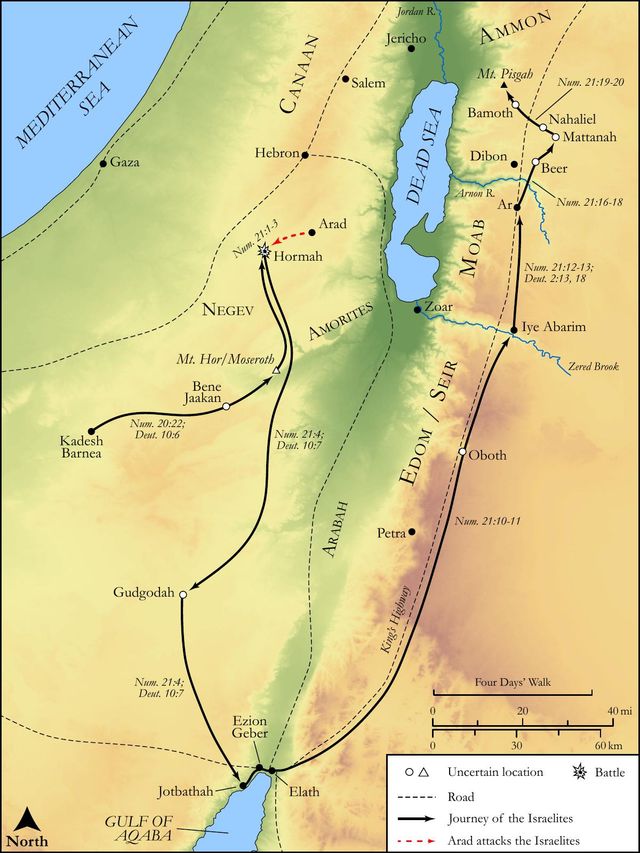
Here is, I. The fatigue of Israel by a long march round the land of Edom, because they could not obtain passage through it the nearest way: The soul of the people was much discouraged because of the way, Num 21:4. Perhaps the way was rough and uneven, or foul and dirty; or it fretted them to go far about, and that they were not permitted to force their passage through the Edomites' country. Those that are of a fretful discontented spirit will always find something or other to make them uneasy.
II.Their unbelief and murmuring upon this occasion, Num 21:5.
Though they had just now obtained a glorious victory over the Canaanites, and were going on conquering and to conquer, yet they speak very discontentedly of what God had done for them and distrustfully of what he would do, vexed that they were brought out of Egypt, that they had not bread and water as other people had by their own care and industry, but by miracle, they knew not how. They have bread enough and to spare; and yet they complain there is no bread, because, though they eat angels' food, yet they are weary of it; manna itself is loathed, and called light bread, fit for children, not for men and soldiers. What will those be pleased with whom manna will not please? Those that are disposed to quarrel will find fault where there is no fault to be found. Thus those who have long enjoyed the means of grace are apt to surfeit even on the heavenly manna, and to call it light bread. But let not the contempt which some cast upon the word of God cause us to value it the less: it is the bread of life, substantial bread, and will nourish those who by faith feed upon it to eternal life, whoever calls it light bread.
III.The righteous judgment which God brought upon them for their murmuring, Num 21:6.
He sent fiery serpents among them, which bit or stung many of them to death. The wilderness through which they had passed was all along infested with those fiery serpents, as appears, Deu 8:15. but hitherto God had wonderfully preserved his people from receiving hurt by them, till now that they murmured, to chastise them for which these animals, which hitherto had shunned their camp, now invade it. Justly are those made to feel God's judgments that are not thankful for his mercies. These serpents are called fiery, from their colour, or from their rage, or from the effects of their bitings, inflaming the body, putting it immediately into a high fever, scorching it with an insatiable thirst. They had unjustly complained for want of water (Num 21:5), to chastise them for which God sends upon them this thirst, which no water would quench. Those that cry without cause have justly cause given them to cry out. They distrustfully concluded that they must die in the wilderness, and God took them at their word, chose their delusions, and brought their unbelieving fears upon them; many of them did die. They had impudently flown in the face of God himself, and the poison of asps was under their lips, and now these fiery serpents (which, it should seem, were flying serpents, Isa 14:29) flew in their faces and poisoned them. They in their pride had lifted themselves up against God and Moses, and now God humbled and mortified them, by making these despicable animals a plague to them. That artillery is now turned against them which had formerly been made use of in their defence against the Egyptians. He that brought quails to feast them let them know that he could bring serpents to bite them; the whole creation is at war with those that are in arms against God.
IV.Their repentance and supplication to God under this judgment, Num 21:7.
They confess their fault: We have sinned. They are particular in their confession: We have spoken against the Lord, and against thee. It is to be feared that they would not have owned the sin if they had not felt the smart; but they relent under the rod; when he slew them, then they sought him. They beg the prayers of Moses for them, as conscious to themselves of their own unworthiness to be heard, and convinced of the great interest which Moses had in heaven. How soon is their tone altered! Those who had just before quarrelled with him as their worst enemy now make their court to him as their best friend, and choose him for their advocate with God. Afflictions often change men's sentiments concerning God's people, and teach them to value those prayers which, at a former period, they had scorned. Moses, to show that he had heartily forgiven them, blesses those who had cursed him, and prays for those who had despitefully used him Herein he was a type of Christ, who interceded for his persecutors, and a pattern to us to go and do likewise, and thus to show that we love our enemies.
V.The wonderful provision which God made for their relief.
He did not employ Moses in summoning the judgment, but, that he might recommend him to the good affection of the people, he made him instrumental in their relief, Num 21:8, Num 21:9. God ordered Moses to make the representation of a fiery serpent, which he did, in brass, and set it up on a very long pole, so that it might be seen from all parts of the camp, and every one that was stung with a fiery serpent was healed by looking up to this serpent of brass. The people prayed that God would take away the serpents from them (Num 21:7), but God saw fit not to do this: for he gives effectual relief in the best way, though not in our way. Thus those who did not die for their murmuring were yet made to smart for it, that they might the more feelingly repent and humble themselves for it; they were likewise made to receive their cure from God, by the hand of Moses, that they might be taught, if possible, never again to speak against God and Moses. This method of cure was altogether miraculous, and the more wonderful if what some naturalists say be true, that looking upon bright and burnished brass is hurtful to those that are stung with fiery serpents. God can bring about his purposes by contrary means. The Jews themselves say that it was not the sight of the brazen serpent that cured them, but, in looking up to it, they looked up to God as the Lord that healed them. But there was much of gospel in this appointment. Our Saviour has told us so (Joh 3:14, Joh 3:15), that as Moses lifted up the serpent in the wilderness so the Son of man must be lifted up, that whosoever believeth in him should not perish. Observe then a resemblance,
1.Between their disease and ours. The devil is the old serpent, a fiery serpent, hence he appears (Rev 12:3) as a great red dragon. Sin is the biting of this fiery serpent; it is painful to the startled conscience, and poisonous to the seared conscience. Satan's temptations are called his fiery darts, Eph 6:16. Lust and passion inflame the soul, so do the terrors of the Almighty, when they set themselves in array. At the last, sin bites like a serpent and stings like an adder; and even its sweets are turned into the gall of asps.
2.Between their remedy and ours.
(1.)It was God himself that devised and prescribed this antidote against the fiery serpents; so our salvation by Christ was the contrivance of Infinite Wisdom; God himself has found the ransom.
(2.)It was a very unlikely method of cure; so our salvation by the death of Christ is to the Jews a stumbling-block and to the Greeks foolishness. It was Moses that lifted up the serpent in the wilderness, so the law is a schoolmaster to bring us to Christ, and Moses wrote of him, Joh 3:14-16. Christ was lifted up by the rulers of the Jews, who were the successors of Moses.
(3.)That which cured was shaped in the likeness of that which wounded. So Christ, though perfectly free from sin himself, yet was made in the likeness of sinful flesh (Rom 8:3), so like that it was taken for granted that this man was a sinner, Joh 9:24.
(4.)The brazen serpent was lifted up; so was Christ. He was lifted up upon the cross (Joh 12:33, Joh 12:34), for his was made a spectacle to the world. He was lifted up by the preaching of the gospel. The word here used for a pole signifies a banner, or ensign, for Christ crucified stands for an ensign of the people, Isa 11:10. Some make the lifting up of the serpent to be a figure of Christ's triumphing over Satan, the old serpent, whose head he bruised, when in his cross he made an open show of the principalities and powers which he had spoiled and destroyed, Col 2:15.
3.Between the application of their remedy and ours. They looked and lived, and we, if we believe, shall not perish; it is by faith that we look unto Jesus, Heb 12:2. Look unto me, and be you saved, Isa 45:22. We must be sensible of our wound and of our danger by it, receive the record which God has given concerning his Son, and rely upon the assurance he has given us that we shall be healed and saved by him if we resign ourselves to his direction. The brazen serpent's being lifted up would not cure if it was not looked upon. If any pored on their wound, and would not look up to the brazen serpent, they inevitably died. If they slighted this method of cure, and had recourse to natural medicines, and trusted to them, they justly perished; so if sinners either despise Christ's righteousness or despair of benefit by it their wound will, without doubt, be fatal. But whoever looked up to this healing sign, though from the outmost part of the camp, though with a weak and weeping eye, was certainly healed; so whosoever believes in Christ, though as yet but weak in faith, shall not perish. There are weak brethren for whom Christ died. Perhaps for some time after the serpent was set up the camp of Israel was molested by the fiery serpents; and it is the probable conjecture of some that they carried this brazen serpent along with them through the rest of their journey, and set it up wherever they encamped, and, when they settled in Canaan, fixed it somewhere within the borders of the land; for it is not likely that the children of Israel went so far off as this was into the wilderness to burn incense to it, as we find they did, Kg2 18:4. Even those that are delivered from the eternal death which is the wages of sin must expect to feel the pain and smart of it as long as they are here in this world; but, if it be not our own fault, we may have the brazen serpent to accompany us, to be still looked up to upon all occasions, by bearing about with us continually the dying of the Lord Jesus.
Historical interpretation
Fourteen Centuries of Reception
3 surviving comments on this verse. Each one is dated, so this reads as a timeline rather than a list.
Select a marker to jump to its quote. Markers stagger vertically where authors wrote within a few decades of each other.
Many things were done in figure which were done in former times. For when he said that the fathers who were bitten by serpents in the desert could not be healed in any other way except that Moses hung up a brazen serpent, and when this was seen, those deadly bites and injurious effects of the poison were cured, he added: But these things were done in figure to instruct us (1 Corinthians 10:6). In the image, a bronze serpent was placed on a cross; because the true one to be crucified was announced to the human race, who would empty the venom of the devilish serpent, cursed in its image, but in truth, would erase all curses of the world.
The wounds caused by the fiery serpent are the poisonous enticements of the vices, which afflict the soul and bring about its spiritual death. The people were murmuring against the Lord. They were stricken by the serpents’ bites. This provides an excellent instance of how one may recognize from the results of an external scourge what a great calamity a person might suffer inwardly by murmuring. In the raising up of the bronze serpent (when those who were stricken beheld it, they were cured) is prefigured our Redeemer’s suffering on the cross, for only by faith in him is the kingdom of death and sin overcome. The sins which drag down soul and body to destruction at the same time are appropriately represented by the serpents, not only because they were fiery and poisonous [and] artful at bringing about death but also because our first parents were led into sin by a serpent, and from being immortal they became mortal by sinning. The Lord is aptly made known by the bronze serpent, since he came in the likeness of sinful flesh. Just as the bronze serpent had the likeness of a fiery serpent but had absolutely none of the strength of harmful poison in its members—rather by being lifted up it cured those who had been stricken by the [live] serpents—so the Redeemer of the human race did not merely clothe himself in sinful flesh but entered bodily into the likeness of sinful flesh, in order that by suffering death on the cross in [this likeness] he might free those who believed in him from all sin and even from death itself.
Fiery serpents: They are so called, because they that were bitten by them were burnt with a violent heat.
Continue studying Numbers 21:6 across the web’s major study libraries — every link below opens this exact verse, chapter, or book on the destination site.
Read & Compare
 BibleGatewayThis verse in more than 200 translations and 70 languages.
 Bible.comThe YouVersion reader — hundreds of translations, reading plans, and highlights.
 ESV.orgCrossway's official English Standard Version reader.
 NET BibleThe NET translation with 60,000+ translators' notes on every rendering decision.
 STEP BibleTyndale House's free study tool — original text, vocabulary, and scholarly resources.
 BibliaLogos Bible Software's free web reader.
 USCCBThe New American Bible (Revised Edition) with the U.S. bishops' study notes.
Commentaries
 BibleHub CommentariesDozens of classic commentaries on this verse, gathered on one page.
 StudyLightMore than 100 commentary sets — the largest collection on the web.
 BibleRefPlain-English commentary on what this verse means, verse by verse.
 Enduring WordDavid Guzik's free commentary on this chapter, widely used by Bible teachers.
 Bible Study ToolsVerse commentary alongside Greek and Hebrew study aids.
Original Language & Research
- BibleHub InterlinearThe verse word by word — original language, transliteration, and English.
- BibleHub LexiconEvery word's original-language definition and Strong's entry.
 Blue Letter BibleDeep-study tools — Strong's numbers, concordance, and word studies.
 SefariaThe Hebrew text with Rashi and centuries of Jewish commentary.
Sermons, Hymns & Audio


TrulyRandomVerse is not affiliated with these sites and doesn’t control their content. They’re linked because they’re genuinely useful.
Summary
Numbers 21:6 recounts a severe divine judgment upon the Israelites during their arduous wilderness wanderings. Following a period of renewed impatience and direct rebellion against God and Moses concerning their provision and journey, the LORD unleashed venomous, "fiery serpents" among the people. These serpents inflicted deadly bites, resulting in widespread death and powerfully underscoring the gravity of Israel's persistent sin and God's holy response to their ingratitude and unbelief.
Context
ShowHideLiterary Context
This verse is strategically positioned within the larger narrative of Israel's wilderness journey, immediately following their detour around Edom and a difficult leg of their journey from Mount Hor by way of the Red Sea. The preceding verses Numbers 21:4-5 explicitly detail the people's renewed grumbling against God and Moses, expressing weariness with the journey and contempt for the manna, which they called "light bread," alongside complaints about the lack of water. This incident is a direct, divine consequence of that specific complaint, fitting into a recurring pattern of sin, divine judgment, repentance, and deliverance that characterizes much of the wilderness narrative, notably seen in the rebellion of Korah in Numbers 16. The subsequent verses Numbers 21:7-9 detail the people's repentance, Moses' intercession, and God's provision of the bronze serpent as a means of healing, setting the stage for a profound theological type of future salvation.
Historical & Cultural Context
The setting is the arid wilderness, a region naturally inhabited by dangerous serpents. The descriptor "fiery serpents" (Hebrew: saraph) likely refers to the intense burning sensation caused by their potent venom, or possibly their vivid, fiery coloration. In Scripture, serpents are associated with evil and divine judgment, a motif powerfully established in the Garden of Eden narrative. God's "sending" of these serpents is not a random natural occurrence but a direct, deliberate act of divine judgment, mirroring earlier plagues and disciplinary actions against both Egypt and Israel. This underscores God's absolute sovereignty over creation and His use of natural elements to execute His righteous will. The Israelites, having witnessed numerous miracles of provision and deliverance, were expected to trust God, yet their repeated complaints demonstrated a profound lack of faith and respect for their covenant relationship.
Key Themes
ShowHideNumbers 21:6 powerfully illustrates several key themes prevalent throughout the book of Numbers and the Pentateuch. Firstly, it highlights Divine Judgment for Sin, demonstrating God's unyielding holiness and His intolerance for persistent disobedience, ingratitude, and outright rebellion against His authority and provision. The severity of the judgment—widespread death—underscores that sin has tangible and often fatal consequences, both spiritual and physical. Secondly, it emphasizes the Consequences of Complaining and Unbelief. The Israelites' words were not mere expressions of discomfort but a direct affront to God's character and faithfulness, revealing a deep-seated lack of trust despite His miraculous sustenance, as seen in Exodus 16:35. This event serves as a stark warning against murmuring and testing God, a theme powerfully echoed in 1 Corinthians 10:9. Thirdly, the verse showcases God's Sovereignty and Discipline. The LORD "sent" the serpents, affirming His ultimate control over all creation and His active involvement in the lives of His people, even through disciplinary measures designed to humble them and draw them back to obedience and dependence, as described in Deuteronomy 8:15-16. This judgment, while severe, also sets the stage for a profound act of divine grace and a foreshadowing of future salvation.
Exposition and Analysis
ShowHideKey Word Analysis
ShowHideThis is the covenant name of God, emphasizing His self-existence, eternal nature, and His personal relationship with Israel. The fact that "the LORD" sent the serpents underscores that this was not a random event but a direct, intentional act of the covenant God, demonstrating His righteousness and authority over His chosen people.
Derived from a root meaning "to burn," this word describes the serpents. It can refer to the intense burning pain caused by their venomous bites, or possibly their striking, fiery coloration. The term is also used elsewhere in Scripture to describe celestial beings (seraphim), suggesting an association with something powerful, awe-inspiring, and potentially destructive, here serving as instruments of divine judgment.
This verb signifies a deliberate, purposeful dispatch. It highlights God's direct agency and active involvement in the judgment. The serpents were not a natural occurrence that God merely allowed; He actively "sent" them, demonstrating His sovereign control and His direct response to Israel's rebellion.
This primitive root means "to die," literally or figuratively. Its inclusion emphasizes the severe and fatal consequence of the serpent bites. The widespread death among the people underscores the gravity of their sin and the ultimate cost of rebellion against God's holy character and provision.
Verse Breakdown
ShowHide"And the LORD sent fiery serpents among the people"
This initial clause establishes the divine origin and intentionality of the judgment. The "LORD," the covenant God of Israel, is the active agent. The "fiery serpents" are specifically chosen instruments, their painful and deadly nature directly contrasting with the people's complaints about their physical discomforts and lack of desirable sustenance. This highlights God's sovereign control over creation and His direct response to human sin.
"and they bit the people"
This clause describes the immediate and widespread execution of God's judgment. The serpents effectively carried out their mission, inflicting venomous and painful bites upon a significant number of Israelites. This emphasizes the tangible and direct nature of the divine retribution, demonstrating that God's judgment is not abstract but has real-world, painful consequences.
"and much people of Israel died"
This final clause reveals the severe and fatal outcome of the judgment. The phrase "much people" indicates a significant loss of life, emphasizing the widespread and deadly impact of God's wrath. It underscores the profound seriousness of their sin and the ultimate, physical cost of persistent rebellion against the Almighty, serving as a stark warning to the community.
Literary Devices
ShowHideNumbers 21:6 employs several literary devices to convey its powerful message of divine judgment. Divine Retribution is the most prominent device, where the punishment directly and immediately follows the offense, establishing a clear cause-and-effect relationship between Israel's grumbling and God's severe judgment. The choice of serpents as the instrument of judgment carries potent Symbolism, as serpents in biblical tradition often represent evil, temptation, and death, as seen in the foundational narrative of Genesis 3. Here, they are ironically transformed into agents of divine wrath, bringing death to a people who had been miraculously preserved. The phrase "much people of Israel died" uses Hyperbole or Intensification to underscore the severity and widespread nature of the judgment, ensuring the reader grasps the magnitude of the divine displeasure and the pervasive impact of sin. The repetition of "people" further emphasizes the broad reach of this calamitous event across the community.
Theological and Thematic Connections
ShowHideNumbers 21:6 serves as a stark reminder of God's holiness and justice, demonstrating that His patience is not limitless in the face of persistent rebellion and ingratitude. While God is merciful and long-suffering, He is also righteous and will not tolerate sin indefinitely without consequence. This judgment highlights the destructive power of unbelief and complaining, revealing how such attitudes grieve God and can lead to severe spiritual and physical repercussions. Yet, even within this severe judgment, the narrative subtly prepares the way for God's redemptive grace, as the subsequent verses introduce the bronze serpent—a powerful symbol of salvation that would later be fulfilled in Christ. This pattern of sin, judgment, repentance, and divine provision underscores God's ultimate desire for His people's restoration and life, even through disciplinary means.
Reflection and Application
ShowHideNumbers 21:6 stands as a timeless warning against the insidious dangers of impatience, ingratitude, and rebellion against God's sovereign will and provision. In our own lives, it is easy to fall into the trap of complaining when circumstances are difficult, when our expectations are not met, or when God's path seems arduous. This passage reminds us that our words and attitudes profoundly matter to God. A spirit of murmuring not only dishonors God but can also poison our own hearts and lead to severe spiritual and relational consequences. Instead, we are called to cultivate a heart of deep gratitude and unwavering trust, recognizing that God's wisdom and goodness are unfailing, even when His ways are challenging. This narrative ultimately calls us to embrace humility, acknowledge our complete dependence on God, and respond to His discipline with genuine repentance, knowing that He always provides a path to healing and restoration for those who turn to Him in faith.
Questions for Reflection
ShowHideFAQ
ShowHideWhy did God send serpents specifically, and was this punishment too harsh?
ShowHideGod's choice of "fiery serpents" in Numbers 21:6 as the instrument of judgment was deeply symbolic and fitting for the context. The Israelites were in a wilderness known for such creatures, as noted in Deuteronomy 8:15, and the painful, burning bites directly countered their complaints about physical discomfort and the "light bread." It was a judgment that directly addressed their physical and spiritual rebellion against God's provision. As for whether the punishment was too harsh, it's crucial to understand the cumulative nature of Israel's sin. This was not an isolated incident but the latest in a long pattern of grumbling, unbelief, and direct rebellion against God and His appointed leaders, despite repeated miraculous interventions and covenant blessings. God's holiness demands a response to persistent sin, and His discipline, while severe, is always purposeful—designed to humble His people, reveal the deadly nature of sin, and ultimately draw them back to repentance and dependence on Him, as explained in Hebrews 12:5-11. The severity underscores the gravity of rejecting divine authority and provision.
Christ-Centered Fulfillment
ShowHideThe seemingly harsh judgment of the fiery serpents in Numbers 21:6 finds its profound Christ-centered fulfillment in the subsequent divine remedy: the bronze serpent lifted up in the wilderness, as detailed in Numbers 21:8-9. This Old Testament event is not merely a historical account but a powerful "type" of Christ, explicitly interpreted by Jesus Himself in John 3:14-15. Just as the dying Israelites, bitten by the venomous serpents, had to look to the bronze serpent to live, so too must humanity, afflicted by the deadly venom of sin, look to Jesus Christ, who was "lifted up" on the cross. The serpents represented the deadly consequence of sin, and in a profound paradox, Jesus, though sinless, became sin for us (2 Corinthians 5:21), bearing the curse and the judgment we deserved (Galatians 3:13). He became the ultimate "antidote" to sin's poison. Those who, in faith, look to the crucified Christ are healed from the spiritual death sentence of sin and receive eternal life. The judgment of the fiery serpents highlights the dire need for salvation, and the bronze serpent points directly to the ultimate, gracious provision of God in His Son, who offers life to all who believe.