


Isaiah 30:6
- מַשָּׂאma·Sa'[the] oracle ofH4853N-mscNoun Singular Masculine Construct
- בַּהֲמוֹתba·ha·Mot[the] animals ofH929N-fpcNoun Plural Feminine Construct
- נֶגֶבNe·gev[the] NegevH5045N-properNoun Proper Location
- בְּאֶרֶץbe·'e·Retzin a land ofH776Prep-b ¦ N-fscNoun Singular Feminine Constructבְּinאֶרֶץa land of
- צָרָהtza·RahtroubleH6869N-fsNoun Singular Feminine Absolute
- וְצוּקָהve·tzu·Kahand distressH6695Conj-w ¦ N-fsNoun Singular Feminine Absoluteוְandצוּקָהdistress
- לָבִיאla·Vi'lionessH3833N-msNoun Singular Masculine Absolute
- וָלַיִשׁva·La·yishand lionH3918Conj-w ¦ N-msNoun Singular Masculine Absoluteוָandלַיִשׁlion
- מֵהֶםme·Hemfrom themPrep-m ¦ 3mpSuffix Personal 3rd Plural Masculineמֵfromהֶםthem
- אֶפְעֶה'ef·'EhviperH660N-msNoun Singular Masculine Absolute
- וְשָׂרָףve·sa·Rafand serpentH8314Conj-w ¦ N-msNoun Singular Masculine Absoluteוְandשָׂרָףserpent
- מְעוֹפֵףme·'o·FefflyingH5774V-Piel-Prtcpl-msVerb Piel Participle Singular Masculine Absolute
- יִשְׂאוּyis·'Uthey carryH5375V-Qal-Imperf-3mpVerb Qal Imperfect 3rd Plural Masculine
- עַל'alonH5921PrepPreposition
- כֶּתֶףKe·tef[the] shoulder ofH3802N-fscNoun Singular Feminine Construct
- עֲיָרִים'a·ya·RimdonkeysH5895N-mpNoun Plural Masculine Absolute
- חֵילֵהֶםchei·le·Hemtheir wealth<s>H2428N-mpc ¦ 3mpNoun Plural Masculine Constructחֵילֵwealth<s>הֶםtheir
- וְעַלve·'aland onH5921Conj-w ¦ PrepPrepositionוְandעַלon
- דַּבֶּשֶׁתda·Be·shet[the] hump ofH1707N-fscNoun Singular Feminine Construct
- גְּמַלִּיםge·ma·LimcamelsH1581N-cpNoun Plural common gender Absolute
- אוֹצְרֹתָם'otz·ro·Tamtheir treasuresH214N-fpc ¦ 3mpNoun Plural Feminine Constructאוֹצְרֹתָtreasuresםtheir
- עַל'altoH5921PrepPreposition
- עַם'ama peopleH5971N-msNoun Singular Masculine Absolute
- לֹאlo'[which] notH3808NegParticle Negative
- יוֹעִילוּyo·'I·luthey will confer profitH3276V-Hiphil-Imperf-3mpVerb Hiphil Imperfect 3rd Plural Masculine
English is a literal word-by-word gloss of the Hebrew, not the KJV's wording. Why?
This is the original text the KJV's translators worked from — each Hebrew word with its own literal English meaning in this verse, prepared by scholars at Tyndale House, Cambridge. The KJV translates whole sentences, not word by word, so its wording differs: one Hebrew word can become several English words, and the KJV may choose “the LORD” where the gloss reads “Yahweh”. Both are faithful — they answer different questions. For the KJV's own rendering, switch to the KJV text.
Details
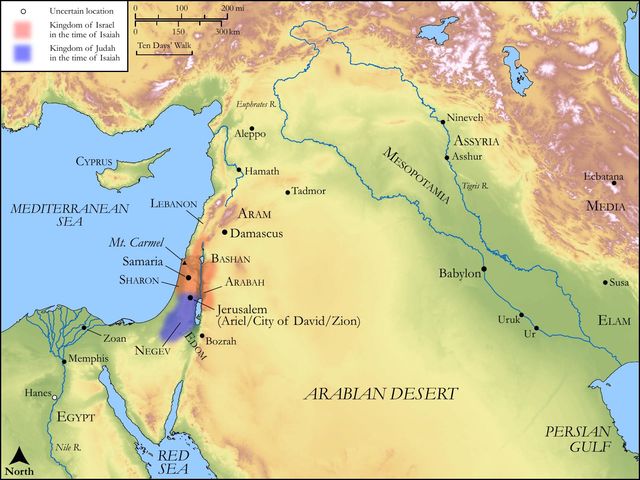
See on the biblical-era map
Study this verse
Public-domain commentary
Matthew Henry
From his Commentary on the Whole Bible. Henry comments on passages, not single verses — this entry covers Isaiah 30:1–7. His three-level outline is real structure in the source text, so it is rendered as structure.
It was often the fault and folly of the people of the Jews that, when they were insulted by their neighbours on one side, they sought for succour from their neighbours on the other side, instead of looking up to God and putting their confidence in him. Against the Israelites they sought to the Syrians, Ch2 16:2, Ch2 16:3. Against the Syrians they sought to the Assyrians, Kg2 16:7. Against the Assyrians they here sought to the Egyptians, and Rabshakeh upbraided them with so doing, Kg2 18:21. Now observe here,
I.How this sin of theirs is described, and what there was in it that was provoking to God.
When they saw themselves in danger and distress, 1. They would not consult God. They would do things of their own heads, and not advise with God, though they had a ready and certain way of doing it by Urim or prophets. They were so confident of the prudence of their own measures that they thought it needless to consult the oracle; nay, they were not willing to put it to that issue: "They take counsel among themselves, and one from another; but they do not ask counsel, much less will they take counsel, of me. They cover with a covering" (they think to secure themselves with one shelter or other, which may serve to cover them from the violence of the storm), "but not of my Spirit" (not such as God by his Spirit, in the mouth of his prophets, directed them to), "and therefore it will prove too short a covering, and a refuge of lies." 2. They could not confide in God. They did not think it enough to have God on their side, nor were they at all solicitous to make him their friend, but they strengthened themselves in the strength of Pharaoh; they thought him a powerful ally, and doubted not but to be able to cope with the Assyrian while they had him for them. The shadow of Egypt (and it was but a shadow) was the covering in which they wrapped themselves.
II.What was the evil of this sin.
1.It bespoke them rebellious children; and a woe is here denounced against them under that character, Isa 30:1. They were, in profession, God's children; but, not trusting in him, they were justly stigmatized as rebellious; for, if we distrust God's providence, we do in effect withdraw ourselves from our allegiance.
2.They added sin to sin. It was sin that brought them into distress; and then, instead of repenting, they trespassed yet more against the Lord, Ch2 28:22. And those that had abused God's mercies to them, making them the fuel of their lusts, abused their afflictions too, making them an excuse for their distrust of God; and so they make bad worse, and add sin to sin; and those that do so, as they make their own chain heavy, so it is just with God to make their plagues wonderful. Now that which aggravated their sin was,
(1.)That they took so much pains to secure the Egyptians for their allies: They walk to go down to Egypt, travel up and down to find an advantageous road thither; but they have not asked at my mouth, never considered whether God would allow and approve of it or no.
(2.)That they were at such a vast expense to do it, Isa 30:6. They load the beasts of the south (horses fetched from Egypt, which lay south from Judea) with their riches, fancying, as it is common with people in a fright, that they were safer any where than where they were. Or they sent their riches thither as bribes to Pharaoh's courtiers, to engage them in their interests, or as pay for their army. God would have helped them gratis; but, if they will have help from the Egyptians, they must pay dearly for it, and they seem willing to do so. The riches that are so spent will turn to a bad account. They carried their effects to Egypt through a land (so it may be read) of trouble and anguish, that vast howling wilderness which lay between Canaan and Egypt, whence come the lion and fiery serpent, Deu 8:15. They would venture through that dangerous wilderness, to bring what they had to Egypt. Or it may be meant of Egypt itself, which had been to Israel a house of bondage and therefore a land of trouble and anguish, and which abounded in ravenous and venomous creatures. See what dangers men run into that forsake God, and what dangers they will run into in pursuance of their carnal confidences and their expectations from the creature.
III.What would be the consequence of it.
1.The Egyptians would receive their ambassadors, would address them very respectfully, and be willing to treat with them (Isa 30:4): His princes were at Zoan, at Pharaoh's court there, and had their audience of the king, who encouraged them to depend upon his friendship and the succours he would send them. But,
2.They would not answer their expectation: They could not profit them, Isa 30:5. For God says, They shall not profit them (Isa 30:6), and every creature is that to us (and no more) which he makes it to be. The forces they were to furnish them with could not be raised in time; or, when they were raised, they were not fit for service, and they would not venture any of their veteran troops in the expedition; or the march was so long that they could not come up when they had occasion for them; or the Egyptians would not be cordial to Israel, but would secretly incline to the Assyrians, upon some account or other: The Egyptians shall help in vain, and to no purpose, Isa 30:7. They shall hinder and hurt, instead of helping. And therefore,
3.These people, that were now so fond of the Egyptians, would at length be ashamed of them, and of all their expectations from them and confidence in them (Isa 30:3): "The strength of Pharaoh, which was your pride, shall be your shame; all your neighbours will upbraid you, and you will upbraid yourselves, with your folly in trusting to it. And the shadow of Egypt, that land shadowing with wings (Isa 18:1), which was your confidence, shall be your confusion; it will not only disappoint you, and be the matter of your shame, but it will weaken all your other supports, and be an occasion of mischief to you." God afterwards threatens the ruin of Egypt for this very thing, because they had dealt treacherously with Israel and been a staff of a reed to them, Eze 29:6, Eze 29:7. The princes and ambassadors of Israel, who were so forward to court an alliance with them, when they come among them shall see so much of their weakness, or rather of their baseness, that they shall all be ashamed of a people that could not be a help or profit to them, but a shame and reproach, Isa 30:5. Those that trust in God, in his power, providence, and promise, are never made ashamed of their hope; but those that put confidence in any creature will sooner or later find it a reproach to them. God is true, and may be trusted, but every man a liar, and must be suspected. The Creator is a rock of ages, the creature a broken reed. We cannot expect too little from man nor too much from God.
IV.The use and application of all this (Isa 30:7):
"Therefore have I cried concerning this matter, this project of theirs. I have published it, that all might take notice of it. I have pressed it as one in earnest. Their strength is to sit still, in a humble dependence upon God and his goodness and a quiet submission to his will, and not to wander about and put themselves to great trouble to seek help from this and the other creature." If we sit still in a day of distress, hoping and quietly waiting for the salvation of the Lord, and using only lawful regular methods for our own preservation, this will be the strength of our souls both for services and sufferings, and it will engage divine strength for us. We weaken ourselves, and provoke God to withdraw from us, when we make flesh our arm, for then our hearts depart from the Lord. When we have tired ourselves by seeking for help from creatures we shall find it the best way of recruiting ourselves to repose in the Creator. Here I am, let him do with me as he pleases.
Historical interpretation
Historical reception
1 surviving comment on this verse from the historical church.
(Vers. 6, 7.) In the land of trouble and distress there will be a lioness and a lion: there will also be venomous snakes and flying serpents. They will carry their riches on the backs of donkeys and their treasures on the humps of camels to a people who cannot help them. Egypt will be useless and in vain for assistance. LXX: In trouble and distress there will be a lion and a lion's cub: then there will be asps and flying snake offspring. They will carry their riches on donkeys and camels to a nation that will not help them. The Egyptians will be empty and useless for your benefit. For the lion, in Hebrew it is written Leis () (also Lehis), and for the flying ruler, which the Seventy translated as flying asps, in Hebrew it is called ἐμπρηστὴς and flying, which we can call the burner, and in Hebrew it is called Saraph (). Again, in that place where we have translated, carrying on the shoulders of the beasts, they have uniformly translated all the animals as foals, that is, the young of donkeys. But the land of tribulation and anguish signifies the very wide desert, through which the remnants of Jerusalem, along with John the son of Careah and the daughters of King Zedekiah, having taken away all they could have, fled to Egypt. Likewise, understand metaphorically the lioness and the lion cub as Jerusalem and its people, as Balaam says in Numbers: Behold the people shall rise up as a lioness, and shall lift itself up as a lion; it shall not rest until it devour the prey, and drink the blood of the slain (Num. XXIII, 24). In Ezekiel it is also written: Take up a lamentation for the prince of Israel, and say: Why has your mother the lioness lain down among lions, and reared her whelps in the midst of young lions? (Ezek. 19:1-2). And lest we think that Holy Scripture truly speaks of the lioness and the lion contrary to the nature of things, that a viper and a flying basilisk should be born of a lioness and a lion, that is, that worse offspring should be generated from evil parents, of whom the Gospel also spoke: Brood of vipers, who has shown you to flee from the wrath to come? (Matt. 3:7). And to the land of Israel it is said: You are a land where it does not rain, nor does the rain come upon you in the day of anger, whose rulers are in its midst, like roaring lions, seizing prey, devouring souls by their power (Above, V). These offspring of vipers, or flying asps, that is, the rulers of the people and the whole crowd of the wicked, went to the people who could not help them, as Jeremiah says (Jer. LVI), that the Lord delivered Pharaoh, the crafty king of Egypt, into the hands of his enemies, and into the hands of those seeking his life, and all the men of Judah, who were in the land of Egypt, were consumed by sword and famine, to the point that the Hebrews delivered Jeremiah and Baruch, before Nebuchadnezzar captured Egypt, from the imminent captivity, avoiding death. A certain lioness and her lion cub, a celestial lion, were deceived by Jerusalem and exposed the people. And a flying king, and vipers, and offspring of asps, of whom we read above (Above. XIV and XXVII), a twisted serpent, and of whom the Savior spoke in the Gospel: I saw Satan, like lightning falling from heaven (Luke X, 19): who is called the dragon in the Apocalypse (Rev. XII), he drew with him a third part of the stars to the earth, who, by the perversity of their judgement, lost their former riches, abandoning them to the Egypt of this age.
Therefore I cried out concerning this: it is only pride: be silent. For this reason, I do not know what the Seventy Interpreters intended: Proclaim these things, because your consolation is in vain. Furthermore, Symmachus interpreted it as 'turbulence is to dwell', that is, they are tumultuous in their habitation. The Hebrew word Reeb, or Reheb according to some, is translated by Aquila as 'impetus and pride', by Symmachus as 'disturbance', by the LXX as 'vanity', and by Theodotion as 'latitudinarianism'; which is written with three letters, Res (ר), He (ה), and Beth (ב), and it is the same as what is read in the Psalms: 'I will be mindful of Rahab and Babylon, those who know me' (Ps. XXVI, 3). And the meaning is: Since the Egyptians offer empty help, I commanded him, that is, Jerusalem, or I exclaimed, that the Egyptians only have the name of a kingdom, and without power they boast; and Israel should sit or dwell in their own land, and not seek help in vain from the weak.
Continue studying Isaiah 30:6 across the web’s major study libraries — every link below opens this exact verse, chapter, or book on the destination site.
Read & Compare
 BibleGatewayThis verse in more than 200 translations and 70 languages.
 Bible.comThe YouVersion reader — hundreds of translations, reading plans, and highlights.
 ESV.orgCrossway's official English Standard Version reader.
 NET BibleThe NET translation with 60,000+ translators' notes on every rendering decision.
 STEP BibleTyndale House's free study tool — original text, vocabulary, and scholarly resources.
 BibliaLogos Bible Software's free web reader.
 USCCBThe New American Bible (Revised Edition) with the U.S. bishops' study notes.
Commentaries
 BibleHub CommentariesDozens of classic commentaries on this verse, gathered on one page.
 StudyLightMore than 100 commentary sets — the largest collection on the web.
 BibleRefPlain-English commentary on what this verse means, verse by verse.
 Enduring WordDavid Guzik's free commentary on this chapter, widely used by Bible teachers.
 Bible Study ToolsVerse commentary alongside Greek and Hebrew study aids.
Original Language & Research
- BibleHub InterlinearThe verse word by word — original language, transliteration, and English.
- BibleHub LexiconEvery word's original-language definition and Strong's entry.
 Blue Letter BibleDeep-study tools — Strong's numbers, concordance, and word studies.
 SefariaThe Hebrew text with Rashi and centuries of Jewish commentary.
Sermons, Hymns & Audio


TrulyRandomVerse is not affiliated with these sites and doesn’t control their content. They’re linked because they’re genuinely useful.
Summary
Isaiah 30:6 delivers a profound prophetic indictment against the Kingdom of Judah for its misguided and faithless reliance on Egypt for military aid against the formidable Assyrian threat. The verse vividly depicts the arduous and perilous journey through a dangerous wilderness, laden with valuable tribute intended for their potential ally, only to declare with divine certainty that this costly and treacherous endeavor would ultimately yield no benefit or profit whatsoever, underscoring the futility of trusting in human alliances over God's sovereign protection and wisdom.
Context
ShowHideLiterary Context
Isaiah 30:6 is situated within a larger prophetic oracle (Isaiah 30-31) where the prophet Isaiah vehemently condemns Judah's decision to seek an alliance with Egypt. This specific verse follows a declaration of "Woe to the rebellious children," who "carry out a plan, but not mine, and make an alliance, but not of my Spirit" Isaiah 30:1. The preceding verses describe Judah's envoys traveling to Egypt, highlighting their spiritual blindness and refusal to trust in the Lord. The subsequent verses continue to emphasize God's judgment on such misplaced trust and His call to repentance, emphasizing that "In quietness and in trust shall be your strength" Isaiah 30:15. The entire section serves as a powerful contrast between divine wisdom and human folly, setting the stage for the specific condemnation of the Egyptian alliance found in verse 6.
Historical & Cultural Context
During the late 8th century BCE, the Kingdom of Judah, under King Hezekiah, faced immense pressure from the rapidly expanding Neo-Assyrian Empire. Assyria had already conquered the Northern Kingdom of Israel in 722 BCE and was threatening Judah's sovereignty. In a desperate attempt to secure their nation, many nations, including Judah, looked to Egypt, a traditional regional power, for military and financial support. This involved sending envoys with rich gifts across the dangerous Sinai desert, a region notorious for its harsh conditions, desolate terrain, and venomous creatures. The "beasts of the south" could refer to the actual animals of the desert or symbolically to the dangerous nature of the Egyptian alliance itself. Culturally, such alliances were often sealed with substantial tribute, and the journey described reflects a significant investment of Judah's precious resources and a willingness to undertake extreme risk.
Key Themes
ShowHideThe central theme is Misplaced Trust, showcasing Judah's profound error in diverting their hope and resources from the Lord to a foreign power. The costly and perilous journey, with "their riches upon the shoulders of young asses, and their treasures upon the bunches of camels," vividly illustrates the extent of their commitment to this human-centric solution, completely disregarding God's clear command to rely on Him alone. This leads directly to the theme of the Futility of Human Schemes, as the verse emphatically concludes that the Egyptian alliance "shall not profit them." This highlights the ultimate emptiness of plans conceived apart from divine will, a warning echoed throughout prophetic literature, such as in the declaration that "No king is saved by the size of his army; no warrior escapes by his great strength" Psalm 33:16-17. Furthermore, the vivid imagery of dangerous animals like "the young and old lion, the viper and fiery flying serpent" underscores the theme of Divine Warning and Inherent Danger, not just of the physical journey but metaphorically of the treacherous and ultimately destructive nature of the ungodly alliance itself.
Exposition and Analysis
ShowHideKey Word Analysis
ShowHideThis term (H4853) is derived from a root meaning "to lift" or "to carry," and in prophetic contexts, it often denotes a weighty prophetic utterance, frequently one of judgment or doom. Its use here immediately signals the solemnity and gravity of the divine pronouncement against Judah's actions, framing the entire verse as a divine oracle rather than a mere observation. It emphasizes the spiritual weight of Judah's sin and the impending consequences.
Chayil (H2428) signifies force, whether of men, means, or other resources, encompassing wealth, strength, and substance. ʼôwtsâr (H214) refers to a depository, a storehouse, or accumulated valuables. Together, these words emphasize the significant material wealth and valuable resources Judah was expending on this alliance. The act of carrying these "riches" and "treasures" across a dangerous land underscores the immense investment and sacrifice Judah was willing to make for human security, rather than investing their trust in God.
This primitive root (H3276) means "to ascend" or, figuratively, "to be valuable," "useful," or "benefited." The declaration that the people "shall not profit them" is a direct divine judgment on the futility of Judah's efforts. Despite the great cost, peril, and expectation, the outcome would be utterly devoid of any true or lasting benefit, highlighting the emptiness of seeking help apart from God.
Verse Breakdown
ShowHide"The burden of the beasts of the south:"
This opening phrase, using "burden" (massâʼ), immediately establishes the prophetic context, signaling a weighty divine pronouncement, often associated with judgment. "The beasts of the south" likely refers to the animals used for transport (asses, camels) carrying tribute to Egypt, located to Judah's south. It also subtly hints at the wild, untamed, and dangerous nature of the region itself, through which Judah's envoys are traveling.
"into the land of trouble and anguish, from whence [come] the young and old lion, the viper and fiery flying serpent,"
This clause vividly describes the perilous journey through the desert to Egypt. "Land of trouble and anguish" paints a picture of hardship, distress, and severe difficulty. The specific mention of "young and old lion, the viper and fiery flying serpent" emphasizes the extreme physical dangers—predatory animals and highly venomous snakes (the "fiery flying serpent" likely referring to a type of venomous snake whose bite causes burning pain, or a symbol of intense danger)—that infest this desolate region, symbolizing the inherent peril and destructive nature of the path Judah has chosen.
"they will carry their riches upon the shoulders of young asses, and their treasures upon the bunches of camels,"
This part details the costly tribute Judah is sending. "Riches" and "treasures" highlight the valuable resources being invested, underscoring the immense material sacrifice. The "young asses" and "camels" are the beasts of burden, emphasizing the significant effort and expense involved in transporting such a substantial offering across the treacherous terrain, all for a misguided alliance.
"to a people [that] shall not profit [them]."
This concluding phrase delivers the divine verdict, rendering the entire costly and dangerous enterprise utterly futile. Despite all the effort, expense, and peril, the intended allies (Egypt) would provide no actual benefit, help, or lasting security. This powerfully emphasizes the emptiness of human-centered solutions when God's will is disregarded, highlighting the ultimate disappointment awaiting those who trust in worldly power.
Literary Devices
ShowHideIsaiah 30:6 is rich in Imagery, painting a vivid and visceral picture of the dangerous desert journey. Phrases like "land of trouble and anguish" and the specific mention of menacing creatures such as "young and old lion, the viper and fiery flying serpent" create a palpable sense of dread and highlight the extreme peril of Judah's chosen path. The "fiery flying serpent" is a particularly potent image, likely referring to a highly venomous snake whose bite causes burning pain, or a symbolic creature (seraph) representing intense danger. The entire passage functions as a powerful Metaphor for the spiritual danger and futility of relying on human alliances rather than divine protection. The act of carrying immense "riches" and "treasures" to a people who "shall not profit them" employs profound Irony, as the immense investment and risk lead to a completely unproductive and disappointing outcome, underscoring the foolishness and spiritual blindness of Judah's misplaced trust.
Theological and Thematic Connections
ShowHideIsaiah 30:6 serves as a profound theological statement on the nature of divine sovereignty versus human self-reliance. It underscores the biblical principle that true security, deliverance, and salvation originate solely from God, not from worldly power, political alliances, or material wealth. Judah's attempt to secure its future through an alliance with Egypt, rather than by trusting in the Lord, is presented as an act of faithlessness that will inevitably lead to futility and disappointment. This passage teaches that any endeavor undertaken outside of God's will, no matter how logical or expedient it appears from a human perspective, is ultimately destined to "not profit" those who pursue it. It is a timeless warning against idolatry in its various forms, particularly the idolatry of human strength, worldly solutions, and self-sufficiency.
Reflection and Application
ShowHideIsaiah 30:6 offers a timeless spiritual lesson for believers today, challenging us to examine where our ultimate trust truly lies. In a world fraught with anxieties, economic uncertainties, and political instability, the temptation to seek security in human systems, financial portfolios, or powerful connections can be overwhelming. This verse powerfully reminds us that such reliance, while seemingly pragmatic and logical from a human perspective, is ultimately a "land of trouble and anguish" that will "not profit" us in the long run. It calls us to cultivate a radical dependence on God, recognizing that His wisdom, provision, and protection are infinitely superior to any human strategy or resource. True peace and lasting security are found not in accumulating wealth or forging strategic alliances, but in quiet trust and obedient reliance on the Lord. When faced with challenges, our first inclination should be to seek God's counsel and rely on His sovereign power, rather than expending our energy and resources on paths that ultimately yield no eternal benefit.
Questions for Reflection
ShowHideFAQ
ShowHideWhat does "the burden of the beasts of the south" mean in this context?
ShowHideThe phrase "the burden" (Hebrew: massâʼ) signifies a weighty prophetic oracle, often one of judgment, indicating that the following message is a divine pronouncement of doom or a solemn warning. "The beasts of the south" refers to the animals (specifically young asses and camels mentioned later in the verse) used to transport the valuable tribute from Judah across the southern desert regions to Egypt. It also implicitly highlights the dangerous nature of the journey and the region itself, which was known for its wild animals and harsh conditions. The entire phrase sets the stage for God's condemnation of Judah's misguided alliance with Egypt.
Why was Judah seeking help from Egypt, and what was the consequence?
ShowHideJudah, under King Hezekiah, was under immense pressure from the powerful Neo-Assyrian Empire, which had already conquered the northern kingdom of Israel and was threatening Judah's sovereignty. Fearing invasion and seeking military protection, Judah's leaders sought a political and military alliance with Egypt, a formidable power to their south. The consequence, as declared in Isaiah 30:6, was that this alliance would "not profit them." God, through Isaiah, condemned this act as a profound lack of faith, emphasizing that true deliverance and security come only from Him, not from human alliances or military might, a theme powerfully reiterated in Isaiah 31:1.
Christ-Centered Fulfillment
ShowHideIsaiah 30:6, with its stark portrayal of Judah's misplaced trust and the futility of their human-centered solutions, profoundly foreshadows humanity's ultimate need for a divine deliverer. Judah sought "profit" and security from Egypt, a worldly power, but found only emptiness and divine condemnation. This mirrors humanity's pervasive tendency to seek salvation, meaning, and security in earthly pursuits, self-effort, or various idols, all of which ultimately "will not profit" us in the face of spiritual trouble and anguish. The "land of trouble and anguish" and its dangerous "lions" and "serpents" can be seen as a metaphor for the fallen world and the spiritual perils of sin and death that threaten all humanity. Christ, however, is the true "profit" for humanity. Unlike the fleeting and ultimately useless aid from Egypt, Jesus offers eternal salvation and true, unfailing security. He is the one who truly delivers us from the "burden" of sin and the "anguish" of separation from God, having Himself trodden the path of suffering to conquer the "fiery flying serpent" of sin and death, thereby destroying "the one who has the power of death, that is, the devil" Hebrews 2:14-15. Our "riches" and "treasures" find their true value and eternal purpose when invested in His kingdom, for He promises that whoever loses his life for His sake will find it Matthew 16:25. He is the one in whom all our trust should be placed, for He alone is the Way, the Truth, and the Life, providing the ultimate, unfailing profit and deliverance from all spiritual perils John 14:6.