


Hosea 8:10
Bible text: King James Version (1769 Blayney text) · Public domain
Bible text: Berean Standard Bible · Public domain
Bible text: American Standard Version (1901) · Public domain
Bible text: World English Bible, Messianic edition · Public domain
Bible text: Geneva Bible (1599) · Public domain
Bible text: Young's Literal Translation · Public domain
- גַּםgamalsoH1571AdvAdverb
- כִּיkiforH3588PrtParticle Conditional
- יִתְנוּyit·Nuthey will hireH8566V-Qal-Imperf-3mpVerb Qal Imperfect 3rd Plural Masculine
- בַגּוֹיִםva·go·Yimamong the nationsH1471Prep-b ¦ N-mpNoun Plural Masculine Absoluteבַamong theגּוֹיִםnations
- עַתָּה'a·TahnowH6258AdvAdverb
- אֲקַבְּצֵם'a·ka·be·TzemI will gather themH6908V-Piel-Imperf-1cs ¦ 3mpVerb Piel Imperfect 1st Singular common genderאֲקַבְּצֵI will gatherםthem
- וַיָּחֵלּוּvai·ya·Che·luand they have begunH2490Conj-w ¦ V-Hiphil-ConsecImperf-3mpVerb Hiphil Consecutive Imperfect 3rd Plural Masculineוַandיָּחֵלּוּthey have begun
- מְּעָטme·'Ata fewH4592N-msNoun Singular Masculine Absolute
- מִמַּשָּׂאmi·ma·Sa'from [the] burden ofH4853Prep-m ¦ N-mscNoun Singular Masculine Constructמִfromמַּשָּׂא[the] burden of
- מֶלֶךְMe·lekha kingH4428N-msNoun Singular Masculine Absolute
- שָׂרִיםsa·RimprincesH8269N-mpNoun Plural Masculine Absolute
English is a literal word-by-word gloss of the Hebrew, not the KJV's wording. Why?
This is the original text the KJV's translators worked from — each Hebrew word with its own literal English meaning in this verse, prepared by scholars at Tyndale House, Cambridge. The KJV translates whole sentences, not word by word, so its wording differs: one Hebrew word can become several English words, and the KJV may choose “the LORD” where the gloss reads “Yahweh”. Both are faithful — they answer different questions. For the KJV's own rendering, switch to the KJV text.
Details
See on the biblical-era map
Study this verse
Public-domain commentary
Matthew Henry
From his Commentary on the Whole Bible. Henry comments on passages, not single verses — this entry covers Hosea 8:8–14. His four-level outline is real structure in the source text, so it is rendered as structure.
It was the honour and happiness of Israel that they had but one God to trust to and he all-sufficient in every strait, and but one God to serve, and he well worthy of all their devotions. But it was their sin, and folly, and shame, that they knew not when they were well off, that they forsook their own mercies for lying vanities; for,
I.They multiplied their alliances (Hos 8:9):
They have hired lovers, or (as the margin reads it) they have hired loves. They were at great expense to purchase the friendship of the nations about them, that otherwise had no value nor affection at all for them, nor cared for having any thing to do with them but only upon the Shechemites' principles - Shall not their cattle and their substance be ours? Gen 34:23. Had Israel maintained the honour of their peculiarity, the surrounding nations would have continued to admire them as a wise and understanding people; but, when they profaned their own crown, their neighbours despised them, and they had no interest in them further than they paid dearly for it. But those surely have behaved ill among their neighbours who have no loves, no lovers, but what they hire. See here,
1.The contempt that Israel lay under among the nations (Hos 8:8): Israel is swallowed up, devoured by strangers, their land eaten up (Hos 8:7), and themselves too, and, being impoverished, they have quite lost their credit and reputation, like a merchant that has become a bankrupt, so that they are among the Gentiles as a vessel wherein is no pleasure, a vessel of dishonour (Ti2 2:20), a despised broken vessel, Jer 22:28. None of their neighbours have any value for them, nor care to have any thing to do with them. Note, Those that have professed religion, if they degenerate and grow profane, are of all men the most contemptible. If the salt have lost its savour, it is fit for nothing but to be trodden under foot of men. Or it denotes their dispersion and captivity among the Gentiles; they shall be among them poor and prisoners; and who has pleasure in such?
2.The court that Israel made to the nations notwithstanding (Hos 8:9): They have gone to Assyria, to engage the king of Assyria to help them; and herein they are as a wild ass alone by himself, foolish, headstrong, and unruly; they will have their way, and nothing shall hold them in, no, not the bridle of God's laws, nothing shall turn them back, no, not the sword of God's wrath. They take a course by themselves, and the effect will be that, like a wild ass by himself, they will be the easier and surer prey to the lion. See Job 11:12; Jer 2:24. Note, Man is in nothing more like the wild ass's colt than in seeking for that succour and that satisfaction in the creature which are to be had in God only.
3.The crosses that they were likely to meet with in their alliances with the neighbouring nations (Hos 8:10): Though they have hired among the nations, and hoped thereby to prevent their own ruin, yet now will I gather them, as the sheaves in the floor (Mic 4:12); so that what they provided for their own safety shall but make them the easier prey to their enemies. Note, There is no fence against the judgments of God, when they come with commission; nay, that which men hire for their own preservation often contributes to their own destruction. See Isa 7:20. The king of Assyria, whose friendship they courted, called himself a king of princes, Isa 10:8. Are not my princes altogether kings? He laid burdens upon Israel, levied taxes upon them, Kg2 15:19, Kg2 15:20. And for these they shall sorrow a little; this shall be but a little burden to them in comparison of what they may further expect; or they will be but little sensible of this grievance, will not lay it to heart, and therefore may expect heavier judgments. They have begun to be diminished (so some read it), by the burden of the king of princes; but this is only the beginning of sorrows (Mat 24:8), the beginning of revenges, Deu 32:42. Note, God often comes gradually with his judgments upon a provoking people, that he may show how slow he is to wrath, and may awaken them to repentance; but those that are made to sorrow a little, if they are not thereby brought to sorrow after a godly sort, will, another day, be made to sorrow a great deal, to sorrow everlastingly.
II.They multiplied their altars and temples. Observe,
1.How they denied the power of godliness, and wholly cast that off (Hos 8:12): I have written to him the great things of my law; this intimates the privilege they enjoyed, as having God's statutes and judgments made known to them, and being entrusted with the lively oracles. Note,
(1.)The things of God's law are magnalia Dei - the great things of God. They are things that proclaim the greatness of the Law-maker, and things of great use and great importance to us; they are our life, and our eternal welfare depends upon our observance of them and obedience to them; they will make us great if we make a right use of them; and they are things which God will magnify and make honourable.
(2.)It is a great privilege to have the things of God's law written; thus they are reduced to a greater certainty, spread the further, and last the longer, with much less danger of being embezzled and corrupted than if they were transmitted by word of mouth only.
(3.)The things of God's law are of his own writing; for Moses and the prophets were his amanuenses, and holy men wrote as they were moved by the Holy Ghost.
(4.)It is the advantage of those that are members of the visible church that these great things are written to them, are intended for their direction, and so they must receive them; what things were written in former ages were written for our learning, and are profitable for us. And, if those were happy who had the great things of God's law written to them, how much happier are we who have the gospel written to us! But see how this privilege was slighted; these great things of the law were counted as a strange thing, as unintelligible and unreasonable (which might therefore be slighted, because not to be fathomed, not to be accounted for), or as foreign, and things of no concernment to them, things that they had nothing to do with nor were to be governed by; they used those things as strangers, which they were shy of, and knew not how to bid welcome. We desire not the knowledge of thy ways. Note,
[1.]God having written to us the great things of his law, we ought to make them familiar to us, as our nearest relations (Pro 7:3, Pro 7:4); for therefore we have them written, that they may talk with us, Pro 6:22.
[2.]We make nothing of the things of God's law if we make strange of them, as if they did not affect us and therefore we need not be affected with them.
2.How they kept up the form of godliness notwithstanding, and to what little purpose they did so.
(1.)They multiplied their altars (Hos 8:11): Ephraim made many altars to sin. God appointed that there should be but one altar for sacrifice (Deu 12:3, Deu 12:5); but the ten tribes, having forsaken that, would still be thought very devout, and zealous for the honour of God, and, as if they would make amends for the affront they put on God's altar, they made many altars, dedicated to the God of Israel, whom hereby they intended, or at least pretended, to give glory to; but that would not justify their violation of God's express command, nor would the example of the patriarchs, who before the law of Moses had many altars. No, they made many altars to sin (that is, they did that which turned into sin to them), and therefore these altars shall be unto them to sin, that is, God will charge it upon them as a heinous sin, and put that upon the score of their crimes which they designed to be for the expiation of their crimes. Or they shall be to them an occasion of further sin. Their multiplying of altars dedicated to the God of Israel would introduce altars dedicated to other gods. Note, It is a great sin to corrupt the worship of God, and it will be charged as sin upon those that do it, how plausible soever their pretensions may be. And the way of this, as other sins, is down-hill; those that once deviate from the fixed rule of God's commands will wander endlessly.
(2.)They multiplied their sacrifices, Hos 8:13. Their altars were smoking altars: They sacrificed flesh for the sacrifices of God's offerings, and they celebrated their feasts upon their sacrifices; they were at a great expense upon their devotions, and (as those commonly are who set up their own inventions in the room of divine institutions) were very zealous in their way; as if they hoped by their impositions on themselves to atone for the contempt of the great atonement, and by their observing a ceremonial law of their own to excuse themselves from the obligation of all God's moral precepts. But how did they speed?
[1.]God makes no reckoning of their services: The Lord accepts them not. How should he, when they did not offer their sacrifice upon that altar which alone sanctified the gift, and when they only sacrificed flesh, but not the spiritual sacrifice of a penitent believing heart? Note, Those services only are acceptable to God which are performed according to the rule of his word, and through Jesus Christ, Pe1 2:5.
[2.]He takes that occasion to reckon with them for their sins; now will he, instead of pardoning their iniquity and blotting out their sins, as they expected, remember their iniquity and visit their sins. Such an abomination to the Lord are the sacrifices of the wicked that they provoke him to call them to an account for all their other abominations. When they think by their sacrifices to bribe the Judge of heaven and earth into a connivance at their wickedness he will resent that as the highest affront they can put upon him, and it shall be the measure-filling sin. Note, A petition for leave to sin amounts to an imprecation of the curse for sin, and so it shall be answered, according to the multitude of the idols. "I will punish their sins, for they shall return to Egypt;" they shall be carried captive into Assyria, which shall be to them a house of bondage, as Egypt was to their fathers. Or it refers to Deu 28:68, where returning to Egypt is made to close and complete the miseries of that sinful nation.
(3.)They multiplied their temples, and these also in honour of the true God, as they pretended, but really in contempt of the choice he had made of Jerusalem to put his name there. Israel has forgotten his Maker, Hos 8:14. They pretended to know him, and yet forgot him, for they liked not to retain God in their knowledge, when the remembrance of him would give check to their lusts. It was an aggravation of their sin in forgetting God that he was their Maker (Deu 32:15, Deu 32:18; Job 35:10), as nothing obliges us more to remember him than that he is our Creator, Ecc 12:1. "He has forgotten his Maker, and builds temples; he seems by the temples he builds to me mindful of his Maker, and to be desirous still to keep him in mind, and yet really he has forgotten him, because he has cast off the fear of him." Some by temples here understand palaces, for so the word sometimes signifies. "He has forgotten his Maker, and yet is so secure and haughty that he sets his judgments at defiance, as Nebuchadnezzar did when he said, Is not this great Babylon that I have built?" Judah is likewise charged with multiplying fenced cities, and trusting in them for safety, when the judgments of God were abroad. To fortify their cities in subjection and subordination to God was well enough; but to fortify them in opposition to God, and without any regard to him or his providence (Isa 22:11), shows their hearts to be desperately hardened through the deceitfulness of sin. But none ever hardened his heart against God and prospered, nor shall they. God will send a fire upon his cities, upon the cities both of Judah and Israel, not only the head-cities of Jerusalem and Samaria, but all the other cities of those two kingdoms, and it shall devour not only the cottages, but the palaces thereof; though ever so strong, the fire shall master them; though ever so stately and sumptuous, the fire shall not spare them. This was fulfilled when all the cities of Israel were laid in ashes by the king of Assyria, and all the cities of Judah by the king of Babylon. The fires they both kindled were of his sending; and when he judges he will overcome.
Historical interpretation
Historical reception
1 surviving comment on this verse from the historical church.
"For they are gone up to Assyria, a wild ass alone by himself: Ephraim hath given gifts to his lovers, yea, though they have hired among the nations, now will I gather them together, and they shall rest a little from the burden of the king and the princes." LXX: "Because they went up to the Assyrians, Ephraim has flourished within himself: they have loved gifts, therefore they shall be given to the Gentiles: now will I gather them together, and they shall rest a little from the labour of the king and the princes." Israel is devoured," he says, "and has become like a useless vessel, or unclean, from which no shard remains, in which water can be drawn, or a little bit of fire. And because he became an unclean vessel, therefore they went up to the Assyrians, imitating a wild ass alone: they were not fed like lambs by the Lord, but rather abusing their freedom and being led into captivity, of whom the prophet mourns and says, 'Ephraim gave gifts to the Assyrians, and hired lovers with a reward,' of which Ezekiel writes: 'All harlots receive rewards; but thou hast given rewards to thy lovers' (Ezek. 16: 33), and it has become the opposite in you. And when he has given gifts to peoples and nations have been hired to help him, they will gather for battle and will be taken captive together. And because they love to offer gifts to their adversaries, for a short time they will receive benefit, so that they will not pay tribute to the king and princes until they reach the Assyrians, where they will not give either tribute or stipend as free men; but they will be brought into the ultimate bondage. We do not doubt concerning the heretics, that they, according to the error of their minds, going to the Assyrians, will think that they are ascending and not descending. Therefore it is said to them through Isaiah: "What is happening to you now, that you have all gone up on vain roofs?" (Isa. XXII, 1), whose Assyrian prince is a great sense. Therefore, Ephraim grew up in presumption within himself. Whether he became a solitary wild ass, as he penetrated not sown by the Church but by the devil's deserted places. He loved gifts for his own error, promising rewards to himself, or doing all things out of the motive of shameful profit. Or certainly he gave gifts and rewards to his lover demons, and when he did this, he will be handed over to the nations. For just as nations venerate physical images: so do they think that they are idols of gods, which they have invented from their own hearts, and therefore they will be considered among the number of nations. But if, he says, now, and in the present age they have repented, and I have accepted them, they will cease to establish a little king and his princes over themselves. So that we understand the small king as the devil, as distinguished from the great king who cannot have fellowship with Belial; but as soon as he is received, he drives out the small king and his princes from the hearts of believers. But according to the Hebrew, those who were previously dispersed will gather in the Church of God and will have hired nations for themselves, and they will rest from the burden of the king, whom the Apostle reproaches for being torn apart from the Church, saying: "You reign without us, and would that you did reign" (I Cor. IV, 8), and from the princes whom they have established in the synagogues of the devil.
Continue studying Hosea 8:10 across the web’s major study libraries — every link below opens this exact verse, chapter, or book on the destination site.
Read & Compare
 BibleGatewayThis verse in more than 200 translations and 70 languages.
 Bible.comThe YouVersion reader — hundreds of translations, reading plans, and highlights.
 ESV.orgCrossway's official English Standard Version reader.
 NET BibleThe NET translation with 60,000+ translators' notes on every rendering decision.
 STEP BibleTyndale House's free study tool — original text, vocabulary, and scholarly resources.
 BibliaLogos Bible Software's free web reader.
 USCCBThe New American Bible (Revised Edition) with the U.S. bishops' study notes.
Commentaries
 BibleHub CommentariesDozens of classic commentaries on this verse, gathered on one page.
 StudyLightMore than 100 commentary sets — the largest collection on the web.
 BibleRefPlain-English commentary on what this verse means, verse by verse.
 Enduring WordDavid Guzik's free commentary on this chapter, widely used by Bible teachers.
 Bible Study ToolsVerse commentary alongside Greek and Hebrew study aids.
Original Language & Research
- BibleHub InterlinearThe verse word by word — original language, transliteration, and English.
- BibleHub LexiconEvery word's original-language definition and Strong's entry.
 Blue Letter BibleDeep-study tools — Strong's numbers, concordance, and word studies.
 SefariaThe Hebrew text with Rashi and centuries of Jewish commentary.
Sermons, Hymns & Audio


TrulyRandomVerse is not affiliated with these sites and doesn’t control their content. They’re linked because they’re genuinely useful.
Summary
Hosea 8:10 pronounces God's sovereign judgment upon the Northern Kingdom of Israel (Ephraim) for their persistent unfaithfulness, particularly their reliance on foreign alliances rather than on the Lord. Despite Israel's attempts to secure peace and protection through "hiring" themselves out to pagan nations, God declares His intention to "gather" them, not for blessing, but for the inevitable sorrow and oppressive "burden" that will come from the very "king of princes" they sought to appease or align with. The verse underscores the futility and tragic consequences of forsaking divine covenant for worldly security.
Context
ShowHideLiterary Context
Hosea 8:10 is situated within a broader prophetic indictment against Israel's idolatry and political apostasy. Chapters 7 and 8 specifically detail Israel's spiritual harlotry, their turning away from God, and their foolish alliances with foreign powers. Hosea 7:11 describes Ephraim as a "silly dove, without heart," fluttering between Egypt and Assyria. This verse, Hosea 8:10, directly follows a denunciation of their making kings without God's approval and their lavish spending on idols (Hosea 8:4). The preceding verses (Hosea 8:7-9) speak of sowing the wind and reaping the whirlwind, and Israel being swallowed up among the nations, becoming "a vessel wherein is no pleasure." Thus, verse 10 serves as a direct consequence and divine declaration of the outcome of their misguided foreign policy and spiritual infidelity.
Historical & Cultural Context
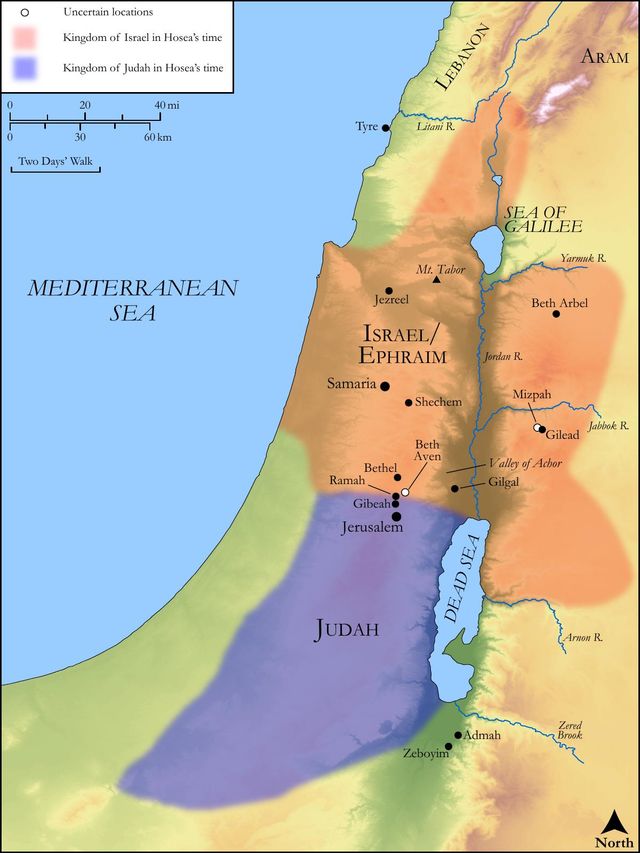
Hosea prophesied during a tumultuous period in Israel's history, roughly from 750-715 BC, leading up to the Assyrian conquest of the Northern Kingdom in 722 BC. The nation was caught between the rising imperial powers of Assyria to the north and Egypt to the south. Instead of trusting in their covenant God for protection, Israel's leaders repeatedly engaged in political maneuvering, forming alliances and paying tribute (the act of "hiring") to these stronger nations, hoping to secure their independence or gain an advantage. This practice was a direct violation of the Mosaic covenant, which called for exclusive loyalty to Yahweh and reliance on Him alone for national security (e.g., Deuteronomy 17:16). The "king of princes" most likely refers to the Assyrian emperor, who indeed ruled over many vassal kings and lesser princes, imposing heavy burdens of tribute and military service on conquered or allied states.
Key Themes
ShowHideThis verse powerfully contributes to several overarching themes in Hosea. It highlights the consequences of covenant unfaithfulness, demonstrating that Israel's spiritual adultery (their idolatry and reliance on foreign gods and nations) inevitably leads to divine judgment and national ruin. The theme of false security is prominent, as Israel's attempts to find safety in worldly alliances prove to be a snare, bringing the very oppression they sought to avoid. Furthermore, the verse underscores God's absolute sovereignty; even in their rebellion, God declares, "now will I gather them," asserting His ultimate control over their destiny and His role in bringing about their judgment, not as an arbitrary act, but as a just response to their persistent sin. This divine action is a form of discipline and purification, intended to bring them to repentance, though it comes with significant "sorrow" and "burden."
Exposition and Analysis
ShowHideKey Word Analysis
ShowHideMeaning "to present (a mercenary inducement), i.e. bargain with (a harlot); hire." This word vividly portrays Israel's foreign policy as akin to prostitution. They were "hiring" or paying for alliances and protection from pagan nations, treating their relationship with foreign powers as a transactional affair, much like a harlot bargaining for payment. This imagery emphasizes the profound spiritual betrayal involved, as Israel, the bride of Yahweh, was seeking illicit relationships with other "lovers" (nations/gods) for security.
Meaning "to grasp, i.e. collect; assemble (selves), gather (bring) (together, selves together, up), heap, resort, [idiom] surely, take up." In this context, God's act of "gathering" them is not for benevolent restoration or protection, but rather for judgment, exile, and the imposition of a heavy burden. It signifies God's active role in orchestrating the consequences of their actions, bringing them together under the yoke of their oppressors.
Meaning "a burden; specifically, tribute, or (abstractly) porterage; figuratively, an utterance, chiefly adoom, especially singing; mental, desire." This word carries multiple layers of meaning. It refers to the literal heavy tribute and taxes imposed by the Assyrian empire, but also carries the prophetic connotation of a "doom" or "oracle" of judgment. The very alliances Israel "hired" would become the source of their heaviest burden, a divine judgment delivered through human instruments.
Verse Breakdown
ShowHide"Yea, though they have hired among the nations,"
This clause highlights Israel's persistent and deliberate strategy of seeking alliances and paying tribute to foreign powers. The phrase "hired among the nations" underscores their transactional approach to international relations, viewing pagan empires as sources of security and strength, rather than relying on the Lord their God. This act is presented as a profound act of spiritual infidelity, akin to spiritual prostitution, as they abandoned their covenant relationship with Yahweh for worldly gain and protection.
"now will I gather them,"
This is a declaration of divine judgment. Despite Israel's efforts to secure themselves through human means, God asserts His sovereign control. The "gathering" here is not for restoration or protection, but for judgment and exile. It signifies God's active role in bringing about the consequences of their sin, assembling them for the impending sorrow and oppression. This demonstrates that even in their rebellion, they cannot escape the Lord's ultimate authority over their destiny.
"and they shall sorrow a little"
This phrase describes the immediate emotional and practical consequence of God's gathering. The "sorrow" (from H2490, châlal, which can also mean to profane or wound) indicates the pain, distress, and hardship that will accompany their judgment. The term "a little" (H4592, mᵉʻaṭ) might imply that the initial sorrow is but a foretaste of a greater, more enduring suffering, or perhaps that the period of intense sorrow will be relatively brief before the full weight of the "burden" settles upon them. It emphasizes the direct link between their actions and their emotional suffering.
"for the burden of the king of princes."
This final clause reveals the specific nature and source of their sorrow. The "burden" refers to the heavy oppression, tribute, and subjugation imposed by a powerful imperial ruler. The "king of princes" (H4428, melek, "king"; H8269, sar, "prince") is a title likely referring to the Assyrian emperor, who reigned over numerous vassal kings and lesser rulers. This burden is the direct, divinely ordained consequence of Israel's unfaithfulness and their misguided alliances, illustrating the futility of trusting in human power over God's covenant faithfulness.
Literary Devices
ShowHideHosea 8:10 employs several potent literary devices to convey its message. Metaphor is central, particularly in the implied comparison of Israel's foreign policy to "hiring" or prostitution, a recurring theme in Hosea that vividly portrays their spiritual infidelity to Yahweh. The "burden of the king of princes" functions as a powerful symbol of the oppressive tribute and subjugation that will be imposed upon Israel, a direct consequence of their choices. This also serves as a form of poetic justice, where the very powers Israel sought to appease become the instruments of their suffering. The phrase "now will I gather them" demonstrates divine irony, as God's "gathering" is not for blessing but for judgment, turning Israel's attempts at self-preservation into the means of their downfall. The entire verse is an example of prophetic oracle, delivering a stern warning and declaration of future events as a direct consequence of present sin.
Theological and Thematic Connections
ShowHideHosea 8:10 profoundly illustrates the theological principle that seeking security and strength outside of God's covenant leads to inevitable sorrow and oppression. Israel's "hiring among the nations" was a rejection of Yahweh as their sole protector and provider, a betrayal of their covenant vows. This act of spiritual harlotry demonstrates a fundamental distrust in God's power and faithfulness, leading them to rely on the fleeting and ultimately destructive power of human empires. The "burden of the king of princes" is a divine consequence, a just recompense for their apostasy, showing that God is sovereign even over the actions of pagan kings and nations, using them as instruments of His righteous judgment. This highlights God's unwavering commitment to His covenant, even when it involves painful discipline for His unfaithful people.
Reflection and Application
ShowHideHosea 8:10 serves as a timeless warning for believers today, challenging us to examine where we place our ultimate trust and seek our security. Just as ancient Israel sought to "hire" protection from worldly powers, we too can be tempted to rely on human systems, financial stability, political influence, or personal achievements rather than on God alone. This verse reminds us that such misplaced trust, while seemingly offering temporary relief or advantage, ultimately leads to greater burdens and sorrow. It calls us to a radical dependence on Christ, recognizing that true peace, security, and freedom are found only in Him. When we compromise our faith or seek worldly solutions in defiance of God's will, we invite spiritual and practical burdens into our lives. The "sorrow" and "burden" mentioned in the verse serve as a powerful reminder that God's discipline, though painful, is a loving act intended to draw us back into faithful relationship with Him, revealing the futility of our self-reliant schemes.
Questions for Reflection
ShowHideFAQ
ShowHideWhat does "hired among the nations" mean in this context?
ShowHideIn Hosea 8:10, "hired among the nations" refers to Israel's practice of seeking political alliances and paying tribute or "hire" to powerful foreign empires like Assyria and Egypt, rather than trusting in God for their security. This act was seen as a profound betrayal of their covenant with Yahweh, akin to spiritual prostitution, where they exchanged their loyalty to God for the fleeting and ultimately destructive protection of pagan nations. It highlights their misplaced trust and spiritual infidelity, as also seen in Hosea 7:11 where Ephraim is described as fluttering between these powers.
Who is the "king of princes" mentioned in the verse?
ShowHideThe "king of princes" (Hebrew: melek sarim) is a regal title that most likely refers to the powerful Assyrian emperor of Hosea's time. Assyria was a dominant imperial power that had subjugated many smaller kingdoms and rulers, making its emperor a "king" over numerous "princes" or vassal kings. The "burden" from this king refers to the heavy tribute, taxation, and oppressive rule that Israel would suffer as a direct consequence of their unfaithfulness and their misguided attempts to align with or appease such a power. This ultimately led to the Assyrian conquest of the Northern Kingdom in 722 BC, fulfilling this prophecy.
Christ-Centered Fulfillment
ShowHideHosea 8:10, with its depiction of Israel's futile search for security in worldly alliances and the resulting "burden," finds its ultimate fulfillment and redemptive answer in Jesus Christ. Israel sought external powers to bear their national burdens, but these only led to greater oppression. Christ, however, is the true "King of kings and Lord of lords" (Revelation 19:16), who alone can lift the ultimate burden of sin and death. Whereas Israel's "hiring among the nations" was an act of spiritual harlotry, betraying their covenant, Christ offers a new covenant, inviting all who are weary and heavy-laden to come to Him, promising rest (Matthew 11:28-30). He bore the "burden" of humanity's sin on the cross, becoming the ultimate sacrifice that removes our transgressions, unlike the oppressive tribute imposed by earthly kings (Isaiah 53:4-6). In Christ, believers are "gathered" not for judgment and sorrow, but for eternal life and adoption into God's family (John 11:52). He is the true source of security and peace, freeing us from the futile reliance on worldly systems and the heavy yoke of sin.