


Ezekiel 23:26
Bible text: King James Version (1769 Blayney text) · Public domain
Bible text: Berean Standard Bible · Public domain
Bible text: American Standard Version (1901) · Public domain
Bible text: World English Bible, Messianic edition · Public domain
Bible text: Geneva Bible (1599) · Public domain
Bible text: Young's Literal Translation · Public domain
- וְהִפְשִׁיטוּךְve·hif·shi·Tukhand they will strip off youH6584Conj-w ¦ V-Hiphil-ConsecPerf-3cp ¦ 2fsVerb Hiphil Consecutive Perfect 3rd Plural common genderוְandהִפְשִׁיטוּthey will strip offךְyou
- אֶת'et<obj.>H853DirObjMParticle Object Indicator
- בְּגָדָיִךְbe·ga·Da·yikhyour clothesH899N-mpc ¦ 2fsNoun Plural Masculine Constructבְּגָדָיִclothesךְyour
- וְלָקְחוּve·la·ke·Chuand they will take awayH3947Conj-w ¦ V-Qal-ConsecPerf-3cpVerb Qal Consecutive Perfect 3rd Plural common genderוְandלָקְחוּthey will take away
- כְּלֵיke·Lei[the] articles ofH3627N-mpcNoun Plural Masculine Construct
- תִפְאַרְתֵּךְtif·'ar·Tekhyour beautyH8597N-fsc ¦ 2fsNoun Singular Feminine Constructתִפְאַרְתֵּbeautyךְyour
English is a literal word-by-word gloss of the Hebrew, not the KJV's wording. Why?
This is the original text the KJV's translators worked from — each Hebrew word with its own literal English meaning in this verse, prepared by scholars at Tyndale House, Cambridge. The KJV translates whole sentences, not word by word, so its wording differs: one Hebrew word can become several English words, and the KJV may choose “the LORD” where the gloss reads “Yahweh”. Both are faithful — they answer different questions. For the KJV's own rendering, switch to the KJV text.
Details
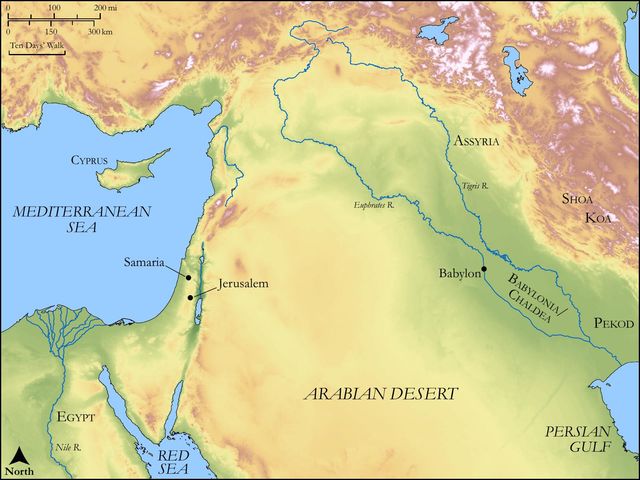
See on the biblical-era map
Study this verse
Public-domain commentary
Matthew Henry
From his Commentary on the Whole Bible. Henry comments on passages, not single verses — this entry covers Ezekiel 23:22–49. His three-level outline is real structure in the source text, so it is rendered as structure.
Jerusalem stands indicted by the name of Aholibah, for that she, as a false traitor to her sovereign Lord the God of heaven, not having his fear before her eyes, but moved by the instigation of the devil, had revolted from her allegiance to him, had compassed and imagined to shake off his government, had kept up a correspondence had joined in confederacy with his enemies, and the pretenders to a deity, in contempt of his crown and dignity. To this indictment she has pleaded, Not guilty: I am not polluted; I have not gone after Baalim. But it is found against her by the notorious evidence of the fact, and she stands convicted of it, nor has any thing material to offer why judgment should not be given and execution awarded according to law. In these verses, therefore, we have the sentence.
I.Her old confederates must be her executioners; and those whom she had courted to be her leaders in sin are now to be employed as instruments of her punishment (Eze 23:22): "I will raise up thy lovers against thee, the Chaldeans, whom formerly thou didst so much admire and covet an acquaintance with, but from whom thy mind is since alienated and with whom thou hast perfidiously broken covenant." They are called thy lovers (Eze 23:22) and yet (Eze 23:28) those whom thou hatest. Note, It is common for sinful love soon to turn into hatred; as Amnon's to Tamar. Those of headstrong and unreasonable passions are often very hot against those persons and things that a little before they were as hot for. Fools run into extremes; nay, and wise men may see cause to change their sentiments. And therefore, as we should rejoice and weep as if we rejoiced not and wept not, so we should love and hate as if we loved not and hated not. Ita ama tanquam osurus - Love as one who may have cause to feel aversion.
II.The execution to be done upon her is very terrible.
1.Her enemies shall come against her on every side (Eze 23:22), those of the several nations that constituted the Chaldean army (Eze 23:23), all of them great lords and renowned, whose pomp, and grandeur, and splendid appearance made them look the more amiable when they came as friends to protect and patronise Jerusalem, but the more formidable when they came to chastise its treachery and aimed at no less than its ruin.
(1.)They shall come with a great deal of military force (Eze 23:24), with chariots and wagons furnished with all necessary provisions for a camp, with arms and ammunition, bag and baggage, with a vast army, and well armed.
(2.)They shall have justice on their side: "I will set judgment before them" (they shall have right with them as well as might; for the king of Babylon had just cause to make war upon the king of Judah, because he had broken his league with him), "and therefore they shall judge thee, not only according to God's judgments, as the instruments of his justice, to punish thee for the indignities done to him, but according to their judgments, according to the law of nations, to punish thee for thy perfidious dealings with them." (3.) They shall prosecute the war with a great deal of fury and resentment. It being a war of revenge, they shall deal with thee hatefully, Eze 23:29. This will make the execution the more severe that their swords will be dipped in poison. Thou hatest them, and they shall deal hatefully with thee; those that hate will be hated and will be hatefully dealt with. (4.) God himself will lead them on, and his anger shall be mingled with theirs (Eze 23:25): I will set my jealousy against thee; that shall kindle this fire, and then they shall deal furiously with thee. If men deal ever so hatefully, ever so furiously, with us, yet, if we have God on our side, we need not fear them; they can do us no real hurt. But if men deal furiously with us, and God set his jealousy against us too, what will become of us?
2.The particulars of the sentence here passed upon this notorious adulteress are,
(1.)That all she has shall be seized on. The clothes and the fair jewels, with which she had endeavoured to recommend herself to her lovers, these she shall be stripped of, Eze 23:26. All those things that were the ornaments of their state shall be taken away: "They shall take away all thy labour, all that thou hast gotten by thy labour, and shall leave thee naked and bare," Eze 23:29. Both city and country shall be impoverished and all the wealth of both swept away.
(2.)That her children shall go into captivity. "They shall take thy sons and thy daughters, and make slaves of them (Eze 23:25); for they are children of whoredoms, unworthy the dignities and privileges of Israelites," Hos 2:4.
(3.)That she shall be stigmatized and deformed: "They shall take away thy nose and thy ears, shall mark thee for a harlot, and render thee for ever odious," Eze 23:25. This intimates the many cruelties of the Chaldean soldiers towards the Jews that fell into their hands, whom, it is probable, they used barbarously. Some will have this to be understood figuratively; and by the nose they think is meant the kingly dignity, and by the ears that of the priesthood.
(4.)That she shall be exposed to shame: Thy lewdness and thy whoredoms shall be discovered (Eze 23:29), as, when a malefactor is punished, all his crimes are ripped up, and repeated to his disgrace; what was secret then comes to light, and what was done long since is then called to mind.
(5.)That she shall be quite cut off and ruined: "The remnant of thy people that have escaped the famine and pestilence shall fall by the sword; and the residue of thy houses that have not been battered down about thy ears shall be devoured by the fire," Eze 23:25. And this shall be the end of Jerusalem.
III.Because she has trod in the steps of Samaria's sins, she must expect no other than Samaria's fate.
It is common, in giving judgment, to have an eye to precedents; so has God in passing this sentence on Jerusalem (Eze 23:31, etc.): "Thou hast walked in the way of thy sister, notwithstanding the warning thou hast had given thee, by the fatal consequences of her wickedness; and therefore I will give her cup, her portion of miseries, into thy hand, the cup of the Lord's fury, which will be to thee a cup of trembling." Now,
1.This cup is said to be deep and large, and to contain much (Eze 23:32), abundance of God's wrath and abundance of miseries, the fruits of that wrath. It is such a cup as that which we read of, Jer 25:15, Jer 25:16. The cup of divine vengeance holds a great deal, and so those will find into whose hand it shall be put.
2.They shall be made to drink the very dregs of this cup, as the wicked are said to do (Psa 75:8): "Thou shalt drink it and suck it out, not because it is pleasant, but because it is forced upon thee (Eze 23:34); thou shalt break the shreds thereof, and pluck off thy own breasts, for indignation at the extreme bitterness of this cup, being full of the fury of the Lord (Isa 51:20), as men in great anguish tear their hair, and throw every thing from them. Finding there is no remedy, but it must be drank (for I have spoken it, saith the Lord God), thou shalt have no manner of patience in the drinking of it." 3. They shall be intoxicated by it, made sick, and be at their wits' end, as men in drink are, staggering, and stumbling, and ready to fall (Eze 23:33): Thou shalt be filled with drunkenness and sorrow. Note, Drunkenness has sorrow attending it, to such a degree that the utmost confusion and astonishment are here represented by it. Who would think that that which is such a force upon nature, such a scandal to it, which deprives men of their reason, disorders them to the last degree, and is therefore expressive of the greatest misery, should yet be with many a beloved sin, that they should damn their own souls to distemper their own bodies? Who has woe and sorrow like them? Pro 23:29. 4. Being so intoxicated, they shall become, as drunkards deserve to be, a laughing-stock to all about them (Eze 23:32): Thou shalt be laughed to scorn and had in derision, as acting ridiculously in every thing thou goest about. When God is about to ruin a people he makes their judges fools and pours contempt on their princes, Job 12:17, Job 12:21.
IV.In all this God will be justified, and by all this they will be reformed; and so the issue even of this will be God's glory and their good.
1.They have been bad, very bad, and that justifies God in all that is brought upon them (Eze 23:30): I will do these things unto thee because thou hast gone a whoring after the heathen, and (Eze 23:35) because thou hast forgotten me and cast me behind thy back. Note, Forgetfulness of God, and a contempt of him, of his eye upon us and authority over us, are at the bottom of all our treacherous adulterous departures from him. Therefore men wander after idols, because they forget God, and their obligations to him; nor could they look with so much desire and delight upon the baits of sin if they did not first cast God behind their back, as not worthy to be regarded. And those who put such an affront upon God, how can they think but that it should turn upon themselves at last? Therefore bear thou also thy lewdness and thy whoredoms; that is, thou shalt suffer the punishment of them, and thou alone must bear the blame. Men need no more to sink them than the weight of their own sins; and those who will not part with their lewdness and their whoredoms must bear them.
2.They shall be better, much better, and this fire, though consuming to many, shall be refining to a remnant (Eze 23:27): Thus will I make thy lewdness to cease from thee. The judgments which were brought upon them by their sins parted between them and their sins, and taught them at length to say, What have we to do any more with idols? Observe,
(1.)How inveterate the disease was: Thy whoredoms were brought from the land of Egypt. Their disposition to idolatry was early and innate, their practice of it was ancient, and had gained a sort of prescription by long usage.
(2.)How complete the cure was notwithstanding: "Though it has taken root, yet it shall be made to cease, so that thou shalt not so much as lift up thy eyes to the idols again, nor remember Egypt with pleasure any more." They shall avoid the occasions of this sin, for they shall not so much as look upon an idol, lest their hearts should unawares walk after their eyes. And they shall abandon all inclinations to it: "They shall not remember Egypt; they shall not retain any of that affection for idols which they had from the very infancy of their nation." They got it, through the corruption of nature, in their bondage in Egypt, and lost it, through the grace of God, in their captivity in Babylon, which this was the blessed fruit of, even the taking away of sin, of that sin; so that whereas, before the captivity, no nation (all things considered) was more impetuously bent upon idols and idolatry than they were, after that captivity no nation was more vehemently set against idols and idolatry than they were, insomuch that at this day the image-worship which is practised in the church of Rome confirms the Jews as much as any thing in their prejudices against the Christian religion.
Historical interpretation
Historical reception
4 surviving comments on this verse. Each one is dated, so this reads as a timeline rather than a list.
(Verse 35, 36, and following) And I will bring you into a desert of peoples, and there I will judge you face to face. Just as I contended with your fathers in the desert of the land of Egypt, so I will judge you, says the Lord. And I will subject you to my scepter, and I will bring you into the bonds of the covenant, and I will choose from among you the transgressors and the wicked: from their place of residence I will bring them out, and they will not enter the land of Israel, and you will know that I am the Lord. Thus says the Lord: I will do for you who are in Babylon, and now serve idols, what I did for your ancestors in Egypt. I will lead you into the desert of the peoples, and there I will judge you face to face, just as I contended with them in judgment when they came out of Egypt. And after I have judged you, I will subject you to my scepter and rule, and I will make a covenant with you and bring you into your land with the bonds of love, so that bound by my love, you will never be able to depart from me. But I will choose from among you the transgressors and the wicked, who persist in the hardness of their hearts in evil deeds, not for possession, but for rejection. And I will indeed bring them out of the land of their dwelling, so that when they are brought out, they will not enter the land of Israel; but they will perish in various regions. And by the distinction between good and evil, you shall know that I am the Lord, who judges all things. The rest of the discourse hastens, and we briefly go through each point, in order to provide only the meaning to the readers.
(Ver. 23, 24 onwards) Again, I raised my hand against them in the wilderness, to scatter them among the nations and disperse them in the lands, because they had not performed my judgments, and had rejected my commandments, and had violated my Sabbaths, and their eyes had been after the idols (or thoughts) of their fathers. Therefore, I also gave them statutes that were not good, and judgments in which they would not live, and I defiled them in their offerings (or transgressions), as they offered (or led astray) everything that opens the womb because of their sins (for which the Septuagint translated, to destroy them and what they had overlooked): and they will know that I am the Lord. Where in the Old Testament, against their children, who fell in the wilderness, the Lord lifted up His hand to scatter them among the nations, Scripture does not say; but it is to be believed that this was done in accordance with what is reported here. Or he signifies by this, that after they entered the promised land, they were given over at various times, for many sins, to different nations and kings, and at that time the commandments of the Lord, which were good according to their nature, and the judgments by which believers could live, were made not good for them, since they were in no way able to keep the precepts of the law in captivity, and to do what the divine word commanded. He did not say, 'I gave them evil commandments,' but, 'not good commandments.' For it does not immediately follow that what is not good is evil, as the Apostle teaches, it is good for a man not to touch a woman; but because of incontinence, let each possess his own vessel in sanctification and honor (I Cor. VII). And if he does not do this, it is neither good nor evil. Therefore, God gave them, dispersed among the nations, not good commandments, that is, he allowed them to follow their own thoughts and desires, to do what is not appropriate. And he defiled them in his gifts: just as a Priest separates lepers from the people, and shows that they are defiled; while they offer to idols what they should offer to God. And they pass everything that opens the womb through the fire of Baal, that is, the firstborn; so that after they have deserted God and been handed over to the worship of idols, then they may understand that He is the Lord whom they have provoked to anger by their own fault. Symmachus interpreted this passage more explicitly, treating the future as past. Therefore, I will also give them bad precepts and judgments for which they will not live, and I will defile them because of their gifts, as they consecrate and offer everything that opens the womb, so that I may destroy them, and they will know that I am the Lord. And the meaning is this: because I have seen the sons of the fathers equaling the wickedness of their ancestors and doing the same things for which they offended God, I wanted to divide them into nations and disperse them throughout the whole world, and give them bad precepts and judgments in which they would not live, so that I may defile them with their gifts, for they consecrated everything that opens the womb to idols, and I may destroy them forever, and they will know that I am the Lord. Through which he showed that he had not given them good commandments who dwelt in the wilderness, but to those whom he wanted to scatter among the nations, and to make foreigners in the whole world, he gave them a desire for things that he did not give: so that there they would do good commandments of God, not good because of their own fault, while they exhibited to idols what God had commanded to be exhibited. This can also be said, that before the offense, they received only the Ten Commandments; but after idolatry and blasphemy, they received multiple ceremonies of the law, so that they would offer victims to God rather than to demons, and by comparison with sacrilege, what was not good in itself became lighter, and by no means evil, because it was offered to God, and yet not good, because they offended the author of good.
(Verse 27, 29 onwards) Therefore speak to the house of Israel, son of man, and tell them: Thus says the Lord God: Moreover, your fathers have blasphemed against me and have treated me with contempt, even as they spurned me. And I brought them into the land that I had lifted my hand to give them ((Vulgate adds: that land)): they saw every high hill and every leafy tree, and there they offered their sacrifices and presented there the irritation of their offerings, and they placed there the fragrance of their sweetness, and they poured out their ((Vulgate is silent on this)) libations there. And I said to them, 'What is the high place to which you are going?' And its name was called the High Place until this day. Therefore speak to the house of Israel, son of man, and say to them, 'Thus says the Lord God: As for your fathers, they have provoked Me to anger by their iniquities, by the fact that they have fallen away from Me. So I brought them into the land that I had lifted My hand in an oath to give them.' They saw every high hill and every leafy tree, and there they offered their sacrifices. They also presented there the provocation of their gifts, and they set there their pleasing aroma, and they poured out there their drink offerings. And I said to them: What is abbana, because you enter there? And they called its name abbana until this day. I wanted, he said, to scatter them in the wilderness, and to give them not good precepts, so that they would sacrifice to idols what they should have offered to me, and consecrate all their first-fruits to them by fire, so that I might kill them and destroy them. But when he says, I wanted, he shows that he did not do what he wanted. And that which follows: 'And they shall know that I am the Lord,' is not found in the Septuagint. For it did not seem fitting to them to know after their destruction that he himself is the Lord. But you, son of man, speak again to them, that is, to the elders of the house of Israel, who have come to inquire of you: Your fathers, from whom you have descended, have also blasphemed against me and held me in contempt; after I brought them into the land which I had given them to possess, they turned against me to provoke me. For when they saw every high hill and leafy tree, they would sacrifice on the mountains and in the groves and thickets, and offer victims to the idols, and pour out libations. And when I saw this, I said to them: What is this, Bama? for it is called high: or why do you enter into such a place which you have chosen for yourselves in all the hills, so that even today these places are called Bamoth, and the ancient error retains its original name? Regarding Bama, which we translate as excelsum, there is an error in the Septuagint edition, where it is written as ἀββανὰ, which does not resonate in the Hebrew language. Bama can mean 'in which' if the two syllables are divided into two words, but in the present context, that sense does not fit. However, wherever it is written in the Books of Kings and Chronicles: 'The people still sacrificed and offered incense on the high places,' Bama in the singular and Bamoth in the plural mean 'high places.'
(v. 22ff.) Therefore, Oholibah, thus says the Lord God: Behold, I will stir up against you your lovers from whom you turned in disgust, and I will bring them against you from every side: the Babylonians and all the Chaldeans, Pekod and Shoa and Koa, and all the Assyrians with them, desirable young men, governors and commanders all of them, officers and men of renown, all of them riding on horses. And they shall come against you from the north with chariots and wagons and with a host of peoples. They shall set themselves against you on every side with buckler, shield, and helmet; and I will commit the judgment to them, and they shall judge you according to their judgments. And I will give them judgment, and they shall judge you with their judgments, and I will put my zeal in you, which they shall exercise against you in fury. They shall cut off your nose and your ears, and what remains, they shall cut off with the sword. They shall take your sons and your daughters, and your last will be devoured by fire, and they shall strip you of your garments, and they shall take away the vessels of your glory. And they shall make your wickedness cease from you, and your prostitution from the land of Egypt. You shall not lift up your eyes to them, nor shall you remember Egypt anymore. LXX: Therefore, Oholibah, thus says the Lord God: Behold, I will stir up your lovers against you, from whom your soul has turned away, and I will bring them against you from every side, the sons of Babylon and all the Chaldeans, Pekod and Shoa and Koa, and all the Assyrians with them, desirable young men, governors and commanders all of them, officers and men of renown, mounted on horses. And they shall come against you from the north with chariots and wagons and a host of peoples. They shall set themselves against you on every side with buckler, shield, and helmet; and I will commit the judgement to them, and they shall judge you according to their judgements. And I will execute judgment in fury and anger upon them; then they shall know that I am the LORD, when I lay My vengeance upon them. Because you remembered the flesh of the Egyptians and imitated the filthiness of the unclean nation, which venerates the images of all beasts, therefore I will bring against you your lovers, with whom you were satisfied, and you departed from their covenant, so that as great as your love once was, you will be turned into such hatred. Sons, I say, of Babylon, and all the Chaldeans, nobles, tyrants, and princes; for whom in Hebrew it is written, Phacud () and Sue () and Cue (), which the diverse Orientals understand, since we do not find such names either in the Book of Kings, or in the Chronicles, nor indeed in Jeremiah, who describes the captivity of Jerusalem, or in any place of the Holy Scripture. It is not surprising that the Septuagint itself used Hebrew names, since Symmachus and Theodotion also agree on the same words. They all say that the Assyrians, the horsemen, and the young men, in their distinguished form, are the leaders and magistrates, or the tristates, whom we have interpreted as the princes of princes. We read about them also in Exodus (Exod. XV, 4). The chosen ones are translated as ascensores tristatas (τριστάτας), for which Latin simplicity translates as ternos statores. But the name is sad among the Greeks, the second rank after royal dignity. About whom it is written: However, it did not reach the first three, who were the leaders of the cavalry and infantry and the tribunes ((or tributes)) (I Chronicles XII, II Kings XXIII): whom we call the magistrates of both military forces, and the prefects of the title of the annual tax. They all, he says, armed with breastplates, helmets, and shields, besieged you all around in their chariots and on their horses, and I will give them judgment, so that you will be judged by those whom you have left behind, and whose covenant you have made void: and they will judge you with their judgments as an adulteress. And I will set my zeal against you, which they will exercise with you in fury. For my zeal is among the enemies, even faith not being preserved. 'I will cut off your nose and your ears,' he says, 'like an adulteress caught in adultery, so that you may cease to please when disfigured. For just as all the beauty of the face consists in the beauty of the nose, and in the ears, from which depend the unions and the pearls in women, so the dignity of the king and the judges, which is marked in the mouth and the ears, will be cut off by their sword.' They will take your sons and daughters. 'Your sons,' he says, 'and your daughters, not mine, because they were conceived in adultery, and they will devour the rest with fire. And they will strip you of the garments with which I adorned you, and the vessels of your glory, which I granted to you, gold and silver, for use in the ceremonies of the temple, of which it is written: 'I gave them gold and silver, and they made them into Baal' (Hosea II, 8). But I will do all these things, so that your lost beauty and bewitched face may finally be at peace, and your wickedness and fornication, which you learned and practiced in Egypt, may cease. After you have lost your nose and ears, you will no longer dare to raise your eyes to the Chaldeans, nor show your ugliness to your former lovers. And you will no longer remember the lust of the Egyptians, whose indulgence in flesh you delighted in. All the things that are said about the punishment of the adulteress, and how she is disgraced because of adultery: so that she may no longer boast in her beauty, but be ashamed in her disgrace, which she has earned through the greatness of her pleasures. Whatever is said metaphorically about Jerusalem, and can be understood in reference to the soul, which, having been joined to the virtues and united to God, later adulterated them with vices and turned away from Him, and with all her crimes exposed, was uncovered, dishonored, and shown to all, so that she may desist from her wickedness to some extent: let her not boast in the dignity of her name, but rather be afraid because of her guilty conscience and remember Egypt, and dare not lift her eyes to heaven. And so his nose is cut off, and his ears are amputated, because he had turned the fragrance of good odor into a foul smell, and he had heard the judgment of blood, which we understand not only from smell and hearing, but also from sight, whereby, because they had made evil use of it, Samson and Zedekiah are deprived. Moreover, God made them deaf and dumb (Exod. IV, 11): lest their speech spread throughout the land, and every touch will be taken away from those who have completely lost their life. And let these things be done, so that everything may be purged by fire, and let the fornication of Egypt perish: nor can it any longer raise its eyes to evil.
Continue studying Ezekiel 23:26 across the web’s major study libraries — every link below opens this exact verse, chapter, or book on the destination site.
Read & Compare
 BibleGatewayThis verse in more than 200 translations and 70 languages.
 Bible.comThe YouVersion reader — hundreds of translations, reading plans, and highlights.
 ESV.orgCrossway's official English Standard Version reader.
 NET BibleThe NET translation with 60,000+ translators' notes on every rendering decision.
 STEP BibleTyndale House's free study tool — original text, vocabulary, and scholarly resources.
 BibliaLogos Bible Software's free web reader.
 USCCBThe New American Bible (Revised Edition) with the U.S. bishops' study notes.
Commentaries
 BibleHub CommentariesDozens of classic commentaries on this verse, gathered on one page.
 StudyLightMore than 100 commentary sets — the largest collection on the web.
 BibleRefPlain-English commentary on what this verse means, verse by verse.
 Enduring WordDavid Guzik's free commentary on this chapter, widely used by Bible teachers.
 Bible Study ToolsVerse commentary alongside Greek and Hebrew study aids.
Original Language & Research
- BibleHub InterlinearThe verse word by word — original language, transliteration, and English.
- BibleHub LexiconEvery word's original-language definition and Strong's entry.
 Blue Letter BibleDeep-study tools — Strong's numbers, concordance, and word studies.
 SefariaThe Hebrew text with Rashi and centuries of Jewish commentary.
Sermons, Hymns & Audio


TrulyRandomVerse is not affiliated with these sites and doesn’t control their content. They’re linked because they’re genuinely useful.
Summary
Ezekiel 23:26 delivers a severe divine judgment upon Oholibah, representing Jerusalem, declaring that the very nations with whom she pursued illicit spiritual and political alliances would become the instruments of her profound humiliation and despoiling. The vivid imagery of being stripped of clothes and having "fair jewels" taken away powerfully portrays a complete loss of dignity, wealth, and status, exposing Jerusalem's spiritual nakedness and the devastating consequences of her persistent idolatry and unfaithfulness to God's covenant. This verse underscores the principle that God's justice ensures that sin, particularly spiritual harlotry against Him, leads to utter disgrace and ruin.
Context
ShowHideLiterary Context
Ezekiel chapter 23 functions as an extended allegorical prophecy, meticulously detailing the spiritual adultery of two sisters: Oholah (representing Samaria and the northern kingdom of Israel) and Oholibah (representing Jerusalem and the southern kingdom of Judah). Both are depicted as harlots who abandoned their covenant fidelity to Yahweh, engaging in illicit relationships with foreign nations and adopting their idolatrous practices. The narrative escalates, portraying Oholibah as even more corrupt than Oholah, a point explicitly made in passages such as Ezekiel 23:11. Verses 22-35 specifically outline the comprehensive judgment pronounced against Oholibah. The "they" in verse 26 refers to the Babylonians and other allied nations (Chaldeans, Assyrians, etc.) whom Judah had alternately courted as lovers and protectors. God now declares that these very nations will be the instruments of her punishment, a public stripping and plundering that is part of a larger divine decree of desolation and public disgrace, culminating in the complete destruction of Jerusalem as described in Ezekiel 23:29.
Historical & Cultural Context
In that day, the public stripping of clothes was a profoundly humiliating act, often inflicted upon conquered enemies, captives, or prostitutes. It symbolized utter vulnerability, loss of honor, and the complete subjugation of an individual or a city. The taking of "fair jewels" and other possessions was a standard practice of plunder by invading armies, signifying the complete despoiling of a city's wealth, prestige, and outward glory. At this historical juncture, Jerusalem was deeply entangled in political alliances with powerful empires like Egypt and Babylon, frequently at the expense of their covenant with God, leading them to adopt foreign gods and customs. This verse reflects the grim historical reality of Jerusalem's impending destruction and exile at the hands of the very Babylonian empire she had sought to manipulate or appease, demonstrating God's sovereign use of pagan nations to execute His righteous judgment upon His unfaithful people. This echoes similar judgments seen in other prophetic books, such as Isaiah 20:4.
Key Themes
ShowHideEzekiel 23:26 powerfully contributes to several overarching themes prevalent in Ezekiel and broader prophetic literature. Firstly, it underscores the theme of Divine Justice and Judgment, illustrating that God will not tolerate persistent idolatry and covenant infidelity, even from His chosen people. The punishment is tailored to the crime: those whom Judah pursued for illicit gain and false security would be the very ones to bring about her downfall. Secondly, it highlights the theme of Humiliation and Disgrace as an inevitable consequence of sin, revealing the true spiritual nakedness and shame that results from abandoning God's covenant. The loss of outward adornments symbolizes the stripping away of any pretense or false glory. Thirdly, it emphasizes the Futility of Worldly Alliances and Idolatry, demonstrating that reliance on human power or false gods ultimately leads to ruin and the loss of all that is valued, a warning echoed throughout prophetic books like Jeremiah 2:19. Finally, it speaks to the Sovereignty of God, who uses even the actions of wicked nations to accomplish His purposes of judgment and, ultimately, purification for His people.
Exposition and Analysis
ShowHideKey Word Analysis
ShowHideA primitive root meaning "to spread out" (i.e., deploy in hostile array), and by analogy, "to strip" (i.e., unclothe, plunder, flay, etc.). In Ezekiel 23:26, it conveys a violent and forceful act of removing clothing, signifying public humiliation, exposure, and the complete taking of possessions. It implies an aggressive act of despoiling, often associated with military conquest and the subjugation of enemies.
Meaning "a covering," specifically "clothing" or "garment." In Israel, clothing provided dignity, modesty, and often indicated social status, honor, and identity. To be stripped of clothes was the ultimate public shame, symbolizing utter vulnerability, loss of honor, and the complete exposure of one's guilt or disgrace.
A primitive root meaning "to take" in a wide variety of applications, including to seize, carry away, or receive. Here, it specifically denotes the act of plundering or seizing valuable items, completing the act of despoiling initiated by the stripping. It implies a forceful appropriation of possessions.
Meaning "ornament" (abstractly or concretely), "beauty," "bravery," "glory," "honor," or "majesty." This word emphasizes that the jewels were not merely ordinary items but were those that contributed to outward splendor, prestige, and a sense of pride, honor, or national glory. It signifies the aesthetic and symbolic value of the items.
Meaning "something prepared, i.e., any apparatus (as an implement, utensil, dress, vessel or weapon)." In this context, combined with "fair" (tiphʼârâh), it specifically refers to "articles of splendor" or "glorious ornaments." These were valuable possessions that symbolized wealth, status, and beauty, making their removal a profound loss of both material riches and symbolic prestige.
Verse Breakdown
ShowHide"They shall also strip thee out of thy clothes"
This clause vividly describes the act of public humiliation and exposure. The "they" refers to the foreign nations, particularly the Babylonians and their allies, who were once Jerusalem's desired partners but now become her executioners. Stripping away clothes in that day was a profound act of shame, signifying the loss of dignity, modesty, and honor, leaving one utterly vulnerable and exposed. It represents the complete unveiling of Jerusalem's spiritual nakedness and guilt before the world, a public display of her disgrace.
"and take away thy fair jewels"
This second clause complements the first, detailing the complete plundering of Jerusalem. "Fair jewels" represent not only personal adornments but also national wealth, prestige, and glory. Their removal symbolizes the utter despoiling of Jerusalem's riches, the destruction of her societal standing, and the stripping away of any outward splendor or false security she had boasted in, leaving her desolate, impoverished, and devoid of all external marks of prosperity or honor.
Literary Devices
ShowHideEzekiel 23:26 masterfully employs several potent literary devices to convey its message of divine judgment and its devastating consequences. The entire chapter functions as an elaborate Allegory, with Oholibah (Jerusalem) personified as a harlot, and her actions representing the nation's profound spiritual idolatry and unfaithfulness to God's covenant. Within this overarching allegory, the specific actions of "stripping thee out of thy clothes" and "taking away thy fair jewels" serve as a powerful Metaphor for the complete loss of dignity, honor, wealth, and national sovereignty that Jerusalem would experience. The clothes and jewels are potent Symbols of outward glory, status, and perceived security, making their forceful removal a stark representation of utter desolation, public shame, and the exposure of inner corruption. The Personification of Jerusalem as a woman undergoing such a traumatic and humiliating experience evokes a strong emotional response, making the consequences of her actions palpable and deeply visceral. The imagery is designed to be graphic and unsettling, emphasizing the severity and completeness of God's righteous judgment.
Theological and Thematic Connections
ShowHideEzekiel 23:26 stands as a stark testament to God's unwavering justice and the severe consequences of spiritual idolatry and covenant infidelity. It underscores the biblical truth that God is a jealous God who demands exclusive devotion, and any pursuit of false gods or reliance on worldly powers for security ultimately leads to shame and ruin. The stripping away of outward adornments signifies the exposure of the inner corruption and spiritual nakedness that results from forsaking the Lord. This judgment, though severe, is not arbitrary but is a direct consequence of Jerusalem's persistent rebellion, demonstrating that God holds His people accountable for their choices. It serves as a timeless warning against placing our trust and affections in anything other than the one true God, for all worldly glory and security are fleeting when God's favor is withdrawn.
Reflection and Application
ShowHideThe vivid imagery of Ezekiel 23:26, though rooted in ancient Israel's specific context, carries profound and timeless implications for believers today. It serves as a sobering reminder that spiritual idolatry, whether it manifests as overt worship of false gods or a more subtle reliance on wealth, status, relationships, or personal achievements for our security and identity, inevitably leads to a spiritual "stripping." When we place our trust and affections in anything other than God, those very things can become instruments of our disillusionment and shame. This verse challenges us to examine where our true security and glory lie. Are we "clothed" in the righteousness of Christ, or are we adorned with fleeting worldly "jewels" that can be stripped away in a moment? God's discipline, though painful, is often a means to expose our spiritual nakedness and lead us back to Him, reminding us that true dignity, lasting worth, and authentic security are found only in a faithful, exclusive relationship with our Creator. It calls us to repent of any divided loyalties and to cling solely to the Lord.
Questions for Reflection
ShowHideFAQ
ShowHideWho are "they" in Ezekiel 23:26, and why are they the instruments of judgment?
ShowHideThe "they" in Ezekiel 23:26 refers to the foreign nations, primarily the Babylonians and their allies (such as the Chaldeans and Assyrians mentioned elsewhere in Ezekiel 23), with whom Jerusalem (Oholibah) had engaged in illicit spiritual and political alliances. These nations were once desired "lovers" whom Jerusalem courted for protection and whose idolatrous practices she adopted. God, in His righteous judgment, declares that these very nations, through whom Jerusalem sought false security and indulged in spiritual harlotry, would become the instruments of her punishment. This demonstrates a powerful principle of divine justice: the very things we turn to instead of God can become the means of our downfall, as seen in the broader historical narrative of Jerusalem's destruction by Babylon (2 Kings 25).
What is the symbolic significance of being "stripped out of thy clothes, and take away thy fair jewels" in this context?
ShowHideThis imagery carries profound symbolic weight within the biblical narrative. Being "stripped out of thy clothes" symbolizes extreme public humiliation, disgrace, and complete vulnerability. Clothing represented dignity, modesty, and often one's social status and honor. Its removal meant utter shame and the exposure of guilt, akin to the nakedness of a captive or a prostitute. "Taking away thy fair jewels" signifies the complete plundering of wealth, prestige, and outward glory. Jewels and ornaments represented beauty, prosperity, and national honor. Together, these acts represent the total despoliation of Jerusalem, the loss of all her outward splendor and perceived security, and the exposure of her spiritual nakedness and corruption due to her unfaithfulness to God. It underscores the transient nature of worldly glory and security when God's favor is withdrawn.
Christ-Centered Fulfillment
ShowHideEzekiel 23:26, with its vivid portrayal of judgment, humiliation, and the stripping away of false glory, finds its ultimate and profound fulfillment in the person and work of Jesus Christ. While Jerusalem was stripped of her dignity and wealth due to her sin, Christ, the innocent Lamb of God, willingly endured the ultimate stripping and humiliation for the sins of humanity. He was stripped of His garments before His crucifixion, exposed and shamed on the cross, bearing the spiritual nakedness and disgrace that was rightfully ours (Matthew 27:28). He became poor so that we, through His poverty, might become spiritually rich (2 Corinthians 8:9). Furthermore, while Jerusalem's "fair jewels" were taken away, symbolizing the loss of her earthly glory, Christ is the true "fair jewel," the pearl of great price, whose glory is eternal and incorruptible (Philippians 2:9-11). He offers us a righteousness that cannot be stripped away, clothing us in His own perfect obedience and cleansing us from our spiritual nakedness (Revelation 3:18). Thus, the judgment foreshadowed in Ezekiel 23:26 is ultimately absorbed and overcome by the grace and sacrifice of Christ, who provides true dignity, eternal treasure, and an unshakeable covering for all who believe, transforming shame into glory through His atoning work (Isaiah 61:10).