


Revelation 3:18
- συμβουλεύωsumbouleuōI counselG4823V-PAI-1SVerb Present Active Indicative 1st Singular
- σοιsoiyouG4771P-2DSPersonal pronoun Dative 2nd Singular
- ἀγοράσαιagorasaito buyG59V-AANVerb Aorist Active Infinitive
- παρ᾽par᾽fromG3844PREPPreposition
- ἐμοῦemouMeG1473S-1SGSNPossessive pronoun Genitive 1st Person Singular Neuter
- χρυσίονchrusiongoldG5553N-ASNNoun Accusative Singular Neuter
- πεπυρωμένονpepurōmenonrefinedG4448V-RPP-ASNVerb Perfect Passive Participle Accusative Singular Neuter
- ἐκekbyG1537PREPPreposition
- πυρὸςpurosfireG4442N-GSNNoun Genitive Singular Neuter
- ἵναinaso thatG2443CONJConjunction
- πλουτήσῃςploutēsēsyou may be richG4147V-AAS-2SVerb Aorist Active Subjunctive 2nd Singular
- καὶkaiandG2532CONJConjunction
- ἱμάτιαhimatiagarmentsG2440N-APNNoun Accusative Plural Neuter
- λευκὰleukawhiteG3022A-APNAdjective Accusative Plural Neuter
- ἵναinaso thatG2443CONJConjunction
- περιβάλῃperibalēyou may be clothedG4016V-2AMS-2SVerb 2nd Aorist Middle Subjunctive 2nd Singular
- καὶkaiandG2532CONJConjunction
- μὴmēnotG3361PRT-NNegative Particle Negative
- φανερωθῇphanerōthēamay be made manifestG5319V-APS-3SVerb Aorist Passive Subjunctive 3rd Singular
- ἡhētheG3588T-NSFDefinite article Nominative Singular Feminine
- αἰσχύνηaischunēshameG152N-NSFNoun Nominative Singular Feminine
- τῆςtēsof theG3588T-GSFDefinite article Genitive Singular Feminine
- γυμνότητόςgumnotētosnakednessG1132N-GSFNoun Genitive Singular Feminine
- σουsouof youG4771P-2GSPersonal pronoun Genitive 2nd Singular
- καὶkaiandG2532CONJConjunction
- κολλούριονkollourioneye-salveG2854N-ASNNoun Accusative Singular Neuter
- ἐγχρῖσαιegchrisaito anointG1472V-AANVerb Aorist Active Infinitive
- τοὺςtoustheG3588T-APMDefinite article Accusative Plural Masculine
- ὀφθαλμούςophthalmouseyesG3788N-APMNoun Accusative Plural Masculine
- σουsouof youG4771P-2GSPersonal pronoun Genitive 2nd Singular
- ἵναinaso thatG2443CONJConjunction
- βλέπῃςblepēsyou may seeG991V-PAS-2SVerb Present Active Subjunctive 2nd Singular
English is a literal word-by-word gloss of the Greek, not the KJV's wording. Why?
This is the original text the KJV's translators worked from — each Greek word with its own literal English meaning in this verse, prepared by scholars at Tyndale House, Cambridge. The KJV translates whole sentences, not word by word, so its wording differs: one Greek word can become several English words, and the KJV may choose “charity” where the gloss reads “love”. Both are faithful — they answer different questions. For the KJV's own rendering, switch to the KJV text.
Details
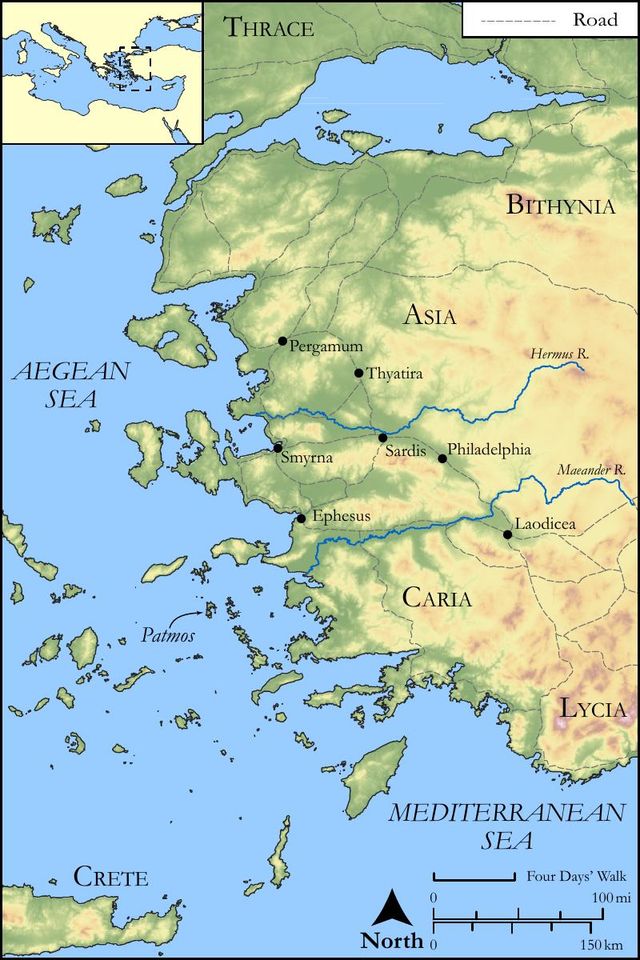
See on the biblical-era map

Study this verse
Public-domain commentary
Matthew Henry
From his Commentary on the Whole Bible. Henry comments on passages, not single verses — this entry covers Revelation 3:14–22. His four-level outline is real structure in the source text, so it is rendered as structure.
We now come to the last and worst of all the seven Asian churches, the reverse of the church of Philadelphia; for, as there was nothing reproved in that, here is nothing commended in this, and yet this was one of the seven golden candlesticks, for a corrupt church may still be a church. Here we have, as before,
I.The inscription, to whom, and from whom.
1.To whom: To the angel of the church of Laodicea. This was a once famous city near the river Lycus, had a wall of vast compass, and three marble theatres, and, like Rome, was built on seven hills. It seems, the apostle Paul was very instrumental in planting the gospel in this city, from which he wrote a letter, as he mentions in the epistle to the Colossians, the last chapter, in which he sends salutations to them, Laodicea not being above twenty miles distant from Colosse. In this city was held a council in the fourth century, but it has been long since demolished, and lies in its ruins to this day, an awful monument of the wrath of the Lamb.
2.From whom this message was sent. Here our Lord Jesus styles himself the Amen, the faithful and true witness, the beginning of the creation of God.
(1.)The Amen, one that is steady and unchangeable in all his purposes and promises, which are all yea, and all amen.
(2.)The faithful and true witness, whose testimony of God to men ought to be received and fully believed, and whose testimony of men to God will be fully believed and regarded, and will be a swift but true witness against all indifferent lukewarm professors.
(3.)The beginning of the creation of God, either of the first creation, and so he is the beginning, that is, the first cause, the Creator, and the Governor of it; or of the second creation, the church; and so he is the head of that body, the first-born from the dead, as it is in Rev 1:5, whence these titles are taken. Christ, having raised up himself by his own divine power, as the head of a new world, raises up dead souls to be a living temple and church to himself.
II.The subject-matter, in which observe,
1.The heavy charge drawn up against this church, ministers and people, by one who knew them better than they knew themselves: Thou art neither cold nor hot, but worse than either; I would thou wert cold or hot, Rev 3:15. Lukewarmness or indifference in religion is the worst temper in the world. If religion is a real thing, it is the most excellent thing, and therefore we should be in good earnest in it; if it is not a real thing, it is the vilest imposture, and we should be earnest against it. If religion is worth any thing, it is worth every thing; an indifference here is inexcusable: Why halt you between two opinions? If God be God, follow him; if Baal (be God), follow him. Here is no room for neutrality. An open enemy shall have a fairer quarter than a perfidious neuter; and there is more hope of a heathen than of such. Christ expects that men should declare themselves in earnest either for him or against him.
2.A severe punishment threatened: I will spue thee out of my mouth. As lukewarm water turns the stomach, and provokes to a vomit, lukewarm professors turn the heart of Christ against them. He is sick of them, and cannot long bear them. They may call their lukewarmness charity, meekness, moderation, and a largeness of soul; it is nauseous to Christ, and makes those so that allow themselves in it. They shall be rejected, and finally rejected; for far be it from the holy Jesus to return to that which has been thus rejected.
3.We have one cause of this indifference and inconsistency in religion assigned, and that is self-conceitedness or self-delusion. They thought they were very well already, and therefore they were very indifferent whether they grew better or no: Because thou sayest, I am rich, and increased with goods, etc., Rev 3:17. Here observe, What a difference there was between the thoughts they had of themselves and the thoughts that Christ had of them.
(1.)The high thoughts they had of themselves: Thou sayest, I am rich, and increased with goods, and have need of nothing, rich, and growing richer, and increased to such a degree as to be above all want or possibility of wanting. Perhaps they were well provided for as to their bodies, and this made them overlook the necessities of their souls. Or they thought themselves well furnished in their souls: they had learning, and they took it for religion; they had gifts, and they took them for grace; they had wit, and they took it for true wisdom; they had ordinances, and they took up with them instead of the God of ordinances. How careful should we be not to put the cheat upon our own souls! Doubtless there are many in hell that once thought themselves to be in the way to heaven. Let us daily beg of God that we may not be left to flatter and deceive ourselves in the concerns of our souls.
(2.)The mean thoughts that Christ had of them; and he was not mistaken. He knew, though they knew not, that they were wretched, and miserable, and poor, and blind, and naked. Their state was wretched in itself, and such as called for pity and compassion from others: though they were proud of themselves, they were pitied by all who knew their case. For,
[1.]They were poor, really poor, when they said and thought they were rich; they had no provision for their souls to live upon; their souls were starving in the midst of their abundance; they were vastly in debt to the justice of God, and had nothing to pay off the least part of the debt.
[2.]They were blind; they could not see their state, nor their way, nor their danger; they could not see into themselves; they could not look before them; they were blind, and yet they thought they saw; the very light that was in them was darkness, and then how great must that darkness be! They could not see Christ, though evidently set forth, and crucified, before their eyes. They could not see God by faith, though always present in them. They could not see death, though it was just before them. They could not look into eternity, though they stood upon the very brink of it continually.
[3.]They were naked, without clothing and without house and harbour for their souls. They were without clothing, had neither the garment of justification nor that of sanctification. Their nakedness both of guilt and pollution had no covering. They lay always exposed to sin and shame. Their righteousnesses were but filthy rags; they were rags, and would not cover them, filthy rags, and would defile them. And they were naked, without house or harbour, for they were without God, and he has been the dwelling-place of his people in all ages; in him alone the soul of man can find rest, and safety, and all suitable accommodations. The riches of the body will not enrich the soul; the sight of the body will not enlighten the soul; the most convenient house for the body will not afford rest nor safety to the soul. The soul is a different thing from the body, and must have accommodation suitable to its nature, or else in the midst of bodily prosperity it will be wretched and miserable.
4.We have good counsel given by Christ to this sinful people, and that is that they drop their vain and false opinion they had of themselves, and endeavour to be that really which they would seem to be: I counsel thee to buy of me, etc., Rev 3:18. Observe,
(1.)Our Lord Jesus Christ continues to give good counsel to those who have cast his counsels behind their backs.
(2.)The condition of sinners in never desperate, while they enjoy the gracious calls and counsels of Christ.
(3.)Our blessed Lord, the counsellor, always gives the best advice, and that which is most suitable to the sinner's case; as here, [1.] These people were poor; Christ counsels them to buy of him gold tried in the fire, that they might be rich. He lets them know where they might have true riches and how they might have them. First, Where they might have them - from himself; he sends them not to the streams of Pactolus, nor to the mines of Potosi, but invites them to himself, the pearl of price. Secondly, And how must they have this true gold from him? They must buy it. This seems to be unsaying all again. How can those that are poor buy gold? Just as they may buy of Christ wine and milk, that is, without money and without price, Isa 55:1. Something indeed must be parted with, but it is nothing of a valuable consideration, it is only to make room for receiving true riches. "Part with sin and self-sufficiency, and come to Christ with a sense of your poverty and emptiness, that you may be filled with his hidden treasure." [2.] These people were naked; Christ tells them where they might have clothing, and such as would cover the shame of their nakedness. This they must receive from Christ; and they must only put off their filthy rags that they might put on the white raiment which he had purchased and provided for them - his own imputed righteousness for justification and the garments of holiness and sanctification. [3.] They were blind; and he counsels them to buy of him eye-salve, that they might see, to give up their own wisdom and reason, which are but blindness in the things of God, and resign themselves to his word and Spirit, and their eyes shall be opened to see their way and their end, their duty and their true interest; a new and glorious scene would then open itself to their souls; a new world furnished with the most beautiful and excellent objects, and this light would be marvellous to those who were but just now delivered from the powers of darkness. This is the wise and good counsel Christ gives to careless souls; and, if they follow it, he will judge himself bound in honour to make it effectual.
5.Here is added great and gracious encouragement to this sinful people to take the admonition and advice well that Christ had given them, Rev 3:19, Rev 3:20. He tells them,
(1.)It was given them in true and tender affection: "Whom I love, I rebuke and chasten. You may think I have given you hard words and severe reproofs; it is all out of love to your souls. I would not have thus openly rebuked and corrected your sinful lukewarmness and vain confidence, if I had not been a lover of your souls; had I hated you, I would have let you alone, to go on in sin till it had been your ruin." Sinners ought to take the rebukes of God's word and rod as tokens of his good-will to their souls, and should accordingly repent in good earnest, and turn to him that smites them; better are the frowns and wounds of a friend than the flattering smiles of an enemy.
(2.)If they would comply with his admonitions, he was ready to make them good to their souls: Behold, I stand at the door and knock, etc., Rev 3:20. Here observe,
[1.]Christ is graciously pleased by his word and Spirit to come to the door of the heart of sinners; he draws near to them in a way of mercy, ready to make them a kind visit.
[2.]He finds this door shut against him; the heart of man is by nature shut up against Christ by ignorance, unbelief, sinful prejudices.
[3.]When he finds the heart shut, he does not immediately withdraw, but he waits to be gracious, even till his head be filled with the dew.
[4.]He uses all proper means to awaken sinners, and to cause them to open to him: he calls by his word, he knocks by the impulses of his Spirit upon their conscience.
[5.]Those who open to him shall enjoy his presence, to their great comfort and advantage. He will sup with them; he will accept of what is good in them; he will eat his pleasant fruit; and he will bring the best part of the entertainment with him. If what he finds would make but a poor feast, what he brings will make up the deficiency: he will give fresh supplies of graces and comforts, and thereby stir up fresh actings of faith, and love, and delight; and in all this Christ and his repenting people will enjoy pleasant communion with each other. Alas! what do careless obstinate sinners lose by refusing to open the door of the heart to Christ!
III.We now come to the conclusion of this epistle; and here we have as before,
1.The promise made to the overcoming believer. It is here implied,
(1.)That though this church seemed to be wholly overrun and overcome with lukewarmness and self-confidence, yet it was possible that by the reproofs and counsels of Christ they might be inspired with fresh zeal and vigour, and might come off conquerors in their spiritual warfare.
(2.)That, if they did so, all former faults should be forgiven, and they should have a great reward. And what is that reward? They shall sit down with me on my throne, as I also overcame, and have sat down with my Father on his throne, Rev 3:21. Here it is intimated,
[1.]That Christ himself had met with his temptations and conflicts.
[2.]That he overcame them all, and was more than a conqueror.
[3.]That, as the reward of his conflict and victory, he has sat down with God the Father on his throne, possessed of that glory which he had with the Father from eternity, but which he was pleased very much to conceal on earth, leaving it as it were in the hands of the Father, as a pledge that he would fulfil the work of a Saviour before he reassumed that manifestative glory; and, having done so, then pignus reposcere - he demands the pledge, to appear in his divine glory equal to the Father.
[4.]That those who are conformed to Christ in his trials and victories shall be conformed to him in his glory; they shall sit down with him on his throne, on his throne of judgment at the end of the world, on his throne of glory to all eternity, shining in his beams by virtue of their union with him and relation to him, as the mystical body of which he is the head.
2.All is closed up with the general demand of attention (Rev 3:22), putting all to whom these epistles shall come in mind that what is contained in them is not of private interpretation, not intended for the instruction, reproof, and correction of those particular churches only, but of all the churches of Christ in all ages and parts of the world: and as there will be a resemblance in all succeeding churches to these, both in their graces and sins, so they may expect that God will deal with them as he dealt with these, which are patterns to all ages what faithful, and fruitful churches may expect to receive from God, and what those who are unfaithful may expect to suffer from his hand; yea, that God's dealings with his churches may afford useful instruction to the rest of the world, to put them upon considering, If judgment begin at the house of God, what shall the end of those be that do not obey the gospel of Christ? Pe1 4:17. Thus end the messages of Christ to the Asian churches, the epistolary part of this book. We now come to the prophetical part.
Historical interpretation
Eight Centuries of Reception
8 surviving comments on this verse. Each one is dated, so this reads as a timeline rather than a list.
Select a marker to jump to its quote. Markers stagger vertically where authors wrote within a few decades of each other.
Us, moreover, Jesus, the Father's Highest and Great Priest, clothing us from His own store -inasmuch as they "who are baptized in Christ have put on Christ"-has made "priests to God His Father," according to John.
You are mistaken and are deceived, whosoever you are, that you think yourself rich in this world. Listen to the voice of your Lord in the Apocalypse, rebuking people of your stamp with righteous reproaches: “You say,” says he, “I am rich, and increased with goods, and have need of nothing, and do not know that you are wretched, and miserable, poor, blind and naked. I counsel you to buy gold from me tried in the fire, that you may be rich. And buy from me white clothing, that you may be clothed, and that the shame of your nakedness may not appear in you. Anoint your eyes with eye salve, that you may see.” You therefore, who are rich and wealthy, buy from Christ gold tried by fire. Then you may be pure gold, with your filth burned out as if by fire. Buy for yourself white raiment, that you who had been naked according to Adam, and were before frightful and tasteless, may be clothed with the white garment of Christ. You who are a wealthy and rich matron in Christ’s church, anoint your eyes, not with the eyewash of the devil but with Christ’s eye salve, that you may be able to attain to see God, by deserving well of God, both by good works and character.
Moreover, the seventh association of the Church declares that they are rich men placed in positions of dignity, but believing that they are rich, among whom indeed the Scriptures are discussed in their bedchamber, while the faithful are outside; and they are understood by none, although they boast themselves, and say that they know all things,-endowed with the confidence of learning, but ceasing from its labour. And thus He says:-
"That they are neither cold nor hot." That is, neither unbelieving nor believing, for they are all things to all men. And because he who is neither cold nor hot, but lukewarm, gives nausea, He says:-
"I will vomit thee out of My mouth." Although nausea is hateful, still it hurts no one; so also is it with men of this kind when they have been cast forth. But because there is time of repentance, He says:-
"I persuade thee to buy of Me gold tried in the fire." That is, that in whatever manner you can, you should suffer for the Lord's name tribulations and passions.
"And anoint thine eyes with eye-salve." That what you gladly know by the Scripture, you should strive also to do the work of the same. And because, if in these ways men return out of great destruction to great repentance, they are not only useful to themselves, but they are able also to be of advantage to many, He promised them no small reward,-to sit, namely, on the throne of judgment.
By the doing of alms and by standing firm in good works you might yourself be made gold. That is, that you might receive understanding from God and through your good behavior you might merit to suffer martyrdom.
He regards those as “naked” who are destitute of the works of righteousness, whom he also regards as “blind.” However, he is clothed with white garments who is vested with the baptism of Christ, and he enjoys that faith “working through love,” for “as many of you as were baptized into Christ have put on Christ.” When he says that the eyes must be anointed with salve, he advises that the heart be directed toward the divine testimonies. For “the commandment of the Lord is clear, enlightening the eyes.”
If you wish to be rich, he says, with a zealous intent and a willing heart obtain from me, who makes rich, gold that has been purified in fire, namely, the word of teaching that is made brilliant in the fire of temptations. And through this you will have in your heart a treasure that is secure, and you will wear the bright stole of virtue, through which the nakedness, which has come to you by sin, will be clothed. The salve is certainly poverty. For, if “gifts make blind the eyes of those who see,” then certainly that which is incorruptible will open them.
I counsel thee to buy gold fire-tried, that thou mayest be made rich. Gold in this passage is taken to mean God's wisdom incarnate, concerning which it is said elsewhere, Take wisdom as gold. [Variant of Prov. 16:16] It is right for this gold to be called fire-tried, because our Redeemer was tested by the fire of the Passion. The meaning is: If you want to be rich in virtues, take me as an example, so that you too may become gold melted by fire. Now what price shall a poor person give for this gold but a pious state of mind in his prayer? To him it is said in addition: and mayest be clothed in white garments, that the shame of thy nakedness may not appear. Someone is clothed in white garments to cover the shame of their nakedness when they buy gold fire-tried, convert to a new life to avoid the shame of lukewarmness, and deserve, thanks to their imitation of him, to be connected with the new and heavenly man. And anoint thy eyes with eye salve, that thou mayest see. As if it were saying: Apply the divine commandments to your blind mind, so that you may see the nakedness in virtues you are suffering from and hurry to cover it. Indeed, if the divine commandments were not eye salve, the Psalmist would not say, The commandment of the Lord is lightsome, enlightening the eyes. [Ps. 18:9] Eye salve, which is made from earth and removes the dust of the earth from the eyes, may represent the temporal poverty our Redeemer assumed for us. Therefore let him who has his eyes blinded with dust put eye salve on them to recover sight, that is, let him who gets lost due to earthly pleasures bring back to his mind his Redeemer's temporal poverty, so that he may contemplate with his inward eyes the future rewards of the saints.
I counsel you to buy from me gold refined by fire, that you may be rich. But what is this gold refined by the spiritual fire? The prophet teaches, saying "the words of the Lord are pure words, like silver refined and tested seven times on the earth" (Ps. 11:7), symbolizing the Gospel proclamation. Therefore, ask from me the one who can make you wise and bring you into harmony with God. For by acquiring this, one will shine forth in virtue and both soul and body will be purified. For this is the new and white garment.
And he says to anoint your eyes with eye-salve so that you may see. This is directed toward those who have dimmed vision concerning the spiritual light of the Lord, reproving them with the words of Jeremiah: "Behold, your eyes are not good, nor is your heart sound." (Jer. 22:17) Therefore, it advises that one should undergo repentance as a remedy for such hardening, just as the barren fig tree undergoes condemnation and a more dishonorable existence because of its manure. (Luke 13.6:9)
Continue studying Revelation 3:18 across the web’s major study libraries — every link below opens this exact verse, chapter, or book on the destination site.
Read & Compare
 BibleGatewayThis verse in more than 200 translations and 70 languages.
 Bible.comThe YouVersion reader — hundreds of translations, reading plans, and highlights.
 ESV.orgCrossway's official English Standard Version reader.
 NET BibleThe NET translation with 60,000+ translators' notes on every rendering decision.
 STEP BibleTyndale House's free study tool — original text, vocabulary, and scholarly resources.
 BibliaLogos Bible Software's free web reader.
 USCCBThe New American Bible (Revised Edition) with the U.S. bishops' study notes.
Commentaries
 BibleHub CommentariesDozens of classic commentaries on this verse, gathered on one page.
 StudyLightMore than 100 commentary sets — the largest collection on the web.
 BibleRefPlain-English commentary on what this verse means, verse by verse.
 Enduring WordDavid Guzik's free commentary on this chapter, widely used by Bible teachers.
 Bible Study ToolsVerse commentary alongside Greek and Hebrew study aids.
Original Language & Research
- BibleHub InterlinearThe verse word by word — original language, transliteration, and English.
- BibleHub LexiconEvery word's original-language definition and Strong's entry.
 Blue Letter BibleDeep-study tools — Strong's numbers, concordance, and word studies.
 CNTR CollationThe earliest Greek manuscripts of this verse, collated letter by letter.
Sermons, Hymns & Audio


TrulyRandomVerse is not affiliated with these sites and doesn’t control their content. They’re linked because they’re genuinely useful.
Summary
Revelation 3:18 presents Jesus Christ's urgent and compassionate counsel to the self-deceived church in Laodicea, offering three vital spiritual remedies to counteract their perceived material wealth and spiritual destitution. He calls them to acquire true spiritual riches—a faith purified by trial—to be clothed in His righteousness, and to receive divine insight to see their true condition and His truth, thereby exposing their spiritual poverty, nakedness, and blindness.
Context
ShowHideLiterary Context
This verse is the climactic and most direct counsel within Jesus's message to the church in Laodicea, the last of the seven churches addressed in the Book of Revelation. Preceding this verse, Jesus delivers a scathing indictment in Revelation 3:15-17, declaring them "lukewarm" and detailing their self-deception: "Because thou sayest, I am rich, and increased with goods, and have need of nothing; and knowest not that thou art wretched, and miserable, and poor, and blind, and naked." Verse 3:18 immediately follows this diagnosis, presenting the divine antidote to their spiritual maladies. The subsequent verses (Revelation 3:19-22) transition to a call for repentance, a promise of intimate fellowship, and the ultimate reward for those who overcome.
Historical & Cultural Context
Laodicea was a highly prosperous city in the Roman province of Asia, renowned for three primary industries. First, it was a major banking center, accumulating vast wealth. Second, it was famous for its production of high-quality black wool, derived from local sheep, which was exported widely. Third, it housed a celebrated medical school, particularly known for its ophthalmic remedies, including a popular eyesalve (Phrygian powder) used to treat eye conditions. Ironically, these very strengths became metaphors for the church's spiritual weaknesses. Their material wealth bred spiritual self-sufficiency, their fine clothing contrasted with their spiritual nakedness, and their famous eyesalve highlighted their profound spiritual blindness, as articulated by Christ in Revelation 3:17.
Key Themes
ShowHideThe central themes in this passage revolve around the stark contrast between worldly prosperity and spiritual poverty, and the divine provision for genuine spiritual transformation. The theme of true wealth versus material riches is paramount, as Jesus offers "gold tried in the fire" as the only enduring treasure, directly challenging their reliance on earthly riches. The theme of righteousness and purity is conveyed through the "white raiment," symbolizing Christ's covering for their spiritual nakedness, emphasizing that true standing before God is by His grace, not human merit. Finally, spiritual discernment is a critical theme, with the "eyesalve" representing the divine illumination needed to perceive spiritual truth and one's true condition, contrasting sharply with the city's celebrated physical medicine. These themes collectively underscore the call for radical repentance and absolute dependence on Christ for all spiritual needs.
Exposition and Analysis
ShowHideKey Word Analysis
ShowHideFrom ἀγορά (agora), meaning "market-place." Properly, to go to market, by implication, to purchase. Specially, it can mean to redeem. In this context, it implies a transaction, not necessarily with money, but with spiritual earnestness and commitment, a willingness to relinquish self-sufficiency to acquire something of ultimate value from Christ.
From γυμνός (gymnos), meaning "naked." It denotes nudity, either absolute or comparative. Here, it signifies spiritual exposure, shame, and vulnerability before God due to sin and lack of righteousness, a condition the Laodiceans were oblivious to despite their fine garments.
Neuter of a presumed derivative of a cake (probably akin to the base of κολλάω, meaning "to glue"). Properly, a poultice (as made of or in the form of crackers), by analogy, a plaster. This refers to a specific medicinal ointment for the eyes. Spiritually, it represents divine anointing or revelation necessary to heal spiritual blindness and gain true insight.
Verse Breakdown
ShowHide"I counsel thee to buy of me gold tried in the fire, that thou mayest be rich"
Jesus, as the divine counselor, offers a remedy for their spiritual poverty. The "gold tried in the fire" symbolizes a faith that has been purified and proven through trials, genuine and enduring, unlike their fleeting material wealth. This true spiritual richness comes only from Him, implying a spiritual transaction where they must surrender their self-sufficiency to receive His invaluable provision.
"and white raiment, that thou mayest be clothed, and that the shame of thy nakedness do not appear"
This command addresses their spiritual nakedness and the shame of their sin. "White raiment" represents Christ's imputed righteousness, purity, and the covering of salvation. By being clothed in it, their spiritual vulnerability and the disgrace of their unrighteousness would be hidden, signifying a divine provision for their spiritual defilement.
"and anoint thine eyes with eyesalve, that thou mayest see"
This final counsel targets their spiritual blindness. The "eyesalve" is a metaphor for divine illumination and spiritual discernment. Just as Laodicea was known for its physical eye medicine, Jesus offers a spiritual remedy to open their eyes to their true spiritual condition, to understand God's truth, and to perceive His will, enabling them to move from self-deception to clear spiritual vision.
Literary Devices
ShowHideRevelation 3:18 is rich in Symbolism, employing three powerful metaphors that directly counter Laodicea's material strengths: "gold tried in the fire" symbolizes spiritual wealth and purified faith, contrasting with their material riches; "white raiment" represents Christ's righteousness and purity, covering their spiritual nakedness; and "eyesalve" signifies divine illumination and spiritual discernment, healing their spiritual blindness. This use of Irony is profound, as Jesus uses the very things Laodicea prided itself on (wealth, fine textiles, eye medicine) to highlight their spiritual deficiencies. The entire verse functions as an extended Metaphor, where physical items represent spiritual realities, urging the church to shift its focus from external appearances to internal spiritual truth. The repeated phrase "that thou mayest..." emphasizes the Purpose of Christ's counsel, highlighting the intended outcome of spiritual transformation.
Theological and Thematic Connections
ShowHideThis verse profoundly underscores the New Testament's consistent emphasis on spiritual realities over material possessions, and the absolute necessity of Christ's provision for salvation and sanctification. It highlights that true wealth is not found in earthly goods but in a purified faith and a relationship with Christ, which ends through trials. The concept of being clothed in white raiment points to the doctrine of imputed righteousness, where believers are declared righteous not by their own works but by Christ's perfect life and atoning sacrifice. Furthermore, the need for spiritual eyesalve speaks to the Holy Spirit's role in granting discernment and understanding of divine truth, without which humanity remains spiritually blind to its true condition and God's saving grace.
Reflection and Application
ShowHideRevelation 3:18 is a timeless call to radical self-assessment and absolute dependence on Christ. It challenges us to examine where we place our trust and derive our sense of security and value. Are we, like the Laodiceans, subtly relying on our own achievements, resources, or even spiritual activities, believing we "have need of nothing"? Or are we humbly acknowledging our spiritual poverty, nakedness, and blindness, and actively seeking Christ's transformative provision? This verse compels us to prioritize cultivating a faith refined by trials, embracing Christ's righteousness as our only covering, and continually seeking the Holy Spirit's illumination to truly see and walk in God's truth. It is a powerful reminder that genuine spiritual prosperity is not about what we accumulate, but what we receive from the One who possesses all true riches.
Questions for Reflection
ShowHideFAQ
ShowHideWhy does Jesus tell them to "buy" these spiritual gifts if salvation is free?
ShowHideThe command to "buy" (Greek, agorázō') does not imply a monetary transaction for salvation, which is freely given by grace through faith (Ephesians 2:8-9). Instead, it signifies a spiritual exchange or commitment. The Laodiceans were rich and self-sufficient, believing they had no needs. To "buy" from Christ means to relinquish their self-reliance and perceived wealth, to acknowledge their spiritual bankruptcy, and to earnestly seek and receive from Him what they truly lack. It implies a willingness to give up their pride, independence, and worldly values in exchange for Christ's invaluable spiritual provisions. It's a call to prioritize and invest in eternal realities over fleeting earthly ones, demonstrating a true desire for what only Christ can provide.
Christ-Centered Fulfillment
ShowHideRevelation 3:18 finds its ultimate fulfillment in Christ Himself, as He is the very source and substance of the spiritual remedies He offers. He is the "gold tried in the fire," representing the purity of His divine nature and the perfection of His obedience, which endured the ultimate trial of the cross, providing the foundation for our true spiritual riches (1 Corinthians 1:30). He is the "white raiment," for He is our righteousness, and through His atoning sacrifice, we are clothed in His perfect holiness, covering the shame of our spiritual nakedness before God (2 Corinthians 5:21). Furthermore, Christ is the divine "eyesalve," the Light of the World (John 8:12), who opens the eyes of the blind, granting spiritual discernment and understanding through the Holy Spirit. He is the one who reveals truth and exposes sin, enabling us to see our true condition and the glorious reality of His saving grace (John 9:39-41). Thus, every aspect of the counsel in Revelation 3:18 points to Christ as the complete and sufficient provision for humanity's deepest spiritual needs, inviting all to come to Him and receive life in abundance.