


Hosea 10:10
Bible text: King James Version (1769 Blayney text) · Public domain
Bible text: Berean Standard Bible · Public domain
Bible text: American Standard Version (1901) · Public domain
Bible text: World English Bible, Messianic edition · Public domain
Bible text: Geneva Bible (1599) · Public domain
Bible text: Young's Literal Translation · Public domain
- בְּאַוָּתִיbe·'a·va·Tiat my desireH185Prep-b ¦ N-fsc ¦ 1csNoun Singular Feminine Constructבְּatאַוָּתִdesireיmy
- וְאֶסֳּרֵםve·'e·so·Remand I will discipline themH3256Conj-w ¦ V-Qal-ConjImperf-1cs ¦ 3mpVerb Qal Conjunction+Imperfect 1st Singular common genderוְandאֶסֳּרֵI will disciplineםthem
- וְאֻסְּפוּve·'u·se·Fuand they will be gatheredH622Conj-w ¦ V-Pual-ConsecPerf-3cpVerb Pual Consecutive Perfect 3rd Plural common genderוְandאֻסְּפוּthey will be gathered
- עֲלֵיהֶם'a·lei·Hemon themH5921Prep ¦ 3mpPreposition Definiteעֲלֵיonהֶםthem
- עַמִּים'a·MimpeoplesH5971N-mpNoun Plural Masculine Absolute
- בְּאָסְרָםbe·'a·se·Ramwhen harness themH631Prep-b ¦ V-Qal-Inf ¦ 3mpVerb Qal Infinitive Constructבְּwhenאָסְרָharnessםthem
- לִשְׁתֵּיlish·Teito [the] twoH8147Prep-l ¦ Adj-fdcAdjective Numerical Dual Feminine Constructלִtoשְׁתֵּי[the] two
- עוֹנֹתָםei·no·tamtheir iniquitiesH5771N-fpc ¦ 3mpNoun Plural Feminine Constructעוֹנֹתָiniquitiesםtheir
English is a literal word-by-word gloss of the Hebrew, not the KJV's wording. Why?
This is the original text the KJV's translators worked from — each Hebrew word with its own literal English meaning in this verse, prepared by scholars at Tyndale House, Cambridge. The KJV translates whole sentences, not word by word, so its wording differs: one Hebrew word can become several English words, and the KJV may choose “the LORD” where the gloss reads “Yahweh”. Both are faithful — they answer different questions. For the KJV's own rendering, switch to the KJV text.
Details
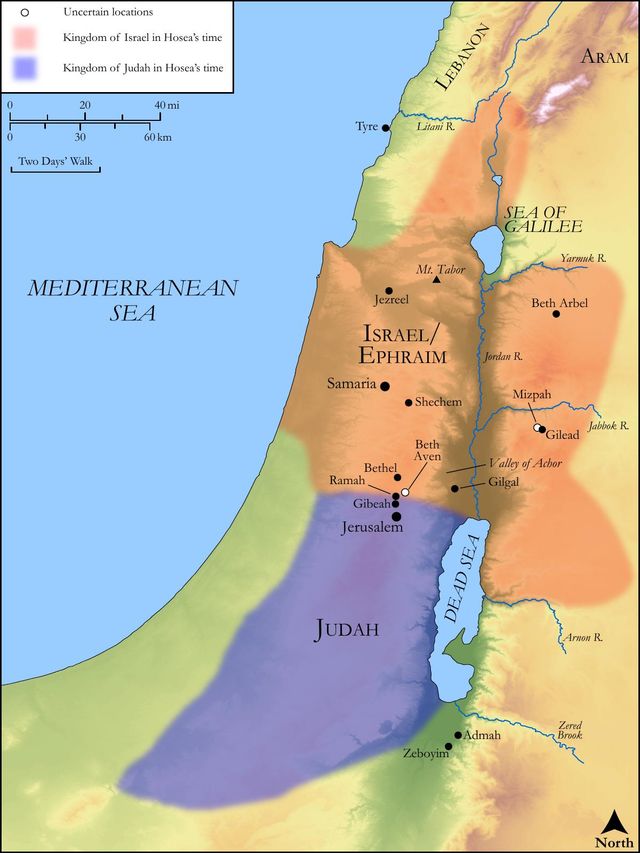
See on the biblical-era map
Study this verse
Public-domain commentary
Matthew Henry
From his Commentary on the Whole Bible. Henry comments on passages, not single verses — this entry covers Hosea 10:9–15. His three-level outline is real structure in the source text, so it is rendered as structure.
Here, I. They are put in mind of the sins of their fathers and predecessors, for which God would now reckon with them. It was told them (Hos 9:9) that they had corrupted themselves, as in the days of Gibeah, and here (Hos 10:9), O Israel! thou hast sinned from the days of Gibeah. Not only the wickedness that was committed in that age is revived in this, and reacted, a copy from that original, but the wickedness that was committed in that age has been continued in a constant series and succession through all the intervening ages down to this; so that the measure of iniquity had been long in filling; and still there had been made additions to it. Or, "Thou has sinned more than in the days of Gibeah" (so it may be read); "the sins of this age exceed those of the worst of former ages. The case was bad then, for there they stood; the criminals stood in their own defence, and the tribes of Israel, who undertook to chastise them for their wickedness, were at a stand, when both in the first and in the second battle the malefactors were the victors; and the battle in Gibeah against the children of iniquity did not overtake them till the third engagement, and then did not overtake them all, for 600 made their escape. But thy sin is worse than theirs, and therefore thou canst not expect but that the battle against the children of iniquity should overtake thee, and overcome thee."
II.They have warning given them, fair warning, of the judgments of God that were coming upon them, Hos 10:10.
God had hitherto pitied and spared them. Though they had been very provoking, he had a mind to try whether they would be wrought upon by patience and forbearance; but now, "It is in my desire that I should chastise them; it is what I have a purpose of and will take pleasure in." He will rejoice over them to do them hurt, Deu 28:63. Note, Because God does not desire the death and ruin of sinners, therefore he does desire their chastisement. And see what the chastisement it: The people shall be gathered against them, as all the other tribes were against Benjamin in the battle of Gibeah. One of the rabbin thus descants upon it: "Because they receive not chastisement from me by my prophets, who in my name rebuke them, I will chastise them by the hands of the people who shall be gathered against them, when they shall bind themselves in their two furrows," that is, when they shall think to fortify themselves, as it were, within a double entrenchment. or, When I shall bind them for their two transgressions (so the margin reads it), meaning their corporal and spiritual whoredom, which they are so often charged with, or the two calves at Dan and Bethel, or those two great evils mentioned Jer 2:13. Or, When I shall bind them to their two furrows, that is, bring them into servitude to the Assyrians, who shall keep them under the yoke as oxen in the plough, who are bound to the two furrows up the field and down it, and dare not, for fear of the goad, stir a step out of them. The Chaldee says, Those that are gathered against them shall exercise dominion over them, in like manner as a pair of heifers are tied to their two furrows. Thus those that would not be God's freemen shall be their enemies' slaves, and shall be made to know the difference between God's service and the service of the kingdoms of the countries, Ch2 12:8.
III.They are made to know that their unacquaintedness with sufferings and hardships should not excuse them from a very miserable captivity, Hos 10:11. See how nice, and tender, and delicate, Ephraim is; he is as a heifer that is taught to tread out the corn, and loves that work, because, being not allowed to be muzzled, she has liberty to eat at pleasure, and the work itself was dry and easy, and both its own diversion and its own wages. "But," says God, "I have a yoke to put upon her fair neck, fair as it is. I will make Ephraim to ride, that is, I will tame them, or cause them to be ridden by the Assyrians and other conquerors that shall rule them with rigour, as men do the beasts they ride upon (Psa 66:12); and Judah too shall be made to plough, and Jacob to break the clods," that is, they shall be used hardly, but not so hardly as Ephraim. Note, It is just with God to make those know what hardships mean that indulge themselves too much in their own ease and pleasure. The learned Dr. Pocock inclines to another sense of these words, as intimating the tender gentle methods God took with this people, to bring them into obedience to his law, as a reason why they should return to that obedience; he had managed them as the husbandman does his cattle that he trains up for service. Ephraim being as a docile heifer, fit to be employed, God took hold of her fair neck, to accustom her to the hand, harnessed her, or put the yoke of his commandments upon her, gave his people Israel a law, that, being trained up in his institutions, they might not be tempted by the usages of the heathen; he had used all fair and likely means with them to keep them in their obedience, had set Judah to plough and Jacob to break the clods, had employed them in the observance of precepts proper for them; and yet they would not be retained in their obedience, but started aside.
IV.They are invited and encouraged to return to God by prayer, repentance, and reformation, Hos 10:12, Hos 10:13. See here,
1.The duties they are called to. They are God's husbandry (Co1 3:9), and the duties are expressed in language borrowed from the husbandman's calling. If they would not be brought into bondage by their oppressors, let them return to God's service.
(1.)Let them break up the fallow ground; let them cleanse their hearts from all corrupt affections and lusts, which are as weeds and thorns, and let them be humbled for their sins, and be of a broken and contrite spirit in the sense of them; let them be full of sorrow and shame at the remembrance of them, and prepare to receive the divine precepts, as the ground that is ploughed is to receive the seed, that it may take root. See Jer 4:3.
(2.)Let them sow to themselves in righteousness; let them return to the practice of good works, according to the law of God, which is the rule of righteousness; let them abound in works of piety towards God, and of justice and charity towards one another, and herein let them sow to the Spirit, as the apostle speaks, Gal 6:7, Gal 6:8. Every action is seed sown. Let them sow in righteousness; let them sow what they should sow, do what they should do, and they themselves shall have the benefit of it.
(3.)Let them seek the Lord; let them look up to him for his grace, and beg of him to bless the seed sown. The husbandman must plough and sow with an eye to God, asking of him rain in the season thereof.
2.The arguments used for the pressing of these duties. Consider,
(1.)It is time to do it; it is high time. The husbandman sows in seed-time, and, if that time be far spent, he applies to the work with the more diligence. Note, Seeking the Lord is to be every day's work, but there are some special occasions given by the providence and grace of God when it is, in a particular manner, time to seek him.
(2.)If we do our part, God will do his. If we sow to ourselves in righteousness - if we be careful and diligent to do our duty, in a dependence upon his grace - he will shower down his grace upon us, will rain righteousness, the very thing that those need most who are to sow in righteousness; for by the grace of God we are what we are. Some apply it to Christ, who should come in the fulness of time, and for whose coming they must prepare themselves; he shall come as the Lord our righteousness, and shall rain righteousness upon us, that everlasting righteousness which he has brought in; he will grant us of it abundantly. It is foretold (Psa 72:6) that he shall come down like rain.
(3.)If we sow in righteousness, we shall reap in mercy, which agrees with that promise, If we sow to the Spirit, we shall of the Spirit reap life everlasting. We shall reap according to the measure of mercy (so the word is); it shall be a great reward, according to the riches of mercy, such a reward, not as becomes such mean creatures as we are to receive, but as becomes a God of infinite mercy to give, a reward, not of debt, but of grace. We reap not in merit, but in mercy. It is what is sown; God gives a body as it has pleased him.
(4.)We have ploughed wickedness and reaped iniquity; and the time past of our life may suffice that we have done so, Hos 10:13. "You have taken a great deal of pains in the service of sin, have laboured at it in the very fire; and will you grudge to bear the burden and heat of the day in God's service and in doing that which will be for your own advantage? You have done much to damn your souls; will you not undo it again, and do something to save them?" (5.) We never got any thing in the service of sin. They have ploughed wickedness (that is, they have done the drudgery of sin), and they have reaped iniquity, that is, they have got all that is to be got by it; they have carried it on to the harvest, and what the better? It is all a cheat. They have eaten the fruit of lies, fruit that is but a lie, which looks fair, but is rotten within; the works of darkness are unfruitful works, Eph 5:11; Rom 6:21. Even the gains of sin yield the sinner no satisfaction. (6.) As our comforts, so our confidences, in the service of sin will certainly fail us: "Thou didst trust in thy ways, in the multitude of thy mighty men; thou has stayed thyself upon creatures, thy own power and policy, and therefore hast ventured to plough wickedness, and thy hopes have deceived thee; come therefore, and seek the Lord, and thy hope in him shall not deceive thee."
V.They are threatened with utter destruction, both for their carnal practices and for their carnal confidences, Hos 10:14, Hos 10:15.
Therefore, because thou has sown wickedness, and trusted in thy own way, a tumult shall arise among thy people, either by insurrections at home or invasions from abroad, either of which will put a kingdom into confusion and make a noise, much more both together.
1.Their cities and strongholds shall be a prey to the enemy: The fortresses which they confided in, and in which they had laid up their effects, shall be seized and rifled, as Shalman spoiled Beth-arbel in the day of battle. This refers to some event that had lately happened, not elsewhere recorded; and probably Shalman is the same with Shalmaneser king of Assyria, who had lately put some town, or castle, or house (Beth-arbel is the house of Arbel), under military execution, which perhaps he used with severity in the beginning of his conquests, to terrify other garrisons into a speedy surrender at the first summons. God tells them that thus Samaria should be spoiled.
2.The inhabitants shall be put to the sword, as it was at Beth-arbel; when it was taken the mother was dashed in pieces upon her children, that is, they were both dashed in pieces together by the fury of the soldiers. See what cruel work war makes. Jusque datum sceleri - Wickedness has free course. It is strange that any of the human race could be so inhuman; but see what comes of sin. Homo homini lupus - Man is a wolf to man, and then, Homo homini agnus - Man is a lamb to man.
3.Even royal blood shall be mingled with common gore: In a morning shall the king of Israel utterly be cut off, Hos 10:15. Hoshea was the last king of Israel; in him the whole kingdom was cut off and came to a period; it may refer either to him or to some of his predecessors that were cut off by treachery. It shall be done in a morning, in a very little time, as suddenly as the dawning of the morning, or at the time appointed, for so the morning comes, punctually at its time. Or in the morning, when they think the night of calamity is over, and expect a returning day, then shall all their hopes be dashed by the sudden cutting off of their king, Hos 10:7. Kings, though gods to us, are men to God, and shall die like men. And (lastly) what does all this desolation owe its rise to? What is the spring of this bloodshed? He tells us (Hos 10:15): So shall Bethel do unto you. Bethel was the place where one of the calves was; Gilgal, where all their wickedness is said to have been, was hard by; there was their great wickedness, the evil of their evil (so the word is), the sum and quintessence of their sin; and that was it that did this to them, that made all this havoc, for that was it that provoked God to bring it upon them. He does not say, "So shall the king of Assyria do to you;" but, "So shall Bethel do to you." Note, Whatever mischief is done to us it is sin that does it. Are the fortresses spoiled? Are the women and children murdered? Is the king cut off? It is sin that does all this. It is sin that ruins soul, body, estate, all. So shall Bethel do unto you. It is thy own wickedness that corrects thee and thy backslidings that reprove thee.
Historical interpretation
Fourteen Centuries of Reception
2 surviving comments on this verse. Each one is dated, so this reads as a timeline rather than a list.
Select a marker to jump to its quote. Markers stagger vertically where authors wrote within a few decades of each other.
"Israel sinned from the days of Gabaa: there they stood. They will not be caught at Gabaa in battle against the sons of iniquity. According to my desire, I will rebuke them: when the peoples are gathered together against them and will be corrected over their two iniquities." LXX: "Since Israel sinned on the hills, there they stood; they were not captured in battle on the hills against the sons of lawlessness. He came to rebuke them, and the peoples will be gathered against them when they are rebuked for their two iniquities." From the day when Benjamin in the city of Gabaa shamefully and cruelly killed the wife of the Levite, all Israel sinned against me (Judges 19): not because he avenged the injury and crime with blood, but because of his marital grief he rushed into battle, and did not want to avenge the sacrilege against his God, because in Micah's house they neglected the ephod and teraphim which were worshiped as idols. Therefore, Israel stood here, where he restrained his step, lest he should walk any longer in the paths of the Lord: for this reason he will not overtake them on account of the battle of Gabaa, or of captivity, as they themselves suppose; for it was well done by them to pursue the sons of iniquity there; but I will rebuke them, saith the Lord, and will instruct them with the whole desire of my heart, and will gather together against them the multitude of peoples, because they have done two iniquities: they have avenged man, and neglected the injury done to their God. Either two iniquities: firstly, they sinned in Michae's idols, secondly, in Jeroboam's calves. Or certainly two calves of Samaria in Dan and Bethel, we can call two iniquities, about which also Jeremiah speaks: "My people have committed two evils: they have forsaken me, the fountain of living waters, and hewed out cisterns for themselves, broken cisterns that can hold no water." (Jeremiah 2:13). These two iniquities went against two precepts of the Decalogue, in which it is said: "I am the Lord your God: you shall have no other gods before me." (Exodus 20:2-3). The Septuagint interpreted "Gabaa, hills" as: In the days of the hills, Israel sinned, when it deserted the mountains of the Church and went down to the hills or cliffs of the heretics, thinking itself more learned than the Church and having discovered something more sublime. "There they stood," that is, they persevered in error. Some interpret what follows, "He will not apprehend them in the hill battle," in this way: because they begot children of iniquity and, departing from the Church, began to be on the hills, when persecution comes, the battle will not apprehend them, since the devil does not want to attack his own. Some say: Since Israel has sinned on the hills, and he stood there and was not able to walk anymore, should he not be caught in the hills from battle? Should not ecclesiastical men fight against him, to destroy them over the sons of iniquity? If they are caught and defeated, they will no longer be able to reproduce. At the same time, the Lord promises that he will rebuke them and that, when they are defeated as masters, their disciples will gather against them, whom they had previously deceived, and see correction for two injustices: because they left the Church, the source of the Lord, and dug broken cisterns for themselves, namely the caves of heretics, which cannot hold water, that is, the doctrine of the Savior and the sacrament of baptism.
Their two iniquities: Their two calves.
Continue studying Hosea 10:10 across the web’s major study libraries — every link below opens this exact verse, chapter, or book on the destination site.
Read & Compare
 BibleGatewayThis verse in more than 200 translations and 70 languages.
 Bible.comThe YouVersion reader — hundreds of translations, reading plans, and highlights.
 ESV.orgCrossway's official English Standard Version reader.
 NET BibleThe NET translation with 60,000+ translators' notes on every rendering decision.
 STEP BibleTyndale House's free study tool — original text, vocabulary, and scholarly resources.
 BibliaLogos Bible Software's free web reader.
 USCCBThe New American Bible (Revised Edition) with the U.S. bishops' study notes.
Commentaries
 BibleHub CommentariesDozens of classic commentaries on this verse, gathered on one page.
 StudyLightMore than 100 commentary sets — the largest collection on the web.
 BibleRefPlain-English commentary on what this verse means, verse by verse.
 Enduring WordDavid Guzik's free commentary on this chapter, widely used by Bible teachers.
 Bible Study ToolsVerse commentary alongside Greek and Hebrew study aids.
Original Language & Research
- BibleHub InterlinearThe verse word by word — original language, transliteration, and English.
- BibleHub LexiconEvery word's original-language definition and Strong's entry.
 Blue Letter BibleDeep-study tools — Strong's numbers, concordance, and word studies.
 SefariaThe Hebrew text with Rashi and centuries of Jewish commentary.
Sermons, Hymns & Audio


TrulyRandomVerse is not affiliated with these sites and doesn’t control their content. They’re linked because they’re genuinely useful.
Summary
Hosea 10:10 reveals God's sovereign intent to discipline the Northern Kingdom of Israel (Ephraim) due to their persistent idolatry and covenant unfaithfulness. The verse declares divine judgment as a desired act of chastisement, leading to the gathering of hostile nations against them. This impending judgment is portrayed as a direct consequence of Israel's self-imposed spiritual bondage and divided loyalties, metaphorically described as binding themselves in their "two furrows," signifying their deep entanglement in sin and their own destructive choices.
Context
ShowHideLiterary Context
Hosea 10:10 is situated within a series of pronouncements of judgment against Israel, particularly Ephraim, for their spiritual apostasy. The preceding verses (Hosea 10:1-8) lament Israel's prosperity, which led to increased idolatry and the multiplication of altars. God's judgment is depicted as a stripping away of their false security, culminating in the destruction of their high places and the rejection of their king. Verse 9 recalls their historical sin from the days of Gibeah, emphasizing their continuous rebellion. Verse 10, then, explicitly states God's active role in their impending downfall, framing it as a deliberate act of chastisement. The subsequent verses (Hosea 10:11-15) continue the agricultural metaphors, urging Israel to "sow righteousness" and "reap mercy" before the full force of judgment arrives, highlighting the contrast between their sinful harvest and God's desire for their repentance.
Historical & Cultural Context
The prophecy of Hosea was delivered during the tumultuous final decades of the Northern Kingdom of Israel, roughly 750-722 BC, leading up to its conquest by Assyria. This period was marked by political instability, frequent changes in kings, and a foreign policy that vacillated between alliances with Egypt and Assyria, rather than relying on God. Culturally, Israel had deeply assimilated Canaanite religious practices, particularly the worship of Baal, which involved fertility rites and idol worship at numerous high places (e.g., Bethel and Dan). This syncretism represented a severe breach of their covenant with Yahweh, who demanded exclusive devotion. The "gathering of the people" against them directly refers to the Assyrian military campaigns that would devastate Israel, fulfilling the covenant curses for disobedience. The agricultural imagery throughout Hosea, including "furrows," resonates deeply with an agrarian society, making the consequences of their spiritual "sowing" readily understandable.
Key Themes
ShowHideThis verse powerfully contributes to several overarching themes in Hosea. Firstly, it underscores the theme of Divine Discipline and Judgment, portraying God's actions as a necessary, albeit painful, response to Israel's unfaithfulness. This is not arbitrary punishment but a corrective measure rooted in God's covenant relationship with His people, aiming to bring them back to righteousness, as seen in passages like Deuteronomy 8:5. Secondly, it highlights the Consequences of Idolatry and Covenant Breaking. Israel's persistent worship of other gods and their reliance on foreign alliances (e.g., Hosea 7:11) directly led to their vulnerability and the impending invasion. Thirdly, the enigmatic phrase "two furrows" touches upon the theme of Divided Loyalty and Spiritual Entrapment. Whether referring to specific sins, dual allegiances (God and Baal, Egypt and Assyria), or their deep-seated commitment to their sinful ways, it illustrates how their own choices led to their predicament, making them ripe for judgment. This resonates with the broader prophetic message that sowing wickedness yields a harvest of iniquity.
Exposition and Analysis
ShowHideKey Word Analysis
ShowHideVerse Breakdown
ShowHide"[It is] in my desire that I should chastise them;"
This opening clause unequivocally declares God's initiative and sovereign will in the impending judgment. The "desire" (or "pleasure," "will") of God is not one of arbitrary wrath but a deliberate, purposeful act of discipline. The word "chastise" indicates that the purpose is corrective, even though the means will be severe. This sets the tone for understanding the coming affliction as divine discipline rather than mere misfortune.
"and the people shall be gathered against them,"
This clause describes the immediate consequence of God's desired chastisement: the mobilization of hostile forces, specifically referring to the Assyrian armies. This gathering of "the people" (foreign nations) against Israel signifies military invasion and conquest, which would lead to the destruction of their kingdom and the exile of its inhabitants. It is the tangible manifestation of God's judgment for their unfaithfulness.
"when they shall bind themselves in their two furrows."
This final clause provides the reason or condition for the judgment, using a powerful metaphor. "Binding themselves" suggests self-imposed entanglement or a deep commitment to a course of action. The phrase "in their two furrows" is highly interpretive, but generally points to Israel's deep-seated sin, divided loyalties, or their stubborn adherence to a destructive path. Whether it refers to specific dual sins, their reliance on two foreign powers, or their persistent spiritual harlotry, the imagery conveys a people yoked to their own iniquity, making them vulnerable to the divine harvest of judgment.
Literary Devices
ShowHideHosea 10:10 employs several potent literary devices. Personification is evident in God's "desire" to chastise, attributing a human emotion and will to the divine, emphasizing the intentionality behind the judgment. The central image of "binding themselves in their two furrows" functions as a powerful Metaphor. This agricultural imagery, prevalent throughout Hosea, likens Israel's sinful actions to plowing a field that will yield a bitter harvest. The "binding" suggests a self-imposed servitude or deep entanglement in their own destructive choices, much like an animal yoked to a plow, unable to deviate from its path. There is also an element of Irony, as Israel's attempts to secure themselves through idolatry and foreign alliances ultimately lead to their self-inflicted bondage and vulnerability to the very "people" they sought to appease or rely upon. The ambiguity of "two furrows" itself is a form of Symbolism, allowing for multiple layers of interpretation, all pointing to Israel's profound and multifaceted spiritual departure from God.
Theological and Thematic Connections
ShowHideHosea 10:10 profoundly illustrates the biblical principle that God, in His holiness and justice, will not tolerate persistent sin and covenant unfaithfulness. His "desire" to chastise is not punitive in a vengeful sense, but disciplinary, aimed at correction and restoration, even when the means are severe. This verse serves as a stark reminder that spiritual rebellion has tangible consequences, often manifesting as external pressures and judgments. It highlights the divine prerogative to intervene in human history to uphold His righteous standards and to call His people back to Himself, demonstrating that God's love includes the painful necessity of discipline for those He calls His own.
Reflection and Application
ShowHideHosea 10:10 offers a sobering yet ultimately hopeful message for believers today. It calls us to examine our own hearts for any divided loyalties or areas where we might be "binding ourselves" to habits, desires, or relationships that pull us away from God. Just as Israel sought security in idols and foreign alliances, we can be tempted to find our comfort, identity, or purpose in worldly pursuits rather than in Christ alone. This verse reminds us that God's discipline, though uncomfortable or painful, is a testament to His love and His desire for our holiness. It is an invitation to humble ourselves, acknowledge our sin, and turn back to Him wholeheartedly. Recognizing that God's chastisement is for our good should motivate us to embrace His correction, repent quickly, and pursue a life of undivided devotion, trusting that His ultimate purpose is our spiritual flourishing and intimate fellowship with Him.
Questions for Reflection
ShowHideFAQ
ShowHideWhat does "two furrows" specifically refer to in Hosea 10:10?
ShowHideThe phrase "two furrows" (KJV) is one of the most debated and ambiguous parts of Hosea 10:10. Based on the Hebrew word (ʻayin, H5869), which primarily means "eye" but can also refer to a "furrow" (from the margin) or even "iniquity" (by a Septuagint interpretation or wordplay), several interpretations are possible. It most likely refers to Israel's divided loyalties and deep-seated sinfulness. This could mean: (1) Their dual forms of idolatry, perhaps worshipping both Yahweh and Baal, or maintaining cultic centers at both Bethel and Dan. (2) Their political double-dealing, seeking alliances with both Egypt and Assyria rather than trusting God, as seen in Hosea 7:11. (3) A more general metaphor for their deep entanglement in sin, as if they were yoked to their own destructive path, plowing a field of wickedness that would yield a bitter harvest, as mentioned in Hosea 10:13. The core idea is that Israel's own choices and divided heart led to their predicament and the impending divine judgment.
Christ-Centered Fulfillment
ShowHideHosea 10:10, with its portrayal of God's "desire" to chastise His people for their sin, finds its ultimate fulfillment and transformation in Jesus Christ. While Israel faced physical invasion and exile for their unfaithfulness, the New Covenant reveals a deeper, spiritual chastisement that culminates in Christ's atoning work. Humanity, like ancient Israel, is "bound in its furrows" of sin, unable to escape the just consequences of rebellion against a holy God. Yet, God's ultimate "desire" for humanity was not merely punitive judgment, but redemptive reconciliation. This was accomplished through Christ, who, unlike Israel, perfectly fulfilled God's righteous demands and bore the full weight of divine wrath and chastisement for sin on the cross (see Isaiah 53:5). Through His sacrifice, believers are freed from the bondage of their "two furrows" of sin and self-reliance, and are instead yoked to Christ, whose "yoke is easy and burden is light" (Matthew 11:29-30). Furthermore, for those in Christ, divine discipline shifts from a judgment unto destruction to a loving correction that molds us into His likeness, proving our sonship and leading to holiness (Hebrews 12:6-11). Thus, the stern warning of Hosea 10:10 foreshadows the ultimate divine intervention in Christ, where God's justice and mercy perfectly converge to offer salvation from the very judgment that Israel faced.