


Hosea 10:11
Bible text: King James Version (1769 Blayney text) · Public domain
Bible text: King James Version with Strong's numbers · Public domain
Bible text: Berean Standard Bible · Public domain
Bible text: American Standard Version (1901) · Public domain
Bible text: World English Bible, Messianic edition · Public domain
Bible text: Geneva Bible (1599) · Public domain
Bible text: Young's Literal Translation · Public domain
- וְאֶפְרַיִםve·'ef·Ra·yimand EphraimH669Conj-w ¦ N-proper-mNoun Proper MasculineוְandאֶפְרַיִםEphraim
- עֶגְלָה'eg·Lah[was] a heiferH5697N-fsNoun Singular Feminine Absolute
- מְלֻמָּדָהme·lu·ma·DahtrainedH3925V-Pual-PassPrtcpl-fsVerb Pual Participle Passive Singular Feminine Absolute
- אֹהַבְתִּי'o·Hav·ti[which] lovedH157V-Qal-Prtcpl-fsVerb Qal Participle Singular Feminine Construct
- לָדוּשׁla·Dushto threshH1758Prep-l ¦ V-Qal-InfVerb Qal Infinitive Constructלָtoדוּשׁthresh
- וַאֲנִיva·'a·Niand IH589Conj-w ¦ Pro-1csPronoun Personal 1st Singular common genderוַandאֲנִיI
- עָבַרְתִּי'a·Var·tiI passedH5674V-Qal-Perf-1csVerb Qal Perfect 1st Singular common gender
- עַל'aloverH5921PrepPreposition
- טוּבtuv[the] goodness ofH2898N-mscNoun Singular Masculine Construct
- צַוָּארָהּtza·va·Rahits neckH6677N-msc ¦ 3fsNoun Singular Masculine Constructצַוָּארָneckהּits
- אַרְכִּיב'ar·KivI will cause to drawH7392V-Hiphil-Imperf-1csVerb Hiphil Imperfect 1st Singular common gender
- אֶפְרַיִם'ef·Ra·yimEphraimH669N-proper-mNoun Proper Masculine
- יַחֲרוֹשׁya·cha·Ro·oshit will plowH2790V-Qal-Imperf-3msVerb Qal Imperfect 3rd Singular Masculine
- יְהוּדָהye·hu·DahJudahH3063N-properNoun Proper Location
- יְשַׂדֶּדye·sa·dedit will harrowH7702V-Piel-Imperf-3msVerb Piel Imperfect 3rd Singular Masculine
- לוֹlo<for> itselfPrep-l ¦ 3msSuffix Personal 3rd Singular Masculineל<for>וֹitself
- יַעֲקֹבya·'a·KoJacobH3290N-proper-mNoun Proper Masculine
English is a literal word-by-word gloss of the Hebrew, not the KJV's wording. Why?
This is the original text the KJV's translators worked from — each Hebrew word with its own literal English meaning in this verse, prepared by scholars at Tyndale House, Cambridge. The KJV translates whole sentences, not word by word, so its wording differs: one Hebrew word can become several English words, and the KJV may choose “the LORD” where the gloss reads “Yahweh”. Both are faithful — they answer different questions. For the KJV's own rendering, switch to the KJV text.
Details
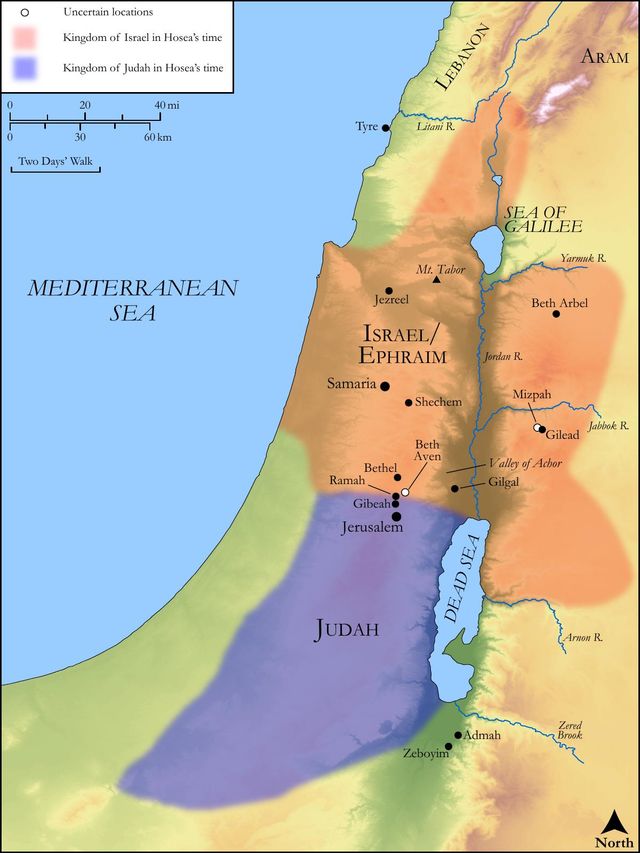
See on the biblical-era map
Study this verse
Public-domain commentary
Matthew Henry
From his Commentary on the Whole Bible. Henry comments on passages, not single verses — this entry covers Hosea 10:9–15. His three-level outline is real structure in the source text, so it is rendered as structure.
Here, I. They are put in mind of the sins of their fathers and predecessors, for which God would now reckon with them. It was told them (Hos 9:9) that they had corrupted themselves, as in the days of Gibeah, and here (Hos 10:9), O Israel! thou hast sinned from the days of Gibeah. Not only the wickedness that was committed in that age is revived in this, and reacted, a copy from that original, but the wickedness that was committed in that age has been continued in a constant series and succession through all the intervening ages down to this; so that the measure of iniquity had been long in filling; and still there had been made additions to it. Or, "Thou has sinned more than in the days of Gibeah" (so it may be read); "the sins of this age exceed those of the worst of former ages. The case was bad then, for there they stood; the criminals stood in their own defence, and the tribes of Israel, who undertook to chastise them for their wickedness, were at a stand, when both in the first and in the second battle the malefactors were the victors; and the battle in Gibeah against the children of iniquity did not overtake them till the third engagement, and then did not overtake them all, for 600 made their escape. But thy sin is worse than theirs, and therefore thou canst not expect but that the battle against the children of iniquity should overtake thee, and overcome thee."
II.They have warning given them, fair warning, of the judgments of God that were coming upon them, Hos 10:10.
God had hitherto pitied and spared them. Though they had been very provoking, he had a mind to try whether they would be wrought upon by patience and forbearance; but now, "It is in my desire that I should chastise them; it is what I have a purpose of and will take pleasure in." He will rejoice over them to do them hurt, Deu 28:63. Note, Because God does not desire the death and ruin of sinners, therefore he does desire their chastisement. And see what the chastisement it: The people shall be gathered against them, as all the other tribes were against Benjamin in the battle of Gibeah. One of the rabbin thus descants upon it: "Because they receive not chastisement from me by my prophets, who in my name rebuke them, I will chastise them by the hands of the people who shall be gathered against them, when they shall bind themselves in their two furrows," that is, when they shall think to fortify themselves, as it were, within a double entrenchment. or, When I shall bind them for their two transgressions (so the margin reads it), meaning their corporal and spiritual whoredom, which they are so often charged with, or the two calves at Dan and Bethel, or those two great evils mentioned Jer 2:13. Or, When I shall bind them to their two furrows, that is, bring them into servitude to the Assyrians, who shall keep them under the yoke as oxen in the plough, who are bound to the two furrows up the field and down it, and dare not, for fear of the goad, stir a step out of them. The Chaldee says, Those that are gathered against them shall exercise dominion over them, in like manner as a pair of heifers are tied to their two furrows. Thus those that would not be God's freemen shall be their enemies' slaves, and shall be made to know the difference between God's service and the service of the kingdoms of the countries, Ch2 12:8.
III.They are made to know that their unacquaintedness with sufferings and hardships should not excuse them from a very miserable captivity, Hos 10:11. See how nice, and tender, and delicate, Ephraim is; he is as a heifer that is taught to tread out the corn, and loves that work, because, being not allowed to be muzzled, she has liberty to eat at pleasure, and the work itself was dry and easy, and both its own diversion and its own wages. "But," says God, "I have a yoke to put upon her fair neck, fair as it is. I will make Ephraim to ride, that is, I will tame them, or cause them to be ridden by the Assyrians and other conquerors that shall rule them with rigour, as men do the beasts they ride upon (Psa 66:12); and Judah too shall be made to plough, and Jacob to break the clods," that is, they shall be used hardly, but not so hardly as Ephraim. Note, It is just with God to make those know what hardships mean that indulge themselves too much in their own ease and pleasure. The learned Dr. Pocock inclines to another sense of these words, as intimating the tender gentle methods God took with this people, to bring them into obedience to his law, as a reason why they should return to that obedience; he had managed them as the husbandman does his cattle that he trains up for service. Ephraim being as a docile heifer, fit to be employed, God took hold of her fair neck, to accustom her to the hand, harnessed her, or put the yoke of his commandments upon her, gave his people Israel a law, that, being trained up in his institutions, they might not be tempted by the usages of the heathen; he had used all fair and likely means with them to keep them in their obedience, had set Judah to plough and Jacob to break the clods, had employed them in the observance of precepts proper for them; and yet they would not be retained in their obedience, but started aside.
IV.They are invited and encouraged to return to God by prayer, repentance, and reformation, Hos 10:12, Hos 10:13. See here,
1.The duties they are called to. They are God's husbandry (Co1 3:9), and the duties are expressed in language borrowed from the husbandman's calling. If they would not be brought into bondage by their oppressors, let them return to God's service.
(1.)Let them break up the fallow ground; let them cleanse their hearts from all corrupt affections and lusts, which are as weeds and thorns, and let them be humbled for their sins, and be of a broken and contrite spirit in the sense of them; let them be full of sorrow and shame at the remembrance of them, and prepare to receive the divine precepts, as the ground that is ploughed is to receive the seed, that it may take root. See Jer 4:3.
(2.)Let them sow to themselves in righteousness; let them return to the practice of good works, according to the law of God, which is the rule of righteousness; let them abound in works of piety towards God, and of justice and charity towards one another, and herein let them sow to the Spirit, as the apostle speaks, Gal 6:7, Gal 6:8. Every action is seed sown. Let them sow in righteousness; let them sow what they should sow, do what they should do, and they themselves shall have the benefit of it.
(3.)Let them seek the Lord; let them look up to him for his grace, and beg of him to bless the seed sown. The husbandman must plough and sow with an eye to God, asking of him rain in the season thereof.
2.The arguments used for the pressing of these duties. Consider,
(1.)It is time to do it; it is high time. The husbandman sows in seed-time, and, if that time be far spent, he applies to the work with the more diligence. Note, Seeking the Lord is to be every day's work, but there are some special occasions given by the providence and grace of God when it is, in a particular manner, time to seek him.
(2.)If we do our part, God will do his. If we sow to ourselves in righteousness - if we be careful and diligent to do our duty, in a dependence upon his grace - he will shower down his grace upon us, will rain righteousness, the very thing that those need most who are to sow in righteousness; for by the grace of God we are what we are. Some apply it to Christ, who should come in the fulness of time, and for whose coming they must prepare themselves; he shall come as the Lord our righteousness, and shall rain righteousness upon us, that everlasting righteousness which he has brought in; he will grant us of it abundantly. It is foretold (Psa 72:6) that he shall come down like rain.
(3.)If we sow in righteousness, we shall reap in mercy, which agrees with that promise, If we sow to the Spirit, we shall of the Spirit reap life everlasting. We shall reap according to the measure of mercy (so the word is); it shall be a great reward, according to the riches of mercy, such a reward, not as becomes such mean creatures as we are to receive, but as becomes a God of infinite mercy to give, a reward, not of debt, but of grace. We reap not in merit, but in mercy. It is what is sown; God gives a body as it has pleased him.
(4.)We have ploughed wickedness and reaped iniquity; and the time past of our life may suffice that we have done so, Hos 10:13. "You have taken a great deal of pains in the service of sin, have laboured at it in the very fire; and will you grudge to bear the burden and heat of the day in God's service and in doing that which will be for your own advantage? You have done much to damn your souls; will you not undo it again, and do something to save them?" (5.) We never got any thing in the service of sin. They have ploughed wickedness (that is, they have done the drudgery of sin), and they have reaped iniquity, that is, they have got all that is to be got by it; they have carried it on to the harvest, and what the better? It is all a cheat. They have eaten the fruit of lies, fruit that is but a lie, which looks fair, but is rotten within; the works of darkness are unfruitful works, Eph 5:11; Rom 6:21. Even the gains of sin yield the sinner no satisfaction. (6.) As our comforts, so our confidences, in the service of sin will certainly fail us: "Thou didst trust in thy ways, in the multitude of thy mighty men; thou has stayed thyself upon creatures, thy own power and policy, and therefore hast ventured to plough wickedness, and thy hopes have deceived thee; come therefore, and seek the Lord, and thy hope in him shall not deceive thee."
V.They are threatened with utter destruction, both for their carnal practices and for their carnal confidences, Hos 10:14, Hos 10:15.
Therefore, because thou has sown wickedness, and trusted in thy own way, a tumult shall arise among thy people, either by insurrections at home or invasions from abroad, either of which will put a kingdom into confusion and make a noise, much more both together.
1.Their cities and strongholds shall be a prey to the enemy: The fortresses which they confided in, and in which they had laid up their effects, shall be seized and rifled, as Shalman spoiled Beth-arbel in the day of battle. This refers to some event that had lately happened, not elsewhere recorded; and probably Shalman is the same with Shalmaneser king of Assyria, who had lately put some town, or castle, or house (Beth-arbel is the house of Arbel), under military execution, which perhaps he used with severity in the beginning of his conquests, to terrify other garrisons into a speedy surrender at the first summons. God tells them that thus Samaria should be spoiled.
2.The inhabitants shall be put to the sword, as it was at Beth-arbel; when it was taken the mother was dashed in pieces upon her children, that is, they were both dashed in pieces together by the fury of the soldiers. See what cruel work war makes. Jusque datum sceleri - Wickedness has free course. It is strange that any of the human race could be so inhuman; but see what comes of sin. Homo homini lupus - Man is a wolf to man, and then, Homo homini agnus - Man is a lamb to man.
3.Even royal blood shall be mingled with common gore: In a morning shall the king of Israel utterly be cut off, Hos 10:15. Hoshea was the last king of Israel; in him the whole kingdom was cut off and came to a period; it may refer either to him or to some of his predecessors that were cut off by treachery. It shall be done in a morning, in a very little time, as suddenly as the dawning of the morning, or at the time appointed, for so the morning comes, punctually at its time. Or in the morning, when they think the night of calamity is over, and expect a returning day, then shall all their hopes be dashed by the sudden cutting off of their king, Hos 10:7. Kings, though gods to us, are men to God, and shall die like men. And (lastly) what does all this desolation owe its rise to? What is the spring of this bloodshed? He tells us (Hos 10:15): So shall Bethel do unto you. Bethel was the place where one of the calves was; Gilgal, where all their wickedness is said to have been, was hard by; there was their great wickedness, the evil of their evil (so the word is), the sum and quintessence of their sin; and that was it that did this to them, that made all this havoc, for that was it that provoked God to bring it upon them. He does not say, "So shall the king of Assyria do to you;" but, "So shall Bethel do to you." Note, Whatever mischief is done to us it is sin that does it. Are the fortresses spoiled? Are the women and children murdered? Is the king cut off? It is sin that does all this. It is sin that ruins soul, body, estate, all. So shall Bethel do unto you. It is thy own wickedness that corrects thee and thy backslidings that reprove thee.
Historical interpretation
Historical reception
1 surviving comment on this verse from the historical church.
"Ephraim likes to tread his grain, as a trained cow; and I passed over his beauty in the hill and climbed over Ephraim: Judah will plow; Jacob will break up the land for himself." LXX: "Ephraim is a cow" (or "heifer:" for what is called Egla in Hebrew means both a calf and heifer), so "Ephraim is a trained cow that loves to thresh; but I will come over his beautiful hill; I will set upon Ephraim, and Judah will be silent. Jacob will again be strengthened." This passage, indeed, all that follows in this chapter, is involved in great obscurity. Therefore, both we who strive to explain, and the wise reader who pays attention, so that we may be able to investigate not the truth, which is very difficult, but at least the suspicion of what is probable. Divine language has this custom of expressing truth through allegory and metaphor in history. Therefore, Ephraim is like a cow or a young cow that learned from its youth to tread the area, and to pull iron wheels over heaps of crops, so that chaff could be separated from the grain; and not only did he learn, but began to love excessively what he was taught. And I," he said, "passed over the beauty of its hill. The Hebrew word Abarthi, that is, "I passed over," especially when said by God, always signifies wounds and adversity. Finally even the destroyer in Egypt is said to have passed over. Therefore, because Ephraim loves to graze in the area like a cow or calf, "I," he said, "passed over the beauty of its hill," and tamed the swelling necks with a yoke imposed. Why should I mention the yoke of the Law? I myself ascended upon it, and while I was working, Judas, that is, two tribes began to cleave the fields with a plow and recline the earth into furrows. However, carrying the yoke of Ephraim, and tilling, he broke the furrows for Jacob. Here we understand by the distinction of Israel and Judah that there were twelve tribes: they began to break the clods with plows ("Al." harrows), and to break apart the earth so that, softened, it may receive seeds and that, after a short time, fertile crops may sprout. For 'threshing floor' or 'area of contention,' the Septuagint translated, and the sense is: Because Ephraim does not want to receive the yoke of the Law, I will cross over and ascend on the beauty of his hill; for the contentious cow and the lustful labor which she does not want to do. But Judah will plow his own land willingly, because he has the temple and remains in the Law, so that all twelve tribes will eagerly prepare fields for planting. And what follows alongside the same Septuagint; 'I will place Ephraim on top and Judah will be silenced, Jacob will be strengthened for himself,' the sense here may be: I will impose captivity on Ephraim, who is contentious and does not want to bear the burden of the Law. But I shall momentarily leave Judah and say nothing more about him: whoever keeps my commands as well in Ephraim as in Judah, he shall be strengthened, and shall be called Jacob. According to interpretation, it can be said that Ephraim, who was learned in the law of God, to plough the field of Scripture, and to meditate in it day and night, began to love contention and to cast off the yoke of the Law, and to contend against the ecclesiastics in the subversion of those who hear. Therefore the Lord shall press upon him who raises his head and promises himself great things, either by the yoke or by passing by and treading underfoot, and shall ascend over him, so that he may know that he has the Lord. But Judas, that is, the Ecclesiasticus, will plow, persevering in the work begun. Whether he says, "I will retain Judas," for it is not those who are healthy who require a physician, but those who are ill. (Luke 5) But Jacob, who is interpreted as "supplanter," and daily supplants vices and sins, and receives his brother's birthright, and is heir to his father's possession, and sleeps in Bethel, which is interpreted as "house of God," will break up furrows and clods, so that the soft soil may receive the thrown seed, and make one hundred measures of barley, or, as it is held in Hebrew, a hundredfold. For it is unbelievable that the patriarch Isaac strove for barley and not wheat. Even today, the holy man Jacob breaks the clods of history and the hardness of letters into parts and divides them spiritually so that they may produce spiritual fruits. Indeed, we read that the Lord Himself did this, that he broke the five loaves of bread from the Law into fragments, which the people could not eat whole, in order to give them to the believers to eat by the hands of the apostles (Luke 9). But he says according to the Septuagint, "Jacob shall be strengthened to himself," showing that he who labors labors for himself, that he may obtain eternal fruits.
Continue studying Hosea 10:11 across the web’s major study libraries — every link below opens this exact verse, chapter, or book on the destination site.
Read & Compare
 BibleGatewayThis verse in more than 200 translations and 70 languages.
 Bible.comThe YouVersion reader — hundreds of translations, reading plans, and highlights.
 ESV.orgCrossway's official English Standard Version reader.
 NET BibleThe NET translation with 60,000+ translators' notes on every rendering decision.
 STEP BibleTyndale House's free study tool — original text, vocabulary, and scholarly resources.
 BibliaLogos Bible Software's free web reader.
 USCCBThe New American Bible (Revised Edition) with the U.S. bishops' study notes.
Commentaries
 BibleHub CommentariesDozens of classic commentaries on this verse, gathered on one page.
 StudyLightMore than 100 commentary sets — the largest collection on the web.
 BibleRefPlain-English commentary on what this verse means, verse by verse.
 Enduring WordDavid Guzik's free commentary on this chapter, widely used by Bible teachers.
 Bible Study ToolsVerse commentary alongside Greek and Hebrew study aids.
Original Language & Research
- BibleHub InterlinearThe verse word by word — original language, transliteration, and English.
- BibleHub LexiconEvery word's original-language definition and Strong's entry.
 Blue Letter BibleDeep-study tools — Strong's numbers, concordance, and word studies.
 SefariaThe Hebrew text with Rashi and centuries of Jewish commentary.
Sermons, Hymns & Audio


TrulyRandomVerse is not affiliated with these sites and doesn’t control their content. They’re linked because they’re genuinely useful.
Summary
Hosea 10:11 vividly portrays God's disciplinary judgment upon the Northern Kingdom of Israel, referred to as Ephraim, and by extension, Judah and all of Jacob, through rich agricultural metaphors. The verse contrasts Israel's initial preference for an easy, self-serving existence—likened to a well-trained heifer that enjoys treading out corn and eating freely—with the severe, laborious tasks God would impose as a consequence of their unfaithfulness. This shift from light work to heavy plowing and breaking clods symbolizes a divinely ordained period of hardship, servitude, and demanding spiritual toil, underscoring the severe implications of their superficial worship and covenant infidelity.
Context
ShowHideLiterary Context
Hosea 10:11 is situated within a broader prophetic indictment against Israel's pervasive idolatry, spiritual harlotry, and political instability. Chapter 10 specifically details Israel's deep-seated sin, their misplaced trust in material prosperity and military alliances rather than in Yahweh. The preceding verses (Hosea 10:1-8) describe Israel's self-deception, their flourishing in sin, and the impending destruction of their altars and high places, culminating in a lament for their kings and a cry for mountains to cover them. The agricultural imagery in verse 11 serves as a direct consequence of this spiritual decline, transitioning from a state of comfortable indulgence to one of forced labor and subjugation, leading into the call for repentance and righteous sowing in Hosea 10:12. The verse thus acts as a pivotal point, illustrating the divine response to Israel's unfaithfulness before offering a glimmer of hope for restoration through genuine repentance.
Historical & Cultural Context
The prophecy of Hosea was delivered to the Northern Kingdom of Israel (Ephraim) during a period of significant political turmoil and spiritual apostasy, prior to its fall to Assyria in 722 BC. Israel, a predominantly agrarian society, would have readily understood the agricultural metaphors employed by Hosea. Treading out corn was a relatively light task for an ox or heifer, often performed on a threshing floor where the animal could eat freely from the grain. This symbolized a period of ease and prosperity for Israel, enjoying God's blessings without commensurate obedience. In contrast, plowing and breaking clods represented arduous, back-breaking labor, often performed under a yoke. The "fair neck" refers to the animal's healthy, unburdened neck, over which God "passes" or places a yoke, signifying the imposition of harsh servitude or divine judgment. This imagery would have resonated deeply with a people whose daily lives revolved around such agricultural practices, making the consequences of their actions starkly clear.
Key Themes
ShowHideThis verse powerfully illustrates several core themes found throughout Hosea and the prophetic books. Firstly, it highlights Divine Discipline and Judgment, demonstrating God's active intervention in the lives of His covenant people when they stray. The shift from ease to toil is a direct punitive measure, intended to bring Israel to repentance, echoing the principle found in Hebrews 12:6 that "the Lord disciplines the one he loves." Secondly, it underscores the Consequences of Unfaithfulness. Israel's spiritual harlotry and reliance on foreign gods and alliances, rather than on Yahweh, led directly to this imposed hardship. Their desire for an easy life, symbolized by "treading out corn," neglected the "hard work" of covenant obedience, ultimately resulting in a heavier yoke. Thirdly, the pervasive Agricultural Metaphors serve as a powerful teaching tool, making abstract theological concepts tangible. The heifer, the yoke, treading, plowing, and breaking clods all symbolize Israel's spiritual state and God's corrective actions. Finally, the verse powerfully affirms the Sovereignty of God, who is depicted as the ultimate master, capable of imposing burdens or granting ease according to the faithfulness of His people, thereby controlling their destiny.
Exposition and Analysis
ShowHideKey Word Analysis
ShowHideThis primitive root means "to goad," and by implication, "to teach" or "to train." In the context of the heifer, it implies that Ephraim was accustomed or trained to a certain way of life—one of ease and benefit, specifically trained for the less strenuous task of treading out grain. This highlights Israel's familiarity with the comfortable aspects of their covenant relationship, where blessings were readily available without demanding spiritual exertion.
This primitive root signifies "to cross over" or "to pass through," used widely for any transition. Here, "I passed over upon her fair neck" denotes a decisive, forceful action by God. It indicates a transition from Ephraim's desired state of ease to a new reality of imposed burden. God is actively placing a yoke upon them, signaling a shift from a period of relative freedom and indulgence to one of servitude and hardship.
This primitive root means "to scratch," and by implication, "to engrave" or "to plow." It also carries connotations of fabricating or devising. In this verse, "Judah shall plow" signifies arduous, demanding labor. Plowing is a foundational and physically taxing agricultural task that prepares the ground for sowing, contrasting sharply with the relatively easy work of treading out corn. This word emphasizes the severe, foundational discipline God will impose, requiring deep, difficult work.
Verse Breakdown
ShowHide"And Ephraim [is] as an heifer [that is] taught, [and] loveth to tread out [the corn];"
This initial clause establishes the metaphor for the Northern Kingdom of Israel (Ephraim). Like a young, trained cow, Ephraim had grown accustomed to a life of ease and prosperity. The phrase "loveth to tread out the corn" highlights their preference for the least laborious agricultural task, which also allowed them to eat freely from the grain. This symbolizes Israel's desire for the blessings and comforts of their covenant relationship with God, without the corresponding commitment to obedience, justice, or genuine spiritual labor. They enjoyed the benefits of God's provision but shirked the deeper responsibilities of their calling.
"but I passed over upon her fair neck:"
This marks a dramatic turning point and reveals God's direct, sovereign intervention. The "fair neck" signifies Ephraim's unburdened, healthy state of ease. God's act of "passing over upon her neck" is the imposition of a yoke. This imagery powerfully conveys divine discipline, signifying that God Himself is placing a heavy burden of servitude or hardship upon Israel. It is a direct consequence of their complacency and unfaithfulness, transforming their preferred ease into a state of forced labor.
"I will make Ephraim to ride; Judah shall plow, [and] Jacob shall break his clods."
This final clause details the nature and scope of the imposed labor. "I will make Ephraim to ride" implies that Ephraim will be ridden or subjugated, becoming the beast of burden rather than the master. This signifies a loss of autonomy and a state of oppression. The subsequent phrases, "Judah shall plow, [and] Jacob shall break his clods," extend the judgment to the Southern Kingdom (Judah) and indeed to all of Israel (Jacob). Plowing and breaking clods are arduous, back-breaking tasks that prepare hard, unyielding ground for planting. This signifies a widespread, severe period of demanding toil, hardship, and perhaps even foreign subjugation, as a direct consequence of their collective spiritual rebellion.
Literary Devices
ShowHideHosea 10:11 is rich in Metaphor, primarily portraying Ephraim as a "heifer that is taught." This central metaphor effectively communicates Israel's spiritual state: comfortable, accustomed to ease, and desiring only the enjoyable aspects of their relationship with God. The actions of the heifer—"treading out the corn," "fair neck," "to ride"—are Symbolic of Israel's past enjoyment of God's blessings, their present state of unburdened complacency, and their future subjugation. God's action of "passing over upon her fair neck" is an act of Anthropomorphism, attributing human-like action (placing a yoke) to God, emphasizing His direct and personal involvement in their discipline. The structure of the final clause, "Judah shall plow, and Jacob shall break his clods," employs Parallelism, reinforcing the universality of the impending judgment across both kingdoms of Israel, highlighting the shared responsibility and consequence for their collective unfaithfulness.
Theological and Thematic Connections
ShowHideHosea 10:11 serves as a profound theological statement on the nature of divine discipline and the consequences of covenant unfaithfulness. It illustrates that God's love for His people is not sentimental but corrective, willing to impose hardship to bring about repentance and righteousness. The transition from the easy "treading out corn" to the arduous "plowing" and "breaking clods" powerfully conveys that spiritual complacency and a pursuit of self-serving ease ultimately lead to a heavier yoke of divine judgment. This passage underscores God's absolute sovereignty over the destiny of nations and individuals, demonstrating that He orchestrates circumstances, even difficult ones, to fulfill His redemptive purposes and uphold His covenant. It is a stark reminder that true worship demands not just outward observance but a heart committed to the "hard work" of obedience and justice, without which blessings can turn into burdens.
Reflection and Application
ShowHideHosea 10:11 offers timeless wisdom for believers today, challenging us to examine the nature of our own walk with God. Are we, like Ephraim, prone to spiritual complacency, seeking only the "easy" aspects of faith—the blessings, the comfort, the self-gratification—while shying away from the "hard work" of discipleship, obedience, and sacrificial service? This verse reminds us that genuine faith is not merely about receiving but about actively engaging in the demanding tasks of spiritual growth, such as confronting sin, pursuing holiness, serving others, and sharing the Gospel. When we become accustomed to an "easy yoke" of convenience, God, in His loving discipline, may permit or impose circumstances that feel like a heavy burden, forcing us to plow difficult ground and break up hardened clods in our lives. This discipline, though painful, is always intended for our good, to refine our character, deepen our dependence on Him, and lead us to a more authentic and fruitful relationship. It calls us to embrace the spiritual toil necessary for true transformation, recognizing that God's ultimate desire is our sanctification, not just our comfort.
Questions for Reflection
ShowHideFAQ
ShowHideWhy does Hosea use agricultural imagery to describe God's judgment?
ShowHideHosea's use of agricultural imagery is highly effective because Israel was primarily an agrarian society, making these metaphors deeply relatable and impactful. Concepts like treading out corn, plowing, and breaking clods were part of their daily life and understood by everyone. This allowed the prophet to vividly illustrate complex theological truths—such as Israel's spiritual complacency, God's disciplinary actions, and the resulting hardship—in terms of their tangible experiences. It underscored the direct cause-and-effect relationship between their unfaithfulness and the divine consequences, making the message of judgment and the call to "sow for yourselves righteousness" in Hosea 10:12 profoundly clear and immediate.
What is the significance of Ephraim being described as a "heifer that is taught"?
ShowHideThe "heifer that is taught" signifies Israel (Ephraim) as a people who had become accustomed to a life of ease and prosperity under God's blessings, much like a well-trained animal that knows its comfortable routine. Specifically, "treading out the corn" was the least strenuous task for an animal on the threshing floor, and it allowed the animal to eat freely from the grain. This symbolizes Israel's desire to enjoy the benefits of their covenant relationship with God without engaging in the demanding spiritual labor of true obedience, justice, and faithfulness. They were "taught" in the sense of being accustomed to a comfortable existence, rather than being trained for rigorous service.
What is the difference between "treading out the corn" and "plowing" in this context?
ShowHideThe contrast between "treading out the corn" and "plowing" is central to the verse's message of divine discipline. "Treading out the corn" (threshing) was a relatively easy and often rewarding task for an animal, as it could eat freely while working. It symbolizes a period of ease, comfort, and abundant provision for Israel, where they enjoyed God's blessings without significant spiritual exertion. In stark contrast, "plowing" and "breaking clods" represent arduous, physically demanding, and often painful labor. Plowing prepares hard, unyielding ground for planting, signifying a period of severe hardship, forced servitude, and difficult spiritual or physical toil that God would impose as a consequence of their unfaithfulness. This shift illustrates God's judgment, turning their preferred ease into a burdensome reality.
Christ-Centered Fulfillment
ShowHideHosea 10:11, with its vivid imagery of a burdensome yoke and arduous labor, finds profound Christ-centered fulfillment in the New Testament. Israel's preference for the "easy" work of treading out corn, leading to a divinely imposed heavy yoke of discipline, foreshadows humanity's universal tendency to seek comfort and self-reliance rather than true obedience to God. Jesus, however, offers a radical alternative to this cycle of sin and burdensome judgment. He invites all who are "weary and burdened" to come to Him, promising that He will give them rest, for His "yoke is easy and His burden is light" (Matthew 11:28-30). Christ Himself is the ultimate "plowman" who prepares the ground of human hearts, not through imposed hardship for sin, but by bearing the ultimate burden of sin on the cross, thereby breaking the "clods" of our hardened hearts and making them fertile for the seed of the Gospel. Through His sacrificial work, He fulfills the law and the prophets, offering a new covenant where the Spirit writes God's law on our hearts, enabling us to walk in true freedom and righteousness, transforming the painful discipline of the old covenant into the joyful obedience of new life in Him (Jeremiah 31:31-34 and Hebrews 8:8-12). Thus, the hard labor imposed on Ephraim points forward to the gracious, liberating work of Christ, who redeems us from the curse of the law and enables us to bear fruit for God, not under compulsion, but out of love.