


Hosea 4:16
Bible text: King James Version (1769 Blayney text) · Public domain
Bible text: Berean Standard Bible · Public domain
Bible text: American Standard Version (1901) · Public domain
Bible text: World English Bible, Messianic edition · Public domain
Bible text: Geneva Bible (1599) · Public domain
Bible text: Young's Literal Translation · Public domain
- כִּיkiforH3588PrtParticle Conditional
- כְּפָרָהke·fa·Rahlike a heiferH6510Prep-k ¦ N-fsNoun Singular Feminine Absoluteכְּlikeפָרָהa heifer
- סֹרֵרָהso·re·RahstubbornH5637V-Qal-Prtcpl-fsVerb Qal Participle Singular Feminine Absolute
- סָרַרsa·Rarit is stubbornH5637V-Qal-Perf-3msVerb Qal Perfect 3rd Singular Masculine
- יִשְׂרָאֵלYis·ra·'ElIsraelH3478N-properNoun Proper Location
- עַתָּה'a·TahnowH6258AdvAdverb
- יִרְעֵםyir·'Emhe will pasture themH7462V-Qal-Imperf-3ms ¦ 3mpVerb Qal Imperfect 3rd Singular Masculineיִרְעֵhe will pastureםthem
- יְהוָהYah·wehYahwehH3068N-properNoun Proper Title
- כְּכֶבֶשׂke·Khe·veslike a lambH3532Prep-k ¦ N-msNoun Singular Masculine Absoluteכְּlikeכֶבֶשׂa lamb
- בַּמֶּרְחָבba·mer·Chavin <the> roomy placeH4800Prep-b ¦ N-msNoun Singular Masculine Absoluteבַּin <the>מֶּרְחָבroomy place
English is a literal word-by-word gloss of the Hebrew, not the KJV's wording. Why?
This is the original text the KJV's translators worked from — each Hebrew word with its own literal English meaning in this verse, prepared by scholars at Tyndale House, Cambridge. The KJV translates whole sentences, not word by word, so its wording differs: one Hebrew word can become several English words, and the KJV may choose “the LORD” where the gloss reads “Yahweh”. Both are faithful — they answer different questions. For the KJV's own rendering, switch to the KJV text.
Details
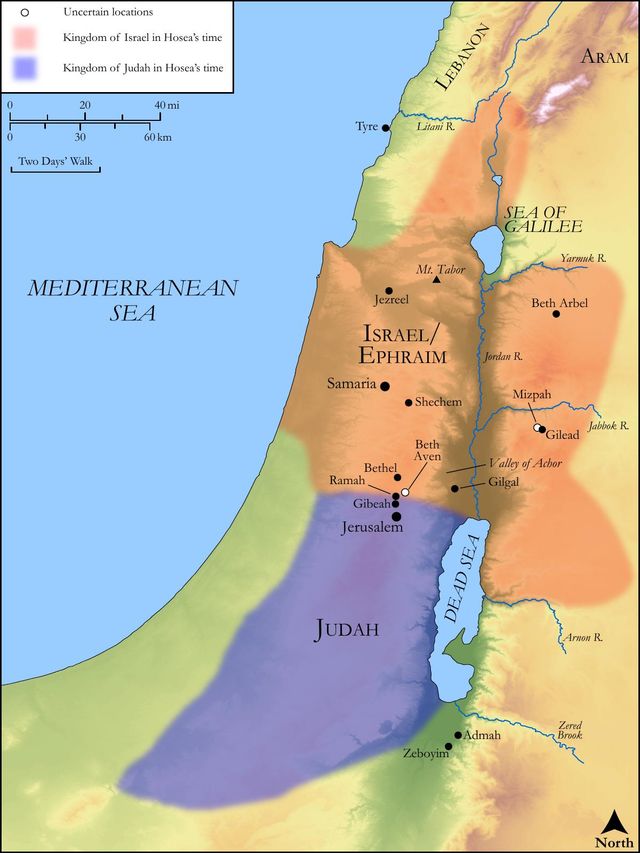
See on the biblical-era map
Study this verse
Public-domain commentary
Matthew Henry
From his Commentary on the Whole Bible. Henry comments on passages, not single verses — this entry covers Hosea 4:12–19. His three-level outline is real structure in the source text, so it is rendered as structure.
In these verses we have, as before,
I.The sins charged upon the people of Israel, for which God had a controversy with them, and they are,
1.Spiritual whoredom, or idolatry. They have in them a spirit of whoredoms, a strong inclination to that sin; the bent and bias of their hearts are that way; it is their own iniquity; they are carried out towards it with an unaccountable violence, and this causes them to err. Note, The errors and mistakes of the judgment are commonly owing to the corrupt affections; men therefore have a good opinion of sin, because they have a disposition towards it. And having such erroneous notions of idols, and such passionate motions towards them, no marvel that with such a head and such a heart they have gone a whoring from under their God, Hos 4:12. They ought to have been in subjection to him as their head and husband, to have been under his guidance and command, but they revolted from their allegiance, and put themselves under the guidance and protection of false gods. So (Hos 4:15) Israel has played the harlot; their conduct in the worship of their idols was like that of a harlot, wanton and impudent. And (Hos 4:16), Israel slideth back as a backsliding heifer, as an untamed heifer (so some), or as a perverse or refractory one (so others), as a heifer that is turned loose runs madly about the pasture, or, if put under the yoke (which seems rather to be alluded to here), will draw back instead of going forward, will struggle to get her neck out of the yoke and her feet out of the furrow. Thus unruly, ungovernable, untractable, were the people of Israel. They had begun to draw in the yoke of God's ordinances, but they drew back, as children of Belial, that will not endure the yoke; and when the prophets were sent with the goads of reproof, to put them forward, they kicked against the pricks, and ran backwards. The sum of all is (Hos 4:17), Ephraim is joined to idols, is perfectly wedded to them; his affections are glued to them, and his heart is upon them. There are two instances given of their spiritual whoredom, in both which they gave that honour to their idols which is due to God only: - (1.) They consulted them as oracles, and used those arts of divination which they had learned from their idolatrous priests (Hos 4:12): My people ask counsel at their stocks, their wooden gods; they apply to them for advice and direction in what they should do and for information concerning the event. They say to a stock, Thou art my father (Jer 2:27); and, if it were indeed a father, it were worthy of this honour; but it was a great affront to God, who was indeed their Father, and whose lively oracles they had among them, with which they had liberty to consult at any time, thus to ask counsel at their stocks. And they expect that their staff should declare to them what course they should take and what the event should be. It is probable that this refers to some wicked methods of divination used among the Gentiles, and which the Jews learned from them, by a piece of wood, or by a staff, like Nebuchadnezzar's divining by his arrows, Eze 21:21. Note, Those who forsake the oracles of God, to take their measures from the world and the flesh, do in effect but consult with their stocks and their staves. (2.) They offered sacrifice to them as gods, whose favour they wanted and whose wrath they dreaded and deprecated (Hos 4:13): They sacrifice to them, to atone and pacify them, and burn incense to them, to please and gratify them, and hope by both to recommend themselves to them. God had pitched upon the place where he would record his name; but they, having forsaken that, chose places for their irreligious rites which pleased their own fancies; they chose, [1.] High places, upon the tops of the mountains and upon the hills, foolishly imagining that the height of the ground gave them some advantage in their approaches towards heaven. [2.] Shady places, under oaks, and poplars, and elms, because the shadow thereof is pleasant to them, especially in those hot countries, and therefore they thought it was pleasing to their gods; or they fancied that a thick shade befriends contemplation, possesses the mind with something of awe, and therefore is proper for devotion.
2.Corporal whoredom is another crime here charged upon them: They have committed whoredom continually, Hos 4:18. They drove a trade of uncleanness; it was not a single act now and then, but their constant practice, as it is of many that have eyes full of adultery and which cannot cease from that sin, Pe2 2:14. Now the abominable filthiness and lewdness that was found in Israel is here spoken of,
(1.)As a concomitant of their idolatry; their false gods drew them to it; for the devil whom they worshipped, though a spirit, is an unclean spirit. Those that worshipped idols were separated with harlots, and they sacrificed with harlots; for because they liked not to retain God in their knowledge, but dishonoured him, therefore God gave them up to vile affections, by the indulging of which they dishonoured themselves, Rom 1:24, Rom 1:28.
(2.)As a punishment of it. The men that worshipped idols were separated with harlots that attended the idolatrous rites, as in the worship of Baal-peor, Num 25:1, Num 25:2. To punish them for that God gave up their wives and daughters to the like vile affections: They committed whoredom and adultery (Hos 4:13), which could not but be a great grief and reproach to their husbands and parents; for those that are not chaste themselves desire to have their wives and daughters so. But thus they might read their sin in their punishment, as David's adultery was punished in the debauching of his concubines by his own son, Sa2 12:11. Note, When the same sin in others is made men's grief and affliction which they have themselves been guilty of they must own that the Lord is righteous.
3.The perverting of justice, Hos 4:18. Their rulers (be it spoken to their shame) do love, Give ye, that is, they love bribes, and have it continually in their mouths, Give, give. They are given to filthy lucre; every one that has any business with them must expect to be asked, What will you give? Though, as rulers, they are bound by office to do justice, yet none can have justice done them without a fee; and you may be sure that for a fee they will do injustice. Note, The love of money is the ruin of equity and the root of all iniquity. But of all men it is a shame for rulers (who should be men fearing God and hating covetousness) to love Give ye. Perhaps this is intended in that part of the charge here, Their drink is sour; it is dead; it is gone. Justice, duly administered, is refreshing, like drink to the thirsty, but when it is perverted, and rulers take rewards either to acquit the guilty or to condemn the innocent, the drink is sour; they turn judgment into wormwood, Amo 5:7. Or it may refer in general to the depraved morals of the whole nation; they had lost all their life and spirit, and were as offensive to God as dead and sour drink is to us. See Deu 32:32, Deu 32:33.
II.The tokens of God's wrath against them for their sins.
1.Their wives and daughters should not be punished for the injury and disgrace they did to their families (Hos 4:14): I will not punish your daughters; and, not being punished for their sin, they would go on in it. Note, The impunity of one sinner is sometimes made the punishment of another. Or, "I will not punish them as I will punish you; for you must own, as Judah did concerning his daughter-in-law, that they are more righteous than you," Gen 38:26.
2.They themselves should prosper for a while, but their prosperity should help to destroy them. It comes in as a token of God's wrath (Hos 4:16): The Lord will feed them as a lamb in a large place; they shall have a fat pasture, and a large one, in which they shall be fed to the full, and fed of the best, but it shall be only to prepare them for the slaughter, as a lamb is that is so fed. If they wax fat and kick, they do but wax fat for the butcher. But others make them feed as a lamb on the common, a large place indeed, but where it has short grass and lies exposed. The Shepherd of Israel will turn them both out of his pastures and out of his protection.
3.No means should be used to bring them to repentance (Hos 4:17): "Ephraim is joined to idols, is in love with them and addicted to them, and therefore let him alone, as Hos 4:4, Let no man reprove him. Let him be given up to his own heart's lusts, and walk in his own counsel; we would have healed him, and he would not be healed, therefore forsake him," See what their end will be, Deu 32:20. Note, It is a sad and sore judgment for any man to be let alone in sin, for God to say concerning a sinner, "He is joined to his idols, the world and the flesh; he is incurably proud, covetous, or profane, an incurable drunkard or adulterer; let him alone; conscience, let him alone; minister, let him alone; providences, let him alone. Let nothing awaken him till the flames of hell do it." The father corrects not the rebellious son any more when he determines to disinherit him. "Those that are not disturbed in their sin will be destroyed for their sin." 4. They should be hurried away with a swift and shameful destruction (Hos 4:19): The wind has bound her up in her wings, to carry her away into captivity, suddenly, violently, and irresistibly; he shall take them away as with a whirlwind, Psa 58:9. And then they shall be ashamed because of their sacrifices, ashamed of their sin in offering sacrifice to idols, ashamed of their folly in putting themselves to such an expense upon gods that have no power to help them, and thereby making that God their enemy who has almighty power to destroy them. Note, There are sacrifices that men will one day be ashamed of. Those that have sacrificed their time, strength, honour, and all their comforts, to the world and the flesh, will shortly be ashamed of it. Yea, and those that bring to God blind, and lame, and heartless sacrifices, will be ashamed of them too.
III.The warning given to Judah not to sin after the similitude of Israel's transgression.
It is said in the close of Hos 4:14, Those that do not understand shall fall; those must needs fall that do not understand how to avoid, or get over, the stumbling-blocks they meet with (and therefore let him that thinks he stands take heed lest he fall), particularly the two tribes (Hos 4:15): Though thou, Israel, play the harlot, yet let not Judah offend. Though Israel be given to idolatry, yet let not Judah take the infection. Now,
1.This was a very needful caution. The men of Israel were brethren, and near neighbours, to the men of Judah; Israel was more numerous, and at this time in a prosperous condition, and therefore there was danger lest the men of Judah should learn their way and get a snare to their souls. Note, The nearer we are to the infection of sin the more need we have to stand upon our guard.
2.It was a very rational caution: "Let Israel play the harlot, yet let not Judah do so; for Judah has greater means of knowledge than Israel, has the temple and priesthood, and a king of the house of David; from Judah Shiloh is to come; and for Judah God has reserved great blessings in store; therefore let not Judah offend, for more is expected from them than from Israel, they will have more to answer for if they do offend, and from them God will take it more unkindly. If Israel play the harlot, let not Judah do so too, for then God will have no professing people in the world." God bespeaks Judah here, as Christ does the twelve, when many turned their backs upon him, Will you also go away? Joh 6:67. Note, Those that have hitherto kept their integrity should, for that reason, still hold it fast, even in times of general apostasy. Now, to preserve Judah from offending as Israel had done, two rules are here given: - (1.) That they might not be guilty of idolatry they must keep at a distance from the places of idolatry: Come not you unto Gilgal, where all their wickedness was (Hos 9:15; Hos 12:11); there they multiplied transgression (Amo 4:4); and perhaps they contracted a veneration for that place because there it was said to Joshua, The place where thou standest is holy ground (Jos 5:15); therefore they are forbidden to enter into Gilgal, Amo 5:5. And for the same reason they must not go up to Bethel, here called the house of vanity, for so Bethaven signifies, not the house of God, as Bethel signifies. Note, Those that would be kept from sin, and not fall into the devil's hands, must studiously avoid the occasions of sin and not come upon the devil's ground. (2.) That they might not be guilty of idolatry they must take heed of profaneness, and not swear, The Lord liveth. They are commanded to swear, The Lord liveth in truth and righteousness (Jer 4:2); and therefore that which is here forbidden is swearing so in untruth and unrighteousness, swearing rashly and lightly, or falsely and with deceit, or swearing by the Lord and the idol, Zep 1:5. Note, Those that would be steady in their adherence to God must possess themselves with an awe and reverence of God, and always speak of him with solemnity and seriousness; for those that can make a jest of the true God will make a god of any thing.
Historical interpretation
Historical reception
2 surviving comments on this verse. Each one is dated, so this reads as a timeline rather than a list.
Select a marker to jump to its quote. Markers stagger vertically where authors wrote within a few decades of each other.
But what is the source of this hardness? It comes from gluttony and drunkenness. Who says so? Moses himself. “Israel ate and was filled, and the darling grew fat and frisky.” When brute animals feed from a full manger, they grow plump and become more obstinate and hard to hold in check; they endure neither the yoke, the reins, nor the hand of the charioteer. Just so, the Jewish people were driven by their drunkenness and plumpness to ultimate evil. They kicked about and failed to accept the yoke of Christ. And they failed to pull the plow of his teaching. Another prophet hinted at this when he said, “Israel is as obstinate as a stubborn heifer.” And still another called the Jews “an untamed calf.”
"If you fornicate, Israel, let not at least Judah sin, and do not enter into Gilgal, and do not ascend into Bethaven, neither shall you swear, by the living Lord, for as an wanton heifer, Israel has sinned. Now the Lord will feed them as a lamb in a large place." LXX: "But you, Israel, do not ignore, and Judah, do not enter into Galgala, nor ascend into the house [ὢν] and do not swear, the Lord lives: for as a refuge-killed cow, Israel went insane. Now the Lord will feed them like a lamb in a spacious place." "For home" [ὢν] being read in some copies, and most particularly in Theodotion as "house of iniquity," which Aquila and Symmachus interpreted as ἀνωφελοῦς ["house of the profitless,"] that is, "useless" which is of no benefit, and is designated by another word "idol". But Bethel was formerly called the "House of God," but after the calves were placed in it, it was called "Bethaven," that is, "useless house" and "house of idols," which we have expressed as we read it in Hebrew. But it seems to me that both the people of Israel and Jeroboam the son of Nebat made a golden calf to be worshipped in the wilderness, and fashioned golden calves as they had learned in Egypt, where the bulls are worshipped as gods in their superstition. Let us discuss the meaning of the chapter: Sisemel, O Israel, you have been deceived by error and have mixed with prostitutes, so that whoever fulfills the act of offering and giving gifts to the king or himself, would become a priest of the high places. At least you, Judah, who possess Jerusalem and have Levites from the law and perform temple ceremonies, should not imitate the examples of your former sister Oolla in fornication and worship idols with her. Do not enter Galgala, about which we read in this same prophet: 'All their wickedness is in Galgala' (Hosea 9:15), where Saul was anointed king, where the people, coming out of the wilderness, camped for the first time, and were purified by a second circumcision. From that time on, in this notorious place, error of an opposing religion crept in. And do not go up to Bethaven, that is, what was once called Bethel, because after golden calves were placed there by Jeroboam son of Nabath, it is not called the House of God but the house of an idol. For which reason, I wonder why the Septuagint interpreted it as "unless I make a mistake, the middle Jod letter which is surrounded on both sides by Aleph and Nun letters was believed to be Vau based solely on its size." "You shall not make a false oath by my name," says the Lord. For I do not want my name to be mentioned on your lips, which is tainted by the memory of idols. For just as a cow that is wanton and throws off her yoke, so too Israel, that is, the ten tribes, turned away from the service of the Lord. For the wanton cow, the Seventy translated παροιστρῶσαν, which stung by desire and struck by the asylum, which they commonly call "tabanus". About which Virgil also reports in the third book of the Georgics.
...The name of the asylum is Roman: the Greeks called it "oestrum," a harsh and bitter name that drives all the herds to flee in terror from the woods. The sky roars and trembles with their cries, and the banks of the dry Tanagra shake. And so because Israel had become insane and, struck by the spirit of fornication, went mad with unbelievable fury, not much longer afterwards, but while the prophet's body was still possessed by the spirit, the Lord said: "I will feed them as a lamb in a spacious place." He kept the metaphor of a cow in heat, in the same way that he had used it before, calling the captivity in Assyria and the dispersion of Israel into the widest land of the Medes, the pasture of a wide field and of flocks of sheep and lambs. A predisposition is present against heretics, concerning whom or about whom it is said: If you fornicate once, heretic, at least, do not offend, church-goer, and do not enter into Galgala, the meetings of heretics, where the sins of everyone are exposed, and are rolled in the mud like pigs. Do not assume that you rise up to the proud and arrogant fictions of false teachings. For there is not the house of God, but the house of an idol. And do not swear by the name of Christ, whose majesty you have defiled by mingling it with idols. For just as a slaughtered cow falls in the asylum, so the heretics are struck by the burning arrows of the devil and abandon knowledge of the Law. Therefore, they will graze in the broad and spacious way that leads to death, and the patience of the Lord and the care of the good Shepherd will nourish them unto their own destruction.
Continue studying Hosea 4:16 across the web’s major study libraries — every link below opens this exact verse, chapter, or book on the destination site.
Read & Compare
 BibleGatewayThis verse in more than 200 translations and 70 languages.
 Bible.comThe YouVersion reader — hundreds of translations, reading plans, and highlights.
 ESV.orgCrossway's official English Standard Version reader.
 NET BibleThe NET translation with 60,000+ translators' notes on every rendering decision.
 STEP BibleTyndale House's free study tool — original text, vocabulary, and scholarly resources.
 BibliaLogos Bible Software's free web reader.
 USCCBThe New American Bible (Revised Edition) with the U.S. bishops' study notes.
Commentaries
 BibleHub CommentariesDozens of classic commentaries on this verse, gathered on one page.
 StudyLightMore than 100 commentary sets — the largest collection on the web.
 BibleRefPlain-English commentary on what this verse means, verse by verse.
 Enduring WordDavid Guzik's free commentary on this chapter, widely used by Bible teachers.
 Bible Study ToolsVerse commentary alongside Greek and Hebrew study aids.
Original Language & Research
- BibleHub InterlinearThe verse word by word — original language, transliteration, and English.
- BibleHub LexiconEvery word's original-language definition and Strong's entry.
 Blue Letter BibleDeep-study tools — Strong's numbers, concordance, and word studies.
 SefariaThe Hebrew text with Rashi and centuries of Jewish commentary.
Sermons, Hymns & Audio


TrulyRandomVerse is not affiliated with these sites and doesn’t control their content. They’re linked because they’re genuinely useful.
Summary
Hosea 4:16 delivers a poignant and stark prophetic indictment against Israel, likening their spiritual apostasy to a stubborn, backsliding heifer that resists the yoke of divine guidance. This vivid agricultural metaphor underscores their persistent rebellion against the Lord's covenant, leading to a severe, ironic judgment: God will "feed" them not with protective care, but by exposing them as vulnerable lambs in a vast, dangerous wilderness, signifying scattering, desolation, and the removal of His protective hand due to their unfaithfulness.
Context
ShowHideLiterary Context
Hosea 4:16 is situated within a profound prophetic indictment against the Northern Kingdom of Israel. Chapter 4 opens with God's "controversy" (or lawsuit) against the inhabitants of the land, accusing them of a pervasive lack of "truth, mercy, nor knowledge of God" (Hosea 4:1). The prophet explicitly condemns the priests for their failure to instruct the people in God's law, leading to a catastrophic spiritual ignorance where the people "are destroyed for lack of knowledge" (Hosea 4:6). This spiritual decay manifests in widespread idolatry, particularly the worship of Baal and Asherah, and rampant sexual immorality linked to pagan fertility cults. The preceding verses detail how the people's "harlotry" (spiritual unfaithfulness) has led them astray, consuming their understanding and leading them to sacrifice on high places and under trees (Hosea 4:12-14). Verse 16, therefore, serves as a climactic declaration of the inevitable divine consequence for such deep-seated and persistent rebellion.
Historical & Cultural Context
Hosea prophesied during the tumultuous final decades of the Northern Kingdom (Israel), roughly 750-715 BC, leading up to its fall to Assyria in 722 BC. This period was marked by political instability, assassinations of kings, and a desperate search for security through foreign alliances rather than reliance on God. Culturally, Israel had deeply assimilated the Canaanite fertility religions, particularly the worship of Baal and Asherah. These cults involved ritual prostitution and sacrifices, promising agricultural prosperity. The imagery of a "heifer" and "lamb" is deeply rooted in an agrarian society where livestock was central to life and economy. Farmers understood the behavior of animals, and a "backsliding heifer" would immediately convey a sense of stubbornness and unruliness, a creature resisting its intended purpose. The concept of "feeding" and "large place" also resonates with pastoral life, where a shepherd's care was paramount for the safety and provision of the flock.
Key Themes
ShowHideThe central theme in Hosea 4, and indeed throughout the book, is Israel's profound spiritual backsliding and covenant infidelity. They have abandoned their covenant relationship with Yahweh, exchanging the knowledge of God for pagan practices and moral decay. This leads directly to the theme of divine judgment and consequences, as God, in His justice, must respond to their persistent rebellion. The "feeding" of the lamb in a "large place" is a powerful expression of this judgment, signifying exposure, vulnerability, and scattering rather than protection. Another crucial theme is the lack of knowledge of God, which Hosea identifies as the root cause of Israel's destruction. This ignorance is not merely intellectual but a relational failure to acknowledge and obey God, leading to a breakdown of societal morality and a rejection of divine instruction (Hosea 4:6). The verse also subtly touches on the nature of God's justice, which, while severe, is always righteous and aimed at bringing His people to repentance, even through painful means.
Exposition and Analysis
ShowHideKey Word Analysis
ShowHideA primitive root meaning "to turn away, i.e. (morally) be refractory." It conveys stubbornness, rebellion, and a willful withdrawal from a proper path or relationship. In the context of Israel, it highlights their deliberate and persistent turning away from God's covenant and commands, rather than an accidental straying.
Meaning "a heifer; cow, kine." A young female cow, often used for plowing or breeding. An unyoked or backsliding heifer is notoriously difficult to control, resisting guidance and pulling backward against the yoke. This imagery powerfully depicts Israel's unruliness and refusal to submit to God's authority, much like an animal that refuses to be trained or work.
A primitive root meaning "to tend a flock; i.e. pasture it; intransitively, to graze (literally or figuratively); generally to rule." While often meaning to shepherd or provide for, in this context, it carries a strong ironic or punitive sense. God will "feed" them, but not with benevolent care. Instead, it implies allowing them to wander unprotected, to "graze" in a desolate place, or even to be devoured, thus experiencing the consequences of their own choices.
Verse Breakdown
ShowHide"For Israel slideth back as a backsliding heifer:"
This clause establishes the central metaphor for Israel's spiritual condition. "Israel" (H3478, Yisrâʼêl), the covenant people of God, is depicted as having "slideth back" (H5637, çârar), indicating a persistent and willful turning away from God. The comparison to a "backsliding heifer" (H6510, pârâh) emphasizes their stubborn, rebellious nature. Like a young cow that resists the farmer's yoke and pulls backward, Israel has resisted God's guidance, refusing to walk in His ways and instead pursuing their own idolatrous paths. This imagery highlights their unruliness, their rejection of divine authority, and their self-destructive independence.
"now the LORD will feed them as a lamb in a large place."
This second clause declares the divine consequence of Israel's rebellion, introduced by "now the LORD" (H3068, Yᵉhôvâh), emphasizing God's sovereign response. The phrase "will feed them" (H7462, râʻâh) is deeply ironic. While "to feed" typically implies provision and protection, here it means the opposite. To "feed them as a lamb" (H3532, kebes) suggests vulnerability and exposure. A lamb, especially one without a shepherd, is utterly defenseless. The "large place" (H4800, merchâb) further amplifies this sense of exposure. While "large place" can denote freedom or spaciousness, for a vulnerable lamb, it signifies a vast, open, and dangerous wilderness, devoid of protection, where predators roam freely. Thus, God's "feeding" is not benevolent pasturing but rather abandoning Israel to the harsh realities and dangers of their self-chosen rebellion, leading to scattering, desolation, and vulnerability to their enemies.
Literary Devices
ShowHideHosea 4:16 employs several powerful literary devices to convey its message. The most prominent is Simile, directly comparing Israel's spiritual state to a "backsliding heifer." This comparison is highly effective because it draws on common agricultural experience, immediately evoking images of stubbornness, resistance to authority, and unruliness. The heifer, meant to be yoked and productive, instead pulls back, illustrating Israel's refusal to be guided by God. Secondly, the verse uses profound Irony in the phrase "now the LORD will feed them as a lamb in a large place." The word "feed" (râʻâh) typically implies benevolent shepherding and provision, but here it is inverted to signify abandonment and exposure to danger. Similarly, a "large place" (merchâb), usually associated with freedom and security, becomes a metaphor for vulnerability and desolation for an unprotected lamb. This ironic reversal underscores the severity of God's judgment, turning what might seem like a promise of care into a pronouncement of punitive scattering. Finally, the entire verse functions as a Metaphor for Israel's relationship with God, using animal husbandry to describe their spiritual rebellion and its consequences. The imagery of the stubborn heifer and the exposed lamb powerfully encapsulates the trajectory of their unfaithfulness and the resulting divine abandonment.
Theological and Thematic Connections
ShowHideHosea 4:16 powerfully illustrates the immutable principle that persistent spiritual rebellion and a willful rejection of God's truth inevitably lead to severe consequences. Israel's "backsliding" was not a momentary lapse but a deep-seated refusal to acknowledge and obey the Lord, culminating in a divine judgment that mirrored their unfaithfulness. God, as the ultimate Shepherd, withdraws His protective care when His flock stubbornly refuses His guidance, leaving them vulnerable to the "predators" of their own choices and the harsh realities of a world without His covering. This verse serves as a stark reminder of the gravity of covenant infidelity and the active nature of divine justice, which, while painful, ultimately seeks to bring about repentance and a return to the true Shepherd.
Reflection and Application
ShowHideHosea 4:16 offers a timeless and sobering warning for believers today, underscoring the profound dangers of spiritual complacency and willful disobedience. Just as ancient Israel, despite being God's chosen people, faced devastating consequences for their persistent "backsliding," so too can individuals and communities experience spiritual desolation when they resist God's guidance and neglect His truth. This verse challenges us to honestly examine our hearts: Are we truly submitted to the "yoke" of Christ, allowing Him to lead us, or are we, like the "backsliding heifer," stubbornly pulling away from His commands and convictions? Our spiritual vitality depends on a diligent pursuit of the knowledge of God, not merely intellectual assent, but a deep, relational understanding that transforms our lives. When we neglect His Word and Spirit, we risk becoming like "lambs in a large place"—vulnerable, exposed, and susceptible to the spiritual dangers that surround us, stripped of the protective care of our Shepherd. Understanding God's discipline, as painful as it may be, is crucial; it is often His loving, albeit firm, means of calling us back to Himself, preventing utter destruction.
Questions for Reflection
ShowHideFAQ
ShowHideDoes "the LORD will feed them as a lamb in a large place" signify a blessing or a curse?
ShowHideIn the context of Hosea 4:16, the phrase "the LORD will feed them as a lamb in a large place" is unequivocally a pronouncement of judgment and a curse, not a blessing. While the word "feed" (Hebrew: râʻâh) can mean to shepherd or provide for, its usage here is deeply ironic. For a vulnerable "lamb" (Hebrew: kebes) to be in a "large place" (Hebrew: merchâb) without the protective care of a shepherd, it signifies exposure, desolation, and vulnerability to predators and harsh conditions. Instead of being safely pastured and protected by God, Israel, due to their stubborn "backsliding," is being abandoned to the consequences of their own rebellion. This "feeding" means being left to wander unprotected, scattered, and defenseless, facing the full brunt of divine judgment and the dangers of a world without God's covering. It is a stark contrast to the benevolent shepherding promised in passages like Psalm 23:1-2 and highlights the severity of God's response to their persistent unfaithfulness.
Christ-Centered Fulfillment
ShowHideHosea 4:16, with its stark imagery of a backsliding people facing judgment, finds its ultimate fulfillment and resolution in the person and work of Jesus Christ. Israel's failure as a "backsliding heifer" underscores humanity's universal propensity to rebel against God's loving authority, leading to spiritual exposure and vulnerability. Yet, in Christ, we see the perfect Lamb of God, who, unlike the vulnerable lamb in a "large place" of judgment, willingly offered Himself as the ultimate sacrifice to atone for humanity's sin and rebellion (John 1:29). Through His perfect obedience and atoning death, Jesus provides the true "feeding" and protection that Israel forfeited. He is the Good Shepherd who lays down His life for His sheep, gathering them into His fold and leading them to green pastures and still waters (John 10:11; Psalm 23:1-2). Under the New Covenant, those who trust in Christ are no longer left as exposed lambs in a dangerous wilderness but are securely held in the Father's hand, assured of His constant presence and unfailing care (John 10:28-29). Thus, Christ reverses the judgment of Hosea 4:16, transforming vulnerability into security, and rebellion into reconciliation, offering true spiritual nourishment and protection to all who come to Him.