


Hosea 10:12
- זִרְעוּzir·'UsowH2232V-Qal-Imp-2mpVerb Qal Imperative 2nd Plural Masculine
- לָכֶםla·Khem<for> yourselvesPrep-l ¦ 2mpSuffix Personal 2nd Plural Masculineלָ<for>כֶםyourselves
- לִצְדָקָהlitz·da·Kah<to> righteousnessH6666Prep-l ¦ N-fsNoun Singular Feminine Absoluteלִ<to>צְדָקָהrighteousness
- קִצְרוּkitz·RureapH7114V-Qal-Imp-2mpVerb Qal Imperative 2nd Plural Masculine
- לְפִיle·fi<to> a mouth ofH6310Prep-l ¦ N-mscNoun Singular Masculine Constructלְ<to>פִיa mouth of
- חֶסֶדChe·sedloyaltyH2617N-msNoun Singular Masculine Absolute
- נִירוּNi·ruplowH5214V-Qal-Imp-2mpVerb Qal Imperative 2nd Plural Masculine
- לָכֶםla·Khem<for> yourselvesPrep-l ¦ 2mpSuffix Personal 2nd Plural Masculineלָ<for>כֶםyourselves
- נִירNirunplowed groundH5215N-msNoun Singular Masculine Absolute
- וְעֵתve·'Etand [it is] timeH6256Conj-w ¦ N-csNoun Singular common gender Absoluteוְandעֵת[it is] time
- לִדְרוֹשׁlid·Ro·oshto seekH1875Prep-l ¦ V-Qal-InfVerb Qal Infinitive Constructלִtoדְרוֹשׁseek
- אֶת'et<obj.>H853DirObjMParticle Object Indicator
- יְהוָהYah·wehYahwehH3068N-properNoun Proper Title
- עַד'aduntilH5704PrepPreposition
- יָבוֹאya·Vo'he will comeH935V-Qal-Imperf-3msVerb Qal Imperfect 3rd Singular Masculine
- וְיֹרֶהve·yo·Rehand he may rain downH3384Conj-w ¦ V-Hiphil-ConjImperf-3msVerb Hiphil Conjunction+Imperfect 3rd Singular Masculineוְandיֹרֶהhe may rain down
- צֶדֶקTze·dekrighteousnessH6664N-msNoun Singular Masculine Absolute
- לָכֶםla·Khemfor youPrep-l ¦ 2mpSuffix Personal 2nd Plural Masculineלָforכֶםyou
English is a literal word-by-word gloss of the Hebrew, not the KJV's wording. Why?
This is the original text the KJV's translators worked from — each Hebrew word with its own literal English meaning in this verse, prepared by scholars at Tyndale House, Cambridge. The KJV translates whole sentences, not word by word, so its wording differs: one Hebrew word can become several English words, and the KJV may choose “the LORD” where the gloss reads “Yahweh”. Both are faithful — they answer different questions. For the KJV's own rendering, switch to the KJV text.
Details
See on the biblical-era map
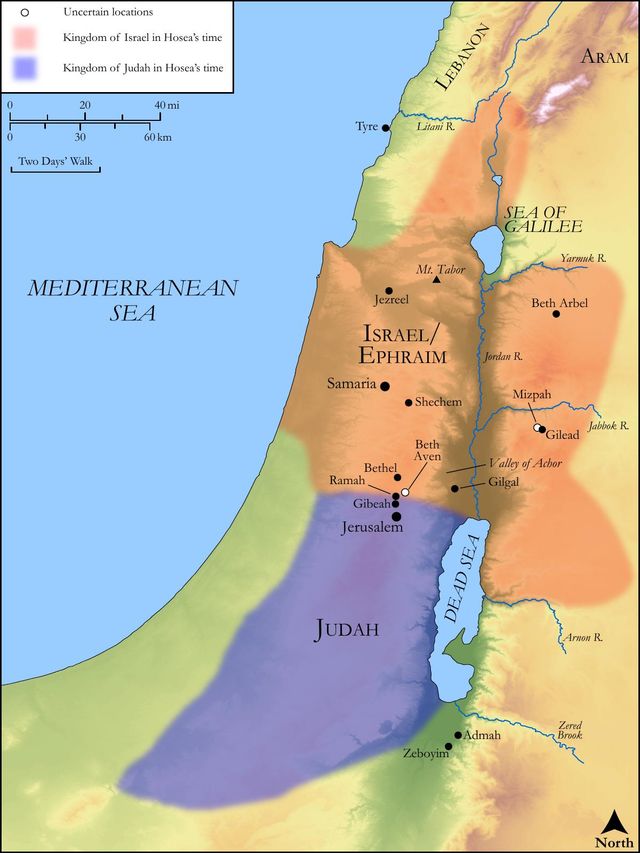
Study this verse
Public-domain commentary
Matthew Henry
From his Commentary on the Whole Bible. Henry comments on passages, not single verses — this entry covers Hosea 10:9–15. His three-level outline is real structure in the source text, so it is rendered as structure.
Here, I. They are put in mind of the sins of their fathers and predecessors, for which God would now reckon with them. It was told them (Hos 9:9) that they had corrupted themselves, as in the days of Gibeah, and here (Hos 10:9), O Israel! thou hast sinned from the days of Gibeah. Not only the wickedness that was committed in that age is revived in this, and reacted, a copy from that original, but the wickedness that was committed in that age has been continued in a constant series and succession through all the intervening ages down to this; so that the measure of iniquity had been long in filling; and still there had been made additions to it. Or, "Thou has sinned more than in the days of Gibeah" (so it may be read); "the sins of this age exceed those of the worst of former ages. The case was bad then, for there they stood; the criminals stood in their own defence, and the tribes of Israel, who undertook to chastise them for their wickedness, were at a stand, when both in the first and in the second battle the malefactors were the victors; and the battle in Gibeah against the children of iniquity did not overtake them till the third engagement, and then did not overtake them all, for 600 made their escape. But thy sin is worse than theirs, and therefore thou canst not expect but that the battle against the children of iniquity should overtake thee, and overcome thee."
II.They have warning given them, fair warning, of the judgments of God that were coming upon them, Hos 10:10.
God had hitherto pitied and spared them. Though they had been very provoking, he had a mind to try whether they would be wrought upon by patience and forbearance; but now, "It is in my desire that I should chastise them; it is what I have a purpose of and will take pleasure in." He will rejoice over them to do them hurt, Deu 28:63. Note, Because God does not desire the death and ruin of sinners, therefore he does desire their chastisement. And see what the chastisement it: The people shall be gathered against them, as all the other tribes were against Benjamin in the battle of Gibeah. One of the rabbin thus descants upon it: "Because they receive not chastisement from me by my prophets, who in my name rebuke them, I will chastise them by the hands of the people who shall be gathered against them, when they shall bind themselves in their two furrows," that is, when they shall think to fortify themselves, as it were, within a double entrenchment. or, When I shall bind them for their two transgressions (so the margin reads it), meaning their corporal and spiritual whoredom, which they are so often charged with, or the two calves at Dan and Bethel, or those two great evils mentioned Jer 2:13. Or, When I shall bind them to their two furrows, that is, bring them into servitude to the Assyrians, who shall keep them under the yoke as oxen in the plough, who are bound to the two furrows up the field and down it, and dare not, for fear of the goad, stir a step out of them. The Chaldee says, Those that are gathered against them shall exercise dominion over them, in like manner as a pair of heifers are tied to their two furrows. Thus those that would not be God's freemen shall be their enemies' slaves, and shall be made to know the difference between God's service and the service of the kingdoms of the countries, Ch2 12:8.
III.They are made to know that their unacquaintedness with sufferings and hardships should not excuse them from a very miserable captivity, Hos 10:11. See how nice, and tender, and delicate, Ephraim is; he is as a heifer that is taught to tread out the corn, and loves that work, because, being not allowed to be muzzled, she has liberty to eat at pleasure, and the work itself was dry and easy, and both its own diversion and its own wages. "But," says God, "I have a yoke to put upon her fair neck, fair as it is. I will make Ephraim to ride, that is, I will tame them, or cause them to be ridden by the Assyrians and other conquerors that shall rule them with rigour, as men do the beasts they ride upon (Psa 66:12); and Judah too shall be made to plough, and Jacob to break the clods," that is, they shall be used hardly, but not so hardly as Ephraim. Note, It is just with God to make those know what hardships mean that indulge themselves too much in their own ease and pleasure. The learned Dr. Pocock inclines to another sense of these words, as intimating the tender gentle methods God took with this people, to bring them into obedience to his law, as a reason why they should return to that obedience; he had managed them as the husbandman does his cattle that he trains up for service. Ephraim being as a docile heifer, fit to be employed, God took hold of her fair neck, to accustom her to the hand, harnessed her, or put the yoke of his commandments upon her, gave his people Israel a law, that, being trained up in his institutions, they might not be tempted by the usages of the heathen; he had used all fair and likely means with them to keep them in their obedience, had set Judah to plough and Jacob to break the clods, had employed them in the observance of precepts proper for them; and yet they would not be retained in their obedience, but started aside.
IV.They are invited and encouraged to return to God by prayer, repentance, and reformation, Hos 10:12, Hos 10:13. See here,
1.The duties they are called to. They are God's husbandry (Co1 3:9), and the duties are expressed in language borrowed from the husbandman's calling. If they would not be brought into bondage by their oppressors, let them return to God's service.
(1.)Let them break up the fallow ground; let them cleanse their hearts from all corrupt affections and lusts, which are as weeds and thorns, and let them be humbled for their sins, and be of a broken and contrite spirit in the sense of them; let them be full of sorrow and shame at the remembrance of them, and prepare to receive the divine precepts, as the ground that is ploughed is to receive the seed, that it may take root. See Jer 4:3.
(2.)Let them sow to themselves in righteousness; let them return to the practice of good works, according to the law of God, which is the rule of righteousness; let them abound in works of piety towards God, and of justice and charity towards one another, and herein let them sow to the Spirit, as the apostle speaks, Gal 6:7, Gal 6:8. Every action is seed sown. Let them sow in righteousness; let them sow what they should sow, do what they should do, and they themselves shall have the benefit of it.
(3.)Let them seek the Lord; let them look up to him for his grace, and beg of him to bless the seed sown. The husbandman must plough and sow with an eye to God, asking of him rain in the season thereof.
2.The arguments used for the pressing of these duties. Consider,
(1.)It is time to do it; it is high time. The husbandman sows in seed-time, and, if that time be far spent, he applies to the work with the more diligence. Note, Seeking the Lord is to be every day's work, but there are some special occasions given by the providence and grace of God when it is, in a particular manner, time to seek him.
(2.)If we do our part, God will do his. If we sow to ourselves in righteousness - if we be careful and diligent to do our duty, in a dependence upon his grace - he will shower down his grace upon us, will rain righteousness, the very thing that those need most who are to sow in righteousness; for by the grace of God we are what we are. Some apply it to Christ, who should come in the fulness of time, and for whose coming they must prepare themselves; he shall come as the Lord our righteousness, and shall rain righteousness upon us, that everlasting righteousness which he has brought in; he will grant us of it abundantly. It is foretold (Psa 72:6) that he shall come down like rain.
(3.)If we sow in righteousness, we shall reap in mercy, which agrees with that promise, If we sow to the Spirit, we shall of the Spirit reap life everlasting. We shall reap according to the measure of mercy (so the word is); it shall be a great reward, according to the riches of mercy, such a reward, not as becomes such mean creatures as we are to receive, but as becomes a God of infinite mercy to give, a reward, not of debt, but of grace. We reap not in merit, but in mercy. It is what is sown; God gives a body as it has pleased him.
(4.)We have ploughed wickedness and reaped iniquity; and the time past of our life may suffice that we have done so, Hos 10:13. "You have taken a great deal of pains in the service of sin, have laboured at it in the very fire; and will you grudge to bear the burden and heat of the day in God's service and in doing that which will be for your own advantage? You have done much to damn your souls; will you not undo it again, and do something to save them?" (5.) We never got any thing in the service of sin. They have ploughed wickedness (that is, they have done the drudgery of sin), and they have reaped iniquity, that is, they have got all that is to be got by it; they have carried it on to the harvest, and what the better? It is all a cheat. They have eaten the fruit of lies, fruit that is but a lie, which looks fair, but is rotten within; the works of darkness are unfruitful works, Eph 5:11; Rom 6:21. Even the gains of sin yield the sinner no satisfaction. (6.) As our comforts, so our confidences, in the service of sin will certainly fail us: "Thou didst trust in thy ways, in the multitude of thy mighty men; thou has stayed thyself upon creatures, thy own power and policy, and therefore hast ventured to plough wickedness, and thy hopes have deceived thee; come therefore, and seek the Lord, and thy hope in him shall not deceive thee."
V.They are threatened with utter destruction, both for their carnal practices and for their carnal confidences, Hos 10:14, Hos 10:15.
Therefore, because thou has sown wickedness, and trusted in thy own way, a tumult shall arise among thy people, either by insurrections at home or invasions from abroad, either of which will put a kingdom into confusion and make a noise, much more both together.
1.Their cities and strongholds shall be a prey to the enemy: The fortresses which they confided in, and in which they had laid up their effects, shall be seized and rifled, as Shalman spoiled Beth-arbel in the day of battle. This refers to some event that had lately happened, not elsewhere recorded; and probably Shalman is the same with Shalmaneser king of Assyria, who had lately put some town, or castle, or house (Beth-arbel is the house of Arbel), under military execution, which perhaps he used with severity in the beginning of his conquests, to terrify other garrisons into a speedy surrender at the first summons. God tells them that thus Samaria should be spoiled.
2.The inhabitants shall be put to the sword, as it was at Beth-arbel; when it was taken the mother was dashed in pieces upon her children, that is, they were both dashed in pieces together by the fury of the soldiers. See what cruel work war makes. Jusque datum sceleri - Wickedness has free course. It is strange that any of the human race could be so inhuman; but see what comes of sin. Homo homini lupus - Man is a wolf to man, and then, Homo homini agnus - Man is a lamb to man.
3.Even royal blood shall be mingled with common gore: In a morning shall the king of Israel utterly be cut off, Hos 10:15. Hoshea was the last king of Israel; in him the whole kingdom was cut off and came to a period; it may refer either to him or to some of his predecessors that were cut off by treachery. It shall be done in a morning, in a very little time, as suddenly as the dawning of the morning, or at the time appointed, for so the morning comes, punctually at its time. Or in the morning, when they think the night of calamity is over, and expect a returning day, then shall all their hopes be dashed by the sudden cutting off of their king, Hos 10:7. Kings, though gods to us, are men to God, and shall die like men. And (lastly) what does all this desolation owe its rise to? What is the spring of this bloodshed? He tells us (Hos 10:15): So shall Bethel do unto you. Bethel was the place where one of the calves was; Gilgal, where all their wickedness is said to have been, was hard by; there was their great wickedness, the evil of their evil (so the word is), the sum and quintessence of their sin; and that was it that did this to them, that made all this havoc, for that was it that provoked God to bring it upon them. He does not say, "So shall the king of Assyria do to you;" but, "So shall Bethel do to you." Note, Whatever mischief is done to us it is sin that does it. Are the fortresses spoiled? Are the women and children murdered? Is the king cut off? It is sin that does all this. It is sin that ruins soul, body, estate, all. So shall Bethel do unto you. It is thy own wickedness that corrects thee and thy backslidings that reprove thee.
Historical interpretation
Two Centuries of Reception
5 surviving comments on this verse. Each one is dated, so this reads as a timeline rather than a list.
Select a marker to jump to its quote. Markers stagger vertically where authors wrote within a few decades of each other.
Observe how holy and how marvelous is the sequence of things. Do not imagine that wisdom will come before its enactment in deeds. The deeds ought to come first, and wisdom sought afterwards.… We ought not teach others before we ourselves are instructed and rational. After these things, however, “truth” is added because “truth” is the highest wisdom. The prophet also preserves this same order when he says, “Sow for yourselves righteousness and reap the fruit of life; illuminate yourselves with the light of knowledge.” See how he does not first say, “Illuminate yourselves with the light of knowledge,” but first, “Sow for yourselves righteousness.” It is not sufficient just to sow, but he says, “reap the fruit of life” so that after these you can fulfill what follows, “illuminate yourselves with the light of knowledge.”
So that we may know clearly what is meant by not having a share in the works which do not bear fruit, let us first inquire as to what sort of actions merit the attribute unfruitful—whether those only that are forbidden or such also are commendable but are not performed in good dispositions. In the Old Testament, the prophet, comparing the saints with the tree, says, “which shall bring forth its fruit in due season.” Solomon declares, “The work of the just is unto life, but the fruit of the wicked is sin”; and Hosea, “Sow for yourselves in justice, reap the fruit of life.”
Be careful, therefore, O bishop, to study the Word, that you may be able to explain everything exactly and that you may copiously nourish your people with much doctrine and enlighten them with the light of the law. For God says, “Enlighten yourselves with the light of knowledge, while we have yet opportunity.”
"Sow for yourselves according to righteousness, reap according to the merciful act. Cultivate for yourselves a new crop, but require the time of seeking the Lord when He comes to teach you righteousness. Sow for yourselves according to righteousness, reap the fruit of life. Illuminate yourselves with the light of knowledge, for it is time to seek the Lord until the fruits of righteousness come to you." The translation once begun by the farmers is preserved. Ephraim said that he loved the trained heifer for threshing and had gone up to the mountains to plow Judah and break up Jacob's clods or furrows. Now he advises that they plant for themselves through repentance, and sow in justice, that is, in the Law, and they reap in mercy, that is, in the grace of the Gospel. For there we read, "An eye for an eye, and a tooth for a tooth" (Exod. XXI); but here we read, "But I say to you not to resist evil: but if one strike you on thy right cheek, turn to him also the other" (Matt. V, 39). And when you have sown in justice, and reaped in mercy, then renew for yourself joyful gardens. And give reasons for why they sow, why they reap, and why they renew the joyful gardens. "Time," said Christ, our savior, "to seek the Lord, when he comes, who will teach you righteousness," which you now hope for in the law: "For the end of the law is Christ, to righteousness to everyone who does good" (Rom. X). For what we have said, "measure in the mouth of mercy," the Seventy translated, "reap the fruit of life:" and the Messiah is more fitting for the seed, than the vintage: but the fruit of life itself is the tree of life. And because we have put forth "innovate vobis novale," they have turned it into "illuminate vobis lumen scientiae," so that we may deserve to have knowledge of the Law from its works and commands, according to what we read in a certain book: "You have desired wisdom: keep the commandments, and the Lord will give it to you" (Ecclus. 1:33). For he who turns commandments into works, sows in justice, and will reap from it the fruits of life. Hence, we read elsewhere: "The commandment of the Lord is a shining light, enlightening the eyes" (Ps. 18:9). And Isaiah said to the Lord: "Your command is a lamp upon my feet." And in another place: "From your precepts I gained understanding" (Psal. 119). Those also, who have separated themselves from the Church, and have falsely taken on the name of Christians, are commanded to repent and receive both the Old and New Testaments: in the Old they sow justice, in the New they reap mercy: and let them illuminate themselves with the light of knowledge, or renew themselves by seeking the Lord, who can teach them true justice, and destroy false teachers from whom they do not learn justice, but iniquity.
Therefore, if you are concerned to attain to the light of spiritual knowledge not by the vice of empty boastfulness but by the grace of correction, you are first inflamed with desire for that blessedness about which it is said, “Blessed are the pure of heart, for they shall see God.” [Thus] you may also attain to that about which the angel said to Daniel: “Those who are learned shall shine like the splendor of the firmament, and those who instruct many in righteousness like the stars forever.” And in another prophet: “Enlighten yourselves with the light of knowledge while there is time.”
Continue studying Hosea 10:12 across the web’s major study libraries — every link below opens this exact verse, chapter, or book on the destination site.
Read & Compare
 BibleGatewayThis verse in more than 200 translations and 70 languages.
 Bible.comThe YouVersion reader — hundreds of translations, reading plans, and highlights.
 ESV.orgCrossway's official English Standard Version reader.
 NET BibleThe NET translation with 60,000+ translators' notes on every rendering decision.
 STEP BibleTyndale House's free study tool — original text, vocabulary, and scholarly resources.
 BibliaLogos Bible Software's free web reader.
 USCCBThe New American Bible (Revised Edition) with the U.S. bishops' study notes.
Commentaries
 BibleHub CommentariesDozens of classic commentaries on this verse, gathered on one page.
 StudyLightMore than 100 commentary sets — the largest collection on the web.
 BibleRefPlain-English commentary on what this verse means, verse by verse.
 Enduring WordDavid Guzik's free commentary on this chapter, widely used by Bible teachers.
 Bible Study ToolsVerse commentary alongside Greek and Hebrew study aids.
Original Language & Research
- BibleHub InterlinearThe verse word by word — original language, transliteration, and English.
- BibleHub LexiconEvery word's original-language definition and Strong's entry.
 Blue Letter BibleDeep-study tools — Strong's numbers, concordance, and word studies.
 SefariaThe Hebrew text with Rashi and centuries of Jewish commentary.
Sermons, Hymns & Audio


TrulyRandomVerse is not affiliated with these sites and doesn’t control their content. They’re linked because they’re genuinely useful.
Summary
Hosea 10:12 is a profound prophetic exhortation to the Northern Kingdom of Israel, urging them to embrace spiritual renewal through genuine repentance. Using rich agricultural metaphors, the verse calls the people to "sow in righteousness" and "break up their fallow ground," signifying a radical turning from idolatry and unfaithfulness. This urgent call to "seek the LORD" is presented as a timely opportunity, promising that God, in His mercy, will respond by "raining righteousness" upon them, leading to spiritual flourishing and restoration.
Context
ShowHideLiterary Context
Hosea 10:12 is situated within a section of Hosea's prophecy (chapters 9-11) that delivers stern warnings and pronouncements of judgment against Israel (Ephraim) for their persistent idolatry, political instability, and covenant unfaithfulness. Chapters 9 and 10 detail the consequences of their sin, including barrenness, exile, and the destruction of their altars and high places. Amidst this backdrop of impending doom, verse 12 emerges as a poignant and compassionate appeal for repentance, offering a final window of opportunity for the nation to avert complete disaster. It serves as a stark contrast to the preceding verses which describe Israel's fruitless efforts and reliance on human strength (e.g., Hosea 10:1), pointing instead to the true source of blessing and restoration.
Historical & Cultural Context
The Book of Hosea addresses the Northern Kingdom of Israel during the tumultuous 8th century BCE, specifically before its fall to Assyria in 722 BCE. This period was marked by political assassinations, shifting alliances (often with Assyria or Egypt instead of relying on God), and rampant syncretism where the worship of Yahweh was mixed with Baal worship. Agriculture was the bedrock of Israelite society, making the metaphors of sowing, reaping, and fallow ground immediately comprehensible and deeply resonant. The concept of rain was vital for survival in their semi-arid climate, making "rain righteousness" a powerful image of divine blessing and life-giving provision. The "time to seek the LORD" reflects the urgent spiritual crisis facing a nation on the brink of judgment due to its covenant violations.
Key Themes
ShowHideThis verse powerfully encapsulates several overarching themes found throughout Hosea and the broader prophetic tradition. It highlights Covenant Unfaithfulness by contrasting Israel's rebellious actions with God's steadfast love (Hebrew: hesed). The call to "sow in righteousness" and "break up your fallow ground" speaks directly to the theme of Repentance and Spiritual Renewal, emphasizing the necessity of internal transformation and a return to covenant obedience. The promise that God will "rain righteousness upon you" underscores the theme of Divine Grace and Restoration, demonstrating God's willingness to bless and renew His people when they turn to Him. This divine initiative is a reflection of God's enduring Steadfast Love (Hesed), which is a foundational concept in Hosea, even amidst judgment, as seen in passages like Hosea 11:8. The agricultural imagery also ties into the theme of Divine Sovereignty over Creation and Blessing, where God controls the rain and the harvest, just as He controls spiritual flourishing.
Exposition and Analysis
ShowHideKey Word Analysis
ShowHideThis primitive root means to sow, figuratively to disseminate, plant, or fructify. In this context, it refers to the intentional act of planting seeds, which Hosea applies metaphorically to the actions and choices of the people. To "sow in righteousness" means to engage in acts of justice, integrity, and faithfulness that align with God's character and commands, expecting a corresponding spiritual harvest.
This noun refers to freshly plowed land or ground that has been left uncultivated. It implies soil that is hard, compacted, and overgrown with weeds, requiring significant effort to prepare it for planting. Spiritually, it represents a heart that has become hardened by sin, neglect, or indifference, making it unreceptive to God's truth and grace. The command to "break up your fallow ground" (from the root nîyr H5214, meaning to till the soil) is a call for deep, transformative repentance.
A primitive root meaning to tread or frequent, to follow (for pursuit or search), and by implication, to seek or ask, specifically to worship. This word denotes an active, diligent, and earnest pursuit of God, implying a turning away from other allegiances and a wholehearted devotion to the LORD. It's not a passive waiting but an intentional engagement with God, seeking His presence, will, and guidance.
This primitive root means to flow as water (i.e., to rain), or transitively, to lay or throw (especially an arrow). Figuratively, it means to point out or teach. In this verse, it refers to God's act of pouring out His blessings, specifically "righteousness." This imagery connects divine provision (rain for crops) with spiritual outpouring, signifying God's active role in bringing about spiritual flourishing and establishing right relationship.
Verse Breakdown
ShowHide"Sow to yourselves in righteousness, reap in mercy"
This opening clause presents a foundational biblical principle: actions have consequences, but God's grace transcends strict merit. "Sowing in righteousness" means living a life characterized by justice, integrity, and obedience to God's covenant commands. It implies intentional acts of spiritual cultivation. The promised "reaping in mercy" (or "according to mercy," H6310 peh "in") indicates that the harvest will not be merely what is deserved by their righteous deeds, but an abundant outpouring of God's compassion and favor, exceeding human merit. It highlights God's gracious nature in responding to genuine repentance.
"break up your fallow ground"
This is a direct, urgent command using a vivid agricultural metaphor. "Fallow ground" refers to unplowed, hardened, and unproductive soil. Spiritually, it represents a heart that has become hardened by sin, neglect, or resistance to God's word. To "break up" this ground means to engage in deep, transformative repentance—to remove the spiritual obstacles, confess sins, and cultivate a soft, receptive heart ready to receive God's truth and allow it to bear fruit. It signifies a radical internal change.
"for [it is] time to seek the LORD"
This phrase provides the compelling reason and urgency for the preceding commands. The present moment is identified as a critical, opportune "time" (ʻêth) for the people to earnestly pursue a relationship with Yahweh. "Seeking the LORD" implies turning away from idols and self-reliance, actively pursuing His presence, guidance, and will through prayer, obedience, and wholehearted devotion. It is an invitation to re-establish a right relationship with their covenant God.
"till he come and rain righteousness upon you"
This final clause expresses the divine promise and the ultimate goal of their repentance. "Till he come" indicates God's responsive action. The imagery of "raining righteousness" signifies God's gracious outpouring of spiritual blessings, renewal, and His very own rectitude upon His repentant people. Just as physical rain brings life and growth to the land, God's "rain of righteousness" brings spiritual flourishing, restoration of right relationship, and the enablement to live righteously. It is God's gift, completing the process initiated by human repentance.
Literary Devices
ShowHideHosea 10:12 is rich in Metaphor, primarily drawing from the agricultural world familiar to its original audience. The act of "sowing in righteousness" and "reaping in mercy" is a central metaphor for the spiritual principle of cause and effect, where righteous actions are expected to yield divine blessing, though tempered by God's Mercy. The command to "break up your fallow ground" is a powerful metaphorical call for Repentance, urging the people to prepare their hardened hearts to receive God's word, much like a farmer prepares the soil for seed. The image of God coming to "rain righteousness upon you" is another vivid metaphor, comparing divine blessing and spiritual renewal to life-giving rain, essential for growth and fruitfulness. The verse also employs Imperative Mood with direct commands ("Sow," "reap," "break up," "seek"), underscoring the urgency and necessity of the people's immediate action and responsibility.
Theological and Thematic Connections
ShowHideHosea 10:12 beautifully intertwines themes of human responsibility, divine grace, and the transformative power of repentance. It underscores the biblical principle that while God is sovereign and gracious, He also calls His people to active participation in their spiritual journey. The command to "sow in righteousness" highlights the ethical demands of the covenant, while the promise to "reap in mercy" emphasizes that God's response is not merely a transactional reward but an overflow of His compassionate nature. The imagery of breaking up fallow ground speaks to the necessity of internal spiritual preparation, a softening of the heart that allows God's truth to take root. This preparation is not an end in itself but a prerequisite for "seeking the LORD," which is the core of true relationship and the gateway to experiencing God's promised outpouring of "righteousness." This righteousness is both a divine gift and an imparted quality, enabling His people to live in right relationship with Him and each other.
Reflection and Application
ShowHideHosea 10:12 offers a timeless and urgent call to spiritual introspection and action for believers today. It challenges us to examine the condition of our hearts: Is there "fallow ground"—areas of stubbornness, unconfessed sin, spiritual apathy, or unaddressed bitterness—that needs to be broken up? This requires honest self-assessment, confession, and a willingness to allow God to till the hard soil of our souls. The verse reminds us that spiritual growth is not passive; we are called to "sow in righteousness," actively pursuing a life of obedience, justice, and integrity in all our dealings. This sowing is not for our own merit, but in anticipation of God's abundant "mercy" and grace. Moreover, the command to "seek the LORD" is a perpetual invitation to cultivate a deep, intentional relationship with Him through prayer, diligent study of His Word, and faithful worship. It is in this active pursuit that we position ourselves to receive His promised "rain of righteousness," which transforms us from within and enables us to live out His character in the world. This divine outpouring is both His gift of justification and His ongoing work of sanctification, empowering us to bear spiritual fruit.
Questions for Reflection
ShowHideFAQ
ShowHideWhat does "fallow ground" mean in a spiritual sense?
ShowHideIn a spiritual sense, "fallow ground" refers to a heart or life that has become hard, unproductive, and unreceptive to God's Word and Spirit, much like unplowed, compacted soil. This hardening can result from unconfessed sin, spiritual neglect, indifference, resistance to truth, or allowing the "weeds" of worldly concerns to choke out spiritual vitality. The command to "break up your fallow ground" (as seen in Jeremiah 4:3 as well) is a call to deep, transformative repentance—to soften the heart, remove obstacles, and prepare the inner self to receive God's truth and allow it to bear fruit. It signifies a radical internal change that makes one receptive to divine grace and guidance.
Why does Hosea say to "sow to yourselves in righteousness, reap in mercy"? Is it not "reap what you sow"?
ShowHideWhile the Bible certainly teaches the principle of "reaping what you sow" (e.g., Galatians 6:7), Hosea 10:12 adds a crucial dimension of divine grace. "Sowing in righteousness" refers to living a life of obedience, justice, and integrity, aligning one's actions with God's will. However, the "reaping in mercy" implies that the harvest of blessings received will not be merely a strict, deserved reward for human effort, but an overflowing outpouring of God's compassion and favor. It highlights that even our righteous acts are imperfect, and God's response to our repentance and obedience is ultimately rooted in His boundless mercy, exceeding what we could ever earn. It's a reminder that God's grace always accompanies our obedience, transforming our efforts into a harvest of abundant blessing.
Christ-Centered Fulfillment
ShowHideHosea 10:12, with its call to "sow in righteousness" and the promise of God "raining righteousness upon you," finds its ultimate fulfillment and deepest meaning in Jesus Christ. Humanity's inherent inability to perfectly "sow in righteousness" and break up its own hardened, fallow ground is precisely why Christ came. He is the embodiment of perfect righteousness, and through His atoning work on the cross, He becomes our righteousness (2 Corinthians 5:21). The "rain of righteousness" that Hosea anticipates is fully realized in the New Covenant through the outpouring of the Holy Spirit, who regenerates hearts and empowers believers to live righteously. When we "seek the LORD" today, we seek Him in and through Christ, who is the Way, the Truth, and the Life (John 14:6). The Kingdom of God, which Jesus inaugurated, is fundamentally a kingdom of righteousness, peace, and joy in the Holy Spirit (Romans 14:17). Thus, the call to prepare our hearts and seek God is a call to embrace Christ, who alone can break up the fallow ground of sin, impart true righteousness, and pour out the living water of His Spirit upon us, leading to eternal life and abundant spiritual fruit (John 7:37-39).