


Galatians 6:7
- μὴmēNotG3361PRT-NNegative Particle Negative
- πλανᾶσθεplanasthedo be misledG4105V-PPM-2PVerb Present Passive Imperative 2nd Plural
- θεὸςtheosGodG2316N-NSM-TNoun Nominative Singular Masculine Title
- οὐounotG3756PRT-NNegative Particle Negative
- μυκτηρίζεται·muktērizetaiis mockedG3456V-PPI-3SVerb Present Passive Indicative 3rd Singular
- ὃhoWhateverG3739R-ASNRelative pronoun Accusative Singular Neuter
- γὰρgarforG1063CONJConjunction
- ἐὰνeanmaybeG1437CONDConjunction
- σπείρῃspeirēshall sowG4687V-PAS-3SVerb Present Active Subjunctive 3rd Singular
- ἄνθρωποςanthrōposa manG444N-NSMNoun Nominative Singular Masculine
- τοῦτοtoutothatG3778D-ASNDemonstrative pronoun Accusative Singular Neuter
- καὶkaialsoG2532CONJConjunction
- θερίσει·theriseihe will reapG2325V-FAI-3SVerb Future Active Indicative 3rd Singular
English is a literal word-by-word gloss of the Greek, not the KJV's wording. Why?
This is the original text the KJV's translators worked from — each Greek word with its own literal English meaning in this verse, prepared by scholars at Tyndale House, Cambridge. The KJV translates whole sentences, not word by word, so its wording differs: one Greek word can become several English words, and the KJV may choose “charity” where the gloss reads “love”. Both are faithful — they answer different questions. For the KJV's own rendering, switch to the KJV text.
Details
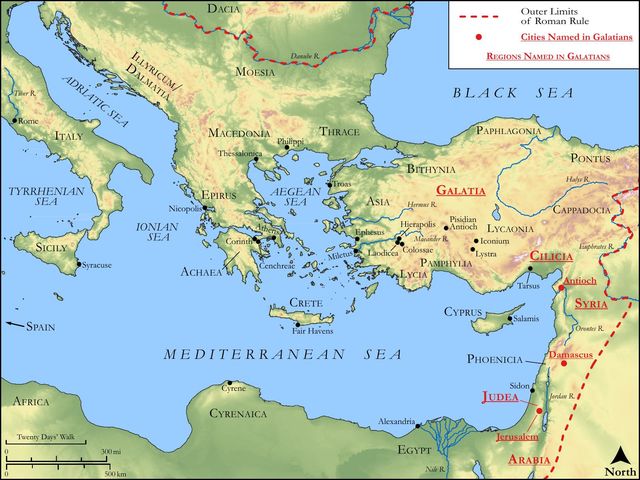
See on the biblical-era map

Study this verse
Public-domain commentary
Matthew Henry
From his Commentary on the Whole Bible. Henry comments on passages, not single verses — this entry covers Galatians 6:1–10. His three-level outline is real structure in the source text, so it is rendered as structure.
The apostle having, in the foregoing chapter, exhorted Christians by love to serve one another (Gal 6:13), and also cautioned us (Gal 6:16) against a temper which, if indulged, would hinder us from showing the mutual love and serviceableness which he had recommended, in the beginning of this chapter he proceeds to give some further directions, which, if duly observed, would both promote the one and prevent the other of these, and render our behaviour both more agreeable to our Christian profession and more useful and comfortable to one another: particularly,
I.We are here taught to deal tenderly with those who are overtaken in a fault, Gal 6:1.
He puts a common case: If a man be overtaken in a fault, that is, be brought to sin by the surprise of temptation. It is one thing to overtake a fault by contrivance and deliberation, and a full resolution in sin, and another thing to be overtaken in a fault. The latter is the case here supposed, and herein the apostle shows that great tenderness should be used. Those who are spiritual, by whom is meant, not only the ministers (as if none but they were to be called spiritual persons), but other Christians too, especially those of the higher form in Christianity; these must restore such a one with the spirit of meekness. Here observe,
1.The duty we are directed to - to restore such; we should labour, by faithful reproofs, and pertinent and seasonable councils, to bring them to repentance. The original word, katartizete, signifies to set in joint, as a dislocated bone; accordingly we should endeavour to set them in joint again, to bring them to themselves, by convincing them of their sin and error, persuading them to return to their duty, comforting them in a sense of pardoning mercy thereupon, and having thus recovered them, confirming our love to them.
2.The manner wherein this is to be done: With the spirit of meekness; not in wrath and passion, as those who triumph in a brother's falls, but with meekness, as those who rather mourn for them. Many needful reproofs lose their efficacy by being given in wrath; but when they are managed with calmness and tenderness, and appear to proceed from sincere affection and concern for the welfare of those to whom they are given, they are likely to make a due impression.
3.A very good reason why this should be done with meekness: Considering thyself, lest thou also be tempted. We ought to deal very tenderly with those who are overtaken in sin, because we none of us know but it may some time or other be our own case. We also may be tempted, yea, and overcome by the temptation; and therefore, if we rightly consider ourselves, this will dispose us to do by others as we desire to be done by in such a case.
II.We are here directed to bear one another's burdens, Gal 6:2.
This may be considered either as referring to what goes before, and so may teach us to exercise forbearance and compassion towards one another, in the case of those weaknesses, and follies, and infirmities, which too often attend us - that, though we should not wholly connive at them, yet we should not be severe against one another on account of them; or as a more general precept, and so it directs us to sympathize with one another under the various trials and troubles that we may meet with, and to be ready to afford each other the comfort and counsel, the help and assistance, which our circumstances may require. To excite us hereunto, the apostle adds, by way of motive, that so we shall fulfil the law of Christ. This is to act agreeably to the law of his precept, which is the law of love, and obliges us to a mutual forbearance and forgiveness, to sympathy with and compassion towards each other; and it would also be agreeable to his pattern and example, which have the force of a law to us. He bears with us under our weaknesses and follies, he is touched with a fellow-feeling of our infirmities; and therefore there is good reason why we should maintain the same temper towards one another. Note, Though as Christians we are freed from the law of Moses, yet we are under the law of Christ; and therefore, instead of laying unnecessary burdens upon others (as those who urged the observance of Moses's law did), it much more becomes us to fulfil the law of Christ by bearing one another's burdens. The apostle being aware how great a hindrance pride would be to the mutual condescension and sympathy which he had been recommending, and that a conceit of ourselves would dispose us to censure and contemn our brethren, instead of bearing with their infirmities and endeavouring to restore them when overtaken with a fault, he therefore (Gal 6:3) takes care to caution us against this; he supposes it as a very possible thing (and it would be well if it were not too common) for a man to think himself to be something - to entertain a fond opinion of his own sufficiency, to look upon himself as wiser and better than other men, and as fit to dictate and prescribe to them - when in truth he is nothing, has nothing of substance or solidity in him, or that can be a ground of the confidence and superiority which he assumes. To dissuade us from giving way to this temper he tells us that such a one does but deceive himself; while he imposes upon others, by pretending to what he has not, he puts the greatest cheat upon himself, and sooner or later will find the sad effects of it. This will never gain him that esteem, either with God or good men, which he is ready to expect; he is neither the freer from mistakes nor will he be the more secure against temptations for the good opinion he has of his own sufficiency, but rather the more liable to fall into them, and to be overcome by them; for he that thinks he stands has need to take heed lest he fall. Instead therefore of indulging such a vain-glorious humour, which is both destructive of the love and kindness we owe to our fellow-christians and also injurious to ourselves, it would much better become us to accept the apostle's exhortation (Phi 2:3), Do nothing through strife nor vain-glory; but in lowliness of mind let each esteem others better than himself. Note, Self-conceit is but self-deceit: as it is inconsistent with that charity we owe to others (for charity vaunteth not itself, is not puffed up, Co1 13:4), so it is a cheat upon ourselves; and there is not a more dangerous cheat in the world than self-deceit. As a means of preventing this evil,
III.We are advised every one to prove his own work, Gal 6:4.
By our own work is chiefly meant our own actions or behaviour. These the apostle directs us to prove, that is seriously and impartially to examine them by the rule of God's word, to see whether or no they are agreeable to it, and therefore such as God and conscience do approve. This he represents as the duty of every man; instead of being forward to judge and censure others, it would much more become us to search and try our own ways; our business lies more at home than abroad, with ourselves than with other men, for what have we to do to judge another man's servant? From the connection of this exhortation with what goes before it appears that if Christians did duly employ themselves in this work they might easily discover those defects and failings in themselves which would soon convince them how little reason they have either to be conceited of themselves or severe in their censures of others; and so it gives us occasion to observe that the best way to keep us from being proud of ourselves is to prove our ownselves: the better we are acquainted with our own hearts and ways, the less liable shall we be to despise and the more disposed to compassionate and help others under their infirmities and afflictions. That we may be persuaded to this necessary and profitable duty of proving our own work, the apostle urges two considerations very proper for this purpose: -
1.This is the way to have rejoicing in ourselves alone. If we set ourselves in good earnest to prove our own work, and, upon the trial, can approve ourselves to God, as to our sincerity and uprightness towards him, then may we expect to have comfort and peace in our own souls, having the testimony of our own consciences for us (as Co2 1:12), and this, he intimates, would be a much better ground of joy and satisfaction than to be able to rejoice in another, either in the good opinion which others may have of us or in having gained over others to our opinion, which the false teachers were wont to glory in (as we see Gal 6:13), or by comparing ourselves with others, as, it should seem, some did, who were ready to think well of themselves, because they were not so bad as some others. Too many are apt to value themselves upon such accounts as these; but the joy that results thence is nothing to that which arises from an impartial trial of ourselves by the rule of God's word, and our being able thereupon to approve ourselves to him. Note,
(1.)Though we have nothing in ourselves to boast of, yet we may have the matter of rejoicing in ourselves: our works can merit nothing at the hand of God; but, if our consciences can witness for us that they are such as he for Christ's sake approves and accepts, we may upon good ground rejoice therein.
(2.)The true way to have rejoicing in ourselves is to be much in proving our own works, in examining ourselves by the unerring rule of God's word, and not by the false measures of what others are, or may think of us.
(3.)It is much more desirable to have matter of glorying in ourselves than in another. If we have the testimony of our consciences that we are accepted of God, we need not much concern ourselves about what others think or say of us; and without this the good opinion of others will stand us in little stead.
2.The other argument which the apostle uses to press upon us this duty of proving our own work is that every man shall bear his own burden (Gal 6:5), the meaning of which is that at the great day every one shall be reckoned with according as his behaviour here has been. He supposes that there is a day coming when we must all give an account of ourselves to God; and he declares that then the judgment will proceed, and the sentence pass, not according to the sentiments of the world concerning us, or any ungrounded opinion we may have had of ourselves, or upon our having been better or worse than others, but according as our state and behaviour have really been in the sight of God. And, if there be such an awful time to be expected, when he will render to every one according to his works, surely there is the greatest reason why we should prove our own works now: if we must certainly be called to an account hereafter, surely we ought to be often calling ourselves to an account here, to see whether or no we are such as God will own and approve then: and, as this is our duty, so if it were more our practice we should entertain more becoming thoughts both of ourselves and our fellow-christians, and instead of bearing hard upon one another, on account of any mistakes or failings we may be guilty of, we should be more ready to fulfil that law of Christ by which we must be judged in bearing one another's burdens.
IV.Christians are here exhorted to be free and liberal in maintaining their ministers (Gal 6:6):
Let him that is taught in the word communicate to him that teacheth, in all good things. Here we may observe,
1.The apostle speaks of it as a thing known and acknowledged, that, as there are some to be taught, so there are others who are appointed to teach them. The office of the ministry is a divine institution, which does not lie open in common to all, but is confined to those only whom God has qualified for it and called to it: even reason itself directs us to put a difference between the teachers and the taught (for, if all were teachers, there would be none to be taught), and the scriptures sufficiently declare that it is the will of God we should do so.
2.It is the word of God wherein ministers are to teach and instruct others; that which they are to preach is the word, Ti2 4:2. That which they are to declare is the counsel of God, Act 20:27. They are not lords of our faith, but helpers of our joy, Co2 1:24. It is the word of God which is the only rule of faith and life; this they are concerned to study, and to open, and improve, for the edification of others, but they are no further to be regarded than as they speak according to this rule.
3.It is the duty of those who are taught in the word to support those who are appointed to teach them; for they are to communicate to them in all good things, freely and cheerfully to contribute, of the good things with which God has blessed them, what is needful for their comfortable subsistence. Ministers are to give attendance to reading, to exhortation, to doctrine (Ti1 4:13); they are not to entangle themselves with the affairs of this life (Ti2 2:4), and therefore it is but fit and equitable that, while they are sowing to others spiritual things, they should reap their carnal things. And this is the appointment of God himself; for as, under the law, those who ministered about holy things lived of the things of the temple, so hath the Lord ordained that those who preach the gospel should live of the gospel, Co1 9:11, Co1 9:13, Co1 9:14.
V.Here is a caution to take heed of mocking God, or of deceiving ourselves, by imagining that he can be imposed upon by mere pretensions or professions (Gal 6:7): Be not deceived, God is not mocked. This may be considered as referring to the foregoing exhortation, and so the design of it is to convince those of their sin and folly who endeavoured by any plausible pretences to excuse themselves from doing their duty in supporting their ministers: or it may be taken in a more general view, as respecting the whole business of religion, and so as designed to take men off from entertaining any vain hopes of enjoying its rewards while they live in the neglect of its duties. The apostle here supposes that many are apt to excuse themselves from the work of religion, and especially the more self-denying and chargeable parts of it, though at the same time they may make a show and profession of it; but he assures them that this their way is their folly, for, though hereby they may possibly impose upon others, yet they do but deceive themselves if they think to impose upon God, who is perfectly acquainted with their hearts as well as actions, and, as he cannot be deceived, so he will not be mocked; and therefore, to prevent this, he directs us to lay down as a rule to ourselves, That whatsoever a man soweth that shall he also reap; or that according as we behave ourselves now, so will our account be in the great day. Our present time is seed-time: in the other world there will be a great harvest; and, as the husbandman reaps in the harvest according as he sows in the seedness, so we shall reap then as we sow now. And he further informs us (Gal 6:8) that, as there are two sorts of seedness, sowing to the flesh and sowing to the Spirit, so accordingly will the reckoning be hereafter: If we sow to the flesh, we shall of the flesh reap corruption. If we sow the wind, we shall reap the whirlwind. Those who live a carnal sensual life, who instead of employing themselves to the honour of God and the good of others, spend all their thoughts, and care, and time, about the flesh, must expect no other fruit of such a course than corruption - a mean and short-lived satisfaction at present, and ruin and misery at the end of it. But, on the other hand, those who sow to the Spirit, who under the guidance and influence of the Spirit do live a holy and spiritual life, a life of devotedness to God and of usefulness and serviceableness to others, may depend upon it that of the Spirit they shall reap life everlasting - they shall have the truest comfort in their present course, and an eternal life and happiness at the end of it. Note, Those who go about to mock God do but deceive themselves. Hypocrisy in religion is the greatest folly as well as wickedness, since the God we have to do with can easily see through all our disguises, and will certainly deal with us hereafter, not according to our professions, but our practices.
VI.Here is a further caution given us, not to be weary in well doing, Gal 6:9.
As we should not excuse ourselves from any part of our duty, so neither should we grow weary in it. There is in all of us too great a proneness to this; we are very apt to flag and tire in duty, yea to fall off from it, particularly that part of it to which the apostle has here a special regard, that of doing good to others. This therefore he would have us carefully to watch and guard against; and he gives this very good reason for it, because in due season we shall reap, if we faint not, where he assures us that there is a recompence of reward in reserve for all who sincerely employ themselves in well doing; that this reward will certainly be bestowed on us in the proper season - if not in this world, yet undoubtedly in the next; but then that it is upon supposition that we faint not in the way of our duty; if we grow weary of it, and withdraw from it, we shall not only miss of this reward, but lose the comfort and advantage of what we have already done; but, if we hold on and hold out in well-doing, though our reward may be delayed, yet it will surely come, and will be so great as to make us an abundant recompence for all our pains and constancy. Note, Perseverance in well-doing is our wisdom and interest, as well as our duty, for to this only is the reward promised.
VII.Here is an exhortation to all Christians to do good in their places (Gal 6:10):
As we have therefore an opportunity, etc. It is not enough that we be good to others, if we would approve ourselves to be Christians indeed. The duty here recommended to us is the same that is spoken of in the foregoing verses; and, as there the apostle exhorts us to sincerity and perseverance in it, so here he directs us both as to the objects and rule of it.
1.The objects of this duty are more generally all men. We are not to confine our charity and beneficence within too narrow bounds, as the Jews and judaizing Christians were apt to do, but should be ready to extend it to all who partake of the same common nature with us, as far as we are capable and they stand in need of us. But yet, in the exercise of it, we are to have a special regard to the household of faith, or to those who profess the same common faith, and are members of the same body of Christ, with us: though others are not to be excluded, yet these are to be preferred. The charity of Christians should be extensive charity: but yet therein a particular respect is to be had to good people. God does good to all, but in an especial manner he is good to his own servants; and we must in doing good be followers of God as dear children.
2.The rule which we are to observe in doing good to others is as we have opportunity, which implies, (1.) That we should be sure to do it while we have opportunity, or while our life lasts, which is the only season wherein we are capable of doing good to his own servants; and we must in doing good be followers of God as dear children. 2. The rule which we are to observe in doing good to others is as we have opportunity, which implies, (1.) That we should be sure to do it while we have opportunity, or while our life lasts, which is the only season wherein we are capable of doing good to others. If therefore we would behave ourselves aright in this matter, we must not, as too many do, neglect it in our life-time, and defer it till we come to die, under a pretence of doing something of this nature then: for, as we cannot be sure that we shall then have an opportunity for it, so neither, if we should, have we any ground to expect that what we do will be so acceptable to God, much less that we can atone for our past neglects by leaving something behind us for the good of others, when we can no longer keep it ourselves. But we should take care to do good in our life-time, yea, to make this the business of our lives. And, (2.) That we be ready to improve every opportunity for it: we should not content ourselves in having done some good already; but, whenever fresh occasions offer themselves, as far as our capacity reaches we should be ready to embrace them too, for we are directed to give a portion to seven and also to eight, Ecc 11:2. Note, [1.] As God has made it our duty to do good to others, so he takes care in his providence to furnish us with opportunities for it. The poor we have always with us, Mat 26:11. [2.] Whenever God gives us an opportunity of being useful to others, he expects we should improve it, according to our capacity and ability. [3.] We have need of godly wisdom and discretion to direct us in the exercise of our charity or beneficence, and particularly in the choice of the proper objects of it; for, though none who stand in need of us are to be wholly overlooked, yet there is a difference to be made between some and others.
Historical interpretation
Three Centuries of Reception
12 surviving comments on this verse. Each one is dated, so this reads as a timeline rather than a list.
Select a marker to jump to its quote. Markers stagger vertically where authors wrote within a few decades of each other.
Knowing, then, that "God is not mocked," we ought to walk worthy of His commandment and glory. In like manner should the deacons be blameless before the face of His righteousness, as being the servants of God and Christ, and not of men. They must not be slanderers, double-tongued, or lovers of money, but temperate in all things, compassionate, industrious, walking according to the truth of the Lord, who was the servant of all. If we please Him in this present world, we shall receive also the future world, according as He has promised to us that He will raise us again from the dead, and that if we live worthily of Him, "we shall also reign together with Him," provided only we believe.
And for you he will pray purely, held in high honour as an angel of God, and grieved not by you, but for you. This is sincere repentance. "God is not mocked," nor does He give heed to vain words. For He alone searches the marrow and reins of the heart, and hears those that are in the fire, and listens to those who supplicate in the whale's belly; and is near to all who believe, and far from the ungodly if they repent not.
For God is "jealous," and is One who is not contemptuously derided -derided, namely, by such as flatter His goodness-and who, albeit "patient," yet threatens, through Isaiah, an end of (His) patience.
"Be not deceived, God is not mocked." But Marcion's god can be mocked; for he knows not how to be angry, or how to take vengeance.
But Marcion's god can be mocked; for he knows not how to be angry, or how to take vengeance. "For whatsoever a man soweth, that shall he also reap." It is then the God of recompense and judgment who threatens this.
For which reason you must diligently observe and keep the practice delivered from divine tradition and apostolic observance, which is also maintained among us, and almost throughout all the provinces; that for the proper celebration of ordinations all the neighbouring bishops of the same province should assemble with that people for which a prelate is ordained. And the bishop should be chosen in the presence of the people, who have most fully known the life of each one, and have looked into the doings of each one as respects his habitual conduct. And this also, we see, was done by you in the ordination of our colleague Sabinus; so that, by the suffrage of the whole brotherhood, and by the sentence of the bishops who had assembled in their presence, and who had written letters to you concerning him, the episcopate was conferred upon him, and hands were imposed on him in the place of Basilides. Neither can it rescind an ordination rightly perfected, that Basilides, after the detection of his crimes, and the baring of his conscience even by his own confession, went to Rome and deceived Stephen our colleague, placed at a distance, and ignorant of what had been done, and of the truth, to canvass that he might be replaced unjustly in the episcopate from which he had been righteously deposed. The result of this is, that the sins of Basilides are not so much abolished as enhanced, inasmuch as to his former sins he has also added the crime of deceit and circumvention. For he is not so much to be blamed who has been through heedlessness surprised by fraud, as he is to be execrated who has fraudulently taken him by surprise. But if Basilides could deceive men, he cannot deceive God, since it is written, "God is not mocked." But neither can deceit advantage Martialis, in such a way as that he who also is involved in great crimes should hold his bishopric, since the apostle also warns, and says, "A bishop must be blameless, as the steward of God."
Some Galatians, who thought that they ought to adopt the Jewish way of life, so as to observe the sabbath and undergo circumcision and do other things of this sort in their carnal understanding, could have hope in the flesh and from the flesh. Anyone, therefore, who has hope in the flesh and sows his own hope in the flesh will have a harvest from the flesh, that is, fruit from the flesh. But what fruit? Corruption, he says; for indeed the flesh is corrupted, and this is its end, that it grows corrupt and putrid. It perishes and dies. All things, then, that are of the flesh grow putrid and suffer corruption.… Therefore it is better to have hope in the Spirit, so that we may have hope [in what comes] from the Spirit: the hope and the fruit of the Spirit. This is what it means to sow in the Spirit—eternal life. For this present life indeed is life but not life eternal. But the one who lives here in the Spirit and acts according to the Spirit and does nothing corrupt sows for himself eternal life. And this will be his harvest, that on departing he will receive eternal life.
He adds another principle which is generally stated but is relevant to what he said above to prevent their following anything beside the gospel (that is, adding also a legalistic way of life and works). Do not err, he says, for all those things which are grounded apart from the gospel are error-prone. And he has added the force of necessity to his precept: “God,” he says, “is not mocked.” He does not say, “God knows all,” lest they should hope for some sort of cheap pardon for their error or for something that might be hidden. Rather “God is not mocked,” and Paul clarifies what will happen to those who err and those who hold fast to worldly life.
And here he points out the difference between ambition of this kind, and in temporal affairs, by saying, "Be not deceived; God is not mocked; for whatsoever a man soweth, that shall he also reap. For he that soweth unto his own flesh shall of the flesh reap corruption; but he that soweth unto the Spirit shall of the Spirit reap eternal life." As in the case of seeds, one who sows pulse cannot reap corn, for what is sown and what is reaped must both be of one kind, so is it in actions, he that plants in the flesh, wantonness, drunkenness, or inordinate desire, shall reap the fruits of these things. And what are these fruits? Punishment, retribution, shame, derision, destruction. For of sumptuous tables and viands the end is no other than destruction; for they both perish themselves, and destroy the body too. But the fruit of the Spirit is of a nature not similar but contrary in all respects to these. For consider; hast thou sown alms-giving? the treasures of heaven and eternal glory await thee: hast thou sown temperance? honor and reward, and the applause of Angels, and a crown from the Judge await thee.
(Verse 7.) Do not be deceived, God is not mocked. Whatever a person sows, that will he also reap. By foreseeing with the Spirit, those who are being taught are able to provide for the needs and expenses of their teachers and to claim poverty, saying, 'My field has withered this year due to drought, my vineyard has been destroyed by hail, the taxes that could have been paid have been seized.' I do not have what is required to give. Therefore, do not be deceived, God is not mocked. He knows, he says, your hearts, he is not ignorant of your abilities. A plausible excuse can appease a person, but it cannot deceive God. And at the same time, he encourages them to do what is commanded, mentioning seed, so that they do not think it is lost, as they will receive it back with interest. He also teaches the Corinthians the principle of giving and receiving, using a similar example: Whoever sows sparingly will also reap sparingly, and whoever sows in blessings will also reap blessings. Each person should give as he has decided in his heart, not reluctantly or under compulsion, for God loves a cheerful giver (I Corinthians 9:6-7).
Foreseeing in the Spirit that those who ought to furnish sustenance for the necessities of life to their teacher might plead poverty … he adds, “Make no mistake; God is not mocked.”
A brother said to Poemen, ‘If I give my brother something, for instance a piece of bread, the demons made the gift worthless by making me think that it was done to please men.’ The hermit said to him, ‘Even if it is done to please men, we still ought to give our brothers what they need.’ He told him this parable: ‘In a town there were two farmers. One of them sowed seed, and gathered a poor harvest; the other was idle and did not sow, and had no harvest to gather. If famine came, which of them would survive?’ The brother answered, ‘The one who sowed seed, even if the harvest was poor.’ He said, ‘It is the same for us. We sow a few seeds, and they are poor, but in the time of famine we shall not die.’
Continue studying Galatians 6:7 across the web’s major study libraries — every link below opens this exact verse, chapter, or book on the destination site.
Read & Compare
 BibleGatewayThis verse in more than 200 translations and 70 languages.
 Bible.comThe YouVersion reader — hundreds of translations, reading plans, and highlights.
 ESV.orgCrossway's official English Standard Version reader.
 NET BibleThe NET translation with 60,000+ translators' notes on every rendering decision.
 STEP BibleTyndale House's free study tool — original text, vocabulary, and scholarly resources.
 BibliaLogos Bible Software's free web reader.
 USCCBThe New American Bible (Revised Edition) with the U.S. bishops' study notes.
Commentaries
 BibleHub CommentariesDozens of classic commentaries on this verse, gathered on one page.
 StudyLightMore than 100 commentary sets — the largest collection on the web.
 BibleRefPlain-English commentary on what this verse means, verse by verse.
 Enduring WordDavid Guzik's free commentary on this chapter, widely used by Bible teachers.
 Bible Study ToolsVerse commentary alongside Greek and Hebrew study aids.
Original Language & Research
- BibleHub InterlinearThe verse word by word — original language, transliteration, and English.
- BibleHub LexiconEvery word's original-language definition and Strong's entry.
 Blue Letter BibleDeep-study tools — Strong's numbers, concordance, and word studies.
 CNTR CollationThe earliest Greek manuscripts of this verse, collated letter by letter.
Sermons, Hymns & Audio


TrulyRandomVerse is not affiliated with these sites and doesn’t control their content. They’re linked because they’re genuinely useful.
Summary
Galatians 6:7 delivers a profound and unyielding truth: one cannot deceive God or treat His divine order with contempt, for the universal principle of sowing and reaping applies irrevocably to all human conduct. This verse serves as a solemn warning that every action, thought, and choice—whether good or ill—will inevitably yield corresponding consequences, underscoring the spiritual reality that God's moral governance cannot be circumvented or mocked.
Context
ShowHideLiterary Context
This verse is situated within the final, hortatory section of Paul's letter to the Galatians, where he transitions from theological exposition to practical Christian living. Having vigorously defended the doctrine of justification by faith apart from works of the law in chapters 1-5, Paul now applies this freedom to ethical responsibilities. Chapter 6 opens with exhortations to restore fallen believers gently, bear one another's burdens, and support those who teach the Word. Verse 7, with its stark warning, undergirds these practical commands by establishing the foundational principle of divine accountability. It serves as a crucial bridge, immediately preceding the contrast between "sowing to the flesh" and "sowing to the Spirit" in Galatians 6:8, making it clear that the choices made in light of Christian liberty have tangible, spiritual consequences.
Historical & Cultural Context
The agricultural metaphor of sowing and reaping was deeply ingrained in the agrarian societies of the ancient world, including first-century Galatia. People understood intimately that the type of seed sown determined the harvest, and that a harvest was inevitable. Paul leverages this universally recognized principle to explain spiritual realities. Furthermore, the Galatian churches were grappling with the influence of Judaizers who advocated for adherence to the Mosaic Law for salvation, potentially leading some to believe that external observances or a superficial religiosity could appease God while living contrary to the Spirit. Paul's warning against being "deceived" and "mocking God" directly addresses any such presumption, emphasizing that God sees beyond outward appearances and cannot be fooled by hypocrisy or a casual disregard for His moral standards.
Key Themes
ShowHideGalatians 6:7 powerfully reinforces several key themes prevalent in the letter and broader Pauline theology. Firstly, it underscores the theme of Divine Accountability, asserting God's absolute sovereignty and unyielding justice, which cannot be circumvented by human pretense or disregard. The phrase "God is not mocked" highlights His omniscience and unwavering moral governance. Secondly, it articulates the Principle of Consequences, a universal law that extends beyond the physical realm into the spiritual and moral dimensions of life. This principle is deeply echoed in other biblical passages, such as Job 4:8 and Proverbs 22:8. Thirdly, the verse implicitly touches on the theme of Authentic Christian Living, challenging believers to live consistently with their profession of faith, understanding that true freedom in Christ does not equate to license for sin but rather empowerment for righteous living, as further expounded in Galatians 5:16-26.
Exposition and Analysis
ShowHideKey Word Analysis
ShowHideMeaning "to (properly, cause to) roam (from safety, truth, or virtue); to go astray, deceive, err, seduce, wander, be out of the way." Paul's initial imperative, "Be not deceived," warns against self-deception. It implies a tendency for humans to delude themselves into believing that their actions might escape divine notice or consequence, or that grace somehow nullifies moral responsibility. This deception leads one astray from truth and virtue.
Literally "to make mouths at, i.e. ridicule." This strong verb conveys the idea of treating God with contempt, scorn, or sneering disregard. To "mock God" is to treat His commands, His character, or the reality of His justice as trivial, irrelevant, or something that can be flouted without repercussion. It's an attitude of disdainful defiance, as if God is unaware, indifferent, or easily fooled by superficial religiosity.
Meaning "to scatter, i.e. sow (literally or figuratively)." This agricultural term is used metaphorically to represent one's actions, choices, and investments in life. What a person "sows" refers to their deeds, words, thoughts, and the overall direction of their life—whether they are aligned with the Spirit or with the desires of the flesh. The act of sowing implies intentionality and effort, leading to an inevitable outcome.
Verse Breakdown
ShowHide"Be not deceived"
This is a present passive imperative, meaning "Stop being deceived" or "Do not allow yourselves to be deceived." It serves as a direct and urgent warning against a dangerous self-delusion that might lead one to believe they can escape the consequences of their actions, especially within the context of Christian liberty. Paul addresses a potential misconception that grace provides a license for ungodly living without accountability.
"God is not mocked"
This declarative statement provides the immutable reason for the preceding warning. It asserts God's absolute sovereignty, omniscience, and unyielding justice. God cannot be treated with contempt, ridiculed, or outsmarted. He perceives the true intentions and character behind every action, and His moral order cannot be circumvented or defied without consequence. This phrase underscores the seriousness of one's conduct before a holy God.
"for whatsoever a man soweth"
The conjunction "for" (Greek: gar) introduces the foundational principle that explains why God cannot be mocked. This clause uses the vivid agricultural metaphor to illustrate that every human action, choice, or investment (the "sowing") has an inherent nature and direction. Whether one sows good seeds (righteousness, kindness, faithfulness) or bad seeds (sin, selfishness, rebellion), the act of sowing itself sets in motion an inevitable process.
"that shall he also reap"
This final clause completes the agricultural metaphor, declaring the unavoidable consequence of the sowing. The "reaping" refers to the inevitable outcome or harvest that corresponds directly to what was sown. This is a divine law of cause and effect, applicable to all aspects of life—spiritual, moral, and even practical. Good seeds yield a good harvest, and bad seeds yield a corrupt harvest, emphasizing the direct correlation between actions and their results.
Literary Devices
ShowHideGalatians 6:7 is a powerful Aphorism, a concise statement of a universal truth, presented with the authority of divine revelation. The central literary device is Metaphor, specifically the agricultural imagery of "sowing and reaping." This vivid and relatable comparison effectively communicates the principle of cause and effect, translating a natural law into a spiritual reality. The verse also employs Antithesis by contrasting human attempts at self-deception or mocking God with God's unyielding nature and the certainty of His justice. The initial Warning ("Be not deceived") sets a serious tone, immediately followed by a declarative statement of divine truth ("God is not mocked"), which grounds the subsequent metaphorical explanation in an immutable reality. The structure moves from a direct admonition to a theological assertion, then to a universally understood illustration, making the message both profound and accessible.
Theological and Thematic Connections
ShowHideThe principle of sowing and reaping articulated in Galatians 6:7 is a foundational theological truth that permeates Scripture, extending far beyond agricultural contexts to encompass moral, spiritual, and even eschatological dimensions. It underscores God's consistent governance of His creation, where actions inevitably lead to corresponding consequences. This is not a legalistic threat, but a statement of divine order and justice, affirming that God is not capricious but operates according to righteous principles. It reminds believers that while salvation is by grace through faith, the Christian life is one of active obedience and stewardship, where choices have eternal ramifications. The verse serves as a powerful call to intentional living, recognizing that every thought, word, and deed contributes to a spiritual harvest.
Reflection and Application
ShowHideGalatians 6:7 challenges us to a profound self-examination, urging us to consider the "seeds" we are sowing daily through our attitudes, words, actions, and even our unspoken intentions. This verse is not meant to induce fear or legalism, but rather to cultivate a profound sense of spiritual responsibility and sober-mindedness. It reminds us that authentic faith is not passive, but active, manifesting in choices that align with God's character and purposes. If we sow seeds of kindness, integrity, faithfulness, and love, we can anticipate a harvest of blessing, both in this life and eternally. Conversely, if we sow seeds of selfishness, deceit, bitterness, or rebellion, the inevitable harvest will be corruption and sorrow. This principle calls us to live with intentionality, acknowledging that our lives are not lived in a vacuum but under the watchful eye of a just and holy God who cannot be deceived. It encourages us to leverage the freedom we have in Christ to sow generously to the Spirit, knowing that our efforts are seen and will yield a harvest of eternal life.
Questions for Reflection
ShowHideFAQ
ShowHideDoes Galatians 6:7 mean that my salvation is based on my works, contradicting salvation by grace?
ShowHideNo, Galatians 6:7 does not contradict salvation by grace through faith. Paul has already firmly established in Galatians 2:16 that "a person is not justified by works of the law but by faith in Jesus Christ." This verse, instead, addresses the consequences of living for those who are already in Christ. It's about sanctification, not justification. Once saved by grace, believers are called to live in a manner consistent with their new identity in Christ. The principle of sowing and reaping here refers to the natural and spiritual outcomes of one's moral choices and stewardship within the Christian life, not the means of attaining salvation. It warns against abusing grace as a license for sin, emphasizing that even believers are accountable for their actions and will experience the corresponding results in their lives and potentially in their eternal rewards, as seen in 1 Corinthians 3:12-15.
Is this verse a threat from God, or a statement of natural law?
ShowHideWhile the verse carries a serious warning, it is more accurately understood as a statement of a divine and universal principle, akin to a spiritual law, rather than merely a threat. Just as gravity is a natural law, sowing and reaping is a spiritual law established by God. The phrase "God is not mocked" highlights His unchanging character and the integrity of His moral order. It's a truth that God's justice and omniscience ensure that actions have consequences, whether positive or negative. For believers, this truth serves as a loving admonition to live wisely and righteously, knowing that God sees all and that living in alignment with His will leads to life and blessing, as described in Galatians 6:8. It's a call to responsible freedom, not a fear-mongering decree.
Christ-Centered Fulfillment
ShowHideWhile Galatians 6:7 speaks to a universal principle of cause and effect, its ultimate fulfillment and most profound meaning are found in Christ. Jesus Himself is the supreme example of one who "sowed" perfectly and reaped gloriously. He "sowed" a life of perfect obedience, selfless love, and sacrificial service, culminating in His death on the cross, where He "sowed" His very life as a seed to die, as foreshadowed in John 12:24. In His resurrection, Jesus "reaped" victory over sin and death, becoming the "firstfruits" of those who sleep, as declared in 1 Corinthians 15:20. For believers, our ability to "sow to the Spirit" and reap eternal life is entirely dependent on Christ's finished work. We reap the benefits of His perfect sowing—righteousness, forgiveness, and eternal life—not by our own merit, but by faith in Him. Furthermore, Jesus' teachings, like the Parable of the Sower in Matthew 13, illustrate the importance of the "soil" of the heart in receiving the "seed" of God's Word, emphasizing that the quality of our spiritual harvest is directly tied to our response to Christ. Thus, Galatians 6:7 calls us to live out the implications of our union with Christ, empowering us by His Spirit to sow righteous seeds that reflect His life within us, anticipating a harvest that glorifies Him.