


2 Corinthians 9:6
Bible text: King James Version (1769 Blayney text) · Public domain
Bible text: King James Version with Strong's numbers · Public domain
Bible text: Berean Standard Bible · Public domain
Bible text: American Standard Version (1901) · Public domain
Bible text: World English Bible, Messianic edition · Public domain
Bible text: Geneva Bible (1599) · Public domain
Bible text: Young's Literal Translation · Public domain
- τοῦτοtoutoThisG3778D-ASNDemonstrative pronoun Accusative Singular Neuter
- δέdenowG1161CONJConjunction
- ὁhoThe [one]G3588T-NSMDefinite article Nominative Singular Masculine
- σπείρωνspeirōnsowingG4687V-PAP-NSMVerb Present Active Participle Nominative Singular Masculine
- φειδομένωςpheidomenōssparinglyG5340ADVAdverb
- φειδομένωςpheidomenōssparinglyG5340ADVAdverb
- καὶkaialsoG2532CONJConjunction
- θερίσειtheriseiwill reapG2325V-FAI-3SVerb Future Active Indicative 3rd Singular
- καὶkaiandG2532CONJConjunction
- ὁhothe [one]G3588T-NSMDefinite article Nominative Singular Masculine
- σπείρωνspeirōnsowingG4687V-PAP-NSMVerb Present Active Participle Nominative Singular Masculine
- ἐπ᾽ep᾽uponG1909PREPPreposition
- εὐλογίαιςeulogiaisblessingsG2129N-DPFNoun Dative Plural Feminine
- ἐπ᾽ep᾽uponG1909PREPPreposition
- εὐλογίαιςeulogiaisblessingsG2129N-DPFNoun Dative Plural Feminine
- καὶkaialsoG2532CONJConjunction
- θερίσειtheriseiwill reapG2325V-FAI-3SVerb Future Active Indicative 3rd Singular
English is a literal word-by-word gloss of the Greek, not the KJV's wording. Why?
This is the original text the KJV's translators worked from — each Greek word with its own literal English meaning in this verse, prepared by scholars at Tyndale House, Cambridge. The KJV translates whole sentences, not word by word, so its wording differs: one Greek word can become several English words, and the KJV may choose “charity” where the gloss reads “love”. Both are faithful — they answer different questions. For the KJV's own rendering, switch to the KJV text.
Details
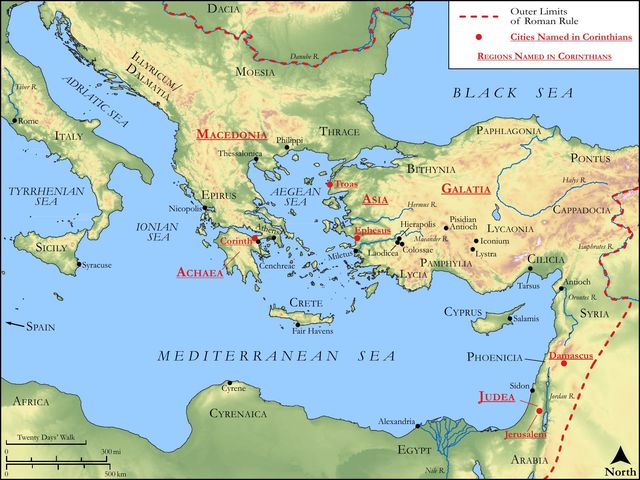
See on the biblical-era maps

Study this verse
Public-domain commentary
Matthew Henry
From his Commentary on the Whole Bible. Henry comments on passages, not single verses — this entry covers 2 Corinthians 9:6–15. His four-level outline is real structure in the source text, so it is rendered as structure.
Here we have,
I.Proper directions to be observed about the right and acceptable manner of bestowing charity; and it is of great concernment that we not only do what is required, but do it as is commanded. Now, as to the manner in which the apostle would have the Corinthians give, observe,
1.It should be bountifully; this was intimated, Co2 9:5, that a liberal contribution was expected, a matter of bounty, not what savoured of covetousness; and he offers to their consideration that men who expect a good return at harvest are not wont to pinch and spare in sowing their seed, for the return is usually proportionable to what they sow, Co2 9:6.
2.It should be deliberately Every man, according as he purposes in his heart, Co2 9:7. Works of charity, like other good works, should be done with thought and design; whereas some do good only by accident. They comply, it may be hastily, with the importunity of others, without any good design, and give more than they intended, and then repent of it afterwards. Or possibly, had they duly considered all things, they would have given more. Due deliberation, as to this matter of our own circumstances, and those of the persons we are about to relieve, will be very helpful to direct us how liberal we should be in our contributions for charitable uses.
3.It should be freely, whatever we give, be it more or less: Not grudgingly, nor of necessity, but cheerfully, Co2 9:7. Persons sometimes will give merely to satisfy the importunity of those who ask their charity, and what they give is in a manner squeezed or forced from them, and this unwillingness spoils all they do. We ought to give more freely than the modesty of some necessitous persons will allow them to ask: we should not only deal out bread, but draw out our souls to the hungry, Isa 58:10. We should give liberally, with an open hand, and cheerfully, with an open countenance, being glad we have ability and an opportunity to be charitable.
II.Good encouragement to perform this work of charity in the manner directed. Here the apostle tells the Corinthians,
1.They themselves would be no losers by what they gave in charity. This may serve to obviate a secret objection in the minds of many against this good work who are ready to think they may want what they give away; but such should consider that what is given to the poor in a right manner is far from being lost; as the precious seed which is cast into the ground is not lost, though it is buried there for a time, for it will spring up, and bear fruit; the sower shall receive it again with increase, Co2 9:6. Such good returns may those expect who give freely and liberally in charity. For,
(1.)God loveth a cheerful giver (Co2 9:7), and what may not those hope to receive who are the objects of the divine love? Can a man be a loser by doing that with which God is pleased? May not such a one be sure that he shall some way or other be a gainer? Nay, are not the love and favour of God better than all other things, better than life itself?
(2.)God is able to make our charity redound to our advantage, Co2 9:8. We have no reason to distrust the goodness of God, and surely we have no reason to question his power; he is able to make all grace abound towards us, and abound in us; to give a large increase of spiritual and temporal good things. He can cause us to have a sufficiency in all things, to be content with what we have, to make up what we give, to be able to give yet more: as it is written (Psa 112:9) concerning the charitable man, He hath dispersed abroad. He hath given to the poor. His righteousness, that is, his almsgiving, endureth for ever. The honour of it is lasting, the reward of it eternal, and he is still able to live comfortably himself and to give liberally to others.
(3.)The apostle puts up a prayer to God in their behalf that they might be gainers, and not losers, Co2 9:10, Co2 9:11. Here observe,
[1.]To whom the prayer is made - to God, who ministereth seed to the sower, who by his providence giveth such an increase of the fruits of the earth that we have not only bread sufficient to eat for one year, but enough to sow again for a future supply: or thus, It is God who giveth us not only a competency for ourselves, but that also wherewith we may supply the wants of others, and so should be as seed to be sown.
[2.]For what he prayeth. There are several things which he desires for them, namely, that they may have bread for their food, always a competency for themselves, food convenient, - that God will multiply their seed sown, that they may still be able to do more good, - and that there may be an increase of the fruits of righteousness, that they may reap plentifully, and have the best and most ample returns of their charity, so as to be enriched in every thing to all bountifulness (Co2 9:11), - that upon the whole they may find it true that they shall be no losers, but great gainers. Note, Works of charity are so far from impoverishing us that they are the proper means truly to enrich us, or make us truly rich.
2.While they would be no losers, the poor distressed saints would be gainers; for this service would supply their wants, Co2 9:12. If we have reason to think them to be saints, whom we believe to be of the household of faith, whose wants are great, how ready should we be to do them good! Our goodness can not extend unto God, but we should freely extend it to these excellent ones of the earth, and thus show that we delight in them.
3.This would redound to the praise and glory of God. Many thanksgivings would be given to God on this account, by the apostle, and by those who were employed in this ministration, Co2 9:11. These would bless God, who had made them happy instruments in so good a work, and rendered them successful in it. Besides these, others also would be thankful; the poor, who were supplied in their wants, would not fail to be very thankful to God, and bless God for them; and all who wished well to the gospel would glorify God for this experiment, or proof of subjection to the gospel of Christ, and true love to all men, Co2 9:13. Note,
(1.)True Christianity is a subjection to the gospel, a yielding of ourselves to the commanding influence of its truths and laws.
(2.)We must evince the sincerity of our subjection to the gospel by works of charity.
(3.)This will be for the credit of our profession, and to the praise and glory of God.
4.Those whose wants were supplied would make the best return they were able, by sending up many prayers to God for those who had relieved them, Co2 9:14. And thus should we recompense the kindnesses we receive when we are not in a capacity of recompensing them in any other way; and, as this is the only recompence the poor can make, so it is often greatly for the advantage of the rich.
Lastly, The apostle concludes this whole matter with this doxology, Thanks be to God for his unspeakable gift, Co2 9:15. Some think that by this unspeakable gift he means the gift of grace bestowed on the churches, in making them able and willing to supply the necessities of the saints, which would be attended with unspeakable benefit both to the givers and receivers. It should seem rather that he means Jesus Christ, who is indeed the unspeakable gift of God unto this world, a gift we have all reason to be very thankful for.
Historical interpretation
Two Centuries of Reception
6 surviving comments on this verse. Each one is dated, so this reads as a timeline rather than a list.
Select a marker to jump to its quote. Markers stagger vertically where authors wrote within a few decades of each other.
But let every one do as he has proposed in his heart: not as if sorrowfully, or of necessity: for God loveth a cheerful giver."
Paul is referring to misers when he talks about people who sow sparingly. He says this here because the Corinthians had promised to send something and had subsequently backtracked.
Accordingly, let us not simply have the recipient in view in showing generosity in almsgiving, but consider who it is who takes as his the kindnesses shown to the poor person and who promises recompense for favors done; and thus let us direct our attention to him while showing all zeal in making offerings with complete enthusiasm, and let us sow generously in season so that we may also reap generously. Scripture says, remember, "he who sows sparingly shall also reap sparingly." Let us consequently sow these good seeds generously so that in due season we may reap generously. Now, after all, is the time for sowing, which I beseech you not to ignore, so that on the day of harvesting we may gather the returns of what was sown here and be regaled with loving kindness from the Lord.
"He that soweth sparingly, shall reap also sparingly; and he that soweth bountifully shall reap also bountifully." And he did not say niggardly, but a milder expression, employing the the name of the sparing. And he called the thing sowing; that thou mightest at once look unto the recompense, and having in mind the harvest, mightest feel that thou receivest more than thou givest. Wherefore he did not say, 'He that giveth,' but "He that soweth:" and he said not 'ye, if ye sow,' but made what he said general. Neither did he say, 'largely,' but "bountifully," which is far greater than this. And again, he betakes himself to that former point of gladness.
And since the apostle himself says: “Now this I say: he who sows sparingly shall also reap sparingly,” you should understand that now is the time, while we are still in this life, to be swift and eager to purchase the gift of eternal life, for when the end of the world comes it will be given only to those who have bought it for themselves by faith before they were able to see it.
A brother said to Poemen, ‘If I give my brother something, for instance a piece of bread, the demons made the gift worthless by making me think that it was done to please men.’ The hermit said to him, ‘Even if it is done to please men, we still ought to give our brothers what they need.’ He told him this parable: ‘In a town there were two farmers. One of them sowed seed, and gathered a poor harvest; the other was idle and did not sow, and had no harvest to gather. If famine came, which of them would survive?’ The brother answered, ‘The one who sowed seed, even if the harvest was poor.’ He said, ‘It is the same for us. We sow a few seeds, and they are poor, but in the time of famine we shall not die.’
Continue studying 2 Corinthians 9:6 across the web’s major study libraries — every link below opens this exact verse, chapter, or book on the destination site.
Read & Compare
 BibleGatewayThis verse in more than 200 translations and 70 languages.
 Bible.comThe YouVersion reader — hundreds of translations, reading plans, and highlights.
 ESV.orgCrossway's official English Standard Version reader.
 NET BibleThe NET translation with 60,000+ translators' notes on every rendering decision.
 STEP BibleTyndale House's free study tool — original text, vocabulary, and scholarly resources.
 BibliaLogos Bible Software's free web reader.
 USCCBThe New American Bible (Revised Edition) with the U.S. bishops' study notes.
Commentaries
 BibleHub CommentariesDozens of classic commentaries on this verse, gathered on one page.
 StudyLightMore than 100 commentary sets — the largest collection on the web.
 BibleRefPlain-English commentary on what this verse means, verse by verse.
 Enduring WordDavid Guzik's free commentary on this chapter, widely used by Bible teachers.
 Bible Study ToolsVerse commentary alongside Greek and Hebrew study aids.
Original Language & Research
- BibleHub InterlinearThe verse word by word — original language, transliteration, and English.
- BibleHub LexiconEvery word's original-language definition and Strong's entry.
 Blue Letter BibleDeep-study tools — Strong's numbers, concordance, and word studies.
 CNTR CollationThe earliest Greek manuscripts of this verse, collated letter by letter.
Sermons, Hymns & Audio


TrulyRandomVerse is not affiliated with these sites and doesn’t control their content. They’re linked because they’re genuinely useful.
Summary
The Apostle Paul articulates a profound spiritual and economic principle: the measure of one's generosity directly correlates with the measure of one's return. Using the agricultural metaphor of sowing and reaping, Paul encourages the Corinthian believers to give liberally towards the collection for the impoverished saints in Jerusalem, assuring them that God's provision will be proportionate to their cheerful and abundant giving. This verse underscores a divine economy where generosity is not a loss, but an investment yielding bountiful returns.
Context
ShowHideLiterary Context
This verse is deeply embedded within Paul's extended discourse on Christian giving, spanning 2 Corinthians chapters 8 and 9 and 2 Corinthians chapter 9. Paul is urging the Corinthian church to fulfill their promised contribution to the struggling believers in Jerusalem, a collection he had initiated earlier. He strategically uses the example of the Macedonian churches' extraordinary generosity, despite their own poverty, as a powerful motivator (2 Corinthians 8:1-5). The immediate preceding verses in 2 Corinthians 9:1-5 express Paul's confidence in the Corinthians' readiness to give, highlighting his boasting about their eagerness to other churches. Verse 6 then introduces the foundational principle that undergirds this act of giving, setting the stage for the subsequent emphasis on cheerful giving and God's abundant provision in 2 Corinthians 9:7-11.
Historical & Cultural Context
The collection for the Jerusalem saints was a significant undertaking in the early church, serving multiple purposes: practical relief for a community suffering from famine and poverty, and a tangible expression of unity between Gentile and Jewish believers (Romans 15:25-27). Agricultural imagery, particularly that of sowing and reaping, was universally understood in the ancient world, where agrarian societies depended on these cycles for survival. Paul's audience, whether urban or rural, would immediately grasp the concept of proportionate return based on initial investment in the soil. This metaphor transcends mere farming; it speaks to a worldview where effort and outcome are intrinsically linked, a concept easily transferable to financial and spiritual realms. Furthermore, the cultural expectation of reciprocity, where acts of generosity were often met with reciprocal favors, provides a human parallel to the divine principle Paul articulates.
Key Themes
ShowHideThe verse contributes significantly to several major themes within 2 Corinthians and the broader biblical narrative. Firstly, it establishes The Divine Principle of Sowing and Reaping, a universal spiritual law extending beyond agriculture to encompass all aspects of life, particularly generosity. It posits that the return one receives is directly proportional to the measure of one's investment, whether in resources, effort, or love. Secondly, it highlights Generosity and God's Provision, teaching that giving is not a depletion of resources but an act of faith that God will honor and multiply. Paul consistently emphasizes that God provides abundantly for those who give liberally, enabling them to continue their acts of benevolence (2 Corinthians 9:8). Thirdly, while not explicitly stated in this verse, the broader context, especially 2 Corinthians 9:7, underscores the crucial theme of Attitude in Giving. Sowing "bountifully" implies an inner disposition of willingness, cheerfulness, and faith, rather than compulsion or reluctance, which is essential for the spiritual fruitfulness of one's giving.
Exposition and Analysis
ShowHideKey Word Analysis
ShowHideMeaning "to scatter, i.e. sow (literally or figuratively)." In this context, it refers to the act of distributing resources, particularly financial contributions, as if scattering seeds in a field. It implies an intentional, active disbursement.
An adverb derived from the verb "to spare" or "to refrain." It means "abstemiously, i.e. stingily." This word conveys the idea of holding back, being parsimonious, or giving with reluctance and a limited measure, reflecting a cautious or even fearful disposition regarding one's resources.
This phrase combines G1909 (epí), a preposition meaning "upon" or "with," and G2129 (eulogía), meaning "fine speaking, commendation, adoration, benediction, consecration; by implication, benefit or largess; blessing (a matter of) bounty." Together, ep' eulogíais literally means "upon or with blessings." This is a powerful expression, suggesting that the act of sowing itself is done "with blessings" – either with a blessed, generous disposition, or in a manner that invites blessings. It implies giving liberally, abundantly, and with a sense of purpose and divine favor.
Verse Breakdown
ShowHide"But this I say"
Paul introduces a foundational principle or a crucial clarification. The "But" (G1161, dé) serves as a transition, emphasizing the importance of what follows in light of the preceding discussion on the collection. It signals a direct, authoritative statement.
"He which soweth sparingly shall reap also sparingly"
This clause establishes the first half of the proportional principle. "Sowing sparingly" refers to giving with a limited hand, holding back, or being stingy with one's resources. The consequence, "reaping sparingly," indicates that the return or blessing received will be equally limited, directly mirroring the initial act of giving. It highlights a direct, cause-and-effect relationship in God's economy.
"and he which soweth bountifully shall reap also bountifully"
This clause presents the contrasting, positive counterpart to the first. "Sowing bountifully" refers to giving generously, liberally, and abundantly, often with a cheerful and blessed disposition (as illuminated by the Greek for "bountifully"). The promise is that such giving will be met with an equally abundant return, a "bountiful" harvest of blessings and provision from God. This reinforces the principle of proportionate return and encourages lavish generosity.
Literary Devices
ShowHideThe verse primarily employs a powerful Metaphor of agricultural sowing and reaping to illustrate a spiritual and financial principle. This metaphor makes an abstract concept tangible and relatable, drawing on a universal experience of cause and effect in nature. The act of giving is likened to planting seeds, and the subsequent receiving is like harvesting a crop. Furthermore, the verse is structured with clear Parallelism, specifically Antithetical Parallelism, where two contrasting ideas are presented side-by-side to highlight their differences and consequences ("soweth sparingly...reap sparingly" versus "soweth bountifully...reap bountifully"). This rhetorical device emphasizes the direct correlation between the action and its outcome, making the principle clear and impactful. The repetition of the structure reinforces the inevitability of the stated consequences.
Theological and Thematic Connections
ShowHideThis verse articulates a core theological truth about God's economy and the nature of generosity. It reveals that God operates on principles of abundance and reciprocity, not as a transactional exchange, but as a divine response to faith-filled giving. Our giving is not a loss, but an investment in God's Kingdom, trusting that He is the ultimate provider and multiplier. This principle challenges a scarcity mindset, inviting believers into a partnership with God where their generosity becomes a channel for His blessings, not only for the recipients but also for the givers themselves. It speaks to God's character as a generous Giver who delights in His children reflecting His nature.
Reflection and Application
ShowHideFor the contemporary believer, 2 Corinthians 9:6 serves as a profound call to re-evaluate our posture towards our resources, time, talents, and love. It challenges us to move beyond a mindset of mere obligation or scarcity and embrace a spirit of radical generosity, understanding that our giving is an act of worship and trust in a God who is infinitely abundant. This principle applies not only to financial contributions but to every area where we can invest ourselves for the Kingdom of God and the good of others. When we "sow bountifully" in compassion, service, forgiveness, and evangelism, we can anticipate a "bountiful harvest" of spiritual fruit, joy, and divine favor. It encourages us to give not out of what is left over, but out of a conviction that God will supply all our needs according to His riches in glory, enabling us to be channels of His blessing to a needy world.
Questions for Reflection
ShowHideFAQ
ShowHideDoes "reaping bountifully" in this verse promise material wealth for generous givers?
ShowHideWhile 2 Corinthians 9:6 certainly implies a return for generous giving, interpreting "reaping bountifully" solely as a promise of material wealth (often associated with the "prosperity gospel") misses the broader biblical context and Paul's primary intent. The "bountiful harvest" includes not only financial provision, which God does promise to supply for those who give (2 Corinthians 9:8), but also spiritual blessings, increased capacity for generosity, and the abundant fruit of righteousness (2 Corinthians 9:10-11). The ultimate purpose of God's provision is to enable further generosity, leading to thanksgiving to God and the glory of His name, rather than merely personal enrichment.
How does this verse relate to the concept of cheerful giving in the following verse?
ShowHide2 Corinthians 9:6 lays the foundational principle of proportionate return, which then provides a strong motivation for the "cheerful giving" emphasized in 2 Corinthians 9:7. If one understands that giving sparingly leads to reaping sparingly, and giving bountifully leads to reaping bountifully, it naturally encourages a generous and willing heart. The cheerfulness in giving stems from a faith-filled understanding of God's character as a generous provider who multiplies what is given for His glory and for the good of others. It's not about giving to get, but giving because God is a giver, and trusting that He will provide for our needs and enable us to continue giving.
Christ-Centered Fulfillment
ShowHideThe principle of sowing and reaping finds its ultimate and most profound fulfillment in Jesus Christ. He is the divine Sower who "sowed bountifully" by giving His very life, laying down His glory and enduring the cross, "though he was rich, yet for your sakes he became poor, that ye through his poverty might be rich" (2 Corinthians 8:9). His ultimate act of self-giving on the cross was the most bountiful sowing imaginable, a seed planted in death that yielded an immeasurable harvest: the redemption of humanity, the defeat of sin and death, and the establishment of His eternal Kingdom (John 12:24). We, who were dead in our trespasses, now "reap bountifully" through His sacrifice, receiving eternal life, forgiveness, righteousness, and adoption into God's family (Ephesians 2:4-5). Our own acts of generosity, therefore, are not merely moral obligations but Spirit-empowered responses to the overwhelming generosity of God in Christ. As we participate in God's economy of grace, our giving becomes an overflow of the bountiful blessings we have received through the ultimate Sower, Jesus, who continues to sow His love and grace in the world through His body, the Church (Colossians 3:17).