


2 Corinthians 9:15
- χάριςcharisThanks [be]G5485N-NSFNoun Nominative Singular Feminine
- δὲdenowG1161CONJConjunction
- τῷtō<the>G3588T-DSMDefinite article Dative Singular Masculine
- θεῷtheōto GodG2316N-DSM-TNoun Dative Singular Masculine Title
- ἐπὶepiforG1909PREPPreposition
- τῇtēatheG3588T-DSFDefinite article Dative Singular Feminine
- ἀνεκδιηγήτῳanekdiēgētōindescribableG411A-DSFAdjective Dative Singular Feminine
- αὐτοῦautouof HimG846P-GSMPersonal pronoun Genitive Singular Masculine
- δωρεᾷdōreagift!G1431N-DSFNoun Dative Singular Feminine
English is a literal word-by-word gloss of the Greek, not the KJV's wording. Why?
This is the original text the KJV's translators worked from — each Greek word with its own literal English meaning in this verse, prepared by scholars at Tyndale House, Cambridge. The KJV translates whole sentences, not word by word, so its wording differs: one Greek word can become several English words, and the KJV may choose “charity” where the gloss reads “love”. Both are faithful — they answer different questions. For the KJV's own rendering, switch to the KJV text.
Details
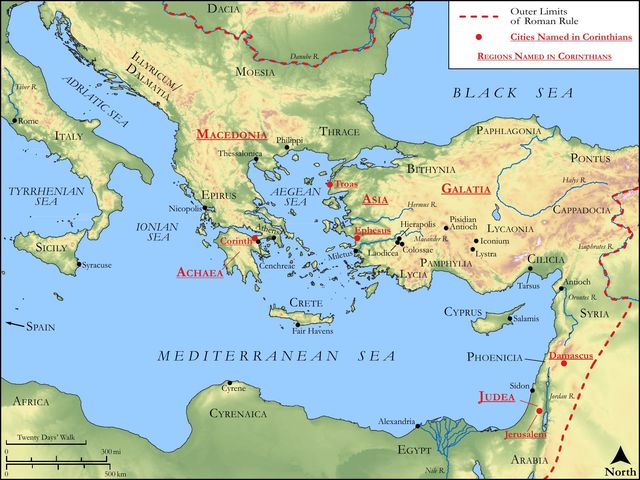
See on the biblical-era map

Study this verse
Public-domain commentary
Matthew Henry
From his Commentary on the Whole Bible. Henry comments on passages, not single verses — this entry covers 2 Corinthians 9:6–15. His four-level outline is real structure in the source text, so it is rendered as structure.
Here we have,
I.Proper directions to be observed about the right and acceptable manner of bestowing charity; and it is of great concernment that we not only do what is required, but do it as is commanded. Now, as to the manner in which the apostle would have the Corinthians give, observe,
1.It should be bountifully; this was intimated, Co2 9:5, that a liberal contribution was expected, a matter of bounty, not what savoured of covetousness; and he offers to their consideration that men who expect a good return at harvest are not wont to pinch and spare in sowing their seed, for the return is usually proportionable to what they sow, Co2 9:6.
2.It should be deliberately Every man, according as he purposes in his heart, Co2 9:7. Works of charity, like other good works, should be done with thought and design; whereas some do good only by accident. They comply, it may be hastily, with the importunity of others, without any good design, and give more than they intended, and then repent of it afterwards. Or possibly, had they duly considered all things, they would have given more. Due deliberation, as to this matter of our own circumstances, and those of the persons we are about to relieve, will be very helpful to direct us how liberal we should be in our contributions for charitable uses.
3.It should be freely, whatever we give, be it more or less: Not grudgingly, nor of necessity, but cheerfully, Co2 9:7. Persons sometimes will give merely to satisfy the importunity of those who ask their charity, and what they give is in a manner squeezed or forced from them, and this unwillingness spoils all they do. We ought to give more freely than the modesty of some necessitous persons will allow them to ask: we should not only deal out bread, but draw out our souls to the hungry, Isa 58:10. We should give liberally, with an open hand, and cheerfully, with an open countenance, being glad we have ability and an opportunity to be charitable.
II.Good encouragement to perform this work of charity in the manner directed. Here the apostle tells the Corinthians,
1.They themselves would be no losers by what they gave in charity. This may serve to obviate a secret objection in the minds of many against this good work who are ready to think they may want what they give away; but such should consider that what is given to the poor in a right manner is far from being lost; as the precious seed which is cast into the ground is not lost, though it is buried there for a time, for it will spring up, and bear fruit; the sower shall receive it again with increase, Co2 9:6. Such good returns may those expect who give freely and liberally in charity. For,
(1.)God loveth a cheerful giver (Co2 9:7), and what may not those hope to receive who are the objects of the divine love? Can a man be a loser by doing that with which God is pleased? May not such a one be sure that he shall some way or other be a gainer? Nay, are not the love and favour of God better than all other things, better than life itself?
(2.)God is able to make our charity redound to our advantage, Co2 9:8. We have no reason to distrust the goodness of God, and surely we have no reason to question his power; he is able to make all grace abound towards us, and abound in us; to give a large increase of spiritual and temporal good things. He can cause us to have a sufficiency in all things, to be content with what we have, to make up what we give, to be able to give yet more: as it is written (Psa 112:9) concerning the charitable man, He hath dispersed abroad. He hath given to the poor. His righteousness, that is, his almsgiving, endureth for ever. The honour of it is lasting, the reward of it eternal, and he is still able to live comfortably himself and to give liberally to others.
(3.)The apostle puts up a prayer to God in their behalf that they might be gainers, and not losers, Co2 9:10, Co2 9:11. Here observe,
[1.]To whom the prayer is made - to God, who ministereth seed to the sower, who by his providence giveth such an increase of the fruits of the earth that we have not only bread sufficient to eat for one year, but enough to sow again for a future supply: or thus, It is God who giveth us not only a competency for ourselves, but that also wherewith we may supply the wants of others, and so should be as seed to be sown.
[2.]For what he prayeth. There are several things which he desires for them, namely, that they may have bread for their food, always a competency for themselves, food convenient, - that God will multiply their seed sown, that they may still be able to do more good, - and that there may be an increase of the fruits of righteousness, that they may reap plentifully, and have the best and most ample returns of their charity, so as to be enriched in every thing to all bountifulness (Co2 9:11), - that upon the whole they may find it true that they shall be no losers, but great gainers. Note, Works of charity are so far from impoverishing us that they are the proper means truly to enrich us, or make us truly rich.
2.While they would be no losers, the poor distressed saints would be gainers; for this service would supply their wants, Co2 9:12. If we have reason to think them to be saints, whom we believe to be of the household of faith, whose wants are great, how ready should we be to do them good! Our goodness can not extend unto God, but we should freely extend it to these excellent ones of the earth, and thus show that we delight in them.
3.This would redound to the praise and glory of God. Many thanksgivings would be given to God on this account, by the apostle, and by those who were employed in this ministration, Co2 9:11. These would bless God, who had made them happy instruments in so good a work, and rendered them successful in it. Besides these, others also would be thankful; the poor, who were supplied in their wants, would not fail to be very thankful to God, and bless God for them; and all who wished well to the gospel would glorify God for this experiment, or proof of subjection to the gospel of Christ, and true love to all men, Co2 9:13. Note,
(1.)True Christianity is a subjection to the gospel, a yielding of ourselves to the commanding influence of its truths and laws.
(2.)We must evince the sincerity of our subjection to the gospel by works of charity.
(3.)This will be for the credit of our profession, and to the praise and glory of God.
4.Those whose wants were supplied would make the best return they were able, by sending up many prayers to God for those who had relieved them, Co2 9:14. And thus should we recompense the kindnesses we receive when we are not in a capacity of recompensing them in any other way; and, as this is the only recompence the poor can make, so it is often greatly for the advantage of the rich.
Lastly, The apostle concludes this whole matter with this doxology, Thanks be to God for his unspeakable gift, Co2 9:15. Some think that by this unspeakable gift he means the gift of grace bestowed on the churches, in making them able and willing to supply the necessities of the saints, which would be attended with unspeakable benefit both to the givers and receivers. It should seem rather that he means Jesus Christ, who is indeed the unspeakable gift of God unto this world, a gift we have all reason to be very thankful for.
Historical interpretation
Two Centuries of Reception
3 surviving comments on this verse. Each one is dated, so this reads as a timeline rather than a list.
Select a marker to jump to its quote. Markers stagger vertically where authors wrote within a few decades of each other.
And he himself again, along with them, sends up thanksgiving, saying, "Thanks be to God for His unspeakable gift." And here he calls "gift," even those so many good things which are wrought by almsgiving, both to them that receive and them that give; or else, those unspeakable good things which through His advent He gave unto the whole world with great munificence, which one may suspect to be the most probable. For that he may at once both sober, and make them more liberal, he puts them in mind of the benefits they had received from God. For this avails very greatly in inciting unto all virtue; and therefore he concluded his discourse with it. But if His Gift be unspeakable, what can match their frenzy who raise curious questions as to His Essence? But not only is His Gift unspeakable, but that "peace" also "passeth all understanding," (Philippians chapter 4, verse 7) whereby He reconciled the things which are above with those which are below.
It is Paul’s custom to praise God every time he expounds some divine dispensation or other.
We should be discerning and aware of the grace that has been effected in us, giving thanks for it to the Maker, praising God for this great and “ineffable gift” to us. We should put aside from ourselves any hateful habits of slackness and neglect which only destroy our lives; instead, we should persevere from the beginning to the end of the times of our offices. And we should behave with all the greater awe and love during the great and perfect mysteries of our salvation, standing firmly before God continually with wakefulness of heart in spiritual service, resembling servants who are eagerly at the ready to serve their master.
Continue studying 2 Corinthians 9:15 across the web’s major study libraries — every link below opens this exact verse, chapter, or book on the destination site.
Read & Compare
 BibleGatewayThis verse in more than 200 translations and 70 languages.
 Bible.comThe YouVersion reader — hundreds of translations, reading plans, and highlights.
 ESV.orgCrossway's official English Standard Version reader.
 NET BibleThe NET translation with 60,000+ translators' notes on every rendering decision.
 STEP BibleTyndale House's free study tool — original text, vocabulary, and scholarly resources.
 BibliaLogos Bible Software's free web reader.
 USCCBThe New American Bible (Revised Edition) with the U.S. bishops' study notes.
Commentaries
 BibleHub CommentariesDozens of classic commentaries on this verse, gathered on one page.
 StudyLightMore than 100 commentary sets — the largest collection on the web.
 BibleRefPlain-English commentary on what this verse means, verse by verse.
 Enduring WordDavid Guzik's free commentary on this chapter, widely used by Bible teachers.
 Bible Study ToolsVerse commentary alongside Greek and Hebrew study aids.
Original Language & Research
- BibleHub InterlinearThe verse word by word — original language, transliteration, and English.
- BibleHub LexiconEvery word's original-language definition and Strong's entry.
 Blue Letter BibleDeep-study tools — Strong's numbers, concordance, and word studies.
 CNTR CollationThe earliest Greek manuscripts of this verse, collated letter by letter.
Sermons, Hymns & Audio


TrulyRandomVerse is not affiliated with these sites and doesn’t control their content. They’re linked because they’re genuinely useful.
Summary
The apostle Paul concludes his detailed exhortation on generous giving in 2 Corinthians 8-9 with a profound doxology, exclaiming "Thanks be unto God for his unspeakable gift." This verse serves as the climactic expression of Paul's overflowing gratitude, shifting the focus from the Corinthians' material contribution to the ultimate source of all blessings: God's supreme, indescribable gift, which undergirds and inspires all human generosity. It encapsulates the theological truth that all good things, especially the greatest spiritual realities, originate from the divine Giver.
Context
ShowHideLiterary Context
This verse stands as the triumphant capstone to Paul's extensive teaching on Christian generosity, spanning 2 Corinthians chapters 8 and 9. Paul has meticulously laid out the theological foundations and practical implications of giving, using the Macedonian churches as an example of sacrificial liberality (2 Corinthians 8:1-5). He encouraged the Corinthians to complete their promised collection for the impoverished saints in Jerusalem, emphasizing principles like willingness (2 Corinthians 8:12), equality (2 Corinthians 8:13-15), and the spiritual harvest of sowing generously (2 Corinthians 9:6). The immediate preceding verses highlight God's abundant provision for the cheerful giver (2 Corinthians 9:8-11) and the twofold blessing of generosity: meeting the needs of the saints and overflowing in thanksgiving to God (2 Corinthians 9:12-14). Thus, 2 Corinthians 9:15 is not merely an isolated statement but the ultimate theological conclusion to Paul's discourse on Christian giving, elevating the discussion from human acts to divine grace.
Historical & Cultural Context
Paul was collecting funds from Gentile churches (like Corinth) to aid the Jewish believers in Jerusalem, who were suffering from poverty and famine. This collection served multiple purposes: practical relief, demonstrating the unity of Jewish and Gentile believers in Christ, and affirming Paul's apostolic authority. In the Greco-Roman world, patronage and reciprocal relationships were common, but Paul redefines generosity through a distinctly Christian lens, rooted in God's prior and ultimate gift. The Corinthians, known for their wealth and sometimes their internal divisions, were being challenged to embody true Christian generosity, which flows from a heart transformed by God's grace, rather than from social obligation or a desire for recognition. Paul's appeal was not a demand but an invitation to participate in a divine work, culminating in praise to God for His unparalleled benevolence.
Key Themes
ShowHideThe overarching theme of 2 Corinthians chapters 8 and 9 is Christian generosity as a spiritual discipline and a tangible expression of faith. This verse specifically introduces or reinforces several key themes: Profound Gratitude, as Paul's exclamation is a spontaneous outpouring of thanks to God, acknowledging Him as the ultimate source of all good. It emphasizes God's Supreme Generosity, highlighting that the "unspeakable gift" is the pinnacle of divine giving, far surpassing any human act of benevolence. This gift is the foundation and motivation for all Christian giving. The term "unspeakable" underscores the Inexpressible Value and Transcendence of God's gift, suggesting its immeasurable worth and profound nature that human language cannot fully capture. This leads to the theme of Doxology and Worship, as the recognition of such a gift naturally elicits praise and adoration for the Giver.
Exposition and Analysis
ShowHideKey Word Analysis
ShowHideThis word, G5485, is from chaírō (to rejoice) and signifies graciousness, favor, or divine influence upon the heart. It also encompasses the reflection of that influence in life, including gratitude. In 2 Corinthians 9:15, it denotes the profound sense of gratitude and thankfulness that Paul expresses, not merely as a polite acknowledgment but as a deep, Spirit-inspired response to God's immense generosity. It highlights that the act of giving thanks is itself a manifestation of God's grace working within the believer.
This word, G411, is a compound term formed from a negative particle and a presumed derivative of ekdiēgéomai (to expound fully). It means "not expounded in full," "indescribable," or "inexpressible." Paul uses this powerful adjective to convey that God's gift is so vast, so profound, and so glorious that human language and comprehension are utterly inadequate to fully describe or articulate its magnitude and significance. It evokes a sense of awe and wonder, acknowledging the transcendent nature of God's benevolence.
This word, G1431, comes from dōron (a gift) and specifically refers to a gratuity or a free gift, something given without expectation of return or merit. In this context, it emphasizes the unmerited nature of God's supreme provision. It is not earned or deserved but freely bestowed out of God's boundless grace. This term underscores that the "unspeakable gift" is entirely an act of divine initiative and generosity.
Verse Breakdown
ShowHide"Thanks be unto God"
This opening phrase is a direct and fervent expression of doxology, a burst of praise and gratitude directed solely to God. It signifies Paul's conviction that all true blessings and the ultimate source of all good, including the very possibility of Christian generosity, originate from God. It sets the tone of profound reverence and acknowledgment of divine sovereignty.
"for his unspeakable gift"
This phrase identifies the specific object of Paul's thanksgiving. The "gift" is qualified as "unspeakable," meaning it is beyond human words to adequately describe or comprehend. While the immediate context is the collection for the saints, the "unspeakable gift" transcends this, pointing to God's ultimate act of generosity—the gift of His Son, Jesus Christ, and the salvation He provides. This divine gift is the foundational reality that enables and inspires all human acts of generosity and is the ultimate reason for thanksgiving.
Literary Devices
ShowHide2 Corinthians 9:15 is a powerful example of Doxology, a spontaneous outburst of praise and glory directed to God. It functions as a climactic exclamation, elevating the discourse from the practicalities of giving to the theological wellspring from which all generosity flows. The term "unspeakable" employs Hyperbole, an exaggeration for emphasis, to convey the immeasurable and incomprehensible nature of God's gift, suggesting its value is so immense that no human language can fully articulate it. Furthermore, the "unspeakable gift" operates as a form of Synecdoche or Metonymy, where a part represents the whole, or a related concept stands for the primary one. While it implicitly refers to the collection and God's blessings upon it, its ultimate and profound meaning points to the comprehensive gift of salvation in Christ, encompassing all spiritual blessings and the very foundation of the believer's life and generosity.
Theological and Thematic Connections
ShowHidePaul's doxology in 2 Corinthians 9:15 is a pivotal theological statement, shifting the focus from the act of human giving to the divine source of all generosity. The "unspeakable gift" is not merely one of God's many blessings but represents the totality of His redemptive work and the boundless grace bestowed upon humanity through Christ. It underscores the truth that all Christian life, including acts of benevolence, is a response to God's prior and ultimate giving. This verse reminds believers that their capacity to give, their desire to give, and the blessings that flow from giving are all rooted in and empowered by God's initial, indescribable act of love. It elevates the discussion of material contributions to a profound theological reflection on God's character as the supreme Giver.
Reflection and Application
ShowHide2 Corinthians 9:15 calls us to a profound reorientation of our perspective, moving from a focus on what we give to what we have received. It challenges us to pause and truly contemplate the magnitude of God's "unspeakable gift"—a gift so vast, so rich, and so eternally significant that it defies all human description. This contemplation should evoke an overwhelming sense of gratitude, not just for specific blessings, but for the very essence of God's redemptive work in our lives. Our generosity, then, is not merely a duty or a transaction, but a joyful, Spirit-empowered overflow from a heart captivated by God's indescribable grace. It transforms our giving from an obligation into an act of worship, a tangible expression of our thanksgiving for the greatest gift ever given. This verse encourages us to live lives marked by continuous gratitude, recognizing that every good and perfect gift, as James 1:17 reminds us, comes from above.
Questions for Reflection
ShowHideFAQ
ShowHideWhat is the "unspeakable gift" Paul refers to in 2 Corinthians 9:15?
ShowHideWhile the immediate context of 2 Corinthians 8-9 is the collection for the poor saints in Jerusalem, the "unspeakable gift" (Greek: anekdiḗgētos dōreá) transcends this specific act of human generosity. The consensus among biblical scholars is that this refers primarily to God's ultimate gift of salvation through His Son, Jesus Christ. This encompasses the entire redemptive work of Christ, including His incarnation, atoning death, resurrection, and the Holy Spirit given to believers. It is "unspeakable" because its depth, breadth, and eternal implications are so vast that human language cannot fully describe or articulate its immeasurable worth and profound nature. It is the foundational gift that enables and inspires all subsequent acts of Christian generosity and is the supreme reason for thanksgiving.
How does 2 Corinthians 9:15 relate to the broader theme of Christian giving?
ShowHide2 Corinthians 9:15 serves as the theological climax and motivation for Christian giving. Paul has spent two chapters encouraging the Corinthians to give generously. This verse reveals the ultimate source and inspiration for such generosity: God's own unparalleled giving. Our giving is not merely an act of charity or obligation, but a grateful response to the "unspeakable gift" we have already received from God. Because God has given us His indescribable gift (Christ and salvation), we are empowered and compelled to give cheerfully and generously to others. It transforms giving from a duty into an overflow of worship and thanksgiving, recognizing that all we have and all we give comes from God's prior and greater generosity.
Christ-Centered Fulfillment
ShowHide2 Corinthians 9:15 finds its ultimate and most profound fulfillment in Jesus Christ. The "unspeakable gift" is supremely the gift of God's Son, who embodies the fullness of divine grace and generosity. In Christ, God has given Himself completely, offering salvation, reconciliation, and eternal life to humanity, a gift truly beyond human comprehension or articulation. As John 3:16 famously declares, "For God so loved the world, that he gave his only begotten Son," highlighting the sacrificial nature of this unparalleled gift. This divine act of giving in Christ is the foundation of all Christian generosity. Believers are empowered to give because they have first received the ultimate gift of grace through faith in Christ (Ephesians 2:8-9). Christ Himself, who "though he was rich, yet for your sakes he became poor, that ye through his poverty might be rich" (2 Corinthians 8:9), is the supreme example and enabler of all true generosity. Thus, every act of giving, every expression of thanks, and every spiritual blessing ultimately flows from and points back to the indescribable, all-sufficient gift of God in Jesus Christ, the Lamb of God who takes away the sin of the world (John 1:29).