


Romans 5:15
- ἀλλ᾽all᾽ButG235CONJConjunction
- οὐχouch[is] notG3756PRT-NNegative Particle Negative
- ὡςhōslikeG5613PRTParticle or Disjunctive
- τὸtotheG3588T-NSNDefinite article Nominative Singular Neuter
- παράπτωμαparaptōmatrespassG3900N-NSNNoun Nominative Singular Neuter
- οὕτωςhoutōssoG3779ADVAdverb
- καὶkaialsoG2532CONJConjunction
- τὸtotheG3588T-NSNDefinite article Nominative Singular Neuter
- χάρισμαcharismagiftG5486N-NSNNoun Nominative Singular Neuter
- εἰeiIfG1487CONDConjunction
- γὰρgarforG1063CONJConjunction
- τῷtōby theG3588T-DSNDefinite article Dative Singular Neuter
- τοῦtouof theG3588T-GSMDefinite article Genitive Singular Masculine
- ἑνὸςhenosoneG1520A-GSMAdjective Genitive Singular Masculine
- παραπτώματιparaptōmatitrespassG3900N-DSNNoun Dative Singular Neuter
- οἱhoitheG3588T-NPMDefinite article Nominative Plural Masculine
- πολλοὶpolloimanyG4183A-NPMAdjective Nominative Plural Masculine
- ἀπέθανονapethanondiedG599V-2AAI-3PVerb 2nd Aorist Active Indicative 3rd Plural
- πολλῷpollōhow muchG4183A-DSNAdjective Dative Singular Neuter
- μᾶλλονmallonmoreG3123ADVAdverb
- ἡhētheG3588T-NSFDefinite article Nominative Singular Feminine
- χάριςcharisgraceG5485N-NSFNoun Nominative Singular Feminine
- τοῦtou<the>G3588T-GSMDefinite article Genitive Singular Masculine
- θεοῦtheouof GodG2316N-GSM-TNoun Genitive Singular Masculine Title
- καὶkaiandG2532CONJConjunction
- ἡhētheG3588T-NSFDefinite article Nominative Singular Feminine
- δωρεὰdōreagiftG1431N-NSFNoun Nominative Singular Feminine
- ἐνeninG1722PREPPreposition
- χάριτιcharitigraceG5485N-DSFNoun Dative Singular Feminine
- τῇtēawhich [is]G3588T-DSFDefinite article Dative Singular Feminine
- τοῦtouof theG3588T-GSMDefinite article Genitive Singular Masculine
- ἑνὸςhenosoneG1520A-GSMAdjective Genitive Singular Masculine
- ἀνθρώπουanthrōpoumanG444N-GSMNoun Genitive Singular Masculine
- ἸησοῦIēsouJesusG2424N-GSM-PNoun Genitive Singular Masculine Individual
- ΧριστοῦChristouChristG5547N-GSM-TNoun Genitive Singular Masculine Title
- εἰςeistoG1519PREPPreposition
- τοὺςtoustheG3588T-APMDefinite article Accusative Plural Masculine
- πολλοὺςpollousmanyG4183A-APMAdjective Accusative Plural Masculine
- ἐπερίσσευσενeperisseusendid abound!G4052V-AAI-3SVerb Aorist Active Indicative 3rd Singular
English is a literal word-by-word gloss of the Greek, not the KJV's wording. Why?
This is the original text the KJV's translators worked from — each Greek word with its own literal English meaning in this verse, prepared by scholars at Tyndale House, Cambridge. The KJV translates whole sentences, not word by word, so its wording differs: one Greek word can become several English words, and the KJV may choose “charity” where the gloss reads “love”. Both are faithful — they answer different questions. For the KJV's own rendering, switch to the KJV text.
Details
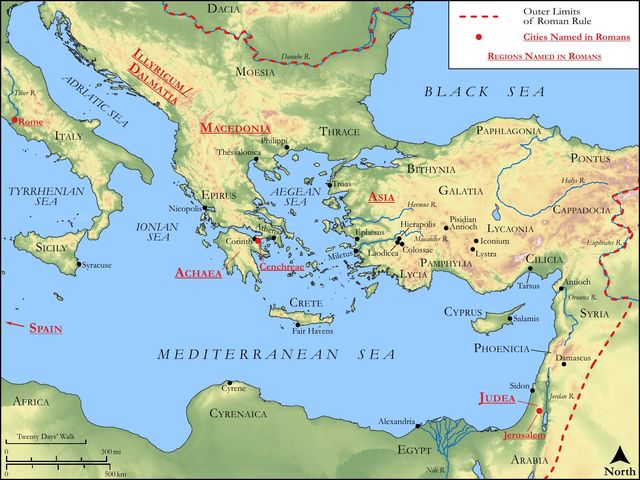
See on the biblical-era map

Study this verse
Public-domain commentary
Matthew Henry
From his Commentary on the Whole Bible. Henry comments on passages, not single verses — this entry covers Romans 5:6–21. His four-level outline is real structure in the source text, so it is rendered as structure.
The apostle here describes the fountain and foundation of justification, laid in the death of the Lord Jesus. The streams are very sweet, but, if you run them up to the spring-head, you will find it to be Christ's dying for us; it is in the precious stream of Christ's blood that all these privileges come flowing to us: and therefore he enlarges upon this instance of the love of God which is shed abroad. Three things he takes notice of for the explication and illustration of this doctrine: - 1. The persons he died for, Rom 5:6-8. 2. The precious fruits of his death, Rom 5:9-11. 3. The parallel he runs between the communication of sin and death by the first Adam and of righteousness and life by the second Adam, Rom 5:12, to the end.
I.The character we were under when Christ died for us.
1.We were without strength (Rom 5:6), in a sad condition; and, which is worse, altogether unable to help ourselves out of that condition - lost, and no visible way open for our recovery - our condition deplorable, and in a manner desperate; and, therefore our salvation is here said to come in due time. God's time to help and save is when those that are to be saved are without strength, that his own power and grace may be the more magnified, Deu 32:36. It is the manner of God to help at a dead lift,
2.He died for the ungodly; not only helpless creatures, and therefore likely to perish, but guilty sinful creatures, and therefore deserving to perish; not only mean and worthless, but vile and obnoxious, unworthy of such favour with the holy God. Being ungodly, they had need of one to die for them, to satisfy for guilt, and to bring in a righteousness. This he illustrates (Rom 5:7, Rom 5:8) as an unparalleled instance of love; herein God's thoughts and ways were above ours. Compare Joh 15:13, Joh 15:14, Greater love has no man.
(1.)One would hardly die for a righteous man, that is, an innocent man, one that is unjustly condemned; every body will pity such a one, but few will put such a value upon his life as either to hazard, or much less to deposit, their own in his stead.
(2.)It may be, one might perhaps be persuaded to die for a good man, that is, a useful man, who is more than barely a righteous man. Many that are good themselves yet do but little good to others; but those that are useful commonly get themselves well beloved, and meet with some that in a case of necessity would venture to be their antipsuchoi - would engage life for life, would be their bail, body for body. Paul was, in this sense, a very good man, one that was very useful, and he met with some that for his life laid down their own necks, Rom 16:4. And yet observe how he qualifies this: it is but some that would do so, and it is a daring act if they do it, it must be some bold venturing soul; and, after all, it is but a peradventure.
(3.)But Christ died for sinners (Rom 5:8), neither righteous nor good; not only such as were useless, but such as were guilty and obnoxious; not only such as there would be no loss of should they perish, but such whose destruction would greatly redound to the glory of God's justice, being malefactors and criminals that ought to die. Some think he alludes to a common distinction the Jews had of their people into tsaddim - righteous, chesedim - merciful (compare Isa 57:1), and rashim - wicked. Now herein God commended his love, not only proved or evidenced his love (he might have done that at a cheaper rate), but magnified it and made it illustrious. This circumstance did greatly magnify and advance his love, not only put it past dispute, but rendered it the object of the greatest wonder and admiration: "Now my creatures shall see that I love them, I will give them such an instance of it as shall be without parallel." Commendeth his love, as merchants commend their goods when they would put them off. This commending of his love was in order to the shedding abroad of his love in our hearts by the Holy Ghost. He evinces his love in the most winning, affecting, endearing way imaginable. While we were yet sinners, implying that we were not to be always sinners, there should be a change wrought; for he died to save us, not in our sins, but from our sins; but we were yet sinners when he died for us.
(4.)Nay, which is more, we were enemies (Rom 5:10), not only malefactors, but traitors and rebels, in arms against the government; the worst kind of malefactors and of all malefactors the most obnoxious. The carnal mind is not only an enemy to God, but enmity itself, Rom 8:7; Col 1:21. This enmity is a mutual enmity, God loathing the sinner, and the sinner loathing God, Zac 11:8. And that for such as these Christ should die is such a mystery, such a paradox, such an unprecedented instance of love, that it may well be our business to eternity to adore and wonder at it. This is a commendation of love indeed. Justly might he who had thus loved us make it one of the laws of his kingdom that we should love our enemies.
II.The precious fruits of his death.
1.Justification and reconciliation are the first and primary fruit of the death of Christ: We are justified by his blood (Rom 5:9), reconciled by his death, Rom 5:10. Sin is pardoned, the sinner accepted as righteous, the quarrel taken up, the enmity slain, an end made of iniquity, and an everlasting righteousness brought in. This is done, that is, Christ has done all that was requisite on his part to be done in order hereunto, and, immediately upon our believing, we are actually put into a state of justification and reconciliation. Justified by his blood. Our justification is ascribed to the blood of Christ because without blood there is no remission Heb 9:22. The blood is the life, and that must go to make atonement. In all the propitiatory sacrifices, the sprinkling of the blood was of the essence of the sacrifice. It was the blood that made an atonement for the soul, Lev 17:11.
2.Hence results salvation from wrath: Saved from wrath (Rom 5:9), saved by his life, Rom 5:10 When that which hinders our salvation is taken away, the salvation must needs follow. Nay, the argument holds very strongly; if God justified and reconciled us when we were enemies, and put himself to so much charge to do it, much more will he save us when we are justified and reconciled. He that has done the greater, which is of enemies to make us friends, will certainly the less, which is when we are friends to use us friendly and to be kind to us. And therefore the apostle, once and again, speaks of it with a much more. He that hath digged so deep to lay the foundation will no doubt build upon that foundation. - We shall be saved from wrath, from hell and damnation. It is the wrath of God that is the fire of hell; the wrath to come, so it is called, Th1 1:10. The final justification and absolution of believers at the great day, together with the fitting and preparing of them for it, are the salvation from wrath here spoken of; it is the perfecting of the work of grace. - Reconciled by his death, saved by his life. His life here spoken of is not to be understood of his life in the flesh, but his life in heaven, that life which ensued after his death. Compare Rom 14:9. He was dead, and is alive, Rev 1:18. We are reconciled by Christ humbled, we are saved by Christ exalted. The dying Jesus laid the foundation, in satisfying for sin, and slaying the enmity, and so making us salvable; thus is the partition-wall broken down, atonement made, and the attainder reversed; but it is the living Jesus that perfects the work: he lives to make intercession, Heb 7:25. It is Christ, in his exaltation, that by his word and Spirit effectually calls, and changes, and reconciles us to God, is our Advocate with the Father, and so completes and consummates our salvation. Compare Rom 4:25 and Rom 8:34. Christ dying was the testator, who bequeathed us the legacy; but Christ living is the executor, who pays it. Now the arguing is very strong. He that puts himself to the charge of purchasing our salvation will not decline the trouble of applying it.
3.All this produces, as a further privilege, our joy in God, Rom 5:11. God is now so far from being a terror to us that he is our joy, and our hope in the day of evil, Jer 17:17. We are reconciled and saved from wrath. Iniquity, blessed be God, shall not be our ruin. And not only so, there is more in it yet, a constant stream of favours; we not only go to heaven, but go to heaven triumphantly; not only get into the harbour, but come in with full sail: We joy in God, not only saved from his wrath, but solacing ourselves in his love, and this through Jesus Christ, who is the Alpha and the Omega, the foundation-stone and the top-stone of all our comforts and hopes - not only our salvation, but our strength and our song; and all this (which he repeats as a string he loved to be harping upon) by virtue of the atonement, for by him we Christians, we believers, have now, now in gospel times, or now in this life, received the atonement, which was typified by the sacrifices under thee law, and is an earnest of our happiness in heaven. True believers do by Jesus Christ receive the atonement. Receiving the atonement is our actual reconciliation to God in justification, grounded upon Christ's satisfaction. To receive the atonement is,
(1.)To give our consent to the atonement, approving of, and agreeing to, those methods which Infinite Wisdom has taken of saving a guilty world by the blood of a crucified Jesus, being willing and glad to be saved in a gospel way and upon gospel terms.
(2.)To take the comfort of the atonement, which is the fountain and the foundation of our joy in God. Now we joy in God, now we do indeed receive the atonement, Kauchōmenoi - glorying in it. God hath received the atonement (Mat 3:17; Mat 17:5; Mat 28:2): if we but receive it, the work is done.
III.The parallel that the apostle runs between the communication of sin and death by the first Adam and of righteousness and life by the second Adam (Rom 5:12, to the end), which not only illustrates the truth he is discoursing of, but tends very much to the commending of the love of God and the comforting of the hearts of true believers, in showing a correspondence between our fall and our recovery, and not only a like, but a much greater power in the second Adam to make us happy, than there was in the first to make us miserable. Now, for the opening of this, observe,
1.A general truth laid down as the foundation of his discourse - that Adam was a type of Christ (Rom 5:14): Who is the figure of him that was to come. Christ is therefore called the last Adam, Co1 15:45. Compare Co1 15:22. In this Adam was a type of Christ, that in the covenant-transactions that were between God and him, and in the consequent events of those transactions, Adam was a public person. God dealt with Adam and Adam acted as such a one, as a common father and factor, root and representative, of and for all his posterity; so that what he did in that station, as agent for us, we may be said to have done in him, and what was done to him may be said to have been done to us in him. Thus Jesus Christ, the Mediator, acted as a public person, the head of all the elect, dealt with God for them, as their father, factor, root, and representative - died for them, rose for them, entered within the veil for them, did all for them. When Adam failed, we failed with him; when Christ performed, he performed for us. Thus was Adam tupos tou mellontos - the figure of him that was to come, to come to repair that breach which Adam had made.
2.A more particular explication of the parallel, in which observe,
(1.)How Adam, as a public person, communicated sin and death to all his posterity (Rom 5:12): By one man sin entered. We see the world under a deluge of sin and death, full of iniquities and full of calamities. Now, it is worth while to enquire what is the spring that feeds it, and you will find it to be the general corruption of nature; and at what gap it entered, and you will find it to have been Adam's first sin. It was by one man, and he the first man (for if any had been before him they would have been free), that one man from whom, as from the root, we all spring.
[1.]By him sin entered. When God pronounced all very good (Gen 1:31) there was no sin in the world; it was when Adam ate forbidden fruit that sin made its entry. Sin had before entered into the world of angels, when many of them revolted from their allegiance and left their first estate; but it never entered into the world of mankind till Adam sinned. Then it entered as an enemy, to kill and destroy, as a thief, to rob and despoil; and a dismal entry it was. Then entered the guilt of Adam's sin imputed to posterity, and a general corruption and depravedness of nature. Eph' hō - for that (so we read it), rather in whom, all have sinned. Sin entered into the world by Adam, for in him we all sinned. As, Co1 15:22, in Adam all die; so here, in him all have sinned; for it is agreeable to the law of all nations that the acts of a public person be accounted theirs whom they represent; and what a whole body does every member of the same body may be said to do. Now Adam acted thus as a public person, by the sovereign ordination and appointment of God, and yet that founded upon a natural necessity; for God, as the author of nature, had made this the law of nature, that man should beget in his own likeness, and so the other creatures. In Adam therefore, as in a common receptacle, the whole nature of man was reposited, from him to flow down in a channel to his posterity; for all mankind are made of one blood (Act 17:26), so that according as this nature proves through his standing or falling, before he puts it out of his hands, accordingly it is propagated from him. Adam therefore sinning and falling, the nature became guilty and corrupt, and is so derived. Thus in him all have sinned.
[2.]Death by sin, for death is the wages of sin. Sin, when it is finished, brings forth death. When sin came, of course death came with it. Death is here put for all that misery which is the due desert of sin, temporal, spiritual, eternal death. If Adam had not sinned, he had not died; the threatening was, In the day thou eatest thou shall surely die, Gen 2:17.
[3.]So death passed, that is, a sentence of death was passed, as upon a criminal, diēlthen - passed through all men, as an infectious disease passes through a town, so that none escape it. It is the universal fate, without exception: death passes upon all. There are common calamities incident to human life which do abundantly prove this. Death reigned, Rom 5:14. He speaks of death as a mighty prince, and his monarchy the most absolute, universal, and lasting monarchy. None are exempted from its sceptre; it is a monarchy that will survive all other earthly rule, authority, and power, for it is the last enemy, Co1 15:26. Those sons of Belial that will be subject to no other rule cannot avoid being subject to this. Now all this we may thank Adam for; from him sin and death descend. Well may we say, as that good man, observing the change that a fit of sickness had made in his countenance, O Adam! what hast thou done?
Further, to clear this, he shows that sin did not commence with the law of Moses, but was in the world until, or before, that law; therefore that law of Moses is not the only rule of life, for there was a rule, and that rule was transgressed, before the law was given. It likewise intimates that we cannot be justified by our obedience to the law of Moses, any more than we were condemned by and for our disobedience to it. Sin was in the world before the law; witness Cain's murder, the apostasy of the old world, the wickedness of Sodom. His inference hence is, Therefore there was a law; for sin is not imputed where there is no law. Original sin is a want of conformity to, and actual sin is a transgression of, the law of God: therefore all were under some law. His proof of it is, Death reigned from Adam to Moses, Rom 5:14. It is certain that death could not have reigned if sin had not set up the throne for him. This proves that sin was in the world before the law, and original sin, for death reigned over those that had not sinned any actual sin, that had not sinned after the similitude of Adam's transgression, never sinned in their own persons as Adam did - which is to be understood of infants, that were never guilty of actual sin, and yet died, because Adam's sin was imputed to them. This reign of death seems especially to refer to those violent and extraordinary judgments which were long before Moses, as the deluge and the destruction of Sodom, which involved infants. It is a great proof of original sin that little children, who were never guilty of any actual transgression, are yet liable to very terrible diseases, casualties, and deaths, which could by no means be reconciled with the justice and righteousness of God if they were not chargeable with guilt.
(2.)How, in correspondence to this, Christ, as a public person, communicates righteousness and life to all true believers, who are his spiritual seed. And in this he shows not only wherein the resemblance holds, but, ex abundanti, wherein the communication of grace and love by Christ goes beyond the communication of guilt and wrath by Adam. Observe,
[1.]Wherein the resemblance holds. This is laid down most fully, Rom 5:18, Rom 5:19.
First, By the offence and disobedience of one many were made sinners, and judgment came upon all men to condemnation. Here observe, 1. That Adam's sin was disobedience, disobedience to a plain and express command: and it was a command of trial. The thing he did was therefore evil because it was forbidden, and not otherwise; but this opened the door to other sins, though itself seemingly small. 2. That the malignity and poison of sin are very strong and spreading, else the guilt of Adam's sin would not have reached so far, nor have been so deep and long a stream. Who would think there should be so much evil in sin? 3. That by Adam's sin many are made sinners: many, that is, all his posterity; said to be many, in opposition to the one that offended, Made sinners, katestathēsan. It denotes the making of us such by a judicial act: we were cast as sinners by due course of law. 4. That judgment is come to condemnation upon all those that by Adam's disobedience were made sinners. Being convicted, we are condemned. All the race of mankind lie under a sentence, like an attainder upon a family. There is judgment given and recorded against us in the court of heaven; and, if the judgment be not reversed, we are likely to sink under it to eternity.
Secondly, In like manner, by the righteousness and obedience of one (and that one is Jesus Christ, the second Adam), are many made righteous, and so the free gift comes upon all. It is observable how the apostle inculcates this truth, and repeats it again and again, as a truth of very great consequence. Here observe, 1. The nature of Christ's righteousness, how it is brought in; it is by his obedience. The disobedience of the first Adam ruined us, the obedience of the second Adam saves us, - his obedience to the law of mediation, which was that he should fulfil all righteousness, and then make his soul an offering for sin. By his obedience to this law he wrought out a righteousness for us, satisfied God's justice, and so made way for us into his favour. 2. The fruit of it. (1.) There is a free gift come upon all men, that is, it is made and offered promiscuously to all. The salvation wrought is a common salvation; the proposals are general, the tender free; whoever will may come, and take of these waters of life. This free gift is to all believers, upon their believing, unto justification of life. It is not only a justification that frees from death, but that entitles to life. (2.) Many shall be made righteous - many compared with one, or as many as belong to the election of grace, which, though but a few as they are scattered up and down in the world, yet will be a great many when they come all together. Katastathēsontai - they shall be constituted righteous, as by letters patent. Now the antithesis between these two, our ruin by Adam and our recovery by Christ, is obvious enough.
[2.]Wherein the communication of grace and love by Christ goes beyond the communication of guilt and wrath by Adam; and this he shows, Rom 5:15-17. It is designed for the magnifying of the riches of Christ's love, and for the comfort and encouragement of believers, who, considering what a wound Adam's sin has made, might begin to despair of a proportionable remedy. His expressions are a little intricate, but this he seems to intend: - First, If guilt and wrath be communicated, much more shall grace and love; for it is agreeable to the idea we have of the divine goodness to suppose that he should be more ready to save upon an imputed righteousness than to condemn upon an imputed guilt: Much more the grace of God, and the gift by grace. God's goodness is, of all his attributes, in a special manner his glory, and it is that grace that is the root (his favour to us in Christ), and the gift is by grace. We know that God is rather inclined to show mercy; punishing is his strange work. Secondly, If there was so much power and efficacy, as it seems there was, in the sin of a man, who was of the earth, earthy, to condemn us, much more are there power and efficacy in the righteousness and grace of Christ, who is the Lord from heaven, to justify and save us. The one man that saves us is Jesus Christ. Surely Adam could not propagate so strong a poison but Jesus Christ could propagate as strong an antidote, and much stronger. 3. It is but the guilt of one single offence of Adam's that is laid to our charge: The judgment was ex henos eis katakrima, by one, that is, by one offence, Rom 5:16, Rom 5:17. Margin. But from Jesus Christ we receive and derive an abundance of grace, and of the gift of righteousness. The stream of grace and righteousness is deeper and broader than the stream of guilt; for this righteousness does not only take away the guilt of that one offence, but of many other offences, even of all. God in Christ forgives all trespasses, Col 2:13. 4. By Adam's sin death reigned; but by Christ's righteousness there is not only a period put to the reign of death, but believers are preferred to reign of life, Rom 5:17. In and by the righteousness of Christ we have not only a charter of pardon, but a patent of honour, are not only freed from our chains, but, like Joseph, advanced to the second chariot, and made unto our God kings and priests - not only pardoned, but preferred. See this observed, Rev 1:5, Rev 1:6; Rev 5:9, Rev 5:10. We are by Christ and his righteousness entitled to, and instated in, more and greater privileges than we lost by the offence of Adam. The plaster is wider than the wound, and more healing than the wound is killing.
IV.In the last two verses the apostle seems to anticipate an objection which is expressed, Gal 3:19, Wherefore then serveth the law? Answer,
1.The law entered that the offence might abound. Not to make sin to abound the more in itself, otherwise than as sin takes occasion by the commandment, but to discover the abounding sinfulness of it. The glass discovers the spots, but does not cause them. When the commandment came into the world sin revived, as the letting of a clearer light into a room discovers the dust and filth which were there before, but were not seen. It was like the searching of a wound, which is necessary to to the cure. The offence, paraptōma - that offence, the sin of Adam, the extending of the guilt of it to us, and the effect of the corruption in us, are the abounding of that offence which appeared upon the entry of the law.
2.That grace might much more abound - that the terrors of the law might make gospel-comforts so much the sweeter. Sin abounded among the Jews; and, to those of them that were converted to the faith of Christ, did not grace much more abound in the remitting of so much guilt and the subduing of so much corruption? The greater the strength of the enemy, the greater the honour of the conqueror. This abounding of grace he illustrates, Rom 5:21. As the reign of a tyrant and oppressor is a foil to set off the succeeding reign of a just and gentle prince and to make it the more illustrious, so doth the reign of sin set off the reign of grace. Sin reigned unto death; it was a cruel bloody reign. But grace reigns to life, eternal life, and this through righteousness, righteousness imputed to us for justification, implanted in us for sanctification; and both by Jesus Christ our Lord, through the power and efficacy of Christ, the great prophet, priest, and king, of his church.
Historical interpretation
Ten Centuries of Reception
9 surviving comments on this verse. Each one is dated, so this reads as a timeline rather than a list.
Select a marker to jump to its quote. Markers stagger vertically where authors wrote within a few decades of each other.
It makes no difference that Paul said [in verse 12] that sin spread to all, whereas here he says that the grace and gift of God have abounded for many. In Paul’s usage, all and many are almost synonymous.… Yet Paul refrains from saying that all will benefit from the free grace of God, because if men had the assurance that they would be saved, they would not fear God and turn away from evil.[In this verse] Paul starts to explain how Adam may be regarded as a type of Christ. Any close similarity between them is obviously absurd, which is why he insists that “the free gift is not like the trespass.” … The judgment on Adam was that through his one sin condemnation came to all men. But in sharp contrast to this, through Christ justification is given to all for the many sins in which the entire human race is bound up.
Paul said that Adam was a type of Christ, but in order to assure us that they were not alike in substance, he says that the gift is not like the trespass. The only similarity between them is that just as one man sinned, so one man put things right.If by the trespass of one man many have died by imitating his transgression, how much more has the grace of God and his gift abounded in those who flee to him for refuge! For there are more who have received grace than who have died because of Adam’s trespass. From this it is clear that Paul was not talking about ordinary death, which is common to us all, since everybody dies but not everybody receives grace. Death does not reign in everyone. It only reigns in those who have died because of the sin of Adam, who have sinned by a transgression like his. Paul is talking only about these when he says that although many have died because of Adam’s sin, many more have received grace.… For both to those who sinned in a way similar to Adam and to those who did not sin in that way but who were nevertheless confined to hell because of God’s judgment on Adam’s sin, the grace of God has abounded by the descent of the Savior to hell, granting pardon to all and leading them up to heaven in triumph.
At first sight it may seem that this verse contradicts what Paul said [in verse 12] above, for there he spoke of death having come to all humanity, whereas here he says only that many have died. In fact there is no contradiction, because death, although it came upon all because we have all sinned, came only to test and to try everyone. Death does not destroy all sinners automatically but only those who persist in their sins. By saying that “many died” Paul shows merely that many turned out to be unrepentant in their sins.
For what he says is somewhat of this kind. If sin had so extensive effects, and the sin of one man too; how can grace, and that the grace of God, not the Father only, but also the Son, do otherwise than be the more abundant of the two? For the latter is far the more reasonable supposition. For that one man should be punished on account of another does not seem to be much in accordance with reason. But for one to be saved on account of another is at once more suitable and more reasonable. If then the former took place, much more may the latter. Hence he has shown from these grounds the likelihood and reasonableness of it. For when the former had been made good, this would then be readily admitted.
The gift is not like the trespass, because one must not give equal value to the type as to the original. Righteousness had more power to bring to life than sin had to put to death. Adam killed only himself and his descendants, whereas Christ freed both those who were then in the body and also succeeding generations. Those who oppose the idea of the transmission of sin try to attack it as follows: “If Adam’s sin harmed even those who were not sinners, then Christ’s righteousness must help even those who are not believers. For Paul says that people are saved through Christ in the same way or to an even greater degree than they had previously perished through Adam.” Secondly, they say: “If baptism washes away that ancient sin, those who are born of two baptized parents should not have that sin, for they could not have passed on to their children what they did not possess themselves. Besides, if the soul does not exist by transmission, but only the flesh, then only the flesh carries the transmission of sin and it alone deserves punishment.” Declaring it to be unjust that a soul which is born today, not from the lump of Adam, bears so ancient a sin belonging to another, these people say that on no account should it be accepted that God, who forgives a man his own sins, imputes to him the sins of someone else.
The gift excels in two ways: first, because grace abounds much more in that it bestows eternal life even though death reigns in the temporal sphere because of the death of Adam, and second, because by the condemnation of one sin the death of many came about through Adam, whereas by the forgiveness of many sins through our Lord Jesus Christ grace has been given for eternal life.
Paul calls Jesus a man in this passage in order to underline the parallel with Adam, for just as death came through one man, so the cure for death came through one man as well.
Christ’s obedience was greater than Adam’s disobedience in the following sense. Death, which originated with the sin of Adam, had our cooperation in the sins which we all committed, and so it was able to gain control over us. For if men had remained free of all wrongdoing, death would not have been in control. But the grace of Christ has come to us all without our cooperation and shows that the grace of the resurrection is such that not only believers, who glory in their faith, will be resurrected, but also unbelievers, both Jews and Greeks. Something which works in us against our will is therefore obviously greater than something which works in us with our cooperation.
After discussing the entry of sin into this world, the Apostle treats of the history of grace, which abolishes sin. And concerning this he does two things. First, he shows how the grace of Christ removed sin, which entered the world through one man; secondly, how it removed sin, which superabounded with the coming of the Law [v. 20; n. 448]. 223 In showing how Christ’s grace removed the sin introduced into the world by Adam, he compares Christ’s grace to Adam’s sin, stating that Christ’s grace can accomplish more good than Adam’s sin accomplishes evil. And concerning this he does two things. First, he compares the causes, namely, Christ’s grace, with Adam’s sin; secondly, he compares their effects [v. 16; n. 435]. In regard to the first he does two things: first, he gives the comparison; secondly, he clarifies it [v. 15b; n. 432]. 431. First, therefore, he says: It has been stated that Adam is the type of the one who was to come, but not like the trespass is the free gift. As if to say: the efficacy of Adam’s trespass must not be considered the equal of Christ’s gift. The reason is that sin came from the weakness of the human will, but grace comes from the immensity of the divine goodness, which excels the human will, especially in its weakness. Therefore, the power of grace exceeds every sin; consequently, David said: "Have mercy on me, O God, according to thy abundant mercy" (Ps 51:1). For this reason Cain’s attitude is justly reproved: "My sin is too great to merit pardon" (Gen 4:13). 432. Then (v.15b) he explains what he had said, namely, that the gift of grace exceeds Adam’s trespass, saying, if through one man’s trespass, namely, Adam’s, many died, i.e., if sin and death passed on to many others, because it passed on to all who sinned in him, much more have the grace of God and the free gift, where the "and" serves to explicate. Or, grace of God refers to the remission of sin as above (3:24): "Justified by his grace as a gift"; but gift refers to the blessings over and above the remission of sins, as 224 in Ps 67 (v.19): "The Lord gave gifts to men." Much more, I say, have the grace and gifts abounded for many. For the more potent something is, the more it can extend to a greater number. But the fact of death, which was Adam’s sin, extended to many. Hence, he says significantly that by the trespass of one many have died. For death is the argument for original sin, as stated above, for God said to Adam: "In the day that you eat of it, you shall die" (Gen 2:17). God’s grace, which is stronger, extends much more abundantly to many: "Who brings many sons to glory" (Heb 2:10). 433. It should be noted that he says, abounded, because God’s grace reached many not only to erase the sin incurred from Adam but also to remove actual sins and to bestow many other blessings: "God is able to provide you with every blessing in abundance" (2 Cor 9:8). For just as sin abounded from one man to many through the first suggestion of the devil, so God’s grace abounded to many through one man. Hence, he says, in the grace, i.e., through the grace, of that one man Jesus Christ. For grace is poured out by God upon many, in order that we might receive it through Christ, in whom every fullness of grace is found; "From his fullness have we all received, grace upon grace" (Jn 1:16). 434. This is how the text should be read according to Augustine’s interpretation, such that the word "many" is not taken comparatively but absolutely. So Augustine would have it that the comparison points to this, that if the sin of the one man Adam spread to many, much more will the grace of the one man Christ spread to many. But according to Ambrose the word "many" should be taken comparatively, so that the meaning is that by the sin, i.e., the actual sin, of one man, namely Adam, many, 225 not all, died by the death of sin, namely by imitating the sin of Adam by idolatry, as was explained above [n. 426]. Wisdom 13(:10) says of idolaters: "They are unhappy, and their hope is among the dead." And much more has the grace of God abounded unto many, namely more than in the idolaters who sinned in the likeness of Adam, because not only their sins are taken away by the grace of Christ but also the sins of those who persevered in the faith of the one God: "He will put away our iniquities: and he will cast all our sins into the bottom of the sea" (Mic 7:19). 435. Then when he says, and the free gift, he compares Christ’s grace to Adam’s sin as regards the effect, because not only does each affect many, but Christ’s grace had a greater effect than Adam’s sin. And concerning this he does three things. First, he states his proposition; secondly, he clarifies it [v. 16b; n. 437]; thirdly, he proves it [v. 17; n. 438]. 436. First, therefore, he says: Not only does Christ’s grace more abound for many than Adam’s sin, but it produces a greater effect in them. And this is what he says: The free gift is not like the effect of that one man’s sin. As if to say: Not as great an effect comes to many through the one sin of Adam as comes to many through the gift of Christ’s grace. For the effect of a stronger cause is stronger. Hence, since it has been established that grace is stronger than Adam’s sin, it follows that it produces a greater effect. 437. Then (v.16b) he clarifies what he has said: For the judgment, i.e., God’s punishment, following one trespass, i.e., the sin of the first parent, brought condemnation on all men, because they sinned in his sin, as stated above (v.12): "Death spread to all 226 men because all men sinned." But the free gift, which is given through Christ, following many trespasses, i.e., following not only that one original sin but also many actual sins, brings justification, i.e., comp1ete cleansing: "And such were some of you. But you were washed, you were sanctified, you were justified" (1 Cor 6:11). 438. Then when he says, If, because of one man’s trespass, he proves what he has said, namely, that Christ’s grace passes from many sins to righteousness. First, he proves this from something later; secondly, from something earlier [v. 19; n. 445]. 439. In regard to the first it should be noted that in the foregoing comparison the Apostle does not posit things that correspond, i.e., things of the same class. For on the side of sin he posits condemnation, which pertains to punishment, while on the side of grace he posits justification, which does not pertain to reward but to the state of merit. Consequently, in stating that sin brings condemnation the Apostle intends to show that grace brings justification. He uses this argument: As the condemnation of death proceeds from the first parent’s sin, so the kingdom of life proceeds from Christ’s grace. 440. For these two correspond uniformly, but no one can attain to the kingdom of life save by justice. Therefore, men are justified by Christ’s grace. First, he lays down the premises; secondly, he draws the conclusion [n. 442]. 441. He states the first premise when he says, If, because of one man’s trespass, death reigned through that one man, because it was stated above (v.12): "Sin came into the world through one man and death through sin," much more will those reign in life, namely, eternal, through the one man Jesus Christ, who says (Jn 10:10): "I came that 227 they may have life, and have it abundantly," by sharing in the eternity of life, the abundance being designated here by "kingdom." Hence, it is stated in Rev (20:4) that they will reign with Christ a thousand years, i.e., eternally. The minor premise is presented in the words, those who receive the abundance of grace and the gift of justice. As if to say: Men cannot attain to the kingdom of life except by receiving this. Here Christ’s grace is referred to the remission of sin, which no merits can anticipate and, therefore, is due entirely to grace: "If it is from works, it is no longer by grace" (Rom 11:6). Gift refers to the gifts by which men are advanced in blessings: "He gave gifts with royal liberality" (Est 2:18). Justice refers to upright actions: "Whom God made our righteousness" (1 Cor 1:30). 442. Then when he says, Therefore as one man’s trespass, he draws the intended conclusion which states the same thing as stated earlier, namely, that as by the sin of one man, Adam, the divine judgment led all men born of him according to the flesh to death, so by the righteous of one, namely, Christ, divine grace passed to all men, leading to acquittal and life for all men. 443. But this seems false, since not all men are justified by Christ, although all men die through Adam. To answer this it must be noted that just as all men born according to the flesh from Adam incur condemnation through his sin, so all men who are reborn spiritually through Christ obtain the justification of life, because, as stated in Jn (3:5): "Unless one is born of water and the spirit, he cannot enter the kingdom of God." 228 Although it can be said that Christ’s justification passes on to justify all men in the sense that it is capable of doing so, although de facto it passes only to believers. Hence, it is stated in 1 Tim (4:10): "He is the Savior of all men, especially of those who believe." 444. From what is said here we should gather that as no one dies except through Adam’s sin, so no one is justified except through Christ’s righteousness; and this is brought about through faith in him "The righteousness of God through faith in Jesus Christ for all who believe" (Rom 3:22). But the men who believe in him are not only those who lived after the resurrection but even those who lived before. For as we believe in him as one who was born and suffered, so they believed in him as one who would be born and suffer. Hence, our faith and theirs is the same: "Having the same spirit of faith…we too believe and so we speak" (2 Cor 4:13). Thus it is that the grace of Christ redounds to the justification of many by appeal to something later, namely to the reign of life. 445. Then the Apostle proves the same thing from something prior, when he says, For as by one man’s disobedience. For causes are similar to their effects. But the disobedience of the first parent, which bears the character of unrighteousness, made men sinners and unrighteous. Therefore, the obedience of Christ, which bears the character of righteousness, made them righteous. And this is what he stated previously, namely, that grace proceeds forth into all men unto justification (v.16). 229 446. But there seems to be some problem about the statement that by one man’s disobedience many were made sinners, i.e., all who are born from his seed. For his first sin seems to have been pride rather than disobedience, as is stated in Sir (10:13): "The beginning of every sin is pride." In answer it must be noted that the same writer says in 10(:21), "The beginning of pride makes men separate themselves from God," because the first step of pride consists in a man’s not willing to be subject to God’s precepts, which pertains to disobedience. Hence, man’s first sin seems to have been disobedience, not as far as the outward action was concerned but in regard to the inner movement of pride, by which be wills to go against the divine command. Hence, the Lord reproves his disobedience: "Because you have listened to the voice of your wife and have eaten of the tree of which I commanded you, ‘You shall not eat of it, cursed is the ground…in your work. In you labor you shall eat from it all the days of your life" (Gen 3:17). On the other hand Christ’s obedience consisted in accepting death for our salvation in accordance with the Father’s command: "He became obedient unto death" (Phil 2:8). This, of course, does not contradict the statement that Christ died out of love for us (Eph 5:2), because the obedience proceeded from the love he had for the Father and for us. 447. And one should not that by obedience and disobedience he proves that through one man we were made sinners and through one man we were justified, because legal justice, which is the ensemble of all virtues, is recognizable in observing the precepts of the law, which pertains to the notion of obedience. But legal injustice, which 230 is the ensemble of all wickedness, is recognizable in transgressing the precepts of the law, which pertains to the notion of disobedience. Consequently, it is fittingly stated that by obedience men were made just and by disobedience sinners.
Continue studying Romans 5:15 across the web’s major study libraries — every link below opens this exact verse, chapter, or book on the destination site.
Read & Compare
 BibleGatewayThis verse in more than 200 translations and 70 languages.
 Bible.comThe YouVersion reader — hundreds of translations, reading plans, and highlights.
 ESV.orgCrossway's official English Standard Version reader.
 NET BibleThe NET translation with 60,000+ translators' notes on every rendering decision.
 STEP BibleTyndale House's free study tool — original text, vocabulary, and scholarly resources.
 BibliaLogos Bible Software's free web reader.
 USCCBThe New American Bible (Revised Edition) with the U.S. bishops' study notes.
Commentaries
 BibleHub CommentariesDozens of classic commentaries on this verse, gathered on one page.
 StudyLightMore than 100 commentary sets — the largest collection on the web.
 BibleRefPlain-English commentary on what this verse means, verse by verse.
 Enduring WordDavid Guzik's free commentary on this chapter, widely used by Bible teachers.
 Bible Study ToolsVerse commentary alongside Greek and Hebrew study aids.
Original Language & Research
- BibleHub InterlinearThe verse word by word — original language, transliteration, and English.
- BibleHub LexiconEvery word's original-language definition and Strong's entry.
 Blue Letter BibleDeep-study tools — Strong's numbers, concordance, and word studies.
 CNTR CollationThe earliest Greek manuscripts of this verse, collated letter by letter.
Sermons, Hymns & Audio


TrulyRandomVerse is not affiliated with these sites and doesn’t control their content. They’re linked because they’re genuinely useful.
Summary
Romans 5:15 profoundly contrasts the universal devastation wrought by Adam's singular act of disobedience with the infinitely greater, superabundant grace and free gift of God brought through the singular obedience of Jesus Christ. It underscores that while sin led to death for many, God's grace, manifested in Christ, has overflowed to bring life and righteousness to an even greater degree for those who receive it, demonstrating the surpassing power and generosity of divine favor over human transgression.
Context
ShowHideLiterary Context
Romans chapter 5 marks a significant transition in Paul's epistle, moving from the doctrine of justification by faith (Romans 3-4) to the glorious benefits and implications of that justification. Having established peace with God and access to grace in Romans 5:1-2, Paul introduces a pivotal theological comparison between Adam and Christ, beginning in Romans 5:12. This comparison aims to illustrate the universal scope of both sin's impact and grace's triumph. Verse 15 specifically elaborates on the qualitative difference between Adam's "offence" and Christ's "free gift," emphasizing that God's grace is not merely a counter-balance but a super-abundant overflow that far exceeds the destructive power of sin. It sets the stage for the more detailed exposition of this contrast in the subsequent verses of Romans 5, culminating in the declaration of grace reigning through righteousness in Romans 5:21.
Historical & Cultural Context
Paul's audience in Rome comprised both Jewish and Gentile believers, grappling with the implications of the Gospel for their respective heritages. The concept of "federal headship," where the actions of one representative affect many, was not alien to Jewish thought, as seen in the consequences of Adam's sin for all humanity or the blessings derived from Abraham's faith. However, Paul recontextualizes this idea, presenting Jesus Christ as the new "federal head" whose righteous act brings life and justification, profoundly contrasting with Adam's legacy. This understanding would have helped both groups grasp how the actions of one man (Adam) could universally condemn and how the actions of another (Christ) could universally save, transcending ethnic and cultural boundaries. The Roman legal system, with its emphasis on imputation and the consequences of a single act, might also have provided a conceptual framework for understanding how Adam's sin could be "imputed" to all, and Christ's righteousness could be "imputed" to believers.
Key Themes
ShowHideRomans 5:15 is rich with several foundational theological themes. Firstly, it powerfully articulates the Contrast between Adam and Christ, presenting them as two pivotal figures whose actions had universal, yet opposing, consequences. Adam's disobedience introduced sin and death, while Christ's obedience brought grace and life. Secondly, the verse highlights the Universality of Sin and Grace, demonstrating that just as "many" were affected by Adam's sin, "many" are also recipients of God's grace through Christ. This underscores the comprehensive scope of both human fallenness and divine redemption. Thirdly, it emphasizes the Abundance and Superiority of God's Grace, using phrases like "much more" and "hath abounded." This theme is central to Paul's argument throughout Romans, asserting that God's solution to sin is not merely sufficient but overwhelmingly generous, surpassing the damage caused by sin. Finally, the verse reinforces the concept of Salvation as a Free Gift, stressing that God's grace and the resulting life are unearned and freely bestowed, not merited by human effort, a truth echoed in passages like Ephesians 2:8-9.
Exposition and Analysis
ShowHideKey Word Analysis
ShowHideMeaning a side-slip, lapse, or deviation; an unintentional error or willful transgression. In Romans 5:15, it refers specifically to Adam's act of disobedience in the Garden of Eden, which constituted a "fall" or "trespass" from God's command. This single act had catastrophic, universal consequences, introducing sin and death into the human experience.
Derived from charis (grace), meaning a divine gratuity or a gift of grace. This term underscores the unmerited and benevolent nature of what God provides through Christ. It is a gift that is not earned or deserved by human effort but is freely given out of God's unmerited favor, directly contrasting with the consequence of Adam's "offence."
Meaning to superabound in quantity or quality, to be in excess, or to overflow. This word, coupled with "much more," vividly portrays the overwhelming and surpassing nature of God's grace through Jesus Christ. It signifies that the divine provision is not merely equal to or sufficient for the problem of sin, but it is lavish, overflowing, and far exceeds the destructive power of Adam's transgression.
Verse Breakdown
ShowHide"But not as the offence, so also [is] the free gift."
This opening clause immediately establishes a profound contrast. Paul is asserting that while there is a parallel between Adam and Christ in terms of their singular actions having widespread effects, the nature and outcome of these effects are fundamentally different. The "offence" (Adam's sin) led to death, but the "free gift" (God's grace through Christ) leads to life, and its abundance is qualitatively superior.
"For if through the offence of one many be dead,"
This clause explains the first part of the contrast, detailing the devastating consequence of Adam's sin. The "one" refers to Adam, and his "offence" (disobedience) resulted in spiritual and physical death for "many" (all humanity). This highlights the universal reach of Adam's transgression and its imputed guilt and corruption.
"much more the grace of God, and the gift by grace, [which is] by one man, Jesus Christ, hath abounded unto many."
This is the crux of the verse, emphasizing the glorious superiority of Christ's work. The phrase "much more" (πολλῷ μᾶλλον) signifies a greater degree and intensity. It asserts that God's "grace" (unmerited favor) and the "gift by grace" (salvation, righteousness, life) brought by the "one man, Jesus Christ," have "abounded" (overflowed and surpassed) unto "many" (all who believe). This demonstrates that God's redemptive power and generosity far outweigh the destructive power of sin.
Literary Devices
ShowHidePaul employs several powerful Literary Devices in Romans 5:15 to convey his profound theological truth. The most prominent is Antithetical Parallelism, where he sets up a direct contrast between the consequences of Adam's action and Christ's action. The structure "not as X, so also Y" immediately signals this opposition. This is further amplified by the use of Hyperbole and Emphasis through the phrase "much more" (πολλῷ μᾶλλον) and the verb "hath abounded" (ἐπερίσσευσεν). These terms are not merely comparative; they signify an overwhelming surplus, an overflowing abundance that far surpasses the negative impact of sin. This rhetorical emphasis serves to magnify the magnitude of God's grace and the efficacy of Christ's redemptive work, ensuring the reader understands that grace is not just sufficient but supremely triumphant over sin.
Theological and Thematic Connections
ShowHideRomans 5:15 encapsulates the core of the Gospel message: the radical difference between humanity's fallen state through Adam and its redemption through Christ. It underscores the theological concept of federal headship, where Adam's sin is imputed to all humanity, leading to universal condemnation and death. However, it simultaneously introduces the glorious truth that Christ, as the new federal head, offers a "free gift" of grace that leads to justification and life, which is not merely a reversal of Adam's curse but an overwhelming abundance that surpasses it. This highlights God's sovereign initiative in salvation, demonstrating that His grace is not a response to human merit but a lavish outpouring of His divine nature, freely given through His Son.
Reflection and Application
ShowHideRomans 5:15 offers profound comfort and a robust foundation for Christian hope. It reminds us that while the reality of sin and its pervasive effects are undeniable, God's answer to humanity's predicament is not merely adequate, but overwhelmingly abundant. We are not left to grapple with the legacy of Adam's sin through our own insufficient efforts. Instead, the "free gift" of God's grace, delivered through Jesus Christ, stands as a testament to divine generosity that far outstrips the destructive power of sin. This truth should lead us to profound humility and gratitude, recognizing that our salvation is entirely a work of God's unmerited favor. It calls us to rest not in our own performance or lineage, but in the finished work of Christ, whose one act of righteousness has brought an overflow of grace and life to all who believe. This understanding liberates us from the burden of earning God's favor and empowers us to live in the freedom and abundance of His grace.
Questions for Reflection
ShowHideFAQ
ShowHideWhat is the "offence" mentioned in Romans 5:15?
ShowHideThe "offence" (Greek: paráptōma) refers specifically to Adam's act of disobedience in the Garden of Eden, as described in Genesis 3. This was his transgression against God's direct command not to eat from the tree of the knowledge of good and evil. Paul uses this singular act as the pivotal point through which sin and death entered the world, affecting all humanity.
What does "much more" signify regarding God's grace?
ShowHideThe phrase "much more" (Greek: pollō mâllon) is a crucial emphasis in Romans 5:15. It signifies that God's grace, as manifested through Jesus Christ, is not merely a sufficient antidote to Adam's sin, but it is overwhelmingly abundant and superior in its power and effect. It means that the positive impact of Christ's righteous act far surpasses the negative impact of Adam's sin, demonstrating God's lavish generosity and the super-abounding nature of His redemptive work. It's not just a counter-balance; it's an overflow.
How is the "free gift" different from the "offence"?
ShowHideThe "free gift" (Greek: chárisma) is fundamentally different from the "offence" in both its source and its outcome. The "offence" originated from human disobedience (Adam) and resulted in death and condemnation for many. In contrast, the "free gift" originates from God's unmerited favor (grace) through the obedience of Jesus Christ, and it results in justification, righteousness, and eternal life for many. While the offence brought universal condemnation, the free gift brings universal salvation to those who receive it by faith.
Christ-Centered Fulfillment
ShowHideRomans 5:15 stands as a profound declaration of Christ's unique and indispensable role in God's redemptive plan. Jesus Christ is presented as the ultimate fulfillment of humanity's need, serving as the "one man" through whom the "grace of God" and "the gift by grace" have "abounded unto many." He is the Last Adam, as described in 1 Corinthians 15:45, whose perfect obedience and sacrificial death on the cross (Philippians 2:8) decisively reversed the curse of the first Adam's disobedience. Where Adam's sin brought death and condemnation to all humanity, Christ's righteousness brings life and justification to all who believe. This verse beautifully foreshadows the New Covenant, established through Christ's blood (Luke 22:20), where God's grace is poured out in an unprecedented measure, not merely covering sin but triumphing over it with an overflowing abundance that secures eternal life and righteousness for His people. Thus, Jesus is not just a solution, but the super-abundant, all-sufficient means by which God's glorious grace reigns.