


Romans 5:16
Bible text: King James Version (1769 Blayney text) · Public domain
Bible text: King James Version with Strong's numbers · Public domain
Bible text: Berean Standard Bible · Public domain
Bible text: American Standard Version (1901) · Public domain
Bible text: World English Bible, Messianic edition · Public domain
Bible text: Geneva Bible (1599) · Public domain
Bible text: Young's Literal Translation · Public domain
- καὶkaiAndG2532CONJConjunction
- οὐχouch[is] notG3756PRT-NNegative Particle Negative
- ὡςhōsasG5613PRTParticle or Disjunctive
- δι᾽di᾽throughG1223PREPPreposition
- ἑνὸςhenosoneG1520A-GSMAdjective Genitive Singular Masculine
- ἁμαρτήσαντοςhamartēsantoshaving sinnedG264V-AAP-GSMVerb Aorist Active Participle Genitive Singular Masculine
- τὸtotheG3588T-NSNDefinite article Nominative Singular Neuter
- δώρημα·dōrēmagiftG1434N-NSNNoun Nominative Singular Neuter
- τὸtoThatG3588T-NSNDefinite article Nominative Singular Neuter
- μὲνmenindeedG3303PRTParticle or Disjunctive
- γὰρgarforG1063CONJConjunction
- κρίμαkrimajudgment [was]G2917N-NSNNoun Nominative Singular Neuter
- ἐξexofG1537PREPPreposition
- ἑνὸςhenosoneG1520A-GSNAdjective Genitive Singular Neuter
- εἰςeis[was] untoG1519PREPPreposition
- κατάκριμαkatakrimacondemnationG2631N-ASNNoun Accusative Singular Neuter
- τὸto<the>G3588T-NSNDefinite article Nominative Singular Neuter
- δὲdehoweverG1161CONJConjunction
- χάρισμαcharismathe giftG5486N-NSNNoun Nominative Singular Neuter
- ἐκek[is] out ofG1537PREPPreposition
- πολλῶνpollōnmanyG4183A-GPNAdjective Genitive Plural Neuter
- παραπτωμάτωνparaptōmatōntrespassesG3900N-GPNNoun Genitive Plural Neuter
- εἰςeisuntoG1519PREPPreposition
- δικαίωμαdikaiōmajustificationG1345N-ASNNoun Accusative Singular Neuter
English is a literal word-by-word gloss of the Greek, not the KJV's wording. Why?
This is the original text the KJV's translators worked from — each Greek word with its own literal English meaning in this verse, prepared by scholars at Tyndale House, Cambridge. The KJV translates whole sentences, not word by word, so its wording differs: one Greek word can become several English words, and the KJV may choose “charity” where the gloss reads “love”. Both are faithful — they answer different questions. For the KJV's own rendering, switch to the KJV text.
Details
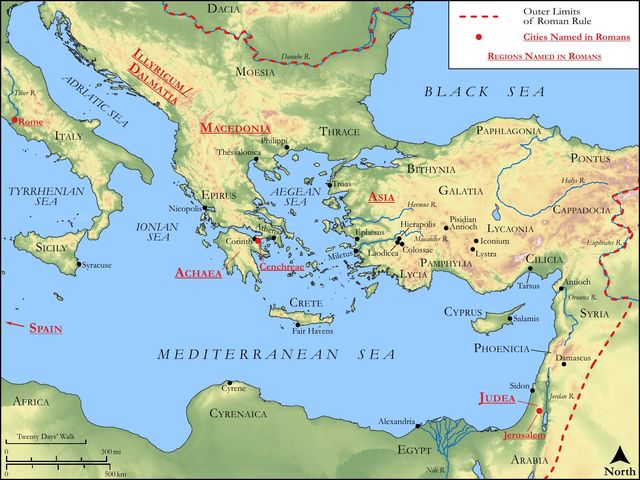
See on the biblical-era maps

Study this verse
Public-domain commentary
Matthew Henry
From his Commentary on the Whole Bible. Henry comments on passages, not single verses — this entry covers Romans 5:6–21. His four-level outline is real structure in the source text, so it is rendered as structure.
The apostle here describes the fountain and foundation of justification, laid in the death of the Lord Jesus. The streams are very sweet, but, if you run them up to the spring-head, you will find it to be Christ's dying for us; it is in the precious stream of Christ's blood that all these privileges come flowing to us: and therefore he enlarges upon this instance of the love of God which is shed abroad. Three things he takes notice of for the explication and illustration of this doctrine: - 1. The persons he died for, Rom 5:6-8. 2. The precious fruits of his death, Rom 5:9-11. 3. The parallel he runs between the communication of sin and death by the first Adam and of righteousness and life by the second Adam, Rom 5:12, to the end.
I.The character we were under when Christ died for us.
1.We were without strength (Rom 5:6), in a sad condition; and, which is worse, altogether unable to help ourselves out of that condition - lost, and no visible way open for our recovery - our condition deplorable, and in a manner desperate; and, therefore our salvation is here said to come in due time. God's time to help and save is when those that are to be saved are without strength, that his own power and grace may be the more magnified, Deu 32:36. It is the manner of God to help at a dead lift,
2.He died for the ungodly; not only helpless creatures, and therefore likely to perish, but guilty sinful creatures, and therefore deserving to perish; not only mean and worthless, but vile and obnoxious, unworthy of such favour with the holy God. Being ungodly, they had need of one to die for them, to satisfy for guilt, and to bring in a righteousness. This he illustrates (Rom 5:7, Rom 5:8) as an unparalleled instance of love; herein God's thoughts and ways were above ours. Compare Joh 15:13, Joh 15:14, Greater love has no man.
(1.)One would hardly die for a righteous man, that is, an innocent man, one that is unjustly condemned; every body will pity such a one, but few will put such a value upon his life as either to hazard, or much less to deposit, their own in his stead.
(2.)It may be, one might perhaps be persuaded to die for a good man, that is, a useful man, who is more than barely a righteous man. Many that are good themselves yet do but little good to others; but those that are useful commonly get themselves well beloved, and meet with some that in a case of necessity would venture to be their antipsuchoi - would engage life for life, would be their bail, body for body. Paul was, in this sense, a very good man, one that was very useful, and he met with some that for his life laid down their own necks, Rom 16:4. And yet observe how he qualifies this: it is but some that would do so, and it is a daring act if they do it, it must be some bold venturing soul; and, after all, it is but a peradventure.
(3.)But Christ died for sinners (Rom 5:8), neither righteous nor good; not only such as were useless, but such as were guilty and obnoxious; not only such as there would be no loss of should they perish, but such whose destruction would greatly redound to the glory of God's justice, being malefactors and criminals that ought to die. Some think he alludes to a common distinction the Jews had of their people into tsaddim - righteous, chesedim - merciful (compare Isa 57:1), and rashim - wicked. Now herein God commended his love, not only proved or evidenced his love (he might have done that at a cheaper rate), but magnified it and made it illustrious. This circumstance did greatly magnify and advance his love, not only put it past dispute, but rendered it the object of the greatest wonder and admiration: "Now my creatures shall see that I love them, I will give them such an instance of it as shall be without parallel." Commendeth his love, as merchants commend their goods when they would put them off. This commending of his love was in order to the shedding abroad of his love in our hearts by the Holy Ghost. He evinces his love in the most winning, affecting, endearing way imaginable. While we were yet sinners, implying that we were not to be always sinners, there should be a change wrought; for he died to save us, not in our sins, but from our sins; but we were yet sinners when he died for us.
(4.)Nay, which is more, we were enemies (Rom 5:10), not only malefactors, but traitors and rebels, in arms against the government; the worst kind of malefactors and of all malefactors the most obnoxious. The carnal mind is not only an enemy to God, but enmity itself, Rom 8:7; Col 1:21. This enmity is a mutual enmity, God loathing the sinner, and the sinner loathing God, Zac 11:8. And that for such as these Christ should die is such a mystery, such a paradox, such an unprecedented instance of love, that it may well be our business to eternity to adore and wonder at it. This is a commendation of love indeed. Justly might he who had thus loved us make it one of the laws of his kingdom that we should love our enemies.
II.The precious fruits of his death.
1.Justification and reconciliation are the first and primary fruit of the death of Christ: We are justified by his blood (Rom 5:9), reconciled by his death, Rom 5:10. Sin is pardoned, the sinner accepted as righteous, the quarrel taken up, the enmity slain, an end made of iniquity, and an everlasting righteousness brought in. This is done, that is, Christ has done all that was requisite on his part to be done in order hereunto, and, immediately upon our believing, we are actually put into a state of justification and reconciliation. Justified by his blood. Our justification is ascribed to the blood of Christ because without blood there is no remission Heb 9:22. The blood is the life, and that must go to make atonement. In all the propitiatory sacrifices, the sprinkling of the blood was of the essence of the sacrifice. It was the blood that made an atonement for the soul, Lev 17:11.
2.Hence results salvation from wrath: Saved from wrath (Rom 5:9), saved by his life, Rom 5:10 When that which hinders our salvation is taken away, the salvation must needs follow. Nay, the argument holds very strongly; if God justified and reconciled us when we were enemies, and put himself to so much charge to do it, much more will he save us when we are justified and reconciled. He that has done the greater, which is of enemies to make us friends, will certainly the less, which is when we are friends to use us friendly and to be kind to us. And therefore the apostle, once and again, speaks of it with a much more. He that hath digged so deep to lay the foundation will no doubt build upon that foundation. - We shall be saved from wrath, from hell and damnation. It is the wrath of God that is the fire of hell; the wrath to come, so it is called, Th1 1:10. The final justification and absolution of believers at the great day, together with the fitting and preparing of them for it, are the salvation from wrath here spoken of; it is the perfecting of the work of grace. - Reconciled by his death, saved by his life. His life here spoken of is not to be understood of his life in the flesh, but his life in heaven, that life which ensued after his death. Compare Rom 14:9. He was dead, and is alive, Rev 1:18. We are reconciled by Christ humbled, we are saved by Christ exalted. The dying Jesus laid the foundation, in satisfying for sin, and slaying the enmity, and so making us salvable; thus is the partition-wall broken down, atonement made, and the attainder reversed; but it is the living Jesus that perfects the work: he lives to make intercession, Heb 7:25. It is Christ, in his exaltation, that by his word and Spirit effectually calls, and changes, and reconciles us to God, is our Advocate with the Father, and so completes and consummates our salvation. Compare Rom 4:25 and Rom 8:34. Christ dying was the testator, who bequeathed us the legacy; but Christ living is the executor, who pays it. Now the arguing is very strong. He that puts himself to the charge of purchasing our salvation will not decline the trouble of applying it.
3.All this produces, as a further privilege, our joy in God, Rom 5:11. God is now so far from being a terror to us that he is our joy, and our hope in the day of evil, Jer 17:17. We are reconciled and saved from wrath. Iniquity, blessed be God, shall not be our ruin. And not only so, there is more in it yet, a constant stream of favours; we not only go to heaven, but go to heaven triumphantly; not only get into the harbour, but come in with full sail: We joy in God, not only saved from his wrath, but solacing ourselves in his love, and this through Jesus Christ, who is the Alpha and the Omega, the foundation-stone and the top-stone of all our comforts and hopes - not only our salvation, but our strength and our song; and all this (which he repeats as a string he loved to be harping upon) by virtue of the atonement, for by him we Christians, we believers, have now, now in gospel times, or now in this life, received the atonement, which was typified by the sacrifices under thee law, and is an earnest of our happiness in heaven. True believers do by Jesus Christ receive the atonement. Receiving the atonement is our actual reconciliation to God in justification, grounded upon Christ's satisfaction. To receive the atonement is,
(1.)To give our consent to the atonement, approving of, and agreeing to, those methods which Infinite Wisdom has taken of saving a guilty world by the blood of a crucified Jesus, being willing and glad to be saved in a gospel way and upon gospel terms.
(2.)To take the comfort of the atonement, which is the fountain and the foundation of our joy in God. Now we joy in God, now we do indeed receive the atonement, Kauchōmenoi - glorying in it. God hath received the atonement (Mat 3:17; Mat 17:5; Mat 28:2): if we but receive it, the work is done.
III.The parallel that the apostle runs between the communication of sin and death by the first Adam and of righteousness and life by the second Adam (Rom 5:12, to the end), which not only illustrates the truth he is discoursing of, but tends very much to the commending of the love of God and the comforting of the hearts of true believers, in showing a correspondence between our fall and our recovery, and not only a like, but a much greater power in the second Adam to make us happy, than there was in the first to make us miserable. Now, for the opening of this, observe,
1.A general truth laid down as the foundation of his discourse - that Adam was a type of Christ (Rom 5:14): Who is the figure of him that was to come. Christ is therefore called the last Adam, Co1 15:45. Compare Co1 15:22. In this Adam was a type of Christ, that in the covenant-transactions that were between God and him, and in the consequent events of those transactions, Adam was a public person. God dealt with Adam and Adam acted as such a one, as a common father and factor, root and representative, of and for all his posterity; so that what he did in that station, as agent for us, we may be said to have done in him, and what was done to him may be said to have been done to us in him. Thus Jesus Christ, the Mediator, acted as a public person, the head of all the elect, dealt with God for them, as their father, factor, root, and representative - died for them, rose for them, entered within the veil for them, did all for them. When Adam failed, we failed with him; when Christ performed, he performed for us. Thus was Adam tupos tou mellontos - the figure of him that was to come, to come to repair that breach which Adam had made.
2.A more particular explication of the parallel, in which observe,
(1.)How Adam, as a public person, communicated sin and death to all his posterity (Rom 5:12): By one man sin entered. We see the world under a deluge of sin and death, full of iniquities and full of calamities. Now, it is worth while to enquire what is the spring that feeds it, and you will find it to be the general corruption of nature; and at what gap it entered, and you will find it to have been Adam's first sin. It was by one man, and he the first man (for if any had been before him they would have been free), that one man from whom, as from the root, we all spring.
[1.]By him sin entered. When God pronounced all very good (Gen 1:31) there was no sin in the world; it was when Adam ate forbidden fruit that sin made its entry. Sin had before entered into the world of angels, when many of them revolted from their allegiance and left their first estate; but it never entered into the world of mankind till Adam sinned. Then it entered as an enemy, to kill and destroy, as a thief, to rob and despoil; and a dismal entry it was. Then entered the guilt of Adam's sin imputed to posterity, and a general corruption and depravedness of nature. Eph' hō - for that (so we read it), rather in whom, all have sinned. Sin entered into the world by Adam, for in him we all sinned. As, Co1 15:22, in Adam all die; so here, in him all have sinned; for it is agreeable to the law of all nations that the acts of a public person be accounted theirs whom they represent; and what a whole body does every member of the same body may be said to do. Now Adam acted thus as a public person, by the sovereign ordination and appointment of God, and yet that founded upon a natural necessity; for God, as the author of nature, had made this the law of nature, that man should beget in his own likeness, and so the other creatures. In Adam therefore, as in a common receptacle, the whole nature of man was reposited, from him to flow down in a channel to his posterity; for all mankind are made of one blood (Act 17:26), so that according as this nature proves through his standing or falling, before he puts it out of his hands, accordingly it is propagated from him. Adam therefore sinning and falling, the nature became guilty and corrupt, and is so derived. Thus in him all have sinned.
[2.]Death by sin, for death is the wages of sin. Sin, when it is finished, brings forth death. When sin came, of course death came with it. Death is here put for all that misery which is the due desert of sin, temporal, spiritual, eternal death. If Adam had not sinned, he had not died; the threatening was, In the day thou eatest thou shall surely die, Gen 2:17.
[3.]So death passed, that is, a sentence of death was passed, as upon a criminal, diēlthen - passed through all men, as an infectious disease passes through a town, so that none escape it. It is the universal fate, without exception: death passes upon all. There are common calamities incident to human life which do abundantly prove this. Death reigned, Rom 5:14. He speaks of death as a mighty prince, and his monarchy the most absolute, universal, and lasting monarchy. None are exempted from its sceptre; it is a monarchy that will survive all other earthly rule, authority, and power, for it is the last enemy, Co1 15:26. Those sons of Belial that will be subject to no other rule cannot avoid being subject to this. Now all this we may thank Adam for; from him sin and death descend. Well may we say, as that good man, observing the change that a fit of sickness had made in his countenance, O Adam! what hast thou done?
Further, to clear this, he shows that sin did not commence with the law of Moses, but was in the world until, or before, that law; therefore that law of Moses is not the only rule of life, for there was a rule, and that rule was transgressed, before the law was given. It likewise intimates that we cannot be justified by our obedience to the law of Moses, any more than we were condemned by and for our disobedience to it. Sin was in the world before the law; witness Cain's murder, the apostasy of the old world, the wickedness of Sodom. His inference hence is, Therefore there was a law; for sin is not imputed where there is no law. Original sin is a want of conformity to, and actual sin is a transgression of, the law of God: therefore all were under some law. His proof of it is, Death reigned from Adam to Moses, Rom 5:14. It is certain that death could not have reigned if sin had not set up the throne for him. This proves that sin was in the world before the law, and original sin, for death reigned over those that had not sinned any actual sin, that had not sinned after the similitude of Adam's transgression, never sinned in their own persons as Adam did - which is to be understood of infants, that were never guilty of actual sin, and yet died, because Adam's sin was imputed to them. This reign of death seems especially to refer to those violent and extraordinary judgments which were long before Moses, as the deluge and the destruction of Sodom, which involved infants. It is a great proof of original sin that little children, who were never guilty of any actual transgression, are yet liable to very terrible diseases, casualties, and deaths, which could by no means be reconciled with the justice and righteousness of God if they were not chargeable with guilt.
(2.)How, in correspondence to this, Christ, as a public person, communicates righteousness and life to all true believers, who are his spiritual seed. And in this he shows not only wherein the resemblance holds, but, ex abundanti, wherein the communication of grace and love by Christ goes beyond the communication of guilt and wrath by Adam. Observe,
[1.]Wherein the resemblance holds. This is laid down most fully, Rom 5:18, Rom 5:19.
First, By the offence and disobedience of one many were made sinners, and judgment came upon all men to condemnation. Here observe, 1. That Adam's sin was disobedience, disobedience to a plain and express command: and it was a command of trial. The thing he did was therefore evil because it was forbidden, and not otherwise; but this opened the door to other sins, though itself seemingly small. 2. That the malignity and poison of sin are very strong and spreading, else the guilt of Adam's sin would not have reached so far, nor have been so deep and long a stream. Who would think there should be so much evil in sin? 3. That by Adam's sin many are made sinners: many, that is, all his posterity; said to be many, in opposition to the one that offended, Made sinners, katestathēsan. It denotes the making of us such by a judicial act: we were cast as sinners by due course of law. 4. That judgment is come to condemnation upon all those that by Adam's disobedience were made sinners. Being convicted, we are condemned. All the race of mankind lie under a sentence, like an attainder upon a family. There is judgment given and recorded against us in the court of heaven; and, if the judgment be not reversed, we are likely to sink under it to eternity.
Secondly, In like manner, by the righteousness and obedience of one (and that one is Jesus Christ, the second Adam), are many made righteous, and so the free gift comes upon all. It is observable how the apostle inculcates this truth, and repeats it again and again, as a truth of very great consequence. Here observe, 1. The nature of Christ's righteousness, how it is brought in; it is by his obedience. The disobedience of the first Adam ruined us, the obedience of the second Adam saves us, - his obedience to the law of mediation, which was that he should fulfil all righteousness, and then make his soul an offering for sin. By his obedience to this law he wrought out a righteousness for us, satisfied God's justice, and so made way for us into his favour. 2. The fruit of it. (1.) There is a free gift come upon all men, that is, it is made and offered promiscuously to all. The salvation wrought is a common salvation; the proposals are general, the tender free; whoever will may come, and take of these waters of life. This free gift is to all believers, upon their believing, unto justification of life. It is not only a justification that frees from death, but that entitles to life. (2.) Many shall be made righteous - many compared with one, or as many as belong to the election of grace, which, though but a few as they are scattered up and down in the world, yet will be a great many when they come all together. Katastathēsontai - they shall be constituted righteous, as by letters patent. Now the antithesis between these two, our ruin by Adam and our recovery by Christ, is obvious enough.
[2.]Wherein the communication of grace and love by Christ goes beyond the communication of guilt and wrath by Adam; and this he shows, Rom 5:15-17. It is designed for the magnifying of the riches of Christ's love, and for the comfort and encouragement of believers, who, considering what a wound Adam's sin has made, might begin to despair of a proportionable remedy. His expressions are a little intricate, but this he seems to intend: - First, If guilt and wrath be communicated, much more shall grace and love; for it is agreeable to the idea we have of the divine goodness to suppose that he should be more ready to save upon an imputed righteousness than to condemn upon an imputed guilt: Much more the grace of God, and the gift by grace. God's goodness is, of all his attributes, in a special manner his glory, and it is that grace that is the root (his favour to us in Christ), and the gift is by grace. We know that God is rather inclined to show mercy; punishing is his strange work. Secondly, If there was so much power and efficacy, as it seems there was, in the sin of a man, who was of the earth, earthy, to condemn us, much more are there power and efficacy in the righteousness and grace of Christ, who is the Lord from heaven, to justify and save us. The one man that saves us is Jesus Christ. Surely Adam could not propagate so strong a poison but Jesus Christ could propagate as strong an antidote, and much stronger. 3. It is but the guilt of one single offence of Adam's that is laid to our charge: The judgment was ex henos eis katakrima, by one, that is, by one offence, Rom 5:16, Rom 5:17. Margin. But from Jesus Christ we receive and derive an abundance of grace, and of the gift of righteousness. The stream of grace and righteousness is deeper and broader than the stream of guilt; for this righteousness does not only take away the guilt of that one offence, but of many other offences, even of all. God in Christ forgives all trespasses, Col 2:13. 4. By Adam's sin death reigned; but by Christ's righteousness there is not only a period put to the reign of death, but believers are preferred to reign of life, Rom 5:17. In and by the righteousness of Christ we have not only a charter of pardon, but a patent of honour, are not only freed from our chains, but, like Joseph, advanced to the second chariot, and made unto our God kings and priests - not only pardoned, but preferred. See this observed, Rev 1:5, Rev 1:6; Rev 5:9, Rev 5:10. We are by Christ and his righteousness entitled to, and instated in, more and greater privileges than we lost by the offence of Adam. The plaster is wider than the wound, and more healing than the wound is killing.
IV.In the last two verses the apostle seems to anticipate an objection which is expressed, Gal 3:19, Wherefore then serveth the law? Answer,
1.The law entered that the offence might abound. Not to make sin to abound the more in itself, otherwise than as sin takes occasion by the commandment, but to discover the abounding sinfulness of it. The glass discovers the spots, but does not cause them. When the commandment came into the world sin revived, as the letting of a clearer light into a room discovers the dust and filth which were there before, but were not seen. It was like the searching of a wound, which is necessary to to the cure. The offence, paraptōma - that offence, the sin of Adam, the extending of the guilt of it to us, and the effect of the corruption in us, are the abounding of that offence which appeared upon the entry of the law.
2.That grace might much more abound - that the terrors of the law might make gospel-comforts so much the sweeter. Sin abounded among the Jews; and, to those of them that were converted to the faith of Christ, did not grace much more abound in the remitting of so much guilt and the subduing of so much corruption? The greater the strength of the enemy, the greater the honour of the conqueror. This abounding of grace he illustrates, Rom 5:21. As the reign of a tyrant and oppressor is a foil to set off the succeeding reign of a just and gentle prince and to make it the more illustrious, so doth the reign of sin set off the reign of grace. Sin reigned unto death; it was a cruel bloody reign. But grace reigns to life, eternal life, and this through righteousness, righteousness imputed to us for justification, implanted in us for sanctification; and both by Jesus Christ our Lord, through the power and efficacy of Christ, the great prophet, priest, and king, of his church.
Historical interpretation
Historical reception
6 surviving comments on this verse. Each one is dated, so this reads as a timeline rather than a list.
Select a marker to jump to its quote. Markers stagger vertically where authors wrote within a few decades of each other.
There is an obvious difference between the fact that those who have sinned in imitation of Adam’s transgression have been condemned and the fact that the grace of God in Christ has justified men not from one trespass but from many sins, giving them forgiveness of sins.
Paul wants to say that it was because of Adam’s sin, although it was only one, that God condemned many, on account of the fact that they copied Adam. But the grace of the Lord was measured not according to that one sin but according to the many sins which all had committed. Thus Christ transformed many sins into righteousness.
And what is this that he is speaking of? It is that sin had power to bring in death and condemnation; but grace did not do away that one sin only, but also those that followed after in its train. Lest then the words "as" and "so" might seem to make the measure of the blessings and the evils equal, and that you might not think, upon hearing of Adam, that it was only that sin which he had brought in which was done away with, he says that it was from many offences that an indemnity was brought about. How is this plain? Because after the numberless sins committed after that in paradise, the matter issued in justification. But where righteousness is, there of necessity follows by all means life, and the countless blessings, as does death where sin was. For righteousness is more than life, since it is even the root of life. That there were several goods then brought in, and that it was not that sin only that was taken away, but all the rest along with it, he points out when he says, that "the gift was of many offences unto justification." In which a proof is necessarily included, that death was also torn up by the roots.
The effect of the gift is greater than that of the sin. From the sin of one righteous man came the judgment of death. Adam never came across all the righteousness which he destroyed, but Christ discharged the sins of many by his grace. Adam was only the model for sin, but Christ both forgave sins freely and gave an example of righteousness.
There is one great difference between Adam’s sin and God’s gift in Christ. Adam’s sin brought punishment on all those who came after him, and so they died. But the free gift is different. For not only did it take effect in the case of those who came afterward; it also took away the sins of those who had gone before. It is therefore much greater, because where sin harmed those who came after, grace rescued not only those who came after but those who had transgressed before as well.
This is the difference: in Adam one sin was condemned, but by the Lord many sins have been forgiven.
Continue studying Romans 5:16 across the web’s major study libraries — every link below opens this exact verse, chapter, or book on the destination site.
Read & Compare
 BibleGatewayThis verse in more than 200 translations and 70 languages.
 Bible.comThe YouVersion reader — hundreds of translations, reading plans, and highlights.
 ESV.orgCrossway's official English Standard Version reader.
 NET BibleThe NET translation with 60,000+ translators' notes on every rendering decision.
 STEP BibleTyndale House's free study tool — original text, vocabulary, and scholarly resources.
 BibliaLogos Bible Software's free web reader.
 USCCBThe New American Bible (Revised Edition) with the U.S. bishops' study notes.
Commentaries
 BibleHub CommentariesDozens of classic commentaries on this verse, gathered on one page.
 StudyLightMore than 100 commentary sets — the largest collection on the web.
 BibleRefPlain-English commentary on what this verse means, verse by verse.
 Enduring WordDavid Guzik's free commentary on this chapter, widely used by Bible teachers.
 Bible Study ToolsVerse commentary alongside Greek and Hebrew study aids.
Original Language & Research
- BibleHub InterlinearThe verse word by word — original language, transliteration, and English.
- BibleHub LexiconEvery word's original-language definition and Strong's entry.
 Blue Letter BibleDeep-study tools — Strong's numbers, concordance, and word studies.
 CNTR CollationThe earliest Greek manuscripts of this verse, collated letter by letter.
Sermons, Hymns & Audio


TrulyRandomVerse is not affiliated with these sites and doesn’t control their content. They’re linked because they’re genuinely useful.
Summary
Romans 5:16 meticulously elaborates on the profound disparity between the consequences of Adam's singular transgression and the boundless efficacy of God's gracious gift in Christ. Paul highlights that while Adam's one act of disobedience resulted in a universal judgment leading to condemnation for all humanity, the divine "free gift" through Jesus Christ addresses the multitude of human offenses, culminating in a declaration of complete justification for those who receive it. This verse underscores the radical abundance of God's grace, which not only counteracts but overwhelmingly surpasses the destructive power of sin.
Context
ShowHideLiterary Context
Romans 5:16 is an integral part of Paul's extended theological argument in Romans 5, where he meticulously compares and contrasts the federal headship of Adam with that of Christ. Building upon the declaration in Romans 5:12, which establishes how sin and death entered the world through one man, Paul then proceeds to demonstrate the even greater impact of Christ's righteousness. Verses Romans 5:13-14 clarify that sin was present and death reigned even before the Mosaic Law, emphasizing the universal reach of Adam's sin. Verse Romans 5:15 introduces the concept that "the free gift is not like the trespass," setting the stage for the more detailed explanation in verse 16, which explicitly differentiates the outcomes: condemnation from Adam versus justification from Christ. This verse, along with Romans 5:17-19, solidifies the argument for the superabundance of grace over sin, culminating in the triumphant declaration of grace reigning through righteousness to eternal life in Romans 5:21.
Historical & Cultural Context
Paul's audience in Rome was a diverse community of Jewish and Gentile believers, grappling with questions of law, sin, and righteousness. The concept of corporate solidarity, where the actions of a representative figure (like Adam or Abraham) have implications for all their descendants, was deeply ingrained in both Jewish thought and Roman societal structures. Adam, as the first man, acted as the federal head of humanity, and his sin had far-reaching consequences for all subsequent generations. Paul leverages this understanding to explain how Christ, as the "second Adam" or new federal head, similarly impacts all who are "in him." The legal terminology used—"judgment," "condemnation," "justification"—would resonate with the Roman context, which was highly structured by law and legal proceedings. Paul is essentially presenting a divine courtroom scenario where humanity's legal standing is determined, first by Adam's trespass, and then decisively by Christ's redemptive work.
Key Themes
ShowHideRomans 5:16 contributes significantly to several overarching themes within Romans. The primary theme is the Contrast between Adam and Christ, highlighting the destructive power of sin through one man versus the life-giving power of grace through another. This verse sharply differentiates Condemnation from Justification: Adam's act led to a legal verdict of guilt and condemnation for all, while Christ's act provides a legal declaration of righteousness. It also emphasizes the Abundance and Superabundance of Grace, demonstrating that God's gift in Christ is not merely a counter-balance to sin but an overflowing provision that far exceeds the damage caused by "many offenses." This concept of grace reigning is foundational to Paul's theology, as seen in Romans 5:20. Furthermore, the verse implicitly touches on the theme of Imputation, where Adam's sin is reckoned to humanity, and Christ's righteousness is reckoned to believers, a concept further developed in Romans 4.
Exposition and Analysis
ShowHideKey Word Analysis
ShowHideFrom dōreomai, meaning "a bestowment." This term refers to something freely given, emphasizing the gratuitous nature of God's provision. In this context, it refers to the gift of justification and life that comes through Christ, distinct from anything earned or merited.
From krínō, meaning "a decision (the function or the effect, for or against)." Here, it denotes the verdict or sentence that resulted from Adam's sin. It's a legal pronouncement, a judicial decision that led to a specific outcome for humanity.
From dikaioō, meaning "an equitable deed; by implication, a statute or decision." In this verse, it is used in parallel with kríma (judgment) and refers to the righteous act or, more precisely, the declaration of righteousness. It signifies being declared righteous in God's sight, a legal standing of innocence and acceptance, which is the result of the "free gift."
Verse Breakdown
ShowHide"And not as [it was] by one that sinned, [so is] the gift:"
This opening clause sets up the fundamental contrast. Paul asserts that the nature and outcome of God's "gift" through Christ are fundamentally different from the consequences brought about by the "one that sinned" (Adam). The "gift" here, though not yet fully defined, is presented as an antithesis to the result of Adam's transgression. It implies a qualitative difference in impact and scope.
"for the judgment [was] by one to condemnation,"
This clause explains the negative side of the contrast. Adam's single act of sin (the "one that sinned") led to a "judgment" (a divine verdict or legal decision) that resulted in "condemnation." This condemnation is not merely a consequence but a judicial sentence, a declaration of guilt and liability to punishment, affecting all humanity because of Adam's federal headship.
"but the free gift [is] of many offences unto justification."
This clause presents the glorious counterpoint, introduced by the strong adversative "but." The "free gift" (a more emphatic term for grace) originates from God and addresses "many offences"—not just Adam's one sin, but the countless individual transgressions of humanity. Critically, this gift leads "unto justification," meaning it results in a declaration of righteousness, a right standing before God. This highlights the expansive and superabundant nature of God's grace, which covers and redeems from the vast accumulation of human sin.
Literary Devices
ShowHidePaul masterfully employs Contrast and Antithesis throughout this verse to underscore the radical difference between the two Adams and their respective impacts. The structure itself is a powerful demonstration of Parallelism, setting up "one that sinned" against "the free gift," and "judgment...to condemnation" against "free gift...unto justification." The repetition of "by one" emphasizes the singular origin of both the sin and the redemptive act. Furthermore, the phrase "many offences" contrasted with "one that sinned" uses a form of Hyperbole or Superabundance to highlight that God's grace in Christ is not merely sufficient to cover Adam's sin, but is vastly more powerful, able to justify those burdened by innumerable personal transgressions. This rhetorical strategy amplifies the magnitude and efficacy of God's saving work.
Theological and Thematic Connections
ShowHideRomans 5:16 is a cornerstone for understanding the doctrine of imputation and the nature of God's grace. It clarifies that just as Adam's sin was imputed to humanity, resulting in a state of condemnation, so too Christ's righteousness is imputed to believers, leading to justification. This is not a mere pardon, but a complete change in legal status, a declaration of righteousness based on Christ's perfect obedience and sacrifice. The "free gift" emphasizes that this new standing is entirely unmerited, a lavish expression of divine favor that far outweighs the destructive power of sin. It highlights the finished work of Christ as the definitive answer to humanity's fallen condition, moving from a verdict of guilt to a verdict of grace.
Reflection and Application
ShowHideRomans 5:16 offers profound comfort and assurance to the believer. It reminds us that our standing before God is not based on our own performance or the cumulative weight of our "many offences," but entirely on the "free gift" of Christ's righteousness. This truth liberates us from the burden of trying to earn God's favor or fearing condemnation due to our past failures. Instead, it invites us to rest in the finished work of Jesus, whose grace is so abundant that it not only covers our sins but declares us righteous. This understanding should cultivate deep gratitude, humility, and confidence in God's unfailing love. It also calls us to live lives that reflect this radical grace, extending forgiveness and compassion to others, knowing that we ourselves have been recipients of an immeasurable gift.
Questions for Reflection
ShowHideFAQ
ShowHideWhat is the difference between "gift" (dōrēma) and "free gift" (chárisma) in this verse?
ShowHideWhile both terms denote something given, their usage in Romans 5:16 distinguishes their emphasis. "Gift" (G1434, dṓrēma') is a general term for a bestowal, used in the first part of the verse to refer broadly to the outcome of Christ's work. "Free gift" (G5486, chárisma') is a more specific and theologically loaded term, derived from charis (grace). It emphasizes that the gift is a "divine gratuity," something given purely out of grace, without any merit or earning on the part of the recipient. Paul uses chárisma to highlight the unmerited, grace-based nature of justification, contrasting it sharply with the condemnation that came through Adam's sin. This distinction underscores the sheer graciousness and unearned nature of salvation in Christ, as further elaborated in Romans 6:23.
Christ-Centered Fulfillment
ShowHideRomans 5:16 finds its ultimate fulfillment in Jesus Christ as the "last Adam" (1 Corinthians 15:45), who perfectly reversed the curse brought by the first Adam. Where Adam's single act of disobedience plunged humanity into a state of condemnation, Christ's singular act of perfect obedience and sacrificial death on the cross (Philippians 2:8) became the basis for a "free gift" of justification that covers "many offences." Jesus, through His atoning work, absorbed the judgment and condemnation that humanity deserved (Romans 8:1), thereby securing a righteous standing for all who believe. His resurrection (Romans 4:25) validated His triumph over sin and death, establishing Him as the source of eternal life and righteousness. Thus, Christ is the embodiment of the "free gift," the one through whom God's abundant grace reigns, transforming a verdict of condemnation into a declaration of perfect justification.