


Isaiah 44:22
- מָחִיתִיma·Chi·tiI have wiped outH4229V-Qal-Perf-1csVerb Qal Perfect 1st Singular common gender
- כָעָבkha·'Avlike <the> dark cloudH5645Prep-k ¦ N-msNoun Singular Masculine Absoluteכָlike <the>עָבdark cloud
- פְּשָׁעֶיךָpe·sha·'Ei·khayour transgressionsH6588N-mpc ¦ 2msNoun Plural Masculine Constructפְּשָׁעֶיtransgressionsךָyour
- וְכֶעָנָןve·khe·'a·Nanand like <the> cloudH6051Conj-w ¦ Prep-k ¦ N-msNoun Singular Masculine Absoluteוְandכֶlike <the>עָנָןcloud
- חַטֹּאותֶיךָcha·to·Tei·khayour sinsH2403N-fpc ¦ 2msNoun Plural Feminine Constructחַטֹּאותֶיsinsךָyour
- שׁוּבָהshu·Vahreturn !H7725V-Qal-Imp-2ms ¦ SfxVerb Qal Imperative 2nd Singular Masculineשׁוּבָreturnה!
- אֵלַי'e·Laito meH413Prep ¦ 1csPrepositionאֵלַtoיme
- כִּיkiforH3588PrtParticle Conditional
- גְאַלְתִּיךָge·'al·Ti·khaI have redeemed youH1350V-Qal-Perf-1cs ¦ 2msVerb Qal Perfect 1st Singular common genderגְאַלְתִּיI have redeemedךָyou
English is a literal word-by-word gloss of the Hebrew, not the KJV's wording. Why?
This is the original text the KJV's translators worked from — each Hebrew word with its own literal English meaning in this verse, prepared by scholars at Tyndale House, Cambridge. The KJV translates whole sentences, not word by word, so its wording differs: one Hebrew word can become several English words, and the KJV may choose “the LORD” where the gloss reads “Yahweh”. Both are faithful — they answer different questions. For the KJV's own rendering, switch to the KJV text.
Details
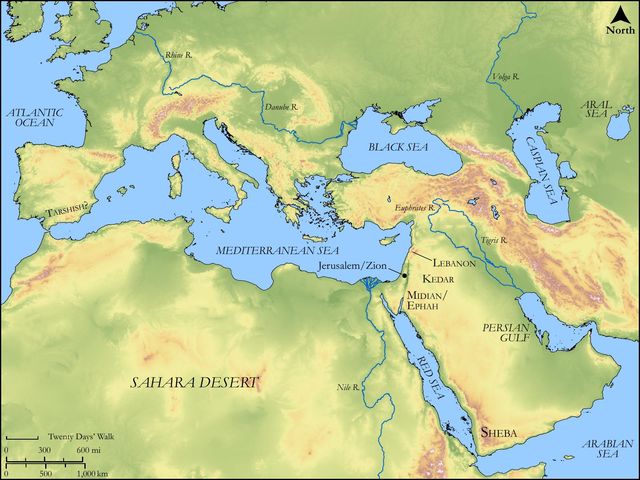
See on the biblical-era map
Study this verse
Public-domain commentary
Matthew Henry
From his Commentary on the Whole Bible. Henry comments on passages, not single verses — this entry covers Isaiah 44:21–28. His four-level outline is real structure in the source text, so it is rendered as structure.
In these verses we have,
I.The duty which Jacob and Israel, now in captivity, were called to, that they might be qualified and prepared for the deliverance designed them. Our first care must be to get good by our afflictions, and then we may hope to get out of them. The duty is expressed in two words: Remember and return, as in the counsel to Ephesus, Rev 2:4, Rev 2:5. 1. "Remember these, O Jacob! Remember what thou hast been told of the folly of idolatry, and let the convictions thou art now under be ready to thee whenever thou art tempted to that sin. Remember that thou art my servant, and therefore must not serve other masters." 2. Return unto me, Isa 44:22. It is the great concern of those who have backslidden from God to hasten their return to him; and this is that which he calls them to when they are in affliction, and when he is returning to them in a way of mercy.
II.The favours which Jacob and Israel, now in captivity, were assured of; and what is here promised to them upon their remembering and returning to God is in a spiritual sense promised to all that in like manner return to God. It is a very comfortable word, for more is implied in it than is expressed (Isa 44:21): "O Israel! thou shalt not be forgotten of me, though for the present thou seemest to be so." When we begin to remember God he will begin to remember us; nay, it is he that remembers us first. Now observe here,
1.The grounds upon which God's favourable intentions to his people were built and on which they might build their expectations from him. He will deliver them out of captivity; for,
(1.)They are his servants, and therefore he has a just quarrel with those that detain them. Let my people go, that they may serve me. The servants of the King of kings are under special protection.
(2.)He formed them into a people, formed them from the womb, Isa 44:24. From the first beginning of their increase into a nation they were under his particular care and government, more than any other people; their national constitution was of his framing, and his covenant with them was the charter by which they were incorporated. They are his, and he will save them.
(3.)He has redeemed them formerly, has many a time redeemed them out of great distress, and he is still the same, in the same relation to them, has the same concern for them. "Therefore return unto me, for I have redeemed thee, Isa 44:22. Whither wilt thou go, but to me?" Having redeemed them, as well as formed them, he has acquired a further title to them and propriety in them, which is a good reason why they should dutifully return to him and why he will graciously return to them. The Lord has redeemed Jacob; he is about to do it (Isa 44:23); he has determined to do it; for he is the Lord their Redeemer, Isa 44:24. Note, The work of redemption which God has by his Son wrought for us encourages us to hope for all promised blessings from him. He that has redeemed us at so vast an expense will not lose his purchase.
(4.)He has glorified himself in them (Isa 44:23), and therefore will do so still, Joh 12:28. It is matter of comfort to us to see God's glory interested in the deliverances of the church; for therefore he will certainly redeem Jacob, because thus he will glorify himself. And this assures us that he will perfect the redemption of his saints by Jesus Christ, because there is a day set when he will be glorified and admired in them all.
(5.)He has pardoned their sins, which were the cause of their calamity and the only obstruction to their deliverance, Isa 44:22. Therefore he will break the yoke of captivity from off their necks, because he has blotted out, as a thick cloud, their transgressions. Note,
[1.]Our transgressions and our sins are as a cloud, a thick cloud; they interpose between heaven and earth, and for a time suspend and intercept the correspondence between the upper and lower world (sin separates between us and God, Isa 59:2); they threaten a storm, a deluge of wrath, as thick clouds do, which God will rain upon sinners. Psa 11:6.
[2.]When God pardons sin he blots out this cloud, this thick cloud, so that the intercourse with heaven is laid open again. God looks down upon the soul with favour; the soul looks up to him with pleasure. The cloud is scattered by the influence of the Sun of righteousness. It is only through Christ that sin is pardoned. When sin is pardoned, like a cloud that is scattered, it appears no more, it is quite gone. The iniquity of Jacob shall be sought for, and not found, Jer 50:20. And the comforts that flow into the soul when sin is pardoned are like the clear shining after clouds and rain.
2.The universal joy which the deliverance of God's people should bring along with it (Isa 44:23): Sing, O you heavens! This intimates,
(1.)That the whole creation shall have cause for joy and rejoicing in the redemption of God's people; to that it is owing that it subsists (that it is rescued from the curse which the sin of man brought upon the ground) and that it is again put into a capacity of answering the ends of its being, and is assured that though now it groans, being burdened, it shall at last be delivered from the bondage of corruption. The greatest establishment of the world is the kingdom of God in it, Psa 96:11-13; Psa 98:7-9.
(2.)That the angels shall rejoice in it, and the inhabitants of the upper world. The heavens shall sing, for the Lord has done it. And there is joy in heaven when God and man are reconciled (Luk 15:7), joy when Babylon falls, Rev 18:20.
(3.)That those who lay at the greatest distance, even the inhabitants of the Gentile world, should join in these praises, as sharing in these joys. The lower parts of the earth, the forest and the trees there, shall bring in the tribute of thanksgiving for the redemption of Israel.
3.The encouragement we have to hope that though great difficulties, and such as have been thought insuperable, lie in the way of the church's deliverance, yet, when the time for it shall come, they shall all be got over with ease; for thus saith Israel's Redeemer, I am the Lord that maketh all things, did make them at first and am still making them; for providence is a continued creation. All being, power, life, emotion, and perfection, are from God. He stretches forth the heavens alone, has no help nor needs any; and the earth too he spreads abroad by himself, and by his own power. Man was not by him when he did it (Job 38:4), nor did any creature advise or assist; only his own eternal wisdom and Word was by him then as one brought up with him, Pro 8:30. His stretching out the heavens by himself denotes the boundless extent of his power. The strongest man, if he has to stretch a thing out, must get somebody or other to lend a hand; but God stretched out the vast expanse and keeps it still upon the stretch, himself, by his own power. Let not Israel be discouraged then; nothing is too hard for him to do that made the world, Psa 124:8. And, having made all things, he can make what use he pleases of all, and has it in his power to serve his own purposes by them.
4.The confusion which this would put upon the oracles of Babylon, by the confutation it would give them, Isa 44:25. God, by delivering his people out of Babylon, would frustrate the tokens of the liars, of all the lying prophets, that said the Babylonian monarchy had many ages yet to live, and pretended to ground their predictions upon some token, some sign or other, which, according to the rules of their arts, foreboded its prosperity. How mad will these conjurors grow with vexation when they see that their skill fails them, and that the contrary happens to that which they so coveted and were so confident of. Nor would it only baffle their pretended prophets, but their celebrated politicians too: He turns the wise men backward. Finding they cannot go on with their projects, they are forced to quit them; and so he makes the judges fools, and makes their knowledge foolish. Those that are made acquainted with Christ see all the knowledge they had before to be foolishness in comparison with the knowledge of him. And those that are adversaries to him will find all their counsels, like Ahitophel's, turned into foolishness, and themselves taken in their own craftiness, Co1 3:19.
5.The confirmation which this would give to the oracles of God, which the Jews had distrusted and their enemies despised: God confirms the word of his servant (Isa 44:26); he confirms it by accomplishing it in its season; and performs the counsel of the messengers whom he hath many a time sent to his people, to tell them what great blessings he had in store for them. Note, The exact fulfilling of the prophecies of scripture is a confirmation of the truth of the whole book and an incontestable evidence of its divine origin and authority.
6.The particular favours God designed for his people, that were now in captivity, Isa 44:26-28. These were foretold long before they went into captivity, that they might see reason to expect a correction, but no reason to fear a final destruction.
(1.)It is here supposed that Jerusalem, and the cities of Judah, should for a time lie in ruins, dispeopled and uninhabited; but it is promised that they shall be rebuilt and repeopled. When Isaiah lived, Jerusalem and the cities of Judah were full of inhabitants; but they will be emptied, burnt, and destroyed. It was then hard to believe that concerning such strong and populous cities. But the justice of God will do that; and, when that is done, it will be hard to believe that ever they will recover themselves again, and yet the zeal of the Lord of hosts will do that to. God has said to Jerusalem, Thou shalt be inhabited; for, while the world stands, God will have a church in it, and therefore he will raise up those who shall say to Jerusalem, Thou shalt be built; for, if it be not built, it cannot be inhabited, Psa 69:35, Psa 69:36. When God's time shall have come for the building up of his church, let him alone to find both houses for his people (for they shall not lie exposed) and people for his houses, for they shall not stand empty. The cities of Judah too shall again be built. The Assyrian army under Sennacherib only took them, and then, upon the defeat of that army, they returned undamaged to the right owners; but the Chaldean army demolished them, and by carrying away the inhabitants left them to go to decay of themselves; for, if less judgments prevail not to humble and reform men, God will send greater. Yet these desolations shall not be perpetual. God will raise up the wastes and decayed places thereof; for he will not contend for ever. The city of strangers, when it is ruined, shall never be built (Isa 25:2), but the city of God's own children is but discontinued for a time.
(2.)It is here supposed that the temple too should be destroyed, and lie for a time rased to the foundations; but it is promised that the foundation of it shall again be laid, and no doubt built upon. As the desolation of the sanctuary was to all the pious Jews the most mournful part of the destruction, so the restoration and re-establishment of it would be the most joyful part of the deliverance. What joy can they have in the rebuilding of Jerusalem if the temple there be not rebuilt? for it is that which makes it a holy city and truly beautiful. This therefore was the chief thing that the Jews had at heart and had in view in their return; therefore they would go back to Jerusalem, to build the house of the Lord God of Israel there, Ezr 1:3.
(3.)It is here supposed that very great difficulties would lie in the way of this deliverance, which it would be impossible for them to wade through; but it is promised that by a divine power they shall all be removed (Isa 44:27): God saith to the deep, Be dry; so he did when he brought Israel out of Egypt, and so he will again when he brings them out of Babylon, if there be occasion. Who art thou, O great mountain? Dost thou stand in the way? Before Zerubbabel, the commander-in-chief of the returning captives, thou shalt become a plain, Zac 4:7. So, Who art thou, O great deep? Dost thou retard their passage and think to block it up? Thou shalt be dry, and thy rivers that supply thee shall be dried up. When Cyrus took Babylon by draining the river Euphrates into many channels, and so making it passable for his army, this was fulfilled. Note, Whatever obstructions lie in the way of Israel's redemption, God can remove them with a word's speaking.
(4.)It is here supposed that none of the Jews themselves would be able by might and power to force their way out of Babylon but it is promised that God will raise up a stranger from afar off, that shall fairly open the way for them, and now at length he names the very man, many scores of years before he was born or thought of (Isa 44:28): That saith of Cyrus, He is my shepherd. Israel is his people, and the sheep of his pasture. These sheep are now in the midst of wolves, in the hands of the thief and robber; they are impounded for trespass. Now Cyrus shall be his shepherd, employed by him to release these sheep, and to take care of their return to their own green pasture again. "In this he shall perform all my pleasure, shall bring about what is purposed by me and will be highly pleasing to me." Note,
[1.]The most contingent things are certain to the divine prescience. He knew who was the person, and what was his name, that should be the deliverer of his people, and, when he pleased, he could let his church know it, that, when they heard of such a name beginning to be talked of in the world, they might lift up their heads with joy, knowing that their redemption drew nigh.
[2.]It is the greatest honour of the greatest men to be employed for God as instruments of his favour to his people. It was more the praise of Cyrus to be God's shepherd than to be emperor of Persia.
[3.]God makes what use he pleases of men, of mighty men, of those that act with the greatest freedom; and, when they think to do as they please, he can overrule them, and make them do as he pleases. Nay, in those very things wherein they are serving themselves, and look no further than that, God is serving his own purposes by them and making them to perform all his pleasure. Rich princes shall do what poor prophets have foretold.
Historical interpretation
Two Centuries of Reception
3 surviving comments on this verse. Each one is dated, so this reads as a timeline rather than a list.
Select a marker to jump to its quote. Markers stagger vertically where authors wrote within a few decades of each other.
It is as though a malicious painter brought together colors to paint an image of the earthly that God did not make in you. So you must now beg God, as the prophet says, “Blot out your iniquities as a cloud, and your sins as a mist.” And when [God] has blotted out all those colors in you which have been taken up from the reddish hues of malice, then that image that was created by God will shine brightly in you. You see, therefore, how the divine Scriptures bring in forms and figures by which the soul may be instructed toward knowledge and cleansing of the soul.
(Vers. 21 seqq.) Remember these things, Jacob, and Israel, for you are my servant: I have formed you, you are my servant, O Israel, do not forget me. I have blotted out your transgressions like a cloud, and your sins like a mist. Return to me, for I have redeemed you. Praise, O heavens, for the Lord has shown mercy: rejoice, O ends of the earth, let the mountains resound with praise, the forests and every tree in it: for the Lord has redeemed Jacob, and Israel will be glorified. LXX: Remember these things, Jacob and Israel; for you are my servant: I have formed you, my servant: and you, Israel, do not forget me. Behold, I have blotted out your iniquities as a cloud, and your sins as a mist. Return to me, and I will redeem you. Rejoice, heavens, for the God of Israel has shown mercy. Sound the trumpet, foundations of the earth, cry out, mountains, with joy: hills and all the trees in them, for God has redeemed Jacob: and Israel will be glorious. When these things are thus, and know that idols of men are figments, O Jacob and my Israel, do not forget your Creator, and do not do injury to yourself, so that you bow down to the work of your hands. Because these things are completely destroyed in the coming of my chosen child, therefore with all the eagerness of your mind, understand that just as a cloud and darkness, and mist, either dissolve in the heat of the sun, or are weakened by the wind that carries them away: so I will dissolve your iniquities and all the sins by which you have previously offended me. Just return to me and repent, for you are to be redeemed by precious blood. If you do this, know that in your salvation, the heavens and the earth will rejoice, and all the elements will harmonize. Whether it be the angels who reside in the heavens, and other powers that support the foundations of the earth. Or certainly the Apostles and Prophets, of whom the Apostle spoke: 'Built upon the foundation of the Apostles and Prophets' (Ephes. II, 20). The mountains and forests, or hills, which, for the variety of their virtues, possessed the first and middle and last places, are commanded to rejoice and sound the trumpet, knowing that the Lord has redeemed Jacob, and in Israel there is joy in the conversion, or that Israel himself, having turned from error, may become illustrious.
God pardoned Israel’s sins when he brought them out of the Babylonian captivity. But, really and truly, it was only after the incarnation that God forgave the sins of those who believed in him. He removed the cloud of their sins and supplied them with eternal life.
Continue studying Isaiah 44:22 across the web’s major study libraries — every link below opens this exact verse, chapter, or book on the destination site.
Read & Compare
 BibleGatewayThis verse in more than 200 translations and 70 languages.
 Bible.comThe YouVersion reader — hundreds of translations, reading plans, and highlights.
 ESV.orgCrossway's official English Standard Version reader.
 NET BibleThe NET translation with 60,000+ translators' notes on every rendering decision.
 STEP BibleTyndale House's free study tool — original text, vocabulary, and scholarly resources.
 BibliaLogos Bible Software's free web reader.
 USCCBThe New American Bible (Revised Edition) with the U.S. bishops' study notes.
Commentaries
 BibleHub CommentariesDozens of classic commentaries on this verse, gathered on one page.
 StudyLightMore than 100 commentary sets — the largest collection on the web.
 BibleRefPlain-English commentary on what this verse means, verse by verse.
 Enduring WordDavid Guzik's free commentary on this chapter, widely used by Bible teachers.
 Bible Study ToolsVerse commentary alongside Greek and Hebrew study aids.
Original Language & Research
- BibleHub InterlinearThe verse word by word — original language, transliteration, and English.
- BibleHub LexiconEvery word's original-language definition and Strong's entry.
 Blue Letter BibleDeep-study tools — Strong's numbers, concordance, and word studies.
 SefariaThe Hebrew text with Rashi and centuries of Jewish commentary.
Sermons, Hymns & Audio


TrulyRandomVerse is not affiliated with these sites and doesn’t control their content. They’re linked because they’re genuinely useful.
Summary
Isaiah 44:22 presents a profound and comforting declaration of God's sovereign and complete forgiveness, extended to His people. Employing vivid imagery of clouds being utterly removed from the sky, the Lord proclaims the total erasure of their transgressions and sins. This divine act of pardon serves as the unshakeable foundation for an urgent, gracious invitation to "return" to Him, grounded in the powerful and redemptive work He has already accomplished on their behalf. The verse encapsulates God's initiative in salvation, His boundless mercy, and the call for a responsive turning back to Him in renewed covenant relationship.
Context
ShowHideLiterary Context
Isaiah 44 is strategically placed within the "Book of Comfort" (Isaiah 40-55), a section primarily addressed to the Jewish exiles in Babylon, offering them profound hope and assurance of future restoration. Chapter 44 specifically contrasts the incomparable power, unique identity, and covenant faithfulness of Yahweh, the Creator and Redeemer, with the utter futility, impotence, and lifelessness of pagan idols. Immediately preceding this verse, God reaffirms His unbreakable covenant relationship with Israel, declaring, "Remember these things, O Jacob, and Israel, for you are my servant; I formed you; you are my servant; O Israel, you will not be forgotten by me" Isaiah 44:21. This divine remembrance and unwavering commitment set the stage for the declaration of forgiveness in verse 22. This pardon is not a result of Israel's merit or perfect obedience, but flows entirely from God's unchanging character and His prior, gracious commitment to them. The subsequent call to "return" is thus a logical and gracious response to God's already-accomplished work of blotting out sin and redeeming His people, leading directly into further declarations of His omnipotence and the coming restoration of Jerusalem and Judah Isaiah 44:24-28.
Historical & Cultural Context
The primary audience for Isaiah's message in this later section of the book was the Jewish exiles enduring captivity in Babylon. They were living in a foreign land, under foreign rule, and constantly exposed to the pervasive influence of pagan idol worship. Their prolonged exile was widely understood by them, and indeed presented by the prophets, as a direct consequence of their persistent sin, idolatry, and covenant unfaithfulness. In this context of national guilt and despair, the declaration "I have blotted out... thy transgressions... thy sins" would have been an incredibly comforting and revolutionary message, signaling the end of their period of divine punishment and the glorious possibility of renewed relationship with God. The concept of "redemption" (Hebrew: gâʼal) carried significant cultural and legal weight in ancient Israel, referring to the act of a kinsman-redeemer who would buy back enslaved relatives, reclaim lost property, or avenge injustice. God's declaration "I have redeemed thee" powerfully speaks to His sovereign power and covenant faithfulness to deliver His people from their spiritual and physical bondage, much like He redeemed Israel from slavery in Egypt Exodus 6:6. This promise of redemption directly addresses their current state of captivity and offers a tangible hope for a miraculous return to their homeland and a restored covenant relationship with their God.
Key Themes
ShowHideIsaiah 44:22 powerfully encapsulates several core theological themes running through the book of Isaiah and the broader Old Testament narrative. Firstly, Divine Forgiveness is central, portraying God as one who actively and completely removes sin, not merely overlooks it. The vivid imagery of "blotting out" like clouds emphasizes the totality and finality of His pardon. Secondly, the verse highlights the Call to Repentance and Restoration, as God's forgiveness serves as the very basis for His tender invitation to "return." This "turning back" (Hebrew: shûwb) is a consistent prophetic theme, urging Israel to abandon idolatry and unfaithfulness for renewed covenant loyalty and obedience Jeremiah 3:12. Thirdly, the theme of God's Initiative in Salvation is profoundly prominent; God declares His actions of blotting out and redeeming before He issues the call to return, underscoring that His grace precedes and enables any human response. Finally, the verse powerfully articulates God as Redeemer, a foundational title for Yahweh, signifying His power, covenant faithfulness, and willingness to deliver His people from bondage, whether spiritual or physical, establishing the grounds for their forgiveness and ultimate restoration, as seen throughout the narrative of the Exodus and beyond Exodus 15:13.
Exposition and Analysis
ShowHideKey Word Analysis
ShowHideA primitive root, properly meaning "to stroke or rub; by implication, to erase." It can also mean "to smooth (as if with oil), i.e. grease or make fat; also to touch, i.e. reach to." In the context of sin, this word signifies a complete and decisive act of erasure or obliteration. The image is not of a partial covering or a temporary overlooking, but of an absolute removal, as if something written or drawn has been wiped clean from a surface, leaving no trace. Applied to sin, it means God has utterly removed the record, the stain, and the guilt of transgression.
From a root meaning "to revolt." This noun refers to "a revolt (national, moral or religious); rebellion, sin, transgression, trespass." This word emphasizes the defiant and rebellious nature of sin. It is not merely a mistake, an error, or a failure, but an intentional breaking of relationship, a conscious uprising or revolt against God's authority, His law, and His covenant. The parallel use with "sins" (H2403, chaṭṭâʼâh, meaning "an offence... and its penalty") highlights the comprehensive nature of the wrongdoing God is forgiving, encompassing both deliberate rebellion and general moral failure.
A primitive root, meaning "to redeem (according to the Oriental law of kinship), i.e.; to be the next of kin (and as such to buy back a relative's property, marry his widow, etc.)." It also carries the idiomatic sense of "to deliver, purchase, ransom, revenger." This term is rich with covenantal, legal, and familial implications. It speaks of a powerful act of deliverance, often involving a cost or payment, by one who has the right and responsibility (as a kinsman) to act on behalf of another. God, as the ultimate Kinsman-Redeemer, has acted decisively to set His people free from the bondage of sin and its devastating consequences, establishing the firm and unshakeable basis for their forgiveness and restoration.
Verse Breakdown
ShowHide"I have blotted out, as a thick cloud, thy transgressions"
This opening clause immediately establishes God's sovereign initiative and the absolute nature of His forgiveness. The verb "blotted out" (Hebrew: mâchâh, H4229) conveys a complete and irreversible erasure, a wiping clean. The powerful simile "as a thick cloud" (Hebrew: ʻâb, H5645) vividly illustrates the totality of this act. Just as a dense, obscuring cloud can be dispersed, dissipated, or vanish entirely from the sky, leaving it clear and unblemished, so too God has utterly removed the heavy burden and dark stain of Israel's "transgressions" (Hebrew: peshaʻ, H6588), which signify their rebellious acts against Him. This imagery implies that the sins, though numerous and weighty, no longer stand as a barrier or a record of guilt between God and His people.
"and, as a cloud, thy sins"
This clause functions as a poetic parallel to the first, reinforcing the message of complete and comprehensive forgiveness through repetition and slight variation. "Sins" (Hebrew: chaṭṭâʼâh, H2403) refers to offenses, failures, and the resultant guilt, encompassing a broader range of wrongdoing than "transgressions." The slightly different Hebrew word for "cloud" here (ʻânân, H6051, referring to a general cloud or nimbus) subtly adds to the imagery, perhaps suggesting both the dense, oppressive nature of accumulated sin and the lighter, more ephemeral nature of individual transgressions, both of which God removes with equal ease and totality. The parallelism underscores the comprehensive nature of God's pardon, covering all forms of moral and spiritual debt and wrongdoing.
"return unto me;"
Following the powerful and unconditional declaration of forgiveness, God issues a direct, tender, and urgent imperative. "Return" (Hebrew: shûwb, H7725) is a foundational biblical concept of repentance, signifying a complete turning away from sin, idolatry, and unfaithfulness, and a decisive turning back to God. This command is not presented as a prerequisite for forgiveness, but rather as a gracious invitation and a logical, necessary response to the forgiveness already extended. It calls for a renewed covenant relationship, a fundamental change of heart, mind, and direction, from straying paths back to the divine Shepherd.
"for I have redeemed thee."
This final clause provides the ultimate theological ground and compelling motivation for the preceding call to return. The conjunction "for" (Hebrew: kî) indicates cause, reason, or basis. God's act of "redeeming" (Hebrew: gâʼal, H1350) His people is the unshakeable foundation for their forgiveness and the compelling reason for their repentance and renewed allegiance. This redemption speaks of God's powerful, costly, and covenantal act of deliverance, liberating Israel from the bondage of sin and the consequences of exile. Because God has already acted decisively to reclaim them as His own, they are now free and obligated by grace to respond to His gracious invitation to return and live in fellowship with Him.
Literary Devices
ShowHideIsaiah 44:22 masterfully employs several powerful literary devices to convey its message with striking clarity and emotional depth. The most prominent is Simile, used twice to great effect: "as a thick cloud, thy transgressions, and, as a cloud, thy sins." This vivid imagery effectively communicates the totality, completeness, and clarity of God's forgiveness. Just as clouds, no matter how dense or widespread, can be dispersed by the wind or vanish from the sky, leaving it clear and unblemished, so too God's act of blotting out sin is complete, leaving no trace or shadow of guilt. The Parallelism between "thy transgressions" and "thy sins," and between "as a thick cloud" and "as a cloud," reinforces the comprehensive nature of God's pardon, emphasizing that it covers all aspects of human wrongdoing, both rebellious acts and general failures. The verse also features an Imperative ("return unto me"), which is a direct command from God, yet it is profoundly framed within a context of overflowing grace, making it a tender invitation rather than a harsh demand. Finally, the logical connection established by "for I have redeemed thee" functions as a Reasoning Clause, providing the profound theological foundation for the preceding command and highlighting God's prior initiative, faithfulness, and redemptive work as the ultimate basis for human response and reconciliation.
Theological and Thematic Connections
ShowHideIsaiah 44:22 stands as a cornerstone declaration of God's character as a forgiving and redeeming God. It underscores the profound truth that divine forgiveness is not a mere overlooking of sin, but a radical, complete erasure, made possible by God's own redemptive action. This verse beautifully illustrates the divine sequence of salvation: God initiates with boundless grace (blotting out, redeeming), which then enables, motivates, and calls for a human response (returning). It challenges any notion that human effort or merit precedes God's pardon, firmly placing the foundation of salvation in God's sovereign, unconditional love and His prior covenant commitment. The powerful imagery of vanishing clouds resonates deeply with the promise of a new beginning, a clean slate, and a fully restored relationship, echoing God's unwavering desire for reconciliation with His wayward people and His ultimate victory over sin and its consequences.
Reflection and Application
ShowHideIsaiah 44:22 offers profound comfort and a clear, compelling call to action for every individual. The absolute assurance that God "blots out" our transgressions and sins, like vast clouds vanishing from the sky, speaks to the complete and irreversible nature of His forgiveness. This means that when God forgives, He does not merely overlook, temporarily set aside, or partially cover our sins; He removes them entirely, leaving no record, no lingering guilt, and no accusation in His sight. This radical, unmerited forgiveness is not earned through our efforts or good deeds, but is freely given, rooted solely in God's prior act of redemption. Our appropriate response, then, is not to strive to earn what has already been freely given, but rather to "return" to Him—to turn away decisively from anything that separates us from His love and grace, and to wholeheartedly embrace the restored relationship He so graciously offers. This turning back is an act of faith, repentance, and obedience, motivated by the overwhelming reality of His boundless love and the liberating freedom He provides. It invites us to live daily in the light of His complete pardon, free from the crushing burden of past failures, and to walk in joyful, renewed fellowship with our Redeemer.
Questions for Reflection
ShowHideFAQ
ShowHideWhat does it mean for God to "blot out" sins, and how is it possible?
ShowHideTo "blot out" (Hebrew: mâchâh, H4229) means to wipe away, erase, or obliterate completely. The vivid imagery of clouds vanishing from the sky emphasizes that God's forgiveness is total and leaves no trace of the transgression. It's not a partial removal or a temporary covering, but a full and final cancellation of the debt of sin. This radical act of pardon is possible because God, as the sovereign Creator and Redeemer, possesses infinite power and absolute authority to pardon. In the Old Testament, this often pointed to His covenant faithfulness and His ability to deliver His people from the consequences of their sin, often foreshadowed through sacrificial atonement, such as on the Day of Atonement Leviticus 16:30. Ultimately, as the New Testament profoundly reveals, this complete blotting out of sin is fully accomplished through the perfect, once-for-all atoning sacrifice of Jesus Christ, who "canceled the record of debt that stood against us... by nailing it to the cross" Colossians 2:14.
Is the call to "return unto me" a condition for God's forgiveness, or a response to it?
ShowHideIn Isaiah 44:22, the call to "return unto me" is unequivocally presented as a response to God's already-accomplished work of blotting out sins and redeeming His people. The verse explicitly states, "I have blotted out... thy transgressions... return unto me; for I have redeemed thee." The crucial conjunction "for" (Hebrew: kî) indicates that God's redemption is the reason or basis for the invitation to return. God initiates with His grace and forgiveness, which then provides the motivation and enablement for humanity to repent and turn back to Him. It is not that we must return in order to be forgiven, but rather that because we have been forgiven and redeemed by God's prior action, we can and should joyfully return to Him in faith and obedience. This divine sequence highlights God's gracious initiative in salvation, demonstrating His love for us even "while we were still sinners" Romans 5:8.
Christ-Centered Fulfillment
ShowHideIsaiah 44:22 finds its ultimate and glorious fulfillment in the person and redemptive work of Jesus Christ. The prophetic declaration "I have blotted out... thy transgressions... and... thy sins" points forward with stunning precision to the definitive act of atonement accomplished on the cross. What God promised in Isaiah, He perfectly executed in Christ. Jesus, as the Lamb of God, bore the full weight of humanity's "transgressions" and "sins," allowing them to be "blotted out" through His shed blood. The legal certificate of our debt, which stood against us with its demands, was definitively "canceled by nailing it to the cross" Colossians 2:14. Furthermore, the declaration "for I have redeemed thee" finds its complete and eternal meaning in Christ, who paid the ultimate price—His own precious blood—to "redeem us from all lawlessness and to purify for himself a people for his own possession who are zealous for good works" Titus 2:14. Through His sacrifice, Christ became our Kinsman-Redeemer, buying us back from the slavery of sin and death, not with perishable things like silver or gold, "but with the precious blood of Christ, a lamb without blemish or spot" 1 Peter 1:18-19. Therefore, the call to "return unto me" becomes a powerful call to repent and believe in Jesus, for it is through Him that we receive the forgiveness of sins and the new life that God promised from eternity past Acts 3:19. In Christ, the clouds of sin are not merely dispersed or temporarily covered, but permanently removed, and we are truly set free to live in reconciled, joyous relationship with God.