


Isaiah 44:26
Bible text: King James Version (1769 Blayney text) · Public domain
Bible text: King James Version with Strong's numbers · Public domain
Bible text: Berean Standard Bible · Public domain
Bible text: American Standard Version (1901) · Public domain
Bible text: World English Bible, Messianic edition · Public domain
Bible text: Geneva Bible (1599) · Public domain
Bible text: Young's Literal Translation · Public domain
- מֵקִיםme·Kim[who] establishesH6965V-Hiphil-Prtcpl-msVerb Hiphil Participle Singular Masculine Absolute
- דְּבַרde·Var[the] word ofH1697N-mscNoun Singular Masculine Construct
- עַבְדּוֹav·Dohis servantH5650N-msc ¦ 3msNoun Singular Masculine Constructעַבְדּservantוֹhis
- וַעֲצַתva·'a·Tzatand [the] counsel ofH6098Conj-w ¦ N-fscNoun Singular Feminine Constructוַandעֲצַת[the] counsel of
- מַלְאָכָיוmal·'a·Khavhis messengersH4397N-mpc ¦ 3msNoun Plural Masculine Constructמַלְאָכָיmessengersוhis
- יַשְׁלִיםyash·Limhe performsH7999V-Hiphil-Imperf-3msVerb Hiphil Imperfect 3rd Singular Masculine
- הָאֹמֵרha·'o·Merwho saysH559Art ¦ V-Qal-Prtcpl-msVerb Qal Participle Singular Masculine Absoluteהָwhoאֹמֵרsays
- לִירוּשָׁלִַםli·ru·sha·Limof JerusalemH3389Prep-l ¦ N-properNoun Proper LocationלִofירוּשָׁלִַםJerusalem
- תּוּשָׁבtu·Shavit will be inhabitedH3427V-Hophal-Imperf-3fsVerb Hophal Imperfect 3rd Singular Feminine
- וּלְעָרֵיu·le·'a·Reiand of [the] cities ofH5892Conj-w ¦ Prep-l ¦ N-mpcNoun Plural Masculine Constructוּandלְofעָרֵי[the] cities of
- יְהוּדָהye·hu·DahJudahH3063N-properNoun Proper Location
- תִּבָּנֶינָהti·ba·Nei·nahthey will be rebuiltH1129V-Niphal-Imperf-3fpVerb Niphal Imperfect 3rd Plural Feminine
- וְחָרְבוֹתֶיהָve·cha·re·vo·Tei·haand its ruinsH2723Conj-w ¦ N-fpc ¦ 3fsNoun Plural Feminine Constructוְandחָרְבוֹתֶיruinsהָits
- אֲקוֹמֵם'a·ko·MemI will raise upH6965V-Piel-Imperf-1csVerb Piel Imperfect 1st Singular common gender
English is a literal word-by-word gloss of the Hebrew, not the KJV's wording. Why?
This is the original text the KJV's translators worked from — each Hebrew word with its own literal English meaning in this verse, prepared by scholars at Tyndale House, Cambridge. The KJV translates whole sentences, not word by word, so its wording differs: one Hebrew word can become several English words, and the KJV may choose “the LORD” where the gloss reads “Yahweh”. Both are faithful — they answer different questions. For the KJV's own rendering, switch to the KJV text.
Details
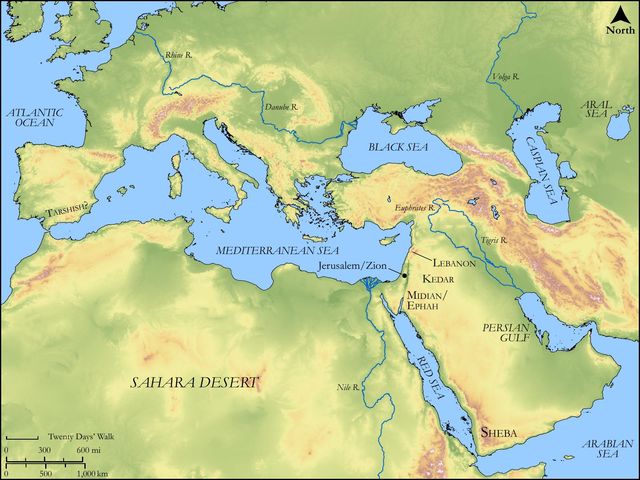
See on the biblical-era map
Study this verse
Public-domain commentary
Matthew Henry
From his Commentary on the Whole Bible. Henry comments on passages, not single verses — this entry covers Isaiah 44:21–28. His four-level outline is real structure in the source text, so it is rendered as structure.
In these verses we have,
I.The duty which Jacob and Israel, now in captivity, were called to, that they might be qualified and prepared for the deliverance designed them. Our first care must be to get good by our afflictions, and then we may hope to get out of them. The duty is expressed in two words: Remember and return, as in the counsel to Ephesus, Rev 2:4, Rev 2:5. 1. "Remember these, O Jacob! Remember what thou hast been told of the folly of idolatry, and let the convictions thou art now under be ready to thee whenever thou art tempted to that sin. Remember that thou art my servant, and therefore must not serve other masters." 2. Return unto me, Isa 44:22. It is the great concern of those who have backslidden from God to hasten their return to him; and this is that which he calls them to when they are in affliction, and when he is returning to them in a way of mercy.
II.The favours which Jacob and Israel, now in captivity, were assured of; and what is here promised to them upon their remembering and returning to God is in a spiritual sense promised to all that in like manner return to God. It is a very comfortable word, for more is implied in it than is expressed (Isa 44:21): "O Israel! thou shalt not be forgotten of me, though for the present thou seemest to be so." When we begin to remember God he will begin to remember us; nay, it is he that remembers us first. Now observe here,
1.The grounds upon which God's favourable intentions to his people were built and on which they might build their expectations from him. He will deliver them out of captivity; for,
(1.)They are his servants, and therefore he has a just quarrel with those that detain them. Let my people go, that they may serve me. The servants of the King of kings are under special protection.
(2.)He formed them into a people, formed them from the womb, Isa 44:24. From the first beginning of their increase into a nation they were under his particular care and government, more than any other people; their national constitution was of his framing, and his covenant with them was the charter by which they were incorporated. They are his, and he will save them.
(3.)He has redeemed them formerly, has many a time redeemed them out of great distress, and he is still the same, in the same relation to them, has the same concern for them. "Therefore return unto me, for I have redeemed thee, Isa 44:22. Whither wilt thou go, but to me?" Having redeemed them, as well as formed them, he has acquired a further title to them and propriety in them, which is a good reason why they should dutifully return to him and why he will graciously return to them. The Lord has redeemed Jacob; he is about to do it (Isa 44:23); he has determined to do it; for he is the Lord their Redeemer, Isa 44:24. Note, The work of redemption which God has by his Son wrought for us encourages us to hope for all promised blessings from him. He that has redeemed us at so vast an expense will not lose his purchase.
(4.)He has glorified himself in them (Isa 44:23), and therefore will do so still, Joh 12:28. It is matter of comfort to us to see God's glory interested in the deliverances of the church; for therefore he will certainly redeem Jacob, because thus he will glorify himself. And this assures us that he will perfect the redemption of his saints by Jesus Christ, because there is a day set when he will be glorified and admired in them all.
(5.)He has pardoned their sins, which were the cause of their calamity and the only obstruction to their deliverance, Isa 44:22. Therefore he will break the yoke of captivity from off their necks, because he has blotted out, as a thick cloud, their transgressions. Note,
[1.]Our transgressions and our sins are as a cloud, a thick cloud; they interpose between heaven and earth, and for a time suspend and intercept the correspondence between the upper and lower world (sin separates between us and God, Isa 59:2); they threaten a storm, a deluge of wrath, as thick clouds do, which God will rain upon sinners. Psa 11:6.
[2.]When God pardons sin he blots out this cloud, this thick cloud, so that the intercourse with heaven is laid open again. God looks down upon the soul with favour; the soul looks up to him with pleasure. The cloud is scattered by the influence of the Sun of righteousness. It is only through Christ that sin is pardoned. When sin is pardoned, like a cloud that is scattered, it appears no more, it is quite gone. The iniquity of Jacob shall be sought for, and not found, Jer 50:20. And the comforts that flow into the soul when sin is pardoned are like the clear shining after clouds and rain.
2.The universal joy which the deliverance of God's people should bring along with it (Isa 44:23): Sing, O you heavens! This intimates,
(1.)That the whole creation shall have cause for joy and rejoicing in the redemption of God's people; to that it is owing that it subsists (that it is rescued from the curse which the sin of man brought upon the ground) and that it is again put into a capacity of answering the ends of its being, and is assured that though now it groans, being burdened, it shall at last be delivered from the bondage of corruption. The greatest establishment of the world is the kingdom of God in it, Psa 96:11-13; Psa 98:7-9.
(2.)That the angels shall rejoice in it, and the inhabitants of the upper world. The heavens shall sing, for the Lord has done it. And there is joy in heaven when God and man are reconciled (Luk 15:7), joy when Babylon falls, Rev 18:20.
(3.)That those who lay at the greatest distance, even the inhabitants of the Gentile world, should join in these praises, as sharing in these joys. The lower parts of the earth, the forest and the trees there, shall bring in the tribute of thanksgiving for the redemption of Israel.
3.The encouragement we have to hope that though great difficulties, and such as have been thought insuperable, lie in the way of the church's deliverance, yet, when the time for it shall come, they shall all be got over with ease; for thus saith Israel's Redeemer, I am the Lord that maketh all things, did make them at first and am still making them; for providence is a continued creation. All being, power, life, emotion, and perfection, are from God. He stretches forth the heavens alone, has no help nor needs any; and the earth too he spreads abroad by himself, and by his own power. Man was not by him when he did it (Job 38:4), nor did any creature advise or assist; only his own eternal wisdom and Word was by him then as one brought up with him, Pro 8:30. His stretching out the heavens by himself denotes the boundless extent of his power. The strongest man, if he has to stretch a thing out, must get somebody or other to lend a hand; but God stretched out the vast expanse and keeps it still upon the stretch, himself, by his own power. Let not Israel be discouraged then; nothing is too hard for him to do that made the world, Psa 124:8. And, having made all things, he can make what use he pleases of all, and has it in his power to serve his own purposes by them.
4.The confusion which this would put upon the oracles of Babylon, by the confutation it would give them, Isa 44:25. God, by delivering his people out of Babylon, would frustrate the tokens of the liars, of all the lying prophets, that said the Babylonian monarchy had many ages yet to live, and pretended to ground their predictions upon some token, some sign or other, which, according to the rules of their arts, foreboded its prosperity. How mad will these conjurors grow with vexation when they see that their skill fails them, and that the contrary happens to that which they so coveted and were so confident of. Nor would it only baffle their pretended prophets, but their celebrated politicians too: He turns the wise men backward. Finding they cannot go on with their projects, they are forced to quit them; and so he makes the judges fools, and makes their knowledge foolish. Those that are made acquainted with Christ see all the knowledge they had before to be foolishness in comparison with the knowledge of him. And those that are adversaries to him will find all their counsels, like Ahitophel's, turned into foolishness, and themselves taken in their own craftiness, Co1 3:19.
5.The confirmation which this would give to the oracles of God, which the Jews had distrusted and their enemies despised: God confirms the word of his servant (Isa 44:26); he confirms it by accomplishing it in its season; and performs the counsel of the messengers whom he hath many a time sent to his people, to tell them what great blessings he had in store for them. Note, The exact fulfilling of the prophecies of scripture is a confirmation of the truth of the whole book and an incontestable evidence of its divine origin and authority.
6.The particular favours God designed for his people, that were now in captivity, Isa 44:26-28. These were foretold long before they went into captivity, that they might see reason to expect a correction, but no reason to fear a final destruction.
(1.)It is here supposed that Jerusalem, and the cities of Judah, should for a time lie in ruins, dispeopled and uninhabited; but it is promised that they shall be rebuilt and repeopled. When Isaiah lived, Jerusalem and the cities of Judah were full of inhabitants; but they will be emptied, burnt, and destroyed. It was then hard to believe that concerning such strong and populous cities. But the justice of God will do that; and, when that is done, it will be hard to believe that ever they will recover themselves again, and yet the zeal of the Lord of hosts will do that to. God has said to Jerusalem, Thou shalt be inhabited; for, while the world stands, God will have a church in it, and therefore he will raise up those who shall say to Jerusalem, Thou shalt be built; for, if it be not built, it cannot be inhabited, Psa 69:35, Psa 69:36. When God's time shall have come for the building up of his church, let him alone to find both houses for his people (for they shall not lie exposed) and people for his houses, for they shall not stand empty. The cities of Judah too shall again be built. The Assyrian army under Sennacherib only took them, and then, upon the defeat of that army, they returned undamaged to the right owners; but the Chaldean army demolished them, and by carrying away the inhabitants left them to go to decay of themselves; for, if less judgments prevail not to humble and reform men, God will send greater. Yet these desolations shall not be perpetual. God will raise up the wastes and decayed places thereof; for he will not contend for ever. The city of strangers, when it is ruined, shall never be built (Isa 25:2), but the city of God's own children is but discontinued for a time.
(2.)It is here supposed that the temple too should be destroyed, and lie for a time rased to the foundations; but it is promised that the foundation of it shall again be laid, and no doubt built upon. As the desolation of the sanctuary was to all the pious Jews the most mournful part of the destruction, so the restoration and re-establishment of it would be the most joyful part of the deliverance. What joy can they have in the rebuilding of Jerusalem if the temple there be not rebuilt? for it is that which makes it a holy city and truly beautiful. This therefore was the chief thing that the Jews had at heart and had in view in their return; therefore they would go back to Jerusalem, to build the house of the Lord God of Israel there, Ezr 1:3.
(3.)It is here supposed that very great difficulties would lie in the way of this deliverance, which it would be impossible for them to wade through; but it is promised that by a divine power they shall all be removed (Isa 44:27): God saith to the deep, Be dry; so he did when he brought Israel out of Egypt, and so he will again when he brings them out of Babylon, if there be occasion. Who art thou, O great mountain? Dost thou stand in the way? Before Zerubbabel, the commander-in-chief of the returning captives, thou shalt become a plain, Zac 4:7. So, Who art thou, O great deep? Dost thou retard their passage and think to block it up? Thou shalt be dry, and thy rivers that supply thee shall be dried up. When Cyrus took Babylon by draining the river Euphrates into many channels, and so making it passable for his army, this was fulfilled. Note, Whatever obstructions lie in the way of Israel's redemption, God can remove them with a word's speaking.
(4.)It is here supposed that none of the Jews themselves would be able by might and power to force their way out of Babylon but it is promised that God will raise up a stranger from afar off, that shall fairly open the way for them, and now at length he names the very man, many scores of years before he was born or thought of (Isa 44:28): That saith of Cyrus, He is my shepherd. Israel is his people, and the sheep of his pasture. These sheep are now in the midst of wolves, in the hands of the thief and robber; they are impounded for trespass. Now Cyrus shall be his shepherd, employed by him to release these sheep, and to take care of their return to their own green pasture again. "In this he shall perform all my pleasure, shall bring about what is purposed by me and will be highly pleasing to me." Note,
[1.]The most contingent things are certain to the divine prescience. He knew who was the person, and what was his name, that should be the deliverer of his people, and, when he pleased, he could let his church know it, that, when they heard of such a name beginning to be talked of in the world, they might lift up their heads with joy, knowing that their redemption drew nigh.
[2.]It is the greatest honour of the greatest men to be employed for God as instruments of his favour to his people. It was more the praise of Cyrus to be God's shepherd than to be emperor of Persia.
[3.]God makes what use he pleases of men, of mighty men, of those that act with the greatest freedom; and, when they think to do as they please, he can overrule them, and make them do as he pleases. Nay, in those very things wherein they are serving themselves, and look no further than that, God is serving his own purposes by them and making them to perform all his pleasure. Rich princes shall do what poor prophets have foretold.
Historical interpretation
Historical reception
2 surviving comments on this verse. Each one is dated, so this reads as a timeline rather than a list.
Select a marker to jump to its quote. Markers stagger vertically where authors wrote within a few decades of each other.
(Verse 24 and following) Thus says the Lord, your redeemer, and your creator from the womb: I am the Lord, the maker of all things, stretching out the heavens alone, establishing the earth, with no one beside me. Making the signs of the diviners void, and driving the soothsayers mad; turning the wise men backward, and making their knowledge foolish. Fulfilling the word of my servant, and performing the counsel of my messengers. I say to Jerusalem: you shall be inhabited, and to the cities of Judah: you shall be rebuilt, and its desolate places I will restore. I say to the depths: be desolate, and I will dry up your rivers. I say to Cyrus: you are my shepherd, and you will fulfill all my desires. I say to Jerusalem: you will be rebuilt; and to the temple: you will be founded. LXX: Thus says the Lord who redeemed you, and formed you from the womb. I am the Lord, who fills all things: I alone stretched out the heavens, and established the earth. Who else has dispersed the signs of the pythons, and the divinations from the heart? Who turns wise men backward, and makes their counsel foolish. And I establish the word of my son, and I approve the true counsel of the Angels. I say to Jerusalem, you will be inhabited: and to the cities of Judah: you will be built, and its desolate places will be restored. I say to the abyss, you will be desolated, and I will dry up your rivers. I say to Cyrus, so that he may understand, and do all my will; I say to Jerusalem, you will be built: and I will establish my holy house. With the idols and injustices of Israel destroyed, and sins cleansed, when every creature will rejoice together; and according to the faith of the Gospel (Luke 15), the Angels will rejoice in heaven for the repentance of sinners, the power of God is described, that it is not great for him to redeem Jacob, and to restore Israel, whom he formed from the womb. And if this seems significant to someone, let it not be difficult for them who alone stretches out the heavens. As it is written elsewhere: He who stretches out the heavens like a skin (Ps. CIII, 2). Not that the Son is excluded from the stretching out of the heavens: For all things were made through him, and without him was not anything made that was made (John I, 3), but so that, as we have often said, idols may be excluded by this understanding. For even in the Proverbs of Solomon, from the person of Christ, the power of God and the wisdom of God is said: When he established the heavens, I was with him (Prov. VIII, 27). For he himself spoke, and they were made; he himself commanded, and they were created (Psalm 148:5; Psalm 33:9). And: By the word of the Lord the heavens were established, and all the power of them by the breath of his mouth (Psalm 33:6). We frequently proclaim these things so that no occasion is given to the heretics to blaspheme Christ. In the stability of the earth, when he was establishing its foundations, there was no one with God except him who was in it. Therefore, when the appointed time of the predetermined mystery arrives, so that all idols are destroyed and the knowledge of the one true God is preached in the world, he will destroy and overthrow all the prophecies of the divine, the pythonesses, and the soothsayers, along with the signs and wonders by which they have deceived the human race. And he will show that the wisdom of the philosophers, which is itself the greatest part of error, is foolish, since by no means can human thoughts comprehend the wisdom of God. And furthermore, the word of the boy, or his servant, about whom we spoke earlier, and the advice of his messengers, will accomplish these things: namely, the Apostles and all the teachers, who will proclaim the will of their master to the nations. Therefore, he himself, who will accomplish such great things, whose power I have described in a few words, also says to Jerusalem, which will be destroyed by the Babylonians, before it is destroyed, that it will be inhabited again by the people, and to the cities of Judea, that they will be restored, and he will raise up its desolations, so that all may be filled with cultivators. Therefore, whoever says that Jerusalem, and Judah, and its deserts should be inhabited, and built, and restored, he is saying that Babylon, which is the deep or abyss, should be made desolate and your rivers should be dried up, along with all the power of kings. And because he had said the deep and abyss, he appropriately added the translation of rivers, about which even the Psalmist sings: By the rivers of Babylon, there we sat down and wept (Psalm 137:1). And he who restores Jerusalem, destroys Babylon. He also says to Cyrus, the king of the Persians, who first destroyed Babylon and the Chaldeans: you are my shepherd, or as the Septuagint translated, so that you may understand. The reason for this difference is clear. For the Hebrew word Roi, if we read it with the letter Res (ר), it is understood as my shepherd; if we read it with the letter Daleth (ד), it means my knowing or understanding, which are distinguished by a small apex, and therefore are often confused. It is written at the beginning of Ezra, that by the edict of Cyrus, the king of the Persians and Medes, the captivity of the people of Israel was released, and those who wanted to return were sent back to Jerusalem under Zerubbabel, the son of Shealtiel, and Joshua, the son of Josedech the high priest. For to him the Lord inspired to do his will, and to fulfill his commandments. Significantly, he added, I say to you Jerusalem, you shall be built, and to the Temple, you shall be founded. For under Cyrus, it was commanded to build Jerusalem and the Temple, of which only the foundations were laid while he was alive. However, under Darius, in his second year, with the prophets Haggai and Zechariah, the building of the Temple was begun.
Here he calls “servant” the very prophet who is exercising the ministry of these words. “And verifying the counsel of his messengers.” Not only of this messenger, he says, but also that of all the others who transmit the divine word. Thus, it is not without forethought that he has made this declaration here but to give force to what is going to be said, for he prophesies in the next passage the royalty of Cyrus, who was the first to reign over the Persians, and the return of the people, the reconstruction of Jerusalem and the total defeat of Babylon. This is why he has prefaced it with “And confirming the word of his servant.” “Who says to Jerusalem, you shall be inhabited; and to the cities of Judea, you shall be built, and its desert places shall spring forth.” The text has shown the tremendous power of the Creator: I only have to speak, he says, and my will is accomplished; for it is by a word that I likewise effected the creation.
Continue studying Isaiah 44:26 across the web’s major study libraries — every link below opens this exact verse, chapter, or book on the destination site.
Read & Compare
 BibleGatewayThis verse in more than 200 translations and 70 languages.
 Bible.comThe YouVersion reader — hundreds of translations, reading plans, and highlights.
 ESV.orgCrossway's official English Standard Version reader.
 NET BibleThe NET translation with 60,000+ translators' notes on every rendering decision.
 STEP BibleTyndale House's free study tool — original text, vocabulary, and scholarly resources.
 BibliaLogos Bible Software's free web reader.
 USCCBThe New American Bible (Revised Edition) with the U.S. bishops' study notes.
Commentaries
 BibleHub CommentariesDozens of classic commentaries on this verse, gathered on one page.
 StudyLightMore than 100 commentary sets — the largest collection on the web.
 BibleRefPlain-English commentary on what this verse means, verse by verse.
 Enduring WordDavid Guzik's free commentary on this chapter, widely used by Bible teachers.
 Bible Study ToolsVerse commentary alongside Greek and Hebrew study aids.
Original Language & Research
- BibleHub InterlinearThe verse word by word — original language, transliteration, and English.
- BibleHub LexiconEvery word's original-language definition and Strong's entry.
 Blue Letter BibleDeep-study tools — Strong's numbers, concordance, and word studies.
 SefariaThe Hebrew text with Rashi and centuries of Jewish commentary.
Sermons, Hymns & Audio


TrulyRandomVerse is not affiliated with these sites and doesn’t control their content. They’re linked because they’re genuinely useful.
Summary
Isaiah 44:26 is a powerful declaration of God's absolute sovereignty, unwavering faithfulness, and unique power to fulfill His prophetic word. It unequivocally asserts that the Lord alone validates the messages of His chosen servants and messengers, bringing to pass their divinely inspired counsel. Specifically, this verse offers a tangible promise of restoration for Jerusalem and the cities of Judah, assuring their re-habitation and rebuilding after a period of desolation, thereby showcasing God's unparalleled control over history and His enduring commitment to His covenant people.
Context
ShowHideLiterary Context
Isaiah 44:26 is situated within the "Book of Comfort" (chapters 40-55) of Isaiah, a section primarily addressed to the exiled people of Judah, offering profound hope and reassurance of their future restoration. This particular verse immediately follows a powerful affirmation of Yahweh as the sole Creator and Redeemer, contrasting His omnipotence with the impotence of idols (Isaiah 44:9-20). The preceding verses (Isaiah 44:24-25) emphasize God's unique ability to "frustrate the tokens of the liars" and "make diviners mad," setting the stage for His positive declaration of confirming His own word. The verse then flows directly into the specific prophecy concerning Cyrus (Isaiah 44:28), who will be God's chosen instrument in fulfilling these promises of rebuilding Jerusalem and the temple, highlighting the detailed and specific nature of God's prophetic plan.
Historical & Cultural Context
The prophecies in Isaiah 40-55 are set against the grim backdrop of the Babylonian exile, a period of immense national trauma and despair for the people of Judah. Jerusalem and its sacred temple had been utterly destroyed, and the population forcibly deported. In this context, the promises of rebuilding and re-habitation would have been incredibly significant, directly addressing the deep wounds of desolation and displacement. Culturally, the surrounding nations worshipped various gods and relied heavily on diviners, astrologers, and soothsayers for guidance, often seeking to manipulate divine favor. Isaiah's message emphatically distinguishes Yahweh from these false deities, asserting His unique power to declare the future and sovereignly bring it to pass, a stark contrast to the unreliable oracles of pagan gods. The mention of "servant" and "messengers" refers to prophets, whose authority and message were often challenged; God's confirmation of their word serves to validate their divine commission in a time of spiritual uncertainty.
Key Themes
ShowHideThis verse powerfully contributes to several overarching themes pervasive throughout the book of Isaiah. It underscores Divine Sovereignty and Omnipotence, portraying God as the ultimate orchestrator of history, whose word is inherently effective and cannot fail. This theme is central to the entire "Book of Comfort," where God repeatedly asserts His unique control over all creation and human events, as seen in His declaration to "declare the end from the beginning" in Isaiah 46:10. Another crucial theme is Prophetic Validation and Fulfillment, emphasizing that the true prophets speak God's very words, which He Himself guarantees to bring to fruition. This divine endorsement of prophetic ministry is a recurring motif, assuring the people that the messages of restoration are not mere human hopes but divine decrees. Finally, the verse clearly articulates the theme of Restoration and Renewal, offering a tangible vision of Jerusalem and Judah's return to prosperity and habitation, a promise that found its initial fulfillment in the post-exilic period, as detailed in books like Ezra and Nehemiah.
Exposition and Analysis
ShowHideKey Word Analysis
ShowHideFrom a primitive root meaning "to rise" (in various applications, literal, figurative, intensive and causative). It conveys the sense of establishing, upholding, making good, or causing to stand up. In this context, it signifies God's active power to make His word stand firm, to establish its truth, and to bring it to pass with certainty and effectiveness.
This term is rich in meaning, encompassing not just spoken words but also matters, things, decrees, affairs, and even deeds. Here, it refers to the authoritative pronouncements and prophecies delivered by God's servants, carrying the full weight of divine intention and the absolute certainty of future action. It highlights the dynamic and effective nature of God's communication.
Feminine in form, this word properly denotes "drought," but by implication, it refers to a "desolation," a "desolate place," "destruction," or a place "laid waste." It vividly describes the ruined and uninhabited state of Jerusalem and the cities of Judah after the Babylonian destruction, emphasizing the extent of the devastation that God promises to miraculously reverse.
Verse Breakdown
ShowHide"That confirmeth the word of his servant,"
This clause emphasizes God's active and sovereign role in validating and establishing the message spoken by His chosen prophet (singular, perhaps referring to Isaiah himself, or a generic true prophet). God does not merely inspire the word; He personally ensures its reliability and ultimate fulfillment, making it stand firm.
"and performeth the counsel of his messengers;"
Expanding on the previous thought, this phrase reiterates God's unwavering commitment to bringing to completion the plans and advice conveyed by His multiple emissaries. "Performeth" (from shâlam) implies making complete, finishing, or bringing to perfection, underscoring the certainty, thoroughness, and comprehensive nature of divine execution.
"that saith to Jerusalem, Thou shalt be inhabited;"
Here, God's word becomes a direct, declarative promise to the devastated capital city. The declaration "Thou shalt be inhabited" directly counteracts the desolation and abandonment, promising a return of its people and a resumption of vibrant life within its walls.
"and to the cities of Judah, Ye shall be built,"
This extends the promise of restoration beyond Jerusalem to the broader region of Judah. The numerous cities, which had also suffered widespread destruction and abandonment, are assured of reconstruction, signifying a comprehensive national renewal and recovery.
"and I will raise up the decayed places thereof:"
This final clause powerfully reinforces the promise of complete restoration. God explicitly states His intention to rebuild and elevate the ruins and desolate areas, demonstrating His unparalleled power to reverse destruction and bring forth new life and flourishing from what was once utter waste.
Literary Devices
ShowHideIsaiah 44:26 employs several powerful literary devices to convey its message with impact and clarity. Personification is evident in the direct address to Jerusalem and the cities of Judah, treating them as entities capable of receiving commands and promises ("Thou shalt be inhabited," "Ye shall be built"). This makes the divine promise more intimate, personal, and direct. The verse also utilizes Parallelism, particularly synonymous parallelism, where the first two clauses ("confirmeth the word of his servant, and performeth the counsel of his messengers") convey a similar idea of divine validation and execution of prophetic messages through slightly different but reinforcing phrasing. Similarly, the promises for Jerusalem and the cities of Judah are parallel in their assurance of restoration. The consistent use of strong, active verbs like "confirmeth," "performeth," "saith," and "raise up" creates a compelling sense of Divine Agency and emphasizes God's direct, powerful, and personal involvement in bringing about these events. The vivid imagery of "decayed places" being "raised up" creates a stark Contrast between the current state of ruin and the promised future of renewal, highlighting the miraculous and transformative nature of God's restorative work.
Theological and Thematic Connections
ShowHideIsaiah 44:26 is a cornerstone passage for understanding the very nature of God's faithfulness and the absolute reliability of His revealed word. It profoundly asserts that God's declarations are not mere predictions or possibilities but divine decrees, carrying the inherent power to bring themselves to pass. This foundational truth undergirds the entire biblical narrative, assuring believers that God is not only sovereign over all creation and history but also intimately involved in fulfilling every promise He has made to His people. The verse establishes a critical and unbreakable link between divine speech and divine action, demonstrating that what God says, He does, with perfect certainty and power. This provides immense comfort and a firm foundation for faith, especially when circumstances seem to contradict His promises, reminding us that His ultimate plan for restoration and blessing will prevail against all odds.
Reflection and Application
ShowHideIsaiah 44:26 offers profound assurance for believers navigating a world often marked by uncertainty, broken promises, and profound despair. It reminds us that our God is fundamentally different from human leaders or false deities; He is utterly dependable and His word is eternally sure. In moments of personal desolation, when our lives or circumstances feel like "decayed places"—whether due to loss, failure, or spiritual barrenness—this verse calls us to remember that the same God who promised to rebuild a physically devastated Jerusalem is infinitely capable of bringing restoration and renewal into our own lives. It encourages us to trust implicitly in the unfailing nature of God's Word, knowing that every promise, every command, and every prophecy He has uttered will ultimately be confirmed and performed. This should inspire us to live with confident hope, to persevere in prayer, and to actively participate in God's restorative work in the world, knowing that His ultimate victory and the fulfillment of His purposes are guaranteed.
Questions for Reflection
ShowHideFAQ
ShowHideWhat is the significance of God confirming the "word of his servant" and "counsel of his messengers"?
ShowHideThe significance lies in the validation of divine authority and the absolute reliability of prophecy. In ancient Israel, prophets often faced skepticism or competition from false prophets who claimed divine inspiration. By declaring that He "confirmeth the word of his servant, and performeth the counsel of his messengers," God is unequivocally endorsing the messages delivered by His true prophets. This means that their words are not merely human opinions or predictions, but divinely inspired decrees that God Himself guarantees to bring to pass. It assures the audience that the promises of restoration, like those for Jerusalem and Judah, are not empty hopes but certainties because they originate from and are upheld by the omnipotent God. This also underscores the unique nature of Israel's God, who unlike pagan deities, declares the future and then sovereignly brings it about, as powerfully emphasized in Isaiah 46:10.
How was the promise of Jerusalem and Judah being "inhabited" and "built" fulfilled?
ShowHideThis prophecy found its primary historical fulfillment after the Babylonian exile. Following the decree of Cyrus the Great in 538 BC (foretold in Isaiah 44:28 and recorded in Ezra 1:1-4), the Jewish exiles were permitted to return to their homeland. Over several decades, under the leadership of figures like Zerubbabel, Ezra, and Nehemiah, Jerusalem's temple was rebuilt (Ezra 3), its walls were reconstructed (Nehemiah 2:17), and the city and surrounding towns were repopulated and re-established. This physical restoration served as a powerful, tangible testament to God's faithfulness to His prophetic word, literally raising up the "decayed places" of Judah.
Christ-Centered Fulfillment
ShowHideWhile Isaiah 44:26 speaks directly to the physical restoration of Jerusalem and Judah after the Babylonian exile, its deeper Christ-centered fulfillment points to the ultimate and spiritual restoration accomplished through Jesus Christ. The "word of his servant" and "counsel of his messengers" find their supreme confirmation in the person and work of Jesus, who is the ultimate Prophet, Priest, and King. He is the very "Word made flesh" (John 1:14), through whom all God's promises are "Yes" and "Amen" (2 Corinthians 1:20). Just as God promised to rebuild the physical cities, Christ came to rebuild and inhabit the desolate places of the human heart, establishing His spiritual kingdom. Through His atoning sacrifice and glorious resurrection, He raises up those who are spiritually "decayed" by sin, transforming them into "new creations" (2 Corinthians 5:17). The promise that Jerusalem "shall be inhabited" finds its eschatological echo in the New Jerusalem, the heavenly city where God dwells with His redeemed people forever (Revelation 21:2-3). Thus, Isaiah 44:26 foreshadows not only a physical return from exile but the grander, spiritual restoration and new creation inaugurated by Christ, culminating in eternal fellowship with God in His perfectly restored kingdom.