


Isaiah 10:5
- הוֹיHowoe to!H1945PrtParticle Interjection
- אַשּׁוּר'a·ShurAssyriaH804N-properNoun Proper Location
- שֵׁבֶטShe·vet[the] rod ofH7626N-mscNoun Singular Masculine Construct
- אַפִּי'a·Pimy angerH639N-msc ¦ 1csNoun Singular Masculine Constructאַפִּangerיmy
- וּמַטֶּהu·ma·tehand [is] a staffH4294Conj-w ¦ N-msNoun Singular Masculine Absoluteוּandמַטֶּה[is] a staff
- הוּאhu'itH1931Pro-3msPronoun Personal 3rd Singular Masculine
- בְיָדָםve·ya·Damin their handH3027Prep-b ¦ N-csc ¦ 3mpNoun Singular common gender Constructבְinיָדָhandםtheir
- זַעְמִיza'·Mimy indignationH2195N-msc ¦ 1csNoun Singular Masculine Constructזַעְמִindignationיmy
English is a literal word-by-word gloss of the Hebrew, not the KJV's wording. Why?
This is the original text the KJV's translators worked from — each Hebrew word with its own literal English meaning in this verse, prepared by scholars at Tyndale House, Cambridge. The KJV translates whole sentences, not word by word, so its wording differs: one Hebrew word can become several English words, and the KJV may choose “the LORD” where the gloss reads “Yahweh”. Both are faithful — they answer different questions. For the KJV's own rendering, switch to the KJV text.
Details
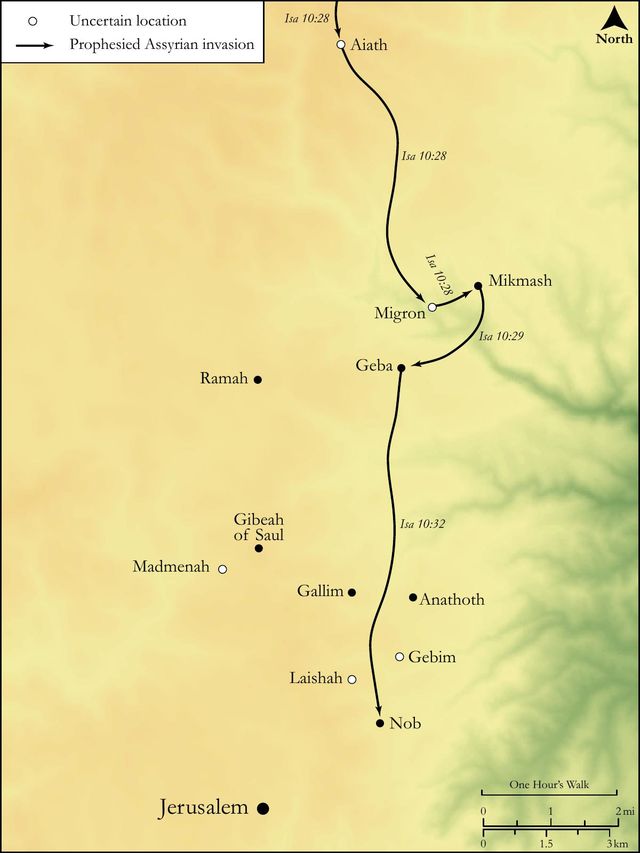
See on the biblical-era map
Study this verse
Public-domain commentary
Matthew Henry
From his Commentary on the Whole Bible. Henry comments on passages, not single verses — this entry covers Isaiah 10:5–19. His four-level outline is real structure in the source text, so it is rendered as structure.
The destruction of the kingdom of Israel by Shalmaneser king of Assyria was foretold in the foregoing chapter, and it had its accomplishment in the sixth year of Hezekiah, Kg2 18:10. It was total and final, head and tail were all cut off. Now the correction of the kingdom of Judah by Sennacherib king of Assyria is foretold in this chapter; and this prediction was fulfilled in the fourteenth year of Hezekiah, when that potent prince, encouraged by the successes of his predecessor against the ten tribes, came up against all the fenced cities of Judah and took them, and laid siege to Jerusalem (Kg2 18:13, Kg2 18:17), in consequence of which we may well suppose Hezekiah and his kingdom were greatly alarmed, though there was a good work of reformation lately begun among them: but it ended well, in the confusion of the Assyrians and the great encouragement of Hezekiah and his people in their return to God. Now let us see here,
I.How God, in his sovereignty, deputed the king of Assyria to be his servant, and made use of him as a mere tool to serve his own purposes with (Isa 10:5, Isa 10:6): "O Assyrian! know this, that thou art the rod of my anger; and I will send thee to be a scourge to the people of my wrath." Observe here,
1.How bad the character of the Jews was, though they appeared very good. They were a hypocritical nation, that made a profession of religion, and at this time particularly of reformation, but were not truly religious, not truly reformed, not so good as they pretended to be now that Hezekiah had brought goodness into fashion. When rulers are pious, and so religion is in reputation, it is common for nations to be hypocritical. They are a profane nation; so some read it. Hezekiah had in a great measure cured them of their idolatry, and now they ran into profaneness; nay, hypocrisy is profaneness: none profane the name of God so much as those who are called by that name and call upon it, and yet live in sin. Being a profane hypocritical nation, they are the people of God's wrath; they lie under his wrath, and are likely to be consumed by it. Note, Hypocritical nations are the people of God's wrath: nothing is more offensive to God than dissimulation in religion. See what a change sin made: those that had been God's chosen and hallowed people, above all people, had now become the people of his wrath. See Amo 3:2.
2.How mean the character of the Assyrian was, though he appeared very great. He was but the rod of God's anger, an instrument God was pleased to make use of for the chastening of his people, that, being thus chastened of the Lord, they might not be condemned with the world. Note, The tyrants of the world are but the tools of Providence. Men are God's hand, his sword sometimes, to kill and slay (Psa 17:13, Psa 17:14), at other times his rod to correct. The staff in their hand, wherewith they smite his people, is his indignation; it is his wrath that puts the staff into their hand and enables them to deal blows at pleasure among such as thought themselves a match for them. Sometimes God makes an idolatrous nation, that serves him not at all, a scourge to a hypocritical nation, that serves him not in sincerity and truth. The Assyrian is called the rod of God's anger because he is employed by him.
(1.)From him his power is derived: I will send him; I will give him a charge. Note, All the power that wicked men have, though they often use it against God, they always receive from him. Pilate could have no power against Christ unless it were given him from above, Joh 19:11.
(2.)By him the exercise of that power is directed. The Assyrian is to take the spoil and to take the prey, not to shed any blood. We read not of any slain, but he is to plunder the country, rifle the houses, drive away the cattle, strip the people of all their wealth and ornaments, and tread them down like the mire of the streets. When God's professing people wallow in the mire of sin it is just with God to suffer their enemies to tread upon them like mire. But why must the Assyrian prevail thus against them? Not that they might be ruined, but that they might be thoroughly reformed.
II.See how the king of Assyria, in his pride, magnified himself as his own master, and pretended to be absolute and above all control, to act purely according to his own will and for his own honour. God ordained him for judgment, even the mighty God established him for correction (Hab 1:12), to be an instrument of bringing his people to repentance, howbeit he means not so, nor does his heart think so, Isa 10:7.
1.He does not think that he is either God's servant or Israel's friend, either that he can do no more than God will let him or that he shall do no more than God will make to work for the good of his people. God designs to correct his people for, and so to cure them of, their hypocrisy, and bring them nearer to himself; but was that Sennacherib's design? No, it was the furthest thing from his thoughts - he means not so. Note,
(1.)The wise God often makes even the sinful passions and projects of men subservient to his own great and holy purposes.
(2.)When God makes use of men as instruments in his hand to do his work it is very common for him to mean one thing and them to mean another, nay, for them to mean quite the contrary to what he intends. What Joseph's brethren designed for hurt God overruled for good, Gen 50:20. See Mic 4:11, Mic 4:12. Men have their ends and God has his, but we are sure the counsel of the Lord shall stand. But what is it the proud Assyrian aims at? The heart of kings is unsearchable, but God knew what was in his heart.
2.He designs nothing but to destroy and to cut off nations not a few, and to make himself master of them. [1.] He designs to gratify his own cruelty; nothing will serve but to destroy and cut off. He hopes to regale himself with blood and slaughter; that of particular persons will not suffice, he must cut off nations. It is below him to deal by retail; he traffics in murders by wholesale. Nations, and those not a few, must have but one neck, which he will have the pleasure of cutting off. [2.] He designs to gratify his own covetousness and ambition, to set up for a universal monarch, and to gather unto him all nations, Hab 2:5. An insatiable desire of wealth and dominion is that which carries him on in this undertaking.
3.The prophet here brings him in vaunting, and hectoring; and by his general's letter to Hezekiah, written in his name, vainglory and arrogance seem to have entered very far into the spirit and genius of the man. His haughtiness and presumption are here described very largely, and his very language copied out, partly to represent him as ridiculous and partly to assure the people of God that he would be brought down; for that maxim generally holds true, that pride goes before destruction. It also intimates that God takes notice, and keeps an account, of all men's proud and haughty words, with which they set heaven and earth at defiance. Those that speak great swelling words of vanity shall hear of them again.
(1.)He boasts of the great things he had done to other nations.
[1.]He had made their kings his courtiers (Isa 10:8): "My princes are altogether kings. Those that are now my princes are such as have been kings." Or he means that he had raised his throng to such a degree that his servants, and those that were in command under him, were as great, and lived in as much pomp, as the kings of other countries. Or those that were absolute princes in their own dominions held their crowns under him, and did him homage. This was a vainglorious boast; but how great is our God whom we serve, who is indeed King of kings, and whose subjects are made to him kings! Rev 1:6.
[2.]He had made himself master of their cities. He names several (Isa 10:9) that were all alike reduced by him. Calno soon yielded as Carchemish did, Hamath could not hold out any more than Arpad, and Samaria had become his as well as Damascus. To support his boasts he is obliged to bring the victories of his predecessor into the account; for it was he that conquered Samaria, not Sennacherib.
[3.]He had been too hard for their idols, their tutelar gods, had found out the kingdoms of the idols and found out ways to make them his own, Isa 10:10. Their kingdoms took denomination from the idols they worshipped; the Moabites are called the people of Chemosh (Jer 48:46), because they imagined their gods were their patrons and protectors; and therefore Sennacherib vainly imagined that every conquest of a kingdom was the conquest of a god.
[4.]He had enlarged his own dominions, and removed the bounds of the people (Isa 10:13), enclosing many large territories within the limits of his own kingdom and shifting a great way further the ancient land-marks which his fathers had set; he could not bear to be hemmed in so closely, but must have more room to thrive. By his removing the border of the people Mr. White understands his arbitrarily transplanting colonies from place to place, which was the constant practice of the Assyrians in all their conquests; and this is a probable interpretation.
[5.]He had enriched himself with their wealth, and brought it into his own exchequer: I have robbed their treasures. In this he said truly, Great conquerors are often no better than great robbers.
[6.]He had mastered all the opposition he met with: "I have put down the inhabitants as a valiant man. Those that sat high, and thought they say firmly, I have humbled and made to come down."
(2.)He boasts of the manner in which he had done them.
[1.]That he had done all this by his own policy and power (Isa 10:13): "By the strength of my hand, for I am valiant; and by my wisdom, for I am prudent;" not by the permission of Providence and the blessing of God. He knows not that it is God that makes him what he is, and puts the staff into his hand, but sacrifices to his own net, Hab 1:16. "This wealth is all gotten by my might and the power of my hand," Deu 8:17. Downright atheism and profaneness, as well as pride and vanity, are at the bottom of men's attributing their prosperity and success thus to themselves and their own conduct, and raising their own character upon it.
[2.]That he had done all this with a great deal of ease, and had made but a sport and diversion of it, as if he had been taking birds' nests (Isa 10:14): my hand has found as a nest the riches of the people; and when he had found them there was no more difficulty in taking them than in rifling a nest, nor any more reluctance or regret within his own breast in destroying families and cities than in destroying crows'-nests; killing children was no more to him than killing birds. "As one gathers the eggs that are left in the nest by the dam, so easily have I gathered all the earth." Like Alexander, he thought he had conquered the world; and whatever prey he seized there was none that moved the wing, or opened the mouth, or peeped, as birds do when their nests are rifled. They durst not make any opposition, no, nor any complaint; such awe did they stand in of this mighty conqueror. They were so weak that they knew it was to no purpose to resist, and he was so arbitrary that they knew it was to no purpose to complain. Strange that ever men who were made to do good should take a pride and a pleasure in doing wrong, and doing mischief to all about them without control, and should reckon that their glory which is their shame! But their day will come to fall who thus make themselves the terror of thy mighty, and much more of the feeble, in the land of the living.
(3.)He threatens what he will do to Jerusalem, which he was now about to lay siege to, Isa 10:10, Isa 10:11. He would master Jerusalem and her idols, as he had subdued other places and their idols, particularly Samaria.
[1.]He blasphemously calls the God of Israel an idol, and sets him on a level with the false gods of other nations, as if none were the true God but Mithras, the sun, whom he worshipped. See how ignorant he was, and then we shall the less wonder that he was so proud.
[2.]He prefers the graven images of other countries before those of Jerusalem and Samaria, when he might have known that the worshippers of the God of Israel were expressly forbidden to make any graven images, and if any did it must be by stealth, and therefore they could not be so rich and pompous as those of other nations. If he means the ark and the mercy-seat, he speaks like himself, very foolishly, and as one that judged by the sight of the eye, and might therefore be easily deceived in matters of spiritual concern. Those who make external pomp and splendour a mark of the true church go by the same rule.
[3.]Because he had conquered Samaria, he concluded Jerusalem would fall of course: "Shall not I do so to Jerusalem? can I not as easily, and may I not as justly?" But it did not follow; for Jerusalem adhered to her God, whereas Samaria had forsaken him.
III.See how God, in his justice, rebukes his pride and reads his doom.
We have heard what the great king, the king of Assyria, says, and how big he talks. Let us now hear what the great God has to say by his servant the prophet, and we shall find that, wherein he deals proudly, God is above him.
1.He shows the vanity of his insolent and audacious boasts (Isa 10:15): Shall the axe boast itself against him that hews therewith? or shall the saw magnify itself against him that draws it? So absurd are the boasts of this proud man. "O what a dust do I make!" said the fly upon the cart-wheel in the fable. "What destruction do I make among the trees!" says the axe. Two ways the axe may be said to boast itself against him that hews with it: - (1.) By way of resistance and opposition. Sennacherib blasphemed God, insulted him, threatened to serve him as he had served the gods of the nations; now this was as if the axe should fly in the face of him that hews with it. The tool striving with the workman is no less absurd than the clay striving with the potter; and as it is a thing not to be justified that men should fight against God with the wit, and wealth, and power, which he gives them, so it is a thing not to be suffered. But if men will be thus proud and daring, and bid defiances to all that is just and sacred, let them expect that God will reckon with them; the more insolent they are the surer and sorer will their ruin be. (2.) By way of rivalship and competition. Shall the axe take to itself the praise of the work it is employed in? So senseless, so absurd was it for Sennacherib to say, By the strength of my hand I have done it, and by my wisdom, Isa 10:13. It is as if the rod, when it is shaken, should boast that it guides the hand which shakes it; whereas, when the staff is lifted up, is it not wood still? so the last clause may be read. If it be an ensign of authority (as the nobles of the people carried staves, Num 21:18), if it be an instrument of service, either to support a weak man or to correct a bad man, still it is wood, and can do nothing but as it is directed by him that uses it. The psalmist prays that God would make the nations to know that they were but men (Psa 9:20), the staff to know that it is but wood
2.He foretels his fall and ruin.
(1.)That when God had done his work by him he would then do his work upon him, Isa 10:12. For the comfort of the people of God in reference to Sennacherib's invasion, though it was a dismal time with them, let them know,
[1.]That God designed to do good to Zion and Jerusalem by this providence. There is a work to be done upon them, which God intends, and which he will perform. Note, When God lets loose the enemies of his church and people, and suffers them for a time to prevail, it is in order to the performing of some great good work upon them; and, when that is done, then, and not till then, he will work deliverance for them. When God brings his people into trouble it is to try them (Dan 11:35), to bring sin to their remembrance and humble them for it, and to awaken them to a sense of their duty, to teach them to pray and to love and help one another; and this must be the fruit, even the taking away of sin, Isa 27:9. When these points are, in some measure, gained by the affliction, it shall be removed, in mercy (Lev 26:41, Lev 26:42), otherwise not; for, as the word, so the rod shall accomplish that for which God sends it.
[2.]That when God had wrought this work of grace for his people he would work a work of wrath and vengeance upon their invaders: I will punish the fruit of the stout heart of the king of Assyria. His big words are here said to come from his stout heart, and they are the fruit of it; for out of the abundance of the heart the mouth speaks. Notice is taken too of the glory of his high looks, for a proud look is the indication of a proud spirit. The enemies of the church are commonly very high and haughty; but, sooner or later, God will reckon for their haughtiness. He glories in it as an incontestable proof of his power and sovereignty that he looks upon proud men and abases them, Job 40:11, etc.
(2.)That, how threatening soever this attempt was upon Zion and Jerusalem, it should certainly be baffled, and broken, and come to nothing, and he should not be able to bring to pass his enterprise, Isa 10:16, Isa 10:19. Observe,
[1.]Who it is that undertakes his destruction, and will be the author of it; not Hezekiah, or his princes, or the militia of Judah and Jerusalem (what can they do against such a potent force?), but God himself will do it, as the Lord of hosts, and as the light of Israel. First, We are sure he can do it, for he is the Lord of hosts, of all the hosts of heaven and earth. All the creatures are at his command; he makes what use he pleases on them. He is the Lord of the hosts both of Judah and of Assyria, and can give the victory to which he pleases. Let us not fear the hosts of any enemy if we have the Lord of hosts for us. Secondly, We have reason to hope he will do it, for he is the light of Israel, and his Holy One. God is light; in him are perfect brightness, purity, and happiness. He is light, for he is the Holy One; his holiness is his glory. He is Israel's light, to direct and counsel his people, to favour and countenance them, and so to gladden and comfort them in the worst of times. He is their Holy One, for he is in covenant with them; his holiness is engaged and employed for them. God's holiness is the saints' comfort; they give thanks at the remembrance of it, and with a great deal of pleasure call him their Holy One, Hab 1:12.
[2.]How this destruction is represented. It shall be, First, As a consumption of the body by a disease: The Lord shall send leanness among his fatnesses, or his fat ones. His numerous army, that was like a body covered with fatness, shall be diminished, and waste away, and become like a skeleton. Secondly, As a consumption of buildings, or trees and bushes, by fire: Under his glory, that very thing which he glories in, he will kindle a burning, as the burning of a fire, which shall lay his army in ruins as suddenly as a raging fire lays a stately house in ashes. Some make it an allusion to the fire kindled under the sacrifices; for proud sinners fall as sacrifices to divine justice. Observe, 1. How this fire shall be kindled, Isa 10:17. The same God that is a rejoicing light to those that serve him faithfully will be a consuming fire to those that trifle with him or rebel against him. The light of Israel shall be for a fire to the Assyrians, as the same pillar of cloud was a light to the Israelites and a terror to the Egyptians in the Red Sea. What can oppose, what can extinguish, such a fire? 2. What desolation it shall make: it shall burn and devour its thorns and briers, his officers and soldiers, which are of little worth, and vexations to God's Israel, as thorns and briers, whose end is to be burned, and which are easily and quickly consumed by a devouring fire. "Who would set the briers and thorns against me in battle? They would be so far from stopping the fire that they would inflame it. I would go through them and burn them together (Isa 27:4); they shall be devoured in one day, all cut off in an instant." When they cried not only Peace and safety, but Victory and triumph, then sudden destruction came; it came surprisingly, and was completed in a little time. "Even the glory of his forest (Isa 10:18), the choice troops of his army, the veterans, the troops of the household, the bravest regiments he had, that he was most proud of and depended most upon, that he valued as men do their timber-trees (the glory of their forest) or their fruit-trees (the glory of the Carmel), shall be put as briers and thorns before the fire; they shall be consumed both soul and body, entirely consumed, not only a limb burned, but life taken away." Note, God is able to destroy both soul and body, and therefore we should fear him more than man, who can but kill the body. Great armies before him are but as great woods, which he can fell or fire when he pleases.
[3.]What would be the effect of this great slaughter. The prophet tells us, First, That the army would hereby be reduced to a very small number: The rest of the trees of his forest shall be few; very few shall escape the sword of the destroying angel, so few that there needs no artist, no muster-master or secretary of war, to take an account of them, for even a child may soon reckon the numbers of them, and write the names of them. Secondly, That those few who remained should be quite dispirited: They shall be as when a standard-bearer fainteth. When he either falls or flees, and his colours are taken by the enemy, this discourages the whole army, and puts them all into confusion. Upon the whole matter we must say, Who is able to stand before this great and holy Lord God?
Historical interpretation
Historical reception
1 surviving comment on this verse from the historical church.
(Verse 5 and following) Woe to Assyria, the rod of my anger, and the staff in their hands is my fury. I will send him against a deceitful nation, and I will command him against the people of my wrath, to take the spoil and seize the prey, and to tread them down like the mire of the streets. But he does not understand this, and his heart does not take it to heart, but his purpose is to destroy and cut off nations. For my princes are not also kings? Is not Charcamis like Chalanno, and Arphad like Emath? Is not Damascus like Samaria? Just as my hand found the kingdoms of idols, so too their images from Jerusalem and Samaria. Shall I not do to Jerusalem and its idols what I did to Samaria and its idols? Let us put here the translation of the Septuagint, which differs in many ways from the Hebrew. LXX: Woe to the Assyrians: the rod of my anger is in their hands, I will send my wrath against a wicked nation, and I will command my people to plunder and loot, and to trample down cities and reduce them to dust. But he did not think so, and did not intend it that way; rather, his purpose is to destroy, and to annihilate many nations. And if they say to him: You alone are the ruler, he will reply: I did not conquer the region above Babylon, and Chalane, where the tower was built. But I came to Arabia, and Damascus, and Samaria: just as I brought these, so I will take all the kingdoms. Howl, statues in Jerusalem and Samaria; for just as I did to Samaria and its idols, so I will do to Jerusalem and its images. First, it must be known that in Hebrew there is no 'Chalane,' but 'Chalanno' (). For the last letter of this name is not 'Iod,' as they believed, but 'Vau,' which letters differ in size only. However, the tower was built in the plain of Shinar, where there were Erech, Akkad, and Calneh, and Babylon, which received its name from the confusion of languages (Genesis 11). However, in Hebrew, Arabia is not mentioned, but rather Hamath, which the Syrians still call Epiphania. They also added idols in Jerusalem of their own accord. And that which is written above: If they say to him, 'You alone are the prince,' he will answer, 'I did not take that region, and that one, but I took Arabia, and Damascus, and Samaria.' This suggests the meaning: When, he says, the Assyrians who were captured say, 'You are the prince of all,' he, still feeling weak, will answer, 'How do you call me prince, when I have only taken Arabia, and Damascus, and Samaria, and the distant nations beyond Babylon have not yet submitted to my rule?' But just as I captured Arabia, Damascus, and Samaria, I will subdue all kingdoms to me. Let us now turn to Hebrew and write down briefly what we think. Woe to the Assyrians, that is, Sennacherib, for he is the rod and staff of my fury. In his hand is my indignation, and through him I will strike down the deceitful nation that has always cowered between me and idols, that has lied about obeying my commands. I will command him against my furious people, to plunder and loot them, and to reduce them to dust and trample them like mud in the streets. That is, to strike them but not kill them, to wound them but not take their lives. But he extended the scope of my anger and not only raged against Israel, against whom it had been directed, but he also ravaged many nations, so that he wore out all the kingdoms around, and his sword raged even against the destruction of many nations. For he rose up in pride, and dared to say: My commanders are the kings of other nations, and they are subject to me, they will rule over all nations. Just as I took (conquered) Carcamis, so I also took (conquered) Chalanne; just as I obtained Arphad, so I also obtained Emath; just as I took (conquered) Damascus, so I also subjugated Samaria. Just as I have conquered the other kingdoms that worshiped idols, I will also bring Jerusalem and Samaria, where the same idols are worshiped, under my control. Just as I have taken Samaria with its idols, I will also capture Jerusalem, because they worship the same gods. Additionally, we have added 70 cities from the region beyond Babylon, including Chalane where the tower was built, completely abandoning Arphad. According to their translation and tropology, as long as it is pious, we can infer freedom from the fact that he says, 'And I will command my people to take the spoils and the plunder, and to trample on cities and reduce them to dust.' We can also interpret this to mean that every day the Lord commands his people to reduce to dust the cities of the adversaries that rise up against the knowledge of God and have been built by the excessive labor of heretics, and to demonstrate that they are nothing. One who understands the weakness of the human heart, and that being encompassed by mortal flesh, cannot have perfect victory over virtues, nor can all nations accept it, even though others may admire and say: You alone are the leader, will respond to them: There are many things which I must destroy, and yet I have not been able to destroy them: I know that I do not know. And although I have overcome many arguments of adversaries, there are still many that must be overcome. At the same time, with hope for the future, he promises himself victory from the things he has overcome and also from the others. The idols of Jerusalem and Samaria are ordered to howl, not the ones that are fake, but those who made them, metaphorically those who made them, through the things that were made, so that not only those who fabricated idols in heresies, but also those who defend falsehood in the Church out of ignorance, may testify that they have erred with howling and repentance.
Continue studying Isaiah 10:5 across the web’s major study libraries — every link below opens this exact verse, chapter, or book on the destination site.
Read & Compare
 BibleGatewayThis verse in more than 200 translations and 70 languages.
 Bible.comThe YouVersion reader — hundreds of translations, reading plans, and highlights.
 ESV.orgCrossway's official English Standard Version reader.
 NET BibleThe NET translation with 60,000+ translators' notes on every rendering decision.
 STEP BibleTyndale House's free study tool — original text, vocabulary, and scholarly resources.
 BibliaLogos Bible Software's free web reader.
 USCCBThe New American Bible (Revised Edition) with the U.S. bishops' study notes.
Commentaries
 BibleHub CommentariesDozens of classic commentaries on this verse, gathered on one page.
 StudyLightMore than 100 commentary sets — the largest collection on the web.
 BibleRefPlain-English commentary on what this verse means, verse by verse.
 Enduring WordDavid Guzik's free commentary on this chapter, widely used by Bible teachers.
 Bible Study ToolsVerse commentary alongside Greek and Hebrew study aids.
Original Language & Research
- BibleHub InterlinearThe verse word by word — original language, transliteration, and English.
- BibleHub LexiconEvery word's original-language definition and Strong's entry.
 Blue Letter BibleDeep-study tools — Strong's numbers, concordance, and word studies.
 SefariaThe Hebrew text with Rashi and centuries of Jewish commentary.
Sermons, Hymns & Audio


TrulyRandomVerse is not affiliated with these sites and doesn’t control their content. They’re linked because they’re genuinely useful.
Summary
Isaiah 10:5 serves as a profound declaration of God's absolute sovereignty over all nations and historical events, particularly in the context of His judgment upon His disobedient people. This verse introduces the formidable Assyrian Empire not as an independent aggressor driven solely by its own imperial ambitions, but as a divinely appointed instrument—a "rod" and "staff"—wielded by Yahweh Himself. It powerfully asserts that Assyria's military might and destructive actions are merely the physical manifestation of God's righteous anger and indignation, purposefully directed to execute His disciplinary and redemptive plans for Israel and Judah, underscoring His meticulous control even over pagan empires.
Context
ShowHideLiterary Context
Isaiah 10:5 is strategically placed within a major prophetic section of the book, specifically within chapters 7-12, often referred to as the "Book of Immanuel" or the "Assyrian Oracles." This segment primarily addresses the impending divine judgment upon both the Northern Kingdom of Israel and the Southern Kingdom of Judah, with the Assyrian Empire serving as the primary agent of this judgment. Immediately preceding this verse, Isaiah 10:1-4 pronounces a series of "woes" against the corrupt leaders and unjust laws within Judah, highlighting the specific social and spiritual sins that have provoked God's wrath. Following Isaiah 10:5, the prophet transitions to detailing Assyria's arrogant boasts and its self-deception regarding its role, emphasizing that it is an unwitting tool in God's hand (as seen in Isaiah 10:7-11). Thus, Isaiah 10:5 acts as a pivotal bridge, moving from God's indictment of His people to His explicit declaration of the instrument He will employ for their discipline, setting the stage for both Assyria's rise and its eventual, divinely ordained fall.
Historical & Cultural Context
The prophetic ministry of Isaiah unfolded during the tumultuous 8th century BC, a period dominated by the relentless expansion and brutal military campaigns of the Neo-Assyrian Empire. This empire was the preeminent superpower of the ancient Near East, renowned for its highly effective, yet merciless, warfare tactics, including siege warfare, mass deportations, and severe subjugation of conquered peoples. Both the Northern Kingdom of Israel (Samaria) and the Southern Kingdom of Judah found themselves precariously positioned under the constant threat of Assyrian aggression. By Isaiah's time, Assyria had already conquered significant territories, culminating in the fall of Samaria, the capital of Israel, in 722 BC (2 Kings 17:6). Judah, under the reigns of kings like Ahaz and Hezekiah, struggled to navigate this perilous geopolitical landscape, often vacillating between alliances and defiance. Culturally, the Assyrians were polytheistic, attributing their military successes and imperial dominance to their own pantheon of gods and their inherent strength, a worldview directly challenged by Isaiah 10:5, which unequivocally asserts Yahweh's ultimate, sovereign control over their actions.
Key Themes
ShowHideIsaiah 10:5 powerfully contributes to several foundational themes woven throughout the book of Isaiah and the broader prophetic corpus. Primarily, it underscores the theme of Divine Sovereignty, asserting God's absolute and meticulous control over all of human history and the affairs of nations. Even the most powerful and seemingly autonomous empires, such as Assyria, are revealed to be entirely subservient to God's will, acting as unwitting agents in His grand cosmic plan. This profound truth is echoed in other biblical texts, such as Daniel 2:21, which declares God's power to "remove kings and set up kings." Secondly, the verse highlights God's Righteous Judgment against sin. By explicitly calling Assyria "the rod of mine anger" and "the staff in their hand is mine indignation," the text signifies that God's wrath is not arbitrary but a just, holy, and necessary response to the widespread idolatry, oppression, and spiritual rebellion of His covenant people. Finally, it illustrates the theme of Nations as Instruments, demonstrating that God raises up and brings down empires according to His divine purpose, even those that are themselves wicked, to achieve His disciplinary, redemptive, or punitive ends for His people and the world.
Exposition and Analysis
ShowHideKey Word Analysis
ShowHideThis interjection is a prolonged form of "woe" or "alas," often employed to introduce a lament, a solemn warning, or a strong declaration of judgment. In Isaiah 10:5, its use serves as a weighty and emphatic address to Assyria, setting a tone of divine pronouncement. It not only highlights Assyria's role as an instrument of judgment but also subtly foreshadows its own eventual downfall due to its pride and cruelty, as detailed later in the chapter. It is a powerful cry that conveys both the sorrow for the impending judgment and the unyielding authority of God.
This term refers to a stick, staff, or club. While it can symbolize a shepherd's rod or a scepter of authority, in this specific context, it carries the strong connotation of an instrument of punishment, correction, or discipline. God is not merely guiding Assyria but actively wielding it as a tool to inflict pain and bring about either repentance or judgment upon Israel. Much like a parent uses a rod to discipline a child, this word signifies a forceful, authoritative, and often painful means of correction, directly applied by God.
This word describes a strong, vehement displeasure or fury, specifically God's righteous wrath against sin. It implies a deep, moral outrage that can be likened to "froth at the mouth," signifying a profound and active displeasure that stems from His holy character. When God's "indignation" is the driving force behind the "staff" in Assyria's hand, it emphatically conveys that Assyria's destructive actions are not random acts of war but a direct and righteous manifestation of God's holy and just response to the rebellion and sin of His covenant people. It underscores the severity, righteousness, and intentionality of divine judgment.
Verse Breakdown
ShowHide"O Assyrian,"
This opening phrase is a direct, emphatic, and solemn address to the Assyrian Empire. The prefixed "O" (from hôwy) immediately establishes a tone of weighty divine pronouncement, indicating that what follows is a significant decree concerning this formidable nation. It instantly positions Assyria as the subject of God's authoritative declaration, not an autonomous power.
"the rod of mine anger,"
This clause unequivocally declares Assyria's primary function as an instrument of divine discipline. Assyria is not acting independently out of its own imperial ambition or military might but is serving as a "rod"—a tool for punishment—wielded directly by God's "anger." This signifies that the impending military actions and the resulting destruction brought by Assyria are a direct consequence and manifestation of God's righteous wrath against the sins of His people, Israel and Judah.
"and the staff in their hand is mine indignation."
This parallel clause powerfully reinforces and intensifies the preceding statement. The "staff" (a similar instrument of correction or authority, often used for striking) is explicitly linked to "mine indignation," which represents God's fierce, righteous, and active displeasure with sin. The phrase "in their hand" refers to Assyria's hand, but the crucial theological point is that the "staff" itself is God's indignation. This emphasizes that Assyria's power, actions, and destructive capabilities are entirely subsumed under God's sovereign purpose, serving as a direct extension of His holy and just wrath.
Literary Devices
ShowHideIsaiah 10:5 is replete with potent literary devices that amplify its theological message and underscore God's absolute control. The most prominent device is Metaphor, where Assyria is not literally a "rod" or "staff," but these terms are used to represent its function as an instrument of divine punishment and authority. This vivid imagery immediately conveys God's absolute control and the instrumental nature of the empire. There is also a strong element of Personification, as Assyria is directly addressed with a "woe" (implied by "O" from hôwy), giving a sense of a living, accountable entity receiving a direct divine decree. Furthermore, the verse employs striking Parallelism through the use of "the rod of mine anger" and "the staff in their hand is mine indignation." This synonymous parallelism reinforces the central message, emphasizing the dual nature of God's instrument and the intensity of His righteous displeasure. Underlying these explicit devices is a profound Irony: Assyria, in its immense pride and self-exaltation, believes it is conquering by its own strength and the power of its gods, yet the prophet reveals that it is merely an unwitting puppet, a tool in the hands of the very God it does not acknowledge, a God who will ultimately judge Assyria for its own arrogance.
Theological and Thematic Connections
ShowHideIsaiah 10:5 profoundly illustrates the biblical doctrine of divine sovereignty, asserting that God is not merely an observer of human history but its ultimate orchestrator and active participant. Even the most formidable and seemingly autonomous world powers, like the Assyrian Empire, operate strictly within the bounds of God's overarching plan and are subject to His ultimate authority. This verse reveals that God can and does use wicked nations as instruments of His righteous judgment against His own disobedient people, demonstrating that His justice will not be mocked and His covenant people are not exempt from discipline. It highlights the terrifying reality of God's holy wrath against sin, yet also subtly foreshadows His ultimate control over the instrument itself, implying that Assyria, too, will eventually face judgment for its own arrogance and cruelty (as seen later in Isaiah 10:12-19). This theological truth provides immense comfort in times of global turmoil, reminding believers that God remains on His throne, actively working His purposes, even through seemingly chaotic or malevolent forces, for the ultimate good of His people and the glory of His name.
Reflection and Application
ShowHideIsaiah 10:5 serves as a potent and enduring reminder that God's hand is sovereign over all circumstances, even those that appear chaotic, unjust, or overwhelming from a human perspective. In a world often marked by political instability, global conflicts, and societal unrest, this verse calls us to look beyond the immediate human actors and recognize the ultimate divine authority at play. It challenges us to trust in God's perfect wisdom, justice, and timing, even when His methods are severe or His purposes are initially obscure. For believers, it provides immense comfort and steadfast hope, knowing that no earthly power can ultimately thwart God's ultimate plan, and He can use even the most unlikely or hostile agents to accomplish His righteous will. Furthermore, this verse serves as a sober and necessary warning regarding the profound consequences of sin and rebellion, both for nations and for individuals. If God would use a powerful, pagan empire to discipline His chosen covenant people, how much more seriously should we take our own obedience, our pursuit of holiness, and our humble submission to the One who holds all things in His powerful hand? This passage compels us to examine our hearts, confess our sins, and live in reverent submission to the Lord of history.
Questions for Reflection
ShowHideFAQ
ShowHideDoes this verse imply that God approves of Assyria's cruelty or its imperialistic ambitions?
ShowHideNo, absolutely not. While God uses Assyria as an instrument for His divine purposes, this does not equate to divine endorsement or approval of Assyria's inherent wickedness, its brutal cruelty, or its self-exalting imperialistic ambitions. Isaiah 10:5 introduces Assyria's role as a tool, but later in the very same chapter (for example, Isaiah 10:12-19), God explicitly condemns Assyria for its arrogance, its self-exaltation, and its failure to recognize that it was merely an unwitting tool in God's hand. God holds all nations accountable for their actions, even when they unwittingly serve His immediate purposes. Assyria's sin and pride will ultimately lead to its own downfall, demonstrating that God is perfectly just to all, judging both His people and the instruments He uses.
How can a holy God use a wicked nation like Assyria to accomplish His purposes without compromising His own holiness?
ShowHideThis highlights the profound mystery and unparalleled power of God's sovereignty, which transcends human understanding and moral limitations. God's ability to use wicked agents for His holy purposes demonstrates His absolute control over all creation and His ability to orchestrate events in ways that uphold His righteousness. It is not that God condones or participates in their sin, but rather that He is able to sovereignly orchestrate events such that even the sinful actions and ambitions of nations serve His ultimate, righteous will. This principle is seen throughout Scripture, such as in Genesis 50:20, where Joseph tells his brothers, "You meant evil against me, but God meant it for good." God's power is such that He can turn the intentions of evil for His good purposes, bringing about judgment, discipline, or even salvation, without ever compromising His own perfect holiness or becoming complicit in sin. He remains distinct from and morally superior to the instruments He employs.
Christ-Centered Fulfillment
ShowHideIsaiah 10:5, with its stark imagery of God wielding a "rod of anger" and a "staff of indignation," finds its ultimate and most profound Christ-centered fulfillment in the person and redemptive work of Jesus Christ. While Assyria was a temporary, earthly instrument of God's judgment against sin, Jesus is the definitive, eternal, and perfect means through which God's justice and wrath against humanity's sin are both perfectly expressed and perfectly satisfied. On the cross, the full weight of God's righteous "indignation" against humanity's rebellion was poured out not upon a nation, but upon His own Son, the Lamb of God who takes away the sin of the world. This ultimate act of divine judgment simultaneously became the ultimate act of divine love and salvation (John 3:16). Furthermore, Christ is not merely an instrument but the sovereign King who holds all authority and power. He is depicted in Revelation as the one who will "strike down the nations with a sharp sword, and He will rule them with a rod of iron," signifying His ultimate and righteous judgment over all earthly powers and His eternal, unyielding reign. Thus, the temporary "rod" of Assyria points forward to the eternal "rod" of Christ's righteous rule, through whom God's anger is perfectly satisfied for all who believe, and His justice is perfectly executed upon all who reject Him, ushering in His everlasting kingdom.