


2 Kings 17:6
Bible text: King James Version (1769 Blayney text) · Public domain
Bible text: King James Version with Strong's numbers · Public domain
Bible text: Berean Standard Bible · Public domain
Bible text: American Standard Version (1901) · Public domain
Bible text: World English Bible, Messianic edition · Public domain
Bible text: Geneva Bible (1599) · Public domain
Bible text: Young's Literal Translation · Public domain
- בִּשְׁנַתbish·Natin [the] yearH8141Prep-b ¦ N-fscNoun Singular Feminine Constructבִּinשְׁנַת[the] year
- הַתְּשִׁיעִיתha·te·shi·'It<of the> ninthH8671Art ¦ Adj-fsAdjective Numerical Position Singular Feminine Absoluteהַ<of the>תְּשִׁיעִיתninth
- לְהוֹשֵׁעַle·ho·She·a'of HosheaH1954Prep-l ¦ N-proper-mNoun Proper MasculineלְofהוֹשֵׁעַHoshea
- לָכַדla·Khadhe capturedH3920V-Qal-Perf-3msVerb Qal Perfect 3rd Singular Masculine
- מֶלֶךְMe·lekh[the] king ofH4428N-mscNoun Singular Masculine Construct
- אַשּׁוּר'a·ShurAssyriaH804N-properNoun Proper Location
- אֶת'et<obj.>H853DirObjMParticle Object Indicator
- שֹׁמְרוֹןsho·me·RonSamariaH8111N-properNoun Proper Location
- וַיֶּגֶלvai·Ye·geland he took into exileH1540Conj-w ¦ V-Hiphil-ConsecImperf-3msVerb Hiphil Consecutive Imperfect 3rd Singular Masculineוַandיֶּגֶלhe took into exile
- אֶת'et<obj.>H853DirObjMParticle Object Indicator
- יִשְׂרָאֵלYis·ra·'ElIsraelH3478N-properNoun Proper Location
- אַשּׁוּרָה'a·Shu·rahAssyria towardsH804N-proper ¦ SfxNoun Proper LocationאַשּׁוּרָAssyriaהtowards
- וַיֹּשֶׁבvai·Yo·shevand he caused to dwellH3427Conj-w ¦ V-Hiphil-ConsecImperf-3msVerb Hiphil Consecutive Imperfect 3rd Singular Masculineוַandיֹּשֶׁבhe caused to dwell
- אֹתָם'o·Tam<obj.> themH853DirObjM ¦ 3mpParticle Object Indicatorאֹתָ<obj.>םthem
- בַּחְלַחbach·Lachin HalahH2477Prep-b ¦ N-properNoun Proper LocationבַּinחְלַחHalah
- וּבְחָבוֹרu·ve·cha·Vorand on [the] HaborH2249Conj-w ¦ Prep-b ¦ N-properNoun Proper Locationוּandבְonחָבוֹר[the] Habor
- נְהַרne·Har[the] river ofH5104N-mscNoun Singular Masculine Construct
- גּוֹזָןgo·ZanGozanH1470N-properNoun Proper Location
- וְעָרֵיve·'a·Reiand [the] cities ofH5892Conj-w ¦ N-mpcNoun Plural Masculine Constructוְandעָרֵי[the] cities of
- מָדָיma·DaiMediaH4074N-properNoun Proper Location
English is a literal word-by-word gloss of the Hebrew, not the KJV's wording. Why?
This is the original text the KJV's translators worked from — each Hebrew word with its own literal English meaning in this verse, prepared by scholars at Tyndale House, Cambridge. The KJV translates whole sentences, not word by word, so its wording differs: one Hebrew word can become several English words, and the KJV may choose “the LORD” where the gloss reads “Yahweh”. Both are faithful — they answer different questions. For the KJV's own rendering, switch to the KJV text.
Details
See on the biblical-era map
Study this verse
Public-domain commentary
Matthew Henry
From his Commentary on the Whole Bible. Henry comments on passages, not single verses — this entry covers 2 Kings 17:1–6. His three-level outline is real structure in the source text, so it is rendered as structure.
We have here the reign and ruin of Hoshea, the last of the kings of Israel, concerning whom observe,
I.That, though he forced his way to the crown by treason and murder (as we read Kg2 15:30), yet he gained not the possession of it till seven or eight years after; for it was in the fourth year of Ahaz that he slew Pekah, but did not himself begin to reign till the twelfth year of Ahaz, Kg2 17:1. Whether by the king of Assyria, or by the king of Judah, or by some of his own people, does not appear, but it seems so long he was kept out of the throne he aimed at. Justly were his bad practices thus chastised, and the word of the prophet was thus fulfilled (Hos 10:3), Now they shall say We have no king, because we feared not the Lord.
II.That, though he was bad, yet not so bad as the kings of Israel had been before him (Kg2 17:2), not so devoted to the calves as they had been. One of them (that at Dan), the Jews say, had been, before this, carried away by the king of Assyria in the expedition recorded Kg2 15:29, (to which perhaps the prophet refers, Hos 8:5, Thy calf, O Samaria! has cast thee off), which made him put the less confidence in the other. And some say that this Hoshea took off the embargo which the former kings had put their subjects under, forbidding them to go up to Jerusalem to worship, which he permitted those to do that had a mind to it. But what shall we think of this dispensation of providence, that the destruction of the kingdom of Israel should come in the reign of one of the best of its kings? Thy judgments, O God! are a great deep. God would hereby show that in bringing this ruin upon them he designed to punish,
1.Not only the sins of that generation, but of the foregoing ages, and to reckon for the iniquities of their fathers, who had been long in filing the measure and treasuring up wrath against this day of wrath.
2.Not only the sins of their kings, but the sins of the people. If Hoshea was not so bad as the former kings, yet the people were as bad as those that went before them, and it was an aggravation of their badness, and brought ruin the sooner, that their king did not set them so bad an example as the former kings had done, nor hinder them from reforming; he gave them leave to do better, but they did as bad as ever, which laid the blame of their sin and ruin wholly upon themselves.
III.That the destruction came gradually.
They were for some time made tributaries before they were made captives to the king of Assyria (Kg2 17:3), and, if that less judgment had prevailed to humble and reform them, the greater would have been prevented.
IV.That they brought it upon themselves by the indirect course they took to shake off the yoke of the king of Assyria, Kg2 17:4.
Had the king and people of Israel applied to God, made their peace with him and their prayers to him, they might have recovered their liberty, ease, and honour; but they withheld their tribute, and trusted to the king of Egypt to assist them in their revolt, which, if it had taken effect, would have been but to change their oppressors. But Egypt became to them the staff of a broken reed. This provoked the king of Assyria to proceed against them with the more severity. Men get nothing by struggling with the net, but entangle themselves the more.
V.That it was an utter destruction that came upon them.
1.The king of Israel was made a prisoner; he was shut up and bound, being, it is probable, taken by surprise, before Samaria was besieged.
2.The land of Israel was made a prey. The army of the king of Assyria came up throughout all the land, made themselves master of it (Kg2 17:5), and treated the people as traitors to be punished with the sword of justice rather than as fair enemies.
3.The royal city of Israel was besieged, and at length taken. Three years it held out after the country was conquered, and no doubt a great deal of misery was endured at that time which is not particularly recorded; but the brevity of the story, and the passing of this matter over lightly, methinks, intimate that they were abandoned of God and he did not now regard the affliction of Israel, as sometimes as he had done.
4.The people of Israel were carried captives into Assyria, Kg2 17:6. The generality of the people, those that were of any note, were forced away into the conqueror's country, to be slaves and beggars there.
(1.)Thus he was pleased to exercise a dominion over them, and to show that they were entirely at his disposal.
(2.)By depriving them of their possessions and estates, real and personal, and exposing them to all the hardships and reproaches of a removal to a strange country, under the power of an imperious army, he chastised them for their rebellion and their endeavour to shake off his yoke.
(3.)Thus he effectually prevented all such attempts for the future and secured their country to himself.
(4.)Thus he got the benefit of their service in his own country, as Pharaoh did that of their fathers; and so this unworthy people were lost as they were found, and ended as they began, in servitude and under oppression.
(5.)Thus he made room for those of his own country that had little, and little to do, at home, to settle in a good land, a land flowing with milk and honey. In all these several ways he served himself by this captivity of the ten tribes. We are here told in what places of his kingdom he disposed of them - in Halah and Habor, in places, we may suppose, far distant from each other, lest they should keep up a correspondence, incorporate again, and become formidable. There, we have reason to think, after some time they were so mingled with the nations that they were lost, and the name of Israel was no more in remembrance. Those that forgot God were themselves forgotten; those that studied to be like the nations were buried among them; and those that would not serve God in their own land were made to serve their enemies in a strange land. It is probable that they were the men of honour and estates who were carried captive, and that many of the meaner sort of people were left behind, many of every tribe, who either went over to Judah or became subject to the Assyrian colonies, and their posterity were Galileans or Samaritans. But thus ended Israel as a nation; now they became Lo-ammi - not a people, and Lo-ruhamah - unpitied. Now Canaan spued them out. When we read of their entry under Hoshea the son of Nun who would have thought that such as this should be their exit under Hoshea the son of Elah? Thus Rome's glory in Augustus sunk, many ages after, in Augustulus. Providence so ordered the eclipsing of the honour of the ten tribes that the honour of Judah (the royal tribe) and Levi (the holy tribe), which yet remained, might shine the brighter. Yet we find a number sealed of every one of the twelve tribes (Rev. 7) except Dan. James writes to the twelve tribes scattered abroad (Jam 1:1) and Paul speaks of the twelve tribes which instantly served God day and night (Act 26:7); so that though we never read of those that were carried captive, nor have any reason to credit the conjecture of some (that they yet remain a distinct body in some remote corner of the world), yet a remnant of them did escape, to keep up the name of Israel, till it came to be worn by the gospel church, the spiritual Israel, in which it will ever remain, Gal 6:16.
Historical interpretation
Historical reception
1 surviving comment on this verse from the historical church.
At this point it is also appropriate to tell where the Samaritans originated. I say this because the entire region is called Samaria. From what source, then, did they derive this name? The mountain is called Semer from the man who had taken possession of it, as Isaiah also said: “And the head of Samaria, Ephraim.” The inhabitants, however, were called not Samaritans but Israelites. But as time went on, they transgressed against God, and during the reign of Pekah, Tiglath-pileser went up and seized many cities. After attacking and killing Elah, he gave the kingdom over to Hoshea. Later, Shalmaneser came and captured other cities and made them subject and tributary. However, though Hoshea at first yielded, he revolted afterwards from subjection and took refuge in the aid of the Ethiopians. The Assyrian learned this and, having made an expedition and taken them captive, forbade the nation to remain there any longer, because he suspected the possibility of another such revolt. These inhabitants, moreover, he transported to Babylon and Medea and, having brought from various regions the people dwelling in that vicinity, he caused them to dwell in Samaria so that his power might be safeguarded for the future, with loyal inhabitants in possession of the place.When these things had taken place, God, wishing to show his power and that he had given over the Jews not because of any lack of power on his part but because of the sins of those whom he had surrendered to their enemies, sent lions on the barbarians, and these preyed on the entire nation. This was reported to the king, and he sent a certain priest to give to them the laws of God. Nevertheless, not even then were they freed entirely from their impiety, but only partly. However, as time went on they turned away from idols and worshiped God. When things had reached this point, the Jews, finally returning, showed a contentious spirit toward them as foreigners and enemies and named them “Samaritans” after the mountain.
Continue studying 2 Kings 17:6 across the web’s major study libraries — every link below opens this exact verse, chapter, or book on the destination site.
Read & Compare
 BibleGatewayThis verse in more than 200 translations and 70 languages.
 Bible.comThe YouVersion reader — hundreds of translations, reading plans, and highlights.
 ESV.orgCrossway's official English Standard Version reader.
 NET BibleThe NET translation with 60,000+ translators' notes on every rendering decision.
 STEP BibleTyndale House's free study tool — original text, vocabulary, and scholarly resources.
 BibliaLogos Bible Software's free web reader.
 USCCBThe New American Bible (Revised Edition) with the U.S. bishops' study notes.
Commentaries
 BibleHub CommentariesDozens of classic commentaries on this verse, gathered on one page.
 StudyLightMore than 100 commentary sets — the largest collection on the web.
 BibleRefPlain-English commentary on what this verse means, verse by verse.
 Enduring WordDavid Guzik's free commentary on this chapter, widely used by Bible teachers.
 Bible Study ToolsVerse commentary alongside Greek and Hebrew study aids.
Original Language & Research
- BibleHub InterlinearThe verse word by word — original language, transliteration, and English.
- BibleHub LexiconEvery word's original-language definition and Strong's entry.
 Blue Letter BibleDeep-study tools — Strong's numbers, concordance, and word studies.
 SefariaThe Hebrew text with Rashi and centuries of Jewish commentary.
Sermons, Hymns & Audio


TrulyRandomVerse is not affiliated with these sites and doesn’t control their content. They’re linked because they’re genuinely useful.
Summary
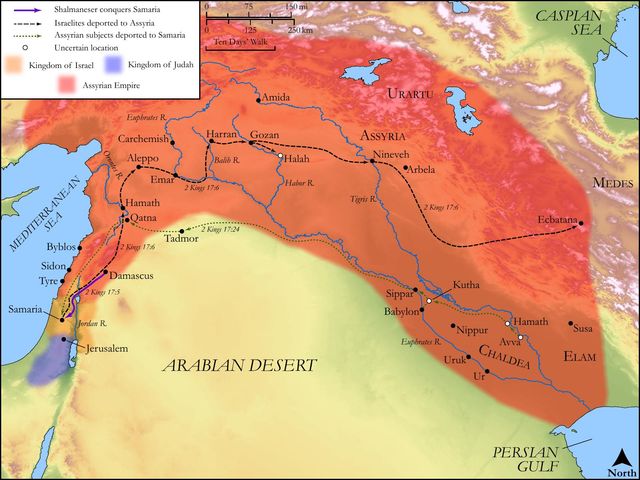
The pivotal verse of 2 Kings 17:6 records the tragic culmination of centuries of Israel's rebellion against God: the fall of Samaria, the capital of the Northern Kingdom, to the Assyrian Empire. In the ninth year of King Hoshea's reign, the Assyrians, under Shalmaneser V and later Sargon II, conquered Samaria and implemented their brutal policy of mass deportation, scattering the Israelite population into various regions of Mesopotamia and Media. This event marked the definitive end of the Northern Kingdom as a distinct political and national entity, serving as a stark fulfillment of divine judgment for persistent idolatry and covenant unfaithfulness.
Context
ShowHideLiterary Context
This verse serves as the climactic point of the narrative detailing the decline and fall of the Northern Kingdom of Israel. It immediately follows the account of Hoshea's rebellion against Assyria, his imprisonment, and the three-year siege of Samaria by Shalmaneser V (2 Kings 17:3-5). The verses that follow 2 Kings 17:6 (specifically 2 Kings 17:7-23) provide an extensive theological commentary on why this catastrophe occurred, attributing it directly to Israel's persistent sin, idolatry, and rejection of God's covenant and prophetic warnings. Thus, 2 Kings 17:6 is not merely a historical report but the central event around which the subsequent theological explanation revolves, highlighting God's justice and faithfulness to His covenant curses.
Historical & Cultural Context
The late 8th century BCE was dominated by the rising power of the Neo-Assyrian Empire, which employed ruthless military tactics and a systematic policy of mass deportation to control conquered territories and prevent future rebellions. This policy involved uprooting entire populations from their homelands and resettling them in distant parts of the empire, thereby dissolving national identity and cohesion. Israel, caught between Assyria and Egypt, attempted to play these superpowers against each other, leading to Hoshea's fatal decision to withhold tribute from Assyria and seek an alliance with Egypt. Culturally, the Northern Kingdom had, since its inception, been plagued by syncretism and idolatry, establishing golden calves at Bethel and Dan and adopting Canaanite Baal worship, practices explicitly forbidden by the Mosaic Law (e.g., Deuteronomy 12:29-31). This deep-seated spiritual apostasy, despite repeated warnings from prophets like Elijah, Elisha, Amos, and Hosea, set the stage for divine judgment executed through the Assyrian Empire.
Key Themes
ShowHideThe fall of Samaria and the exile of Israel in 2 Kings 17:6 underscore several profound themes. Foremost is the theme of Divine Judgment, demonstrating God's unwavering justice against persistent sin and covenant unfaithfulness, as prophesied in the Law (e.g., Deuteronomy 28:64). This event also highlights the Sovereignty of God over all nations, even using pagan empires like Assyria as instruments of His righteous purposes (Isaiah 10:5-6). Furthermore, it marks the End of the Northern Kingdom, signifying the definitive dissolution of the ten northern tribes as a distinct political entity and the beginning of their dispersion, leading to the concept of the "lost tribes of Israel." Finally, the narrative implicitly emphasizes the Consequences of Idolatry and Disobedience, serving as a stark warning against spiritual apostasy and the abandonment of God's covenant commands, a theme consistently present throughout the book of 2 Kings.
Exposition and Analysis
ShowHideKey Word Analysis
ShowHideThis refers to the Neo-Assyrian Empire, the dominant geopolitical power among the nations during the 8th century BCE. Far from being a random historical actor, Assyria is consistently portrayed in biblical prophecy and narrative as an instrument of divine judgment, a "rod" in God's hand to punish rebellious nations, including Israel. Their brutal efficiency in warfare and systematic deportation policies made them a fearsome and effective tool for fulfilling God's covenant curses.
This primitive root means "to catch (in a net, trap or pit); generally, to capture or occupy." In the context of 2 Kings 17:6, it signifies the decisive military conquest of Samaria by the Assyrian king. This was not merely a siege but a complete seizure, marking the end of the city's, and thus the kingdom's, independence.
This primitive root means "to denude (especially in a disgraceful sense); by implication, to exile (captives being usually stripped); figuratively, to reveal." The use of this word emphasizes the forced removal and humiliation of the Israelite population, a direct fulfillment of the covenant curses that warned of scattering and loss of land due to unfaithfulness.
This primitive root means "to sit down... by implication, to dwell, to remain; causatively, to settle." In this context, it describes the Assyrian policy of forcibly resettling the exiled Israelites in new, distant locations within their empire. This act was designed to break their national identity and prevent future rebellions by integrating them into the broader Assyrian populace.
Verse Breakdown
ShowHide"In the ninth year of Hoshea"
This specifies the precise historical timing of Samaria's fall, placing it within the reign of Hoshea, the last king of the Northern Kingdom of Israel. This detail anchors the event firmly in the historical chronology of the kings of Israel and Judah, highlighting the finality of Israel's decline under its last monarch.
"the king of Assyria took Samaria"
This declares the conquest of the capital city, Samaria, by the Assyrian monarch. While Shalmaneser V initiated the siege, it was likely completed by his successor, Sargon II, who claimed the capture of Samaria in his own inscriptions. "Took" signifies a decisive military victory, ending the three-year siege mentioned in the preceding verses and dismantling the political heart of the Northern Kingdom.
"and carried Israel away into Assyria"
This describes the subsequent act of deportation, a hallmark of Assyrian imperial policy. "Israel" here refers to the inhabitants of the Northern Kingdom, who were forcibly removed from their homeland and transported to various parts of the vast Assyrian Empire. This act effectively dismantled the nation of Israel, dissolving its national and tribal cohesion.
"and placed them in Halah and in Habor [by] the river of Gozan, and in the cities of the Medes"
These are specific geographical locations within the Assyrian sphere of influence, detailing the destinations of the exiled Israelites. Halah and Habor (likely the Khabur River, a tributary of the Euphrates) are in northern Mesopotamia, while "the cities of the Medes" refers to regions east of Assyria, in what is now northwestern Iran. This precise geographical detail underscores the historical veracity of the biblical account and the vast reach of the Assyrian deportation policy, ensuring the thorough scattering of the Israelite population.
Literary Devices
ShowHideThe primary literary device at play in 2 Kings 17:6 is Historical Narrative, presenting a concise, factual account of a pivotal geopolitical event. The verse functions as a climactic summary of the preceding narrative of Hoshea's reign and Assyrian aggression, marking the definitive end of the Northern Kingdom. It also employs Foreshadowing, as the total destruction and scattering of the Northern Kingdom implicitly warns the Southern Kingdom of Judah about the consequences of their own potential unfaithfulness, setting a precedent for future exiles. Furthermore, there is an element of Divine Irony in God using a pagan, ruthless empire like Assyria as the instrument of His righteous judgment against His own covenant people, demonstrating His absolute sovereignty over all nations and their rulers, even those who do not acknowledge Him.
Theological and Thematic Connections
ShowHideThe fall of Samaria and the exile of Israel represent a profound theological statement about God's justice, holiness, and covenant faithfulness. This was not a random historical misfortune but a direct consequence of Israel's persistent idolatry, oppression, and rejection of the Mosaic covenant, despite repeated warnings from prophets. God, who had brought Israel out of Egypt and established them in the land, was also faithful to His covenant curses, demonstrating that He holds His people accountable for their actions. This event serves as a powerful reminder that God's patience has limits and that persistent rebellion against His revealed will inevitably leads to severe consequences. It underscores the truth that true security and blessing lie only in faithful obedience to the Lord.
Reflection and Application
ShowHideThe tragic account of Israel's exile in 2 Kings 17:6 serves as a powerful and sobering lesson for believers today. It underscores the gravity of sin and the inevitable consequences of persistent disobedience to God's commands. Just as ancient Israel faced judgment for abandoning the Lord and pursuing idolatry, we too are called to examine our hearts for any "idols" that compete for God's rightful place in our lives—whether they be wealth, power, comfort, or self-reliance. This narrative reminds us that God is sovereign, just, and holy, and while He is merciful and patient, He also holds His people accountable. It challenges us to cultivate a deep and unwavering faithfulness, recognizing that true flourishing comes only through wholehearted devotion to Him. The history of Israel's fall is a perpetual call to vigilance against spiritual complacency and a renewed commitment to living in humble obedience to God's Word.
Questions for Reflection
ShowHideFAQ
ShowHideWhat was the primary reason for the Northern Kingdom's fall and exile?
ShowHideThe primary reason for the Northern Kingdom's fall and exile was their persistent and pervasive idolatry and unfaithfulness to the covenant with Yahweh. From the very beginning of the divided monarchy, King Jeroboam I established golden calves at Bethel and Dan, leading the people into a pattern of false worship (1 Kings 12:28-30). This was compounded by the adoption of Baal worship under kings like Ahab and Jezebel, and a general disregard for God's laws and prophetic warnings. The subsequent verses in 2 Kings 17:7-23 explicitly detail these sins, including worshipping other gods, building high places, practicing divination, and rejecting God's statutes. The Assyrian conquest was, therefore, not merely a political defeat but a divinely ordained judgment for their spiritual apostasy.
What happened to the "lost tribes of Israel" after the Assyrian deportation?
ShowHideThe "lost tribes of Israel" refer to the ten northern tribes deported by the Assyrians. While the term "lost" implies their complete disappearance, it's more accurate to say they lost their distinct tribal and national identity. The Assyrian policy was designed to integrate conquered peoples into the empire, breaking their cohesion. Some Israelites likely assimilated into the nations round about, intermarrying and adopting local customs and religions. However, some remnants of these tribes undoubtedly remained in the land or eventually migrated south to Judah, contributing to the population there. Furthermore, the New Testament indicates that the twelve tribes, though scattered, were still recognized as a people (e.g., James 1:1, Acts 26:7). Ultimately, in God's redemptive plan, all of scattered Israel will be gathered and restored through Christ.
Christ-Centered Fulfillment
ShowHideThe tragic exile of Israel in 2 Kings 17:6, a consequence of their covenant unfaithfulness, powerfully foreshadows the ultimate scattering of humanity due to sin and points directly to the necessity of Christ. Just as Israel was exiled from the promised land, humanity was exiled from God's presence in Eden due to disobedience (Genesis 3:23-24). The failure of the Northern Kingdom, and indeed all of Israel, to perfectly uphold the Law demonstrated humanity's inability to achieve righteousness on its own. Jesus Christ, the true Israel, perfectly fulfilled the Law and bore the ultimate judgment for sin, becoming the Lamb of God, who takes away the sin of the world!. Through His death and resurrection, He inaugurated a New Covenant, not written on tablets of stone but on human hearts (Jeremiah 31:31-34), gathering a new people—Jew and Gentile—from every nation, tribe, and tongue into His spiritual kingdom (Revelation 7:9). He is the true Shepherd who gathers the scattered sheep (John 10:16), offering not exile but eternal life and restoration in His presence. The judgment against Israel highlights the depths of human sin, making the grace and redemptive work of Christ all the more glorious as the means by which God's people are truly brought home.