


Revelation 7:9
- ΜετὰMetaAfterG3326PREPPreposition
- ταῦταtautathese thingsG3778D-APNDemonstrative pronoun Accusative Plural Neuter
- εἶδονeidonI lookedG1492V-2AAI-1SVerb 2nd Aorist Active Indicative 1st Singular
- καὶkaiandG2532CONJConjunction
- ἰδοὺidoubeholdG2400INJInterjection
- ὄχλοςochlosa multitudeG3793N-NSMNoun Nominative Singular Masculine
- πολὺςpolusgreatG4183A-NSMAdjective Nominative Singular Masculine
- ὃνhonwhichG3739R-ASMRelative pronoun Accusative Singular Masculine
- ἀριθμῆσαιarithmēsaito numberG705V-AANVerb Aorist Active Infinitive
- αὐτὸνautonitG846P-ASMPersonal pronoun Accusative Singular Masculine
- οὐδεὶςoudeisno [one]G3762A-NSMAdjective Nominative Singular Masculine
- ἐδύνατοedunatowas ableG1410V-INI-3SVerb Imperfect Middle Or Passive Deponent Indicative 3rd Singular
- ἐκekout ofG1537PREPPreposition
- παντὸςpantoseveryG3956A-GSNAdjective Genitive Singular Neuter
- ἔθνουςethnousnationG1484N-GSNNoun Genitive Singular Neuter
- καὶkaiandG2532CONJConjunction
- φυλῶνphulōntribesG5443N-GPFNoun Genitive Plural Feminine
- καὶkaiandG2532CONJConjunction
- λαῶνlaōnpeoplesG2992N-GPMNoun Genitive Plural Masculine
- καὶkaiandG2532CONJConjunction
- γλωσσῶνglōssōntonguesG1100N-GPFNoun Genitive Plural Feminine
- ἑστῶτεςhestōtesstandingG2476V-RAP-NPMVerb Perfect Active Participle Nominative Plural Masculine
- ἐνώπιονenōpionbeforeG1799PREPPreposition
- τοῦtoutheG3588T-GSMDefinite article Genitive Singular Masculine
- θρόνουthronouthroneG2362N-GSMNoun Genitive Singular Masculine
- καὶkaiandG2532CONJConjunction
- ἐνώπιονenōpionbeforeG1799PREPPreposition
- τοῦtoutheG3588T-GSNDefinite article Genitive Singular Neuter
- ἀρνίουarniouLambG721N-GSNNoun Genitive Singular Neuter
- περιβεβλημένουςperibeblēmenoushaving clothed themselves withG4016V-RMP-APMVerb Perfect Middle Participle Accusative Plural Masculine
- στολὰςstolasrobesG4749N-APFNoun Accusative Plural Feminine
- λευκὰςleukaswhiteG3022A-APFAdjective Accusative Plural Feminine
- καὶkaiandG2532CONJConjunction
- φοίνικεςphoinikespalm branchesG5404N-NPMNoun Nominative Plural Masculine
- ἐνeninG1722PREPPreposition
- ταῖςtaistheG3588T-DPFDefinite article Dative Plural Feminine
- χερσὶνchersinhandsG5495N-DPFNoun Dative Plural Feminine
- αὐτῶνautōnof themG846P-GPMPersonal pronoun Genitive Plural Masculine
English is a literal word-by-word gloss of the Greek, not the KJV's wording. Why?
This is the original text the KJV's translators worked from — each Greek word with its own literal English meaning in this verse, prepared by scholars at Tyndale House, Cambridge. The KJV translates whole sentences, not word by word, so its wording differs: one Greek word can become several English words, and the KJV may choose “charity” where the gloss reads “love”. Both are faithful — they answer different questions. For the KJV's own rendering, switch to the KJV text.
Details
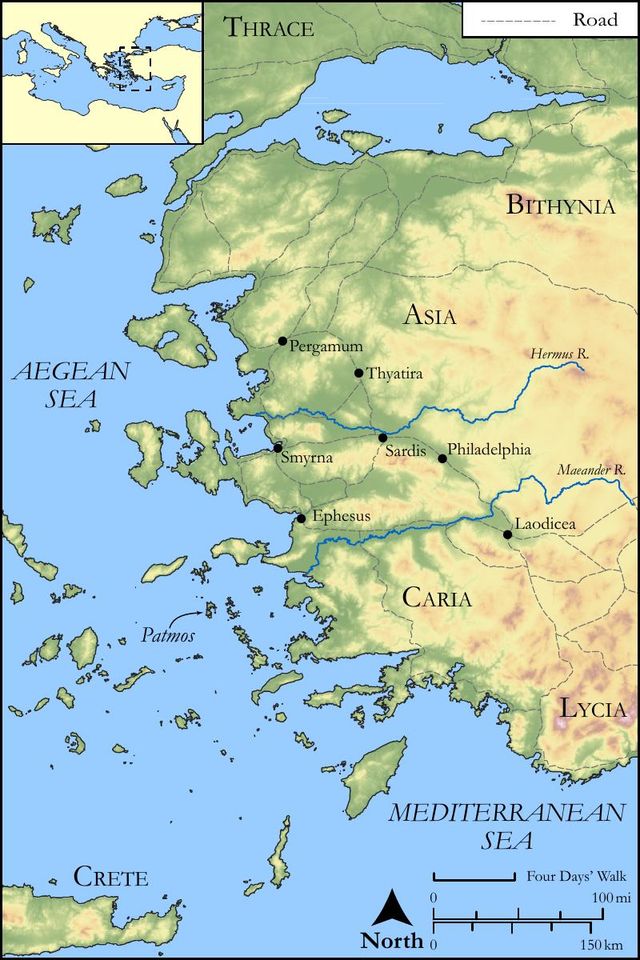
See on the biblical-era map

Study this verse
Public-domain commentary
Matthew Henry
From his Commentary on the Whole Bible. Henry comments on passages, not single verses — this entry covers Revelation 7:1–12. His four-level outline is real structure in the source text, so it is rendered as structure.
Here we have, I. An account of the restraint laid upon the winds. By these winds we suppose are meant those errors and corruptions in religion which would occasion a great deal of trouble and mischief to the church of God. Sometimes the Holy Spirit is compared to the wind: here the spirits of error are compared to the four winds, contrary one to another, but doing much hurt to the church, the garden and vineyard of God, breaking the branches and blasting the fruits of his plantation. The devil is called the prince of the power of the air; he, by a great wind, overthrew the house of Job's eldest son. Errors are as wind, by which those who are unstable are shaken, and carried to and fro, Eph 4:14. Observe, 1. These are called the winds of the earth, because they blow only in these lower regions near the earth; heaven is always clear and free from them. 2. They are restrained by the ministry of angels, standing on the four corners of the earth, intimating that the spirit of error cannot go forth till God permits it, and that the angels minister to the good of the church by restraining its enemies. 3. Their restraint was only for a season, and that was till the servants of God were sealed in their foreheads. God has a particular care and concern for his own servants in times of temptation and corruption, and he has a way to secure them from the common infection; he first establishes them, and then he tries them; he has the timing of their trials in his own hand.
II.An account of the sealing of the servants of God, where observe,
1.To whom this work was committed - to an angel, another angel. While some of the angels were employed to restrain Satan and his agents, another angel was employed to mark out and distinguish the faithful servants of God.
2.How they were distinguished - the seal of God was set upon their foreheads, a seal known to him, and as plain as if it appeared in their foreheads; by this mark they were set apart for mercy and safety in the worst of times.
3.The number of those that were sealed, where observe,
(1.)A particular account of those that were sealed of the twelve tribes of Israel - twelve thousand out of every tribe, the whole sum amounting to a hundred and forty-four thousand. In this list the tribe of Dan is omitted, perhaps because they were greatly addicted to idolatry; and the order of the tribes is altered, perhaps according as they had been more or less faithful to God. Some take these to be a select number of the Jews who were reserved for mercy at the destruction of Jerusalem; others think that time was past, and therefore it is to be more generally applied to God's chosen remnant in the world; but, if the destruction of Jerusalem was not yet over (and I think it is hard to prove that it was), it seems more proper to understand this of the remnant of that people which God had reserved according to the election of grace, only here we have a definite number for an indefinite.
(2.)A general account of those who were saved out of other nations (Rev 7:9): A great multitude, which no man could number, of all nations, and kindreds, and people, and tongues. Though these are not said to be sealed, yet they were selected by God out of all nations, and brought into his church, and there stood before the throne. Observe,
[1.]God will have a greater harvest of souls among the Gentiles than he had among the Jews. More are the children of the desolate than of the married woman.
[2.]The Lord knows who are his, and he will keep them safe in times of dangerous temptation.
[3.]Though the church of God is but a little flock, in comparison of the wicked world, yet it is no contemptible society, but really large and to be still more enlarged.
III.We have the songs of saints and angels on this occasion, Rev 7:9-12, where observe,
1.The praises offered up by the saints (and, as it seems to me, by the Gentile believers) for the care of God in reserving so large a remnant of the Jews, and saving them from infidelity and destruction. The Jewish church prayed for the Gentiles before their conversion, and the Gentile churches have reason to bless God for his distinguishing mercy to so many of the Jews, when the rest were cut off. Here observe,
(1.)The posture of these praising saints: they stood before the throne, and before the Lamb, before the Creator and the Mediator. In acts of religious worship we come nigh to God, and are to conceive ourselves as in his special presence; and we must come to God by Christ. The throne of God would be inaccessible to sinners were it not for a Mediator.
(2.)Their habit: they were clothed with white robes, and had palms in their hands; they were invested with the robes of justification, holiness, and victory, and had palms in their hands, as conquerors used to appear in their triumphs: such a glorious appearance will the faithful servants of God make at last, when they have fought the good fight of faith and finished their course.
(3.)Their employment: they cried with a loud voice, saying, Salvation to our God who sitteth upon the throne, and to the Lamb. This may be understood either as a hosannah, wishing well to the interest of God and Christ in the church and in the world, or as a hallelujah, giving to God and the Lamb the praise of the great salvation; both the Father and the Son are joined together in these praises; the Father contrived this salvation, the Son purchased it, and those who enjoy it must and will bless the Lord and the Lamb, and they will do it publicly, and with becoming fervour.
2.Here is the song of the angels (Rev 7:11, Rev 7:12), where observe,
(1.)Their station - before the throne of God, attending on him, and about the saints, ready to serve them.
(2.)Their posture, which is very humble, and expressive of the greatest reverence: They fell before the throne on their faces, and worshipped God. Behold the most excellent of all the creatures, who never sinned, who are before him continually, not only covering their faces, but falling down on their faces before the Lord! What humility then, and what profound reverence, become us vile frail creatures, when we come into the presence of God! We should fall down before him; there should be both a reverential frame of spirit and a humble behaviour in all our addresses to God (3.) Their praises. They consented to the praises of the saints, said their Amen thereto; there is in heaven a perfect harmony between the angels and saints; and then they added more of their own, saying, Blessing, and glory, and wisdom, and thanksgiving, and honour, and power, and might, be unto our God for ever and ever. Amen. Here,
[1.]They acknowledge the glorious attributes of God - his wisdom, his power, and his might.
[2.]They declare that for these his divine perfections he ought to be blessed, and praised, and glorified, to all eternity; and they confirm it by their Amen. We see what is the work of heaven, and we ought to begin it now, to get our hearts tuned for it, to be much in it, and to long for that world where our praises, as well as happiness, will be perfected.
Historical interpretation
Seven Centuries of Reception
14 surviving comments on this verse. Each one is dated, so this reads as a timeline rather than a list.
Select a marker to jump to its quote. Markers stagger vertically where authors wrote within a few decades of each other.
If, therefore, we also live as dedicated and devoted to God-if we make our way over the ancient and sacred footsteps of the righteous, let us go through the same proofs of sufferings, the same testimonies of passions, considering the glory of our time the greater on this account, that while ancient examples may be numbered, yet that subsequently, when the abundance of virtue and faith was in excess, the Christian martyrs cannot be numbered, as the Apocalypse testifies and says: "After these things I beheld a great multitude, which no man could number, of every nation, and of every tribe, and people, and language, standing in the sight of the throne and of the Lamb; and they were clothed in white robes, and palms were in their hands; and they said with a loud voice, Salvation to our God, who sitteth upon the throne, and unto the Lamb! And one of the elders answered and said unto me, Who are those which are arrayed in white robes, and whence come they? And I said unto him, My lord, thou knowest. And he said unto me, These are they who have come out of great tribulation, and have washed their robes, and made them white in the blood of the Lamb. Therefore are they before the throne of God, and serve Him day and night in His temple."106 But if the assembly of the Christian martyrs is shown and proved to be so great, let no one think it a hard or a difficult thing to become a martyr, when he sees that the crowd of martyrs cannot be numbered.
Of the benefits of martyrdom. In the Proverbs of Solomon: "The faithful martyr delivers his soul from evils." Also in the same place: "Then shall the righteous stand in great boldness against them who have afflicted them, and who took away their labours. When they see them, they shall be disturbed with a horrible fear; and they shall wonder at the suddenness of their unhoped-for salvation, saying among themselves, repenting and groaning with distress of spirit, These are they whom some time we had in derision, and in the likeness of a proverb; we fools counted their life madness, and their end without honour. How are they reckoned among the children of God, and their lot among the saints! Therefore we have wandered from the way of truth, and the light of righteousness has not shined upon us, and the sun has not risen upon us. We have been wearied in the way of iniquity and of perdition, and we have walked through difficult solitudes; but we have not known the way of the Lord. What hath pride profited us? or what hath the boasting of riches brought to us? All these things have passed away as a shadow." Of this same thing in the cxvth Psalm: "Precious in the sight of the Lord is the death of His saints." Also in the cxxvth Psalm: "They who sow in tears shall reap in joy. Walking they walked, and wept as they cast their seeds; but coming they shall come in joy, raising up their laps." Of this same thing in the Gospel according to John: "He who loveth his life shall lose it; and he that hateth his life in this world shall find it to life eternal." Also in the same place: "But when they shall deliver you up, take no thought what ye shall speak; for it is not ye who speak, but the Spirit of your Father which speaketh in you." Also in the same place: "The hour shall come, that every one that killeth you shall think he doeth service to God l but they shall do this also because they have not known the Father nor me." Of this same matter, according to Matthew: "Blessed are they which shall suffer persecution for righteousness' sake; for theirs is the kingdom of heaven." Also in the same place: "Fear not them which kill the body, but are not able to kill the soul; but rather fear Him which is able to kill the soul and body in Gehenna." Also in the same place: "Whosoever shall confess me before men, him also will I confess before my Father which is in heaven; but he who shall deny me before men, him also will I deny before my Father which is in heaven. And he that shall endure to the end, the same shall be saved." Of this same thing, according to Luke: "Blessed shall ye be when men shall hate you, and shall separate you (from their company), and shall drive you out, and shall speak evil of your name, as wicked, for the Son of man's sake. Rejoice in that day, and exult; for, lo, your reward is great in heaven." Also in the same place: "Verily I say unto you, There is no man that leaveth house, or parents, or brethren, or wife, or children, for the sake of the kingdom of God, and does not receive seven times as much in this present time, but in the world to come life everlasting." Of this same thing in the Apocalypse: "And when he had opened the fifth seal, I saw under the altar of God the souls of them that were slain on account of the word of God and His testimony. And they cried with a loud voice, saying, How long, O Lord, holy and true, dost Thou not judge and avenge our blood on them that dwell on the earth? And unto every one of them were given white robes; and it was said to them, that they should rest still for a short time, until the number of their fellow-servants, and of their brethren, should be fulfilled, and they who shall afterwards be slain, after their example." Also in the same place: "After these things I saw a great crowd, which no one among them could number, from every nation, and from every tribe, and from every people and tongue, standing before the throne and before the Lamb; and they were clothed with white robes, and palms were in their hands. And they said with a loud voice, Salvation to our God, that sitteth upon the throne, and to the Lamb. And one of the elders answered and said to me, What are these which are clothed with white robes? who are they, and whence have they come? And I said unto him, My lord, thou knowest. And he said unto me, These are they who have come out of great tribulation, and have washed their robes, and made them white in the blood of the Lamb. Therefore they are before the throne of God, and serve Him day and night in His temple; and He who sitteth upon the throne shall dwell among them. They shall neither hunger nor thirst ever; and neither shall the sun fall upon them, nor shall they suffer any heat: for the Lamb who is in the midst of the throne shall protect them, and shall lead them to the fountains of the waters of life; and God shall wipe away every tear from their eyes." Also in the same place: "He who shall overcome I will give him to eat of the tree of life, which as in the paradise of my God." Also in the same place: "Be thou faithful even unto death, and I will give thee a crown of life." Also in the same place: "Blessed shall they be who shall watch, and shall keep their garments, lest they walk naked, and they see their shame." Of this same thing, Paul in the second Epistle to Timothy: "I am now offered up, and the time of my assumption is at hand. I have fought a good fight, I have finished my course, I have kept the faith. There now remains for me a crown of righteousness, which the Lord, the righteous Judge, will give me in that day; and not only to me, but to all also who love His appearing." Of this same thing to the Romans: "We are the sons of God: but if sons and heirs of God, we are also joint-heirs with Christ; if we suffer together, that we may also be magnified together." Of this same thing in the cxviiith Psalm: "Blessed are they who are undefiled in the way, and walk in the law of the Lord. Blessed are they who search into His testimonies."
"After this I beheld, and, lo, a great multitude, which no man was able to number, of every nation, tribe, and people, and tongue, clothed with white robes." What the great multitude out of every tribe implies, is to show the number of the elect out of all believers, who, being cleansed by baptism in the blood of the Lamb, have made their robes white, keeping the grace which they have received.
He did not say, “After this I saw another people,” but “I saw a people,” that is, the same people that he had seen in the mystery of the 144,000, which he now sees as without number from every tribe and tongue and nation. For by believing, all nations have been engrafted into the root. In the Gospel the Lord showed forth in the [figure of the] twelve tribes the whole church both from the Jews and from the Gentiles. He said, “You will sit on twelve thrones, judging the twelve tribes of Israel.”
By the white robes he means the gift of the Holy Spirit.
By the sign of the sacred number he signifies the multitude of the elect, “whom God foreknew and predestined to be conformed to the image of his Son.” For those who come from the nations are made to be Israel and so by right are called sons of Abraham, not by flesh but by faith in that seed which is Christ, the cornerstone, of whom the apostle said, “He is our peace, who has made us both one, and has broken down the dividing wall of hostility, by abolishing in his flesh the law of commandments and ordinances, that he might create in himself one new man in the place of two, and so make peace, and might reconcile both to God in one body through the cross.”
By the robes he suggests baptism, and by the palms the triumph of the cross. Since they have conquered the world in Christ, it may be that the robes signify the love which is given through the Holy Spirit.… They are said to carry palm branches in their hands. “In their hands” indicates either their perseverance in good works—we read here, “The Lord made strong his arm for a good work,” and “With my hands at night I was before him, and I was not deceived”13—or it indicates that power which they received so that they might become sons of God, as is said of Joseph, “And the Lord had placed all things in his hand,” that is, into his power.
These are the ones of whom David spoke: “I shall number them, and they will be more than the sand.” Namely, these are those who long ago struggled as martyrs for the sake of Christ and those from every tribe and tongue who will fight valiantly at the end of time.
By the outpouring of their own blood for the sake of Christ, some have made white and others will make white the robes of their deeds. And they have in their hands palm branches, which are symbolic of victory and which are good, straight and white as are their hearts. And they form a chorus around the divine throne of the godly rest, as grateful family members ascribing the victory over the demons to him who provides it.
Let us think attentively about the eternal feast of the martyrs, which is in heaven, and by following in their footsteps insofar as we can, let us also take care to become ourselves participants in this heavenly feast, for as the apostle bears witness, if we have been companions of his passion, we will at the same time be companions of his consolation. Nor should we mourn their death as much as we should rejoice about their attaining the palm of righteousness. Rachel must groan over each of them when, through torments, they are driven away from this life—that is, the church which begot [them] exhorts them with mourning and tears, but when they have been driven out, the heavenly Jerusalem, who is the mother of us all, soon receives them into another life by ministers of gladness who are ready at hand and introduces them into the joy of the Lord to be crowned as his forever. Hence, says John, they were standing before the throne “in the sight of the Lamb, dressed in white robes, and palms were in their hands.” For they now stand before God’s throne, crowned, who once lay, worn down by pain, before the thrones of earthly judges. They stand in the sight of the Lamb, and for no cause can they be separated from contemplating his glory there, since here they could not be separated from his love through punishments. They shine in white robes and have palms in their hands, who possess the rewards for their works; while they get back their bodies, glorified through resurrection, which for the Lord’s sake they suffered to be scorched by flames, torn to pieces by beasts, worn out by scourges, broken by falls from high places, scraped by hoofs and completely destroyed by every kind of punishment.
After these things, I saw a great multitude, which no one could number. Having finished the recapitulation, which he had interposed for the sake of example, he returns to the order, proclaiming the glory of those who will overcome the wickedness of the final persecution. And what follows: From all nations, and tribes, and peoples, and tongues, etc., it can also be understood thus, that, having enumerated the tribes of Israel, to whom the Gospel was first preached, he also wishes to commemorate the salvation of the Gentiles.
Clothed in white robes, and palms in their hands. By robes he hints at baptism, by palms, the triumph of the cross, and that they have overcome the world in Christ. Although the clarity which is given through the Holy Spirit is also signified by the robes.
After this I saw a great multitude, which no man could number, of all nations, and tribes, and peoples, and tongues. Here it is clearly revealed that the aforementioned number does not only consist of Jews, but of all the elect; for it is the same people that are indicated by the countless multitude and by the hundred forty-four thousand signed. This multitude is not countless for God, but for us; for he himself said, I will number them, and they shall be multiplied above the sand. [Ps. 138:18] Standing before the throne. Although the countless multitude is itself the throne of God, it is nonetheless said to be standing before the throne, because the vision changes as it is obscured by symbols, although the thing represented by the symbols does not change at all. But does it mean something that this multitude is said to be standing whereas the same was described above as sitting with the ancients round about the throne? It clearly does: it is sitting when it examines the acts of others through some of its members, and it is standing when it strengthens its heart in the solidity of faith and love in all its elect. And in sight of the Lamb, clothed with white robes. What is represented by the white robes but their disposition of mind? These robes were not however white before the Lord's coming, because the hearts of mankind were besprinkled with the stains of original sins. And palms in their hands. By the palms is represented victory, and by the hands, work. Therefore to have palms in one's hands means to triumph over the old enemy and the pleasures of the world.
These things, which the discourse has narrated, have been demonstrated to the divine evangelist concerning those sealed from Israel by blood and therefore saved, and also those who have believed. But so that nothing may be lacking in his vision, the prophecy reveals to him the countless myriads of the nations, who after these things run to faith, being present both around the Lord and at the divine throne. For since the Lord is said to arrive at the second coming, which has not yet been announced in the vision, the saints are then "caught up in clouds" to meet the Savior, as the divine apostle has previously described them being caught up. (1 Thess. 4:17)
The vision also shows that they have attained the blessedness reserved for them. For what could be more worthy than to be with Christ and to behold the divine throne?
The countless myriads of the nations, therefore, who have received the faith of Christ and have attained the blessed end, have inherited the glorious place, standing before the Lord and His Father's throne, as was said before.
It is necessary for them to be clothed in white robes, a sign of the purity existing in their life.
The palm branches, being symbols of victory, are said to boast of the victory of Christ both over the invisible enemies and the visible ones.
Continue studying Revelation 7:9 across the web’s major study libraries — every link below opens this exact verse, chapter, or book on the destination site.
Read & Compare
 BibleGatewayThis verse in more than 200 translations and 70 languages.
 Bible.comThe YouVersion reader — hundreds of translations, reading plans, and highlights.
 ESV.orgCrossway's official English Standard Version reader.
 NET BibleThe NET translation with 60,000+ translators' notes on every rendering decision.
 STEP BibleTyndale House's free study tool — original text, vocabulary, and scholarly resources.
 BibliaLogos Bible Software's free web reader.
 USCCBThe New American Bible (Revised Edition) with the U.S. bishops' study notes.
Commentaries
 BibleHub CommentariesDozens of classic commentaries on this verse, gathered on one page.
 StudyLightMore than 100 commentary sets — the largest collection on the web.
 BibleRefPlain-English commentary on what this verse means, verse by verse.
 Enduring WordDavid Guzik's free commentary on this chapter, widely used by Bible teachers.
 Bible Study ToolsVerse commentary alongside Greek and Hebrew study aids.
Original Language & Research
- BibleHub InterlinearThe verse word by word — original language, transliteration, and English.
- BibleHub LexiconEvery word's original-language definition and Strong's entry.
 Blue Letter BibleDeep-study tools — Strong's numbers, concordance, and word studies.
 CNTR CollationThe earliest Greek manuscripts of this verse, collated letter by letter.
Sermons, Hymns & Audio


TrulyRandomVerse is not affiliated with these sites and doesn’t control their content. They’re linked because they’re genuinely useful.
Summary
Revelation 7:9 unveils a glorious celestial vision, shifting the narrative from earthly tribulation to heavenly triumph. John beholds an immeasurable multitude, comprised of individuals from every nation, tribe, people, and language, standing in reverent worship before the divine throne and the Lamb. Clothed in radiant white robes and holding palm branches, this assembly represents the culmination of God's redemptive purpose, showcasing the universal scope of His salvation and the ultimate victory of His diverse people.
Context
ShowHideLiterary Context
This verse serves as a pivotal interlude within the Book of Revelation, specifically between the opening of the sixth and seventh seals. Immediately preceding it, Revelation 7:1-8 describes the sealing of 144,000 from the twelve tribes of Israel, providing assurance of divine protection amidst impending judgments. The vision of the great multitude in Revelation 7:9 then broadens the scope dramatically, moving from a specific, numbered group within Israel to an uncountable, global assembly of the redeemed. This juxtaposition emphasizes that God's salvation plan encompasses both Israel and a vast company from all humanity, offering a powerful message of hope and universal reach before the intensity of the trumpet judgments commences in Revelation 8.
Historical & Cultural Context
The imagery in Revelation 7:9 draws from significant historical and cultural practices. The "white robes" evoke purity, victory, and divine favor, often associated with those who had triumphed or were set apart for sacred service in both Jewish and Greco-Roman contexts. The "palms in their hands" are particularly rich in symbolism. In Jewish tradition, palm branches (lulav) were used during the Feast of Tabernacles (Sukkot), a joyous harvest festival commemorating God's provision and dwelling among His people, as described in Leviticus 23:40. They symbolized joy, celebration, and national deliverance. In Roman culture, palm branches were carried in triumphal processions to honor victorious generals or emperors, signifying conquest and acclaim. Thus, their presence here signifies the redeemed's joyous celebration of God's ultimate victory and their own triumph over tribulation through the Lamb.
Key Themes
ShowHideRevelation 7:9 powerfully articulates several core themes central to Revelation and biblical theology. The "innumerable multitude" highlights the boundless extent of God's grace and the success of His redemptive work, demonstrating that salvation is far grander than human capacity to count or comprehend. The description "of all nations, and kindreds, and people, and tongues" underscores the universal reach of God's kingdom, challenging any ethnocentric or exclusive view of salvation and affirming God's desire to redeem humanity from every corner of the earth. Their posture "before the throne, and before the Lamb" signifies direct, intimate access to the divine presence, the ultimate privilege and joy of the redeemed, echoing the throne room visions found earlier in Revelation 4. Finally, the "white robes" symbolize the righteousness and purity granted to believers through Christ's atoning sacrifice, while the "palms" represent victory and celebratory worship, marking the culmination of their journey and their eternal adoration of God and the Lamb.
Exposition and Analysis
ShowHideKey Word Analysis
ShowHideThis term (G3793) denotes a throng or a crowd, often unorganized or uncounted. Its usage here emphasizes the sheer, overwhelming number of people, so vast that it defies human enumeration, highlighting the immense scope of God's redemptive work across humanity.
Referring to a race or tribe (G1484), this word specifically denotes foreign, non-Jewish peoples, often by implication, pagan. Its inclusion alongside "kindreds, people, and tongues" powerfully emphasizes the global and Gentile dimension of this redeemed assembly, signifying that salvation extends beyond any single ethnic or national boundary.
This word (G1100) primarily means "tongue" but by implication refers to a language, especially one naturally unacquired. Its presence here reinforces the multi-linguistic and cultural diversity of the redeemed, indicating that people from every linguistic group will be present in this heavenly gathering, united in worship.
Verse Breakdown
ShowHide"After this I beheld, and, lo, a great multitude"
John's vision continues, shifting focus. "After this" (G3326, G5023) signals a new phase of revelation. "I beheld" (G1492, G5627) and "lo" (G2400, G5628) emphasize the sudden, awe-inspiring nature of the sight, drawing the reader's attention to the profound revelation that follows. The "great multitude" (G4183, G3793) immediately conveys the vastness of the assembly.
"which no man could number"
This phrase (G3739, G3762, G1410, G5711, G705, G846) is a hyperbole underscoring the immeasurable size of this group. It signifies that God's redemptive work is far more expansive and successful than human comprehension or calculation can grasp, demonstrating His boundless grace and the effectiveness of Christ's sacrifice.
"of all nations, and kindreds, and people, and tongues"
This four-fold description (G1537, G3956, G1484, G2532, G5443, G2532, G2992, G2532, G1100) provides a comprehensive picture of the multitude's universal origin. "Nations" (Gentiles), "kindreds" (tribes or clans), "people" (general populace), and "tongues" (languages) together emphasize that this redeemed company is drawn from every ethnic, familial, national, and linguistic group on earth, highlighting the truly global and inclusive nature of God's salvation.
"stood before the throne, and before the Lamb"
Their posture of standing (G2476, G5761) signifies reverence, readiness, and a privileged position of access. To stand "before the throne" (G1799, G2362) means to be in the immediate, glorious presence of God Almighty. To stand "before the Lamb" (G1799, G721) indicates their direct access to Jesus Christ, the one through whom their salvation was accomplished, and their worship of Him. This is the ultimate fulfillment of their journey.
"clothed with white robes, and palms in their hands;"
Their attire (G4016, G5772, G3022, G4749) of "white robes" symbolizes purity, righteousness, and victory, often denoting garments of salvation made clean through Christ's blood (as clarified in Revelation 7:14). The "palms" (G5404) held "in their hands" (G1722, G846, G5495) are symbols of triumph, joy, and celebration, signifying their victory over tribulation and their enthusiastic acclamation of God and the Lamb.
Literary Devices
ShowHideRevelation 7:9 is rich in Symbolism and Hyperbole. The "great multitude" itself is a powerful symbol of the vastness and universal reach of God's redeemed people, while the phrase "which no man could number" functions as Hyperbole, an intentional exaggeration to convey the immeasurable scale of this assembly, far exceeding any human census. The "white robes" are potent symbols of purity, righteousness, and victory, signifying the spiritual transformation and cleansing achieved through Christ. The "palms in their hands" are a vivid symbol of triumph, joy, and celebration, drawing on ancient traditions of victorious processions and festive worship. The repetition of "and" ("nations, and kindreds, and people, and tongues") is an example of Polysyndeton, which serves to emphasize the comprehensive and exhaustive nature of the multitude's diverse origins, underscoring that no group is excluded from this glorious gathering.
Theological and Thematic Connections
ShowHideThis vision in Revelation 7:9 is a profound theological statement on the nature and scope of God's redemptive plan. It emphatically declares that salvation is not confined to one nation or lineage but extends to every corner of the earth, embracing a diverse humanity united by faith in the Lamb. This universalism is a consistent theme throughout biblical prophecy, culminating in this heavenly scene where all barriers of ethnicity, language, and culture are transcended in worship. The presence of the "great multitude" before the throne and the Lamb underscores the ultimate purpose of redemption: to bring humanity into direct, unhindered communion with God and Christ, where their worship is the eternal response to His saving grace. It assures believers that despite earthly tribulations, the final outcome is glorious triumph and eternal adoration.
Reflection and Application
ShowHideRevelation 7:9 offers immense encouragement and a powerful call to action for believers today. The vision of an innumerable, globally diverse multitude worshipping before God's throne reminds us that God's kingdom is far vaster and more inclusive than we often imagine. It instills hope, assuring us that despite the chaos and brokenness of the world, God's redemptive plan is unfurling towards a glorious, victorious culmination. This vision should inspire us to persevere through trials, knowing that our ultimate destiny is joyful communion with God and the Lamb. Furthermore, it serves as a profound impetus for missions and evangelism, challenging us to actively participate in God's desire to gather people from "all nations, and kindreds, and people, and tongues." Our worship here on earth is a foretaste of that grand heavenly chorus, and our efforts to share the Gospel contribute directly to the swelling ranks of this redeemed multitude.
Questions for Reflection
ShowHideFAQ
ShowHideWho are the "great multitude" in Revelation 7:9, and how do they relate to the 144,000 sealed in the preceding verses?
ShowHideThe "great multitude" in Revelation 7:9 represents the entirety of the redeemed from every nation, tribe, people, and language, who have come out of the great tribulation. They are a universal company of believers, distinct from but complementary to the 144,000 sealed from the tribes of Israel in Revelation 7:4-8. While the 144,000 are often understood as a specific, symbolic, or literal group of Jewish evangelists or protected remnant during the tribulation, the great multitude is an unquantifiable, global assembly, emphasizing the vast and inclusive scope of God's salvation that encompasses both Jew and Gentile. The sealing of the 144,000 provides assurance of God's protection for His people on earth, while the vision of the great multitude offers a glimpse into the ultimate, glorious outcome of redemption in heaven.
What is the significance of the "white robes" and "palms in their hands"?
ShowHideThe "white robes" symbolize purity, righteousness, and victory. Revelation 7:14 clarifies that these robes have been "washed, and made white in the blood of the Lamb," indicating that their purity is not self-achieved but is a gift of salvation through Christ's atoning sacrifice. These robes also signify their triumph over sin and the world. The "palms in their hands" are symbols of triumph, joy, and celebration. This imagery draws from both Jewish tradition (the Feast of Tabernacles, a celebration of God's provision and deliverance) and Roman triumphal processions. In this heavenly context, the palms signify the redeemed's victory over tribulation, death, and evil, and their joyous acclamation and worship of God and the Lamb for their salvation and ultimate triumph.
Christ-Centered Fulfillment
ShowHideRevelation 7:9 is profoundly Christ-centered, presenting the ultimate triumph of the Lamb's redemptive work. The "great multitude" stands "before the Lamb," signifying that their very presence in glory is a direct result of His sacrifice. It is through the "blood of the Lamb" that their robes are made "white" (Revelation 7:14), underscoring that their purity and righteousness are imputed, not earned. This vision fulfills the prophetic promise that through Christ, salvation would extend to "all the ends of the earth" (Isaiah 49:6), breaking down the dividing wall between Jew and Gentile to create "one new man" (Ephesians 2:14-16). The Lamb, who was "slain, and has redeemed us to God by his blood out of every kindred, and tongue, and people, and nation" (Revelation 5:9), is the focal point of this universal worship. Thus, Revelation 7:9 is a glorious testament to the efficacy and cosmic scope of Christ's cross, revealing the multi-ethnic, multi-linguistic fruit of His finished work, gathered eternally around His throne in triumphant adoration.