


Revelation 7:15
Bible text: King James Version (1769 Blayney text) · Public domain
Bible text: King James Version with Strong's numbers · Public domain
Bible text: Berean Standard Bible · Public domain
Bible text: American Standard Version (1901) · Public domain
Bible text: World English Bible, Messianic edition · Public domain
Bible text: Geneva Bible (1599) · Public domain
Bible text: Young's Literal Translation · Public domain
- διὰdiaBecause ofG1223PREPPreposition
- τοῦτόtoutothisG3778D-ASNDemonstrative pronoun Accusative Singular Neuter
- εἰσινeisinThey areG1510V-PAI-3PVerb Present Active Indicative 3rd Plural
- ἐνώπιονenōpionbeforeG1799PREPPreposition
- τοῦtoutheG3588T-GSMDefinite article Genitive Singular Masculine
- θρόνουthronouthroneG2362N-GSMNoun Genitive Singular Masculine
- τοῦtou<the>G3588T-GSMDefinite article Genitive Singular Masculine
- θεοῦtheouof GodG2316N-GSM-TNoun Genitive Singular Masculine Title
- καὶkaiandG2532CONJConjunction
- λατρεύουσινlatreuousinserveG3000V-PAI-3PVerb Present Active Indicative 3rd Plural
- αὐτῷautōHimG846P-DSMPersonal pronoun Dative Singular Masculine
- ἡμέραςhēmerasby dayG2250N-GSFNoun Genitive Singular Feminine
- καὶkaiandG2532CONJConjunction
- νυκτὸςnuktosnightG3571N-GSFNoun Genitive Singular Feminine
- ἐνeninG1722PREPPreposition
- τῷtōtheG3588T-DSMDefinite article Dative Singular Masculine
- ναῷnaōtempleG3485N-DSMNoun Dative Singular Masculine
- αὐτοῦautouof HimG846P-GSMPersonal pronoun Genitive Singular Masculine
- καὶkaiandG2532CONJConjunction
- ὁhothe [One]G3588T-NSMDefinite article Nominative Singular Masculine
- καθήμενοςkathēmenossittingG2521V-PNP-NSMVerb Present Middle Or Passive Deponent Participle Nominative Singular Masculine
- ἐπὶepionG1909PREPPreposition
- τοῦtoutheG3588T-GSMDefinite article Genitive Singular Masculine
- θρόνουthronouthroneG2362N-GSMNoun Genitive Singular Masculine
- σκηνώσειskēnōseiwill tabernacleG4637V-FAI-3SVerb Future Active Indicative 3rd Singular
- ἐπ᾽ep᾽overG1909PREPPreposition
- αὐτούςautousthemG846P-APMPersonal pronoun Accusative Plural Masculine
English is a literal word-by-word gloss of the Greek, not the KJV's wording. Why?
This is the original text the KJV's translators worked from — each Greek word with its own literal English meaning in this verse, prepared by scholars at Tyndale House, Cambridge. The KJV translates whole sentences, not word by word, so its wording differs: one Greek word can become several English words, and the KJV may choose “charity” where the gloss reads “love”. Both are faithful — they answer different questions. For the KJV's own rendering, switch to the KJV text.
Details
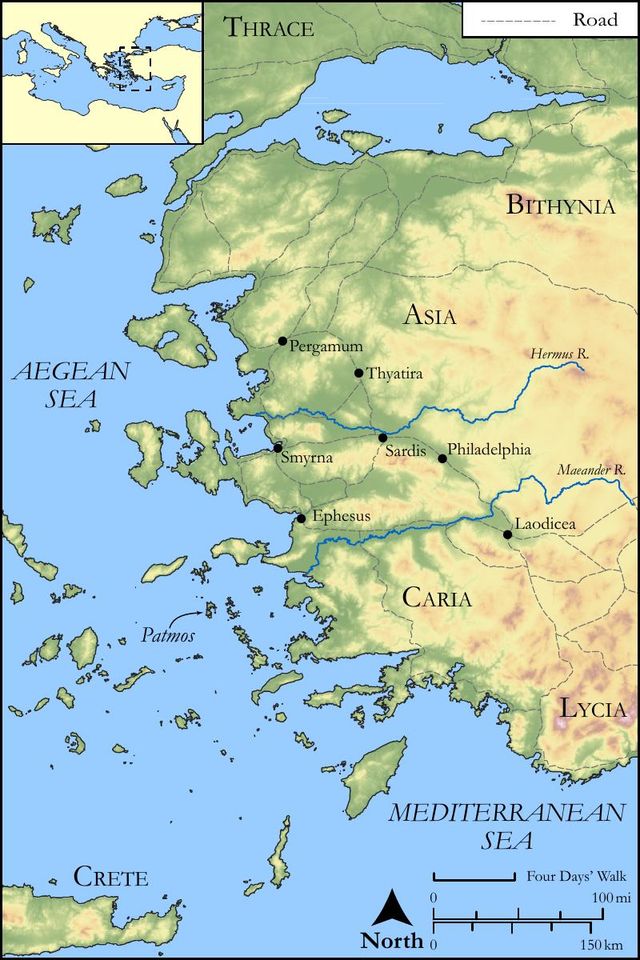
See on the biblical-era maps

Study this verse
Public-domain commentary
Matthew Henry
From his Commentary on the Whole Bible. Henry comments on passages, not single verses — this entry covers Revelation 7:13–17. His four-level outline is real structure in the source text, so it is rendered as structure.
Here we have a description of the honour and happiness of those who have faithfully served the Lord Jesus Christ, and suffered for him. Observe,
I.A question asked by one of the elders, not for his own information, but for John's instruction:
ministers may learn from the people, especially from aged and experienced Christians; the lowest saint in heaven knows more than the greatest apostle in the world. Now the question has two parts: - 1. What are these that are arrayed in white robes? 2. Whence came they? It seems to be spoken by way of admiration, as Sol 3:6, Who is this that cometh out of the wilderness! Faithful Christians deserve our notice and respect; we should mark the upright.
II.The answer returned by the apostle, in which he tacitly acknowledges his own ignorance, and sues to this elder for information:
Thou knowest. Those who would gain knowledge must not be ashamed to own their ignorance, nor to desire instruction from any that are able to give it.
III.The account given to the apostle concerning that noble army of martyrs who stood before the throne of God in white robes, with palms of victory in their hands: and notice is taken here of,
1.The low and desolate state they had formerly been in; they had been in great tribulation, persecuted by men, tempted by Satan, sometimes troubled in their own spirits; they had suffered the spoiling of their goods, the imprisonment of their persons, yea, the loss of life itself. The way to heaven lies through many tribulations; but tribulation, how great soever, shall not separate us from the love of God. Tribulation, when gone through well, will make heaven more welcome and more glorious.
2.The means by which they had been prepared for the great honour and happiness they now enjoyed: they had washed their robes, and made them white in the blood of the Lamb, Rev 7:14. It is not the blood of the martyrs themselves, but the blood of the Lamb, that can wash away sin, and make the soul pure and clean in the sight of God. Other blood stains; this is the only blood that makes the robes of the saints white and clean.
3.The blessedness to which they are now advanced, being thus prepared for it.
(1.)They are happy in their station, for they are before the throne of God night and day; and he dwells among them; they are in that presence where there is fulness of joy.
(2.)They are happy in their employment, for they serve God continually, and that without weakness, drowsiness, or weariness. Heaven is a state of service, though not of suffering; it is a state of rest, but not of sloth; it is a praising delightful rest.
(3.)They are happy in their freedom from all the inconveniences of this present life.
[1.]From all want and sense of want: They hunger and thirst no more; all their wants are supplied, and all the uneasiness caused thereby is removed.
[2.]From all sickness and pain: they shall never be scorched by the heat of the sun any more.
(4.)They are happy in the love and guidance of the Lord Jesus: He shall feed them, he shall lead them to living fountains of waters, he shall put them into the possession of every thing that is pleasant and refreshing to their souls, and therefore they shall hunger and thirst no more.
(5.)They are happy in being delivered from all sorrow or occasion of it: God shall wipe away all tears from their eyes. They have formerly had their sorrows, and shed many tears, both upon the account of sin and affliction; but God himself, with his own gentle and gracious hand, will wipe those tears away, and they shall return no more for ever; and they would not have been without those tears, when God comes to wipe them away. In this he deals with them as a tender father who finds his beloved child in tears, he comforts him, he wipes his eyes, and turns his sorrow into rejoicing. This should moderate the Christian's sorrow in his present state, and support him under all the troubles of it; for those that sow in tears shall reap in joy; and those that now go forth weeping, bearing precious seed, shall doubtless come again rejoicing, bringing their sheaves with them.
Historical interpretation
Four Centuries of Reception
7 surviving comments on this verse. Each one is dated, so this reads as a timeline rather than a list.
Select a marker to jump to its quote. Markers stagger vertically where authors wrote within a few decades of each other.
Before the throne of God is the church, in whose “heart he has placed ways to go up in the valley of tears to a place which he has established.” They serve him day and night, that is, in times of prosperity and in times of adversity. They are regarded as a “temple” who are said to serve in the temple, just as [they are regarded as] a throne. Therefore, it continues, “And he who sits upon the throne will dwell among them.” The soul of the righteous is the seat of wisdom. However, wisdom is Christ, and Christ is truly God.
Blessed are those who through temporary sufferings receive the fruit of eternal rest, and by suffering with Christ also reign with him and serve him continuously. In this passage, the words “day and night” indicate the absence of cessation or end, for then there will be no night. Rather, there will be one day which is illumined by the Sun of righteousness, not by the sun that we see with our eyes. In like manner, night refers to the hidden and deep mysteries of knowledge, while day refers to the mysteries that are open and easily obtained. “His temple” is the entire creation, which is being renewed through the Spirit, but especially those who have preserved the living and unquenchable gift of the Spirit, for among them he has promised to dwell and to walk.
And they serve him day and night in his temple. Speaking in our manner, he signifies eternity.
To be continuously present at the praises of God is not a laborious servitude but a servitude that is pleasant and desirable. “Day and night,” indeed, do not exclusively signify the vicissitude of time, but typologically [they signify] its perpetuity.
And he who sits on the throne will dwell over them. The throne of God is the saints, upon whom and in whom God dwells forever.
Therefore they are before the throne, and they serve him day and night in his temple: and he, that sitteth on the throne, dwelleth over them. As if he were saying, “The same people are the throne of God and his temple because we see they are clothed in this kind of garments and have been cleansed by the blood of the Lamb.” Note also that he does not say “dwelleth in them” but over them in order to show that they are the throne and the temple at the same time. By day and night he means in success and in adversity.
These, therefore, worship God forever; and God dwells among them. One of the saints said that the dwelling of God is the unceasing remembrance of Him that remains in the souls of the saints; therefore, God reasonably dwells there. They worship Him day and night.
Continue studying Revelation 7:15 across the web’s major study libraries — every link below opens this exact verse, chapter, or book on the destination site.
Read & Compare
 BibleGatewayThis verse in more than 200 translations and 70 languages.
 Bible.comThe YouVersion reader — hundreds of translations, reading plans, and highlights.
 ESV.orgCrossway's official English Standard Version reader.
 NET BibleThe NET translation with 60,000+ translators' notes on every rendering decision.
 STEP BibleTyndale House's free study tool — original text, vocabulary, and scholarly resources.
 BibliaLogos Bible Software's free web reader.
 USCCBThe New American Bible (Revised Edition) with the U.S. bishops' study notes.
Commentaries
 BibleHub CommentariesDozens of classic commentaries on this verse, gathered on one page.
 StudyLightMore than 100 commentary sets — the largest collection on the web.
 BibleRefPlain-English commentary on what this verse means, verse by verse.
 Enduring WordDavid Guzik's free commentary on this chapter, widely used by Bible teachers.
 Bible Study ToolsVerse commentary alongside Greek and Hebrew study aids.
Original Language & Research
- BibleHub InterlinearThe verse word by word — original language, transliteration, and English.
- BibleHub LexiconEvery word's original-language definition and Strong's entry.
 Blue Letter BibleDeep-study tools — Strong's numbers, concordance, and word studies.
 CNTR CollationThe earliest Greek manuscripts of this verse, collated letter by letter.
Sermons, Hymns & Audio


TrulyRandomVerse is not affiliated with these sites and doesn’t control their content. They’re linked because they’re genuinely useful.
Summary
Revelation 7:15 presents a profound vision of the redeemed multitude in their eternal state, standing perpetually before the very throne of God. This verse encapsulates their blessed reality, characterized by unceasing worship and devoted service within God's heavenly temple. It culminates in the glorious promise of intimate, perpetual communion, where the Almighty God, who sits upon the throne, will personally tabernacle among His people, signifying the ultimate fulfillment of His redemptive plan and His desire to dwell with humanity forever.
Context
ShowHideLiterary Context
Revelation 7:15 serves as the climactic declaration regarding the identity and blessed state of the "great multitude, which no man could number, of all nations, and kindreds, and people, and tongues" introduced in Revelation 7:9. This vision of the multitude, distinct from the 144,000 sealed Israelites, follows a period of intense tribulation. The preceding verses, Revelation 7:13-14, explicitly identify them as those "which came out of great tribulation, and have washed their robes, and made them white in the blood of the Lamb." Thus, verse 15 details the immediate and eternal consequences of their redemption and perseverance, describing their privileged access to God's presence and their perpetual, intimate relationship with Him. It transitions from their earthly suffering to their heavenly reward, solidifying their secure and blessed future.
Historical & Cultural Context
The imagery in Revelation 7:15 draws heavily on Old Testament concepts of divine presence and worship, which would have resonated deeply with its original Jewish and early Christian audience. The "throne of God" evokes the heavenly court seen by prophets like Isaiah (Isaiah 6) and Ezekiel (Ezekiel 1), representing ultimate authority and sovereignty. The "temple" refers not to an earthly structure, but to the heavenly sanctuary, the true dwelling place of God, echoing the Tabernacle and Temple in Israel's history as places where God's presence was manifested and worship was offered. The phrase "serve him day and night" reflects the continuous priestly service in the earthly temple (1 Chronicles 9:33), but here it is elevated to an eternal, unceasing spiritual devotion. For Christians facing persecution under the Roman Empire, this vision offered immense hope: a future free from suffering, in the direct, protective presence of God, a stark contrast to the earthly realities of exile and death.
Key Themes
ShowHideRevelation 7:15 powerfully reinforces several core themes prevalent in the book of Revelation and broader biblical theology. The theme of Divine Sovereignty is paramount, as the redeemed stand "before the throne of God," acknowledging His supreme authority and rightful place as the object of all worship. Eternal Worship and Service is another central theme, emphasized by the continuous "day and night" service in His temple, signifying that the ultimate purpose and joy of the redeemed in heaven is ceaseless adoration and spiritual ministry to God. This perpetual worship is not burdensome but a joyful expression of their redeemed state. Finally, the profound theme of God's Dwelling Presence reaches its zenith with the promise that "he that sitteth on the throne shall dwell among them." This echoes God's desire for intimate communion with humanity from the Garden of Eden (Genesis 3:8) through the Tabernacle (Exodus 25:8) and the Incarnation (John 1:14), culminating in the New Jerusalem where God's tabernacle is explicitly "with men" (Revelation 21:3). This verse, therefore, paints a picture of ultimate security, purpose, and intimate fellowship with the Creator.
Exposition and Analysis
ShowHideKey Word Analysis
ShowHideThis word (G3000) signifies a specific type of worshipful service, denoting religious homage or priestly duties rendered to God. It implies more than mere work; it is service offered in a sacred capacity, indicating that the redeemed will engage in a form of spiritual ministry or adoration. Their service is not a chore but a continuous act of devotion and worship.
Referring to a stately seat (G2362), "throne" here primarily symbolizes divine authority, power, and sovereignty. To be "before the throne of God" signifies direct access to the ultimate source of power and a position of privileged intimacy and security in the divine presence.
This verb (G4637) literally means "to pitch a tent" or "to tabernacle." Its use is highly significant, recalling the Old Testament Tabernacle where God's presence symbolically "dwelt" among Israel (Exodus 40:34-35). In Revelation 7:15, it powerfully foreshadows the ultimate, intimate dwelling of God with humanity, implying protection, communion, and an enduring, personal presence, a theme fully realized in the New Jerusalem (Revelation 21:3).
Verse Breakdown
ShowHide"Therefore are they before the throne of God,"
This clause establishes the privileged and secure position of the redeemed multitude. "Therefore" links their present blessed state to their past endurance of tribulation and their cleansing by the Lamb's blood. To be "before the throne of God" signifies direct, unhindered access to the Almighty, a position of honor, protection, and intimacy, contrasting sharply with the earthly struggles they faced.
"and serve him day and night in his temple:"
This describes the primary activity and purpose of the redeemed in their eternal state. "Serve" (latreúō) implies worshipful devotion and spiritual ministry. "Day and night" is a merism indicating continuous, ceaseless, and unending service and adoration, not bound by earthly time. Their service takes place "in his temple," referring to the heavenly sanctuary, emphasizing the sacred and pure environment of their eternal occupation.
"and he that sitteth on the throne shall dwell among them."
This is the profound culmination of the verse, promising ultimate intimacy and communion. The "he that sitteth on the throne" is God Himself, the sovereign Lord. The promise that He "shall dwell among them" (skēnóō) signifies His personal, protective, and intimate presence, tabernacling with His people. This is the ultimate fulfillment of God's desire to be with humanity, providing comfort, security, and unending fellowship.
Literary Devices
ShowHideRevelation 7:15 is rich in Symbolism and Allusion. The "throne of God" symbolizes His absolute sovereignty, authority, and the center of divine power and justice. The "temple" is not a literal building but a symbolic representation of God's immediate, holy presence and the locus of heavenly worship, an Allusion to the earthly Tabernacle and Temple where God's presence was manifested. The phrase "day and night" functions as a Merism, a figure of speech where two contrasting parts represent a whole, signifying perpetual, unending, and ceaseless activity. This conveys the eternal nature of their worship and service. The verb "shall dwell" (skēnóō) is a powerful Allusion to the Old Testament Tabernacle, where God "pitched His tent" among Israel, and it carries the profound theological weight of God's desire for intimate communion with His people, culminating in the New Jerusalem. The entire verse uses vivid imagery to convey a profound spiritual reality, offering comfort and hope through its symbolic language.
Theological and Thematic Connections
ShowHideRevelation 7:15 offers a breathtaking glimpse into the eschatological reality of the redeemed, underscoring the ultimate purpose of humanity: to worship and serve God in His unadulterated presence. The perpetual nature of their service ("day and night") signifies an eternal state of joyful devotion, where their very existence is an act of worship. This continuous communion and service are the consummation of God's redemptive work, fulfilling His ancient desire to dwell intimately with His people. It highlights that salvation is not merely escape from judgment, but entrance into an eternal, meaningful relationship with the Creator, characterized by direct access, divine protection, and purposeful engagement in His heavenly realm. This vision serves as a profound source of comfort and motivation for believers enduring earthly trials, assuring them of a glorious, secure, and eternally fulfilling destiny.
Reflection and Application
ShowHideRevelation 7:15 provides an incredibly powerful and comforting vision for believers in every generation. It assures us that our present sufferings, trials, and tribulations are temporary, leading to an eternal reality of peace, security, and intimate fellowship with God. This verse challenges us to consider our ultimate purpose: to worship and serve God. If our eternal destiny is ceaseless adoration and service in His presence, how ought that shape our lives now? It encourages us to cultivate a heart of worship and service in our daily lives, recognizing that our earthly endeavors, when offered to God, are a foretaste of our heavenly occupation. It calls us to persevere through hardship, knowing that a glorious reward awaits, where God Himself will shelter and dwell among us. This vision of heaven should not lead to passive waiting, but to active, joyful, and faithful living, inspired by the certainty of our future in His glorious presence.
Questions for Reflection
ShowHideFAQ
ShowHideWhat does "serve him day and night in his temple" truly mean for believers in heaven?
ShowHideThe phrase "serve him day and night in his temple" signifies a continuous, unceasing, and joyful devotion to God. It does not imply a burdensome or exhausting labor, but rather a perpetual state of worship, adoration, and spiritual ministry. The "temple" here refers to the heavenly sanctuary, God's immediate presence, not a physical building. This service is the ultimate fulfillment of our redeemed purpose, an eternal expression of love and gratitude, where every aspect of our being is dedicated to glorifying God. It suggests that our eternal existence will be one of active, purposeful communion with the Divine, free from the limitations and weariness of earthly service. It is a state of perfect alignment with God's will, where worship is our very being, as seen in the ceaseless praise of the heavenly beings in Revelation 4:8.
Christ-Centered Fulfillment
ShowHideRevelation 7:15, while depicting the redeemed before God's throne, finds its ultimate fulfillment and accessibility through the person and work of Jesus Christ. It is through the "blood of the Lamb" that the multitude has "washed their robes and made them white" (Revelation 7:14), signifying that their very presence before the throne is a direct result of Christ's atoning sacrifice. Jesus Himself is the ultimate "temple," the one in whom God's presence dwells fully (John 1:14, John 2:19-21), and it is through Him that believers gain direct access to the Father's throne (Hebrews 10:19-22). Furthermore, the promise that "he that sitteth on the throne shall dwell among them" is profoundly Christ-centered. Jesus, as the incarnate God, "tabernacled" among humanity during His earthly ministry, foreshadowing this ultimate dwelling. In the New Jerusalem, it is God and the Lamb who are the temple (Revelation 21:22), and the Lamb is the one who will "guide them to springs of living water" (Revelation 7:17). Thus, the intimate dwelling, the perpetual service, and the privileged access described in Revelation 7:15 are all made possible, mediated, and ultimately centered in the redemptive work and ongoing presence of Jesus Christ, the Lamb of God.