


Revelation 7:16
they will never again be thirsty,
the sun will not beat down on them,
nor will any burning heat.
- οὐouNotG3756PRT-NNegative Particle Negative
- πεινάσουσινpeinasousinthey will hungerG3983V-FAI-3PVerb Future Active Indicative 3rd Plural
- ἔτιetiany moreG2089ADVAdverb
- οὐδὲoudeneitherG3761CONJ-NConjunction Negative
- διψήσουσινdipsēsousinwill they thirstG1372V-FAI-3PVerb Future Active Indicative 3rd Plural
- ἔτιetianymoreG2089ADVAdverb
- οὐδὲoudenorG3761CONJ-NConjunction Negative
- μὴmēnoG3361PRT-NNegative Particle Negative
- πέσῃpesēmay fallG4098V-2AAS-3SVerb 2nd Aorist Active Subjunctive 3rd Singular
- ἐπ᾽ep᾽uponG1909PREPPreposition
- αὐτοὺςautousthemG846P-APMPersonal pronoun Accusative Plural Masculine
- ὁhotheG3588T-NSMDefinite article Nominative Singular Masculine
- ἥλιοςhēliossunG2246N-NSMNoun Nominative Singular Masculine
- οὐδὲoudenorG3761CONJ-NConjunction Negative
- πᾶνpananyG3956A-NSNAdjective Nominative Singular Neuter
- καῦμαkaumascorching heatG2738N-NSNNoun Nominative Singular Neuter
English is a literal word-by-word gloss of the Greek, not the KJV's wording. Why?
This is the original text the KJV's translators worked from — each Greek word with its own literal English meaning in this verse, prepared by scholars at Tyndale House, Cambridge. The KJV translates whole sentences, not word by word, so its wording differs: one Greek word can become several English words, and the KJV may choose “charity” where the gloss reads “love”. Both are faithful — they answer different questions. For the KJV's own rendering, switch to the KJV text.
Details
See on the biblical-era map

Study this verse
Public-domain commentary
Matthew Henry
From his Commentary on the Whole Bible. Henry comments on passages, not single verses — this entry covers Revelation 7:13–17. His four-level outline is real structure in the source text, so it is rendered as structure.
Here we have a description of the honour and happiness of those who have faithfully served the Lord Jesus Christ, and suffered for him. Observe,
I.A question asked by one of the elders, not for his own information, but for John's instruction:
ministers may learn from the people, especially from aged and experienced Christians; the lowest saint in heaven knows more than the greatest apostle in the world. Now the question has two parts: - 1. What are these that are arrayed in white robes? 2. Whence came they? It seems to be spoken by way of admiration, as Sol 3:6, Who is this that cometh out of the wilderness! Faithful Christians deserve our notice and respect; we should mark the upright.
II.The answer returned by the apostle, in which he tacitly acknowledges his own ignorance, and sues to this elder for information:
Thou knowest. Those who would gain knowledge must not be ashamed to own their ignorance, nor to desire instruction from any that are able to give it.
III.The account given to the apostle concerning that noble army of martyrs who stood before the throne of God in white robes, with palms of victory in their hands: and notice is taken here of,
1.The low and desolate state they had formerly been in; they had been in great tribulation, persecuted by men, tempted by Satan, sometimes troubled in their own spirits; they had suffered the spoiling of their goods, the imprisonment of their persons, yea, the loss of life itself. The way to heaven lies through many tribulations; but tribulation, how great soever, shall not separate us from the love of God. Tribulation, when gone through well, will make heaven more welcome and more glorious.
2.The means by which they had been prepared for the great honour and happiness they now enjoyed: they had washed their robes, and made them white in the blood of the Lamb, Rev 7:14. It is not the blood of the martyrs themselves, but the blood of the Lamb, that can wash away sin, and make the soul pure and clean in the sight of God. Other blood stains; this is the only blood that makes the robes of the saints white and clean.
3.The blessedness to which they are now advanced, being thus prepared for it.
(1.)They are happy in their station, for they are before the throne of God night and day; and he dwells among them; they are in that presence where there is fulness of joy.
(2.)They are happy in their employment, for they serve God continually, and that without weakness, drowsiness, or weariness. Heaven is a state of service, though not of suffering; it is a state of rest, but not of sloth; it is a praising delightful rest.
(3.)They are happy in their freedom from all the inconveniences of this present life.
[1.]From all want and sense of want: They hunger and thirst no more; all their wants are supplied, and all the uneasiness caused thereby is removed.
[2.]From all sickness and pain: they shall never be scorched by the heat of the sun any more.
(4.)They are happy in the love and guidance of the Lord Jesus: He shall feed them, he shall lead them to living fountains of waters, he shall put them into the possession of every thing that is pleasant and refreshing to their souls, and therefore they shall hunger and thirst no more.
(5.)They are happy in being delivered from all sorrow or occasion of it: God shall wipe away all tears from their eyes. They have formerly had their sorrows, and shed many tears, both upon the account of sin and affliction; but God himself, with his own gentle and gracious hand, will wipe those tears away, and they shall return no more for ever; and they would not have been without those tears, when God comes to wipe them away. In this he deals with them as a tender father who finds his beloved child in tears, he comforts him, he wipes his eyes, and turns his sorrow into rejoicing. This should moderate the Christian's sorrow in his present state, and support him under all the troubles of it; for those that sow in tears shall reap in joy; and those that now go forth weeping, bearing precious seed, shall doubtless come again rejoicing, bringing their sheaves with them.
Historical interpretation
Six Centuries of Reception
5 surviving comments on this verse. Each one is dated, so this reads as a timeline rather than a list.
Select a marker to jump to its quote. Markers stagger vertically where authors wrote within a few decades of each other.
They will not hunger because they are fed by the living Bread. He said, “I am the living Bread who comes came down from heaven.” Nor will they thirst, for they will drink from a cup so excellent that it will be for them what the Truth said, “Whoever believes in me shall never thirst,” and again, “Whoever drinks from the water that I shall give him, it will become in him a spring of water welling up to eternal life.” Nor will the sun strike them, nor will they be burned by the deadly heat of its fire. God promised something similar to his church through Isaiah, “A shelter from the storm, shade from the heat.” He proclaims that the strength of his sacraments will be strong in those who belong to him and that they will not be vexed by the heat of temptation.
They will neither hunger nor thirst anymore. This is what the Lord himself promised: "I am," he says, "the bread of life; whoever comes to me shall not hunger, and whoever believes in me shall never thirst" (John VI). For blessed are those who hunger and thirst for righteousness, for they shall be satisfied (Matthew V).
Neither shall the sun strike them, nor any scorching heat. "We have passed," he says, "through fire and water, and you have brought us to a place of refreshment" (Psalm LXV).
They shall no more hunger nor thirst, neither shall the sun fall on them, nor any heat. For the Lamb, which is in the midst of the throne, shall rule them, and shall lead them to the fountains of the waters of life. They suffer no trouble, because the Lamb rules them. Now where is he leading them to, but to the fountain of waters, that is to the Trinity, which is signified by a fountain? And by what way, but himself? For he himself said, I am the way. [John 14:6] It should also be noted that it is one and the same fountain that takes away hunger because it is the living bread, and thirst because it is the drink of life; for, as the apostle says, God will be all in all. [1 Cor. 15:28] So the fountain is said to be one because of the unity of nature of the Father, of the Son, and of the Holy Spirit; and it is presented as a fountain of waters so that the multiplicity of God's gifts in the saints may be expressed by this phrase. So the person who is led to this satiety of water by the Lamb as the latter rules them, suffers neither sun nor any heat, because they are not burned by the heat of vices. And God shall wipe away all tears from their eyes. What a wonderful tenderness! He shows himself a father, as well as a mother, as he wipes away the tears of his bewailing children; whence Isaiah justly says, For thou art our father, and Abraham hath not known us: thou, O Lord, art our father. [Is. 63:16] Now what are these tears? The fact that one person bewails the evil they have done, another the fact that they have not done good, and many other similar things. These tears of his children are to be wiped away when they are back from exile to their fatherland.
They will hunger no more, neither thirst anymore; for previously, those from the nations came through every kind of trial. But now they will be satisfied with the countless blessings.
Nor will the sun strike them anymore, he says. The temptation of the sun is interpreted in various ways in the Holy Scripture; in one instance, the prophet says that "the sun will not harm you by day, nor will the moon by night," (Ps. 120:6) while in another, the evangelist writes that when the sun shone, it dried up the seeds that had sprouted in the rocky ground (Matt. 13:5), interpreting the sun as a temptation.
Continue studying Revelation 7:16 across the web’s major study libraries — every link below opens this exact verse, chapter, or book on the destination site.
Read & Compare
 BibleGatewayThis verse in more than 200 translations and 70 languages.
 Bible.comThe YouVersion reader — hundreds of translations, reading plans, and highlights.
 ESV.orgCrossway's official English Standard Version reader.
 NET BibleThe NET translation with 60,000+ translators' notes on every rendering decision.
 STEP BibleTyndale House's free study tool — original text, vocabulary, and scholarly resources.
 BibliaLogos Bible Software's free web reader.
 USCCBThe New American Bible (Revised Edition) with the U.S. bishops' study notes.
Commentaries
 BibleHub CommentariesDozens of classic commentaries on this verse, gathered on one page.
 StudyLightMore than 100 commentary sets — the largest collection on the web.
 BibleRefPlain-English commentary on what this verse means, verse by verse.
 Enduring WordDavid Guzik's free commentary on this chapter, widely used by Bible teachers.
 Bible Study ToolsVerse commentary alongside Greek and Hebrew study aids.
Original Language & Research
- BibleHub InterlinearThe verse word by word — original language, transliteration, and English.
- BibleHub LexiconEvery word's original-language definition and Strong's entry.
 Blue Letter BibleDeep-study tools — Strong's numbers, concordance, and word studies.
 CNTR CollationThe earliest Greek manuscripts of this verse, collated letter by letter.
Sermons, Hymns & Audio


TrulyRandomVerse is not affiliated with these sites and doesn’t control their content. They’re linked because they’re genuinely useful.
Summary
Revelation 7:16 offers a profound vision of the eternal blessedness awaiting the redeemed multitude in God's presence, promising a complete and permanent cessation of all earthly suffering. It depicts a future reality where fundamental human needs like hunger and thirst are forever satisfied, and protection from harsh environmental elements, symbolized by the sun and heat, is divinely guaranteed. This verse serves as a powerful assurance of ultimate peace, security, and abundant provision for those who persevere through tribulation and stand before the throne of God.
Context
ShowHideLiterary Context
This verse is part of a pivotal interlude in the Book of Revelation, situated between the sealing of the 144,000 from the tribes of Israel in Revelation 7:1-8 and the seventh trumpet judgment. Following the vision of the sealed, John sees a "great multitude, which no man could number, of all nations, and kindreds, and people, and tongues" standing before the throne and the Lamb, clothed in white robes and bearing palms (Revelation 7:9). An elder then identifies this multitude as "they which came out of great tribulation, and have washed their robes, and made them white in the blood of the Lamb" (Revelation 7:14). Verse 16, along with the subsequent verses, describes the glorious state and divine provision enjoyed by this multitude, emphasizing the Lamb's role as their shepherd and guide to living fountains of waters (Revelation 7:17).
Historical & Cultural Context
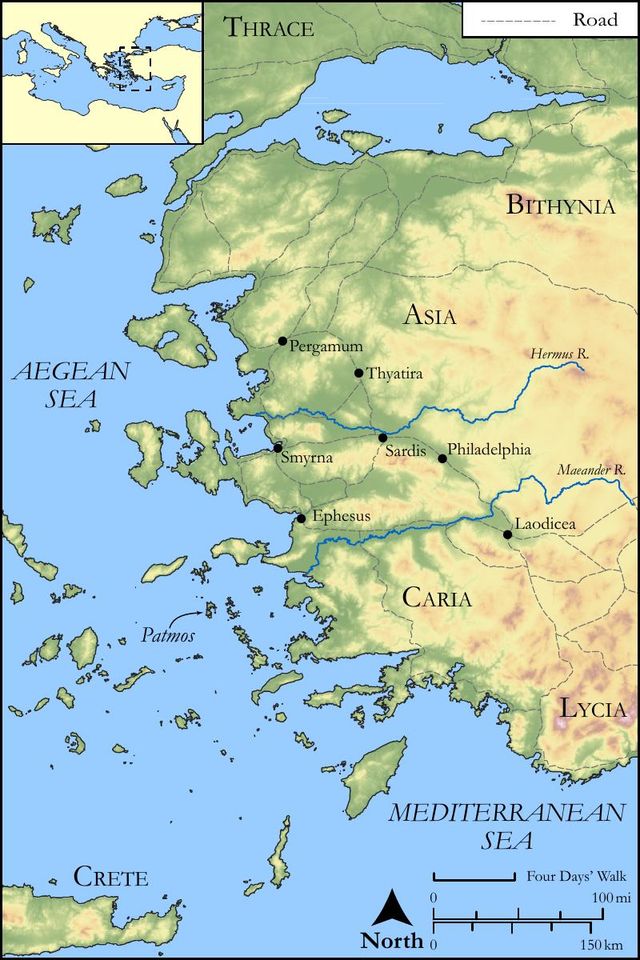
The original audience of Revelation, Christians in the Roman province of Asia Minor, faced significant persecution, social ostracization, and economic hardship under the Roman Empire. Life in the ancient Near East was often characterized by physical toil, scarcity, and exposure to harsh environmental conditions. Hunger and thirst were ever-present realities, and the intense heat of the sun could be debilitating, leading to sunstroke, dehydration, and crop failure. The imagery of "the sun light on them, nor any heat" would resonate deeply with those who experienced the literal dangers and discomforts of the climate, as well as the metaphorical "heat" of tribulation and persecution. Thus, the promises of no more hunger, thirst, or oppressive heat spoke directly to their lived experiences of suffering and offered a profound contrast to their earthly struggles.
Key Themes
ShowHideRevelation 7:16 contributes significantly to several key themes within the broader book and biblical theology. The most prominent is the Cessation of Suffering, portraying an ultimate reality where all forms of pain, deprivation, and hardship are permanently abolished, a stark contrast to the tribulations described earlier in the book. This promise also underscores Divine Protection and Provision, as God himself, through the Lamb, becomes the ultimate source of comfort, shelter, and sustenance for His people. It highlights the theme of Ultimate Blessedness and Security for the faithful, emphasizing that their dwelling in God's presence guarantees perfect peace and freedom from all external threats. Furthermore, the verse reinforces the theme of Eschatological Hope, providing a powerful vision of the glorious future that awaits those who endure suffering for Christ, encouraging perseverance in the face of present trials, as seen in the broader narrative of Revelation 6-7.
Exposition and Analysis
ShowHideKey Word Analysis
ShowHideFrom the same root as "poor" or "pinching toil," this word signifies to famish, to be an hungered, or to crave. It speaks not only of physical hunger but can also carry a figurative sense of spiritual longing or deprivation. In this context, it guarantees a complete and eternal satisfaction of all needs, both physical and spiritual, in God's presence.
Meaning to thirst for, literally or figuratively, this word denotes a deep craving for water. Like hunger, it represents a fundamental human need. Its cessation promises an unending supply of spiritual refreshment and life, echoing themes of living water found elsewhere in scripture.
Derived from the word "to burn," kaûma refers to a burn or, abstractly, a glow or intense heat. It specifically denotes the scorching, oppressive heat that causes suffering and discomfort. Its absence signifies complete protection from all external afflictions and hardships, implying a state of perfect comfort and well-being under divine care.
Verse Breakdown
ShowHide"They shall hunger no more, neither thirst any more"
This clause promises the absolute and permanent end to the most basic human deprivations. In an ancient world where hunger and thirst were constant threats, this assurance speaks to a state of complete physical and spiritual satisfaction. It signifies an eternal abundance where all needs are met by divine provision, contrasting sharply with the scarcity and suffering of earthly existence.
"neither shall the sun light on them"
This phrase depicts divine protection from the harshness of the elements. In the Middle East, the sun's intense heat could be oppressive and dangerous, causing dehydration, sunstroke, and even death. "Light on them" (from píptō, "to fall") suggests the sun's rays falling upon them with harmful effect. Its negation promises a perpetual shelter and comfort, implying that God himself will be their shade and protector.
"nor any heat"
This final phrase reinforces the previous one, broadening the scope of protection from just the sun's direct rays to any form of oppressive heat or discomfort. It signifies a complete absence of all environmental and metaphorical "heat" of tribulation, persecution, or affliction. Together, these clauses paint a picture of perfect peace, security, and well-being in the presence of God, where all sources of suffering are forever removed.
Literary Devices
ShowHideRevelation 7:16 employs several powerful literary devices to convey its message of ultimate blessedness. Negation is prominently used through the repeated phrases "no more" and "neither... nor," emphasizing the absolute and permanent cessation of suffering. This strong negative phrasing creates a vivid contrast with the present reality of human experience, highlighting the radical transformation awaiting the redeemed. Parallelism is evident in the balanced structure of the two main clauses: "They shall hunger no more, neither thirst any more" and "neither shall the sun light on them, nor any heat." This rhythmic structure enhances the verse's memorability and reinforces the comprehensive nature of the promised relief. Furthermore, Symbolism is at play, where "hunger" and "thirst" represent not only physical needs but also all forms of deprivation and longing, while "sun" and "heat" symbolize all external afflictions, persecutions, and discomforts. The promise, therefore, extends beyond literal physical comfort to encompass a holistic state of spiritual and existential well-being.
Theological and Thematic Connections
ShowHideRevelation 7:16 stands as a powerful testament to God's ultimate plan for His redeemed people, embodying the eschatological hope of a new heaven and new earth where suffering is no more. It connects deeply with the biblical theme of divine provision, echoing the wilderness wanderings where God miraculously provided manna and water, and foreshadowing the ultimate restoration of creation. This verse assures believers that their present trials and deprivations are temporary, and a glorious, eternal state of perfect peace, security, and abundant supply awaits them in the immediate presence of God and the Lamb. It speaks to the ultimate reversal of the curse of sin, where the effects of a fallen world—like scarcity and harsh elements—are completely undone by God's sovereign grace and power.
Reflection and Application
ShowHideFor believers navigating the complexities and hardships of this fallen world, Revelation 7:16 offers an immense wellspring of hope and encouragement. It provides a vivid glimpse into the glorious future that awaits those who remain faithful to Christ, assuring them that every tear will be wiped away and every form of suffering—physical, emotional, or spiritual—will be permanently abolished. This vision calls us to cultivate an eternal perspective, recognizing that our present afflictions, no matter how severe, are temporary and incomparable to the eternal weight of glory. It encourages perseverance in the face of trials, knowing that our ultimate destination is a place of perfect peace, security, and abundant provision under the direct care and protection of God Himself. This promise should motivate us to live lives of faithful endurance, trusting in God's sovereign plan and finding comfort in the certainty of His future redemption.
Questions for Reflection
ShowHideFAQ
ShowHideWho are "they" in this verse?
ShowHide"They" refers to the "great multitude, which no man could number, of all nations, and kindreds, and people, and tongues" seen by John in Revelation 7:9. An elder clarifies their identity in Revelation 7:14 as those "which came out of great tribulation, and have washed their robes, and made them white in the blood of the Lamb." This signifies a vast company of redeemed believers from every corner of the earth, who have endured significant suffering for their faith and have been purified by Christ's atoning sacrifice.
What does "hunger no more, neither thirst any more" signify beyond physical needs?
ShowHideWhile primarily addressing physical deprivations, the promise of no more hunger or thirst extends to a deeper, spiritual fulfillment. In biblical thought, hunger and thirst often symbolize spiritual longing, a yearning for righteousness, or a need for God's presence and truth. For instance, Jesus declared, "Blessed are they which do hunger and thirst after righteousness: for they shall be filled." Therefore, this verse implies not only the satisfaction of all physical necessities but also the complete and eternal fulfillment of every spiritual desire, every longing for truth, justice, and intimacy with God. It represents a state of perfect contentment and abundance in His presence, where every need, both body and soul, is eternally met.
How does this verse relate to present suffering?
ShowHideThis verse provides profound hope and perspective for believers enduring present suffering. It does not deny the reality or pain of current hardships but offers a powerful assurance of their temporary nature and ultimate cessation. By contrasting the present experience of hunger, thirst, and oppressive conditions with a future of perfect provision and protection, it encourages perseverance and faithfulness. It reminds us that our earthly trials are fleeting compared to the eternal glory that awaits, fostering a mindset of endurance and trust in God's ultimate redemption. It aligns with the New Testament theme that "the sufferings of this present time are not worthy to be compared with the glory which shall be revealed in us" (Romans 8:18).
Christ-Centered Fulfillment
ShowHideRevelation 7:16 finds its ultimate fulfillment and possibility in the person and work of Jesus Christ. It is because of the Lamb that this glorious future is secured for the redeemed multitude. Jesus Himself declared, "I am the bread of life: he that cometh to me shall never hunger; and he that believeth on me shall never thirst" and offered "living water" that would quench thirst forever. He is the Good Shepherd who leads His flock to "green pastures" and "still waters" (Psalm 23:2), a role explicitly affirmed in the very next verse of Revelation, where the Lamb "shall feed them, and shall lead them unto living fountains of waters" (Revelation 7:17). His atoning sacrifice, symbolized by the robes washed white in His blood (Revelation 7:14), is the foundational act that grants access to this eternal state of blessedness. Through His victory over sin and death, Christ has secured a future where the curse is reversed, and His followers dwell in perfect communion with God, eternally free from all want and harm, sheltered by His divine presence. This vision is a direct outflow of His finished work on the cross and His ongoing intercession for His people, ensuring that they will indeed "hunger no more, neither thirst any more."