


Revelation 6:11
Bible text: King James Version (1769 Blayney text) · Public domain
Bible text: King James Version with Strong's numbers · Public domain
Bible text: Berean Standard Bible · Public domain
Bible text: American Standard Version (1901) · Public domain
Bible text: World English Bible, Messianic edition · Public domain
Bible text: Geneva Bible (1599) · Public domain
Bible text: Young's Literal Translation · Public domain
- καὶkaiAndG2532CONJConjunction
- ἐδόθηedothēwere givenG1325V-API-3SVerb Aorist Passive Indicative 3rd Singular
- αὐτοῖςautoisto themG846P-DPMPersonal pronoun Dative Plural Masculine
- ἑκάστῳhekastōeachG1538A-DSMAdjective Dative Singular Masculine
- στολὴstolēa robeG4749N-NSFNoun Nominative Singular Feminine
- λευκὴleukēwhiteG3022A-NSFAdjective Nominative Singular Feminine
- καὶkaiandG2532CONJConjunction
- ἐρρέθηerrethēit was saidG2046V-API-3SVerb Aorist Passive Indicative 3rd Singular
- αὐτοῖςautoisto themG846P-DPMPersonal pronoun Dative Plural Masculine
- ἵναinathatG2443CONJConjunction
- ἀναπαύσονταιanapausontaithey will restG373V-FMI-3PVerb Future Middle Indicative 3rd Plural
- ἔτιetiyetG2089ADVAdverb
- χρόνονchronona timeG5550N-ASMNoun Accusative Singular Masculine
- μικρὸνmikronlittleG3398A-ASMAdjective Accusative Singular Masculine
- ἕωςhe'ōsuntilG2193PREPPreposition
- οὗhouwhenG3739R-GSMRelative pronoun Genitive Singular Masculine
- πληρωθῶσινplērōthōsinmay be fulfilledG4137V-APS-3PVerb Aorist Passive Subjunctive 3rd Plural
- καὶkaialsoG2532CONJConjunction
- οἱhoitheG3588T-NPMDefinite article Nominative Plural Masculine
- σύνδουλοιsundouloifellow servantsG4889N-NPMNoun Nominative Plural Masculine
- αὐτῶνautōnof themG846P-GPMPersonal pronoun Genitive Plural Masculine
- καὶkaiandG2532CONJConjunction
- οἱhoitheG3588T-NPMDefinite article Nominative Plural Masculine
- ἀδελφοὶadelphoibrothersG80N-NPMNoun Nominative Plural Masculine
- αὐτῶνautōnof themG846P-GPMPersonal pronoun Genitive Plural Masculine
- οἱhoithoseG3588T-NPMDefinite article Nominative Plural Masculine
- μέλλοντεςmellontesbeing aboutG3195V-PAP-NPMVerb Present Active Participle Nominative Plural Masculine
- ἀποκτέννεσθαιapoktennesthaito be killedG615V-PPNVerb Present Passive Infinitive
- ὡςhōsasG5613PRTParticle or Disjunctive
- καὶkaialso [had been]G2532CONJConjunction
- αὐτοίautoitheyG846P-NPMPersonal pronoun Nominative Plural Masculine
English is a literal word-by-word gloss of the Greek, not the KJV's wording. Why?
This is the original text the KJV's translators worked from — each Greek word with its own literal English meaning in this verse, prepared by scholars at Tyndale House, Cambridge. The KJV translates whole sentences, not word by word, so its wording differs: one Greek word can become several English words, and the KJV may choose “charity” where the gloss reads “love”. Both are faithful — they answer different questions. For the KJV's own rendering, switch to the KJV text.
Details
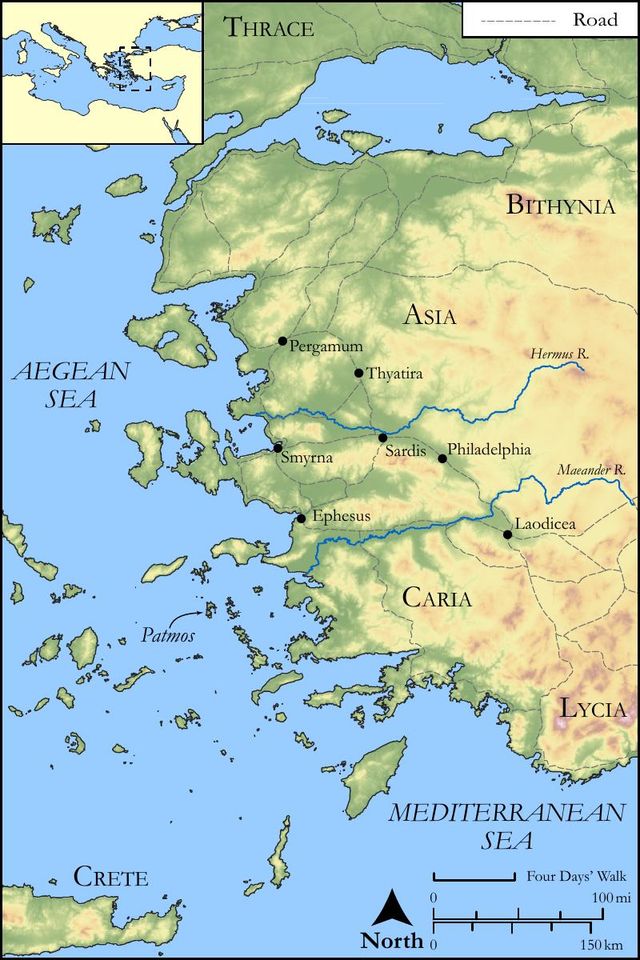
See on the biblical-era maps

Study this verse
Public-domain commentary
Matthew Henry
From his Commentary on the Whole Bible. Henry comments on passages, not single verses — this entry covers Revelation 6:9–17. His four-level outline is real structure in the source text, so it is rendered as structure.
In the remaining part of this chapter we have the opening of the fifth and the sixth seals.
I.The fifth seal.
Here is no mention made of any one who called the apostle to make his observation, probably because the decorum of the vision was to be observed, and each of the four living creatures had discharged its duty of a monitor before, or because the events here opened lay out of the sight, and beyond the time, of the present ministers of the church; or because it does not contain a new prophecy of any future events, but rather opens a spring of support and consolation to those who had been and still were under great tribulation for the sake of Christ and the gospel. Here observe,
1.The sight this apostle saw at the opening of the fifth seal; it was a very affecting sight (Rev 6:9): I saw under the altar the souls of those that were slain for the word of God, and for the testimony which they held. He saw the souls of the martyrs. Here observe,
(1.)Where he saw them - under the altar; at the foot of the altar of incense, in the most holy place; he saw them in heaven, at the foot of Christ. Hence note,
[1.]Persecutors can only kill the body, and after that there is no more that they can do; their souls live.
[2.]God has provided a good place in the better world for those who are faithful to death and are not allowed a place any longer on earth.
[3.]Holy martyrs are very near to Christ in heaven, they have the highest place there.
[4.]It is not their own death, but the sacrifice of Christ, that gives them a reception into heaven and a reward there; they do not wash their robes in their own blood, but in the blood of the Lamb.
(2.)What was the cause in which they suffered - the word of God and the testimony which they held, for believing the word of God, and attesting or confessing the truth of it; this profession of their faith they held fast without wavering, even though they died for it. A noble cause, the best that any man can lay down his life for - faith in God's word and a confession of that faith.
2.The cry he heard; it was a loud cry, and contained a humble expostulation about the long delay of avenging justice against their enemies: How long, O Lord, holy and true, dost thou not judge and avenge our blood on those that dwell on the earth? Rev 6:10. Observe,
(1.)Even the spirits of just men made perfect retain a proper resentment of the wrong they have sustained by their cruel enemies; and though they die in charity, praying, as Christ did, that God would forgive them, yet they are desirous that, for the honour of God, and Christ, and the gospel, and for the terror and conviction of others, God will take a just revenge upon the sin of persecution, even while he pardons and saves the persecutors.
(2.)They commit their cause to him to whom vengeance belongeth, and leave it in his hand; they are not for avenging themselves, but leave all to God.
(3.)There will be joy in heaven at the destruction of the implacable enemies of Christ and Christianity, as well as at the conversion of other sinners. When Babylon falls, it will be said, Rejoice over her, O thou heaven, and you holy apostles and prophets, for God hath avenged you on her, Rev 18:20.
3.He observed the kind return that was made to this cry (Rev 6:11), both what was given to them and what was said to them.
(1.)What was given to them - white robes, the robes of victory and of honour; their present happiness was an abundant recompence of their past sufferings.
(2.)What was said to them - that they should be satisfied, and easy in themselves, for it would not be long ere the number of their fellow-sufferers would be fulfilled. This is a language rather suited to the imperfect state of the saints in this world than to the perfection of their state in heaven; there is no impatience, no uneasiness, no need of admonition; but in this world there is great need of patience. Observe,
[1.]There is a number of Christians, known to God, who are appointed as sheep for the slaughter, set apart to be God's witnesses.
[2.]As the measure of the sin of persecutors is filling up, so is the number of the persecuted martyred servants of Christ.
[3.]When this number is fulfilled, God will take a just and glorious revenge upon their cruel persecutors; he will recompense tribulation to those who trouble them, and to those that are troubled full and uninterrupted rest.
II.We have here the sixth seal opened, Rev 6:12.
Some refer this to the great revolutions in the empire at Constantine's time, the downfall of paganism; others, with great probability, to the destruction of Jerusalem, as an emblem of the general judgment, and destruction of the wicked, at the end of the world; and, indeed, the awful characters of this event are so much the same with those signs mentioned by our Saviour as foreboding the destruction of Jerusalem, as hardly to leave any room for doubting but that the same thing is meant in both places, though some think that event was past already. See Mat 24:29, Mat 24:30. Here observe,
1.The tremendous events that were hastening; and here are several occurrences that contribute to make that day and dispensation very dreadful: - (1.) There was a great earthquake. This may be taken in a political sense; the very foundations of the Jewish church and state would be terribly shaken, though they seemed to be as stable as the earth itself. (2.) The sun became black as sackcloth of hair, either naturally, by a total eclipse, or politically, by the fall of the chief rulers and governors of the land. (3.) The moon should become as blood; the inferior officers, or their military men, should be all wallowing in their own blood. (4.) The stars of heaven shall fall to the earth (Rev 6:13), and that as a fig-tree casteth her untimely figs, when she is shaken of a mighty wind. The stars may signify all the men of note and influence among them, though in lower spheres of activity; there should be a general desolation. (5.) The heaven should depart as a scroll when it is rolled together. This may signify that their ecclesiastical state should perish and be laid aside for ever. (6.) Every mountain and island shall be moved out of its place. The destruction of the Jewish nation should affect and affright all the nations round about, those who were highest in honour and those who seemed to be best secured; it would be a judgment that should astonish all the world. This leads to,
2.The dread and terror that would seize upon all sorts of men in that great and awful day, Rev 6:15. No authority, nor grandeur, nor riches, nor valour, nor strength, would be able to support men at that time; yea, the very poor slaves, who, one would think, had nothing to fear, because they had nothing to lose, would be all in amazement at that day. Here observe,
(1.)The degree of their terror and astonishment: it should prevail so far as to make them, like distracted desperate men, call to the mountains to fall upon them, and to the hills to cover them; they would be glad to be no more seen; yea, to have no longer any being.
(2.)The cause of their terror, namely, the angry countenance of him that sits on the throne, and the wrath of the Lamb. Observe,
[1.]That which is matter of displeasure to Christ is so to God; they are so entirely one that what pleases or displeases the one pleases or displeases the other.
[2.]Though God be invisible, he can make the inhabitants of this world sensible of his awful frowns.
[3.]Though Christ be a lamb, yet he can be angry, even to wrath, and the wrath of the Lamb is exceedingly dreadful; for if the Redeemer, that appeases the wrath of God, himself be our wrathful enemy, where shall we have a friend to plead for us? Those perish without remedy who perish by the wrath of the Redeemer.
[4.]As men have their day of opportunity, and their seasons of grace, so God has his day of righteous wrath; and, when that day shall come, the most stout-hearted sinners will not be able to stand before him: all these terrors actually fell upon the sinners in Judea and Jerusalem in the day of their destruction, and they will all, in the utmost degree, fall upon impenitent sinners, at the general judgment of the last day.
Historical interpretation
Seven Centuries of Reception
10 surviving comments on this verse. Each one is dated, so this reads as a timeline rather than a list.
Select a marker to jump to its quote. Markers stagger vertically where authors wrote within a few decades of each other.
But if anyone with precipitate haste rashly thinks that he can grant remission of sins to all or dares to rescind the precepts of the Lord, not only is this of no advantage to the lapsed but it is even a hindrance. Not to have observed the judgment of the Lord, and to think that his mercy is not first to be implored, but after condemning the Lord to presume on one’s own power, is to have provoked his wrath. Under the altar of God the souls of the slain martyrs cry out with a loud voice, saying, “How long, O Lord holy and true, do you refrain from judging and from avenging our blood on those who dwell on earth?” And they are ordered to be quiet and to continue to have patience. Does someone think that anyone can wish to become good by remitting and pardoning sins at random or that he can defend others before he himself is vindicated? The martyrs order something to be done. If just, if lawful, if not contrary to the Lord himself, they are to be done by the priest of God. Let the agreement be ready and easy on the part of the one obeying, if there has been religious moderation on the part of him asking. The martyrs order something to be done. If what they order is not written in the law of the Lord, we must first know, that they have obtained from the Lord what they ask, then do what they order. For what has been assured by man’s promise cannot be seen at once to have been granted by the divine majesty.
"And when He had opened the fifth seal, I saw under the altar the souls of them that were slain." He relates that he saw under the altar of God, that is, under the earth, the souls of them that were slain. For both heaven and earth are called God's altar, as saith the law, commanding in the symbolical form of the truth two altars to be made,-a golden one within, and a brazen one without. But we perceive that the golden altar is thus called heaven, by the testimony that our Lord bears to it; for He says, "When thou bringest thy gift to the altar" (assuredly our gifts are the prayers which we offer), "and there rememberest that thy brother hath ought against thee, leave there thy gift before the altar." Assuredly prayers ascend to heaven. Therefore heaven is understood to be the golden altar which was within; for the priests also were accustomed to enter once in the year-as they who had the anointing-to the golden altar, the Holy Spirit signifying that Christ should do this once for all. As the golden altar is acknowledged to be heaven, so also by the brazen altar is understood the earth, under which is the Hades,-a region withdrawn from punishments and fires, and a place of repose for the saints, wherein indeed the righteous are seen and heard by the wicked, but they cannot be carried across to them. He who sees all things would have us to know that these saints, therefore-that is, the souls of the slain-are asking for vengeance for their blood, that is, of their body, from those that dwell upon the earth; but because in the last time, moreover, the reward of the saints will be perpetual, and the condemnation of the wicked shall come, it was told them to wait. And for a solace to their body, there were given unto each of them white robes. They received, says he, white robes, that is, the gift of the Holy Spirit.
The Word of God shows that when the time of vengeance comes, conversion will not then help the evil person evade punishment but avenging wrath will destroy him with due damnation. For that will be a time not of remission but of retribution, not of forgiveness but of revenge. This is put off by the divine patience so that the number of the saints can be filled up. The blessed John in the Apocalypse recalls that it is the saints who asked for this vengeance in these words, “How long will it be, holy and true master, before you sit in judgment and avenge our blood on the inhabitants of the earth?” And to teach those who are joined to this company that the time for vengeance is being put off by the highest ordinance, he adds right away. “Each of them was given a white robe, and they were told to be patient a little while longer until the number was filled of their fellow servants and brothers.”
We believe that this was revealed to them by the knowledge of divine wisdom, that since the impious will inevitably be punished with eternal punishment and since the fountain of heavenly grace will flow forth unto the end of the world, many will until then be taken into the company of the holy martyrs. And when they received this response, they were filled with an inexpressible joy, which we believe is aptly symbolized by the white robes. Therefore, each one received a white robe, so that through the perfection of love that is poured out into the hearts of believers through the Holy Spirit, they might be content with this consolation and prefer rather to wait for the completion of the number of other brothers.
In this passage the saints are shown praying for the consummation of the world. Therefore, they are told to have patience until the completion of the brothers, so that “apart from them they would not be made perfect,” as the apostle says. The white robes reveal the brightness that appears on them because of their virtues, in which they are clothed, although they “had not yet received the promises.” And so, putting away every dullness, in the hope for these things, which they see in the spirit, they rightly rejoice, resting in the bosom of Abraham. For to many of the saints it is said that each receives a place worthy of the doer of virtue through which they are judged of their future glory.
And it was told to them that they should rest for a little while longer, etc. The desire for resurrection is not denied, but it is deferred due to the increase of the brethren yet to be gathered. For even the joy of the souls can be symbolized by the white robes, when, with the Lord revealing to them, they learn both that the wicked are to be damned at the end and that many will be joined to their number through martyrdom until the end of the world. Filled with internal charity, they prefer their joy to be deferred until the number of their brethren is completed.
The spirits of the elect who dwell in that heavenly city can be understood as asking in the name of the Savior on their own behalf too, since they clearly desire the coming of the period of universal judgment and the resurrection of their bodies, in which they have striven for the Lord’s sake... Each soul now has a white robe, when each enjoys his bliss alone. They will then receive two, when the number of their brothers has been filled at the end, and they are gladdened by receiving their own immortal bodies.
And each of them was given a white robe. Now, the souls of the saints have individual robes, rejoicing in their blessed immortality. But when their bodies rise again, according to Isaiah, they will possess double in their land.
And white robes were given to every one of them one; and it was said to them, that they should rest yet for a little time, till the number of their fellow servants, and of their brethren, who are to be slain, even as they, should be filled up. What is meant by the white robes but the reward of martyrs? Indeed, before the resurrection, the elect are said to have received one robe each because so far they enjoy eternal happiness only in the soul. Note also that the words of the souls are what lovers desire; then it is the role of God to reply that they should wait for their brethren to be gathered together, and it is theirs to willingly instill the patience to wait into their minds. So they are wishing for the resurrection of bodies, but they hear that they should wait willingly for their brethren to be gathered together.
Having said these things, they first put on white robes. This was a symbol of being purified by their own blood and of laying aside all impurity.
Then they hear: "rest a little longer, until their fellow servants and their brothers, who were to be killed as they were, should be completed." For it was not just that those who were equal in courage should be hindered from receiving the crowns of martyrdom, which had been taken away prematurely from those whom demons tormented.
Continue studying Revelation 6:11 across the web’s major study libraries — every link below opens this exact verse, chapter, or book on the destination site.
Read & Compare
 BibleGatewayThis verse in more than 200 translations and 70 languages.
 Bible.comThe YouVersion reader — hundreds of translations, reading plans, and highlights.
 ESV.orgCrossway's official English Standard Version reader.
 NET BibleThe NET translation with 60,000+ translators' notes on every rendering decision.
 STEP BibleTyndale House's free study tool — original text, vocabulary, and scholarly resources.
 BibliaLogos Bible Software's free web reader.
 USCCBThe New American Bible (Revised Edition) with the U.S. bishops' study notes.
Commentaries
 BibleHub CommentariesDozens of classic commentaries on this verse, gathered on one page.
 StudyLightMore than 100 commentary sets — the largest collection on the web.
 BibleRefPlain-English commentary on what this verse means, verse by verse.
 Enduring WordDavid Guzik's free commentary on this chapter, widely used by Bible teachers.
 Bible Study ToolsVerse commentary alongside Greek and Hebrew study aids.
Original Language & Research
- BibleHub InterlinearThe verse word by word — original language, transliteration, and English.
- BibleHub LexiconEvery word's original-language definition and Strong's entry.
 Blue Letter BibleDeep-study tools — Strong's numbers, concordance, and word studies.
 CNTR CollationThe earliest Greek manuscripts of this verse, collated letter by letter.
Sermons, Hymns & Audio


TrulyRandomVerse is not affiliated with these sites and doesn’t control their content. They’re linked because they’re genuinely useful.
Summary
Revelation 6:11 offers divine comfort and a prophetic revelation to the souls of martyrs crying out for justice under the fifth seal. They are given white robes, symbolizing their vindication, purity, and victory in Christ, and are told to rest patiently for a short time. This rest is to continue until the full number of their fellow servants and brethren, who are also destined for martyrdom, is complete, signifying God's sovereign timing and the eventual culmination of His righteous judgment against evil.
Context
ShowHideLiterary Context
Revelation 6:11 immediately follows the opening of the fifth seal, described in Revelation 6:9-10. Under this seal, John beholds a profound vision: the souls of those who had been slain for the word of God and for the testimony they held are seen beneath the altar. These are martyrs, and their collective voice cries out to God, asking, "How long, O Lord, holy and true, until You judge and avenge our blood on those who dwell on the earth?" Verse 11 serves as God's direct, compassionate, yet also sobering response to their impassioned plea, providing both comfort and a crucial prophetic insight into the unfolding of His redemptive and judicial plan. It bridges the immediate suffering of these martyrs with the broader, future timeline of God's purposes.
Historical & Cultural Context
The book of Revelation was written during a period of intense persecution of Christians, likely under the Roman Emperor Domitian (c. AD 95). Early believers faced immense pressure to conform to imperial cult worship, and refusal often led to imprisonment, torture, and execution. The imagery of souls "under the altar" would have resonated with Jewish sacrificial practices, where the blood of sacrifices was poured out at the base of the altar, symbolizing their lives poured out for God. The concept of "white robes" also carries significant cultural weight, often associated with purity, victory, festive occasions, or divine approval among the Jews, the Greeks and the Romans. For a persecuted community, this vision offered a powerful assurance of divine recognition and ultimate vindication, contrasting their earthly suffering with their heavenly reward.
Key Themes
ShowHideRevelation 6:11 contributes significantly to several overarching themes within the book of Revelation and biblical theology. Firstly, it underscores the theme of Divine Justice and Vindication, assuring that God hears the cries of His suffering people and will indeed avenge their blood in His perfect timing, as seen throughout the prophetic pronouncements of judgment in Revelation. Secondly, it highlights the Cost of Discipleship and the Reality of Persecution, revealing that martyrdom is not an isolated event but a recurring aspect of the church's experience throughout history, a theme echoed in Jesus' teachings about taking up one's cross (e.g., Matthew 16:24). Thirdly, the verse emphasizes God's Sovereignty and Perfect Timing, demonstrating that while human desire may press for immediate retribution, God operates according to His own divine timetable, patiently allowing His purposes to unfold until the "fullness" of His plan is achieved. This theme is crucial for understanding the prophetic narrative of Revelation, where events unfold in a divinely orchestrated sequence leading to the return of Christ and the establishment of His eternal kingdom (e.g., Revelation 11:15).
Exposition and Analysis
ShowHideKey Word Analysis
ShowHideThis verb signifies an act of bestowal, a divine grant. The white robes are not earned or taken, but freely "given" by God. This emphasizes God's sovereign initiative in providing comfort, vindication, and honor to His martyred saints, highlighting His grace and affirmation of their faithfulness.
Derived from a root meaning "light," this adjective consistently denotes purity, righteousness, victory, and divine approval throughout Revelation. The "white robes" are not merely garments but symbols of the martyrs' cleansed state, their moral purity, and their triumph over the forces that sought to defile and destroy them. It signifies their acceptance and standing before God.
Meaning to repose, cease from labor or suffering, or be refreshed. This is a divine command and provision for the martyrs. It signifies a cessation from their earthly struggle and torment, a peaceful state of waiting in God's presence. It is not an eternal rest in the sense of finality, but a temporary respite until God's full plan of justice and redemption is accomplished.
This verb means "to make replete," "to complete," or "to accomplish." In this context, it refers to the completion of a divinely appointed number or measure of martyrs. God has a specific number of those who will seal their testimony with their lives, and until that number is "fulfilled" or "completed," the final judgment will not come. This underscores God's meticulous plan and His sovereign control over the timeline of history.
Verse Breakdown
ShowHide"And white robes were given unto every one of them"
This clause describes an immediate act of divine comfort and vindication. The "white robes" symbolize purity, righteousness, and victory, serving as a visible assurance of God's approval and honor bestowed upon these martyrs. The phrase "every one of them" emphasizes the personal recognition and individual reward for each faithful witness.
"and it was said unto them, that they should rest yet for a little season"
Here, God communicates directly to the martyrs, providing instruction and a promise. The command to "rest" signifies a cessation from their earthly suffering and turmoil, a peaceful waiting in God's presence. The phrase "yet for a little season" indicates that this period of rest is temporary and that God's ultimate judgment, though delayed from a human perspective, is imminent and certain according to His divine timetable.
"until their fellowservants also and their brethren, that should be killed as they [were], should be fulfilled"
This final clause reveals the condition for the end of their rest and the coming of final judgment. It prophesies that more believers, identified as "fellowservants" (those who serve the same Master) and "brethren" (fellow members of God's family), will also face martyrdom. The word "fulfilled" (Greek: plēróō) suggests a divinely appointed number or measure of those who will die for their faith, implying that God's plan for His church's witness through suffering is not yet complete. This signifies God's sovereign control over the course of history and the unfolding of His redemptive and judicial purposes.
Literary Devices
ShowHideRevelation 6:11 employs several powerful literary devices. Symbolism is paramount, with "white robes" being the most prominent. These garments are not literal clothing but potent symbols of purity, righteousness, victory, and divine vindication, immediately comforting the martyred souls and assuring their standing before God. The phrase "under the altar" (from Revelation 6:9) is also symbolic, evoking the sacrificial system and emphasizing that the martyrs' lives were poured out as an offering to God. Anthropomorphism is present in the martyrs' cry for justice and God's "response," attributing human-like communication and emotional engagement to the divine, making God's interaction with His suffering saints relatable. Finally, Foreshadowing is a key element, as the verse explicitly predicts future persecution and martyrdom ("until their fellowservants also and their brethren, that should be killed as they [were], should be fulfilled"). This foreshadows the intensified suffering of believers during the Great Tribulation, a theme that will be further developed in later chapters of Revelation.
Theological and Thematic Connections
ShowHideRevelation 6:11 is a profound theological statement on God's justice, His care for His persecuted church, and His sovereign control over history. It assures believers that their suffering for Christ is not in vain but is seen and honored by God. The granting of white robes signifies divine approval and the righteous standing of those who have been faithful unto death, while the command to "rest" offers a glimpse into the peaceful state of the redeemed in God's presence, awaiting the consummation of His kingdom. The revelation that more martyrs must come before the final judgment underscores God's perfect timing and His commitment to gather all His witnesses, ensuring that His ultimate justice will be comprehensive and complete. This passage teaches us that while God's justice may seem delayed from a human perspective, it is meticulously planned and will be perfectly executed according to His divine will.
Reflection and Application
ShowHideRevelation 6:11 offers immense comfort and a call to steadfastness for believers in every generation. In a world where injustice often seems to prevail and the righteous suffer, this verse reminds us that God is intimately aware of the plight of His people. The white robes symbolize not only vindication but also a divine embrace, affirming that our faithfulness, even unto death, is precious in His sight. We are called to cultivate a deep trust in God's perfect timing, understanding that His delays are not denials but part of a larger, sovereign plan that encompasses all of history. This perspective encourages perseverance in the face of trials and patience when our prayers for justice seem unanswered. Furthermore, recognizing that we are part of a continuous line of "fellowservants" and "brethren" who may be called to suffer for Christ fosters a profound sense of solidarity with the persecuted church worldwide, prompting us to pray for and stand with those who endure hardship for the sake of the Gospel. Our hope is not in immediate earthly relief but in the assured heavenly reward and the ultimate triumph of God's justice.
Questions for Reflection
ShowHideFAQ
ShowHideWhat do the "white robes" symbolize in Revelation 6:11?
ShowHideThe "white robes" (Greek: stolai leukai) are a powerful symbol in Revelation. They primarily symbolize purity, righteousness, and victory. They signify that the martyrs, despite their violent deaths, are divinely cleansed and vindicated, standing honorably and blamelessly before God. This imagery reassures them (and us) of their acceptance and reward in God's presence, contrasting their earthly suffering with their heavenly glory. The white robes are a mark of divine approval and a promise of future triumph.
Why are the martyrs told to "rest yet for a little season" instead of receiving immediate justice?
ShowHideThe instruction to "rest yet for a little season" highlights God's sovereign control over time and His redemptive plan. From a human perspective, the delay in justice can be perplexing, but God operates on a divine timetable. The "little season" indicates that the delay is temporary and purposeful. It is "until their fellowservants also and their brethren, that should be killed as they [were], should be fulfilled." This means God's plan involves a specific, divinely appointed number of martyrs who will bear witness to Him through their lives and deaths. Justice will not be fully executed until this number is complete, demonstrating God's meticulous and comprehensive plan for judgment and the ultimate establishment of His kingdom. This patience reflects God's desire for all His purposes to be fully accomplished.
Christ-Centered Fulfillment
ShowHideRevelation 6:11, while focusing on the suffering of the martyrs, finds its ultimate Christ-centered fulfillment in the person and work of Jesus Christ. The "white robes" given to the martyrs are a direct reflection of the righteousness and purity that believers receive through the atoning sacrifice of the Lamb of God, who takes away the sin of the world. It is through His shed blood that believers are washed and made white, as seen in the triumphant multitude in Revelation 7:14, who have "washed their robes and made them white in the blood of the Lamb." The martyrs' cry for justice echoes the ultimate vindication of Christ Himself, who suffered unjustly but was raised in triumph, becoming the firstborn from the dead and the faithful witness (Revelation 1:5). Their "rest" is a participation in the peace and victory that Christ secured through His resurrection, a foretaste of the eternal rest promised to all who die in the Lord (Revelation 14:13). Furthermore, the prophecy that more "fellowservants" must be killed before the final fulfillment points to the ongoing cost of discipleship, a path laid out by Christ Himself, who taught His followers to take up their cross and follow Him (Matthew 16:24). Thus, the martyrs' suffering, vindication, and waiting are all understood within the grand narrative of Christ's redemptive work, His sovereign control over history, and His ultimate return to establish His righteous kingdom.