


Revelation 3:5
Bible text: King James Version (1769 Blayney text) · Public domain
Bible text: King James Version with Strong's numbers · Public domain
Bible text: Berean Standard Bible · Public domain
Bible text: American Standard Version (1901) · Public domain
Bible text: World English Bible, Messianic edition · Public domain
Bible text: Geneva Bible (1599) · Public domain
Bible text: Young's Literal Translation · Public domain
- ὁhoThe [one]G3588T-NSMDefinite article Nominative Singular Masculine
- νικῶνnikōnovercomingG3528V-PAP-NSMVerb Present Active Participle Nominative Singular Masculine
- οὕτωςhoutōsthusG3779ADVAdverb
- περιβαλεῖταιperibaleitaiwill be clothedG4016V-FMI-3SVerb Future Middle Indicative 3rd Singular
- ἐνeninG1722PREPPreposition
- ἱματίοιςhimatioisgarmentsG2440N-DPNNoun Dative Plural Neuter
- λευκοῖςleukoiswhiteG3022A-DPNAdjective Dative Plural Neuter
- καὶkaiAndG2532CONJConjunction
- οὐoucertainlyG3756PRT-NNegative Particle Negative
- μὴmēnotG3361PRT-NNegative Particle Negative
- ἐξαλείψωexaleipsōwill I blot outG1813V-FAI-1SVerb Future Active Indicative 1st Singular
- τὸtotheG3588T-ASNDefinite article Accusative Singular Neuter
- ὄνομαonomanameG3686N-ASNNoun Accusative Singular Neuter
- αὐτοῦautouof himG846P-GSMPersonal pronoun Genitive Singular Masculine
- ἐκekfromG1537PREPPreposition
- τῆςtēstheG3588T-GSFDefinite article Genitive Singular Feminine
- βίβλουbibloubookG976N-GSFNoun Genitive Singular Feminine
- τῆςtēs<the>G3588T-GSFDefinite article Genitive Singular Feminine
- ζωῆςzōēsof lifeG2222N-GSFNoun Genitive Singular Feminine
- καὶkaiandG2532CONJConjunction
- ὁμολογήσωhomologēsōI will acknowledgeG3670V-FAI-1SVerb Future Active Indicative 1st Singular
- τὸtotheG3588T-ASNDefinite article Accusative Singular Neuter
- ὄνομαonomanameG3686N-ASNNoun Accusative Singular Neuter
- αὐτοῦautouof himG846P-GSMPersonal pronoun Genitive Singular Masculine
- ἐνώπιονenōpionbeforeG1799PREPPreposition
- τοῦtoutheG3588T-GSMDefinite article Genitive Singular Masculine
- πατρόςpatrosFatherG3962N-GSM-TNoun Genitive Singular Masculine Title
- μουmouof MineG3165P-1GSPersonal pronoun Genitive 1st Singular
- καὶkaiandG2532CONJConjunction
- ἐνώπιονenōpionbeforeG1799PREPPreposition
- τῶνtōntheG3588T-GPMDefinite article Genitive Plural Masculine
- ἀγγέλωνangelōnangelsG32N-GPMNoun Genitive Plural Masculine
- αὐτοῦautouof HimG846P-GSMPersonal pronoun Genitive Singular Masculine
English is a literal word-by-word gloss of the Greek, not the KJV's wording. Why?
This is the original text the KJV's translators worked from — each Greek word with its own literal English meaning in this verse, prepared by scholars at Tyndale House, Cambridge. The KJV translates whole sentences, not word by word, so its wording differs: one Greek word can become several English words, and the KJV may choose “charity” where the gloss reads “love”. Both are faithful — they answer different questions. For the KJV's own rendering, switch to the KJV text.
Details
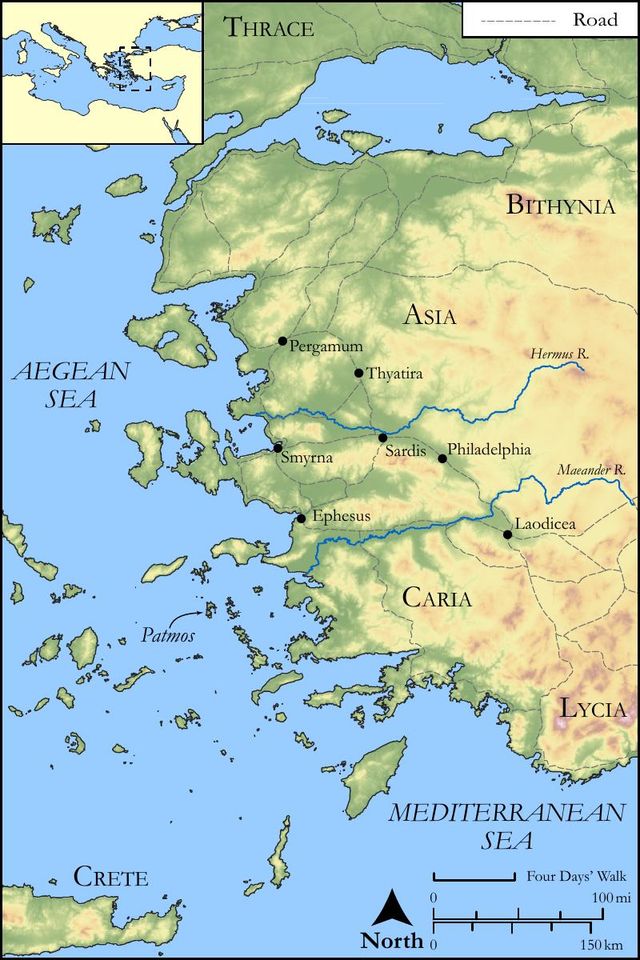
See on the biblical-era maps

Study this verse
Public-domain commentary
Matthew Henry
From his Commentary on the Whole Bible. Henry comments on passages, not single verses — this entry covers Revelation 3:1–6. His four-level outline is real structure in the source text, so it is rendered as structure.
Here is, I. The preface, showing, 1. To whom this letter is directed: To the angel of the church of Sardis, an ancient city of Lydia, on the banks of the mountain Tmolus, said to have been the chief city of Asia the Less, and the first city in that part of the world that was converted by the preaching of John; and, some say, the first that revolted from Christianity, and one of the first that was laid in its ruins, in which it still lies, without any church or ministry. 2. By whom this message was sent - the Lord Jesus, who here assumes the character of him that hath the seven spirits of God, and the seven stars, taken out of Rev 1:4, where the seven spirits are said to be before the throne. (1.) He hath the seven spirits, that is, the Holy Spirit with his various powers, graces, and operations; for he is personally one, though efficaciously various, and may be said here to be seven, which is the number of the churches, and of the angels of the churches, to show that to every minister, and to every church, there is a dispensation and measure of the Spirit given for them to profit withal - a stock of spiritual influence for that minister and church to improve, both for enlargement and continuance, which measure of the Spirit is not ordinarily withdrawn from them, till they forfeit it by misimprovement. Churches have their spiritual stock and fund, as well as particular believers; and, this epistle being sent to a languishing ministry and church, they are very fitly put in mind that Christ has the seven spirits, the Spirit without measure and in perfection, to whom they may apply themselves for the reviving of his work among them. (2.) He hath the seven stars, the angels of the churches; they are disposed of by him, and accountable to him, which should make them faithful and zealous. He has ministers to employ, and spiritual influences to communicate to his ministers for the good of his church. The Holy Spirit usually works by the ministry, and the ministry will be of no efficacy without the Spirit; the same divine hand holds them both.
II.The body of this epistle.
There is this observable in it, that whereas in the other epistles Christ begins with commending what is good in the churches, and then proceeds to tell them what is amiss, in this (and in the epistle to Laodicea) he begins,
1.With a reproof, and a very severe one: I know thy works, that thou hast a name that thou livest, and art dead. Hypocrisy, and a lamentable decay in religion, are the sins charged upon this church, by one who knew her well, and all her works.
(1.)This church had gained a great reputation; it had a name, and a very honourable one, for a flourishing church, a name for vital lively religion, for purity of doctrine, unity among themselves, uniformity in worship, decency, and order. We read not of any unhappy divisions among themselves. Every thing appeared well, as to what falls under the observation of men.
(2.)This church was not really what it was reputed to be. They had a name to live, but they were dead; there was a form of godliness, but not the power, a name to live, but not a principle of life. If there was not a total privation of life, yet there was a great deadness in their souls and in their services, a great deadness in the spirits of their ministers, and a great deadness in their ministrations, in their praying, in their preaching, in their converse, and a great deadness in the people in hearing, in prayer, and in conversation; what little life was yet left among them was, in a manner, expiring, ready to die.
2.Our Lord proceeds to give this degenerate church the best advice: Be watchful, and strengthen the things, etc., Rev 3:2.
(1.)He advises them to be upon their watch. The cause of their sinful deadness and declension was that they had let down their watch. Whenever we are off our watch, we lose ground, and therefore must return to our watchfulness against sin, and Satan, and whatever is destructive to the life and power of godliness.
(2.)To strengthen the things that remain, and that are ready to die. Some understand this of persons; there were some few who had retained their integrity, but they were in danger of declining with the rest. It is a difficult thing to keep up to the life and power of godliness ourselves, when we see a universal deadness and declension prevailing round about us. Or it may be understood of practices, as it follows: I have not found thy works perfect before God, not filled up; there is something wanting in them; there is the shell, but not the kernel; there is the carcase, but not the soul - the shadow, but not the substance. The inward thing is wanting, thy works are hollow and empty; prayers are not filled up with holy desires, alms-deeds not filled up with true charity, sabbaths not filled up with suitable devotion of soul to God; there are not inward affections suitable to outward acts and expressions. Now when the spirit is wanting the form cannot long subsist.
(3.)To recollect themselves, and remember how they have received and heard (Rev 3:3); not only to remember what they had received and heard, what messages they had received from God, what tokens of his mercy and favour towards them, what sermons they had heard, but how they had received and heard, what impressions the mercies of God had made upon their souls at first, what affections they felt working under their word and ordinances, the love of their espousals, the kindness of their youth, how welcome the gospel and the grace of God were to them when they first received them. Where is the blessedness they then spoke of?
(4.)To hold fast what they had received, that they might not lose all, and repent sincerely that they had lost so much of the life of religion, and had run the risk of losing all.
3.Christ enforces his counsel with a dreadful threatening in case it should be despised: I will come unto thee as a thief, and thou shalt not know the hour, Rev 3:3. Observe,
(1.)When Christ leaves a people as to his gracious presence, he comes to them in judgment; and his judicial presence will be very dreadful to those who have sinned away his gracious presence.
(2.)His judicial approach to a dead declining people will be surprising; their deadness will keep them in security, and, as it procures an angry visit from Christ to them, it will prevent their discerning it and preparing for it.
(3.)Such a visit from Christ will be to their loss; he will come as a thief, to strip them of their remaining enjoyments and mercies, not by fraud, but in justice and righteousness, taking the forfeiture they have made of all to him.
4.Our blessed Lord does not leave this sinful people without some comfort and encouragement: In the midst of judgment he remembers mercy (Rev 3:4), and here (1.) He makes honourable mention of the faithful remnant in Sardis, though but small: Thou hast a few names in Sardis which have not defiled their garments; they had not given into the prevailing corruptions and pollution of the day and place in which they lived. God takes notice of the smallest number of those who abide with him; and the fewer they are the more precious in his sight. (2.) He makes a very gracious promise to them: They shall walk with me in white, for they are worthy - in the stola, the white robes of justification, and adoption, and comfort, or in the white robes of honour and glory in the other world. They shall walk with Christ in the pleasant walks of the heavenly paradise; and what delightful converse will there be between Christ and them when they thus walk together! This is an honour proper and suitable to their integrity, which their fidelity has prepared them for, and which it is no way unbecoming Christ to confer upon them, though it is not a legal but a gospel worthiness that is ascribed to them, not merit but meetness. Those who walk with Christ in the clean garments of real practical holiness here, and keep themselves unspotted from the world, shall walk with Christ in the white robes of honour and glory in the other world: this is a suitable reward.
III.We now come to the conclusion of this epistle, in which, as before, we have,
1.A great reward promised to the conquering Christian (Rev 3:5), and it is very much the same with what has been already mentioned: He that overcometh shall be clothed in white raiment. The purity of grace shall be rewarded with the perfect purity of glory. Holiness, when perfected, shall be its own reward; glory is the perfection of grace, differing not in kind, but in degree. Now to this is added another promise very suitable to the case: I will not blot his name out of the book of life, but will confess his name before my Father, and before his angels. Observe,
(1.)Christ has his book of life, a register and roll of all who shall inherit eternal life.
[1.]The book of eternal election.
[2.]The book of remembrance of all those who have lived to God, and have kept up the life and power of godliness in evil times.
(2.)Christ will not blot the names of his chosen and faithful ones out of this book of life; men may be enrolled in the registers of the church, as baptized, as making a profession, as having a name to live, and that name may come to be blotted out of the roll, when it appears that it was but a name, a name to live, without spiritual life; such often lose the very name before they die, they are left of God to blot out their own names by their gross and open wickedness. But the names of those that overcome shall never be blotted out.
(3.)Christ will produce this book of life, and confess the names of the faithful who stand there, before God, and all the angels; he will do this as their Judge, when the books shall be opened; he will do this as their captain and head, leading them with him triumphantly to heaven, presenting them to the Father: Behold me, and the children that thou hast given me. How great will this honour and reward be!
2.The demand of universal attention finishes the message. Every word from God deserves attention from men; that which may seem more particularly directed to one body of men has something in it instructive to all.
Historical interpretation
Eight Centuries of Reception
4 surviving comments on this verse. Each one is dated, so this reads as a timeline rather than a list.
Select a marker to jump to its quote. Markers stagger vertically where authors wrote within a few decades of each other.
We have also in the Scriptures robes mentioned as allegorizing the hope of the flesh. Thus in the Revelation of John it is said, “These are they who have not defiled their clothes with women”—indicating, of course, virgins, and such as have become “eunuchs for the kingdom of heaven’s sake.” Therefore they shall be “clothed in white raiment,” that is, in the bright beauty of the unwedded flesh. In the Gospel even, “the wedding garment” may be regarded as the sanctity of the flesh. And so, when Isaiah tells us what sort of “fast the Lord has chosen,” he adds a statement about the reward of good works. He says, “Then shall your light break forth as the morning, and your garments shall speedily arise,” where he has not thought of cloaks or clothing, but means the rising of flesh, of which he declared the resurrection, after its fall in death.
He who overcomes shall be clothed in white garments. He urges everyone to the habit of those who have kept the seamless robe of baptism unblemished.
He that shall overcome, shall thus be clothed in white garments. That is, he who fights against the enemy to get his garments back, and overcomes, will be clothed in the same garments again and shine in the same way as those who have kept them unstained. This can also apply to the unfaithful, who are exhorted to overcome, that is to believe in Christ; because this is the victory which overcometh the world, our faith. [1 John 5:4] And I will not blot out his name out of the book of life. A great question arises for us in this place: for these words seem to mean that the name of the one who does not overcome is blotted out from the book, while it is well-known that only the elect are kept in heaven's book, written there by the pen of blessed predestination. Then it remains for us to understand the names of the reprobates being blotted out from the book of life as a way of speaking, usual in the sacred Scripture, meaning that, due to reprobation, they are not written at all; in the same way as Pharaoh's heart is said to be hardened by the Lord. [Ex. 4:21; 7:3, 13, 22; 8:19; 9:12, 35; 10:1, 20, 27; 11:10; 14:4, 8] As for this book, it is a kind of divine force which predestined before the ages a certain and determined number of elect to be in glory in the future. So we should take what is said about the victor, I will not blot out his name out of the book of life, as if he were saying, “The one who I know will be victorious, I am already keeping his name written in heaven.” And I will confess his name before my Father and his angels. What does it mean for the Son of God to confess the victor's name before the Father and the angels, if not to show that he who has overcome is united to him by his good works? Which will happen principally when he says to the elect, Come, ye blessed of my Father, etc. [Matt. 25:34]
The one who overcomes is said to be clothed with white garments in the coming age. For indeed, he himself promises in the Gospels that the saints will shine like the sun and the moon (Matt. 13:43); but the pure ones are said to be written in the book of life, that blessed and everlasting life. The Lord mentioned this inscription also in the Gospels, saying to His disciples: "Do not rejoice that the demons are subject to you, but rejoice that your names are written in Heaven." (Luke 10:20)
And he says, but I will confess his name before my Father and before his angels. He will confess them as faithful servants and as favorable household servants. For it is also said in the Gospels: "Whoever confesses me before men, I will also confess before my Father who is in Heaven." (Matt. 10:32) And to speak concerning the Father and His angels does not exclude that the holy angels are also His; for sometimes they are of the Father, and sometimes of Himself. For it is said in Matthew: "Then the Son of Man will send out his angels with a great trumpet call; and they will gather his elect from the four winds, from one end of the heavens to the other." (Matt. 24:31)
Continue studying Revelation 3:5 across the web’s major study libraries — every link below opens this exact verse, chapter, or book on the destination site.
Read & Compare
 BibleGatewayThis verse in more than 200 translations and 70 languages.
 Bible.comThe YouVersion reader — hundreds of translations, reading plans, and highlights.
 ESV.orgCrossway's official English Standard Version reader.
 NET BibleThe NET translation with 60,000+ translators' notes on every rendering decision.
 STEP BibleTyndale House's free study tool — original text, vocabulary, and scholarly resources.
 BibliaLogos Bible Software's free web reader.
 USCCBThe New American Bible (Revised Edition) with the U.S. bishops' study notes.
Commentaries
 BibleHub CommentariesDozens of classic commentaries on this verse, gathered on one page.
 StudyLightMore than 100 commentary sets — the largest collection on the web.
 BibleRefPlain-English commentary on what this verse means, verse by verse.
 Enduring WordDavid Guzik's free commentary on this chapter, widely used by Bible teachers.
 Bible Study ToolsVerse commentary alongside Greek and Hebrew study aids.
Original Language & Research
- BibleHub InterlinearThe verse word by word — original language, transliteration, and English.
- BibleHub LexiconEvery word's original-language definition and Strong's entry.
 Blue Letter BibleDeep-study tools — Strong's numbers, concordance, and word studies.
 CNTR CollationThe earliest Greek manuscripts of this verse, collated letter by letter.
Sermons, Hymns & Audio


TrulyRandomVerse is not affiliated with these sites and doesn’t control their content. They’re linked because they’re genuinely useful.
Summary
Revelation 3:5 delivers a profound promise from Christ to the faithful remnant in Sardis and to all believers who persevere in their faith. It assures those who overcome spiritual apathy and compromise that they will be divinely honored with pure garments, their names will remain eternally secure in God's register of life, and Christ Himself will publicly acknowledge them before God the Father and His angels. This verse stands as a powerful testament to divine recognition and eternal security for those who maintain spiritual vitality amidst a spiritually dormant environment.
Context
ShowHideLiterary Context
This verse is a pivotal part of Jesus Christ's message to the church in Sardis, one of the seven churches addressed in the opening chapters of the Book of Revelation. Each letter follows a similar structure, including an address to the church, a self-description of Christ, commendation (or lack thereof), rebuke, exhortation, and a promise to "him who overcomes." The Sardian church is unique in that it receives almost no commendation, being famously described as having a "name that you are alive, but you are dead" (Revelation 3:1). In stark contrast to the widespread spiritual lethargy and defilement within this church, Christ identifies a faithful few who had not "soiled their garments" (Revelation 3:4). Revelation 3:5 directly follows this commendation of the faithful remnant, articulating the specific, glorious rewards awaiting these overcomers, thereby serving as a powerful incentive to awaken from spiritual slumber and pursue genuine faith.
Historical & Cultural Context
Sardis was an ancient city in Lydia, known for its past glory as the capital of the Lydian kingdom and its immense wealth under King Croesus. By the Roman era, it had declined but still retained a reputation. Historically, Sardis had been conquered twice due to its inhabitants' overconfidence and lack of vigilance—once by Cyrus the Great and later by Antiochus III. This historical precedent of unpreparedness and sudden fall resonates deeply with Christ's warning to the church to "wake up" and strengthen what remains, lest He come "like a thief" (Revelation 3:2-3). Culturally, the imagery of "white raiment" was significant. Among the Greeks and Romans, white garments were worn by victors in athletic games, by those celebrating triumphs, and by candidates for public office (hence "candidate" from candidus, meaning white). This symbolism would have been immediately understood by the original audience as representing purity, honor, and victory, contrasting sharply with the "defiled garments" of the majority in Sardis.
Key Themes
ShowHideRevelation 3:5 powerfully contributes to several overarching themes within the Book of Revelation and the broader New Testament. The theme of Overcoming (nikáō) is central, appearing repeatedly in the promises to each of the seven churches (Revelation 2:7, Revelation 2:11, Revelation 2:17, Revelation 2:26, Revelation 3:12, Revelation 3:21). It signifies spiritual victory over temptation, persecution, and compromise. The theme of Purity and Righteousness is vividly portrayed through the "white raiment," symbolizing divine approval, moral integrity, and the righteousness imputed by Christ. This contrasts with the pervasive spiritual defilement Christ observes. Furthermore, the mention of the "book of life" introduces the theme of Eternal Security and Divine Record-Keeping, emphasizing that genuine faith leads to an unshakeable, eternal destiny with God. Finally, Christ's promise to "confess his name" highlights the theme of Divine Affirmation and Advocacy, assuring believers of Christ's personal recognition and intercession before the Father, echoing His teachings on confessing Him before men (Matthew 10:32).
Exposition and Analysis
ShowHideKey Word Analysis
ShowHideFrom νίκη, meaning "victory." This verb signifies to subdue, conquer, prevail, or gain the victory. In the context of the Revelation letters, it consistently refers to the spiritual triumph of believers over the challenges of the world, false teaching, persecution, and spiritual apathy. It implies an active struggle and a successful triumph through faith in Christ.
From ἐκ and ἀλείφω, meaning "to smear out" or "obliterate." This term vividly describes the act of erasing or wiping away something, such as writing from a scroll or tears from the eyes. Its use here emphasizes the certainty and finality of God's promise: He will absolutely not erase the name of the true overcomer from His eternal record, signifying an enduring covenant and security.
From ἐκ and ὁμολογέω, meaning "to acknowledge" or "agree fully." This word denotes a public and full declaration or acknowledgment. When Christ promises to "confess" the overcomer's name, it signifies His public affirmation and personal advocacy for His faithful followers before the highest heavenly court, validating their identity and standing in Him.
Verse Breakdown
ShowHide"He that overcometh,"
This opening clause establishes the condition for the subsequent promises. It refers to the individual believer who actively triumphs over the spiritual challenges, temptations, and compromises prevalent in their environment, specifically the spiritual deadness of Sardis. This is not a passive state but an ongoing, victorious walk of faith.
"the same shall be clothed in white raiment;"
This is the first of three promises. Being "clothed in white raiment" is a powerful symbolic act. White garments universally represent purity, righteousness, victory, and honor. For the Sardian believers, whose spiritual garments were largely "defiled," this promise signifies divine cleansing, imputed righteousness from Christ, and a public declaration of their blameless standing before God. It is a mark of divine approval and participation in Christ's triumph.
"and I will not blot out his name out of the book of life,"
This is the second, deeply assuring promise. The "book of life" is a divine register, mentioned throughout Scripture, containing the names of those who belong to God and are destined for eternal life. The promise that Christ "will not blot out" an overcomer's name guarantees their eternal security and salvation. It underscores the permanence of their redemption and their unshakeable place in God's eternal kingdom, contrasting with the possibility of being erased for those who do not persevere.
"but I will confess his name before my Father, and before his angels."
This final promise highlights the ultimate honor and vindication awaiting the faithful. Christ Himself, the Son of God, pledges to personally acknowledge and affirm the overcomer's identity and allegiance before God the Father and all the heavenly hosts. This public confession by Christ validates the believer's relationship with God, confirming their status as true children of God and co-heirs with Christ, a profound and glorious recognition.
Literary Devices
ShowHideRevelation 3:5 is rich with Symbolism. The "white raiment" is a potent symbol of purity, righteousness, and victory, contrasting with the "defiled garments" mentioned in the preceding verse. It also evokes imagery of heavenly beings and the redeemed in glory, often depicted in white robes. The "book of life" is a symbolic register, representing God's divine knowledge and eternal decree concerning those who belong to Him, emphasizing Eternal Security. There is a strong element of Contrast in the passage, juxtaposing the spiritual deadness of the majority in Sardis with the vibrant, overcoming faith of the faithful remnant, and the potential for one's name to be "blotted out" versus Christ's promise not to do so. The act of "confessing" one's name before the Father and angels employs Personification, as Christ acts as an advocate, publicly acknowledging His followers in a heavenly court, thereby providing a powerful Metaphor for divine affirmation and vindication.
Theological and Thematic Connections
ShowHideRevelation 3:5 offers profound theological insights into the nature of salvation, perseverance, and divine justice. It underscores that while salvation is by grace through faith, genuine faith is active and persevering, leading to victory over spiritual compromise. The promise of "white raiment" speaks to the imputed righteousness of Christ and the sanctifying work of the Holy Spirit, assuring believers of their clean standing before a holy God. The "book of life" reinforces the concept of election and the eternal security of the believer, emphasizing God's sovereign knowledge and unwavering commitment to those who are truly His. Christ's promise to confess His followers before the Father highlights His role as our great High Priest and Advocate, interceding on our behalf and publicly affirming our identity in Him, a truth that provides immense comfort and motivation for faithful living.
Reflection and Application
ShowHideRevelation 3:5 serves as a powerful mirror for self-examination and a profound source of encouragement for the contemporary believer. In a world often characterized by spiritual apathy, nominal faith, or compromise, this verse challenges us to ask: Am I truly "overcoming" the spiritual battles in my life, or am I merely existing with a reputation of being alive, while spiritually dormant? It calls us to vigilance, to "wake up" to the realities of our spiritual walk, and to strengthen what remains of our faith. The promise of being clothed in "white raiment" reminds us of the call to live lives of purity and integrity, reflecting the righteousness of Christ. Furthermore, the assurance that our name will not be blotted out of the Book of Life and that Christ Himself will confess us before the Father offers immense comfort and security. This divine affirmation provides the ultimate motivation to persevere, knowing that our faithful endurance is not only seen but will be eternally celebrated by our Lord. It compels us to live in a manner worthy of such a glorious inheritance, striving for genuine spiritual vitality over mere outward appearance.
Questions for Reflection
ShowHideFAQ
ShowHideWhat does it mean to "overcome" in the context of Revelation 3:5?
ShowHideTo "overcome" (Greek: nikáō) in Revelation 3:5, and throughout the letters to the seven churches, means to conquer or prevail over spiritual challenges. For the church in Sardis, it specifically meant overcoming spiritual deadness, apathy, and compromise. It implies an active, persevering faith that resists the pressures of the world, false teachings, and internal spiritual lethargy. It is not merely enduring, but actively triumphing through reliance on Christ, demonstrating genuine spiritual vitality in contrast to a superficial religious reputation.
Does Revelation 3:5 suggest that one's name can be erased from the "book of life," implying a loss of salvation?
ShowHideThe phrase "I will not blot out his name out of the book of life" is a promise of assurance to the overcomer, not a threat that genuine believers can lose their salvation. The "book of life" (also mentioned in Revelation 20:12 and Revelation 20:15) is God's eternal register of those who truly belong to Him. The promise here emphasizes the certainty of the overcomer's eternal security. Those whose names are not blotted out are those who demonstrate genuine, persevering faith. The warning is against a superficial faith that never truly overcomes, indicating that such individuals were never truly written in the book in the first place, or that their initial inclusion was conditional on a genuine, living faith that they failed to demonstrate. It affirms the security of the truly faithful, rather than suggesting a precarious state for the genuinely saved.
Christ-Centered Fulfillment
ShowHideRevelation 3:5 finds its ultimate Christ-centered fulfillment in the person and work of Jesus Christ Himself. It is because Christ Himself is the ultimate Overcomer—He "has overcome the world" (John 16:33) and triumphed over sin and death through His cross and resurrection (Colossians 2:15)—that His followers are empowered to overcome. The "white raiment" promised to the overcomer is not earned by human merit but is a direct result of Christ's perfect righteousness, imputed to believers through faith. We are "clothed with Christ" (Galatians 3:27) and our robes are made "white in the blood of the Lamb" (Revelation 7:14). Furthermore, the security of our name in the "book of life" is entirely dependent on Christ's atoning sacrifice and His intercessory work. He is the Lamb "slain from the foundation of the world" (Revelation 13:8) whose redemption secures our place. Finally, Christ's promise to "confess his name before my Father, and before his angels" highlights His role as our faithful High Priest and Advocate (Hebrews 4:14-16; 1 John 2:1). Just as He confessed us by dying for us, He continues to confess and intercede for us in heaven, ensuring our eternal standing and public vindication before the divine court. Thus, every promise in Revelation 3:5 flows directly from Christ's finished work and ongoing ministry.