


Revelation 2:1
Bible text: King James Version (1769 Blayney text) · Public domain
Bible text: King James Version with Strong's numbers · Public domain
Bible text: Berean Standard Bible · Public domain
Bible text: American Standard Version (1901) · Public domain
Bible text: World English Bible, Messianic edition · Public domain
Bible text: Geneva Bible (1599) · Public domain
Bible text: Young's Literal Translation · Public domain
- ΤῷTōTo theG3588T-DSMDefinite article Dative Singular Masculine
- ἀγγέλῳangelōangelG32N-DSMNoun Dative Singular Masculine
- τῆςtēsof theG3588T-GSFDefinite article Genitive Singular Feminine
- ἘφέσῳEphesōEphesusG2181N-DSF-LNoun Dative Singular Feminine Location
- ἐκκλησίαςekklēsiaschurchG1577N-GSFNoun Genitive Singular Feminine
- γράψον·grapsondo writeG1125V-AAM-2SVerb Aorist Active Imperative 2nd Singular
- τάδεtadeThese thingsG3592D-APNDemonstrative pronoun Accusative Plural Neuter
- λέγειlegeisaysG3004V-PAI-3SVerb Present Active Indicative 3rd Singular
- ὁhothe [One]G3588T-NSMDefinite article Nominative Singular Masculine
- κρατῶνkratōnholdingG2902V-PAP-NSMVerb Present Active Participle Nominative Singular Masculine
- τοὺςtoustheG3588T-APMDefinite article Accusative Plural Masculine
- ἑπτὰheptasevenG2033A-NUIAdjective
- ἀστέραςasterasstarsG792N-APMNoun Accusative Plural Masculine
- ἐνeninG1722PREPPreposition
- τῇtēatheG3588T-DSFDefinite article Dative Singular Feminine
- δεξιᾷdexiaright handG1188A-DSFAdjective Dative Singular Feminine
- αὐτοῦautouof HimG846P-GSMPersonal pronoun Genitive Singular Masculine
- ὁhowhoG3588T-NSMDefinite article Nominative Singular Masculine
- περιπατῶνperipatōnis walkingG4043V-PAP-NSMVerb Present Active Participle Nominative Singular Masculine
- ἐνeninG1722PREPPreposition
- μέσῳmesō[the] midstG3319A-DSNAdjective Dative Singular Neuter
- τῶνtōnof theG3588T-GPFDefinite article Genitive Plural Feminine
- ἑπτὰheptasevenG2033A-NUIAdjective
- λυχνιῶνluchniōnlampstandsG3087N-GPFNoun Genitive Plural Feminine
- τῶνtōn<the>G3588T-GPFDefinite article Genitive Plural Feminine
- χρυσῶν·chrusōngoldenG5552A-GPFAdjective Genitive Plural Feminine
English is a literal word-by-word gloss of the Greek, not the KJV's wording. Why?
This is the original text the KJV's translators worked from — each Greek word with its own literal English meaning in this verse, prepared by scholars at Tyndale House, Cambridge. The KJV translates whole sentences, not word by word, so its wording differs: one Greek word can become several English words, and the KJV may choose “charity” where the gloss reads “love”. Both are faithful — they answer different questions. For the KJV's own rendering, switch to the KJV text.
Details
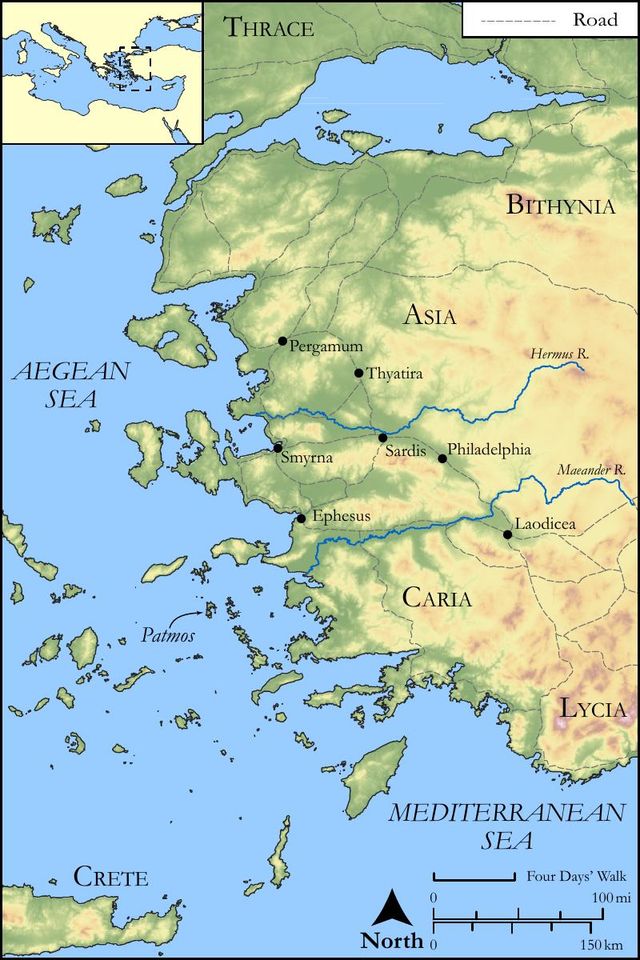
See on the biblical-era maps

Study this verse
Public-domain commentary
Matthew Henry
From his Commentary on the Whole Bible. Henry comments on passages, not single verses — this entry covers Revelation 2:1–7. His three-level outline is real structure in the source text, so it is rendered as structure.
We have here,
I.The inscription, where observe,
1.To whom the first of these epistles is directed: To the church of Ephesus, a famous church planted by the apostle Paul (Acts 19), and afterwards watered and governed by John, who had his residence very much there. We can hardly think that Timothy was the angel, or sole pastor and bishop, of this church at this time, - that he who was of a very excellent spirit, and naturally cared for the good state of the souls of the people, should become so remiss as to deserve the rebukes given to the ministry of this church. Observe,
2.From whom this epistle to Ephesus was sent; and here we have one of those titles that were given to Christ in his appearance to John in the chapter foregoing: He that holds the seven stars in his right hand, and walks in the midst of the seven golden candlesticks, Rev 1:13, Rev 1:16. This title consists of two parts: - (1.) He that holds the stars in his right hand. The ministers of Christ are under his special care and protection. It is the honour of God that he knows the number of the stars, calls them by their names, binds the sweet influences of Pleiades and looses the bands of Orion; and it is the honour of the Lord Jesus Christ that the ministers of the gospel, who are greater blessings to the church than the stars are to the world, are in his hand. He directs all their motions; he disposes of them into their several orbs; he fills them with light and influence; he supports them, or else they would soon be falling stars; they are instruments in his hand, and all the good they do is done by his hand with them. (2.) He walks in the midst of the golden candlesticks. This intimates his relation to his churches, as the other his relation to his ministers. Christ is in an intimate manner present and conversant with his churches; he knows and observes their state; he takes pleasure in them, as a man does to walk in his garden. Though Christ is in heaven, he walks in the midst of his churches on earth, observing what is amiss in them and what it is that they want. This is a great encouragement to those who have the care of the churches, that the Lord Jesus has graven them upon the palms of his hands.
II.The contents of the epistle, in which, as in most of those that follow, we have,
1.The commendation Christ gave this church, ministers and members, which he always brings in by declaring that he knows their works, and therefore both his commendation and reprehension are to be strictly regarded; for he does not in either speak at a venture: he knows what he says. Now the church of Ephesus is commended,
(1.)For their diligence in duty: I know thy works, and thy labour, Rev 2:2. This may more immediately relate to the ministry of this church, which had been laborious and diligent. Dignity calls for duty. Those that are stars in Christ's hand had need to be always in motion, dispensing light to all about them. For my name's sake thou hast laboured, and hast not fainted, Rev 2:3. Christ keeps an account of every day's work, and every hour's work, his servants do for him, and their labour shall not be in vain in the Lord.
(2.)For their patience in suffering: Thy labour and thy patience, Rev 2:2. It is not enough that we be diligent, but we must be patient, and endure hardness as good soldiers of Christ. Ministers must have and exercise great patience, and no Christian can be without it. There must be bearing patience, to endure the injuries of men and the rebukes of Providence; and there must be waiting patience, that, when they have done the will of God, they may receive the promise: Thou hast borne, and hast patience, Rev 2:3. We shall meet with such difficulties in our way and work as require patience to go on and finish well.
(3.)For their zeal against what was evil: Thou canst not bear those that are evil, Rev 2:2. It consists very well with Christian patience not to dispense with sin, much less allow it; though we must show all meekness to men, yet we must show a just zeal against their sins. This their zeal was the more to be commended because it was according to knowledge, a discreet zeal upon a previous trial made of the pretences, practices, and tenets of evil men: Thou hast tried those that say they are apostles and are not, and hast found them liars. True zeal proceeds with discretion; none should be cast off till they be tried. Some had risen up in this church that pretended to be not ordinary ministers, but apostles; and their pretensions had been examined but found to be vain and false. Those that impartially search after truth may come to the knowledge of it.
2.The rebuke given to this church: Nevertheless, I have somewhat against thee, Rev 2:4. Those that have much good in them may have something much amiss in them, and our Lord Jesus, as an impartial Master and Judge, takes notice of both; though he first observes what is good, and is most ready to mention this, yet he also observes what is amiss, and will faithfully reprove them for it. The sin that Christ charged this church with was their decay and declension in holy love and zeal: Thou hast left thy first love; not left and forsaken the object of it, but lost the fervent degree of it that at first appeared. Observe,
(1.)The first affections of men towards Christ, and holiness, and heaven, are usually lively and warm. God remembered the love of Israel's espousals, when she would follow him withersoever he went.
(2.)These lively affections will abate and cool if great care be not taken, and diligence used, to preserve them in constant exercise.
(3.)Christ is grieved and displeased with his people when he sees them grow remiss and cold towards him, and he will one way or other make them sensible that he does not take it well from them.
3.The advice and counsel given them from Christ: Remember therefore whence thou hast fallen, and repent, etc.
(1.)Those that have lost their first love must remember whence they have fallen; they must compare their present with their former state, and consider how much better it was with them then than now, how much peace, strength, purity, and pleasure they have lost, by leaving their first love, - how much more comfortably they could lie down and sleep at night, - how much more cheerfully they could awake in the morning, - how much better they could bear afflictions, and how much more becomingly they could enjoy the favours of Providence, - how much easier the thoughts of death were to them, and how much stronger their desires and hopes of heaven.
(2.)They must repent. They must be inwardly grieved and ashamed for their sinful declension; they must blame themselves, and shame themselves, for it, and humbly confess it in the sight of God, and judge and condemn themselves for it.
(3.)They must return and do their first works. They must as it were begin again, go back step by step, till they come to the place where they took the first false step; they must endeavour to revive and recover their first zeal, tenderness, and seriousness, and must pray as earnestly, and watch as diligently, as they did when they first set out in the ways of God.
4.This good advice is enforced and urged,
(1.)By a severe threatening, if it should be neglected: I will come unto thee quickly, and remove thy candlestick out of its place. If the presence of Christ's grace and Spirit be slighted, we may expect the presence of his displeasure. He will come in a way of judgment, and that suddenly and surprisingly, upon impenitent churches and sinners; he will unchurch them, take away his gospel, his ministers, and his ordinances from them, and what will the churches or the angels of the churches do when the gospel is removed?
(2.)By an encouraging mention that is made of what was yet good among them: This thou hast, that thou hatest the deeds of the Nicolaitans, which I also hate, Rev 2:6. "Though thou hast declined in thy love to what is good, yet thou retainest thy hatred to what is evil, especially to what is grossly so." The Nicolaitans were a loose sect who sheltered themselves under the name of Christianity. They held hateful doctrines, and they were guilty of hateful deeds, hateful to Christ and to all true Christians; and it is mentioned to the praise of the church of Ephesus that they had a just zeal and abhorrence of those wicked doctrines and practices. An indifference of spirit between truth and error, good and evil, may be called charity and meekness, but it is not pleasing to Christ. Our Saviour subjoins this kind commendation to his severe threatening, to make the advice more effectual.
III.We have the conclusion of this epistle, in which, as in those that follow, we have,
1.A call to attention: He that hath an ear, let him hear what the Spirit saith unto the churches. Observe,
(1.)What is written in the scriptures is spoken by the Spirit of God.
(2.)What is said to one church concerns all the churches, in every place and age.
(3.)We can never employ our faculty of hearing better than in hearkening to the word of God: and we deserve to lose it if we do not employ it to this purpose. Those who will not hear the call of God now will wish at length they had never had a capacity of hearing any thing at all.
2.A promise of great mercy to those who overcome. The Christian life is a warfare against sin, Satan, the world, and the flesh. It is not enough that we engage in this warfare, but we must pursue it to the end, we must never yield to our spiritual enemies, but fight the good fight, till we gain the victory, as all persevering Christians shall do; and the warfare and victory shall have a glorious triumph and reward. That which is here promised to the victors is that they shall eat of the tree of life which is in the midst of the paradise of God. They shall have that perfection of holiness, and that confirmation therein, which Adam would have had if he had gone well through the course of his trial: he would then have eaten of the tree of life which was in the midst of paradise, and this would have been the sacrament of confirmation to him in his holy and happy state; so all who persevere in their Christian trial and warfare shall derive from Christ, as the tree of life, perfection and confirmation in holiness and happiness in the paradise of God; not in the earthly paradise, but the heavenly, Rev 22:1, Rev 22:2.
Historical interpretation
Eight Centuries of Reception
7 surviving comments on this verse. Each one is dated, so this reads as a timeline rather than a list.
Select a marker to jump to its quote. Markers stagger vertically where authors wrote within a few decades of each other.
Therefore he has trifled both with his own "spirit," and with "the angel of the Church," and with "the power of the Lord," if he rescinded what by their counsel he had formally pronounced.
In many places, and especially in the Psalms, you will find speech addressed to the angels. Power has been given to man—at least to him who has the Holy Spirit—to speak even to the angels. I shall give one example from these instances, so that we might realize that angels too can be taught by human voices. It has been written in the Apocalypse of John, “Write to the angel of the church of the Ephesians, ‘I have something against you.’ ” And again, “Write to the angel of the church of Pergamum, ‘I have something against you.’ ” Clearly it is a man who writes to angels and enjoins something.
These things says he who holds the seven stars in his right hand. That is, he holds you in his hand and governs and controls you by his power.
To the angel of the church in Ephesus write. He reproaches part of this church according to the quality of its name and praises part. For Ephesus is said to be interpreted as a great fall and my will in it.
Who walks in the midst of the seven golden candlesticks. Who, moving among you, investigates the hearts and loins of each one.
And unto the angel of the church of Ephesus write: These things saith he, who holdeth the seven stars in his right hand, who walketh in the midst of the seven golden candlesticks: I know thy works, and thy labour, and thy patience. In this place, blessed John, either in his own person or in that of preceding preachers, writes the Lord's words at the latter's bidding to the universal Church, which is represented by the angel. In this angel, sometimes the whole body of the elect, which consists of holy preachers and good listeners, is extolled by the proclamation of its merits, sometimes a part in particular is censured as wicked. So, what does it mean that the Redeemer Lord holds stars in his right hand, if not that he has predestined his elect to the blessedness of success? What does it mean that the same walks in the midst of the candlesticks, if not that he is present everywhere by bestowing the grace of gifts on every one of the saints through his inward discernment? If by the stars and candlesticks we understand the whole body of the Church, which consists of the elect and of the reprobates, by the right hand of Christ we should understand the power of his divinity, which no one can escape, for in his hand are all the ends of the earth; [Ps. 94:4] and he walks among the candlesticks, visiting the just and forsaking the unjust. The Lord says he knows the works, labor, and patience of the saints, which means that he approves them by the grace of choosing. But then the speech turns back to a specific weak part of the body when it is said after that, and how thou canst not bear them that are evil: for it is not a sign of merit, but of great weakness, that the angel cannot bear them that are evil. It is also to be noted that he says below to the same angel, Thou hast endured for my name: [Rev. 2:3] which is not incompatible with this passage, because in the one is indicated the weakness of some limbs, and in the other the strength of others. And thou hast tried them, who say they are apostles, and are not, and hast found them liars. It is to be believed that false apostles had then spread in the Church of Ephesus, whom the same John calls Antichrists in his epistle, [1 John 2:18] and in whose persons is denoted the perfidy of all heretics. As for trying, it is sometimes done with a view to approbation, as in The Lord your God trieth you. [Deut. 13:3] So the Church tries the false ones when, through the preachers, it interrogates the heretics about faith, to see whether they are disciples of the truth or of falsehood.
The first act of my words and interpretations has indeed been accomplished; now again another target must be struck, showing what is the exhortation to the churches. Therefore, first to the church in Ephesus, as presiding over the rest of Asia, it is commanded to write.
He referred to the church in Ephesus in an indirect way as the angel of the church in Ephesus. For his angel, the protector of the church, has not sinned in a way that requires repentance upon hearing; he is the most holy one and, because of this, being at the right hand of the Lord, he bears this sign of his natural purity and radiant brilliance. Why was it necessary to say to the one who was exchanging words to write to the evangelist? For the divine angel was present and heard the things being said; for he was on the right hand of the one speaking, and finally, the holy one himself, interpreting the vision shown to him, says: He who has an ear, let him hear what the Spirit says to the churches. For he did not say this to the angels of the churches, but to the churches themselves. Therefore, in the other visions wherever you find them, write these things to the angel of this church, that the words are not about the angel, but about the church. What does he command to be written to the church in Ephesus?
It is similar to saying, "this is what the one who surrounds, holds sway over, and binds together both the holy angels in heaven and the men on earth," for these are the seven stars. For these are the seven lampstands, as has been said before; because He walks in the midst of those who worship Him, and through the prophet He says: "I will dwell among them and walk among them." (Lev. 26:12)
Continue studying Revelation 2:1 across the web’s major study libraries — every link below opens this exact verse, chapter, or book on the destination site.
Read & Compare
 BibleGatewayThis verse in more than 200 translations and 70 languages.
 Bible.comThe YouVersion reader — hundreds of translations, reading plans, and highlights.
 ESV.orgCrossway's official English Standard Version reader.
 NET BibleThe NET translation with 60,000+ translators' notes on every rendering decision.
 STEP BibleTyndale House's free study tool — original text, vocabulary, and scholarly resources.
 BibliaLogos Bible Software's free web reader.
 USCCBThe New American Bible (Revised Edition) with the U.S. bishops' study notes.
Commentaries
 BibleHub CommentariesDozens of classic commentaries on this verse, gathered on one page.
 StudyLightMore than 100 commentary sets — the largest collection on the web.
 BibleRefPlain-English commentary on what this verse means, verse by verse.
 Enduring WordDavid Guzik's free commentary on this chapter, widely used by Bible teachers.
 Bible Study ToolsVerse commentary alongside Greek and Hebrew study aids.
Original Language & Research
- BibleHub InterlinearThe verse word by word — original language, transliteration, and English.
- BibleHub LexiconEvery word's original-language definition and Strong's entry.
 Blue Letter BibleDeep-study tools — Strong's numbers, concordance, and word studies.
 CNTR CollationThe earliest Greek manuscripts of this verse, collated letter by letter.
Sermons, Hymns & Audio


TrulyRandomVerse is not affiliated with these sites and doesn’t control their content. They’re linked because they’re genuinely useful.
Summary
Revelation 2:1 initiates the series of seven prophetic letters to the churches in Asia Minor, specifically addressing the Ephesian congregation. This foundational verse not only identifies the intended recipient—the "angel" or messenger of the church in Ephesus—but, more significantly, presents a majestic and authoritative self-description of the sender: Jesus Christ Himself. Through vivid symbolic imagery, Christ establishes His intimate knowledge, sovereign control, and active presence among His churches, setting the divine precedent for the commendations, rebukes, and exhortations that follow.
Context
ShowHideLiterary Context
Revelation 2:1 marks the transition from the opening vision and commission in Revelation 1 to the specific messages addressed to the seven churches. Following John's awe-inspiring encounter with the glorified Christ and the explicit interpretation of the seven stars and seven golden candlesticks, this verse immediately applies that interpretive key. Each subsequent letter (Revelation 2-3) follows a similar pattern: an address to the "angel" of the church, a self-description of Christ often drawn from His initial appearance in Revelation 1, a commendation, a rebuke (if necessary), an exhortation, and a promise to the overcomer. This structured approach underscores the direct, personal, and authoritative nature of Christ's communication with His people.
Historical & Cultural Context
Ephesus was one of the most significant cities in the Roman province of Asia (modern-day Turkey), serving as a major port, commercial hub, and center of religious and cultural life. It was home to the massive Temple of Artemis (Diana), whose worshippers cried out, "Great is Diana of the Ephesians," and a stronghold of pagan worship, magic, and emperor cult. The Ephesian church, founded by Paul and later ministered to by Apollos, Aquila, Priscilla, and possibly John himself, had a rich history (see Acts 18-19). By the time of Revelation, likely in the late first century under Emperor Domitian, Christians in Ephesus faced increasing pressure to conform to Roman religious practices, leading to potential persecution and the need for spiritual vigilance. The city's intellectual and spiritual vibrancy also made it susceptible to false teachings, which the church was commended for discerning.
Key Themes
ShowHideThis verse introduces several overarching themes that resonate throughout the letters to the seven churches and the entire book of Revelation. The primary theme is Divine Authority and Sovereignty, as Christ's self-description emphasizes His supreme power and right to address His churches. Closely related is the theme of Christ's Intimate Presence and Oversight; His "walking in the midst" signifies His constant, watchful care and deep involvement in the affairs of His people, contrasting with any perception of a distant deity. Furthermore, the verse highlights the theme of Accountability, as the church is reminded that their spiritual state is fully known to their Lord. This sets the stage for the subsequent themes of Commendation and Rebuke, demonstrating that Christ's love for His church includes both affirmation of faithfulness and correction of spiritual decline, as seen in Revelation 2:2-6.
Exposition and Analysis
ShowHideKey Word Analysis
ShowHideFrom a word meaning "to bring tidings," this term refers to a messenger, especially an "angel," but by implication, it can also refer to a pastor or leader. In the context of the seven letters, it is widely understood to signify the human leader or representative of each church, responsible for receiving and conveying the divine message to the congregation.
Derived from "strength" (κράτος), this verb means to use strength, to seize or retain, either literally or figuratively. Here, it conveys Christ's firm possession, sovereign control, and secure grip over the "seven stars," indicating His protective power and authority over the messengers/leaders of the churches.
From "around" (περί) and "to tread" (πατέω), this word literally means to tread all around or walk at large. Figuratively, it signifies one's manner of life, deportment, or active presence. In this context, it emphasizes Christ's intimate, active, and observant presence within His churches, indicating His full awareness of their condition and His constant oversight.
Verse Breakdown
ShowHide"Unto the angel of the church of Ephesus write;"
This clause directly identifies the recipient of the letter. The "angel" (Greek: ángelos) is best understood as the specific human leader, pastor, or representative of the church in Ephesus, who would be responsible for receiving and disseminating the message to the entire congregation. This highlights the personal and direct nature of Christ's communication, addressing the leadership as a conduit to the body.
"These things saith he that holdeth the seven stars in his right hand,"
This segment introduces the divine author of the message. The phrase "These things saith" (Greek: hóde légei) is a common prophetic formula, emphasizing the authoritative and divine origin of the words. The description of Christ as the one who "holdeth" (Greek: kratéō, implying firm grasp and control) the "seven stars" directly references the interpretation given in Revelation 1:20, where the stars are identified as the "angels" (messengers/leaders) of the seven churches. This imagery powerfully conveys Christ's sovereign authority, protective care, and ownership over the leaders of His churches, holding them securely in His position of power ("right hand").
"who walketh in the midst of the seven golden candlesticks;"
This final clause further elaborates on Christ's self-description, reinforcing His intimate relationship with His churches. The "seven golden candlesticks" are explicitly identified in Revelation 1:20 as the seven churches themselves. Christ's "walking" (Greek: peripatéō, suggesting active movement and presence) "in the midst" of these candlesticks signifies His constant, watchful, and intimate presence within His churches. He is not distant or disengaged but actively observing, ministering to, and sustaining His people, fully aware of their spiritual condition and activities.
Literary Devices
ShowHideRevelation 2:1 masterfully employs Symbolism to convey profound theological truths about Christ's relationship with His church. The "seven stars" and "seven golden candlesticks" are not literal objects but powerful symbols whose meaning is explicitly revealed in Revelation 1:20. The stars symbolize the "angels" or messengers/leaders of the churches, indicating Christ's direct authority over and care for those entrusted with spiritual oversight. The golden candlesticks symbolize the churches themselves, representing their role as light-bearers in the world. The actions attributed to Christ—"holdeth" and "walketh"—are also symbolic. "Holdeth" conveys His Sovereignty and secure grip, implying protection and ownership. "Walketh" signifies His Omnipresence and active engagement, portraying Him as intimately present, observing, and sustaining His people. This rich symbolic language immediately establishes the divine perspective from which the subsequent messages will be delivered, underscoring the weight and importance of Christ's words.
Theological and Thematic Connections
ShowHideRevelation 2:1 lays a foundational theological truth: Jesus Christ is the sovereign Head of His Church, intimately involved in its affairs. His self-description as the one who "holdeth the seven stars in his right hand" and "walketh in the midst of the seven golden candlesticks" is not merely a majestic title but a declaration of His ongoing, active governance and pastoral care. This imagery assures believers that their Lord is fully aware of their struggles, triumphs, and spiritual state, and that He possesses all authority to commend, correct, and sustain them. It underscores the profound reality that the Church, though imperfect and earthly, is eternally under the direct oversight and protection of its divine founder.
Reflection and Application
ShowHideRevelation 2:1 offers profound comfort and a sobering challenge for believers today. The image of Christ holding the "stars" (our leaders) and walking among the "candlesticks" (our churches) reminds us that no church, no pastor, and no individual believer is outside of His watchful eye or beyond His powerful grasp. This should inspire immense confidence and peace, knowing that our Lord is intimately acquainted with our spiritual condition, our faithfulness, and our struggles. It also calls us to a deeper sense of accountability. If Christ is truly walking among us, observing every detail, then our worship, our service, our relationships, and our doctrine should reflect a sincere desire to honor His presence. This verse encourages us to live with an awareness of Christ's immediate spiritual proximity, prompting us to examine our collective and individual spiritual health in light of His sovereign oversight.
Questions for Reflection
ShowHideFAQ
ShowHideWhat is the significance of "the angel of the church of Ephesus"?
ShowHideThe "angel" (Greek: ángelos) in this context is widely understood by scholars not as a celestial being, but as the human messenger or leader of the church in Ephesus. This interpretation aligns with the practical nature of the letters, which are addressed to specific human communities and their oversight. This leader would have been responsible for receiving Christ's message and conveying it to the entire congregation, acting as its spiritual representative. This highlights Christ's direct communication with and accountability for the leadership of His churches, as seen throughout Revelation 2-3.
What do the "seven stars" and "seven golden candlesticks" symbolize?
ShowHideThe meaning of these symbols is explicitly given by Christ Himself in Revelation 1:20. The "seven stars" represent the "angels" or messengers/leaders of the seven churches, signifying Christ's sovereign authority over those He has appointed to guide His people. The "seven golden candlesticks" represent the seven churches themselves, emphasizing their divine purpose as light-bearers in a dark world. Christ's actions of holding the stars and walking among the candlesticks underscore His intimate connection, protective care, and active presence within His Church.
Christ-Centered Fulfillment
ShowHideRevelation 2:1 profoundly centers on Christ, not merely as the author of these letters, but as the active, sovereign Head of His Church. The vivid imagery of Him "holding the seven stars in his right hand" and "walking in the midst of the seven golden candlesticks" is a powerful continuation of the vision of the glorified Son of Man from Revelation 1. This portrayal reveals Christ as the ultimate Pastor and Overseer, whose authority is absolute and whose presence is constant. He is the one to whom "all power is given in heaven and in earth" (Matthew 28:18), and who is "the head of the body, the church" (Colossians 1:18). His intimate "walking" among the churches foreshadows His promise to be with His disciples "always, even unto the end of the world" (Matthew 28:20). This verse assures believers that the same Christ who died for them and rose again is continually interceding for them (Romans 8:34) and actively sustaining His Church until His glorious return, ensuring its ultimate triumph over all spiritual adversaries (Ephesians 5:25-27).